speaking of angelina weld grimke

agrimke

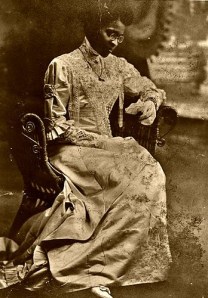
Angelina Weld Grimké (February 27, 1880 – June 10, 1958) was an African-American journalist, teacher, playwright and poet who was part of the Harlem Renaissance and was one of the first African-American women to have a play performed. Born in Boston, the daughter of Archibald Grimke, a prominent journalist who served as Vice-President of the NAACP. The Grimkes were a prominent biracial family whose members included both slaveowners and abolitionists. Two of her great aunts, Angelina and Sarah, were prominent abolitionists in the North. Angelina Weld Grimke was named after her aunt who had died the year before.Her paternal grandfather was their brother Henry Grimké, of their large, slaveholding family based in Charleston, South Carolina. Their paternal grandmother was Nancy Weston, an enslaved woman of European and African descent, with whom Henry became involved after becoming a widower.  Grimke’s mother, Sarah Stanley Grimke, a white woman, left her husband under the influence of her parents who never approved of her interracial marriage, and took her three-year old daughter with her. However, at the age of seven, Angelina was returned to her father, and although she and her mother corresponded, they never saw one another again. Sarah Stanley died of suicide several years later.

Grimké wrote essays, short stories and poems which were published in The CrisisOpportunityThe New NegroCaroling Dusk, and Negro Poets and Their Poems. Some of her more famous poems include, “The Eyes of My Regret”, “At April”, and “Trees”. She was an active writer and activist included among the figures of the Harlem Renaissance. Her poetry dealt with more conventional romantic themes, often marked with frequent images of frustration and isolation. Recent scholarship has revealed Grimke’s unpublished lesbian poems and letters; she did not feel free to live openly as a gay woman during her lifetime. 

Grimké also wrote a play called Rachel, one of the first plays to protest lynching and racial violence. She wrote the three-act drama for the National Association for the Advancement of Colored People (NAACP) to rally public support against the recently released film The Birth of a Nation. The play was produced in 1916 in Washington, D.C., performed by an all-black cast. It was published in 1920.

After her father died, Grimké left Washington, DC, for New York, where she lived a reclusive life in Brooklyn. She died in 1958 after a long illness.

http://www.aaregistry.com/detail.php?id=1123

http://en.wikipedia.org/wiki/Angelina_Weld_Grimké

http://www.scils.rutgers.edu/~cybers/grimke2.html

nancy weston

with friends like these….

Nancy Weston

3397121950_a831785417


She lived in Charleston, South Carolina, in the 1850s as a free woman. However, in order to satisfy the laws of the state, she was a ‘nominal slave’ legally owned by a white friend. She was also the grandmother of writer Angelina Weld Grimke.

‘The Face of Our Past: Images of Black Women from Colonial America to the Present’ edited by Kathleen Thompson and Hilary Mac Austin 

http://www.flickr.com/photos/22067139@N05/3397121950/

I would love to write a book or a screenplay based on this one sentence: she was a ‘nominal slave’ legally owned by a white friend.   That has really got my imagination going.  I’ve actually never heard of nominal slaves before.  I read a bit about them today.  Interesting stuff.  Most of what I read was connected to writings pertaining to black slave owners, and the Weston name in S. Carolina came up frequently.  But Nancy was ‘owned’ by a white friend.  I am fascinated.

From http://www.straightdope.com/columns/read/2821/before-the-civil-war-were-some-slave-owners-black

Between 1800 and 1830 slave states began restricting manumission, seeing free blacks as potential fomenters of slave rebellion. Now you could buy your friends, but you couldn’t free them unless they left the state — which for the freed slave could mean leaving behind family still in bondage. So more free blacks took to owning slaves benevolently. Being a nominal slave was risky — among other things, you could be seized as payment for your nominal owner’s debts. But at least one state, South Carolina, granted nominal slaves certain rights, including the right to buy slaves of their own….

We do, however, need to acknowledge a less common form of black slaveholding. Whites in Louisiana and South Carolina fostered a class of rich people of mixed race — typically they were known as “mulattoes,” although gradations such as “quadroon” and “octoroon” were sometimes used — as a buffer between themselves and slaves. Often the descendants and heirs of well-off whites, these citizens were encouraged to own slaves, tended to side with whites in racial disputes, and generally identified more with their white forebears than black. Nationwide maybe 10 percent of the mixed-race population (about 1 percent of all those identified as African-American) fell into this category.

dr. charlotte hawkins brown

Here’s another great story.  This woman was amazing.  I can imagine no nobler task than “establishing for Negro youth something superior to Jim Crowism.”  Her influence must have been so great on those she encountered.  I would love to talk with her about today’s “negro youth.”  What she would have imagined and hoped things would be like in 2009 and how that differs from the current reality.  

Dr. Charlotte Hawkins Brown

2642553943_8d452ccd72

Above is a photo from her wedding in 1912.
**********************
[b. 1870 – d. 1961]

Charlotte Hawkins Brown was born in Henderson, North Carolina, but grew up in Massachusetts after her family moved from the South. She was educated in Boston and had planned to finish her college education when two events changed her life.

First, she met Alice Freeman Palmer, a prominent New England woman, who was so impressed by Hawkins’ determination to get an education that she became Brown’s benefactor. Then, in 1901, Brown returned to the South to teach in a country school that was supported by a Northern missionary society in the town of Sedalia, North Carolina.

Quote: “I have devoted my life to establishing for Negro youth something superior to Jim Crowism”

She arrived during the worst years of the Jim Crow era. Blacks had been disfranchised as well as segregated and there was little money available for black schools. When the school’s funding ended after two years, Brown decided to remain in Sedalia to start her own school. She went north to raise money and returned with $100, which she used to open the Palmer Memorial Institute, an academic and industrial school for African Americans, in 1902.

Brown’s life was a balancing act. She passionately hated segregation and continually sought ways around it. When she went to town to visit her doctor or lawyer, she would arrange to enter into their office immediately upon her arrival. Thus, she avoided sitting in the Jim Crow section of the waiting room. When her students went to the movies or other cultural events, she would rent the theater for the day so that they did not have to sit in the “colored” section.

To raise funds for the school, she wrote letters to potential supporters. Her students learned French, Latin, and other academic subjects. Brown prepared her students to be leaders of their race.

In addition to building her school, Charlotte Hawkins Brown was active in the women’s club and suffragist movements. She later became president of the North Carolina Association of Colored Women’s Clubs, and she helped organize voter registration drives for black women and tried to get white club women to back suffrage for black women.

She saw herself as part of the freedom struggle that was taking place in the black community. The Palmer Institute became an educational success and remained open until a decade after her death, in 1961.

Charles W. Wadelington and Richard F. Knapp, ‘Charlotte Hawkins Brown and Palmer Memorial Institute; What One Young African American Woman Could Do.’

http://www.flickr.com/photos/22067139@N05/2642553943/

viola desmond


Here’s one of those Black Women stories.  Maybe Canada’s not as not-racist as they say.


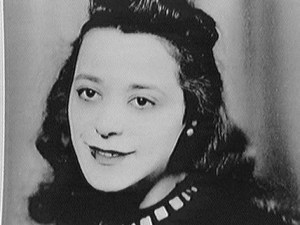
Viola Desmond didn’t set out to make history, but she did (1946)

2562673380_a23de368ca2[b. 1914 – d. 1965]

Viola Desmond was a successful 32-year-old Halifax entrepreneur when her car broke down in New Glasgow, Nova Scotia. She decided to go to a movie at the Roseland Theatre while the car was being serviced.

It was November 8, 1946, and she was about to make history.

Desmond requested a ticket for the main floor of the theatre, paid for it, went in and sat down. Although it was not posted anywhere to see, the theatre’s policy was that persons of colour had to sit in the balcony.

When ordered to move, Desmond replied that she couldn’t see from the balcony, that she had paid to sit on the main floor, and that she would stay there. The manager ran out of the theatre and got a policeman. Together, the two men carried Viola Desmond into the street, injuring her knee and hip in the process.

She spent that night in the town jail. No one informed her of her rights, she was not allowed parole, and she was incarcerated in the same jail block as male prisoners. Determined to maintain her dignity, she sat bolt upright, wearing her white gloves, for the entire night.

In the morning – without representation, without understanding that she could question the witnesses against her, without even having been told that she could have a lawyer – she was tried and found guilty: tax evasion.

She had not paid the extra one cent tax on a ticket for a seat on the main floor of the theatre. She had paid for a less expensive seat in the balcony. That she had requested the floor seat, that she had no way to know that Blacks were restricted to the balcony, that she believed she had paid for the ticket on the first floor, that she offered to pay the difference, that she had been assaulted, injured, held then tried in irregular and perhaps illegal ways – it made no difference.

The sentence: 30 days in jail or a fine of $20, plus $6 to the manager of the theatre – one of the two men who had carried her out so roughly. She paid.

The doctor who treated her injuries recommended that Desmond get a lawyer. After discussing her arrest and trial with friends, she decided to challenge the verdict in the Supreme Court of Nova Scotia. In its decision, although one of the four judges, Justice Hall, referred in passing to the race issue, he agreed with the other three judges that no error in law had occurred in the original trial. The court unanimously upheld the verdict. The conviction stood.

The unspoken, unacknowledged truth: Viola Desmond was found guilty of being a Black person who had stepped out of her assigned place in society.

This resounding defeat in the courts left her discouraged. Her marriage – already strained by her business success – did not survive the trial. Desmond’s husband thought she was making a fuss over a matter that didn’t warrant it.

She did have significant supporters. And her stand had helped to build something much bigger.

The Nova Scotia Association for the Advancement of Coloured People (NSAACP) – aided by Viola’s friends, newspaper publisher Carrie Best and activist Pearleen Oliver campaigned to raise money. After the appeal, her lawyer, Frederick Bissett – a white man from Halifax – donated his fees back to the NSAACP.

With these funds, the fight Viola had started could continue. Vigorous further action by Best, Oliver, community members, and the NSAACP led finally to the repeal of segregation policies in Nova Scotia in 1954 – more than a year before Rosa Parks’s action in Montgomery, Alabama, helped bring the civil rights movement in the U.S. into sharp media focus.

Viola Desmond grew up in a prosperous family in Halifax. She decided early to be a hairdresser, one of the few professions open to an ambitious, independent-minded black woman. Unable to gain admission to a hairdressing school in Nova Scotia, she trained in Montreal, New York and Atlantic City.

Back in Halifax, Viola married and opened her first salon, where she specialized in hair styles and treatments tailored for her community. Beauty shops had become a major social gathering place in the 1930s, soon after salons first appeared. After a few years in business, she founded a school to train other beauticians. Her dream was to open a chain of salons across Canada – salons staffed by people she trained, specializing in Black women’s hair.

After the trial, Viola gave up her salon and her ambition of a chain of salons across the country. She went to Montreal to business school, then moved to New York to set up a new business, this time as an agent for performers. Very shortly after she arrived in New York, Viola Desmond died at the age of fifty.

Viola Desmond Unintentional Revolutionary
by Frances Rooney

 http://www.flickr.com/photos/22067139@N05/2562673380/

vintage black women

black-rose

black-women1


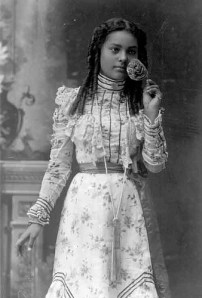
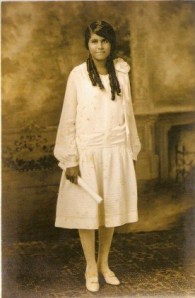
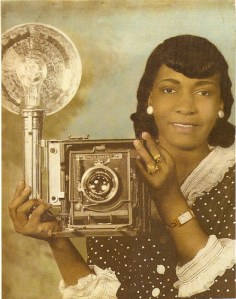
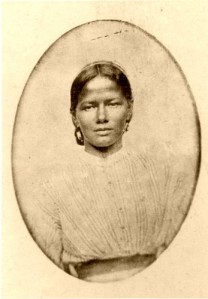
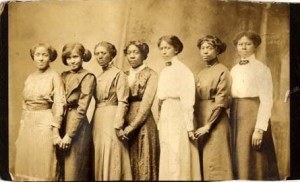
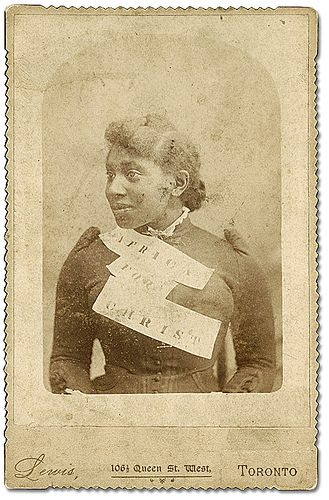
While searching for photos of black women with long, long hair I stumbled upon this great flickr photostream entitled BlackWomen  http://www.flickr.com/photos/22067139@N05/sets/72157603627219253/.  Some of the photos have biographical info.  Maybe I’ll post some from time to time.

vintage-black-women-with-cameranative-and-african-american


group-of-vintage-black-women


africa-for-christ1sash reads “Africa for Christ”
ella and marilyn

I’m kind of freaking out about this.  As much as I love anyone that I’ve said that said that I love on this blog, I LOVE Ella Fitzgerald!  When it comes down to it, I would rate her #1 vocalist of all time.  A constant on the list of (dead) people I’d like to have dinner with/invite to a dinner party is Ella.  I had no idea about Marilyn!  I just found this story at http://donttouchmymoleskine.wordpress.com/2009/02/18/miguxas-3/

ella_fitzgerald_and_marilyn_monroe

marilyn-e-ella

It’s 1955 and Marilyn Monroe is at the height of her fame. Despite this, she wants to be taken seriously as an artist, like the woman she most admires, jazz icon Ella Fitzgerald, who is also at the peak of her career.

Even though she can’t quite believe her own success, Ella wants more too. She wants the kind of fame Marilyn has. She wants to be in the movies. But to break into Hollywood , she needs to meet the ‘right’ people like the producers and money-men who frequent the ‘living-room of the stars’ Mocambo night club.

But Ella stands no chance of singing at the whites-only Mocambo…until Marilyn steps in and pulls strings like nobody else can!

These two iconic women – both outsiders – come together in an evening of raw emotion and great songs. A true but forgotten moment of American showbiz history re-enacted live on stage.

the result

I think that the reality and the dichotomy that this photo depict are the result of the racist advertising we’ve been discussing.

eye8n31kdigglqzbtknw2lzdo1_500

This photo also leads me to question whether or not I think that all advertising is racist.  I understand that whites are still the “majority” (for now), but I think it’s undeniable that it’s presented to the masses as an exclusive club.  The club has privileges.  In my opinion, that billboard could be deemed racist even without the people standing in line before it.  The truth of the matter is that if you look like the people in that car the sky’s the limit, you can achieve the highest standard of living, it’ll be grand.  If you look like the people in the line, you will serve those in the car.  At best you will strive to be like them, struggle for what they take for granted.  That’s just the way things are.  The people in the car deserve the best, the people in the line deserve the rest.  Just because.  That’s what this country has been advertising for years.  Under the guise of all men are created equal, liberty and justice for all, &  land of the free they’ve been pushing the opposite.  They’ve sold and we’ve bought.  Another truth is that we are all slaves to the notions, images, dogmas passed down and regurgitated through the years.  It’s everywhere. Books, film, television, magazines, packaging, newspapers.  It kind of seems normal.  This country could be so great.  It was founded on wonderful ideals and beautiful words, but without the actions to create the reality dreamt of.  It’s still a dream.  I think we can achieve it.  But first there has to be widespread acknowledgement of the dogma and it’s major flaws and then we have to fix our thinking.  Free our minds.

ten little what!?

Not done with Golly yet.  When I first looked into what the heck that was, I was led to a website for collectors of Golly memorabilia.  I saw Golly as a doctor, an astrounaut, all sorts of things, so I thought “Maybe he isn’t really racist because he doesn’t seem to be held back by his color or regulated to a station of servitude.  He’s achieving things.”  Short-lived thought, for next i was led to this site http://www.golliwogg.co.uk/racism.htm

For the past four decades Europeans have debated whether the Golliwog is a lovable icon or a racist symbol. In the 1960s relations between Blacks and Whites in England were often characterised by conflict. This racial antagonism resulted from many factors, including: the arrival of increasing numbers of coloured immigrants; minorities’ unwillingness to accommodate themselves to old patterns of racial and ethnic subordination; and, the fear among many Whites that England was losing its national character. British culture was also influenced by images – often brutal – of racial conflict occurring in the United States.

The claim that Golliwogs are racist is supported by literary depictions by writers such as Enid Blyton. Unlike Florence Upton’s, Blyton’s Golliwogs were often rude, mischievous, elfin villains. Blyton, one of the most prolific European writers, included the Golliwogs in many stories, but she only wrote three books primarily about Golliwogs: The Three Golliwogs (1944), The Proud Golliwog (1951), and The Golliwog Grumbled (1953). Her depictions of Golliwogs are, by contemporary standards, racially insensitive. An excerpt from The Three Golliwogs is illustrative:

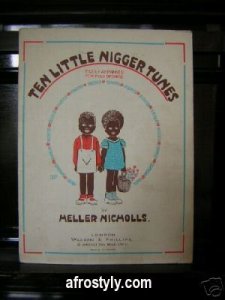
Once the three bold Golliwogs, Golly, Woggie, and Nigger, decided to go for a walk to Bumble-Bee Common. Golly wasn’t quite ready so Woggie and Nigger said they would start off without him, and Golly would catch them up as soon as he could. So off went Woggie and Nigger, arm-in-arm, singing merrily their favourite song – which, as you may guess, was Ten Little Nigger Boys.

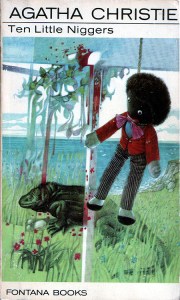
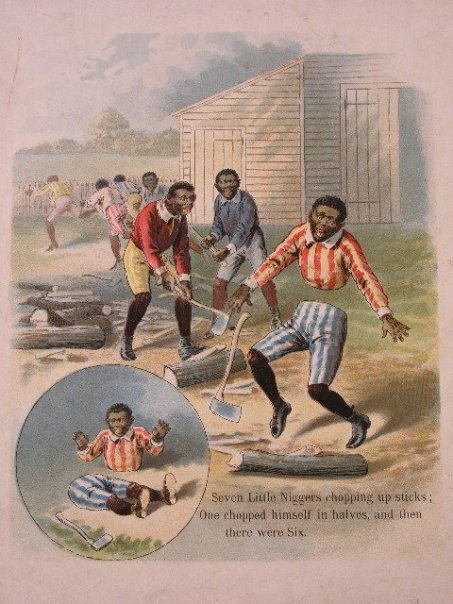
Ten Little Niggers is the name of a children’s poem, sometimes set to music, which celebrates the deaths of ten Black children, one-by-one. The Three Golliwogs was reprinted as recently as 1968, and it still contained the above passage. Ten Little Niggers was also the name of a 1939 Agatha Christie novel, whose cover showed a Golliwog lynched, hanging from a noose.


10_little_nigger_tunes1


7little-ns1


ac149tenlittleniggersf

By-Frickin’-Golly