alice disrobed

More on the Rhinelander Trial.  I’d like to make a movie about this.

Leonard “Kip” Rhinelander Trial (1925)

The New Rochelle, New York annulment trial of Leonard “Kip” Rhinelander and his wife, Alice Jones Rhinelander, was a much-publicized issue in the 1920s which highlighted white America’s definitions of race, class, and marriage.

Alice Jones was the daughter of working-class English immigrants.  Her mother was known to be white, while her father’s ancestry was “mixed.”   Leonard “Kip” Rhinelander was descended from a wealthy, white New York family.

Rhinelander and Jones met in 1921, fell in love, and married in 1924.  Because of the Rhinelander family prestige, the union soon became public.  In the social atmosphere of the 1920s, it was scandalous that Rhinelander would marry a woman of lower socioeconomic class, or who possessed any “non-white” blood.  Rhinelander’s father pushed the annulment lawsuit brought by his son only weeks after the wedding, in which Rhinelander, Jr. charged Mrs. Rhinelander with deceiving him as to her race.  The prosecution argued that if Leonard had known she was “not white,” he would not have married Alice.  A leading issue in the trial thus became what Alice Rhinelander’s true race was, bringing into sharp focus the arbitrary nature of white America’s obsession with racial classification during that period.

Attorneys on each side attempted to answer this question using Alice Jones Rhinelander’s social network, her father’s ancestry, and even her language as evidence of her racial status.  The Rhinelander attorneys attempted to paint Leonard as a “dupe” victimized by a “vamp,” playing on sexualized stereotypes of African American women, while defense counsel resorted to desperate means to prove that Rhinelander must have known his bride was not “white” when they induced a stricken Alice to disrobe before the jury.

During the trial, the court required Alice to disrobe on the witness stand for examination of her skin. The court wanted the jury to inspect the color of her nipples.

The Rhinelander Trial held the public in its grip for the better part of 1925, with both black and white press weighing in with varying opinions.  Ultimately, on December 6, 1925, the jury ruled in Mrs. Rhinelander’s favor.  Playing on the notion that race can be visually established, the defense attorney successfully “showed” Mrs. Rhinelander to be “colored,”  argued that she could not have deceived her husband, and therefore his claims for annulment were invalid.

LATE IN 1929, Alice agreed to a divorce in exchange for a small monthly pension, and with the stroke of a pen a Nevada judge erased Kip Rhinelander’s social error. According to the terms of the settlement, Kip Jr. paid Jones a lump sum of $32,500 and $3,600 per year for life if she would disown their family name. Ironically, Jones would outlive her ex-husband by 50 years, passing away in 1989. On her gravestone read the name Alice J. Rhinelander.

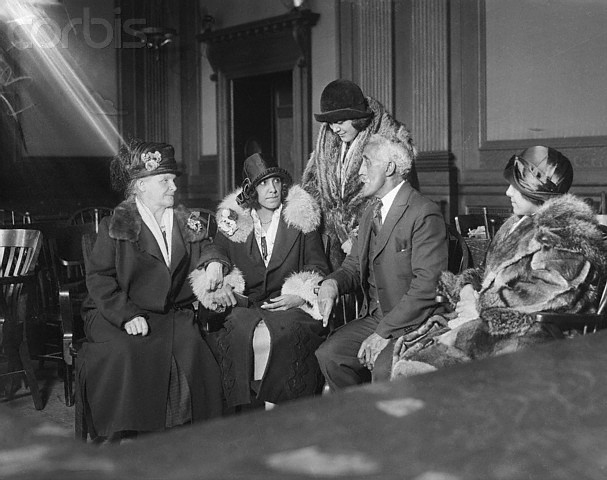
Original caption: Photo shows Mrs. Alice Rhinelander surrounded by relatives as jury decides case…Rhinelander jury locked for night; both sides anxiously await verdict. “Sentiment, passion, and prejudices should not interfere with your honest determination,” Justice Morschauser charged jury deciding Rhinelander case. Having failed to reach a verdict by 5:50 p.m. December 4th, they were ordered locked for the night. Left to right: Mrs. Jones, Alice, Grace, Jones, and Emily awaiting verdict.

SOURCE

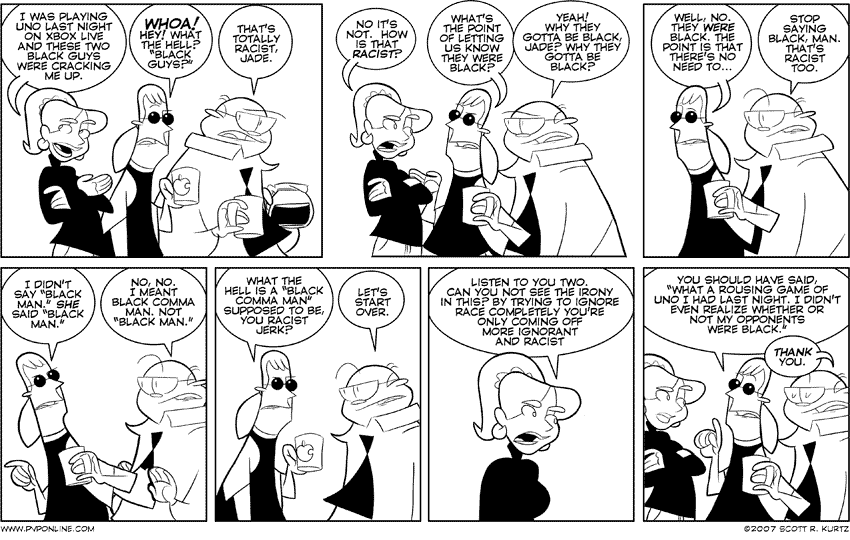
strategic colorblindness

Ignoring the obvious does not equal social change or justice.  It’s simply a detrimental sweeping under the rug and ignoring of the elephant.  I think that the only way to achieve true color blindness, is to work through the complex and intricate web of color consciousness that has been the way of the nation from day one.  And to work through it we have to dialogue about it.  Honestly.

Seeing race and seeming racist? Whites go out of their way to avoid talking about race

White people – including children as young as 10 — may avoid talking about race so as not to appear prejudiced, according to new research. But that approach often backfires as blacks tend to view this “colorblind” approach as evidence of prejudice, especially when race is clearly relevant. These results are from two separate sets of experiments led by researchers from Tufts University and Harvard Business School. Their findings are reported in the October issue of the Journal of Personality and Social Psychology and the September issue of Developmental Psychology. Both journals are published by the American Psychological Association.

“Efforts to talk about race are fraught with the potential for misunderstandings,” said the studies’ lead author, Evan Apfelbaum, a PhD candidate at Tufts University. “One way that whites try to appear unbiased is to avoid talking about race altogether, a tendency we refer to as strategic colorblindness.”

In one study, 101 white undergraduate students were paired with either a white or black female partner who pretended to be another participant. The pairs were presented with 30 photographs of faces that varied in race, gender and background color. Each white participant’s objective was to guess which of the photographs the partner was holding by asking as few yes-or-no questions as possible.

Even though asking about the race of the person in the photograph was a sound strategy for completing the task, white participants were far less likely to do so with a black versus a white partner. Moreover, when the black partner was the first one to have a turn asking questions, whether she mentioned race had a dramatic effect. White participants whose black partner asked about race mentioned race on their own turn 95 percent of the time. When the black partner never asked about race, white participants only did so 10 percent of the time.

“There was clear evidence the white participants’ behavior was influenced by the precedent set by their partner, but especially when that partner was black,” said Samuel Sommers, assistant professor at Tufts and co-author of both papers. “Whites are strategically avoiding the topic of race because they’re worried that they’ll look bad if they admit they notice it in other people.”

The researchers also wanted to see how outsiders interpreted such interactions. In another experiment, 74 black and white college students evaluated videos of whites engaging in the photo task. The results showed that whites’ effort to appear colorblind backfired. Black observers rated whites’ avoidance of asking about race as being evidence of prejudice. What’s more, when the researchers showed silent video clips of whites from the study to another group of individuals, those whites who avoided asking about race were judged as less friendly, just on the basis of their nonverbal behavior.

“The findings suggest that when race is clearly relevant, whites who think that it is a wise social strategy to avoid talking about race should think again,” said Apfelbaum.

Even children appear to adopt this strategically colorblind approach. In another set of experiments, 101 white children between the ages of 8 and 11 were asked to perform a similar photo task. The children were told that asking as few yes-or-no questions as possible would mean they would get a higher score on the task.

The results showed that the older children, ages 10 and 11, avoided asking about race more than the younger children, even though this led them to perform less efficiently than their younger counterparts on the task. In a control version where all the faces in the photos were white, the older children outperformed the younger children, as expected. “This result is fascinating because it shows that children as young as 10 feel the need to try to avoid appearing prejudiced, even if doing so leads them to perform poorly on a basic cognitive test,” said Kristin Pauker, a PhD candidate at Tufts and co-author of this study.

The authors associated with both studies said their findings offer several important implications. “Our findings don’t suggest that individuals who avoid talking about race are racists,” Apfelbaum explained. “On the contrary, most are well-intentioned people who earnestly believe that colorblindness is the culturally sensitive way to interact. But, as we’ve shown, bending over backward to avoid even mentioning race sometimes creates more interpersonal problems than it solves.”

SOURCE

click to enlarge

more on the racial ‘integrity’ act

Perhaps even more influential than John Powell was Walter Plecker.  Plecker dedicated his life to making sure that people like me could not exist.  And though the notion predated him, I believe that he further ingrained into the consciousness of the nation the myth of the “tragic mulatto.” But even worse than that, he stripped the Native Americans of Virginia of their rights and identity.  In my opinion Powell, Plecker, and the Eugenics movement in general are major pieces of this race in America puzzle. 

John Powell, the renowned Richmond-born composer and pianist, clutches an American flag in this news service photograph from 1920. Wealthy Virginians and powerful newspaper editors supported the white-supremacist sentiments espoused by Powell. Fear of racial mixing was particularly pronounced among genealogy-obsessed Virginians who wanted to maintain a “pure” bloodline.

Disdaining the Ku Klux Klan’s violent white supremacist policies and tactics, elite white Virginians embraced the scientific racism espoused by the Anglo-Saxon Clubs of America. Founded in Richmond in September 1922 by internationally renowned pianist John Powell, self-styled ethnologist Earnest Sevier Cox, and Walter Plecker, the ASCOA committed itself to preserving white “racial purity.” Powell provided the movement’s star power and publicity; Cox’s book White America (1923) provided the pseudoscientific, eugenic justifications; and Plecker backed the other two with the state’s police power. The ASCOA demanded legislation prohibiting interracial marriage and defining anyone with any non-white heritage—even one drop—as black.

Passed at the height of the eugenics movement, the Racial Integrity Act proclaimed the existence of only two racial categories in Virginia—”colored” and white.  The law stripped Native Americans, and members of other groups with dark skin, of their land, voting rights, and legal identity.

Walter Ashby Plecker was the first registrar of Virginia’s Bureau of Vital Statistics, which records births, marriages and deaths. He accepted the job in 1912.  For the next 34 years, he led the effort to purify the white race in Virginia by forcing Indians and other nonwhites to classify themselves as blacks. It amounted to bureaucratic genocide.

He worked with a vengeance.

Plecker was a white supremacist and a zealous advocate of—a now discredited movement to preserve the integrity of white blood by preventing interracial breeding. Unless this can be done,” he once wrote, “we have little to hope for, but may expect in the future decline or complete destruction of our civilization.”

Plecker would recall his early days in a letter to a magazine editor expressing his abhorrence of interracial breeding. He remembered “being largely under the control” of a “faithful” slave named Delia. When the war ended, she stayed on as a servant. The Pleckers were so fond of her that they let her get married in their house. When Plecker’s mother died in 1915, it was Delia “who closed her eyes,” he wrote.

Then Plecker got to his point. “As much as we held in esteem individual negroes this esteem was not of a character that would tolerate marriage with them, though as we know now to our sorrow much illegitimate mixture has occurred.” Plecker added, “If you desire to do the correct thing for the negro race … inspire (them) with the thought that the birth of mulatto children is a standing disgrace.”

Walter Plecker sits at his desk in 1935 at the Bureau of Vital Statistics

Plecker was a devout Presbyterian. He helped establish churches around the state and supported fundamentalist missionaries. Plecker belonged to a conservative Southern branch of the church that believed the Bible was infallible and condoned segregation. Members of Plecker’s branch maintained that God flooded the earth and destroyed Sodom to express his anger at racial interbreeding.

“Let us turn a deaf ear to those who would interpret Christian brotherhood as racial equality,” Plecker wrote in a 1925 essay.

Plecker saw everything in black and white. There were no other races. There was no such thing as a Virginia Indian. The tribes, he said, had become a “mongrel” mixture of black and American Indian blood.

Their existence greatly disturbed Plecker. He was convinced that mulatto offspring would slowly seep into the white race.  “Like rats when you’re not watching,” they “have been sneaking in their birth certificates through their own midwives, giving either Indian or white racial classification,” Plecker wrote.

Photograph of 1943 letter from Walter Plecker.

Many who came into Plecker’s cross hairs were acting with pure intentions. They registered as white or Indian because that’s how their parents identified themselves. Plecker seemed to delight in informing them they were “colored,” citing genealogical records dating back to the early 1800s that he said his office possessed. His tone was cold and final.

In one letter, Plecker informed a Pennsylvania woman that the Virginia man about to become her son-in-law had black blood. “You have to set the thing straight now and we hope your daughter can see the seriousness of the whole matter and dismiss this young man without any more ado,” he wrote.

In another missive, he rejected a Lynchburg woman’s claim that her newborn was white. The father, he told her in a letter, had traces of “negro” blood.

“This is to inform you that this is a mulatto child and you cannot pass it off as white,” he wrote.

“You will have to do something about this matter and see that this child is not allowed to mix with white children. It cannot go to white schools and can never marry a white person in Virginia.

“It is a horrible thing.”

Plecker demanded the removal of bodies from white cemeteries. He tried to evict a set of twins from a Presbyterian orphanage because they were illegitimate and, therefore, the “chances are 10-1 they are of negro blood.”

Plecker maintained that all of his racial designations were based on impeccable records. There was, however, a secret Plecker revealed to only a few trusted allies: A lot of the time he was just guessing.

He acknowledged the sham when a Richmond attorney questioned his authority to change the birth certificate of a woman classified as an Indian before 1924. Plecker quietly admitted he had no such power and rescinded his designation of the woman as “colored.”

Plecker fretted that he would lose his hold on Indians if word of his retreat got out. “In reality I have been doing a good deal of bluffing, knowing all the while that it could never be legally sustained,” he wrote to his cohort, John Powell. “This is the first time that my hand has been absolutely called.”

The setback was temporary, however. The attorney kept quiet.

Plecker’s racial records were largely ignored after 1959, when his handpicked successor retired. Virginia schools were fully integrated in 1963 and, four years later, the state’s ban on interracial marriage was ruled unconstitutional. In 1975, the General Assembly repealed the rest of the Racial Integrity Act.

Virginia has tried to erase Plecker’s legacy. It has established councils on Indian affairs and has conferred official state recognition on eight tribes, a designation that provides no privileges. But Indian leaders say recognition equals respect.

The approach to healing for mixed-race Indians must be holistic, inclusive of their bi-racial and tri-racial and Indian identity.

SOURCE

white top

White Top Folk Festival by Jason Riedy.

Text of the sign: “The White Top Folk Festival was held annually from 1931 to 1939 (except 1937) on Whitetop Mountain — the second highest peak in Virginia. Annabel Morris Buchanan, John Powell, and John A. Blakemore organized the event that featured banjo players, fiddlers, string bands, and ballad singers, as well as storytelling, clog dancing, morris and sword dancing, and theatrical presentations. Thousands of people attended the festival each year, including nationally known academic folklorists, art critics, composers, and in 1933, First Lady Eleanor Roosevelt. The festival was cancelled in 1940 because of heavy rains and floods and never returned.

A First Lady in a False Kingdom: A Curious

Convergence on White Top Mountain

CHRISTA SMITH ANDERSON

From 1932 to 1939, the Whitetop Folk Festival attracted people from far and wide to the small mountain community. In 1933, even First Lady Eleanor Roosevelt stopped by to celebrate.

It was August 12, and the tenure of America’s longest-running first lady was in its infancy. Franklin Roosevelt had been in office just over five months. The FBI was still called the Bureau of Investigation, and its director, J. Edgar Hoover, hadn’t started compiling what would become his largest secret file — the 3,271 pages on Eleanor Roosevelt’s activities, many of them anti-segregation and, thus, “subversive.” The Ku Klux Klan didn’t know Eleanor Roosevelt well enough yet to have a price on her head. Another six years would pass before her infamous resignation from the Daughters of the American Revolution (DAR) over that organization’s refusal to allow African-American contralto Marian Anderson to perform in Constitution Hall.

…One of the festival’s organizers, John Powell, proudly asserted that “the great proof of the importance and the significance of the great musical heritage of our people is in the fact that Mrs. Roosevelt should come.”

Like many a memorable character, John Powell, who was also a founder of the Anglo- Saxon Clubs of America, is both compelling and repelling. A classical composer and pianist from Richmond, Virginia, Powell studied in Vienna with Theodor Leschetizky, in Prague with Karl Navrátil. He made his debut in Berlin in 1907, when he was twenty-five years old; the performance was hailed by critics as one of the most successful the city had ever known.

In the first part of his career, Powell incorporated all forms of American music — notably, African-American music — into compositions like Sonata Virginianesque and Rhapsodie Nègre. But by the 1930s, when he was selecting and shaping the White Top Folk Festival musicians, he was committed to promoting what he considered “Anglo-Saxon” music: a pure, white music from a pure, white region of America, whose music was dangerously at risk of becoming defined by a black American baby called Jazz.

By excluding black musicians, probably of some Anglo heritage themselves, Powell and other festival organizers brought to the mountaintop the pernicious bias that would become Powell’s legacy.

In 1924, Powell was instrumental in a court case that prevented the marriage of Dorothy Johns and James Connor by proving that one of Johns’s ancestors was black, thus she could not legally marry Connor, who was white. Some thirty-four years later, Powell was also instrumental — by virtue of his efforts in the 1920s — in making sure that interracial newly-weds Mildred and Richard Loving didn’t get a full night’s sleep. A few weeks after they were married, the Lovings were awakened around two a.m. by flashing police lights and escorted from their bed so they could be booked into the Caroline County, Virginia, jail. Each was charged with a felony.

The Dorothy Johns case was the first test of Virginia’s Racial Integrity Act, the Lovings’ the last. The “one-drop” law made interracial marriage a felony in Virginia and was especially targeted at whites marrying blacks, blacks being defined, of course, as anyone with “one drop” of black blood. Powell worked with other racial eugenicists to get the law passed in 1924, and was the self-proclaimed originator of it. By 1967, when the U.S. Supreme Court overturned the Racial Integrity Act in Loving v. Virginia, there were similar laws in fifteen other states as far north as Delaware, and as far west as Oklahoma.

For Eleanor Roosevelt, this 1933 trip to Southwest Virginia was a sentimental journey. Her father, Elliott, lived out the Panic of 1893 — the Great Depression’s predecessor — in the Southwestern Virginia town of Abingdon, close to the Tennessee and North Carolina borders.

At the festival, Eleanor warmly addressed the crowd of some ten thousand attendees: “To the people who live here I want to say a special word of gratitude. They have given me the feeling that they remember affectionately my father, whom I adore.”  And then she ended her speech, “For the rest of the day I hope to be just a spectator.”

Hundreds of performers took the stage for the festival that year. Among the prizewinners was Jack Reedy from Marion, Virginia. He won first prize in banjo; tied for first in clog dancing; and performing with the Blevins Brothers in the band competition, tied for first.


Eleanor Roosevelt posed with White Top Folk Festival contestants Frank Blevins (fiddle), Jack Reedy (banjo), Edd Blevins (guitar), and six-year-old mandolin sensation, Muriel Dockery, in 1933.
Library of Virginia

Mrs. Roosevelt may very well have heard some of the same songs her father did. But didn’t she, or any of those reporters who’d read about the “quartette of negroes” singing to him in the 1890s, think it curious that in the 1930s, not a one of the singers, instrumentalists, dancers, or storytellers at this folk-music festival with a five-state view was black? Did they not find the complexion of this kingdom to be unusually fair?  I’d like to think the White Top Mountain Folk Music Festival was the fool-me-once in Eleanor’s evolution as a Civil Rights activist.  Eleanor never publicly criticized the White Top Mountain Folk Music Festival organizers for their exclusion of black performers. But her reaction to some of the people who did perform hints at the cost of Powell’s agenda on the music he was trying to elevate. In her “Passing Thoughts of Mrs. Franklin D. Roosevelt” column in the Women’s Democratic News, Eleanor wrote of the women ballad singers she saw and heard on White Top: “[They were] fine featured … showing in their carriage and expression that there is something in inheritance.” As for the music, “Their voices were not remarkable but the whole thing was of great interest to those who believe that there is value in preserving the folk lore which has come out of the early customs and experiences of the people of the country.”

For whatever Powell might have thought of Eleanor Roosevelt in 1933, it’s quite certain that his opinion would’ve changed drastically by the 1950s, when racists flat-out hated her, some of them wondering why on earth a white person would talk so much about civil rights, others coming to the conclusion that Mrs. Roosevelt must have some black ancestry. Eleanor was downright snide about the whole eugenics thing. In her “My Day” newspaper column, she wrote about receiving an “amusing postcard” from someone in Mobile, Alabama, who wrote: “Dear Mrs. Roosevelt:
You have not answered my questions, the amount of Negro blood you have in your veins, if any.”

To which she responded: “I am afraid none of us know how much or what kind of blood we have in our veins, since chemically it is all the same. And most of us cannot trace our ancestry more than a few generations.” She went on, “As far as I know, I have no Negro blood, but, of course, I do have some Southern blood in my veins, for my Grandmother Roosevelt came from Georgia.”

As for John Powell, he was too “refined” to wear a white sheet. His cloak was musical brilliance, and that brilliance was about as flooded out as the last-planned White Top Mountain Folk Music Festival. (The 1940 festival was rained out, and organizers never brought it back.)

But for all the record-industry packaging that would corral white into “hillbilly” and black into “blues,” making country music today seem the province of white folk, when it comes down to it, American country music got its start as a Virginia-born, biracial baby. Biracial unless, of course, you were to follow Powell’s one-drop definition — in which case it’s black music, just like Powell’s own early compositions, just like every song played on White Top Mountain with that African instrument, the banjo.

SOURCE

re: sometimes the apple does fall far from the tree

Here are excerpts from two stories similar to the one I posted yesterday.  You can read them in their entirety HERE.

Her Father’s Daughter

Cindy Foster will never forget the face in the window.

She woke up in the middle of the night, sat up in bed, and saw a man — she believes it was a white man — peering through her bedroom window. It was the early 1960s in a small Alabama city, and her family had just received a bomb threat from the Black Panthers because of her father’s notoriety as a Klan leader.

Foster, then about 6, tried to scream for help but her voice failed. Then the face disappeared. She later found out it was probably an FBI agent checking on her family’s safety.

The midnight memory is just one example of how her late father’s Klan activities cast an uneasy shadow over her childhood. The family received other threats; she recalls long stretches of wariness punctuated by moments of fear. That legacy continued to haunt her as an adult. She suffered from nightmares, was constantly vigilant, and didn’t easily trust others. She saw a therapist for several years and was diagnosed with post-traumatic stress disorder, an anxiety condition that can develop after frightening events. And she struggled to assert her own identity in the hometown where nearly everyone knew who her father was and assumed she shared his views about race.

“I just wanted to be me — not my father’s daughter,” said Foster, who now lives in northern Florida. (The Intelligence Report agreed not to identify her father, who died in 2003, to protect Foster’s privacy.)

In fact, Foster held beliefs very different from her father’s — a phenomenon she attributes partly to her faith. As a child of about 4 attending Sunday school in her family’s Methodist Church, she sang that Christ’s love is colorblind: “Jesus loves the little children/all the children of the world/black and yellow, red and white/They’re all precious in his sight.”

“I realized at a very young age that you either had to believe what the church taught or what my father stood for,” she said. “And what I saw my father doing was wrong.”

…Foster became a nurse, married and raised two children. For several years she volunteered as a Girl Scout leader, often working with black children from poor families. “I wanted to go out and do something for humanity and show that I believed differently than he did,” she said.

The Price of Hate

When Stephan Mills was 10 or 11, his father sat him and his older sister down after supper one night and told them that if they ever became emotionally involved with someone of color, he would kill them.

“I just nodded in agreement,” said Stephan, now 16.

The incident seemed normal to a boy who for years had been steeped in his father’s bigotry. Arthur Kemp, a South African white supremacist who has ties to British and American hate groups, indoctrinated his children with racist and anti-Semitic beliefs from the time they were very young. Stephan mostly adopted those views as his own. Several years ago, however, he rejected all that his father stood for. The experience would radically change his life and lead to his ongoing estrangement from his father, who’s now divorced from his mother and believed to be living in England.

“Stephan’s resentment toward his father is based partly on the fact that, in his sister’s words, he had to relearn to be a civilized human,” said his mother, Karen Mills.

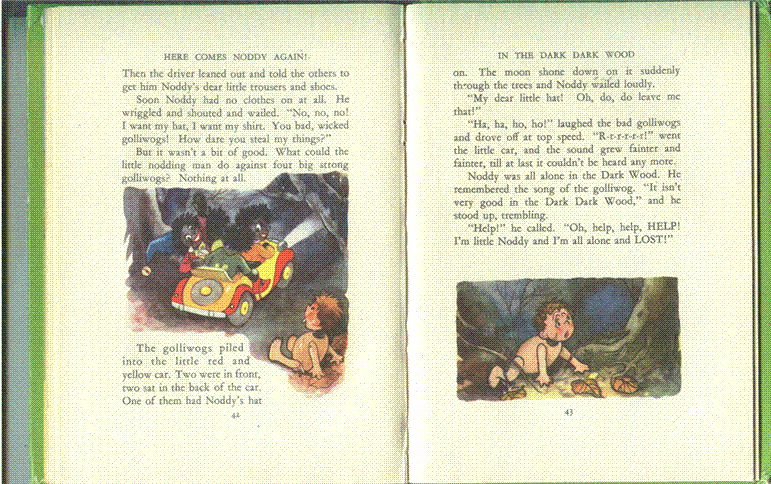
There was a lot to relearn. Arthur Kemp “was a very involved and doting father” when his children were small, Karen Mills said. He read to them often, carefully choosing books he felt would reinforce his ideology. Among them were the original “Noddy” series, English children’s books that featured Golliwogs, dark-skinned caricatures that were later removed from the text because they were deemed racist. In one of Kemp’s favorite Noddy books, the Golliwogs steal Noddy’s car. Kemp enjoyed telling his children that the Golliwogs’ theft of the car amounted to typical behavior for blacks.

…He also forbade socializing with non-white children. If they arrived at a friend’s party to find that a black child had also been invited, Kemp made his children go home. When Stephan was six, his father reluctantly took him and his sister to swimming lessons at a public pool where one of the children turned out to be black. “He told us to get out and that we were leaving,” said Stephan, who now uses his mother’s maiden name. “I was still pretty young so I didn’t really understand what was going on.”

…He also relished showing them articles and statistics that purported to prove that blacks were inferior. He contended that blacks could never be race car drivers because they have poor depth perception, that they cannot swim because their bones are too dense, that they are not as intelligent because their brains are smaller.

“The children were actively encouraged to be vocal about their views and to challenge their peers,” Karen Mills wrote. “In Stephan’s case in particular, this resulted in him being ostracized and made an outcast as he followed his father’s lead.”

Stephan said he had few friends until his first year of high school. At times, he suffered from depression because his father’s brainwashing had so alienated him from his peers, his mother said.

“I wasn’t really someone that people wanted to hang around with,” Stephan said. “They regarded me as weird because I was constantly talking about Hitler.”

…Karen Mills said Kemp has had almost no contact with his children since their divorce. “I don’t think there’s any way that Arthur could fix the broken relationship with Stephan,” she said. Nonetheless, “Stephan has gone through something of a catharsis.” In addition to his posts on Lancaster Unity, he chose to discuss his father when he was assigned to give a school speech on someone who had influenced him — only he said his father’s influence had been entirely negative. Now, his social life is improving, and he has resolved to be as unlike his father as possible. “I am stuck with some of his traits and characteristics — Mom used to joke with me that I have the Kemp laziness gene — but definitely not his political views,” he said.

Yet there’s no bringing back the years he lost to his father’s hate. “You,” he wrote to him in the September 2008 Lancaster Unity post, “will never understand what you have done to me.”

sometimes the apple does fall far from the tree

Thank God!  This is such an amazing story.  I’m so fascinated.  Not only by the bravery of a little white girl who crossed KKK, but also the shades of “mulatto” history sprinkled throughout.  Coon-hunting based on the supposed threat that black males posed to white women.  The “black” member of the Klan.  Passing.  Male chauvinism.  Homophobia. This is our sordid past.  And it is still haunting us.

Taking on the Klan

One summer night in 1965, 12-year-old Carolyn Wagner watched as Klansmen bound a young black man to a tree in her father’s field, accused him of violating the “sundown” rules in nearby Booneville, Ark., that forbade blacks from staying in town after dark, and lashed him a few times with a bullwhip as he cried out in pain and fear.

It was no different from beatings at other Klan gatherings her father had attended, but what happened next remains vivid in her memory: the Klansmen decided to tie the man to the railroad tracks below the pasture. When they were done, they ambled back to the field to discuss crops and politics. Wagner, a reluctant witness to her father’s Klan meetings, couldn’t stand it anymore. She stole down to the tracks, used a knife she kept in her boot to slash the rope that bound the man, and told him he could follow the tracks to Fort Smith, the nearest large town.

“That was a turning point,” recalled Wagner, now 56 and living in Tulsa, Okla. “I felt like I had made a difference when I was able to cut that man free. I realized I can make a choice to be a passive observer or I can become involved to diminish the harm that they’re doing. And that’s what I did from that night on, and that’s what I’m still doing.”

After years working for civil rights and children’s organizations, Wagner co-founded Families United Against Hate, a nonprofit group that helps people affected by bias incidents. Her experience growing up with a father in the Klan made her determined and fearless in her fight against hate. “That image of my dad and those men, and even the smells, are still with me, and they’ll always be with me. And it was very important that my children never know the world I knew when I was growing up.”

It was a world where Wagner’s father, Edward Greenwood, and his acquaintances gathered at least once a month at each other’s farms for Klan meetings, often bringing their children and grandkids. Because her father, then in his late 50s, couldn’t see well enough to drive at night, Wagner ferried him to meetings in a 1951 Chevy pickup. (Back then in rural Arkansas, it wasn’t unusual for children as young as 12 to drive on country roads.) The men — including lawyers, judges, cops and pastors — would begin their gatherings with a prayer and eschew alcohol. “They felt like they were doing God’s work,” Wagner said.

Sometimes, the gatherings would feature a beating like the one Wagner witnessed at her family’s farm. The victims were usually young men who’d been picked up on a pretext, such as paying too much attention to a white woman. “We would hear terms like ‘coon’ hunting,” she said. “My father would say, ‘I’m going ‘coon’ hunting.'”

But more often, the men would talk big, complaining about Presidents John F. Kennedy or Lyndon B. Johnson or even threatening to blow up the Supreme Court building. They’d eat bologna sandwiches that Wagner had prepared. Campfire smoke would mingle with the sweet-sour odor of Brylcreem, sweat and Old Spice. It was the one place where her father seemed happy. “I don’t remember seeing him smile or laugh unless he was with those goons,” she said.

…But her father probably would not have found a home in the Klan if his comrades had known about his heritage. “We knew there was this dirty secret in the family,” Wagner said.

In fact, her father’s great-great-great grandmother, Elizabeth Greenwood, was part Cherokee and part black, a former slave who’d settled in Arkansas when it was still part of France’s Louisiana Territory, according to family lore. Her father had cousins who identified as black, though he would have nothing to do with them. Wagner believes part of his racism stemmed from shame about his origins.

Wagner’s mother didn’t share her husband’s views about race, but she felt powerless to oppose him. Divorce was taboo in her family; resources for victims of domestic abuse were nearly nonexistent. “Mother never asked what he did [at Klan meetings],” Wagner said. “It was like she couldn’t bear to know.”

Wagner did receive support from her maternal grandparents, who passionately disliked her father. After Wagner secretly untied the black man from the railroad tracks, her maternal grandfather taught her how to use a 12-gauge double-barrel shotgun. She cut away the springs in the seat of the pickup to create a compartment where she hid the weapon, loaded and wrapped in a blanket. Though she never used it, she says she would have done so to defend herself or to help a potential Klan victim.

It wasn’t the last time she would defy all that her father represented. In April 1968, Wagner drove him to Memphis to take part in a Klan protest during the sanitation workers strike made famous by the appearance of Martin Luther King Jr. She was there when the civil rights leader was assassinated. In a Memphis newspaper, she read that the Department of Justice was planning a crackdown on the perpetrators of civil-rights era violence. After the assassination of Robert Kennedy two months later, Wagner, then 15, wrote a letter to the FBI accompanied by a list of names and addresses she’d copied from her father’s Klan directory. She wanted to get them all arrested. “I included my dad on that list,” she said.

Wagner, who used her maternal grandparents’ home as the return address, never heard back from the FBI.

She left home the day she finished high school and at 19 eloped with Bill Wagner, now her husband of 37 years. Her father died in 1980 when she was pregnant with her younger child, William. “I am so grateful that my children will have no memory of him or his politics,” she said.

But her own memories of her father came back strongly on William’s 14th birthday, the day he told his parents that he was gay. That day she and her husband’s biggest concern was for their son’s safety. “I had a very clear understanding of who the hatemongers were,” she said. They decided to move from their farm in tiny Booneville, a conservative town where homosexuality was widely condemned, to the more liberal university town of Fayetteville, some 120 miles away.

Still, they couldn’t protect their son from hate. Harassment at school culminated in a brutal assault in 1996. William, then 16, left school with friends to get lunch at a nearby convenience store when six teenagers shouted anti-gay slurs. They knocked him off his feet, then kicked him as he lay bleeding on the ground. “I thought about how easily that could have been my father’s group,” Wagner recalled. “And I wasn’t there.”

Two of the attackers were convicted of assault. After the Wagners filed a complaint on behalf of their son under Title IX, the federal anti-discrimination law, Fayetteville became the first public school district in the nation to enter into an agreement with the Department of Education’s Office of Civil Rights that required it to protect all students, including gays and lesbians, from harassment. The Wagners continue to advocate for young people who are targeted because of their actual or perceived sexual orientation.

Looking back on her childhood, Wagner remembers reading novels by Pearl S. Buck and biographies about women such as Harriet Tubman and Florence Nightingale. She wanted to learn about people who had survived difficult circumstances to help others, because she was determined to do the same.

“I found ways to survive,” she said. “I found ways to more than survive — to endure, to become stronger and to make our little corner of the world in the South a little better.”

have you noticed…

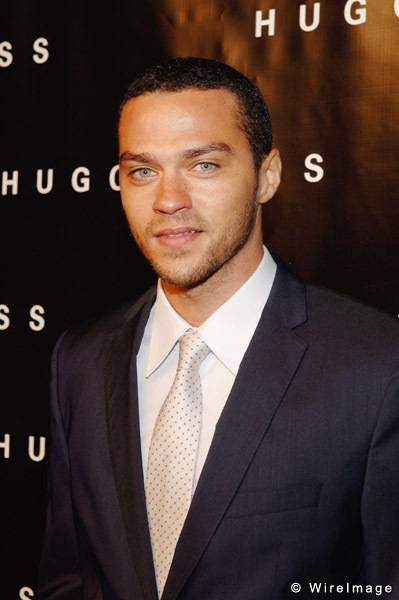
The new (biracial) guy on Grey’s Anatomy?  As soon as he first hit the screen I was like, “I think he’s one of us!”  But I wasn’t 100% sure until I saw Jesse Williams on the Bonnie Hunt Show.  He showed pictures of himself as a child with his (Black) dad.  So cute!  Then and now!!  My friend google led me to some more info about him….

Williams is the son of an African American father and a Swedish mother, and as a teenager, he moved from urban Chicago to ‘lily-white’ suburban Massachusetts.  His interest in acting was sparked, in part, when a film he was writing about this uneasy transition was chosen as a finalist in the Sundance Screenwriter’s Lab.  “It was a big part of my life.  I really rejected that move.  It was a complete cultural shock.”  Williams recalls, “It wasn’t good.  My friends were sh***y, the people were sh***y, the parents were sh***y.  A lot of parents closed the door in my face, so I was like, I don’t need to be here.  I’m not going to try and change you, which, I guess I did try for a while.”- via

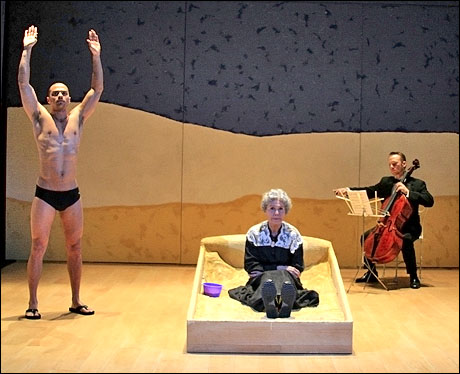
This is from an off-broadway play that Williams did last year.  So wish I had seen it.

Jesse Williams isn’t embarrassed to admit he wasn’t fully aware of who Edward Albee was when he auditioned for him to play the scantily-clad Angel of Death in the revival of The Sandbox that the 80-year-old playwright is now directing (in tandem with The American Dream) at The Cherry Lane. “Actually, I think it helped me, not being so intimidated,” says Williams. “He was so funny, cracking jokes with me even from the beginning. And I didn’t even fully process that he had offered me the job. But it’s all been an amazing experience, getting this immediate response from the audience, and working with this cast. And honestly, I don’t even really know what I look like on stage. I said I was going to go to the gym more often, but I end up just doing push-ups in the basement of the theater and trying to keep quiet.”

Williams’ enthusiasm is understandable, since he has only been acting professionally for a couple of years. While studying filmmaking at Philadelphia’s Temple University, he did some commercial and modeling work, with the occasional acting audition — even turning down a prime soap opera role. “I am a biracial man, and I was supposed to play this tragic mulatto character lusting after a white girl, and I didn’t want to leave school to do that kind of part.” Instead, after graduation, he took a job as a public school teacher in Philadelphia, and then a high-level law firm job in New York — “I was supervising 60 attorneys, even though I’m not a lawyer” — before deciding to focus on acting.- via

Oh, Jesse Williams.  I can’t wait to interview you!

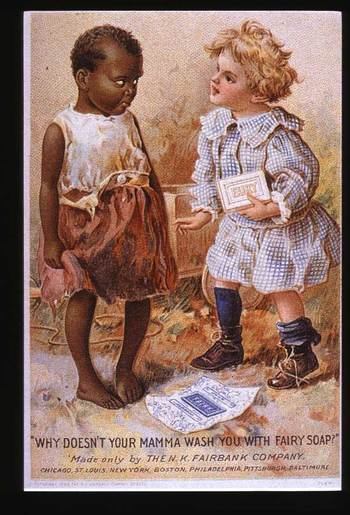
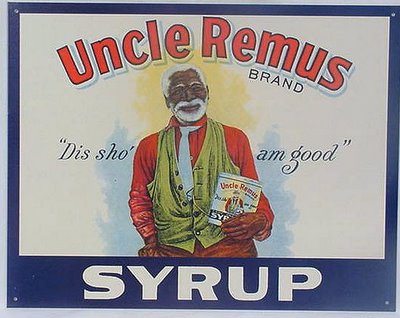
worse ads

The products are/were the real problem, I suppose.

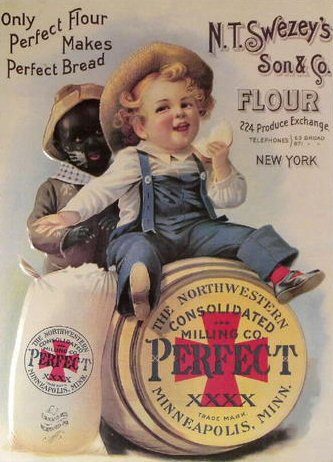
Offensive & Politically incorrect advertising and propaganda:No fuss, to the point racist packaging. What you see here is an old Norwegian brand of tar/varnish used on wood burning ovens. It’s been out of production for a good while now, but boxes like this can still be found tucked away in old dusty closets in Norway. more examples of mindblowing advertising here

Offensive & Politically incorrect advertising and propaganda:

No fuss, to the point racist packaging. What you see here is an old Norwegian brand of tar/varnish used on wood burning ovens. It’s been out of production for a good while now, but boxes like this can still be found tucked away in old dusty closets in Norway.

via

here

kimball

1900sc_Nigger_Head_Oysters_Can

negro head oysters

In the US and the UK, the word nigger featured in branding and packaging consumer products, e.g. “Nigger Hair Tobacco” and “Niggerhead Oysters”, Brazil nuts were called nigger toes, et cetera. As racism became unacceptable in mainstream culture, the tobacco brand became “Bigger Hare” and the canned goods brand became “Negro Head”.

conditioned to the method of white superiority

I’d love to see the show that this article details.  All whites are racist!?  I have a hard time buying that.  Prejudiced or biased, maybe.  I think all people are no matter the color.  Anyway, it upsets me greatly that the black father of the mixed-race girl doesn’t want to expose her “secret.”  Um…. how is she supposed to form a positive, all-encompassing identity if her black father is hiding from her white friends?  I wonder if this will be on BBC America.

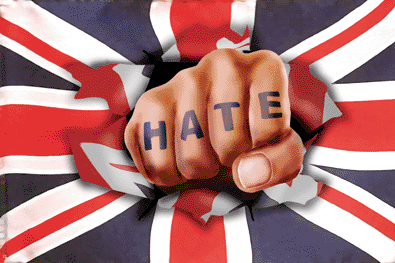
racism-fist-large.gif

TEACHER: ‘ALL WHITES ARE RACIST’

29th October 2009 by Peter Dyke

DailyStarUK

A Bombshell new television show will tonight claim that all white people are racist.

An American schoolteacher and anti-race campaigner will conduct an experiment for Channel 4 to prove how prejudiced Britain is.

Jane Elliott, 76, whose nickname is The Bitch, travelled to the UK for the test.

Part of the show features former Prime Minister Margaret Thatcher made up as a black person and US President Barack Obama as a Chinese.

Elliott is given a group of 30 volunteers, of mixed age and race, and splits them into two teams based on their eye colour.

Those with brown eyes are treated well, but those with blue eyes are ridiculed, humiliated and insulted.

Her aim is to create a mock “apartheid regime” to make the blue eyed people experience prejudice, discrimination and racism.

However at the end of the experiment, set in an old warehouse and lasting several hours, the white and black volunteers end up in a bitter row.

Some even walk out. Many of the white volunteers claim that black people do not have the monopoly on discrimination.

A middle aged white woman says: “They think racism is just for black people. I’ve had comments made about me because I’m blonde and white.”

However one dad, who is black, reveals how he never picks his daughter up from school because her mum is white and he doesn’t want anyone to know she is mixed race in case she is taunted.

At the end of the experiment, Elliott claims the white volunteers have shown their true colours.

She tells the C4 documentary tonight at 10pm: “White people should feel guilty about their behaviour.

“You don’t do things because you’re white, you do things because you’re ignorant.

“We are conditioned to the method of white superiority from the moment of birth.”

stop-racism