speaking of unicef

I’ve been sitting on this for a while now.  It came to my attention before I even had a blog.  My blood boils every time I see it in my folder of pictures.  Thank God today seems to be it’s day because now I can delete it.  I’m certain that Audrey would NOT approve…
unicef blackface

http://www.alternet.org/blogs/peek/59019/

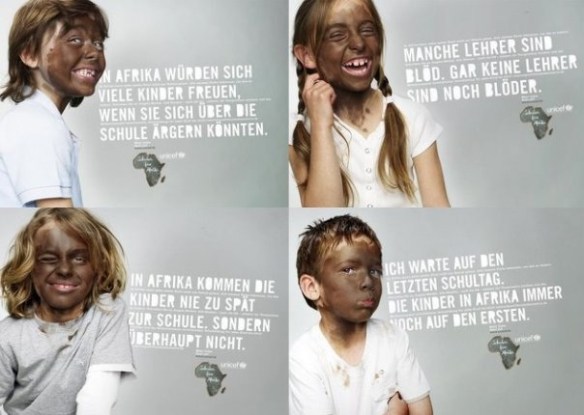
This is an actual ad-campaign by UNICEF Germany from 2007!

This campaign is “blackfacing” white children with mud to pose as “uneducated africans”.

The headline translates “This Ad-campaign developped pro bono by the agency Jung von Matt/Alster shows four german kids who appeal for solidarity with their contemporaries in Afrika”

The first kid says:

“I’m waiting for my last day in school, the children in africa still for their first one.”

second kid:

“in africa, many kids would be glad to worry about school”

third kid:

“in africa, kids don’t come to school late, but not at all” (!)

fourth kid:

“some teachers suck. no teachers sucks even more.”

Besides claiming that every single person in “Africa” isn’t educated, and doing so in an extremely patronising way, it is also disturbing that this organisation thinks blackfacing kids with mud (!) equals “relating to african children”. Also, the kids’ statements ignore the existence of millions of african academics and regular people and one again reduces a whole continent to a village of muddy uneducated uncivilized people who need to be educated (probably by any random westerner). This a really sad regression.

Bottom lines of this campaign are: Black = mud = African = uneducated. White = educated. We feel this campaign might do just as much harm as it does any good. You don’t collect money for helping people by humiliating and trivializing them first.

Unfortunately, if it was clear to the average German that this is wrong, UNICEF and the advertising agency wouldn’t come out with such a campaign.

Below is the official response from UNICEF about the ads run in Germany:

 “Thank you for bringing this to our attention. We agree — these advertisements are not appropriate and run against UNICEF’s mission. They have been dropped from the UNICEF German National Committee’s website and there are no plans to use them in the future. We apologize for any offence caused.

As a UNICEF supporter, you may be interested to know a little more about the German National Committee’s campaign to promote child-friendly schools in six African countries. Launched in late 2004, the campaign aims to raise awareness of the fact that nearly half of all children in Africa lack even primary education.

With funds from private donors, 350 schools have been repaired or newly constructed. In addition, several thousand teachers have been trained and school management improved. In total, around 100,000 children and young people have benefited from this campaign since 2004. The right to education for all children is a prerequisite to develop their full potential and a basis for social and economic development. Again, we apologize for any offense caused.

http://www.alternet.org/blogs/peek/59019/

speaking of angelina weld grimke

agrimke

Angelina Weld Grimké (February 27, 1880 – June 10, 1958) was an African-American journalist, teacher, playwright and poet who was part of the Harlem Renaissance and was one of the first African-American women to have a play performed. Born in Boston, the daughter of Archibald Grimke, a prominent journalist who served as Vice-President of the NAACP. The Grimkes were a prominent biracial family whose members included both slaveowners and abolitionists. Two of her great aunts, Angelina and Sarah, were prominent abolitionists in the North. Angelina Weld Grimke was named after her aunt who had died the year before.Her paternal grandfather was their brother Henry Grimké, of their large, slaveholding family based in Charleston, South Carolina. Their paternal grandmother was Nancy Weston, an enslaved woman of European and African descent, with whom Henry became involved after becoming a widower.  Grimke’s mother, Sarah Stanley Grimke, a white woman, left her husband under the influence of her parents who never approved of her interracial marriage, and took her three-year old daughter with her. However, at the age of seven, Angelina was returned to her father, and although she and her mother corresponded, they never saw one another again. Sarah Stanley died of suicide several years later.

Grimké wrote essays, short stories and poems which were published in The CrisisOpportunityThe New NegroCaroling Dusk, and Negro Poets and Their Poems. Some of her more famous poems include, “The Eyes of My Regret”, “At April”, and “Trees”. She was an active writer and activist included among the figures of the Harlem Renaissance. Her poetry dealt with more conventional romantic themes, often marked with frequent images of frustration and isolation. Recent scholarship has revealed Grimke’s unpublished lesbian poems and letters; she did not feel free to live openly as a gay woman during her lifetime. 

Grimké also wrote a play called Rachel, one of the first plays to protest lynching and racial violence. She wrote the three-act drama for the National Association for the Advancement of Colored People (NAACP) to rally public support against the recently released film The Birth of a Nation. The play was produced in 1916 in Washington, D.C., performed by an all-black cast. It was published in 1920.

After her father died, Grimké left Washington, DC, for New York, where she lived a reclusive life in Brooklyn. She died in 1958 after a long illness.

http://www.aaregistry.com/detail.php?id=1123

http://en.wikipedia.org/wiki/Angelina_Weld_Grimké

http://www.scils.rutgers.edu/~cybers/grimke2.html

finally

y188438846791963

I often consider that, because “mulatto” doesn’t really “exist” in the world at large, medical studies that cite race as a qualifier of the subjects studied mean absolutely nothing for me.  Am I to assume that the ills that typically plague African Americans are apt to plague me, or those of Caucasians?  Or neither?  Or both?  I mean surely our DNA does not take into account the one drop rule and decide that I have only black genes.  For these reasons I was very pleased to hear of the Bogalusa Heart Study…

The Bogalusa Heart Study is the longest and most detailed epidemiologic study of a biracial (black-white) population of children in the world. The study focuses on understanding the early natural history of coronary artery disease and essential hypertension. It is the only major program studying a total and geographically well-defined, biracial and semi-rural community. http://www.newswise.com/articles/view/552027/

nancy weston

with friends like these….

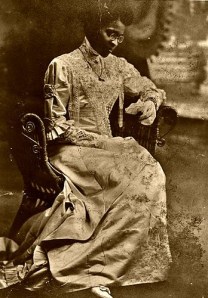
Nancy Weston

3397121950_a831785417


She lived in Charleston, South Carolina, in the 1850s as a free woman. However, in order to satisfy the laws of the state, she was a ‘nominal slave’ legally owned by a white friend. She was also the grandmother of writer Angelina Weld Grimke.

‘The Face of Our Past: Images of Black Women from Colonial America to the Present’ edited by Kathleen Thompson and Hilary Mac Austin 

http://www.flickr.com/photos/22067139@N05/3397121950/

I would love to write a book or a screenplay based on this one sentence: she was a ‘nominal slave’ legally owned by a white friend.   That has really got my imagination going.  I’ve actually never heard of nominal slaves before.  I read a bit about them today.  Interesting stuff.  Most of what I read was connected to writings pertaining to black slave owners, and the Weston name in S. Carolina came up frequently.  But Nancy was ‘owned’ by a white friend.  I am fascinated.

From http://www.straightdope.com/columns/read/2821/before-the-civil-war-were-some-slave-owners-black

Between 1800 and 1830 slave states began restricting manumission, seeing free blacks as potential fomenters of slave rebellion. Now you could buy your friends, but you couldn’t free them unless they left the state — which for the freed slave could mean leaving behind family still in bondage. So more free blacks took to owning slaves benevolently. Being a nominal slave was risky — among other things, you could be seized as payment for your nominal owner’s debts. But at least one state, South Carolina, granted nominal slaves certain rights, including the right to buy slaves of their own….

We do, however, need to acknowledge a less common form of black slaveholding. Whites in Louisiana and South Carolina fostered a class of rich people of mixed race — typically they were known as “mulattoes,” although gradations such as “quadroon” and “octoroon” were sometimes used — as a buffer between themselves and slaves. Often the descendants and heirs of well-off whites, these citizens were encouraged to own slaves, tended to side with whites in racial disputes, and generally identified more with their white forebears than black. Nationwide maybe 10 percent of the mixed-race population (about 1 percent of all those identified as African-American) fell into this category.

dr. charlotte hawkins brown

Here’s another great story.  This woman was amazing.  I can imagine no nobler task than “establishing for Negro youth something superior to Jim Crowism.”  Her influence must have been so great on those she encountered.  I would love to talk with her about today’s “negro youth.”  What she would have imagined and hoped things would be like in 2009 and how that differs from the current reality.  

Dr. Charlotte Hawkins Brown

2642553943_8d452ccd72

Above is a photo from her wedding in 1912.
**********************
[b. 1870 – d. 1961]

Charlotte Hawkins Brown was born in Henderson, North Carolina, but grew up in Massachusetts after her family moved from the South. She was educated in Boston and had planned to finish her college education when two events changed her life.

First, she met Alice Freeman Palmer, a prominent New England woman, who was so impressed by Hawkins’ determination to get an education that she became Brown’s benefactor. Then, in 1901, Brown returned to the South to teach in a country school that was supported by a Northern missionary society in the town of Sedalia, North Carolina.

Quote: “I have devoted my life to establishing for Negro youth something superior to Jim Crowism”

She arrived during the worst years of the Jim Crow era. Blacks had been disfranchised as well as segregated and there was little money available for black schools. When the school’s funding ended after two years, Brown decided to remain in Sedalia to start her own school. She went north to raise money and returned with $100, which she used to open the Palmer Memorial Institute, an academic and industrial school for African Americans, in 1902.

Brown’s life was a balancing act. She passionately hated segregation and continually sought ways around it. When she went to town to visit her doctor or lawyer, she would arrange to enter into their office immediately upon her arrival. Thus, she avoided sitting in the Jim Crow section of the waiting room. When her students went to the movies or other cultural events, she would rent the theater for the day so that they did not have to sit in the “colored” section.

To raise funds for the school, she wrote letters to potential supporters. Her students learned French, Latin, and other academic subjects. Brown prepared her students to be leaders of their race.

In addition to building her school, Charlotte Hawkins Brown was active in the women’s club and suffragist movements. She later became president of the North Carolina Association of Colored Women’s Clubs, and she helped organize voter registration drives for black women and tried to get white club women to back suffrage for black women.

She saw herself as part of the freedom struggle that was taking place in the black community. The Palmer Institute became an educational success and remained open until a decade after her death, in 1961.

Charles W. Wadelington and Richard F. Knapp, ‘Charlotte Hawkins Brown and Palmer Memorial Institute; What One Young African American Woman Could Do.’

http://www.flickr.com/photos/22067139@N05/2642553943/

flesh tone line

16647119_500

THE FLESH TONE LINE

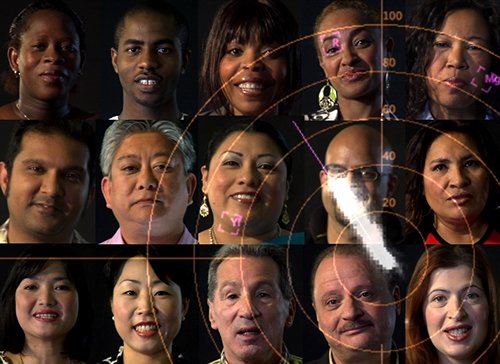
“As far as color correction is concerned, all people are basically the same ‘color’ when you define color in terms of hue angle. The variation in our ‘skin color’ is a really variation in tone, or relative lightness-darkness value of the human hue. We all line up on the same line on a vectorscope, this line is called the ‘Flesh Tone Line’ or FTL and its on most vectorscopes.”

So someone with dark skin:

Is the same hue as someone with light skin:

We all line up along that line:

It makes sense though, right?


Our skin ‘color’ is largely determined by the amount of the pigment melanin, and blood present in our skin. Melanin and blood color are the same color in all humans, its just the amount and relationship between the two that determine our tone. 

reblogged from http://lonelysandwich.com/page/91 via http://prepshootpost.blogspot.com/2007/10/skin-color.html

disturbing headline


Arkansas Democrat-Gazette

Five plead innocent to plotting to burn cross

They conspired to intimidate mother of 3 biracial children, U.S. indictment says

by Amy Upshaw

TEXARKANA – Five men pleaded innocent Friday to federal charges accusing them of plotting to burn a cross last summer in the yard of a white woman who had three biracial children.

A federal indictment unsealed Friday says the men built the cross and attempted to set it on fire to scare then-23-year-old Loretta Marie Slaughter-Shirah into moving out of the Donaldson community.

On June 15, Jacob Wingo, Dustin Nix, Darren McKim, Richard Robins and Clayton Morrison, “did knowingly and willfully combine, conspire and agree to injure, oppress, threaten and intimidate [Slaughter-Shirah] and her children in the free exercise and enjoyment of a right secured by the Constitution … because of race and color,” a portion of the indictment reads.

The indictment also says that while four of the men were at McKim’s house that day, they talked about forcing the family out of the neighborhood because there were “‘niggers’ at the residence.”

Wingo’s mother, Yvette Briggs, said Friday afternoon that her son and his friends were joking when they came up with the idea for the cross.

“It wasn’t meant as racist,” Briggs said. “He made a very fool- ish mistake. He didn’t mean it as a threat at all.”

Slaughter-Shirah could not be reached for comment, but she previously told the Arkansas Democrat-Gazette that she moved away from Donaldson because she no longer felt safe there.

When the events took place last year, she had lived in the mostly white community of about 300 people for only a few weeks. Donaldson is about 15 miles northeast of Arkadelphia…..

burning-cross-and-dukes-of-hazzard

Such a great non-racist joke they were playing!  You can read the rest of the article at http://www.nwanews.com/adg/national/258569/

ella and marilyn

I’m kind of freaking out about this.  As much as I love anyone that I’ve said that said that I love on this blog, I LOVE Ella Fitzgerald!  When it comes down to it, I would rate her #1 vocalist of all time.  A constant on the list of (dead) people I’d like to have dinner with/invite to a dinner party is Ella.  I had no idea about Marilyn!  I just found this story at http://donttouchmymoleskine.wordpress.com/2009/02/18/miguxas-3/

ella_fitzgerald_and_marilyn_monroe

marilyn-e-ella

It’s 1955 and Marilyn Monroe is at the height of her fame. Despite this, she wants to be taken seriously as an artist, like the woman she most admires, jazz icon Ella Fitzgerald, who is also at the peak of her career.

Even though she can’t quite believe her own success, Ella wants more too. She wants the kind of fame Marilyn has. She wants to be in the movies. But to break into Hollywood , she needs to meet the ‘right’ people like the producers and money-men who frequent the ‘living-room of the stars’ Mocambo night club.

But Ella stands no chance of singing at the whites-only Mocambo…until Marilyn steps in and pulls strings like nobody else can!

These two iconic women – both outsiders – come together in an evening of raw emotion and great songs. A true but forgotten moment of American showbiz history re-enacted live on stage.