re: re: michael

Michael Jackson is still at the forefront of my mind.  I’ve read so many great, and so many not great, articles on Michael’s life and death.  I thought I’d share some of my favorites.

On Michael Jackson: Respite, sadness and memory

by Sean Kirst / The Post-Standard

http://www.syracuse.com/kirst/index.ssf/2009/07/on_michael_jackson_respite_sad.html

Gina Ingram is trying to avoid the endless media recaps of the spectacle and scandal that dominated the last 20 years of Michael Jackson’s life…

…When Ingram was born, her mom was 17. Her dad was gone by the time she was a toddler. With her mother and older brother Zach, Ingram moved from apartment to apartment.

Once they hit school, she and Zach quickly learned what it meant to be biracial in an era when it wasn’t common.

“We were considered freaks of nature,” Ingram said.

Her white relatives didn’t know how to handle her hair. Children routinely offered cruel comments. But Ingram’s mom provided a means of escape: She handed down a love of reading to her daughter, who spent countless hours in her room, alone with books or music.

Ingram always liked Jackson’s work, especially “Ben,” a haunting ballad that seemed to put some of her own childhood sadness into words. In 1982, she used a battered record player to listen to Jackson’s revelatory album, “Thriller.” The vinyl soon became so scratched and worn that she would load pennies onto the phonograph needle to keep it from skipping.

Once school let out, Ingram and her brother would be alone until their mother finished working. “When the date and time of the ‘Thriller’ video (premiere) was announced on MTV — you know, when they used to play videos — we both rushed home, made our daily snack of tea and toast and sat anxiously waiting for it to come on,” Ingram wrote.

The TV was in their mother’s room. They sat side by side at the foot of the bed, astounded by Jackson’s zombie makeup and elaborate dance routine.

To this day, Ingram recalls the look of sheer awe she and Zach exchanged when it was over….

tVTNYU7uApd9bm9ssqtDeOqfo1_400

Colorism: Prejudice seen through a painful prism

By DENEEN L. BROWN
The Washington Post

http://www.thecabin.net/stories/071209/sty_0712090028.shtml

Colorism is the crazy aunt in the attic of racism. If you find it necessary to talk about her at all, do it in whispers among relatives and people who already know about her.

On June 25, when Michael Jackson died, there she was again: colorism, that sub-category of racism and prejudice based on skin color, staring us right in the face.

By the time Jackson died, he was perhaps whiter than any white man that you know. Those who looked at the constant stream of replayed televised interviews, at the pale skin, the thin lips painted red, the straight hair, saw in his face the psychological wound that has scarred so many in the black community.

You line up his album covers, from “Got to Be There” when he was 13 and brown with a big-tooth grin, to “Off the Wall,” when he still had a beautiful nose and a big Afro, to “Thriller,” when his skin was still beautiful brown, but his nose was smaller, to “Bad,” when his nose was even thinner and his skin was white.

“He is an over-the-top manifestation of that undercurrent in the black community,” says Alice M. Thomas, associate professor of law at Howard University. “If you are light, you are all right. If you are brown, you can stick around. If you are black, get back.

Jackson has insisted that his skin faded as the result of vitiligo, a condition that damages the skin’s pigment. But experts say that condition leaves the skin spotted and blotchy. To the outer world, Jackson’s skin appeared consistently white. And before-and-after photos of Jackson tell a deeper story about color discrimination, also known as colorism an intra-racial discrimination among African-Americans.

Colorism began during slavery when darker-skinned blacks were relegated to field work and lighter-skinned blacks, often the children of slave masters, were given housework. For years after, many blacks, some say, internalized the declaration that the lighter one was the better one.

Nobody wants to talk about colorism. And yet everybody talks about it.

“Colorism was venomous because it did so much damage to the psyche,” says Alvin Poussaint, media director at the Judge Baker Children’s Center in Boston and professor of psychiatry at Harvard Medical School. “There was nothing like walking around feeling you are a rejected person, a wretched person, as Frantz Fanon put it in ‘The Wretched of the Earth.'”

tVTNYU7uApcfqgeu0GG4IKVCo1_400

Why Michael Jackson’s Death is Heartbreaking for me… Finally

by Cynthia Boaz

…It had been hard for me to mourn Michael Jackson, because the person the world lost is not the person he was supposed to have been.

And that realization is very sad.

Without making excuses for his eccentricities — or reportedly inappropriate behavior — Michael Jackson’s life and death give us the opportunity to look more closely at ourselves as a society. What did we do to him? What does it say about us? What can we learn from it?

Take a moment to think about the destructive forces that pulled at him constantly, from the first time he appeared onstage — all the horrors of celebrity: commercialism, consumerism, superficiality, disconnection, judgment. What gentle soul could bear that never-ending barrage? The truth is we wanted a freak to gawk at, to mock in the vain hope of filling up a void in ourselves. We were like bullies on the playground, kicking the shy, slightly weird kid when he was down.

Looking back, it seems that Michael Jackson was always searching for an identity that we would embrace, and that he, ultimately, would also accept. It was an impossible task, because the Michael Jackson we wanted was a specter, an ideal. So with each rejection, he recoiled and tried again harder the next time. He was lonely, so we exploited it. He was kind, so we twisted it. He was brilliant, so we marginalized it. At the end of his life, it seems that Michael himself did not know who he was, and that is why to us now, he remains an icon, a caricature of himself. And we all have a part in that. Maybe — at the end of the day — he was just too sensitive for this world.

At first glance, what made us uncomfortable about Michael Jackson in the later years was how severely he diverged from what we understand to be normal. But who amongst us hasn’t searched for identity? For acceptance? For love? Who hasn’t struggled with intense loneliness and a desire to connect?

Because of our role in his own understanding of himself, how we respond to Michael Jackson’s death reflects on us as a culture and a people. There is a conventional wisdom that when you point a finger at someone, there are three pointing back towards you. Those who take the sadness of his death to cruelly rebuke Michael Jackson for his oddities transparently reveal their own pathetic insecurities.

The spectacle we made of Michael Jackson’s life shouldn’t be repeated in his death. Perhaps it’s time for us to ponder our role in the destruction of the person that Michael Jackson was meant to be. Perhaps we should use this as an opportunity to heal ourselves as a culture. Perhaps it’s time to turn off the television reality shows, cancel the subscription to celebrity gossip magazines, and take a few moments out of the day to be conscious of the effect our attention — positive and negative — has on the people around us.

And to paraphrase a well-known person of great compassion, let s/he who has never felt the sting of rejection or the despair of loneliness cast the only stones.

JBy6l1Bb3pqle1unGldzwN8po1_400

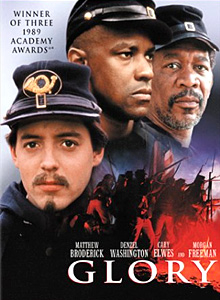
the movie glory

I just finished watching Glory for the 5th time.  It might be my favorite movie.  This movie was actually the catalyst for my whole “biracial” revelatory aha moment.  While watching Glory for the 4th time, I realized that, seeing as this was the history of our country, it is a miracle that I (a black and white person) even exist.  Truly.  And then I realized that I didn’t really exist.  There was no recognition of the miracle.  Not even an internal, personal one.  I realized that the history depicted in the film was the truth and that I had fallen victim to it’s legacy and failed to know myself fully.  

15341747-15341751-large

Watching the movie tonight, I was again blown away by Denzel Washington.  “The tear” is one of the most memorable moments I have witnessed on screen.  I also kept searching for the moment that might have triggered the big realization. My guess is the part where Matthew Broderick (as Robert Shaw) takes the 54th out with the other “negro regiment.”  The other leader is an ass to say the least.  He not only refers to the black soldiers as “little monkey children,” but he is extremely immoral in every sense of the word.  He treats his soldiers like animals, they act like animals.  Robert Shaw treats his soldiers with respect, like men.  In turn they are respectful and respectable men.  

The most poignant moment for me this viewing though was when Broderick and Denzel Washington’s character (whose name escapes me), were discussing the predicament that was life in America at that time.  And arguably still is to a certain extent.  Denzel says “It stinks real bad.  And all of us are in it.  Ain’t no one clean.”  Broderick asks, “How do we get clean?”  There wasn’t a definitive answer, but if I had to glean one from the film it’s that we become clean when we decide to die fighting for what we now know to be right, no matter how many wrongs we may have committed in the past.  

Thank you Edward Zwick, for the movie Glory.  I think it should be required viewing for every American.

how do you think?

basket1am212

This is so ridiculous I don’t even know what to say about it.  Other than, I’m actually glad he said it because I know he isn’t alone in holding this backwards, racist belief.  That’s how he thinks like everyone else, actually.  Well, not everyone thank God, but you know…  Most people wouldn’t admit it though.  Or maybe it’s so subconscious that they aren’t aware of it.  Either way, or whatever, it’s so perverse!!

Manuel Miranda: Latinos are ‘not like African-Americans. We think just like everybody else.’

Manuel Miranda, who was busted for hacking into the files of Senate Democrats while he served as an aide to former Senate Majority Leader Bill Frist (R-TN), is leading the conservative charge against Judge Sonia Sotomayor’s nomination to the Supreme Court. At a Heritage Foundation lunch for conservative bloggers today, Miranda discussed how conservatives could attack Sotomayor’s qualifications without alienating the Latino community. Miranda, who is Latino himself, argued that Latinos had concerns similar to those of “everyone else,” but then appeared to suggest that African-Americans somehow think differently from other people. Latinos are “not like African-Americans. We think just like everybody else”:

Hispanic polls, Hispanic surveys, indicate that Hispanics think just like everyone else. We’re not like African-Americans. We think just like everybody else. When I was on the leader’s staff, someone called me once and asked me: ‘What’s Senator Frist’s Hispanic agenda?’ I said, ‘low taxes, better education, more jobs … what are you talking about?’ And that’s how Hispanics are. This is an opportunity to educate them on all of our issues and they will resonate in the way that they resonate with everyone else.

via http://thinkprogress.org/2009/06/02/manuel-miranda-african-americans/

1am210

tennessee again

I used to, and by that I mean before yesterday, think that I would love to live in Tennessee.  I admit that this belief had a lot to do with my love and admiration for one Amy Grant.  I know that nothing can come between me and my Amy, but Tennessee I’m rethinking.

jack-in-the-box-is-backkkk

Jack in the Box settles claim on behalf of worker

Associated Press – May 20, 2009 11:15 AM ET

NASHVILLE, Tenn. (AP) – Fast-food chain Jack in the Box has settled a lawsuit filed by federal officials on behalf of a worker at a Nashville restaurant for $20,000.

The Tennessean reported Frances Griffith, a white hostess, said she was subjected to repeated “obscene racial epithets” by African-American co-workers and that one told her she should kill her unborn baby because it was of mixed race.

The lawsuit by the Equal Opportunity Employment Commission stated Griffith called a company ethics hot line last April, after which the chain investigated and fired one employee for making racial remarks.

The claim stated the harassment continued and the company did not respond to her further complaints.

In a statement Tuesday, Jack in the Box said the company doesn’t tolerate discrimination or harassment of any kind.

 Information from: The Tennessean, http://www.tennessean.com

I don’t think of Jack in the Box as having a hostess, but I’ve never actually been to one.  I also don’t suddenly hate Tennessee because crap like this can happen anywhere.

christia adair

Christia Adair (1920)

3395503109_2335fcbbc0

In 1920, Christia Adair took some schoolchildren to meet the train when Republican Warren G. Harding was campaigning for the presidency. After seeing him shake hands only with the white children, she became a Democrat.
***************************************
[b.1893 – d.1989]

Christia Adair was a teacher, a community leader, and a tireless activist for the rights of women and African-Americans. Born in Victoria on October 22, 1893, Adair spent her early years in Edna, then moved to Austin with her family in 1910. She attended college first at Samuel Huston (now Huston-Tillotson University) and then at Prairie View Normal and Industrial College (now Prairie View A&M.) After graduation she moved back to Edna, where she taught elementary school.

She married Elbert Adair in 1918, and they moved to Kingsville. There she opened a Sunday school, and also began her community activism. She joined a multiracial group opposed to gambling, and then became involved in the suffrage movement. At that time neither blacks nor women could vote, and anyone who knows her feminist history knows that there was some racism in the suffrage movement. Indeed, after the 19th Amendment was ratified in 1920, blacks were still turned away from the polls because of racist whites’ tactic to deter them: the white primary. Since the South was wholly Democratic at that point, the primary basically decided the election. Thus excluding African-Americans from the primary effectively disenfranchised them. Adair had this to say:

“Back in 1918 Negroes could not vote and women could not vote either. The white women were trying to help get a bill passed in the legislature where women could vote. I said to the Negro women, “I don’t know if we can use it now or not, but if there’s a chance, I want to say we helped make it. 

“We went to the polls at the white primary but could not vote…We kept after them until they finally said ‘You cannot vote because you are a Negro.'”

This was a smart strategy, because that gave them grounds to sue. And sue they did. The Adairs had moved to Houston in 1925, and Christia had become very active in the Houston chapter of the NAACP. As executive secretary, she was a driving force behind the landmark lawsuit, Smith v. Allwright, which overturned the white primary – and helped set the stage for Brown v. Board of Education.

In the Jim Crow South, these activities made Adair and her colleagues targets for racist whites. The chapter received bomb threats with alarming regularity. The Houston police were not helpful. In fact, they were a hindrance. According to Adair’s entry at the Handbook of Texas Online:

In 1957 Houston police attempted for three weeks to locate the chapter’s membership list. While the official charge was battery – the illegal solicitation of clients by attorneys – Adair believed the real purpose was to destroy the organization and its advocacy of civil rights. She testified for five hours in a three-week trial over the attempted seizure of NAACP records. Two years later, on appeal to the Supreme Court, Thurgood Marshall again won a decision for the organization. Adair never admitted having membership lists or having member’s names. In 1959 the chapter disbanded and she resigned as executive secretary, though she later helped rebuild the group’s rolls to 10,000 members.

Now that’s a hardcore sister. And she didn’t stop there. She was a lifelong leader in the Methodist Episcopal Church and a precinct judge for more than 25 years. She also helped to…

* desegregate Houston’s public buildings, city buses, and department stores
* win Blacks the right to serve on juries and be considered for county jobs
* convince newspapers to refer to blacks with the same courtesy titles used for 
whites
* desegregate the Democratic Party in Texas

Any one of her achievements is impressive. Taken together, they’re downright amazing. And folks noticed. Adair was recognized by many for her brave and principled activism. Zeta Phi Beta sorority named her Woman of the Year in 1952. In 1974 Houston NOW honored her for suffrage activism. In 1977 she was selected as one of four participants in the Black Women Oral History Project, sponsored by the Schlesinger Library at Radcliffe College. That same year the city of Houston named a park for her. And in 1984, she was named to the Texas Women’s Hall of Fame. Adair died just a few years later at the age of 96, on New Year’s Eve 1989, leaving behind her an indelible legacy of justice and equality.

Above bio from: NOW National Organization for Women
Photo and paragraph directly below photo from: 
‘The Face of Our Past: Images of Black Women from Colonial America to the Present’ edited by Kathleen Thompson and Hilary Mac Austin 

http://www.flickr.com/photos/22067139@N05/3395503109/

WOW!!!  Such an important woman.  How had I not heard of her before?  Thank you, Omega!


viola desmond


Here’s one of those Black Women stories.  Maybe Canada’s not as not-racist as they say.


Viola Desmond didn’t set out to make history, but she did (1946)

2562673380_a23de368ca2[b. 1914 – d. 1965]

Viola Desmond was a successful 32-year-old Halifax entrepreneur when her car broke down in New Glasgow, Nova Scotia. She decided to go to a movie at the Roseland Theatre while the car was being serviced.

It was November 8, 1946, and she was about to make history.

Desmond requested a ticket for the main floor of the theatre, paid for it, went in and sat down. Although it was not posted anywhere to see, the theatre’s policy was that persons of colour had to sit in the balcony.

When ordered to move, Desmond replied that she couldn’t see from the balcony, that she had paid to sit on the main floor, and that she would stay there. The manager ran out of the theatre and got a policeman. Together, the two men carried Viola Desmond into the street, injuring her knee and hip in the process.

She spent that night in the town jail. No one informed her of her rights, she was not allowed parole, and she was incarcerated in the same jail block as male prisoners. Determined to maintain her dignity, she sat bolt upright, wearing her white gloves, for the entire night.

In the morning – without representation, without understanding that she could question the witnesses against her, without even having been told that she could have a lawyer – she was tried and found guilty: tax evasion.

She had not paid the extra one cent tax on a ticket for a seat on the main floor of the theatre. She had paid for a less expensive seat in the balcony. That she had requested the floor seat, that she had no way to know that Blacks were restricted to the balcony, that she believed she had paid for the ticket on the first floor, that she offered to pay the difference, that she had been assaulted, injured, held then tried in irregular and perhaps illegal ways – it made no difference.

The sentence: 30 days in jail or a fine of $20, plus $6 to the manager of the theatre – one of the two men who had carried her out so roughly. She paid.

The doctor who treated her injuries recommended that Desmond get a lawyer. After discussing her arrest and trial with friends, she decided to challenge the verdict in the Supreme Court of Nova Scotia. In its decision, although one of the four judges, Justice Hall, referred in passing to the race issue, he agreed with the other three judges that no error in law had occurred in the original trial. The court unanimously upheld the verdict. The conviction stood.

The unspoken, unacknowledged truth: Viola Desmond was found guilty of being a Black person who had stepped out of her assigned place in society.

This resounding defeat in the courts left her discouraged. Her marriage – already strained by her business success – did not survive the trial. Desmond’s husband thought she was making a fuss over a matter that didn’t warrant it.

She did have significant supporters. And her stand had helped to build something much bigger.

The Nova Scotia Association for the Advancement of Coloured People (NSAACP) – aided by Viola’s friends, newspaper publisher Carrie Best and activist Pearleen Oliver campaigned to raise money. After the appeal, her lawyer, Frederick Bissett – a white man from Halifax – donated his fees back to the NSAACP.

With these funds, the fight Viola had started could continue. Vigorous further action by Best, Oliver, community members, and the NSAACP led finally to the repeal of segregation policies in Nova Scotia in 1954 – more than a year before Rosa Parks’s action in Montgomery, Alabama, helped bring the civil rights movement in the U.S. into sharp media focus.

Viola Desmond grew up in a prosperous family in Halifax. She decided early to be a hairdresser, one of the few professions open to an ambitious, independent-minded black woman. Unable to gain admission to a hairdressing school in Nova Scotia, she trained in Montreal, New York and Atlantic City.

Back in Halifax, Viola married and opened her first salon, where she specialized in hair styles and treatments tailored for her community. Beauty shops had become a major social gathering place in the 1930s, soon after salons first appeared. After a few years in business, she founded a school to train other beauticians. Her dream was to open a chain of salons across Canada – salons staffed by people she trained, specializing in Black women’s hair.

After the trial, Viola gave up her salon and her ambition of a chain of salons across the country. She went to Montreal to business school, then moved to New York to set up a new business, this time as an agent for performers. Very shortly after she arrived in New York, Viola Desmond died at the age of fifty.

Viola Desmond Unintentional Revolutionary
by Frances Rooney

 http://www.flickr.com/photos/22067139@N05/2562673380/

disturbing headline


Arkansas Democrat-Gazette

Five plead innocent to plotting to burn cross

They conspired to intimidate mother of 3 biracial children, U.S. indictment says

by Amy Upshaw

TEXARKANA – Five men pleaded innocent Friday to federal charges accusing them of plotting to burn a cross last summer in the yard of a white woman who had three biracial children.

A federal indictment unsealed Friday says the men built the cross and attempted to set it on fire to scare then-23-year-old Loretta Marie Slaughter-Shirah into moving out of the Donaldson community.

On June 15, Jacob Wingo, Dustin Nix, Darren McKim, Richard Robins and Clayton Morrison, “did knowingly and willfully combine, conspire and agree to injure, oppress, threaten and intimidate [Slaughter-Shirah] and her children in the free exercise and enjoyment of a right secured by the Constitution … because of race and color,” a portion of the indictment reads.

The indictment also says that while four of the men were at McKim’s house that day, they talked about forcing the family out of the neighborhood because there were “‘niggers’ at the residence.”

Wingo’s mother, Yvette Briggs, said Friday afternoon that her son and his friends were joking when they came up with the idea for the cross.

“It wasn’t meant as racist,” Briggs said. “He made a very fool- ish mistake. He didn’t mean it as a threat at all.”

Slaughter-Shirah could not be reached for comment, but she previously told the Arkansas Democrat-Gazette that she moved away from Donaldson because she no longer felt safe there.

When the events took place last year, she had lived in the mostly white community of about 300 people for only a few weeks. Donaldson is about 15 miles northeast of Arkadelphia…..

burning-cross-and-dukes-of-hazzard

Such a great non-racist joke they were playing!  You can read the rest of the article at http://www.nwanews.com/adg/national/258569/

the result

I think that the reality and the dichotomy that this photo depict are the result of the racist advertising we’ve been discussing.

eye8n31kdigglqzbtknw2lzdo1_500

This photo also leads me to question whether or not I think that all advertising is racist.  I understand that whites are still the “majority” (for now), but I think it’s undeniable that it’s presented to the masses as an exclusive club.  The club has privileges.  In my opinion, that billboard could be deemed racist even without the people standing in line before it.  The truth of the matter is that if you look like the people in that car the sky’s the limit, you can achieve the highest standard of living, it’ll be grand.  If you look like the people in the line, you will serve those in the car.  At best you will strive to be like them, struggle for what they take for granted.  That’s just the way things are.  The people in the car deserve the best, the people in the line deserve the rest.  Just because.  That’s what this country has been advertising for years.  Under the guise of all men are created equal, liberty and justice for all, &  land of the free they’ve been pushing the opposite.  They’ve sold and we’ve bought.  Another truth is that we are all slaves to the notions, images, dogmas passed down and regurgitated through the years.  It’s everywhere. Books, film, television, magazines, packaging, newspapers.  It kind of seems normal.  This country could be so great.  It was founded on wonderful ideals and beautiful words, but without the actions to create the reality dreamt of.  It’s still a dream.  I think we can achieve it.  But first there has to be widespread acknowledgement of the dogma and it’s major flaws and then we have to fix our thinking.  Free our minds.

ten little what!?

Not done with Golly yet.  When I first looked into what the heck that was, I was led to a website for collectors of Golly memorabilia.  I saw Golly as a doctor, an astrounaut, all sorts of things, so I thought “Maybe he isn’t really racist because he doesn’t seem to be held back by his color or regulated to a station of servitude.  He’s achieving things.”  Short-lived thought, for next i was led to this site http://www.golliwogg.co.uk/racism.htm

For the past four decades Europeans have debated whether the Golliwog is a lovable icon or a racist symbol. In the 1960s relations between Blacks and Whites in England were often characterised by conflict. This racial antagonism resulted from many factors, including: the arrival of increasing numbers of coloured immigrants; minorities’ unwillingness to accommodate themselves to old patterns of racial and ethnic subordination; and, the fear among many Whites that England was losing its national character. British culture was also influenced by images – often brutal – of racial conflict occurring in the United States.

The claim that Golliwogs are racist is supported by literary depictions by writers such as Enid Blyton. Unlike Florence Upton’s, Blyton’s Golliwogs were often rude, mischievous, elfin villains. Blyton, one of the most prolific European writers, included the Golliwogs in many stories, but she only wrote three books primarily about Golliwogs: The Three Golliwogs (1944), The Proud Golliwog (1951), and The Golliwog Grumbled (1953). Her depictions of Golliwogs are, by contemporary standards, racially insensitive. An excerpt from The Three Golliwogs is illustrative:

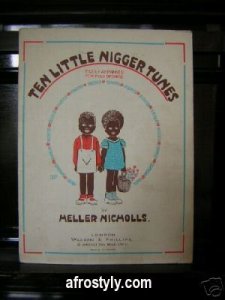
Once the three bold Golliwogs, Golly, Woggie, and Nigger, decided to go for a walk to Bumble-Bee Common. Golly wasn’t quite ready so Woggie and Nigger said they would start off without him, and Golly would catch them up as soon as he could. So off went Woggie and Nigger, arm-in-arm, singing merrily their favourite song – which, as you may guess, was Ten Little Nigger Boys.

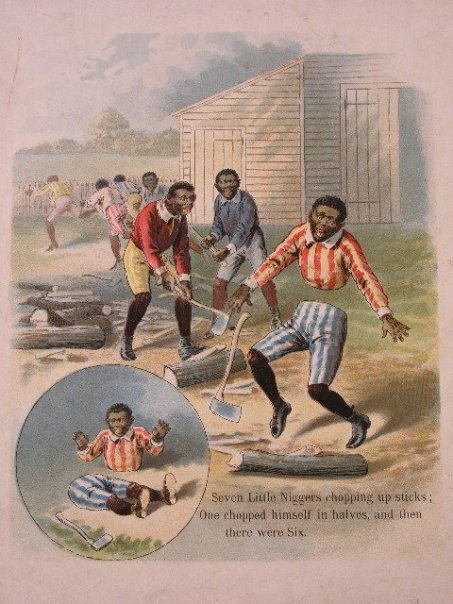
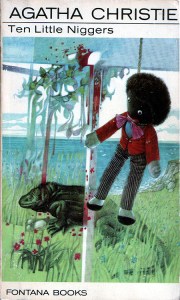
Ten Little Niggers is the name of a children’s poem, sometimes set to music, which celebrates the deaths of ten Black children, one-by-one. The Three Golliwogs was reprinted as recently as 1968, and it still contained the above passage. Ten Little Niggers was also the name of a 1939 Agatha Christie novel, whose cover showed a Golliwog lynched, hanging from a noose.


10_little_nigger_tunes1


7little-ns1


ac149tenlittleniggersf

By-Frickin’-Golly

golly

6a00cd97849482f9cc00cdf3ac32e4cb8f-500pi


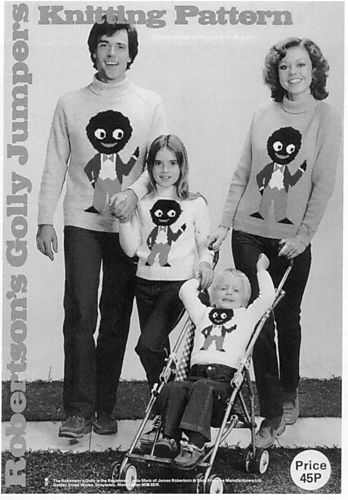
At first I was just going to post this photo as something I don’t like.  Why on earth are these white people wearing sambo on their sweaters?  Homemade sweaters at that!  Then I figured I should look into this.  Oh boy!  This is Golly.  You could buy this pattern today on ebay.  Golly began as golliwogg in Florence Kate Upton’s 1895 book “The Adventures of Two Dutch Dolls and a Golliwogg.” Upton, a native New Yorker, first describes him as “a horrid sight, the blackest gnome.”  He was a caricature of American black faced minstrels – in effect, the caricature of a caricature. The book became very popular in England and thirteen books featuring Golliwogg were published.  Then they began making rag dolls. During the first half of the twentieth century, the Golliwog doll was a favourite children’s soft toy in Europe. Only the Teddy Bear exceeded the Golliwog in popularity.

6jaj7fm

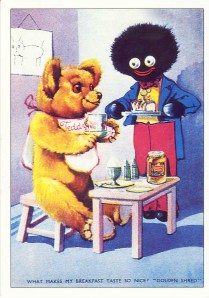
Small children slept with their black dolls. Many White Europeans still speak with nostalgic sentiment about their childhood gollies. Now onto Robertson’s. The Golliwog is inextricably linked with the famous English preserves company, James Robertson & Sons. Robertson’s Jams has been using the smiling Golliwog as its logo since the 1920s until it was discontinued in 2001. Despite much criticism during the 1960s and ’70s, they simply changed their logo’s name to ‘Golly’, and continued to stand by their trusty mascot. Consequently, the collecting of Robertson’s Golly memorabilia is a hobby in itself, with a vast array of promotional material and items to be collected.


http://www.golliwogg.co.uk/history.htm