recently on the interweb

I’ve come across some interesting stories, commentary, and subsequent comments all dealing with… Biracialness! Big shocker, right?  I love reading the comments.  So many different opinions, which simply reinforce my will to stay with my self and stand confident in my personal ideology.

The Seattle Times

Via

Rant and Rave Rant to the women on the bus who, when asked to quell their use of expletives around my young children, disparaged me for having a biracial family and insulted my daughters’ hair. Rave to the man who told them my request concerning their language was valid and that they had no reason to insult me and my family. Thank you, sir.

Answer.com

JUST ASK AND LET THE OTHER TO ANSWER IT FOR YOU

Via

Pregnancy & Parenting

How do I tell my mum I’m having a mixed race baby?

the baby is going to be half black but i don’t think my mum or my family would be too happy about it.. I want my family to accept the baby but what can do I to make them accept my unborn baby…

5 Responses to “How do I tell my mum im having a mixed race baby?”

blessed says:

all you can really do is explain to them as much as you can to get them to understand, but even at that it might not change their minds, but if it doesn’t then just say it’s my baby and no matter what it is going to be family and they’ll just have to get over it.

Charles J says:

You don’t. I would recommend getting an abortion. No one likes a half-breed.

VincentL says:

just tell them straight up…they probably be very mad at first but sooner or later they will adjust to i

Due 12.3.10 says:

just tell her its ur child..

R.I.P Michael Jackson says:

u don’t have to they will c it when u have it………….
Run, Racists, Run! Biracials Are Everywhere!

By Sam Watson

Via

Gone are the days where the majority of people will shout racist remarks at those of color on the streets. It still happens, but nowhere near as much as in the past. Racists are kind of afraid to spew their hatred in public, and I feel us biracials are to blame. We represent an abomination to racists. An old, white guy- a complete stranger- once saw my mom (white, Ukrainian) with my sister and I, when we were very young children, and he shouted, “Slut!” at her. We’re mixed – half white and half black. We represent an absolute breakdown of a racist’s hateful beliefs.

…Racists don’t know whether or not the “white” person next to them is either mixed or married to someone of a different race. Racists better up their paranoia levels, and warn the town sheriff in Bigotville.  During the World Cup, I turned to my seemingly white co-worker, and started ragging on the Mexican team. She instantly scowled at me in return. I forgot! She’s half white and half Mexican! Even I- a biracial- was fooled! We’re everywhere, now, and this is a racist’s worst nightmare.

Comments

-You are right. When it comes to black people, they now hate themselves much more. All of us are mixed up with something. We are one human race. Our race is different from that of the animals, not each other.
-A study I heard cited recently encouraged parents to discuss race and racism with their kids. Several families dropped out because they were so uncomfortable with this requirement of the study.

The study discovered that racism is not discussed at all in many progressive, liberal households. The idea is that if we’re all supposed to be colorblind, discussing race, or any difference for that matter, is taboo. Of course, that’s the best way to make it a dark, secretive thing- precisely the problem. People who desperately want their kids to be not just tolerant, but accepting, are practically guaranteeing their kids get no exposure to the subject by pretending it’s not there.

Racism and bigotry is a vampire- it can’t stand the light. If we want it to die out, we have to do the uncomfortable, inconvenient thing and talk about it even when it’s not a major in-your-face problem.

-I am half German (white) and Puerto Rican (brown) and I always baffle people. I think it’s interesting that we assume that racism is disappearing when I feel like it is only growing. In an all colorful nation I still feel like I need to watch what I say when I am naming a race ~ whether it’s politically “correct” or not because I never know who is going to be offended.

-You better believe we are everywhere. Though I know I’m not the only unique biracial person out there, I do admit that people are surprise when they hear that my mom is from Dominican Republic and my father is from Afghanistan. Talk about fusing two totally different cultures.

I also understand when you talk about racism being a private thing. My step mother is racist, even though she’s married to my father. It makes me mad when she makes stupid comments regaurding race. She also tries to inplant her ideas on my half brother. I try my best to counter these thoughts though… my diverse background has raised me to be open to new ideas, cultures, and people. The more people who are biracial, the more tolerance we have of one another.

-Racism is still alive but it’s a endangered species. I say this because the current generation doesn’t hold race as important as the previous ones. Most of my friends (I, myself included) have bi-racial children. At times I wonder when these kids grow up will that look at their peers and ask in shock “You’re not mixed?” I think it’s a great thing, however as parents we still need to pour our cultures into the children, letting them know they have and even more extended set of roots and the beauty contained within both.

-Racism is part of human nature. Embrace it!

-I’m old enough to have seen overt racism, as well as the more prevalent covert racism. Sometimes I feel that the only hope we have to eradicate racism is the gradual blending of all races into an “everyman.”

-I was recently showing off pictures of my friends in New York to some people here. They nodded politely at all of them, but paused at a picture of two my best friends.

“What race are they?” I was asked.

I couldn’t believe it mattered. A lot of my previous pictures had been of people who were black or Asian or of some non-white race, but these two mixed-race girls came into question?

“Er, she’s Romanian and Jamaican, and she’s Indian, Portuguese and Italian.”

“Oh, okay.” The guy replied. “I just couldn’t figure it out.”

Why should you have to?

profiled

Yes, I believe they were… Disturbing.

Teen With Asperger’s Arrested: Were Callers Racial Profiling?

by Ken Reibel

VIA

Reginald Latson loves to walk.

“He’ll walk five or 10 miles, it’s nothing to him. Sometimes he walks five miles just to grab a bite to eat at Chili’s,” says his mother, Lisa, who lives in Stafford, Virginia. “Walking is his release.”

Neli, as his family calls him, is 18 and has Asperger’s, a mild form of autism. Three Mondays ago, he rose early and left home without telling his mother. “When I entered his room at 6:30 am and didn’t see him, I assumed he had gone for another walk,” she says. It was a school day.

Four hours later Stafford County authorities had ordered a lock down for eight schools, and Neli was in police custody, facing one count of malicious wounding of a law enforcement officer, one count of assault and battery of a law enforcement officer, and one count of knowingly disarming a police officer in performance of his official duties. The cascade of missteps that led to the arrest suggest a combination of public racial profiling and the over reaction of law enforcement officers who are unfamiliar with autistic behavior.

* * *

After Neli left home early that morning he walked two miles to Porter Library on Parkway Blvd. “He goes there frequently. There’s a teen room there, and he enjoys it,” says Lisa. The library was closed, so he sat under a tree, in the grass, at the front of the building. The parking lot at Park Ridge Elementary, about 400 feet to the west, was filling up.

According to officials reports, someone at the school called police at about 8:38 am to report a suspicious person sitting outside the library, “possibly in possession of a gun.” A bulletin went out with Neli’s description, and officials, concerned that a gunman was on the loose, ordered a school lockdown and set up a search perimeter.

When police arrived at the library, Neli was gone. Unaware of the report, and impatient for the library to open, he began walking in the direction of the high school. A forested green belt of trees some 500 feet-wide with a well-worn path separates the school from nearby homes. At about 9 am, a “school resources officer” who is also a Stafford County Sheriff deputy approached Neli. That’s when accounts begin to diverge.

Lisa said her son complied with a search, which failed to find a weapon. Police say Neli “attacked and assaulted the deputy for no apparent reason.”

Neli told his mother that the school officer threatened him, and that Neli said “You’re harassing me. You’re not allowed to do that. I know my rights,” then turned and walked away. According to Neli, the officer grabbed him from behind and choked him. Police reports say a scuffle ensued, during which the officer pepper sprayed Neli. The police version, which you can read here, says Neli then took the spray from the officer and turned it on him.

According to Lisa, Neli said he took the spray and ran into the woods. The deputy, Thomas Calverley, reportedly suffered a cut to the head and a broken ankle, and underwent surgery.

By this time sheriff deputies were combing the area with search dogs, and at least one TV news crew offered a breathless live report of the manhunt. Neli somehow eluded the dragnet for another 45 minutes before being spotted and arrested in the high school parking lot, shortly before 10 am.

No gun was found “and subsequent investigation has indicated that that a gun was not actually seen by the reporting parties,” according to the official report.

Lisa learned of the arrest at 10:30 am, when she called the police to report that her son was missing. “I was told that he was in custody and was currently being questioned but I was not told why,” she said. “They wouldn’t tell me anything, and wouldn’t allow me to visit him. I told the police that Neli has autism, but they didn’t seem to care.”

For the next 11 days, Neli was held without bail, and in isolation at the Rappahannock Regional Jail. Police allowed Neli’s school counselor to visit, and she relayed messages and information to Lisa, who was allowed only one visit. “He wasn’t able to speak or communicate with me. He appeared to be in a catatonic state,” Lisa says.

She is understandably frustrated and angry.

“The actions that were taken by the police that day were excessive in the least and grossly mishandled,” she wrote on a website started to counter inaccurate local media reports. “Someone says ‘I see a suspicious black male’ and he ‘could’ have a gun, while all my son was doing was sitting in the grass at the library. And you shut down six schools and go out on a manhunt for this dangerous black man who was sitting in the grass. Anyone can read between the lines and see that this just doesn’t add up.”

2010-06-13-Neli61310.jpg

Neli is from a military family, and during his 18 years has lived in Florida, Germany, Oklahoma and Georgia. Seven years ago his family moved to Stafford, a sprawling bedroom community about an hour south of Washington, DC. The family struggled to find appropriate school placement, finally settling on a private school. “The public high school was crowded, with about 30 kids to a class. Neli wasn’t getting the attention he needed, and his self esteem was slipping.” But he had never been in serious trouble. Never like this.

Lisa heeded the warning signs. A month earlier, she asked Neli how he would feel about wearing a medical alert bracelet that identified him as a person with Asperger’s. “He said that he didn’t have a problem with that, but I didn’t follow up. I’m just kicking myself for that,” she said.

Lisa, who works as a defense contractor, had also asked for a two month leave of absence to spend more time with Neli. That Monday was her first day off work. Her husband, Neli’s stepfather, retired from the Army and is currently stationed in Iraq as a military contractor.

* * *

As Neli’s time in isolation dragged on, police interrogators found him non-responsive and disturbed, and a judge ordered the young man transferred to a state mental institution for 30-days of treatment and evaluation. If the case is not resolved by then, he will end up back in jail.

The hospital is a two-and-a-half hour trip from Stafford, which Lisa says she has made four times. Horrified, she watched her son’s mental state worsen with each visit. “He is locked away and doesn’t understand why,” says Lisa. “He’s been through an ordeal.”

That ordeal has also changed Lisa, and the way she thinks about race, the police, and her community. She suspects Neli’s arrest was in part racially motivated, but it is not a charge she makes lightly.

“I used to donate money to the police benevolent society. I never imagined something like this could happen,” she says.

“I don’t think in terms of ‘watch out for those kinds of people’ or ‘you need to be scared,'” she says. “I grew up in south Florida. That’s a melting pot of cultures. I know there are good people and bad of every race.” Her life in the military, she says, has brought her friends “of every racial background.”

Has the ordeal changed her views on race and racism?

“It has,” she said, her voice trailing off. “It most definitely has.”

* * *
Cross posted at AutismNewsBeat.com

another social taboo

The first taboo being openly discussing biraciality without adhering to the one-drop rule.  Of course I find this blog post to be interesting, or I wouldn’t put it up here.  I appreciate the bit about biracial identity as well as the outline of the overall struggle and the shame that go along with the labels of mental illness in this country.  Especially in the black community.

Coming out of an entirely different closet… the one of mental illness

by Eliza Barnett

VIA

Unfortunately as prevalent as mental health disorders are the nation (50+ million diagnosed in the US alone) and world wide, it still tops the ranks as the most difficult to admit.

Higher than revealing to be a victim of domestic abuse, sexual assault, or molestation, harder than confessing a drinking problem or previous bankruptcy; surveys have even shown it to more difficult than admitting ones gender identity or homosexuality. Sufferers face significant social taboos. And it doesn’t affect just one type of person. Mental illness knows nothing of age, race, gender, or economic background.

You don’t have to personally admit it yourself to believe the notion the reality that people are more likely to break off, or not even start, a relationship with someone with mental issues -which I for one find particularly interesting because members of society are more likely to stay with someone with a physical disability. People with mental disorders tend to prefer to hide their illness like major depression and anxiety, because unlike people with physical illnesses, people with mental disorders must also fear being rejected by family & friends, harassed, fired or not hired, or denied child custody—just for starters.

(Please check out this personal blog discussing the Price of being Bipolar in Public)

Last week I had an entire conversation with a friend about them being practically afraid to admit their Christian faith at their workplace because of the negative assumptions his non-same faith based peers might think about his character or behavior.

Once you know someone’s religious preference it changes your whole personality to people who don’t agree with you. Sometimes it’s like every negative image or thought they have about it becomes who I am as a person- even though I haven’t changed. It’s their behavior towards me that has.

I’ve read more than a few articles of a biracial person attempting, or enjoying the ability to pass for one race over another—not because they have a problem with it necessarily themselves, but because other people do.

Sometimes it’s like every negative stereotype or prejudice they have against a race I share membership of encompasses who I am as a person. Granted racism is an ongoing issue for those of one race, but it is just as prevalent towards those of plural heritage.

Sexual orientation discrimination —don’t even get me started.

(great message board discussion here coming coming out as gay with coming out as bipolar)

Mental illness sufferers are also victims of discrimination and the issue continually needs to be recognized.

“I’m Asian, I’m gay, and I have faced discrimination – but not for the reasons most people think; it was actually when I got depression that I faced most discrimination.”

(Quote from an article in the Guardian)

Attempts to end this discrimination are being lead by strong individuals, in the public eye, and by everyday people. Changed perception comes through increased knowledge and visibility.

People need to be taught that mental disorders don’t come from places of personal weakness, and don’t make everyone violent or unpredictable. They need to be made comfortable in seeking help. (Two thirds of sufferers in need of treatment do not seek it. ) Even more importantly open, honest visibility helps others with the illnesses themselves to stand up without shame.

Negative stigma’s of this variety aren’t just external, they’re internal. Who wants to think of themselves as crazy…? When feelings of guilt, shame, or a notion that you’re somehow weakened for needing help are thrown in the mix, it only reinforces the negative feelings.

Isn’t it always the case that telling the ones you love is the hardest thing to do? This isn’t any different. And ignorance towards the idea of mental disorders can to be hard to deal with; some people may not even believe mental illnesses exist. Americans particularly have vast misconception that all mental disorders can be simply be self-corrected with enough work.

Similar to the first step in admitting you have an addiction; your own acceptance is where it all begins. Examine your own feeling first and foremost. You have control over who you tell, so it’s okay to be cautious about it.

“There is no rule for who needs to know about your mental illness diagnosis, but sharing it with someone is a great way to get support.

The silence helps maintain the ignorance about mental illness.”

(http://www.webmd.com/mental-health/features/coming-out-about-mental-illness?page=2)

That being said,

“It doesn’t mean that it is always beneficial to open up indiscriminately about mental health, to your detriment. It would be wonderful if everybody came out.

But it is a very subjective decision and consequences should be considered. Society isn’t at the place of acceptance that it needs to be. Not everyone in the world needs to know if you struggle with diabetes or hypertension or some other illness. The same is true for mental illness. Those with the disorder, are the ones in charge, and should think about what the payoff is to share information about their mental health. For example, if you need to miss work to see a psychiatrist, you might want to tell your employer about what you are going through.”

When someone does react negatively, agree to disagree or try to educate that person. Share educational materials. Share your own experience. And to those on the receiving end of the information, think before you speak.

“Try to react the same way you would if you were told about a physical health problem that you don’t know much about. Avoid trying to be the hero or savior. Being empathic and understanding is one thing, but trying rescue someone is a completely different. You shouldn’t try to fix them. This is something that is way beyond your capacity.”

Treatment and support from others goes a long way; the mental illness journey is a rough one for everyone involved. Help is required, it’s critical down the path of recovery, management of ones condition, and ability to lead constructive and healthy lives. Support can and does come from strangers as well, who share in this unity of diagnosis. As corny as it sounds, sharing is caring.

–Posted By Eliza Barnett

unhappy father’s day

Not much to say about this one, other than it’s a crying shame!  And 12 is way too young to be dating. Thank you.

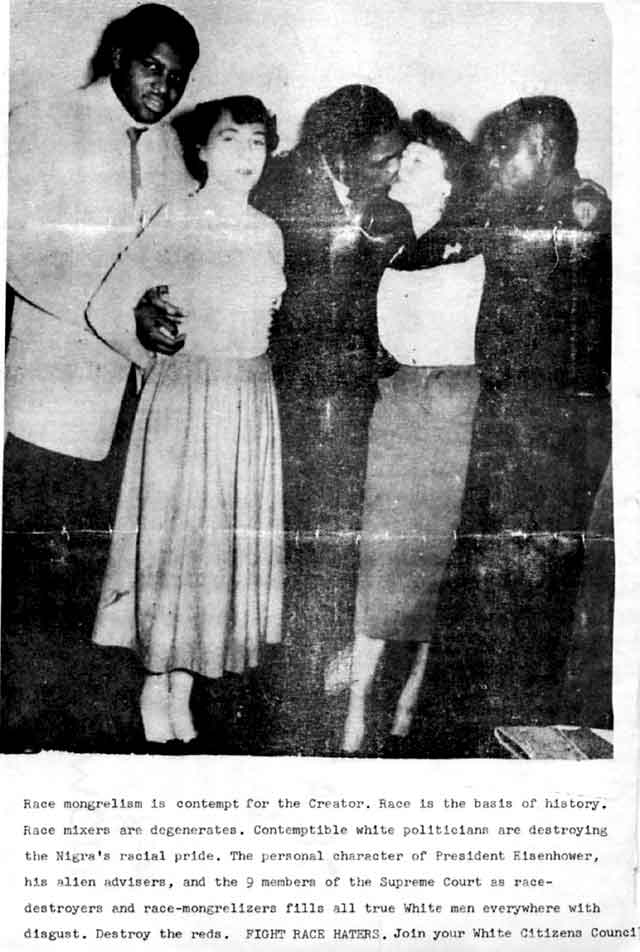
Ex Forbids Interracial Dating

Toddler and Teenager Expert Advice from Carleton Kendrick, Ed.M., LCSW

VIA

Question: My 12-year-old daughter is very mature emotionally and has very fine-tuned common sense. She and I are close and talk about most issues openly, but recently she brought up an issue that I am not sure how to handle.

We are white, but my daughter has an attraction for the black males in her school. She and her father (my ex-husband) are extremely close, but he is very much against her dating black boys.

My ex has threatened to do one of two things if she should want to date a black male: take me to court and assume custody of her, or exclude her from his life forever. I feel stuck! I can’t side with her dad at all because I feel if she is treated respectfully in a relationship, the color of the boy’s skin doesn’t bother me. I also can’t allow my child to lie to her father about what she is doing with her life and during her time with me. What do I do?

Answer: I commend you for wanting to take the high road in this dilemma and to honor all family members involved with honesty. Your ex is hurt, scared, and angry that his daughter would be attracted to and/or wants to date black boys. His heightened fears and considerable prejudice against the black race have made him become a desperate man.

I doubt there is any court that would grant him custody of your daughter simply because you allowed her to socialize with or date black boys. It would take something rather grievous and destructive in your parenting to have a court consider remanding sole custody to your ex. You cannot prevent him, however, from punishing her by eliminating all contact with her. He does have the power to harm her in that way if he chooses.

Going along with and enforcing your ex’s demands, which are based upon racial prejudice (and possibly racial hatred), would be a horrible lesson in morality and ethics for your daughter. He may also harbor similar prejudices toward other racial, ethnic, or religious groups and threaten the same things if she wants to date any boys in these groups that he does not like or respect.

I would suggest that you, your ex, and your daughter attempt to air this dilemma in the presence of a skilled, family-oriented therapist. My guess is that your ex will not agree to participate in this process and will cling to his ultimatum. In any event, I would recommend that you and your daughter see a therapist together.

I do believe that your 12-year-old daughter is too young to be dating boys, regardless of how emotionally mature you believe she is “for her age.” I would also explore with her why she is drawn to the black boys in her school more than any other group of boys. You seem to have a close enough relationship where you could ask such a question in an open-ended manner. The answers may be very simple or may involve some things that she has not articulated yet. Again, I encourage you to continue to deal with this issue in a forthright and open way, always with the intention of bringing about understanding and harmony, if at all possible.

oblivious to racial overtones

I am pained by this story.  I remember being this little girl.  I remember being singled out at times, usually not having anything to do with my hair unless it was mandatory school-wide lice check day.  No one wanted to deal with me then.  And that was fine with me.  But it wasn’t really.  I can only imagine the consequences this incident will have for this little girl.  Her parents really have their work cut out for them now.  I hope they sue and win big!  The damage is done.  Let’s hope it can be undone.  Oh, and I’d like to send the Mudede family a copy of Teri LaFlesh’s Curly Like Me.  All you need is conditioner people.  All you need is conditioner…

Biracial Girl Removed From Classroom Because Of Her Hair

by Amelia Thomson-DeVeaux

VIA

This story is an example of the sad fact that within schools, sensitivity training can only go so far – sometimes, there are unpredictable situations where teachers just have to intuitively react, and often they’re not prepared to do so.  And often, these issues are much larger than they appear on the surface.  Such is the case with the 8-year-old biracial student who was removed from her advanced-placement class because the teacher claimed that she was allergic to the girl’s hair moisturizer.  The teacher first put the girl in the hallway, and then moved her to a different classroom where she found herself in a lower-level class with predominately African-American students.

This behavior seems bizarre enough – but add the fact that the girl was the only student of color  in her school’s accelerated program, and the concerns of her angry parents, who may now sue the school (the NAACP, along with the Department of Education, have already filed a complaint), seem justified.  The girl’s father, Charles Mudede, is black, and says that he had talked to his daughter about resisting pressures to straighten her hair so that she would look more like her white classmates.  The product that so irritated the teacher was a compromise, Mudede said, “something light that kept her hair in its natural state.”

The girl’s parents have a host of questions to which there seem to be no adequate answers: “Why did the teacher think the problem was his daughter’s hair? Why hadn’t the school called the parents? What investigation was being done to pinpoint the source of the problem? And, finally, why did the school seem oblivious to the racial overtones of a white teacher singling out her only black student?”

Mudede says that the situation escalated because no one at the school seemed prepared to answer these basic questions.  He wrote on his blog,

“When we, her parents, were later informed of this incident, we also learned that once my daughter was removed from the class, the teacher felt much better. We were also told that the teacher had experienced something like a fainting spell because of our daughter’s hair. Feeling the seriousness of this situation, we decided not to send our daughter to school until the teacher had medical proof that our daughter’s hair or something in her hair was to blame for the nausea. (The last thing you want to happen to your daughter is for a teacher to faint or vomit at the mere sight of her.)

Days passed and the school took no action. This unresponsiveness left us with no other choice than to turn to a lawyer. The whole thing is a mess. Getting entangled in a racial dilemma is something most black parents do not want for their children. It’s just not worth the trouble. Then again, like I said, if not checked and confronted, the incident will have permanent consequences for my child.”

And although the school is now making limited comments because of the threat of a lawsuit, it definitely seems as though this situation was horrifically mismanaged; without communicating privately with the student and involving the parents, of course this would turn into a humiliating ordeal for a little girl who clearly was already suffering from self-esteem issues.  If the teacher had allergies, that’s something that she couldn’t help.  But to target the student in such a dismissive embarrassing way shows a level of insensitivity that no teacher should have.

brown babies

I’ve been meaning to post more about these AfroGerman children since blogging about  the holocaust memorial last month.  This post is mostly a reblog from MochaJuden.com.  As someone who has a hard time embracing my German heritage (none of which is “afro”), I find myself fascinated by this piece of our history.  I would love to track down some of these “brown babies” and interview them about their experiences in Germany and in the U.S.  The Black German Cultural Society website is definitely worth checking out.  So many resources, so much information.  I have a feeling I’ll be touching on this topic again…. and again.

Germany’s Brown Babies

Many of our constituents are children who were born to German mothers who were abandoned by African American soldiers during the U. S. Occupation following World War II. While some remained in Germany, many were raised in orphanages or with foster families; a few remained with their natural mothers. Many were offered for International Adoption to African American Families and accepted into the US under the Displaced Persons Act of 1948 (amended June 16, 1950) , where it was assumed that they would “more easily assimilate into the culture.”

This result is a generation of culturally displaced persons who remain disconnected and alienated from the mainstream of the societies in which they lived and from both ethnic communities to which they belong.

Adoption is a wonderful concept and is generally accepted as an ideal social mechanism for improving lives and circumstances for abandoned or orphaned children. However, recent psychological and sociological research has determined that these children often suffer significant lifelong emotional and social problems such as identity deficits, separation and attachment disorders, and chronic depression, as well as other problems as a result of separation trauma and what has been identified as “the primal wound.”

The issue is magnified and the outlook becomes ever more complicated when we explore the international adoption and abandonment of interracial children who were created by opposing forces following a major global war. For the most part, there was no professional follow up in terms of the physical, social and emotional well being of these children once they were placed.

Historians in the last decade have begun to study and write publications about the Brown Baby Plan and the cooperative attempt between the two governments to place and provide for these unwanted and displaced children. Autobiographical Interviews and publications have given voice to the trauma and lifelong suffering stemming from the dramatic loss of identity and heritage and the cultural alienation that these children faced, particularly while growing up both in post war Germany and in the US during the Civil Rights era, a period when intense racism and discrimination was under scrutiny and identified as a major problem in both societies.

“We struggled through childhoods filled with confusion, fear, anger, and feelings of inferior self-esteem. Navigated adolescence in extreme conformity to perceived structures of authority, in order to redeem our existence, or in defiance to them in utter rebellion. Adulthood was either accomplished successfully by integrating the powerful nuances of our diversified selves, or postponed until safety could be found in the distanced wisdom of experience. Some of us didn’t make it. Some of us are just now coming of age.” ~ Rebecca, Black German Cultural Society.

American Homes For Germany’s Brown Babies Are Scarce – Jet Mag, May 15, 1952

Tan Tots Attend German Schools – Jet Magazine, July 24, 1952

Brotherly Love – Jet Magazine, December 18, 1952

2607979643_5a07458832_o

German Brown Babies Arrive in US – Jet Magazine, January 29, 1953

Brown Babies Become Americanized – Jet Magazine, May 21, 1953

Brown Babies Find New Homes In America – Jet Mag, Oct 8, 1953

all photos found atVieilles_annonces of Flickr

people don’t know how to treat you

This article is from 2005.  I wonder if the family has noticed a shift in attitudes over the last five years.  And of course I’d love to hear from little Toni.  The bridge between them.  I like that part a lot.

HOW DARE THEY TREAT US LIKE THIS?

by DIANA APPLEYARD

JAN LLOYD, 45, has been married to Tony, 48, for ten years. The couple have a four-year-old daughter, Toni. They run a successful martial arts business, Fighting Fit, with gyms around South London, where they live.

photo by Jenny Goodall

Jan says:

PEOPLE have spat at me in the street, stared at me, jostled me and shouted at me — all because I fell in love with a black man. But unless you have experienced it, you are unlikely to have any idea of the racism in British society.

It’s terrifying, but it’s something I am aware of every day of my life. We were taking our daughter Toni to see the GP when she was only two years old, when I was spat at in the street. It was completely random — a white man in his 40s looked us up and down and then spat at me.

It was so disgusting — I couldn’t believe it was happening. I looked for support, but everyone looked away. They were embarrassed and probably disgusted too, but no one wanted to get involved. I was shaking and tearful, but angry as well — how could someone behave like that in a civilised society?

As I walk down the street, go to the pictures, eat out in restaurants or go to the theatre, I am frequently aware of a kind of coldness and embarrassment around me. The only way I can describe it is that it’s like being disabled — people don’t know how to treat you.

They don’t know what to say to me. You can see the thought running through people’s minds: ‘Why is she with a black man?’
When I got together with Tony, a lot of my friends melted away. They’d invite me to a party with my new boyfriend, but then, mysteriously, they’d never invite us again. Once, early in our relationship, I’d booked a table at a nice restaurant. When we arrived, there were lots of empty tables — but they put us at the back, next to the toilets. I was going to complain, but Tony told me just to leave it. He’s used to it. Our backgrounds could not be more different. I was brought up in a well-off family in Sussex and was privately educated. I met Tony when I took up aerobics and he was my instructor.  I thought he was nice, but our relationship didn’t progress until I was in a horrid road-rage incident, when a man hit my car and then bashed on my window. It made me realise I ought to learn self-defence and Tony also taught martial arts. Before I fell for him, I’d been out with City types, public-school educated white men, so Tony was a real change. I thought he was intelligent and interesting — I was fascinated by the fact that his life was so different from mine.

He was born in Yorkshire, but his family moved to London when he was three. He had traditional values and an old-fashioned approach to relationships. There was also a lovely warmth about him. He was successful and welloff through his business and he was a real self-made man.

We started going out and six months later I met his family. He’s one of six and it was so different from my middle-class home — they were so loud, so welcoming, pressing food on me and firing questions at me.

Tony told me he’d been badly beaten up as a child by racist bullies and that nearly every day he faced some kind of prejudice or abuse — it hurt him so much.

But it wasn’t long before I started to experience the kind of hostility he’d faced most of his life. Suddenly, being with him, I was made to feel like a freak, a secondclass citizen. It was bizarre. There was so much disapproval in people’s glances. There seems to be this attitude like ‘Aren’t white men good enough?’ when all I had done was fall in love.

We had been together only six months when we decided to get married and it came as a shock to my parents, who asked me if I was sure it was going to work given our cultural backgrounds. But they have since mellowed and little Toni is the bridge between us.

My parents are very traditional, and all they could see were problems in a mixed marriage.

We married on a beach in St Lucia. Both sets of parents came and it made such a difference being there — we were surrounded by welcoming black people, and my parents felt less uneasy.  Now they are very supportive of Tony and can see what a good man he is. Before, they — like so many others — had only seen the stereotypes.

After our wedding I joined Tony in his business, and Fighting Fit is now very successful. We live in a lovely four-bedroom house, we enjoy great holidays, scuba dive, ride horses and have a happy, middle-class life. Now when I get the looks, I ignore them and carry on. They can’t harm our life or family.

I did worry a little about our daughter and whether she’d face any prejudice at school being mixed race, but she’s totally accepted — she’s just Toni, with a big personality for a little girl, so sunny and confident. Everyone loves her.

SOURCE

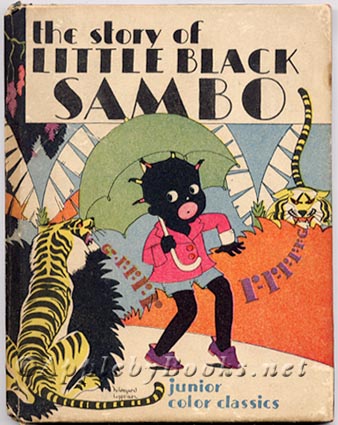
re: little. black. sambo.

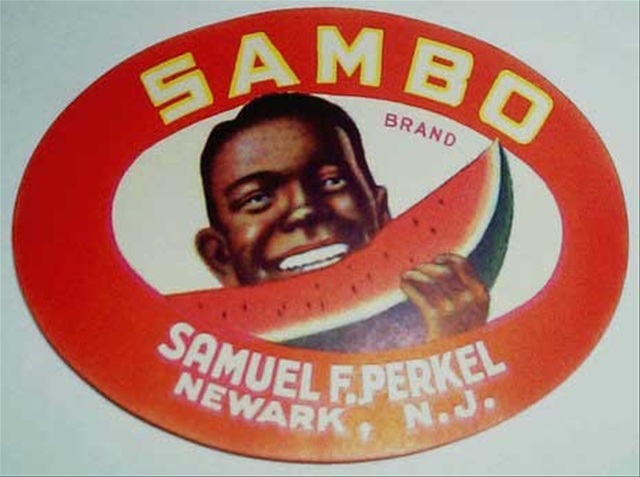
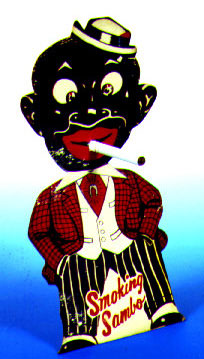
I just wanted to post a bit more about the history of Little Black Sambo.  I think the most important aspect of this history is the way the character/story has made people feel about themselves.  White privilege protects a majority of people from the hurts that can be evoked by “harmless” depictions in story books and advertisements.  The price for that protection can come in the form indifferent ignorance.

  • “The cultural understanding of ‘Little Black Sambo’ is a negative,” says Professor Frank Gilliam of UCLA. “It’s meant to suggest that people of African descent are childlike, that they’re irresponsible, that they’re not fully developed human beings.”
  • Langston Hughes pointed out that Little Black Sambo was “amusing undoubtedly to the white child, but like an unkind word to one who has known too many hurts to enjoy the additional pain of being laughed at.”

The following is excerpted from an essay found at the Jim Crow Museum of Racist Memorabilia:

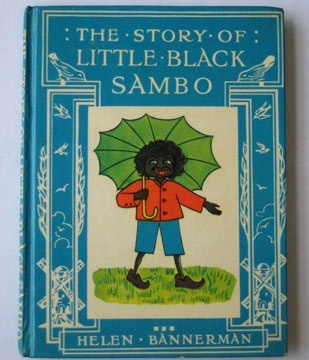
Arguably, the most controversial picaninny image is the one created by Helen Bannerman…The book appeared in England in 1899 and was an immediate success. The next year it was published in the United States by Frederick A. Stokes, a mainstream publisher. It was even more successful than it had been in England. The book’s success led to many imitators — and controversies.

Was Bannerman’s Little Black Sambo racist? The major characters: Little Black Sambo, his mother (Black Mumbo) and his father (Black Jumbo) used standard English, not the bastardized English then associated with Blacks. Stereotypical anti-Black traits — for example, laziness, stupidity, and immorality — were absent from the book. Little Black Sambo, the character, was bright and resourceful unlike most portrayals of Black children. Nevertheless, the book does have anti-Black overtones, most notably the illustrations. Sambo is crudely drawn, an obvious caricature… The names Mumbo and Jumbo also make the characters seem nonsensical at a time when Blacks were routinely thought to be inherently dumb.

The illustrations were racially offensive, and so was the name Sambo. At the time that the book was originally published Sambo was an established anti-Black epithet, a generic degrading reference. It symbolized the lazy, grinning, docile, childlike, good-for-little servant. Maybe Bannerman was unfamiliar with Sambo’s American meaning. For many African Americans Little Black Sambo was an entertaining story ruined by racist pictures and racist names. Julius Lester, who has recently co-authored Sam and the Tigers, an updated Afrocentric version of Little Black Sambo, wrote:

When I read Little Black Sambo as a child, I had no choice but to identify with him because I am black and so was he. Even as I sit here and write the feelings of shame, embarrassment and hurt come back. And there was a bit of confusion because I liked the story and I especially liked all those pancakes, but the illustrations exaggerated the racial features society had made it clear to me represented my racial inferiority — the black, black skin, the eyes shining white, the red protruding lips. I did not feel good about myself as a black child looking at those pictures.

Little Black Sambo served as the boiler plate for a spate of other versions, many of which used mean-spirited racist drawings and dialogue. The vulgar reprint versions were symbolic of Black-White relations. Little Black Sambo’s popularity coincided with the crystallization of Jim Crow laws and etiquette. Blacks were denied basic human and civil rights, discriminated against in the labor market, barred from many public schools and libraries, harassed at voting booths, subjected to physical violence, and generally treated as second class citizens. The year that Little Black Sambo came to America a Whites-initiated race riot occurred in New Orleans. It was effectively a pogrom — Blacks were beaten, their schools and homes destroyed. Little Black Sambo did not, of course, cause riots, but it entered America during a period of strained and harsh race relations. It was, simply, another insult in the daily lives of African Americans.

The anti-Little Black Sambo movement started in the 1930s and continued into the 1970s. Black educators and civil rights leaders organized numerous campaigns to get the book banned from public libraries, especially in elementary schools. In the 1940s and 1950s the book was dropped from many lists of “Recommended Books.” By the 1960s the book was seen as a remnant of a racist past.

Little Black Sambo was again popular by the mid-1990s. Its recent popularity is a result of many factors, including a white backlash against perceived political correctness. This is evident in internet discussions. Americans, Black and White, are rereading the original book (and some of the unauthorized reprints). There is agreement that Bannerman’s book is entertaining. However, there is little agreement regarding whether it is racist. White readers tend to focus on Bannerman’s non-racist intentions and the unfairness of judging yesterday’s “classics” by today’s standards of racial equality. Blacks find the book’s title and the illustrations offensive. Most of the debate centers on Bannerman’s version; there is no debating the racism explicit in later editions of the book produced by other writers and publishers.

© Dr. David Pilgrim, Professor of Sociology
Ferris State University
Oct., 2000

SOURCE

empower women, eliminate racism

March 24, 1912 – April 20, 2010

Thank you, Dr. Dorothy Height!

Here’s an excerpt of a 2008 NPR interview with Dr. Height.  You can read the transcript in its entirety HERE.

Civil Rights Elder Sees Dream Come True

hosted by Michel Martin

MARTIN:  Dr. Dorothy Height began a lifetime of activism during the Great Depression, a time when the simple right to vote free of the fear of violence seemed like an impossible dream for many African-Americans. And at the of 96, she is still going to the office just about every day trying to further the cause of equal rights for all Americans. She’s serving as chair and president emerita of the National Council of Negro Women. She was kind enough to receive us at her office on historic Pennsylvania Avenue yesterday. We’re talking about President-elect Barack Obama’s historic win.

MARTIN: I wanted to ask you about that because you have been working in this field since you were a very young woman. I mean, really, your entire adult life. Since your early 20s you’ve been an activist. Did you believe this day would come in your lifetime?

…Dr. HEIGHT: Well, you know, I guess I got to – my faith was renewed working for 33 years with the YWCA of the United States. And I went there as a secretary or a staffer or something related to interracial education. After 33 years, I retired as a director of the Center for Racial Justice, and I split this organization, that from 1946 really set out to open its services to all women, regardless of race or with full regard for race, and so I saw the way an organization that was founded by white, Protestant women that now is very inclusive, and I was a part of that development.

When the YWCA in 1946 adopted an interracial charter, that was ahead of the Supreme Court’s decision on Brown versus the Board of Education, so that in a sense I had already the experience. And I listened to people when they kept saying – well, some people, particularly white people, will say this but they won’t go in. I also know that I worked with many white women who took a strong stand but they didn’t discuss it at home because their husbands didn’t agree with them, but they worked hard to see that the YWCA was integrated, as they called it. And today, the YWCA has Empower Women and Eliminate Racism as its slogan. And I think that made me know that there are many people who know that this is right to do and that they were willing to do it, but they didn’t necessarily announce it.

MARTIN: I remember that, reading in your memoir how your organization, the YWCA, was one of the first – and some precursor organizations were among the first to have integrated meetings, and how dangerous it was for some of these women to participate.

Dr. HEIGHT: At that time there were – when we had meetings, sometimes we were talking about the klan. Sometimes we found that we were denied services that we had been promised when they realized fully what it meant that we would be women of different races. But you know, I found that were strong women in all racial groups, and I think that’s what Barack Obama has shown us. There are people in every group who know what is right and who want to move, and they just need some kind of direction and some kind of feeling that other people are with them. I remember Dr. Mayo(ph) saying, I hear people say the time isn’t right. And he said, but if it isn’t right then it’s your job to ripen the time, and that’s the way I feel about it.

12 Nov 1960, New York, New York, USA — Eleanor Roosevelt is presented the Mary McLeod Bethune Human Rights Award by Dorothy Height, President of the National Council of Negro Women. — Image by © Bettmann/CORBIS

…MARTIN: What role do you think civil rights organizations have now?

Dr. HEIGHT: Well, there’s still a lot of unfinished business. Right now you have going across the country a whole effort to destroy affirmative action. In other words, we’re finding that people are using civil rights in a negative way, and they’re calling it, this is a civil right. In a sense, these bills that are being introduced are really anti-civil rights, and they just use the term civil right in order to fool people and make them vote.

MARTIN: Are you speaking about Ward Connerly and some of his efforts to reverse affirmative action…

Dr. HEIGHT: Yes, Connerly has gone into several states, and he has does this in a misleading way, and I think people ought to be alert to it and realize that if you vote for what he is talking about, you’re cutting back something that got started during the days of Lyndon Johnson and was a part of the whole civil rights effort. It is not a preference. It is a way of saying, those who have been denied should be given an opportunity to be sought in (ph) so they can move ahead.

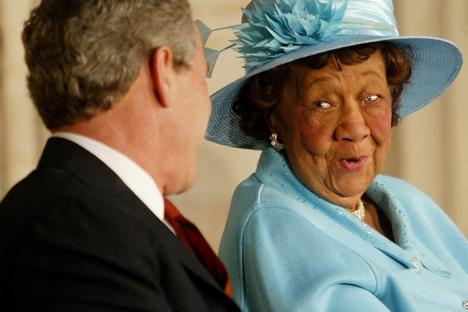
In 2004 President Bush presented Dr. Dorothy Height with the Congressional Gold Medal of Honor.

MARTIN: There are those who would argue, though, that – to be blunt about it – that Barack Obama takes these so-called excuses off the table. People look at that, and they say, look at Barack Obama in the White House. And they say, what discrimination? What could they possibly – what barriers?

Dr. HEIGHT: Yes. I think they will, but I would hope that they would also say to themselves, we need to look at who has the opportunities. We need to look at – Obama himself pointed that to us, that you can’t have a flourishing Wall Street and a destroyed Main Street. He could have also said, I’m working for the middle class, but we still have poverty. And we cannot divide up like that. We cannot say who’s hurting the most. We have to make sure they be dealing with everyone.

I have been working since my teenage days when I did an oration and won my college scholarship on the Constitution of the United States. I chose the 13th, 14th and 15th Amendments. And I looked and realized, here, now, at this age, I’m still working to make the 14th amendment and its promise of equal justice under law, making it real for everybody. That’s what you have to do.

MARTIN: Is there anything that you fear about an Obama presidency, about having an African-American – the first African-American in the White House?

Dr. HEIGHT: I suppose it’s not a real fear. It’s a hope that we will not take it for granted, that now we have achieved and all of our problems are answered. I think we will (unintelligible), as he did, as he said, I will be president of all the people. And by that he meant that he will work for all of us and that we all have to realize that there is unfinished business in civil rights.

It will – we don’t need the marches that we had in the past. But we need more consideration in looking at the boardroom tables and at the policies that are going on, looking at what’s happening in industry, what’s happening in terms of employment opportunities, housing and the like. So that I think it opens up a new way for us to look at our community.

And one thing, I go down now to Deep South and Mississippi and places, where during the ’60s, we moved with fear. I go down now and people are so welcoming that I forget what part of the country I’m in. And I think the people who are saying, we have no problem, have the biggest problem, that they really need to see how we can all work together and recognize that we need each other and see how we can really make this a society in which a person is judged, as Dr. Hayes(ph) said, on the basis of their character and what they do rather than on color of their skin or the language which they speak or their sexual preference, or any of those things.

MARTIN: Since you were a young woman yourself, you’ve been famous when you work with young people. Do you have any wisdom to share, perhaps, to a young Dorothy Height who might be listening to us?

Dr. HEIGHT: I like to say to young people today, you are the beneficiaries of what a lot of people worked and gave their lives for. And you are enjoying things – no matter how bad it may seen, you are still better off than any of those who worked to bring us to this point. And the important thing now is not to go it alone on your own, by yourself, but see how you will join with others. Get organized in how you will serve others and how you will help to move this forward.

And I was so excited to hear President-elect Obama, like they call him now, to hear him say that he needed our help. And I think he does. And we need it not by thinking just of what we want, but how can we help achieve the kind of roles that he has said. Because when you do that and we’re for something bigger than yourself, there’s no way you can help but grow, and that will help to prepare you for the future.