I love, love, love Angela Davis. Thank you Sable Verity for turning me on to this fantastic interview!
the historicity of political rhetoric
2

I love, love, love Angela Davis. Thank you Sable Verity for turning me on to this fantastic interview!
By Sally A. Downey
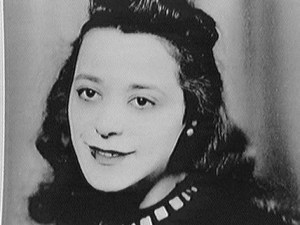
Gladys Kinard Hernblad, 79, of Northern Liberties, an educator, author, and advocate for interracial understanding, died of heart failure July 27 at Penn Hospice at Rittenhouse.
Mrs. Hernblad grew up in Saluda, S.C. Encouraged by her mother, Sadie, she walked six miles each way to high school, and after graduation moved to Philadelphia in search of better educational and employment opportunities.
She met Robert Hernblad at a gathering for young adults at a fellowship house in North Philadelphia. He was white, of Swedish and Irish descent. She was African American. They married in 1966, one year before the U.S. Supreme Court struck down bans on interracial marriage in all states.
In 1992, Mrs. Hernblad established the Interracial Families United Network. She told a reporter at the time that she and her husband had experienced discrimination in the early years of their marriage. “We had no support for our situation,” she said. The new network, she said, would support, “all interracial marriages – Asian, Hispanic, and African American.”
Mrs. Hernblad was a major supporter of President Obama, not only for his political views, but because his biracial background mirrored her family’s, which she considered a symbol of improving race relations in America.

By now it’s old news that Harvard Professor Henry Louis Gates, Jr. was arrested in his own home for… well… for being unexpectedly black in his own home I guess. This is an excerpt from an interview conducted by Gates’ daughter Elizabeth, which can be found in it’s entirety here. Reading this brought to mind my experience of being barred from a flight after calling a gate agent out on his seemingly racist motives for harrassing me about my carry on luggage.
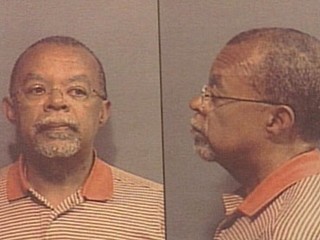
So you do think this was reduced to race? You do think this was purely racially motivated—that when he came into your home uninvited and didn’t read you your Miranda rights and he didn’t follow procedure?
No, when I was arrested I was not read my Miranda rights. I clearly was arrested as a vindictive act, an act of spite. I think Sgt. Crowley was angry that I didn’t follow his initial orders—his demand—his order—to step outside my house because I was protected as long as I was in the house because he didn’t have a warrant. I think what he really wanted to do was throw me down and put handcuffs on me because he was terrified that I could be dangerous to him and that I was causing violence in my own home—though obviously he didn’t know it was my home.
If I had been white this incident never would have happened. He would have asked at the door, “Excuse me, are you okay? Because there are two black men around here try’na rob you [laughter] and I think he also violated the rules by not giving his name and badge number, and I think he would have given that to one of my white colleagues or one of my white neighbors. So race definitely played a role. Whether he’s an individual racist? I don’t know—I don’t know him. But I think he stereotyped me.
And that’s what racial profiling is all about. I was cast by him in a narrative and he didn’t know how to get out of it, and then when I demanded—which I did—his name and badge number, I think he just got really angry. And he knew that he had to give me that, and his police report lies and says he gave it to me. If he had done that I would have simply taken it down and wrote a report! I was definitely going to file a report, now—just not as big as the one I’m about to file!
So since it’s clear this happens every day to minorities everywhere who don’t have representation, who like yourself previously believed in the justice system, what can we do as a community to make sure that our world starts to place value on all people of color—not only the exception, as you have been referred to so often during this ordeal?
I think its incumbent upon me to not let it drop—not to sweep it under the carpet—but to use this as a teaching event for the Cambridge police and police in general and for black people—don’t step out of your house. Don’t step onto that porch! You’re vulnerable. And second? To teach the police about the history of racism, what racism is. Sgt. Crowley found it outrageous that I was demanding his name? I mean, excuse me? Whose house was he in? Hello?
Yeah.
My house. I mean, he was there investigating? He should have gotten out of there and said, “I’m sorry, sir, good luck. Loved your PBS series—check with you later!” [laughter from both of us] If he would have given me his card I would have sent him a DVD! [more laughter]
But you’ve always taught my sister Maggie and me to stay on the right side of the law. Did this challenge your perception of what side that really is? Or are we always going to have to humble ourselves to this humiliating degree?
No. I believe in the law. I think we have a great system of justice. But I do think that system of justice has been corrupted by racism and classism. I think it’s difficult for “poor people”—poor white people, brown people—to be treated fairly before the law in the same way that upper-class people are. I mean listen, Liza. I was lucky. I could have been in there all night with as few as three other prisoners. What if I had been anonymous and in some other place? It’s scary, man. That’s why we have to fight through organizations such as the NAACP defense fund, on whose board I sit—we have to fight for equal rights for all people. It’s beyond race, it’s class and race! And that’s crucial.
There’s been so much talk about Black America moving into a “Post-Black Era.” What do you think it will take to actually achieve that? I mean, is it possible?
The only people who live in a post-black world are four people who live in a little white house on Pennsylvania Avenue. [laughter] The idea that America is post-racial or post-black because a man I admire, Barack Obama, is president of the United States, is a joke. And I hope no one will even wonder about this crazy fiction again. I am proud of the American people for electing the best candidate who happened to be a black man and that’s a great historical precedent in the United States, but America is just as classist and just as racist as it was the day before the election—and we all, to quote my friend Cornel West, “are recovering racists,” and we all have to fight those tendencies. In America there is institutional racism that we all inherit and participate in, like breathing the air in this room—and we have to become sensitive to it.

Arresting officer Sgt. Crowley who teaches a racial profiling class at the Police Academy in Lowell, Mass. Apparently it is not a “how to” course.
I never would have guessed Utah!

By Christopher Smart
The Salt Lake Tribune
http://www.sltrib.com/ci_12530272
Utah’s mixed-race population grew at the fastest rate in the nation from 2007 to 2008 — a trend some say could show Utahns are increasingly comfortable identifying themselves as multiracial.
“People are more willing to take a stand and say, ‘This is what I am,’ ” said Betty Sawyer, who works closely with students of various ethnic backgrounds and is president of Ogden’s NAACP.
New census data show multiracial Americans make up the nation’s fastest-growing demographic group. Between 2007 and 2008 the number of people identifying themselves as being of mixed race grew 3.4 percent; in Utah, the number jumped 5.9 percent.
But before 2000, the U.S. Census Bureau didn’t even provide a way for people to identify themselves as multiracial.
…Still, the new Census Bureau option doesn’t mean the country has moved beyond racism, said Darron Smith, an adjunct professor of sociology at Utah Valley University in Orem.
Smith, a black man who is married to a white woman, studies census trends.
In Utah Valley, people often make note of the black-and-white couple who have two girls, he explained.
“I always tell my kids they are biracial,” Smith said. “But the world will consider them black.”
While more people are identifying themselves as being of mixed race, those numbers don’t necessarily reflect a more racially progressive society, according to Smith. The percentage of biracial marriages and their mixed-race offspring is still very small — 3 to 5 percent.
“It’s a [statistical] outlier,” he said of interracial marriage. “It’s still not accepted.”
I just finished watching Glory for the 5th time. It might be my favorite movie. This movie was actually the catalyst for my whole “biracial” revelatory aha moment. While watching Glory for the 4th time, I realized that, seeing as this was the history of our country, it is a miracle that I (a black and white person) even exist. Truly. And then I realized that I didn’t really exist. There was no recognition of the miracle. Not even an internal, personal one. I realized that the history depicted in the film was the truth and that I had fallen victim to it’s legacy and failed to know myself fully.
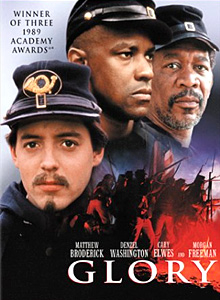
Watching the movie tonight, I was again blown away by Denzel Washington. “The tear” is one of the most memorable moments I have witnessed on screen. I also kept searching for the moment that might have triggered the big realization. My guess is the part where Matthew Broderick (as Robert Shaw) takes the 54th out with the other “negro regiment.” The other leader is an ass to say the least. He not only refers to the black soldiers as “little monkey children,” but he is extremely immoral in every sense of the word. He treats his soldiers like animals, they act like animals. Robert Shaw treats his soldiers with respect, like men. In turn they are respectful and respectable men.
The most poignant moment for me this viewing though was when Broderick and Denzel Washington’s character (whose name escapes me), were discussing the predicament that was life in America at that time. And arguably still is to a certain extent. Denzel says “It stinks real bad. And all of us are in it. Ain’t no one clean.” Broderick asks, “How do we get clean?” There wasn’t a definitive answer, but if I had to glean one from the film it’s that we become clean when we decide to die fighting for what we now know to be right, no matter how many wrongs we may have committed in the past.
Thank you Edward Zwick, for the movie Glory. I think it should be required viewing for every American.
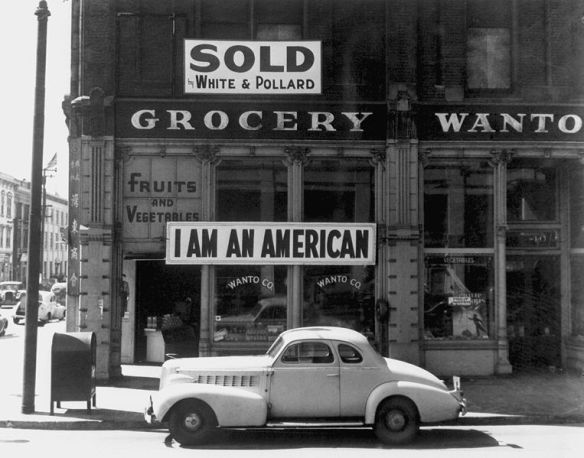
San Francisco, Calif., Mar. 1942.
A large sign reading “I am an American” placed in the window of a store, at 13th and Franklin streets, on December 8, the day after Pearl Harbor. The store was closed following orders to persons of Japanese descent to evacuate from certain West Coast areas. The owner, a University of California graduate, will be housed with hundreds of evacuees in War Relocation Authority centers for the duration of the war. Photo by Dorothea Lange.
http://community.livejournal.com/vintagephoto
On February 19, 1942, President Franklin D. Roosevelt signed Executive Order 9066 relocating 120,000 Japanese Americans from the West Coast into internment camps for the duration of the war. The personal rights, liberties, and freedoms of Japanese Americans were taken away from them by their own country. Since World War II, a Japanese American struggle continues to obtain reparation from the U.S. Government.
August 10, 1988 H.R. 442 is signed into law by President Ronald Reagan. It provides for individual payments of $20,000 to each surviving internee and a $1.25 billion education fund among other provisions.
October 9, 1990 The first nine redress payments are made at a Washington D.C. One hundred seven year-old Rev. Mamoru Eto of Los Angeles is the first to receive his check.
The Civil Liberties Act was an official apology made to Japanese Americans in 1988 by Congress.
I’ve never been one to make much of a case for reparations for African American slavery, but I can’t help feeling like if “they” got it “we” should too. It seems to me that this is further evidence of the dehumanization of black people. Black people don’t deserve reparations? They should be grateful to find themselves in America today instead of in the jungle? They were created to work and don’t need much in return? That’s what the implications of reparations for some, but not for those treated the worst while doing the most to make this country what it is- what it should be, but isn’t right now- today. It’s kind of like the one-drop rule in a way. Only applies to black people. Asians, Hispanics, Indians can mix with whites for a couple of generations and their legacy is then white. There is no one-drop to follow them around and accuse them of denying something or being ashamed or self-hating. Their blood is not tainted. Of course neither is mine, yet these implications remain.

I don’t know who Jay Smooth or Asher Roth are, but I really liked this video. A whole lot!
Here’s one of those Black Women stories. Maybe Canada’s not as not-racist as they say.
Viola Desmond didn’t set out to make history, but she did (1946)
Viola Desmond was a successful 32-year-old Halifax entrepreneur when her car broke down in New Glasgow, Nova Scotia. She decided to go to a movie at the Roseland Theatre while the car was being serviced. It was November 8, 1946, and she was about to make history. Desmond requested a ticket for the main floor of the theatre, paid for it, went in and sat down. Although it was not posted anywhere to see, the theatre’s policy was that persons of colour had to sit in the balcony. When ordered to move, Desmond replied that she couldn’t see from the balcony, that she had paid to sit on the main floor, and that she would stay there. The manager ran out of the theatre and got a policeman. Together, the two men carried Viola Desmond into the street, injuring her knee and hip in the process. She spent that night in the town jail. No one informed her of her rights, she was not allowed parole, and she was incarcerated in the same jail block as male prisoners. Determined to maintain her dignity, she sat bolt upright, wearing her white gloves, for the entire night. In the morning – without representation, without understanding that she could question the witnesses against her, without even having been told that she could have a lawyer – she was tried and found guilty: tax evasion. She had not paid the extra one cent tax on a ticket for a seat on the main floor of the theatre. She had paid for a less expensive seat in the balcony. That she had requested the floor seat, that she had no way to know that Blacks were restricted to the balcony, that she believed she had paid for the ticket on the first floor, that she offered to pay the difference, that she had been assaulted, injured, held then tried in irregular and perhaps illegal ways – it made no difference. The sentence: 30 days in jail or a fine of $20, plus $6 to the manager of the theatre – one of the two men who had carried her out so roughly. She paid. The doctor who treated her injuries recommended that Desmond get a lawyer. After discussing her arrest and trial with friends, she decided to challenge the verdict in the Supreme Court of Nova Scotia. In its decision, although one of the four judges, Justice Hall, referred in passing to the race issue, he agreed with the other three judges that no error in law had occurred in the original trial. The court unanimously upheld the verdict. The conviction stood. The unspoken, unacknowledged truth: Viola Desmond was found guilty of being a Black person who had stepped out of her assigned place in society. This resounding defeat in the courts left her discouraged. Her marriage – already strained by her business success – did not survive the trial. Desmond’s husband thought she was making a fuss over a matter that didn’t warrant it. She did have significant supporters. And her stand had helped to build something much bigger. The Nova Scotia Association for the Advancement of Coloured People (NSAACP) – aided by Viola’s friends, newspaper publisher Carrie Best and activist Pearleen Oliver campaigned to raise money. After the appeal, her lawyer, Frederick Bissett – a white man from Halifax – donated his fees back to the NSAACP. With these funds, the fight Viola had started could continue. Vigorous further action by Best, Oliver, community members, and the NSAACP led finally to the repeal of segregation policies in Nova Scotia in 1954 – more than a year before Rosa Parks’s action in Montgomery, Alabama, helped bring the civil rights movement in the U.S. into sharp media focus. Viola Desmond grew up in a prosperous family in Halifax. She decided early to be a hairdresser, one of the few professions open to an ambitious, independent-minded black woman. Unable to gain admission to a hairdressing school in Nova Scotia, she trained in Montreal, New York and Atlantic City. Back in Halifax, Viola married and opened her first salon, where she specialized in hair styles and treatments tailored for her community. Beauty shops had become a major social gathering place in the 1930s, soon after salons first appeared. After a few years in business, she founded a school to train other beauticians. Her dream was to open a chain of salons across Canada – salons staffed by people she trained, specializing in Black women’s hair. After the trial, Viola gave up her salon and her ambition of a chain of salons across the country. She went to Montreal to business school, then moved to New York to set up a new business, this time as an agent for performers. Very shortly after she arrived in New York, Viola Desmond died at the age of fifty. Viola Desmond Unintentional Revolutionary |
THE FLESH TONE LINE
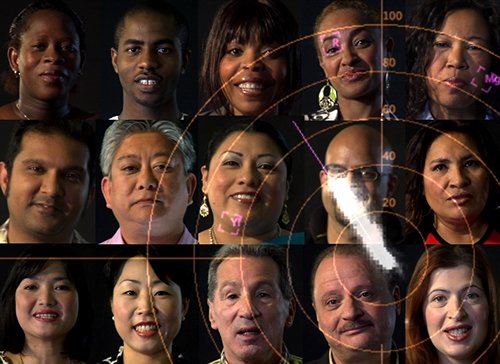
“As far as color correction is concerned, all people are basically the same ‘color’ when you define color in terms of hue angle. The variation in our ‘skin color’ is a really variation in tone, or relative lightness-darkness value of the human hue. We all line up on the same line on a vectorscope, this line is called the ‘Flesh Tone Line’ or FTL and its on most vectorscopes.”
So someone with dark skin:

Is the same hue as someone with light skin:

We all line up along that line:

It makes sense though, right?
Our skin ‘color’ is largely determined by the amount of the pigment melanin, and blood present in our skin. Melanin and blood color are the same color in all humans, its just the amount and relationship between the two that determine our tone.
reblogged from http://lonelysandwich.com/page/91 via http://prepshootpost.blogspot.com/2007/10/skin-color.html
Here are some excerpts from a very insightful Newsweek article on transracial adoption…

http://www.newsweek.com/id/194886/page/1
…As a black father and adopted white daughter, Mark Riding and Katie O’Dea-Smith are a sight at best surprising, and at worst so perplexing that people feel compelled to respond. Like the time at a Pocono Mountains flea market when Riding scolded Katie, attracting so many sharp glares that he and his wife, Terri, 37, and also African-American, thought “we might be lynched.” And the time when well-intentioned shoppers followed Mark and Katie out of the mall to make sure she wasn’t being kidnapped. Or when would-be heroes come up to Katie in the cereal aisle and ask, “Are you OK?”—even though Terri is standing right there.
…the Ridings’ experience runs counter to these popular notions of harmony. And adoption between races is particularly fraught. So-called transracial adoptions have surged since 1994, when the Multiethnic Placement Act reversed decades of outright racial matching by banning discrimination against adoptive families on the basis of race. But the growth has been all one-sided. The number of white families adopting outside their race is growing and is now in the thousands, while cases like Katie’s—of a black family adopting a nonblack child—remain frozen at near zero.
Decades after the racial integration of offices, buses and water fountains, persistent double standards mean that African-American parents are still largely viewed with unease as caretakers of any children other than their own—or those they are paid to look after. As Yale historian Matthew Frye Jacobson has asked: “Why is it that in the United States, a white woman can have black children but a black woman cannot have white children?”
…”Let me just put it out there,” says Mark, a 38-year-old private-school admissions director with an appealing blend of megaphone voice and fearless opinion, especially when it comes to his family. “I’ve never felt more self-consciously black than while holding our little white girl’s hand in public.” He used to write off the negative attention as innocent curiosity. But after a half-decade of rude comments and revealing faux pas—like the time his school’s guidance counselor called Katie a “foster child” in her presence—he now fights the ignorance with a question of his own: why didn’t a white family step up to take Katie?

 [b. 1914 – d. 1965]
 mulatto diaries