a mammy tale

The following essay is reblogged from Southern-Style.  A real life modern-ish mammy story!  I’ve long been interested in the dynamic between black women and other people’s white children.  When I was in college studying African-American history for the first time, I stumbled upon the thought that Mammies had raised our nation and yet black women generally are not revered (to say the least).  When I was a nanny myself, I thought a lot about mammy.  And, back in January, when I devoured The Help I pondered her some more.  If you haven’t read it yet, please do yourself a favor and put Kathryn Stockett’s The Help on your summer reading list.  It’s one of the greatest books I’ve ever read.  Right up there with The Girl Who Fell From the Sky, Caucasia, The Curious Incident of the Dog in the Nighttime, Memoirs of a Geisha, and Life of Pi.  i.e. the rest of your summer reading list.

I Remember Mammy:
Mattie Lee Martin (“Mammy”)
By one who loved her, Sharman Burson Ramsey

Thirteen year old Mattie Lee Martin took her mentally challenged older sister by the hand and led her down the rutted, red clay country road. Neither looked back. Mattie was determined her sister would not be abused again in their grandparent’s home. She’d finally accepted that her parents would never come back to get them. The road led to the town of Dothan, Alabama, and a life, Mattie Lee hoped, that would be better than the one they’d known on that god-forsaken farm.

Mrs. Bender stood at the door of her variety store, broom in hand, and watched the two girls walk toward her down the sidewalk. Mattie, the spokesperson for the two, stepped forward and boldly asked, “I need work and a place where me and my sister can stay. Do you know of anything?” She looked up at Mrs. Bender quite seriously.  Her black eyes were wide.  Anxiety was written all over her round black face that now dripped in sweat in the hot summer day after her long walk. Mrs. Bender read in that expression that she’d gotten this far, but now the little girl was in a quandary as to what should she do now? She looked at the tight grip she had on her much larger, but obviously more dependent, sister.

Mrs. Bender sized them up and in her gentle voice said, “I hear they are hiring maids across the street at the Wadlington Hotel, but come in here and let me help you with something to wear to your interview. Your sister can rest here while you go and inquire. Tell them I sent you.”

Mattie stood straight and said, “I don’t take no charity. I’ll pay you back.” Mrs. Bender nodded.

That Jewish lady remained a dear friend to Mattie the rest of her life.

Mattie Lee Martin later became highly regarded for her cooking skills. She cooked at the restaurant of the Houston Hotel for awhile and then took a job as the private cook for Dr. Moody, founder of Moody Hospital in Dothan. When the Moodys moved into their big house on Main Street from the house across from the hospital, Mattie for some reason was not going with them. Dr. Moody recommended Mattie to Dr. E. G. Burson, my father. The Moodys gave her a house as a parting gift.

When Mattie Lee Martin interviewed with my mother, she told my mother, “I don’t work with children.”

Yet as the pictures reveal, Mattie Lee Martin became as dear to us as our grandmothers and so she deserved just as endearing a name. Thus she came to be called “Mammy.”

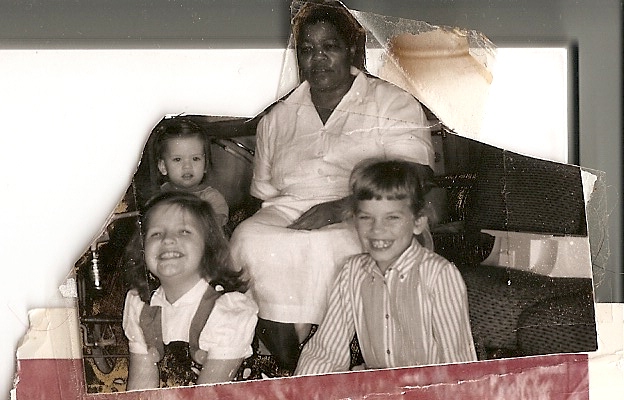
Mammy came to work every morning before seven, except Sunday, either by bus or by taxi and stayed until after five.  Even after our overweight dog, Sir Bow Wow, went blind, he would meet Mammy at the bottom of the hill where she got off the bus every morning and together they would plod their way to the house.  She cooked, cleaned, and loved us. I remember seeing one of her paychecks in the amount of $27.00. I also remember the days we’d take Mammy home and she’d ask Mother to stop by the grocery store several blocks away. Then she’d put some money in my hand and I’d run into the grocery store and plunk the money down saying, “Bit o Dental Snuff, please.”

Mammy ordered the groceries to cook for lunch from Murphy’s Market downtown first thing in the morning and a boy on a bicycle delivered them in time for her to cook. Dinner was served at exactly 12:00 noon. (In the South we eat breakfast, dinner and supper.) The meat went on a platter before “the doctor”. The table was set precisely with forks on the left of the plate (with the napkin) and the knife (facing inward) on the right. The glass was placed above the knife. She trained us well.

…Mammy had worked for the aristocracy of the town, Dr. and Mrs. Earl Moody. While she often locked horns with my mother (whose own father had been killed when logs rolled off a log truck when she was 13 leaving her mother to struggle raising five children) she refused to give up on us. “Yo mama, she be mean. But I be mean too, so we get along.” Mother had been awarded campaign ribbon for service in World War II as a nurse at the Battle of the Bulge. She could curse a blue streak and did so on occasion when things did not go to suit her. Sometimes those disagreements would get so heated that Mother would fire Mammy, but we’d cry and carry on so, she’d have to go and ask her to come back. My father was a doctor and his father was a doctor and that made us worth Mammy’s time and effort. My mother might not know what was “proper” but Mammy did, and she was determined to turn us out well.
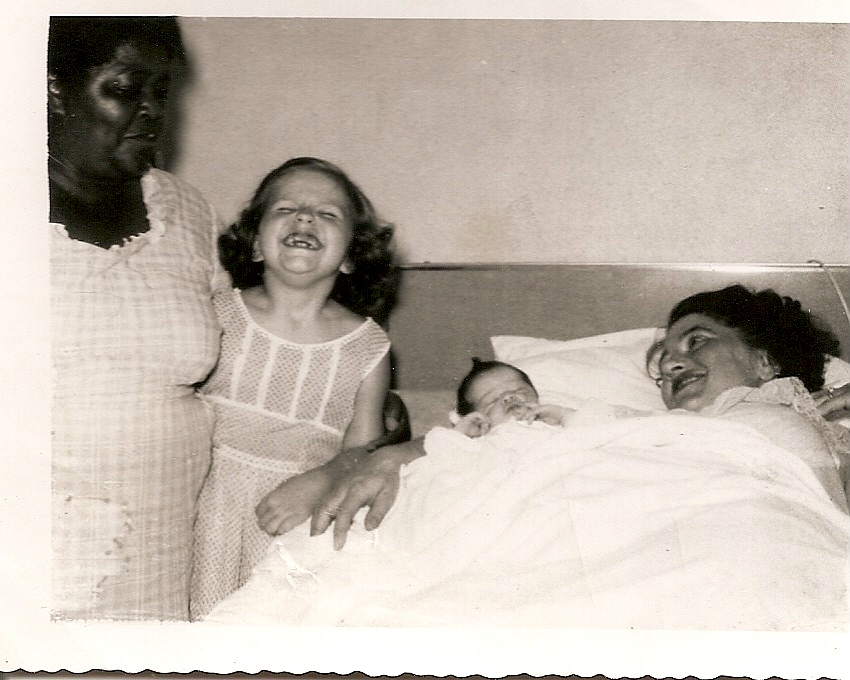
…Mammy did have her own family…a daughter Lucy Mae Dixon who was my Mother’s age. Mammy had very little education herself and the lists she made could barely be read, so she valued a good education. Mammy skrimped and saved and sent her to college in the North. It must have been a Catholic college because Lucy Mae converted to Catholicism. Mammy was a dedicated member of the Cherry Street AME Church. Lucy earned her Masters and came home to teach. Mammy bought her items of silver “on time” as birthday gifts. The mahogany furniture in their living areas was always covered in plastic to “save” it.

…I guess Mammy told my brother and sister the same thing she drilled into me. “Yo daddy be somebody. You gotta be somebody.” My sister is a cardiologist in New Orleans (Dr. Sylvia Burson Rushing) and my brother (Elkanah George Burson III ) has just started a pharmaceutical company (Burel Pharmaceuticals). Me? After you’ve got a man it’s all right “to rune yo hands” with Ajax, I learned. I wash a mean bathtub and have stayed married to the same man, an attorney of whom she approved (whose family once owned the Houston Hotel where she had worked) for forty years doing a little teaching and writing. This humble generous woman whom I never saw wear a single piece of jewelry gave me a pearl and gold bracelet for graduation from high school.  She who worked from can to can’t all of her life gave me a silver goblet when I got married.  I wonder if she ever knew how much they mean to me and that I realize the sacrifice and love those gifts demonstrated.

…Mammy was a proud person who made the most of her situation and, selflessly, with hard work and determination earned respect and made a good life for herself and her family. She raised us, her white family, to believe we could do whatever we chose to do and that we should make our parents proud. She drilled into us values of honesty, integrity, and a sense of responsibility.  Because we had been given so much; much was expected.  Because we loved her, it was Mammy we wanted to make proud.

Read more HERE

unhappy father’s day

Not much to say about this one, other than it’s a crying shame!  And 12 is way too young to be dating. Thank you.

Ex Forbids Interracial Dating

Toddler and Teenager Expert Advice from Carleton Kendrick, Ed.M., LCSW

VIA

Question: My 12-year-old daughter is very mature emotionally and has very fine-tuned common sense. She and I are close and talk about most issues openly, but recently she brought up an issue that I am not sure how to handle.

We are white, but my daughter has an attraction for the black males in her school. She and her father (my ex-husband) are extremely close, but he is very much against her dating black boys.

My ex has threatened to do one of two things if she should want to date a black male: take me to court and assume custody of her, or exclude her from his life forever. I feel stuck! I can’t side with her dad at all because I feel if she is treated respectfully in a relationship, the color of the boy’s skin doesn’t bother me. I also can’t allow my child to lie to her father about what she is doing with her life and during her time with me. What do I do?

Answer: I commend you for wanting to take the high road in this dilemma and to honor all family members involved with honesty. Your ex is hurt, scared, and angry that his daughter would be attracted to and/or wants to date black boys. His heightened fears and considerable prejudice against the black race have made him become a desperate man.

I doubt there is any court that would grant him custody of your daughter simply because you allowed her to socialize with or date black boys. It would take something rather grievous and destructive in your parenting to have a court consider remanding sole custody to your ex. You cannot prevent him, however, from punishing her by eliminating all contact with her. He does have the power to harm her in that way if he chooses.

Going along with and enforcing your ex’s demands, which are based upon racial prejudice (and possibly racial hatred), would be a horrible lesson in morality and ethics for your daughter. He may also harbor similar prejudices toward other racial, ethnic, or religious groups and threaten the same things if she wants to date any boys in these groups that he does not like or respect.

I would suggest that you, your ex, and your daughter attempt to air this dilemma in the presence of a skilled, family-oriented therapist. My guess is that your ex will not agree to participate in this process and will cling to his ultimatum. In any event, I would recommend that you and your daughter see a therapist together.

I do believe that your 12-year-old daughter is too young to be dating boys, regardless of how emotionally mature you believe she is “for her age.” I would also explore with her why she is drawn to the black boys in her school more than any other group of boys. You seem to have a close enough relationship where you could ask such a question in an open-ended manner. The answers may be very simple or may involve some things that she has not articulated yet. Again, I encourage you to continue to deal with this issue in a forthright and open way, always with the intention of bringing about understanding and harmony, if at all possible.

speaking of drake…

I’m super-curious about this guy and am itching to know more about the experiential intricacies of his Black/Jewish upbringing, and how he reflects on all of that from where he sits currently as the “New Jew in Hip-Hop.”  I don’t think this is a direct quote from Drake, but it rings true:  “Finally, his outsider background has become an asset.”  That’s exactly how I feel about my own self and I wouldn’t be surprised if a multitude of biracials are emerging into the same space of appreciation for the experience and are cultivating ways to make use of it in a world that was not ready to handle our truth before.  Some still aren’t ready.  Look out, some!

The New Face of Hip-Hop

By JON CARAMANICA

New York Times

For most of his teenage years Drake, tall, broad and handsome, was still known as Aubrey Graham (Drake is his middle name) and played the basketball star Jimmy Brooks on the popular Canadian teenage drama “Degrassi: The Next Generation.” In the last 18 months, though, he’s become the most important and innovative new figure in hip-hop, and an unlikely one at that. Biracial Jewish-Canadian former child actors don’t have a track record of success in the American rap industry.

But when “Thank Me Later” (Aspire/Young Money/Cash Money) is released this week, it will cement Drake’s place among hip-hop’s elite. It’s a moody, entrancing and emotionally articulate album that shows off Drake’s depth as a rapper, a singer and a songwriter, without sacrificing accessibility. That he does all those things well marks him as an adept student of the last 15 years: there’s Jay-Z’s attention to detail, Kanye West’s gift for melody, Lil Wayne’s street-wise pop savvy.

In rapid fashion Drake has become part of hip-hop’s DNA, leapfrogging any number of more established rappers. “I’m where I truly deserve to be,” Drake said over quesadillas at the hotel’s lobby bar. “I believe in myself, in my presence, enough that I don’t feel small in Jay’s presence. I don’t feel small in Wayne’s presence.”

But “Thank Me Later” is fluent enough in hip-hop’s traditions deftly to abandon them altogether in places. Finally his outsider background has become an asset. As a rapper, Drake manages to balance vulnerability and arrogance in equal measure, a rare feat. He also sings — not with technological assistance, as other rappers do, but expertly.

Then there’s his subject matter: not violence or drugs or street-corner bravado. Instead emotions are what fuel Drake, 23, who has an almost pathological gift for connection. Great eye contact. Easy smile. Evident intelligence. Quick to ask questions. “He’s a kid that can really work the room, whatever the room,” said his mother, Sandi Graham. “Thank Me Later” has its share of bluster, but is more notable for its regret, its ache.

As for Ms. Berry’s cousin, Drake’s interested, of course, but wary. “I think I have to live this life for a little bit longer before I even know what love is in this atmosphere,” he said. More fame only means less feeling, he knows.

Dodging vulnerability has been a fact of Drake’s life since childhood. His parents split when he was 3. An only child, he lived with his mother, who soon began battling rheumatoid arthritis, a condition that eventually prevented her from working, forcing Drake to become responsible at a young age. “We would have this little drill where, Lord forbid something happened, if there was a fire or an emergency, he would have to run outside and get a neighbor and call 911,” Ms. Graham said. His father, Dennis, who is black, was an intermittent presence — sometimes struggling with drugs, sometimes in jail.

“One thing I wasn’t was sheltered from the pains of adulthood,” Drake said. When something upset him as a teenager, he often told himself: “That’s just the right now. I can change that. I can change anything. The hand that was dealt doesn’t exist to me.’ ”

From an early age he’d been interested in performing, whether rewriting the lyrics to “Mary Had a Little Lamb” or spending time as a child model. By then, he and his mother were living in Forest Hill, a well-to-do, heavily Jewish neighborhood on the north side of Toronto, where he attended local schools, often the only black student in sight. His mother is white and Jewish, and Drake had a bar mitzvah. At school he struggled academically and socially. “Character-building moments, but not great memories,” he recalled. In eighth grade he got an agent and was soon sent off to audition for “Degrassi: The Next Generation,” an updated version of the popular 1980s Canadian drama.

He auditioned after school, on the same day, he said, that he first smoked pot from a bong. Nevertheless he landed the role of the wealthy, well-liked basketball star Jimmy Brooks, who was originally conceived as a white football player.

“Part of his journey is trying to figure where he does fit in in the world, having a white Jewish mom and a black, often absentee father,” said Linda Schuyler, a creator of the show. “It’s almost a comfort factor with Jimmy Brooks. That was the antithesis of his life at the time. It was probably reassuring and a bit escapist for him to play that role.”

Sometimes he was hiding even when the cameras were off, sleeping on the show’s set. “When I woke up in the morning, I was still the guy that could act and laugh,” he said. “It’s just that home was overwhelming.” Along with “Degrassi” came a new, more diverse school closer to the set, where he first tried rapping in public. As he got older, he also tried out his verses on one of his father’s jailhouse friends, who listened over the phone…

READ MORE

threat to america’s essential character

I’m loving the ideas raised in this piece reflecting on the Pew Research Center’s report on interracial marriage which I blogged about earlier this week.  Was that this week?  Anyway, I think it’s healthy for white identity to be “threatened”.  I’ve been under the impression that white identity is without definition beyond the color and the perks that come with it.  Perhaps the perceived “threat” will bring about a deepened awareness of the struggle to maintain personal identity in the face of adversity, stereotypes, and societal expectations.  For thoughtful “minorities” this endeavor is par for the course, however it seems to me that the majority of the “majority” do not expend energy grappling with such issues.  By being called upon to do so, a new common ground may be created.  A ground upon which we collectively come together to redefine  “America’s essential character”. Other than that, all I have to say is that I was shocked by the stat that  less than 5% of whites marry outside of their race.  Not because I was under the impression that the number would be large, but because in the last couple of years I’ve witnessed (and am thrilled to be a part of) the blossoming of a community of biracial people who are proud and happy to be such.  Where did we all come from if the numbers are so low!?  I suppose that in the grand scheme of things there still aren’t all that many of us.  I simply went from 0-60 in a flash, so to speak.

U.S. far from an interracial melting pot

By Daniel T. Lichter, Special to CNN

Ithaca, New York (CNN) — According to a recent report by the Pew Research Center, one of every seven new marriages in 2008 was interracial or interethnic — the highest percentage in U.S. history. The media and blogosphere have been atwitter.

Finally, it seems, we have tangible evidence of America’s entry into a new post-racial society, proof of growing racial tolerance. Intermarriage trends are being celebrated as a positive sign that we have come to think of all Americans as, well, Americans.

But others have an entirely different take — a more ominous one. They see increasing interracial marriage rates as proof that the country is amalgamating racially.

To them, intermarriage is a putative threat to whites and America’s essential character. Their concerns are heightened by recent Census Bureau projections that the U.S. will become a majority-minority society by the middle of the century.

My research with Ken Johnson, a demographer at the University of New Hampshire, indicates that for American’s youngest residents, that future is now. Nearly half of U.S.births today are to minority women.

It’s time for everyone — on all sides of this issue — to relax and take a deep breath. The reality is that racial boundaries remain firmly entrenched in American society. They are not likely to go away anytime soon.

We are still far from a melting pot where distinct racial and ethnic groups blend into a multi-ethnic stew.

Indeed, seemingly overlooked in the Pew Report is the finding that less than 5 percent of all married whites have a spouse of a different race or ethnicity. The vast majority of whites today — as in the past — marry other whites.

What is changing are marriage patterns among America’s minorities, but in ways that are not easy to understand or summarize in short news releases. (Pew used the categories of non-Hispanic whites, blacks, Asians, American Indians and Hispanics.)

For example, Pew reports that the share of newly married blacks with spouses of a different race increased threefold between 1980 and 2008. Media accounts have variously trumpeted this as good or bad news for America’s future, depending on the presumptive beliefs and attitudes of their audiences about racial matters.

It is easy to forget the U.S. Supreme Court waited until 1967, in Loving v. Virginia, to outlaw state prohibitions against interracial marriage. Increases in black-white marriages, at least on a percentage basis, are large because baseline numbers are very small.

Romantics like to believe that love is blind. We embrace the idea that falling in love is a product of our emotions rather than rational deliberation. Of course, the empirical evidence suggests otherwise. Love may be blind, but it clearly is not color-blind.

Indeed, for all the hyperventilation, the demographic reality is that only about 15 percent of newly married blacks today became married to whites or other minorities. This is hardly a basis for celebrating a new racial tolerance in America or, if you prefer, for now believing that white identity is rapidly being lost to interracial intimacy and childbearing.

Unfortunately, most of the nation’s headlines ignored Pew’s observation that intermarriage rates with whites actually have declined among Asians and Hispanics since 1980. This is something new.

My research with Julie Carmalt and Zhenchao Qian, to be published in Sociological Forum, documents recent declines in intermarriage rates among U.S.-born Hispanics and Asians after decades-long increases. Declines in intermarriage have been largest among the second generation, the U.S.-born children of immigrant parents.

Among second-generation Hispanics, for example, intermarriages with whites declined by more than one-third between 1995 and 2008. Over the same period, they became more likely to marry Hispanic immigrants.

Since 1980, there has been a fivefold increase in the number of native-born Asian women marrying Asian immigrants.

One explanation is that substantial new immigration has simply expanded the marriage opportunities for native-born Hispanics and Asians. But it is also likely that the extraordinary recent growth of the immigrant population has reinforced a new sense of identity rooted in shared ethnicity and culture. This seems to have encouraged more in-marriage with co-ethnics at the expense of more out-marriage with whites.

Demographers sometimes consider intermarriage to be the final step in the assimilation process, or an indicator of racial boundaries or lack of them. The current retreat from intermarriage among America’s non-black minorities raises new questions about racial and ethnic balkanization in America.

Issues of race and immigration are an important part of the public dialogue.

In today’s highly charged political environment, it is easy to latch onto information that buttresses our own point of view and preconceptions.

Unfortunately, short headlines and easy-to-digest narratives about rising intermarriage rates tend to oversimplify or even distort a complicated statistical story that is still unfolding.

The opinions expressed in this commentary are solely those of Daniel T. Lichter.


“kinds” of biracial

Fantastic commentary on something that I totally missed in the media.  I honestly don’t know who Drake is.  I’ll look him up in a sec…. Oh. I see.  Anyway, Whitney Teal makes such great points here (a fav being that one would never compare G.W. Bush to Eminem), and has me wanting to make a list of all the “kinds of biracial” that I can imagine.  And then I want to study the intricacies of the experiences that molded the various varieties of biracialness.  I love biracial.  It never gets old for me.  I suppose you can call me Captain Obvious for that statement.

Is One Mulatto the Same as the Next?

VIA

By Whitney Teal

Has the election of President Obama changed the way we think about biracial people in this country? I’d argue that it’s questionable. Especially when people are drawing comparisons between the prez — a half-white, half-Kenyan, Ivy League-educated lawyer — and Aubrey Graham, otherwise known as Drake, who is a half-Jewish and half-African-American entertainer from Canada. Yeah, I don’t see the similarities either.

Image of Thomas Chatterton Williams

thomas chatterton williams

But TheRoot.com contributor Thomas Chatterton Williams, who describes himself as the son of a black father and a white mother,” seems to think that the two mulattoes (his word, not mine) deserve a comparison. Yes, Williams thinks that it’s helpful to compare a Canadian rapper and the President (as he puts it, one of the “most visible mulattoes living and working today”). And he’s not alone, either. A few months back, a couple of my Twitter friends and I ripped Chester French band member David-Andrew ‘D.A.’ Wallach a new one for tweeting that he was discussing “all the similarities” between the two men. When I asked him to explain himself, he replied, “For one, I think they’re both extremely studied.” Womp, womp, cop-out. Lots of men are studied. President Obama and Drake are both, simply, biracial. And they’re not even the same “kind” biracial either, but that doesn’t seem to make a difference.

When I showed my sister the story on The Root, she screamed (via Google Messenger) and replied, “Obama and Drake in the same sentence? Do people mention [President] Bush and Eminem in the same sentence?” She’s right. White men are allowed to choose their own identities. Black men not so much, and biracial men certainly not. Which begs the question, why can’t we see that one biracial person is not the same as the next?

In general, polite company, we as general, polite people, recognize that a person’s experiences are not solely dictated by their race or ethnicity. For example, I don’t think people considering Lucy Liu, a famous actress, and Connie Chung, an award-winning journalist, would try and argue that the two have much in common, at least on the surface. The same with Denzel Washington and Reggie Bush, or Barbara Streisand and Heidi Fleiss. No comparisons. But people, general and polite as they are, still seem to view the experiences of biracial people in this country as singular in nature.

And often, as The Root essay explores, polarizing. “Mixed-race blacks […] are the physical incarnation of a racial dilemma that all blacks inevitably must confront: To sell out or keep it real? That is the question,” writes Williams, who spends the better part of 1,000 words waxing on about the definition of authentic blackness (or at least how he sees it). According to Williams, a mixed-race person must choose to be black, like the president and like Drake, who “both proudly define themselves as black.” A mixed-race person must then “act black,” which Williams sees as wearing loose clothes and playing basketball.

If blackness meant just one thing, and if mixed-race people were able to align themselves with just one part of their identity, then his essay might hold more weight. But black people don’t have just one identity, at least not to ourselves. Hollywood directors, novelists and journalists may see us as trash-talking, saggy pant-wearing basketball fanatics, but I don’t think that’s how we see ourselves. And by asserting that he can turn his black switch on and off, simply by altering the fit of his pants, Williams — though he may identify as black — shows how much he doesn’t understand the complexity of black culture.

Which is why I don’t believe that we should automatically label mixed-race people as black; they’re mixed-race. Being biracial may be similar to African-American culture, just as West African and West Indian cultures share similarities to black culture, but ultimately have their own dialects, dress, worship practices, food and courtship rituals. But biracial people etch out their own identities. Sure, they may be similar to that of African-Americans or other cultures. But it’s limiting to both black and biracial people when society automatically labels anyone with brown skin and textured hair black. Whether we’re talking about President Obama or anyone else, what it means to be biracial is an entirely individual question.

offensive or no?

Upon reading the headline of the article my mom emailed me, I was all set to be very offended by these photos.  After reading it and seeing the pics, I am not offended.  Is that bad?  When I read “blackface” I think poorly applied shoe polish and outrageously red lipstick.  When I saw these pictures and read Schiffer’s statement that they were playing with different men’s fantasies, I thought it made sense.  Lagerfeld and Dom Perignon hired one super Supermodel to play two characters (for lack of a better analogy).  To me this is not offensive.  I don’t think Schiffer kept a black model from working that day.  What if Naomi Campbell had done the ad in “whiteface”?  Would that be offensive?  I also wonder if Heidi Klum would have agreed to participate in this.  I would love to get her take on it.

Claudia Schiffer strikes controversial pose in ‘blackface’ for German magazine

BY MEENA HARTENSTEIN
DAILY NEWS STAFF WRITER

Claudia Schiffer is drawing criticism for her controversial photo on a German magazine cover.

Claudia Schiffer is one of the world’s best-loved supermodels, but she’s drawing a firestorm of criticism for her latest magazine cover.

The blond stunner is at the center of a racially-charged controversy after a photo of her in “blackface” hit the Internet this month.

In the photo, which was shot by Karl Lagerfeld two years ago as part of an ad campaign for Dom Perignon, Schiffer is disguised in an Afro wig and dark face paint, prompting accusations of insensitivity.

“It shows poor taste and it’s offensive,” Shevelle Rhule, fashion editor at black lifestyle magazine Pride, told U.K.’s Daily Mail. “There are not enough women of color featured in mainstream magazines. This just suggests you can counteract the problem by using white models.”

The photo resurfaced when German magazine Stern Fotografie repurposed the image as one of six hardback covers for its 60th anniversary issue.

The other covers also feature Schiffer in various costumed looks shot by Lagerfeld – as a sexy secretary, a leather-clad cop, Marie Antoinette, and even an Asian woman in a kimono.

Schiffer’s rep defended the series, saying, “The pictures have been taken out of context. The images were designed to reflect different men’s fantasies. The pictures were not intended to offend.

The sexy shots of Schiffer are drawing serious criticism from those who think the makeup choice was offensive.

Read more HERE

oblivious to racial overtones

I am pained by this story.  I remember being this little girl.  I remember being singled out at times, usually not having anything to do with my hair unless it was mandatory school-wide lice check day.  No one wanted to deal with me then.  And that was fine with me.  But it wasn’t really.  I can only imagine the consequences this incident will have for this little girl.  Her parents really have their work cut out for them now.  I hope they sue and win big!  The damage is done.  Let’s hope it can be undone.  Oh, and I’d like to send the Mudede family a copy of Teri LaFlesh’s Curly Like Me.  All you need is conditioner people.  All you need is conditioner…

Biracial Girl Removed From Classroom Because Of Her Hair

by Amelia Thomson-DeVeaux

VIA

This story is an example of the sad fact that within schools, sensitivity training can only go so far – sometimes, there are unpredictable situations where teachers just have to intuitively react, and often they’re not prepared to do so.  And often, these issues are much larger than they appear on the surface.  Such is the case with the 8-year-old biracial student who was removed from her advanced-placement class because the teacher claimed that she was allergic to the girl’s hair moisturizer.  The teacher first put the girl in the hallway, and then moved her to a different classroom where she found herself in a lower-level class with predominately African-American students.

This behavior seems bizarre enough – but add the fact that the girl was the only student of color  in her school’s accelerated program, and the concerns of her angry parents, who may now sue the school (the NAACP, along with the Department of Education, have already filed a complaint), seem justified.  The girl’s father, Charles Mudede, is black, and says that he had talked to his daughter about resisting pressures to straighten her hair so that she would look more like her white classmates.  The product that so irritated the teacher was a compromise, Mudede said, “something light that kept her hair in its natural state.”

The girl’s parents have a host of questions to which there seem to be no adequate answers: “Why did the teacher think the problem was his daughter’s hair? Why hadn’t the school called the parents? What investigation was being done to pinpoint the source of the problem? And, finally, why did the school seem oblivious to the racial overtones of a white teacher singling out her only black student?”

Mudede says that the situation escalated because no one at the school seemed prepared to answer these basic questions.  He wrote on his blog,

“When we, her parents, were later informed of this incident, we also learned that once my daughter was removed from the class, the teacher felt much better. We were also told that the teacher had experienced something like a fainting spell because of our daughter’s hair. Feeling the seriousness of this situation, we decided not to send our daughter to school until the teacher had medical proof that our daughter’s hair or something in her hair was to blame for the nausea. (The last thing you want to happen to your daughter is for a teacher to faint or vomit at the mere sight of her.)

Days passed and the school took no action. This unresponsiveness left us with no other choice than to turn to a lawyer. The whole thing is a mess. Getting entangled in a racial dilemma is something most black parents do not want for their children. It’s just not worth the trouble. Then again, like I said, if not checked and confronted, the incident will have permanent consequences for my child.”

And although the school is now making limited comments because of the threat of a lawsuit, it definitely seems as though this situation was horrifically mismanaged; without communicating privately with the student and involving the parents, of course this would turn into a humiliating ordeal for a little girl who clearly was already suffering from self-esteem issues.  If the teacher had allergies, that’s something that she couldn’t help.  But to target the student in such a dismissive embarrassing way shows a level of insensitivity that no teacher should have.

a fearless champion

I knew nothing of Evelyn Cunningham before her death.  Shame on me.  All I know now is that in the name of Evelyn, in the name of Lena, and in the name of the nameless:  I have got to do better.  I’m posting segments of the New York Times obituary of Ms. Cunningham and what I presume to be one of the last interviews with her that appeared in the NY Daily News in November of 2009.  For whatever reason, today I am particularly struck by what she said about her four husbands.  I feel a feminist kick coming on…

2009-12-14-cunningham.jpg

Evelyn Cunningham, a civil-rights-era journalist and later an aide to Gov. Nelson A. Rockefeller of New York, died on Wednesday (April 28th, 2010) in Manhattan. She was 94 and lived in Harlem most of her life.

At a time when few women worked at newspapers — never mind as reporters handling hard news — Ms. Cunningham covered many of the civil rights era’s biggest stories, including the battle over school desegregation in Birmingham, Ala., and the work of the Rev. Dr. Martin Luther King Jr. and Malcolm X.

Starting in 1940, she worked for more than 20 years as a reporter and editor for The Pittsburgh Courier, a black newsweekly with nationwide circulation. Much of that time she worked out of the paper’s New York office.

In the newsroom, she was nicknamed “Big East,” partly because of her height, 5-foot-11 in heels. She also became known as the “lynching editor,” a reference to her reporting on such killings in the segregated South.

…Ms. Cunningham entered another realm of public life in the late 1960s, when she took a job as special assistant to Governor Rockefeller, who had been impressed with her when she interviewed him as a candidate.

Governor Rockefeller named her to lead an office on women’s affairs, and she later served on many government panels dealing with women’s rights and community issues. She continued to advise him when he became President Gerald R. Ford’s vice president.

Evelyn Elizabeth Long was born on Jan. 25, 1916, in Elizabeth City, N.C., the daughter of a taxi driver and a dressmaker. She moved with her parents to New York as a child, and earned a bachelor’s degree from Long Island University. She had no children.

…Politically, Ms. Cunningham described herself as a “Rockefeller Republican,” Ms. Bell-Stevens said. “She said, ‘That means I’m a liberal Republican,’ and then she would add in more recent years that there hasn’t been a good one since.”

In a statement, Mayor Michael R Bloomberg, who appointed Ms. Cunningham to a commission on women’s issues in 2002, said, “With the passing of Evelyn Cunningham, all New Yorkers and all Americans who value our ideals of liberty and justice for all have lost a good friend and a fearless champion.”

…Ms. Cunningham married four times, taking the name of her third husband. Her fourth marriage was to Austin Brown, a Juilliard-trained pianist and watchmaker who died last year.

“Each one of my husbands tried to diminish my independence and my work,” Ms. Cunningham said in a profile in The New York Times in 1998. “They all loved me most while I was cooking — and I am not a good cook.”

Well-versed journalist Evelyn Cunningham writing piece on ‘unknown black history’

CLEM RICHARDSON

Monday, November 23rd 2009

VIA

She has interviewed and worked with some of the most historically significant people of the past 60 years; Nelson Rockefeller, Martin Luther King and Malcolm X, Sheriff Eugene (Bull) Connor, Supreme Court Justice Thurgood Marshall, and Presidents Richard Nixon and Gerald Ford.

Yet at 93 years old and after a journalism career that began in 1940 with the Pittsburgh Courier, it’s American women of all races who most impress Evelyn Cunningham.

“The women in my country, there does not seem to be anything they cannot be,” she said. “Presidents, heads of banks, millionaires. In the United States, women seem to gain or get practically everything they want.”

Seated on an overstuffed chair in the sunny study of her Riverside Drive apartment in Harlem, the television tuned to CNN, Cunningham said “I’m still a reporter, every inch of me.”

Though she doesn’t get out as much as she used to, Cunningham said she’s busy.

With the help of a group of local college students who do her leg work (“They think I’m this talky old lady,” she said.), she is writing and rewriting a piece on black history.

“I call it unknown black history, and there is a lot of it out there,” she said. “So much of black history is unknown, but even I am shocked to find out how much of it there is.

“Black people don’t even know what’s missing,” said Cunningham, who declined to give examples pending publication of her work. “That intrigues me to no end. Here I am part of a people who do not know much of their history.”

Cunningham honed her reporting skills covering lynchings in the South before and during the civil rights movement.

She was one of the first reporters to identify the Rev. Martin Luther King Jr. as a rising leader in the movement, and once asked Connor, who became infamous for using police dogs and fire hoses on peaceful demonstrators, for an interview.

He walked away.

Cunningham and several members of the Pittsburgh Courier staff of her era were awarded a George Polk Award in 1998 for the paper’s civil rights reporting.

After the civil rights era, Cunningham went on to hold a variety of civic and government positions, including special assistant to New York Gov. Rockefeller and on President Nixon’s Task Force on Women’s Rights and Responsibilities.

Having lived and worked in the segregated South – she was born in Elizabeth, N.C.- Cunningham said Barack Obama’s election “is hard to believe, hard to believe.

“No, I did not see it happening,” she said. “I never saw it, imagined it, or believed it, and here we got a black President.

“I met him right here in this apartment,” she said. “He came up to see me when he first visited the city. I adored him. He was a natural born leader.

“He is the greatest thing to hit our country.”

But if Cunningham could cover one story today it would not be local.

“I would go to Africa,” she said. “There is so much … I can only put it this way, dirty work going on there that even Africans don’t want people to know.

“That bothers me. It’s terrible and sad.”

re: previous posts

I’ve been meaning to post these things that have some correlation to a few of the week’s previous posts.  So now I’m doing it.

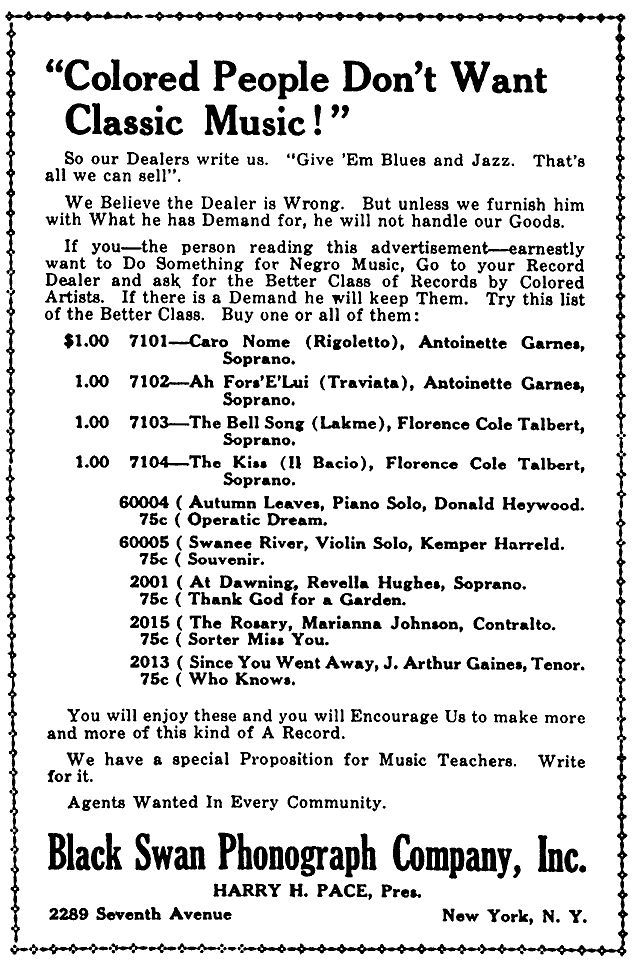
  • I think Philippa Schuyler and George Bridgetower help to disprove the theory that they were trying to disprove in this ad:

  • When I read about Stacey Bush,the white girl who (along with her biracial sister) was adopted by a black woman and is now on a multicultural scholarship, I thought of the mistake that Crayola made when naming this pack of crayons.  Maybe Stacey could explain to Crayola the difference between race and culture.  Throw in ethnicity and nationality too because a lot of people don’t seem to understand that those words are not synonyms:

  • This one goes along with the whole darn blog and it made me smile, so: