what Loving and loving are all about

I don’t feel quite right about focusing more on Cheerios than on the Lovings yesterday.  Perhaps I did it because this is the 4th Loving Day that I’ve had this blog so felt that I’d covered that already. Or, perhaps I did it because I knew I had this one in store for today.  This article, written by the Rev. Jacqueline J. Lewis (Ph.D/black woman married to a white man/woman of color and of God who stands for equal rights for all re:gay marriage) for the Huffington Post Religion blog, is all about liberty and justice for all.  On a good day I’m all about liberty and justice for all!  That there’s a place called “Middle Church” makes my heart swell.  I want to go to there.  I love knowing that Reverend Lewis exists.  I find inspiration in that knowing.  I love knowing what Mildred Loving thought and how she felt about life and love and equality, and am inspired by that too.

Let’s encourage one another to stop saying no to love.  Let’s encourage love in whatever form it arises.  Let us love that.

P.S. I also love that Willy Wonka meme, yet I have no idea what Mr. Wonka has to do with this, if anything.  That was my own find on the world wide web, not part of the Reverend’s article. Just for the record.

P.P.S. It is nearly impossible to be depressed and inspired at the same time, so let us also encourage one another to be inspired.  Or, even better, start living an inspired life yourself and watch the inspiration and the health of your community grow.

Making Love Legal

Senior Minister, Middle Collegiate Church

Posted: 06/07/2013

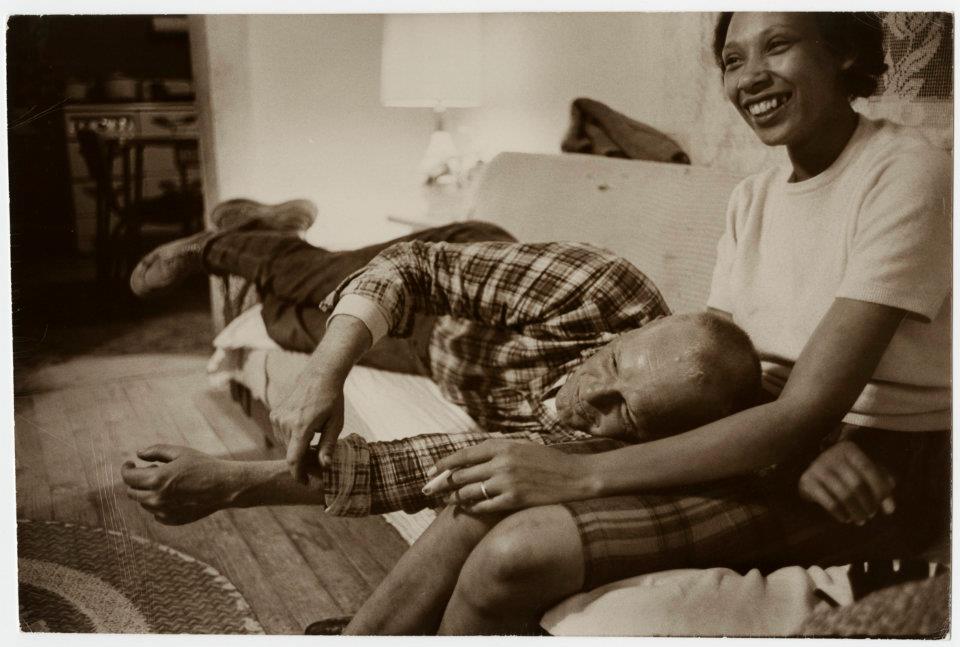
Central Point, Virginia. 1958: Richard and Mildred Loving jailed. Their crime: marriage. He was white. She was black. “We were married on the second day of June. And the police came after us the fourteenth day of July,” Mildred Loving said in the documentary “The Loving Story” (HBO, 2011).

An anonymous tip sent police to their house in the middle of the night. Making love was a crime, too, for people of different races. The police found them sleeping. They were arrested for “cohabitating as man and wife, against the peace and dignity of the Commonwealth.” Their marriage was illegal in 24 states in 1958.

Richard and Mildred pled guilty, and received a one-year prison sentence, which would be suspended if they left Virginia. They moved to Washington, D.C., sneaking home to see family and friends. Mildred wrote a letter to U.S. Attorney General Robert F. Kennedy who referred her to the A.C.L.U. Richard told their lawyer, “Mr. Cohen, tell the court I love my wife, and it is just unfair that I can’t live with her in Virginia.”

Love was not enough to mitigate the racial fear and hatred that resisted their union. It was not enough to unravel the complicated narrative of white supremacy that led to segregation, to Jim Crow and anti-miscegenation laws.

In Loving v. Virginia, the U.S. Supreme Court’s unanimous decision held that the prohibition of biracial marriage was unconstitutional. Chief Justice Earl Warren and the other justices claimed that “Marriage is one of the ‘basic civil rights of man,’ fundamental to our very existence and survival … Under our constitution, the freedom to marry, or not marry a person of another race resides with the individual and cannot be infringed by the State.”

No matter what society asserts about race, no matter what religious institutions teach about race and no matter the ethnicity of the couple, marriage is a basic civil right.

The Supreme Court changed the narrative, changed the story. And it changed the culture. According to Pew Research study of married couples (February 2012), the share of interracial couples reached an all-time high of 8.4 percent. In 1980, that share was just 3.2 percent.

The narrative of homophobia in our nation is also complicated and tragic. The culture has shaped it, religious institutions have often reinforced it, and fear feeds it. I believe that no matter what the culture asserts, adults have the civil right to marry, no matter their sexual orientation.
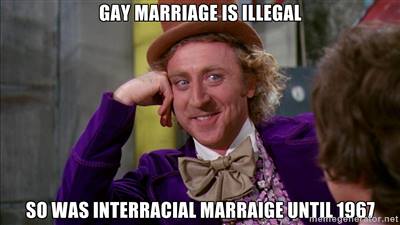
gay marriage is illegal so was interracial wonka

And I believe this is also true: Wherever love is, God is. The writer of 1 John says, “God is love. When we take up permanent residence in a life of love, we live in God and God lives in us.” I think it is important for congregations that teach “God is love” to also affirm the marriage of same-gender loving couples. They should have the civil right to marry and their love should be blessed in our churches.

On Sunday, June 9 at 6 p.m., at Middle Church, my white husband and I will celebrate Loving Day (celebrated nationally on June 12) and the landmark case that gave us the right to marry and live with each other. We will celebrate in hope that the Supreme Court will once again change the story, that it will rule on Prop 8 and DOMA in such a way that all couples have the right to marry in every state in our union.

Original gospel music by Broadway and television actor Tituss Burgess will be performed and there will be a renewal of vows for straight and gay couples. Burgess (Jersey BoysThe Little MermaidGuys and Dolls and 30 Rock), Alyson Palmer (of BETTY, whose music has been heard on The L-WordUgly Betty and Weeds), and Broadway’s Jenny Powers (Grease and Little Women) will solo at the event. Middle Church stands for the freedom of all couples to legally marry. During the commitment ceremony, all couples — no matter their ethnicity, or their gender or sexuality — can renew or make new vows to each other. We will celebrate loving, because we know for sure that love heals. Come and bring someone special with you!

Commenting on the similarities between interracial and same-sex marriage in 2007, Mildred Loving said,

I believe all Americans, no matter their race, no matter their sex, no matter their sexual orientation, should have that same freedom to marry … I am proud that Richard’s and my name is on a court case that can help reinforce the love, the commitment, the fairness and the family that so many people, black or white, young or old, gay or straight, seek in life. I support the freedom to marry for all. That is what Loving and loving are all about.

Amen, and may it be so.

loving

…and then

It happens to be Loving Day which is what prompted me to finally get around to posting about the Cheerios.  Happy Loving Day! Interracial Marriage (black/white) has been legal for a grand total of….46 years!  That’s only ten more years than I have existed!  So in the grand scheme, if there is still a small to medium segment of the population who simply has not taken advantage of any opportunity to grow out of this debilitating mindset, well, that’s only to be expected… and it’s too bad for them… and absolutely ok with me actually.  Love people where they are, right?

4-up on 6-12-13 at 7.32 PM #5 (compiled)

4-up on 6-12-13 at 7.26 PM #5 (compiled)

Here’s a nice article that brings together the Cheerios and the Lovings.

Opinion: The importance of ‘Loving’ in the face of racism

Editor’s note: June 12 is the 46th anniversary of Loving v. Virginia,  which made interracial marriage legal in the United States.  Thousands of people nationwide celebrate that anniversary as “Loving Day’.  Ken Tanabe is the founder and president of Loving Day, an international, annual celebration that aims to build multicultural community and fight racial prejudice through education. He is a speaker on multiracial identity, community organizing and social change through design. 

By Ken Tanabe, Special to CNN

(CNN) – Racism is alive and well in 2013, and what’s striking is the recent notable examples aimed at interracial couples – or one of their children.

Even breakfast cereal commercials aren’t safe. A recent Cheerios ad depicting an interracial couple and their multiracial child got so many racist remarks on YouTube that the company had to disable the comments.

There is nothing out of the ordinary about the commercial, except that the parents happen to be an interracial couple.

But the truth is, racially blended families are becoming more ordinary every day, due to the 1967 Supreme Court decision that declared all laws against interracial marriage unconstitutional. 

Opinion: Two different marriage bans, both wrong.

Today is the 46th anniversary of that decision, and one in seven new marriages in the United States is interracial or interethnic.  Multiracial Americans are the fastest-growing youth demographic.

Number of interracial couples in U.S. reaches all-time high:

While the negative comments about the Cheerios commercial made it newsworthy, there were also many others who showed their support for the Cheerios brand.

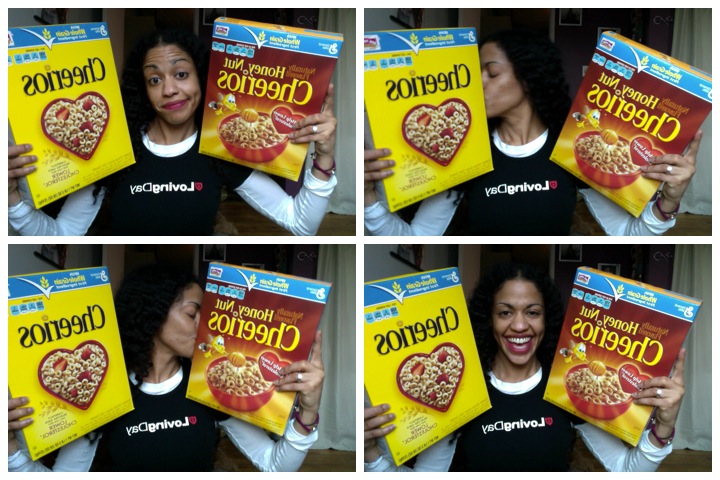
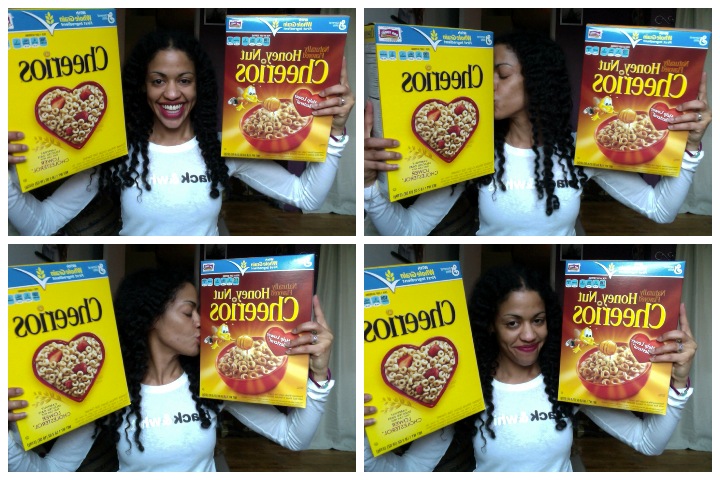
Multiracial Americans of Southern California, a multiethnic community group, started a Facebook album for people to post photos of themselves holding a box of Cheerios. And in articles and in social media, supporters expressed gratitude to General Mills for depicting a multiracial family.

The weddings of two multiracial couples from high-profile families also prompted racist comments online. Lindsay Marie Boehner, daughter of House Speaker John Boehner, married Dominic Lakhan, a black Jamaican man. And Jack McCain, son of Sen. John McCain, married Renee Swift, a woman of color.

The reaction to these marriages is reminiscent of the response to the marriage of Peggy Rusk – the daughter of then-Secretary of State Dean Rusk – and Guy Smith, a black man. In 1967, interracial marriage was a cover story, several months after laws against interracial marriage were struck down.

Things have changed since then, but not enough.

In a 2011 Gallup poll, 86% of Americans approved of “marriage between blacks and whites.”  In 1958, the approval rating was 4%. But it makes me wonder: What do the other 14% of Americans think? Apparently, many of them spend a lot of time leaving comments online.

The election of Barack Obama inspired many of us to hope that widespread racism was a relic of the past.

And while he was elected to a second term, we must not be complacent when it comes to racism in our daily lives. We must seek out opportunities to educate others about the history of our civil rights.

Dr. Martin Luther King Jr. wished that his children would “one day live in a nation where they will not be judged by the color of their skin but by the content of their character.”  I wonder what he would think of our collective progress as the 50th anniversary of his “I Have a Dream” speech approaches.

On June 15th, the 10th annual Loving Day Flagship Celebration in New York City will draw an expected 1,500 guests. And while many participants are multiracial, anyone can host a Loving Day Celebration for friends and family, and make it a part of their annual traditions.

We need to work collectively to fight prejudice through education and build a strong sense of multiethnic community. If we do, one day we might live in a nation where the racial identities of politicians’ children’s spouses are no longer national news, and cereal commercials are more about cereal than race.

The opinions expressed in this commentary are solely those of Ken Tanabe.

972137_587973641223951_425650949_n 390813_299940643381681_919990126_n

Mildred and Richard Loving

Peggy, Sidney, and Donald Loving playing, April, 1965

 Peggy, Sidney, and Donald Loving playing April 1965

now…

cheerios meme

Certainly you’ve heard of this, right?  The barrage of hateful comments left under the commercial featuring a mixed race family on Cheerios’ YouTube channel.  Comments so offensive that General Mills deleted and disabled them.  “It’s 2013!!!” is the gist of the typical response from “normal” people on the internet.  “I want to eat so many Cheerios right now,” was quite literally my response.  And I got a little choked up.  Not about the comment fiasco.  I stopped getting choked up about youtube comments years ago, thank God, and it comes as absolutely no surprise to me that hateful voices rose from the trollers. None.  So all I’m left with is this beautiful commercial, with this adorable child who makes some sincerely delightful faces depicted in a family that almost resembles mine in a way that I cannot recall having seen before.  Ever.  I am 36 years old.  I was in commercials as a kid.  I have never seen a commercial like this.  That is what is shocking.  That in 2013, this near-revolutionary advertising.  People took note, did double takes.  Heads were scratched.  Fears and tempers were flared.  Clearly this is long overdue.  So, thank you Cheerios!! Thank you for looking at your community and your consumers and seeing what is actually in front of you. And being “bold” enough to “endorse” it.  By endorsing reality, you make us face it and give us the opportunity to adjust to it.  Maybe even to like it You reflect me and all the others like me who had never experienced the normalization of our lives in a television commercial. This makes for a healthier society.  That makes for a healthier me.

And then there’s this! Maybe it’s not as bad as it seems after all.

Turns Out Americans Love ‘Controversial’ Cheerios Ad

Perhaps Racist YouTubers Not Representative of Country as a Whole

By: 
June 5, 2013

Last week, a new ad from Cheerios was deemed controversial when media outlets discovered that the racist contingent of the idiocracy known as the YouTube comment section trashed the ad for featuring a mixed-race couple and a biracial child.

But according to data from Ace Metrix, Americans like the ad. In fact, “Good for Your Heart” (called “Just Checking” on YouTube) tested the highest of six new Cheerios ads this year and garnered attention and likeability scores 9% and 11% “above the current 90-day norm for cereals.”

General Mills rightly decided not to be swayed by the rantings of deranged internet comments, telling USA Today that the supposed uproar would not affect future casting decisions.

According to Ace Metrix, the ad — created by Saatchi & Saatchi, New York — “appealed to all age/gender demographics with the exception of males over 50.” While that could be taken as a statement on racial attitudes, Ace Metrix noted that ads with babies tend to perform poorly with this demographic regardless of the race of the child.

The report, which surveyed over 500 consumers, went on to note: “The ad scored best with African-Americans, who collectively scored the ad a 721, followed by Asian Americans and Hispanics. While African Americans and Hispanics generally award advertising higher scores than their ethnic counterparts — the 721 score is 100 higher than average for African-Americans.”

And filtering verbatim commentary from those surveyed, those who specifically mentioned “couple” did so in a positive manner.

“I liked that the couple is mixed race,” wrote one respondent. “Good to see that on TV, but in a subtle manner.”

WordCloudCheerios

word cloud from Ace Metrix survey comments

no shame in crazy


crazy marliyn monroe


crazy lyrics


“What does it mean to be crazy? To have a disorder of the mind. But “disorder” can only exist if there is some kind of pre determined “order” set in place. And who decides on order relative to the human mind? Human society. Sane and insane is a judgment based on perspective. And according to many other perspectives within this universe, it is human society that is rampant with disorder. So there is no reason to think of yourself as insane; if the very mindset of the society that determines whether you are sane or insane… is in and of itself insane!”
-Teal Scott-

confessions

1) This one’s a confession of sorts because since the Adam Lambert debacle I have not really watched any reality contestant type t.v.  And by “really” I mean never seen a full episode.  One can’t avoid bits and pieces.  Therefore, I am surprised to find myself sitting here on pins and needles so hopeful that Zendaya will win Dancing with the Stars.  The first time I watched an episode of DWTS was last night.  It happened because my mom told me about this biracial girl Zendaya who is just fantastic and a judge favorite, but may need extra votes because her parents were shown on camera and that could cost her the support of… well… “certain” viewers.  The only sad thing about that statement is that the concern is not invalid.  So I turned the show on and lo and behold… I think that if I had more time in my life I would become slightly obsessed with this girl because I just think she is spectacular and her parents are so adoring and even if it cost her votes I’m so glad that that reality is being televised!  In such a mainstream way.  So awesome! Makes me happy and brings me peace!  I kinda want to be her when I was 16.

7137-zendaya-coleman-dwts-dancing-with-the-stars-video-photos-tango-perfect

zendaya-parents-pic-nov-22

Zendaya-Coleman-Mother

zendaya_coleman_zendaya_and_val_dwts_season_16_cast_first_look_WoVb4RGt.sized

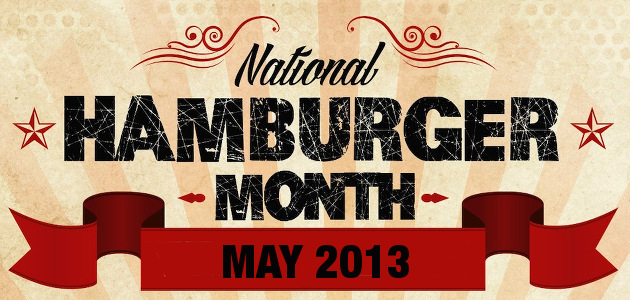
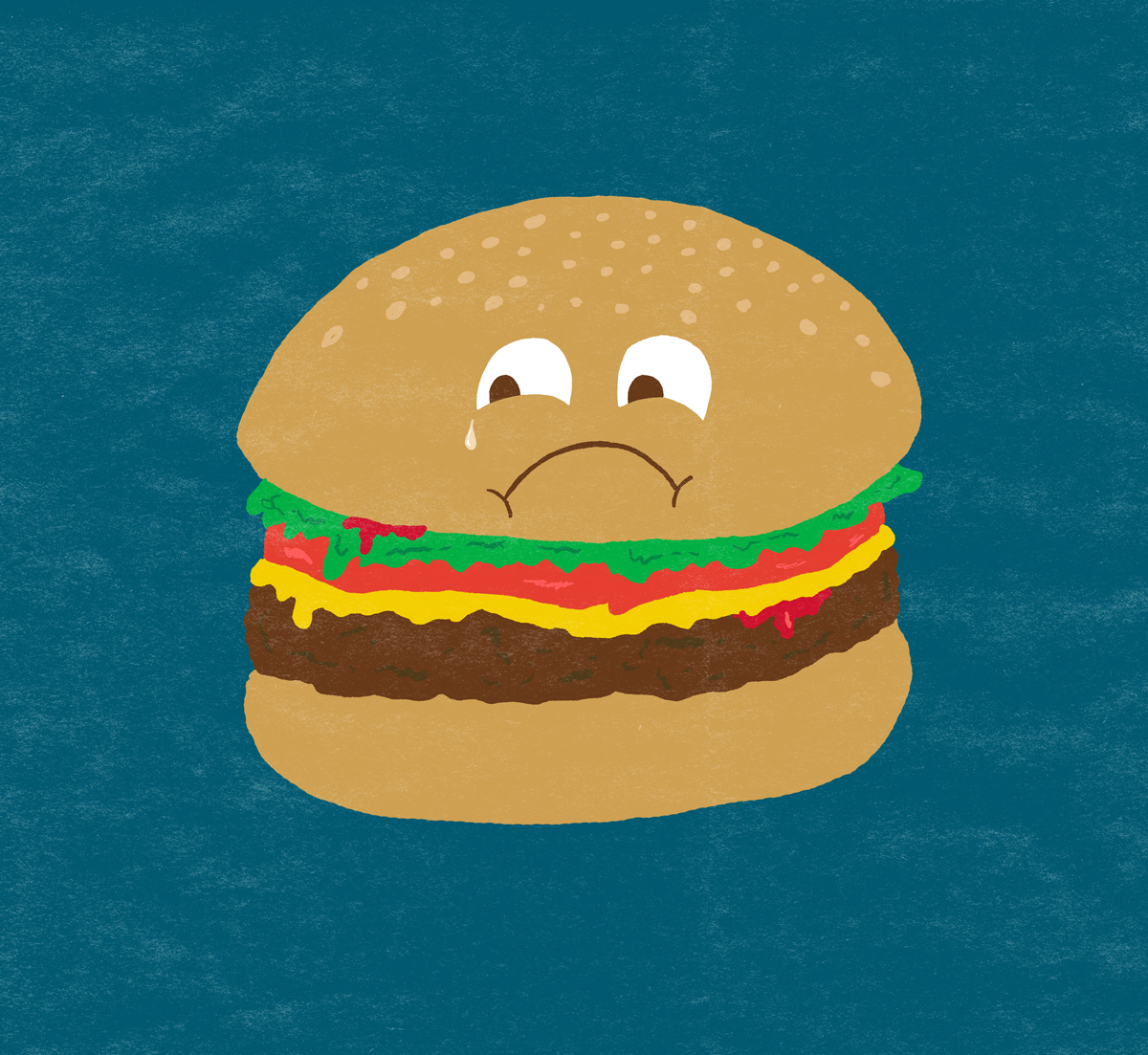
2) As in second confession…. In addition to Mental Health Awareness Month, May is also National Hamburger month.  Apparently I’m not one to discriminate because in the last 2 weeks I have had 3 cheeseburgers.  That’s 1/4 of my yearly burger intake!  In the last 2 weeks!  Clearly I am celebrating National Burger Month as well as MHAM and just thought you should be aware.  If burgers were alive they would probably be depressed because there is really no hope for a burger.  It will be eaten.  That would be beyond sad.

nation burger month may

SadBurger

sad?

Since I last posted (where does the time go!?) I’ve been thinking about how the opposite of depressed is not happy.  Because depression is not sadness.  I fully realized this when I found myself experiencing great sadness over the fact that I was not able to witness a very, very dear friend’s wedding.  I was so, so sad about it.  I cried.  Then I stopped crying.  While I was still aware of the sadness around this though the tears were done, I noticed that I had been able to allow the feeling to pass through me and then I found myself back at peace in the present moment.  (Yes, I have been meditating.  More on that in some other post.) It was in that present space that I had a lovely aha moment in which for the first time I clearly felt the difference between sad and depressed.  I had just allowed myself to experience my sadness without it causing great anxiety and/or influencing my every thought and my outlook on life in general.  And this was awesome because I spent a lot of years trying to avoid my feelings because they were overwhelming and I simply had no earthly idea what to do with them.
i hid my deepest feelings so wellSo I resisted them.  I depressed (def: having been pushed or forced down) them.  The awareness of that internal shift made me truly happy, as in pleased and content, for this is a sign that my efforts to nourish and balance my mind, body, and spirit have been somewhat successful (with the help of my therapist(s)) in calming my nervous system, and in redirecting and reconnecting pathways in my brain that had habitually spun in anxious patterns of negative expectation so that I can experience my feelings without attaching my identity to them or getting carried away by them.  So that I can truly live.
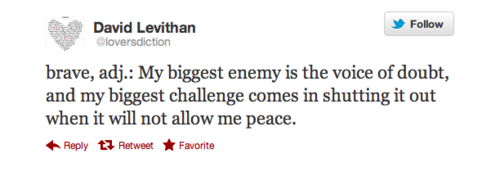
After that mildly profound experience, I came across the blog post below for which Junior Seau’s death was the catalyst. Junior Seau committed suicide, but was not known to be suffering from depression at the time.  I am not implying that depression and suicide go hand in hand, nor am I  making any statement about race.  I simply like the way Miriam Mogilevsky differentiates between sadness and depression.  As I’ve contemplated my own depression, the part of me that is still resistant to it’s existence will every now and then pipe up with a, “But I’m so happy a lot of the time.”  And it’s true. Sometimes I am so happy.  Many times.  And sometimes I am not.  But, whatever, because happy is just an adjective (a word or phrase naming an attribute, added to or grammatically related to a noun to modify or describe it.  Happy: feeling or showing pleasure (satisfaction/enjoyment) or contentment.  Sad:  Feeling or showing sorrow: unhappy.I believe that I can be not depressed forever.  If not forever, for most of it I hope.  Speaking of which, to me depression most plainly described is a severe lack of hope.  I know that one can experience a moment of happy in the midst of the hopelessness of depression. Likewise, without depression, happyness is not guaranteed.  Sadness will enter.  After all we are talking about the human experience here.  There is no way that I will always, 100% of the time, experience pleasure, enjoyment, contentment, or satisfaction.  I don’t even want that.  That would lead to complacency and boredom.  I do crave peace, however. That is my goal. I want to always know the way back to the peace of the present moment that I find in the center of my heart.  When I can allow myself to feel that. That’s huge.  Peace in the midst of sorrow and joy and all the rest of it. I can only experience happiness.  I don’t think it can or should be held onto.  I can actually be peaceful though.  That is a state of being that is sustainable and maintainable.  That’s what I’m working toward.

artful peace hand

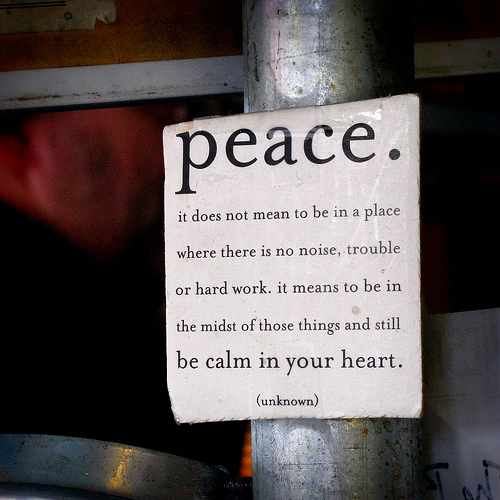
Peace:

-freedom from disturbance; quiet and tranquility

-mental calm, serenity

-freedom from dispute or dissension between individuals or groups (now we’re getting loser to race)

DEPRESSION IS NOT SADNESS: JUNIOR SEAU AND PUBLIC DISCOURSE ON MENTAL ILLNESS

by: Miriam Mogilevsky

A few days ago I came across the story of Junior Seau, an NFL linebacker who committed suicide on May 2 (2012). He shot himself in the chest and was found in his home by his girlfriend. Although little is known of Seau’s mental health leading up to his death, he had apparently suffered from insomnia for the last seven years of his life.

Sportswriter Chris McCosky  wrote a beautiful column in the Detroit News about Seau’s death and continuing ignorance about depression and suicide. In the column, McCosky shares his own experiences with depression and suicidal thoughts and laments how difficult it is to explain them to people. He notes, as I’ve noted before, that one common reaction that non-depressed people have is to wonder what the hell we have to be so sad about. He writes, “It’s almost impossible to talk about it to regular people (bosses, spouses, friends). They can’t fathom how somebody in good physical health, with a good job, with kids who love them, who seems relatively normal on the outside, can be terminally unhappy.”

The unbearable frequency at which McCosky and I and probably everyone else who tries to talk about depression get this response could be a testament to the fact the most visible symptom of depression is usually sadness. So that’s the one people latch on to: “What do you have to be so sad about?” “Cheer up!” “You have to decide to be happy!”

Because of the sheer obviousness of our sadness, we’re often forced to try to use it to describe depression. We say that we’re just extremely sad, or unhealthily sad, or adifferent kind of sad. It’s sadness that never goes away like sadness is supposed to. It’s sadness that’s out of proportion to the troubles that we face in our lives. It’s sadness that we can’t stop thinking about. For those of us with bipolar or cyclothymic disorder, it’s sadness that comes and goes much too quickly.

The truth is that sadness actually has very little to do with depression, except that it is one of its many possible symptoms.

Based on the diagnostic criteria for depression, you don’t even need to be chronically sad to be considered “depressed.” Anhedonia, which means losing the ability to feel pleasure from things that you used to enjoy, could be present instead. Under the formal DSM-IV definition, you must have at least five of nine possible symptoms to have major depression–and one of the five must be either depressed mood or anhedonia–and only one of those symptoms involves sadness. (If you so some very basic math, you will notice that this means that two people, both of whom officially have major depression, might only have one symptom in common. Weird, huh?)

So, even if your particular depression does include sadness, it’ll only be one of many other symptoms. The others might be much more painful and salient for you than the sadness is. Some people can’t sleep, others gain weight, some think constantly about death, others can’t concentrate or remember anything. Many lose interest in sex, or food, or both. Almost everyone, it seems, experiences a crushing fatigue in which your limbs feel like stone and no amount of sleep ever helps. Then there are headaches, stomachaches, and so on.

So, depression doesn’t necessarily mean sadness to us. (And a gentle reminder to non-depressed folks: being sad doesn’t mean you’re “depressed,” either.)

Depression is not sadness; it’s an illness that often, though not always, involves sadness. No amount of happy things will make a depressed person spontaneously recover, and, usually, no amount of sad things will make a well-adjusted person with good mental health suddenly develop depression. (Grief, of course, is another matter.) And sadness, on its own, does not cause suicide.

We need to start talking about mood disorders as disorders, not as emotional states. McCosky writes:

Junior Seau wasn’t sad when he pointed that gun to his chest. He wasn’t being a coward. He wasn’t being selfish. He was sick. I wasn’t sad when I thought about swerving into on-coming traffic on Pontiac Trail some 20 years ago. I was sick.

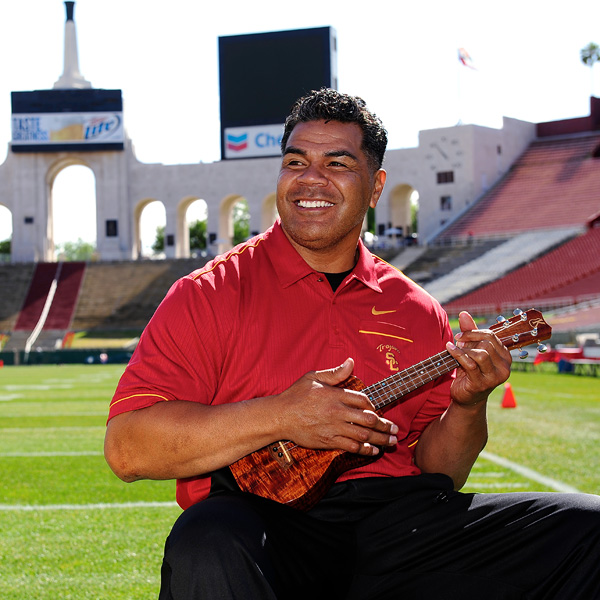
mag_a_seauukelele_600

Junior Seau one month prior to his death

What he’s saying is that people don’t kill themselves because they’re sad. They kill themselves because they have an illness.

There is a tendency, I think, to assume that people are depressed because they are sad. A better way to look at it is that people are sad because they are depressed. That’s why, even if we could “turn that frown upside down!” and “just look on the sunny side!” for your benefit, it would do absolutely no good. The depression would still be there, but in a different form.

Junior Seau did not leave a suicide note, so only God knows what he was thinking when he died. I would guess, though, that he was thinking about much more than just being sad.

dm_130402_nfl_junior_seau_schaap_essay