omg

omg

Hugh Jackman has refused to deny that he is gay.
The married actor has been persistently rumoured to be homosexual since he played Australian musician Peter Allen in camp musical The Boy From Oz in 2003.
Jackman is reluctant to refute the allegations because he feels it encourages a derogatory view of homosexuality.
“I’d be happy to go and deny being gay, because I’m not. But by denying it, I’m saying there is something shameful about it, and there isn’t anything shameful,” he said.
“The questions about sexuality I find more in America than anywhere else, because it’s a big hang-up and defines what people think about themselves and others. It’s not a big issue in Australia.”
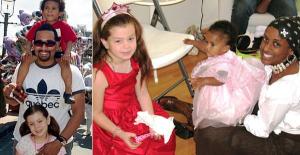
Jackman also revealed he and his wife Deborra-Lee Furness – who have been married for 13 years – felt very strongly about adopting multi-racial children Oscar, eight, and Ava, three.
He told Parade magazine: “Mixed-race babies have such a hard time being adopted that Deb and I checked off that box specifically when we were filling out our forms.
“Our lawyer brought the form back to us and said, ‘This is not the time to be politically correct. Are you sure this is what you want?’ We were definite about it. Adoption is about taking a baby into your home and your heart. It’s the best thing we’ve ever done.”
4/23/2009
http://www.thewest.com.au/default.aspx?MenuID=5&ContentID=137722


I enjoy Hugh Jackman very much.
A) He’s Wolverine, and as a University of Michigan graduate aren’t I obligated to like him?
2) I saw The Boy From Oz and he blew me away. Really fantastic! Like Liza. (The real Liza, tho the Liza in The Boy From Oz was quite good.)
3) Did you see the opening of the Oscars? Enough said.
4) I actually stood a few feet away from the impossibly handsome Hugh Jackman and his mixed race son, and witnessed one of my favorite interactions ever. It was so good that I didn’t even pick up on the fact that his son is mixed. Picture it: New York City. 2006. The Time Warner Center at Columbus Circle. Heading out of the building, Hugh and son. Heading into the building, Barbara Walters. (Standing in between, me, but who cares.) Hugh sees her and calls out, “Hi Barbara!” Barbara, head down trying desperately not to be recognized, keeps eyes to the ground moves to her left still heading for the escalators. Hugh keeps grinning and says, “Barbara? Barbara, it’s Hugh.” At this point they’ve caught up to each other. (Like right next to me, but who cares.) He keeps walking with her and actually bends down to meet her downcast gaze. “It’s Hugh.” She is simultaneously relieved and embarrassed. She laughs a bit nervously, “Oh, Hugh….” They have a nice little convo and part ways. It was funny and cute.
Here are some excerpts from a very insightful Newsweek article on transracial adoption…

http://www.newsweek.com/id/194886/page/1
…As a black father and adopted white daughter, Mark Riding and Katie O’Dea-Smith are a sight at best surprising, and at worst so perplexing that people feel compelled to respond. Like the time at a Pocono Mountains flea market when Riding scolded Katie, attracting so many sharp glares that he and his wife, Terri, 37, and also African-American, thought “we might be lynched.” And the time when well-intentioned shoppers followed Mark and Katie out of the mall to make sure she wasn’t being kidnapped. Or when would-be heroes come up to Katie in the cereal aisle and ask, “Are you OK?”—even though Terri is standing right there.
…the Ridings’ experience runs counter to these popular notions of harmony. And adoption between races is particularly fraught. So-called transracial adoptions have surged since 1994, when the Multiethnic Placement Act reversed decades of outright racial matching by banning discrimination against adoptive families on the basis of race. But the growth has been all one-sided. The number of white families adopting outside their race is growing and is now in the thousands, while cases like Katie’s—of a black family adopting a nonblack child—remain frozen at near zero.
Decades after the racial integration of offices, buses and water fountains, persistent double standards mean that African-American parents are still largely viewed with unease as caretakers of any children other than their own—or those they are paid to look after. As Yale historian Matthew Frye Jacobson has asked: “Why is it that in the United States, a white woman can have black children but a black woman cannot have white children?”
…”Let me just put it out there,” says Mark, a 38-year-old private-school admissions director with an appealing blend of megaphone voice and fearless opinion, especially when it comes to his family. “I’ve never felt more self-consciously black than while holding our little white girl’s hand in public.” He used to write off the negative attention as innocent curiosity. But after a half-decade of rude comments and revealing faux pas—like the time his school’s guidance counselor called Katie a “foster child” in her presence—he now fights the ignorance with a question of his own: why didn’t a white family step up to take Katie?
I think that the reality and the dichotomy that this photo depict are the result of the racist advertising we’ve been discussing.

This photo also leads me to question whether or not I think that all advertising is racist. I understand that whites are still the “majority” (for now), but I think it’s undeniable that it’s presented to the masses as an exclusive club. The club has privileges. In my opinion, that billboard could be deemed racist even without the people standing in line before it. The truth of the matter is that if you look like the people in that car the sky’s the limit, you can achieve the highest standard of living, it’ll be grand. If you look like the people in the line, you will serve those in the car. At best you will strive to be like them, struggle for what they take for granted. That’s just the way things are. The people in the car deserve the best, the people in the line deserve the rest. Just because. That’s what this country has been advertising for years. Under the guise of all men are created equal, liberty and justice for all, & land of the free they’ve been pushing the opposite. They’ve sold and we’ve bought. Another truth is that we are all slaves to the notions, images, dogmas passed down and regurgitated through the years. It’s everywhere. Books, film, television, magazines, packaging, newspapers. It kind of seems normal. This country could be so great. It was founded on wonderful ideals and beautiful words, but without the actions to create the reality dreamt of. It’s still a dream. I think we can achieve it. But first there has to be widespread acknowledgement of the dogma and it’s major flaws and then we have to fix our thinking. Free our minds.
Not done with Golly yet. When I first looked into what the heck that was, I was led to a website for collectors of Golly memorabilia. I saw Golly as a doctor, an astrounaut, all sorts of things, so I thought “Maybe he isn’t really racist because he doesn’t seem to be held back by his color or regulated to a station of servitude. He’s achieving things.” Short-lived thought, for next i was led to this site http://www.golliwogg.co.uk/racism.htm
For the past four decades Europeans have debated whether the Golliwog is a lovable icon or a racist symbol. In the 1960s relations between Blacks and Whites in England were often characterised by conflict. This racial antagonism resulted from many factors, including: the arrival of increasing numbers of coloured immigrants; minorities’ unwillingness to accommodate themselves to old patterns of racial and ethnic subordination; and, the fear among many Whites that England was losing its national character. British culture was also influenced by images – often brutal – of racial conflict occurring in the United States.
The claim that Golliwogs are racist is supported by literary depictions by writers such as Enid Blyton. Unlike Florence Upton’s, Blyton’s Golliwogs were often rude, mischievous, elfin villains. Blyton, one of the most prolific European writers, included the Golliwogs in many stories, but she only wrote three books primarily about Golliwogs: The Three Golliwogs (1944), The Proud Golliwog (1951), and The Golliwog Grumbled (1953). Her depictions of Golliwogs are, by contemporary standards, racially insensitive. An excerpt from The Three Golliwogs is illustrative:
Once the three bold Golliwogs, Golly, Woggie, and Nigger, decided to go for a walk to Bumble-Bee Common. Golly wasn’t quite ready so Woggie and Nigger said they would start off without him, and Golly would catch them up as soon as he could. So off went Woggie and Nigger, arm-in-arm, singing merrily their favourite song – which, as you may guess, was Ten Little Nigger Boys.
Ten Little Niggers is the name of a children’s poem, sometimes set to music, which celebrates the deaths of ten Black children, one-by-one. The Three Golliwogs was reprinted as recently as 1968, and it still contained the above passage. Ten Little Niggers was also the name of a 1939 Agatha Christie novel, whose cover showed a Golliwog lynched, hanging from a noose.
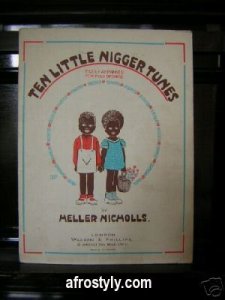
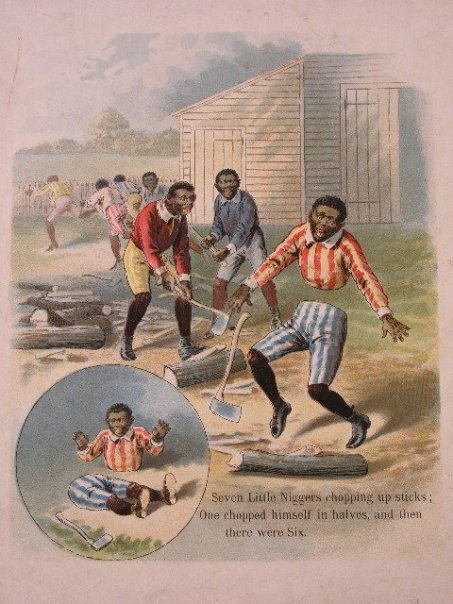
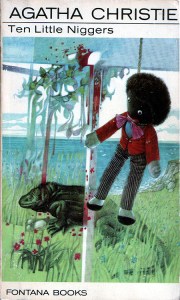
By-Frickin’-Golly
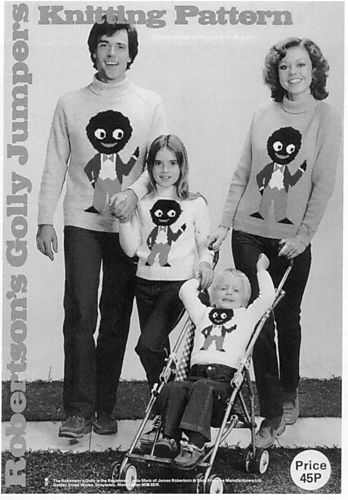
At first I was just going to post this photo as something I don’t like. Why on earth are these white people wearing sambo on their sweaters? Homemade sweaters at that! Then I figured I should look into this. Oh boy! This is Golly. You could buy this pattern today on ebay. Golly began as golliwogg in Florence Kate Upton’s 1895 book “The Adventures of Two Dutch Dolls and a Golliwogg.” Upton, a native New Yorker, first describes him as “a horrid sight, the blackest gnome.” He was a caricature of American black faced minstrels – in effect, the caricature of a caricature. The book became very popular in England and thirteen books featuring Golliwogg were published. Then they began making rag dolls. During the first half of the twentieth century, the Golliwog doll was a favourite children’s soft toy in Europe. Only the Teddy Bear exceeded the Golliwog in popularity.
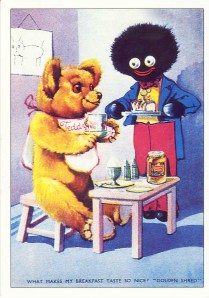
Small children slept with their black dolls. Many White Europeans still speak with nostalgic sentiment about their childhood gollies. Now onto Robertson’s. The Golliwog is inextricably linked with the famous English preserves company, James Robertson & Sons. Robertson’s Jams has been using the smiling Golliwog as its logo since the 1920s until it was discontinued in 2001. Despite much criticism during the 1960s and ’70s, they simply changed their logo’s name to ‘Golly’, and continued to stand by their trusty mascot. Consequently, the collecting of Robertson’s Golly memorabilia is a hobby in itself, with a vast array of promotional material and items to be collected.





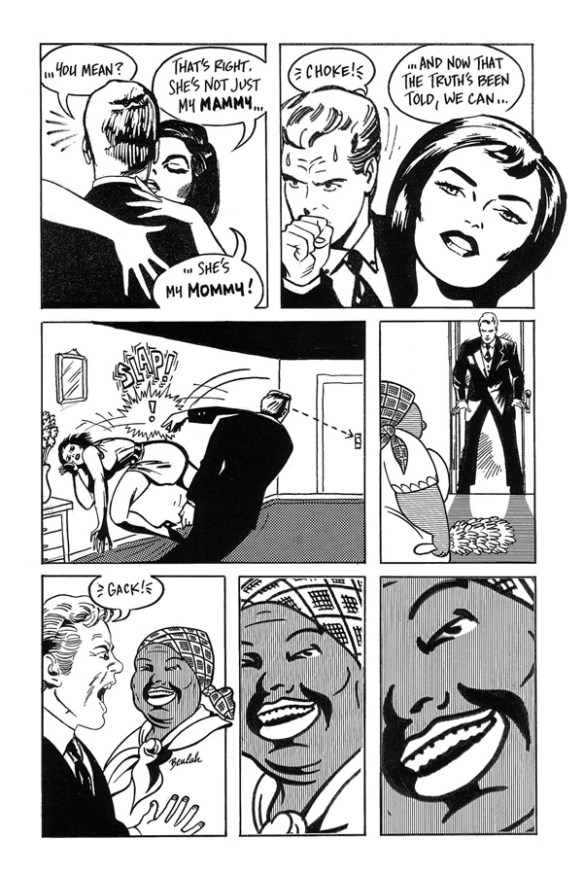 (I’m sorry that I don’t have the artist info for the cartoon. I can’t remember where i found it.)
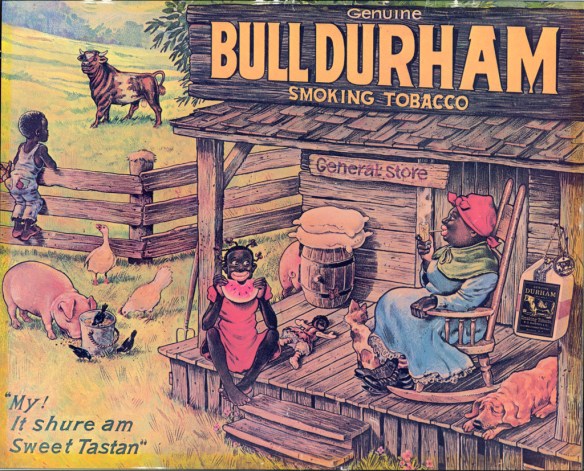
And here I was thinking that Bull Durham was just a baseball movie with Susan Sarandon (love, love, love) and Kevin Costner.

I guess that’s the best they could come up with. I’ve always thought of dentyne gum as sucking, so perhaps there were no other selling points.
i also love cream of wheat
but not this

i LOVE pancakes, but I really do not like this

or this

 mulatto diaries