mixed race barbies

I don’t think I would have been allowed to have one of these Barbies either.  Actually, I kind of don’t get this.  The designer doesn’t say that she made them so that little mixed girls will have a doll that more accurately represents their background.  She says it’s for African-American girls (which is weird because this is in the UK), so how are these different from the black barbies that have been around for years?  Is it that they’re wearing Rocawear, which we can assume white Barbie either knows nothing about, or wouldn’t be caught dead in?  Is it that African-American girls have career aspirations that include having Jay Z as their boss?   Ok, clearly I don’t just kind of not get it, I don’t get it at all.

First collection of mixed race Barbie dolls hits the UK

The ‘So In Style’ dolls designed by African American mum debut today in Selfridges

The So In Style dolls launched today at Selfridges

It seems Barbie has some new friends to add to her circle and they come in the shape of four mixed race girls named Jayla, Kara, Trichelle and Chandra. The first of their kind in a sea of fair skinned Barbie dolls, the four ‘So In Style’ girls were unveiled today as part of a cultural Barbie retrospective at the Wonder Room concept store within Selfridges.

Adding to the Wonder Room’s repertoire of all things contemporary and interesting, the mixed race dolls, designed by Barbie designer Stacey McBride-Irby, feature as part of an exhibition to celebrate 40 years of black Barbie history.

Unveiled by brand consultant and founder of WAH-Nails Sharmadean Reid, the authentic looking dolls stand alongside vintage black Barbies as well as 12 larger than life dolls.  The woman behind the creation of the ‘So In Style’ girls, who are decked out in Jay Z’s Rocawear clothing, says her inspiration behind the range was her daughter and her own heritage.

“As a Barbie doll designer for more than 10 years, I want African-American girls to know that dolls can represent their career aspirations, hobbies and ethnic backgrounds. Barbie inspired me to realise my dream of becoming a designer, and I want my dolls to inspire girls to play, create and live out their dreams,” explains Stacey.

The dolls are available in Selfridges (link) from today and cost £25.

SOURCE

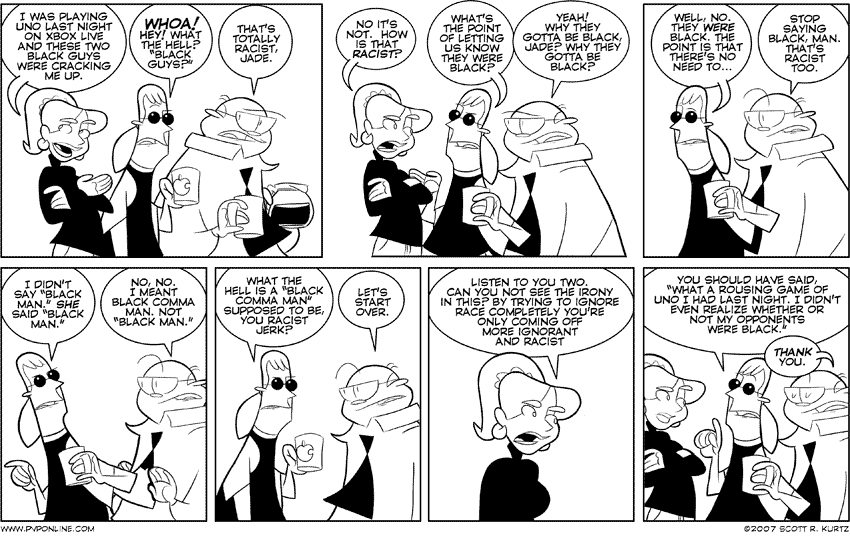
strategic colorblindness

Ignoring the obvious does not equal social change or justice.  It’s simply a detrimental sweeping under the rug and ignoring of the elephant.  I think that the only way to achieve true color blindness, is to work through the complex and intricate web of color consciousness that has been the way of the nation from day one.  And to work through it we have to dialogue about it.  Honestly.

Seeing race and seeming racist? Whites go out of their way to avoid talking about race

White people – including children as young as 10 — may avoid talking about race so as not to appear prejudiced, according to new research. But that approach often backfires as blacks tend to view this “colorblind” approach as evidence of prejudice, especially when race is clearly relevant. These results are from two separate sets of experiments led by researchers from Tufts University and Harvard Business School. Their findings are reported in the October issue of the Journal of Personality and Social Psychology and the September issue of Developmental Psychology. Both journals are published by the American Psychological Association.

“Efforts to talk about race are fraught with the potential for misunderstandings,” said the studies’ lead author, Evan Apfelbaum, a PhD candidate at Tufts University. “One way that whites try to appear unbiased is to avoid talking about race altogether, a tendency we refer to as strategic colorblindness.”

In one study, 101 white undergraduate students were paired with either a white or black female partner who pretended to be another participant. The pairs were presented with 30 photographs of faces that varied in race, gender and background color. Each white participant’s objective was to guess which of the photographs the partner was holding by asking as few yes-or-no questions as possible.

Even though asking about the race of the person in the photograph was a sound strategy for completing the task, white participants were far less likely to do so with a black versus a white partner. Moreover, when the black partner was the first one to have a turn asking questions, whether she mentioned race had a dramatic effect. White participants whose black partner asked about race mentioned race on their own turn 95 percent of the time. When the black partner never asked about race, white participants only did so 10 percent of the time.

“There was clear evidence the white participants’ behavior was influenced by the precedent set by their partner, but especially when that partner was black,” said Samuel Sommers, assistant professor at Tufts and co-author of both papers. “Whites are strategically avoiding the topic of race because they’re worried that they’ll look bad if they admit they notice it in other people.”

The researchers also wanted to see how outsiders interpreted such interactions. In another experiment, 74 black and white college students evaluated videos of whites engaging in the photo task. The results showed that whites’ effort to appear colorblind backfired. Black observers rated whites’ avoidance of asking about race as being evidence of prejudice. What’s more, when the researchers showed silent video clips of whites from the study to another group of individuals, those whites who avoided asking about race were judged as less friendly, just on the basis of their nonverbal behavior.

“The findings suggest that when race is clearly relevant, whites who think that it is a wise social strategy to avoid talking about race should think again,” said Apfelbaum.

Even children appear to adopt this strategically colorblind approach. In another set of experiments, 101 white children between the ages of 8 and 11 were asked to perform a similar photo task. The children were told that asking as few yes-or-no questions as possible would mean they would get a higher score on the task.

The results showed that the older children, ages 10 and 11, avoided asking about race more than the younger children, even though this led them to perform less efficiently than their younger counterparts on the task. In a control version where all the faces in the photos were white, the older children outperformed the younger children, as expected. “This result is fascinating because it shows that children as young as 10 feel the need to try to avoid appearing prejudiced, even if doing so leads them to perform poorly on a basic cognitive test,” said Kristin Pauker, a PhD candidate at Tufts and co-author of this study.

The authors associated with both studies said their findings offer several important implications. “Our findings don’t suggest that individuals who avoid talking about race are racists,” Apfelbaum explained. “On the contrary, most are well-intentioned people who earnestly believe that colorblindness is the culturally sensitive way to interact. But, as we’ve shown, bending over backward to avoid even mentioning race sometimes creates more interpersonal problems than it solves.”

SOURCE

click to enlarge

white top

White Top Folk Festival by Jason Riedy.

Text of the sign: “The White Top Folk Festival was held annually from 1931 to 1939 (except 1937) on Whitetop Mountain — the second highest peak in Virginia. Annabel Morris Buchanan, John Powell, and John A. Blakemore organized the event that featured banjo players, fiddlers, string bands, and ballad singers, as well as storytelling, clog dancing, morris and sword dancing, and theatrical presentations. Thousands of people attended the festival each year, including nationally known academic folklorists, art critics, composers, and in 1933, First Lady Eleanor Roosevelt. The festival was cancelled in 1940 because of heavy rains and floods and never returned.

A First Lady in a False Kingdom: A Curious

Convergence on White Top Mountain

CHRISTA SMITH ANDERSON

From 1932 to 1939, the Whitetop Folk Festival attracted people from far and wide to the small mountain community. In 1933, even First Lady Eleanor Roosevelt stopped by to celebrate.

It was August 12, and the tenure of America’s longest-running first lady was in its infancy. Franklin Roosevelt had been in office just over five months. The FBI was still called the Bureau of Investigation, and its director, J. Edgar Hoover, hadn’t started compiling what would become his largest secret file — the 3,271 pages on Eleanor Roosevelt’s activities, many of them anti-segregation and, thus, “subversive.” The Ku Klux Klan didn’t know Eleanor Roosevelt well enough yet to have a price on her head. Another six years would pass before her infamous resignation from the Daughters of the American Revolution (DAR) over that organization’s refusal to allow African-American contralto Marian Anderson to perform in Constitution Hall.

…One of the festival’s organizers, John Powell, proudly asserted that “the great proof of the importance and the significance of the great musical heritage of our people is in the fact that Mrs. Roosevelt should come.”

Like many a memorable character, John Powell, who was also a founder of the Anglo- Saxon Clubs of America, is both compelling and repelling. A classical composer and pianist from Richmond, Virginia, Powell studied in Vienna with Theodor Leschetizky, in Prague with Karl Navrátil. He made his debut in Berlin in 1907, when he was twenty-five years old; the performance was hailed by critics as one of the most successful the city had ever known.

In the first part of his career, Powell incorporated all forms of American music — notably, African-American music — into compositions like Sonata Virginianesque and Rhapsodie Nègre. But by the 1930s, when he was selecting and shaping the White Top Folk Festival musicians, he was committed to promoting what he considered “Anglo-Saxon” music: a pure, white music from a pure, white region of America, whose music was dangerously at risk of becoming defined by a black American baby called Jazz.

By excluding black musicians, probably of some Anglo heritage themselves, Powell and other festival organizers brought to the mountaintop the pernicious bias that would become Powell’s legacy.

In 1924, Powell was instrumental in a court case that prevented the marriage of Dorothy Johns and James Connor by proving that one of Johns’s ancestors was black, thus she could not legally marry Connor, who was white. Some thirty-four years later, Powell was also instrumental — by virtue of his efforts in the 1920s — in making sure that interracial newly-weds Mildred and Richard Loving didn’t get a full night’s sleep. A few weeks after they were married, the Lovings were awakened around two a.m. by flashing police lights and escorted from their bed so they could be booked into the Caroline County, Virginia, jail. Each was charged with a felony.

The Dorothy Johns case was the first test of Virginia’s Racial Integrity Act, the Lovings’ the last. The “one-drop” law made interracial marriage a felony in Virginia and was especially targeted at whites marrying blacks, blacks being defined, of course, as anyone with “one drop” of black blood. Powell worked with other racial eugenicists to get the law passed in 1924, and was the self-proclaimed originator of it. By 1967, when the U.S. Supreme Court overturned the Racial Integrity Act in Loving v. Virginia, there were similar laws in fifteen other states as far north as Delaware, and as far west as Oklahoma.

For Eleanor Roosevelt, this 1933 trip to Southwest Virginia was a sentimental journey. Her father, Elliott, lived out the Panic of 1893 — the Great Depression’s predecessor — in the Southwestern Virginia town of Abingdon, close to the Tennessee and North Carolina borders.

At the festival, Eleanor warmly addressed the crowd of some ten thousand attendees: “To the people who live here I want to say a special word of gratitude. They have given me the feeling that they remember affectionately my father, whom I adore.”  And then she ended her speech, “For the rest of the day I hope to be just a spectator.”

Hundreds of performers took the stage for the festival that year. Among the prizewinners was Jack Reedy from Marion, Virginia. He won first prize in banjo; tied for first in clog dancing; and performing with the Blevins Brothers in the band competition, tied for first.


Eleanor Roosevelt posed with White Top Folk Festival contestants Frank Blevins (fiddle), Jack Reedy (banjo), Edd Blevins (guitar), and six-year-old mandolin sensation, Muriel Dockery, in 1933.
Library of Virginia

Mrs. Roosevelt may very well have heard some of the same songs her father did. But didn’t she, or any of those reporters who’d read about the “quartette of negroes” singing to him in the 1890s, think it curious that in the 1930s, not a one of the singers, instrumentalists, dancers, or storytellers at this folk-music festival with a five-state view was black? Did they not find the complexion of this kingdom to be unusually fair?  I’d like to think the White Top Mountain Folk Music Festival was the fool-me-once in Eleanor’s evolution as a Civil Rights activist.  Eleanor never publicly criticized the White Top Mountain Folk Music Festival organizers for their exclusion of black performers. But her reaction to some of the people who did perform hints at the cost of Powell’s agenda on the music he was trying to elevate. In her “Passing Thoughts of Mrs. Franklin D. Roosevelt” column in the Women’s Democratic News, Eleanor wrote of the women ballad singers she saw and heard on White Top: “[They were] fine featured … showing in their carriage and expression that there is something in inheritance.” As for the music, “Their voices were not remarkable but the whole thing was of great interest to those who believe that there is value in preserving the folk lore which has come out of the early customs and experiences of the people of the country.”

For whatever Powell might have thought of Eleanor Roosevelt in 1933, it’s quite certain that his opinion would’ve changed drastically by the 1950s, when racists flat-out hated her, some of them wondering why on earth a white person would talk so much about civil rights, others coming to the conclusion that Mrs. Roosevelt must have some black ancestry. Eleanor was downright snide about the whole eugenics thing. In her “My Day” newspaper column, she wrote about receiving an “amusing postcard” from someone in Mobile, Alabama, who wrote: “Dear Mrs. Roosevelt:
You have not answered my questions, the amount of Negro blood you have in your veins, if any.”

To which she responded: “I am afraid none of us know how much or what kind of blood we have in our veins, since chemically it is all the same. And most of us cannot trace our ancestry more than a few generations.” She went on, “As far as I know, I have no Negro blood, but, of course, I do have some Southern blood in my veins, for my Grandmother Roosevelt came from Georgia.”

As for John Powell, he was too “refined” to wear a white sheet. His cloak was musical brilliance, and that brilliance was about as flooded out as the last-planned White Top Mountain Folk Music Festival. (The 1940 festival was rained out, and organizers never brought it back.)

But for all the record-industry packaging that would corral white into “hillbilly” and black into “blues,” making country music today seem the province of white folk, when it comes down to it, American country music got its start as a Virginia-born, biracial baby. Biracial unless, of course, you were to follow Powell’s one-drop definition — in which case it’s black music, just like Powell’s own early compositions, just like every song played on White Top Mountain with that African instrument, the banjo.

SOURCE

learn something everyday

Literally.  Every single day.  By clicking HERE

I guess I could try an apple with my coffee, but I’m not ready to trade.

WHAT!? Um… that is not ok.

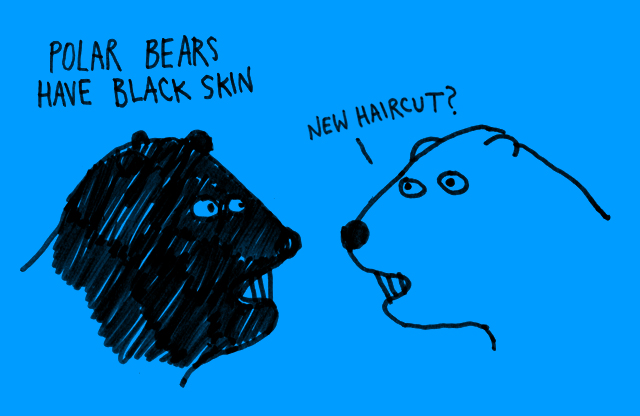
And now for my personal favorite…

As one who has been prone to using bears as an analogy for race/colorism in humans, I look at this as a perfect analogy of the “We’re all descendants of people from Africa” fact.  So, even the “white” people are technically “black” at their core. Am I making any sense here?

segregated orphans

A discarded term!?  I guess Bill Kemp has never visited this blog.  I’m grateful for this little piece of our history.

Booker T. Washington Home offered safe haven for black children

By Bill Kemp Archivist/librarian McLean County Museum of History | Posted: Saturday, December 12, 2009

For much of the 20th century, Bloomington-Normal residents thought it necessary to maintain segregated group homes for underprivileged children. One would be hard-pressed to find a better illustration of the embarrassing state of race relations over the decades than the fact that impoverished, neglected and unwanted children were separated by race until the 1960s.

From World War I until JFK and Camelot, African-American children lived at the McLean County Home for Colored Children, later renamed for Booker T. Washington, on Bloomington’s far west side.

This institution dates to 1918 when Alexander Barker and his wife Cedonia, with assistance from Margaret Wyche, took it upon themselves to care for six orphaned black children. Not long after, the Missionary Union, a group of four local churches stepped in to lend much-needed assistance. Though chartered by the state of Illinois in December 1920, the home was a rather primitive operation, with 25 children and 2 adults living in a six-room house with no plumbing or running water.

Improvements in the home, both in its physical plant and operation, soon followed. Located on the 1200 block of West Moulton Street, now MacArthur Avenue, the home’s mission was to “foster self respect, independence and good character.”

Overseen by a 15-member board of progressive-minded women, the home expanded to an adjacent residence. Also acquired in the early years were five nearby lots that were converted to truck gardens so the home could grow much of its own food. The boys generally worked the garden plots and the girls handled the laundry and canning, along with other duties.

The 1920 U.S. Census identified 15 of the 18 children at the home as mulatto, a since-discarded term for someone of mixed-race heritage. Back then, children with one black parent and one white were often outcasts, and into the 1940s, if not later, the home served as a safe haven for mixed-race children abandoned by their parents and local communities.

Money was always tight and the needs of the new arrivals great. “A special effort has been made to give each child his full quota of milk and butter fat, as many of the children were underweight,” read one report from 1921.

“There is absolutely no place of good repute open to such children in Illinois, except this one,” noted The Pantagraph two years later. “The question arises, shall a child be permitted to subsist on the contents of garbage cans … simply because of their race? Paraphrasing the Biblical interrogatory, ‘Who is thy brother’s keeper?’”

sometimes the apple does fall far from the tree

Thank God!  This is such an amazing story.  I’m so fascinated.  Not only by the bravery of a little white girl who crossed KKK, but also the shades of “mulatto” history sprinkled throughout.  Coon-hunting based on the supposed threat that black males posed to white women.  The “black” member of the Klan.  Passing.  Male chauvinism.  Homophobia. This is our sordid past.  And it is still haunting us.

Taking on the Klan

One summer night in 1965, 12-year-old Carolyn Wagner watched as Klansmen bound a young black man to a tree in her father’s field, accused him of violating the “sundown” rules in nearby Booneville, Ark., that forbade blacks from staying in town after dark, and lashed him a few times with a bullwhip as he cried out in pain and fear.

It was no different from beatings at other Klan gatherings her father had attended, but what happened next remains vivid in her memory: the Klansmen decided to tie the man to the railroad tracks below the pasture. When they were done, they ambled back to the field to discuss crops and politics. Wagner, a reluctant witness to her father’s Klan meetings, couldn’t stand it anymore. She stole down to the tracks, used a knife she kept in her boot to slash the rope that bound the man, and told him he could follow the tracks to Fort Smith, the nearest large town.

“That was a turning point,” recalled Wagner, now 56 and living in Tulsa, Okla. “I felt like I had made a difference when I was able to cut that man free. I realized I can make a choice to be a passive observer or I can become involved to diminish the harm that they’re doing. And that’s what I did from that night on, and that’s what I’m still doing.”

After years working for civil rights and children’s organizations, Wagner co-founded Families United Against Hate, a nonprofit group that helps people affected by bias incidents. Her experience growing up with a father in the Klan made her determined and fearless in her fight against hate. “That image of my dad and those men, and even the smells, are still with me, and they’ll always be with me. And it was very important that my children never know the world I knew when I was growing up.”

It was a world where Wagner’s father, Edward Greenwood, and his acquaintances gathered at least once a month at each other’s farms for Klan meetings, often bringing their children and grandkids. Because her father, then in his late 50s, couldn’t see well enough to drive at night, Wagner ferried him to meetings in a 1951 Chevy pickup. (Back then in rural Arkansas, it wasn’t unusual for children as young as 12 to drive on country roads.) The men — including lawyers, judges, cops and pastors — would begin their gatherings with a prayer and eschew alcohol. “They felt like they were doing God’s work,” Wagner said.

Sometimes, the gatherings would feature a beating like the one Wagner witnessed at her family’s farm. The victims were usually young men who’d been picked up on a pretext, such as paying too much attention to a white woman. “We would hear terms like ‘coon’ hunting,” she said. “My father would say, ‘I’m going ‘coon’ hunting.'”

But more often, the men would talk big, complaining about Presidents John F. Kennedy or Lyndon B. Johnson or even threatening to blow up the Supreme Court building. They’d eat bologna sandwiches that Wagner had prepared. Campfire smoke would mingle with the sweet-sour odor of Brylcreem, sweat and Old Spice. It was the one place where her father seemed happy. “I don’t remember seeing him smile or laugh unless he was with those goons,” she said.

…But her father probably would not have found a home in the Klan if his comrades had known about his heritage. “We knew there was this dirty secret in the family,” Wagner said.

In fact, her father’s great-great-great grandmother, Elizabeth Greenwood, was part Cherokee and part black, a former slave who’d settled in Arkansas when it was still part of France’s Louisiana Territory, according to family lore. Her father had cousins who identified as black, though he would have nothing to do with them. Wagner believes part of his racism stemmed from shame about his origins.

Wagner’s mother didn’t share her husband’s views about race, but she felt powerless to oppose him. Divorce was taboo in her family; resources for victims of domestic abuse were nearly nonexistent. “Mother never asked what he did [at Klan meetings],” Wagner said. “It was like she couldn’t bear to know.”

Wagner did receive support from her maternal grandparents, who passionately disliked her father. After Wagner secretly untied the black man from the railroad tracks, her maternal grandfather taught her how to use a 12-gauge double-barrel shotgun. She cut away the springs in the seat of the pickup to create a compartment where she hid the weapon, loaded and wrapped in a blanket. Though she never used it, she says she would have done so to defend herself or to help a potential Klan victim.

It wasn’t the last time she would defy all that her father represented. In April 1968, Wagner drove him to Memphis to take part in a Klan protest during the sanitation workers strike made famous by the appearance of Martin Luther King Jr. She was there when the civil rights leader was assassinated. In a Memphis newspaper, she read that the Department of Justice was planning a crackdown on the perpetrators of civil-rights era violence. After the assassination of Robert Kennedy two months later, Wagner, then 15, wrote a letter to the FBI accompanied by a list of names and addresses she’d copied from her father’s Klan directory. She wanted to get them all arrested. “I included my dad on that list,” she said.

Wagner, who used her maternal grandparents’ home as the return address, never heard back from the FBI.

She left home the day she finished high school and at 19 eloped with Bill Wagner, now her husband of 37 years. Her father died in 1980 when she was pregnant with her younger child, William. “I am so grateful that my children will have no memory of him or his politics,” she said.

But her own memories of her father came back strongly on William’s 14th birthday, the day he told his parents that he was gay. That day she and her husband’s biggest concern was for their son’s safety. “I had a very clear understanding of who the hatemongers were,” she said. They decided to move from their farm in tiny Booneville, a conservative town where homosexuality was widely condemned, to the more liberal university town of Fayetteville, some 120 miles away.

Still, they couldn’t protect their son from hate. Harassment at school culminated in a brutal assault in 1996. William, then 16, left school with friends to get lunch at a nearby convenience store when six teenagers shouted anti-gay slurs. They knocked him off his feet, then kicked him as he lay bleeding on the ground. “I thought about how easily that could have been my father’s group,” Wagner recalled. “And I wasn’t there.”

Two of the attackers were convicted of assault. After the Wagners filed a complaint on behalf of their son under Title IX, the federal anti-discrimination law, Fayetteville became the first public school district in the nation to enter into an agreement with the Department of Education’s Office of Civil Rights that required it to protect all students, including gays and lesbians, from harassment. The Wagners continue to advocate for young people who are targeted because of their actual or perceived sexual orientation.

Looking back on her childhood, Wagner remembers reading novels by Pearl S. Buck and biographies about women such as Harriet Tubman and Florence Nightingale. She wanted to learn about people who had survived difficult circumstances to help others, because she was determined to do the same.

“I found ways to survive,” she said. “I found ways to more than survive — to endure, to become stronger and to make our little corner of the world in the South a little better.”

re: willing to accept

Here’s another article that references the perils of placing biracial babies in adoptive homes.  Is adoptive a word?  Anyway, this just reinforces my strong desire to adopt a brood of biracial kids.  I guess it’s not going to be that difficult once I’m ready.  Getting ready is the difficult part.

Adoption fulfills dream of blended family for Erie County couple

By DANA MASSING

A chatty little social butterfly, 5-year-old Grace Ann May can be sassy and likes to show off a little.

That’s how Annette May describes the daughter who is most like May was as a child.

“Other than she’s brown and I’m white,” May said.

Grace is one of two girls and two boys who became part of the May family, of Greene Township, through adoption.

Gracie, as she’s called, and two of the others are biracial. The children, who range in age from 5 to 12, were joined by Annette and Scott May’s first biological child, a daughter born on Mother’s Day.

“White, black, purple with pink polka dots, it really doesn’t matter to us,” Annette May said. “Everybody deserves a family that loves them.”

…The Mays’ four adoptions were done through Catholic Charities, even though the family is Presbyterian. The agency works with families of all faiths. It had more adoption options and lower fees than other agencies, Annette May said.

Heather Hough, adoption counselor for the agency, said cute babies with blonde hair and blue eyes are the easiest to find families for.  “Everybody wants those,” she said.

Some children up for adoption have physical, mental or behavioral issues, said Ellen Miller, Catholic Charities’ special-needs adoption coordinator. She worked with the Mays on their adoptions.

The Web site for the Statewide Adoption and Permanency Network, or S.W.A.N., states that “special needs” refers to “children waiting to be adopted who are older, of minority heritage, part of a sibling group or have a disability” or “for whom finding an adoptive family may be more challenging.”

“A lot of our kids, their need is they need a family more than (they) have special requirements,” Miller said.

Annette May said one of the most difficult parts of adopting was answering questions about what she and her husband would accept in a child.

“You can’t make those decisions when you have a child naturally, so I felt very awkward feeling like I could make those decisions in this circumstance…  We had fertility issues,” Annette May said. “We’re kind of traditional folk. We never really financially could afford in-vitro (fertilization) or things like that, and I’m just not that type of person, not interested in going through all that. It sounds very cliché, but as a kid, I always thought it would be very neat to have a blended family.”

That family started with Grace Ann. She was 10 days old when the Mays took her home. They were early in the adoption process and hadn’t expected results so soon, but no other family wanted a biracial baby at the time, Annette May said.
“We’ve always been open to pretty much any age and any race,” she said.

When Gracie was 6 months old, the couple heard from Miller at Catholic Charities again.

“She called and said, ‘We have a biracial little boy, born at Hamot yesterday, needs somebody to pick him up tomorrow. Are you willing?'” Annette May recalled.

“At the time, we just kind of thought, ‘This is so unusual.’ We had those thoughts of, ‘People say it takes forever. It’s a boy and a girl. Are we ever going to have the opportunity if we turn it down?  And so we said yes, and I thought, ‘Hey, people have twins all the time. What’s the big deal? We’ll just get it all out of the way at once — diapers, bottles, the whole thing.'”


Read the rest of the Mays’ story HERE

don’t call me george

The Society for the Prevention of Calling Sleeping Car Porters “George” was a lighthearted association with a useful, if incidental, cause. Most railway porters were black, and many passengers called them all George, following the racist custom of naming slaves after their masters. (George Pullman ran the company that made the cars, so the porters were regarded as his servants.) Strangely, the prevention society was founded not by the black porters, but by white railway employees who were actually named George. Apparently they were either annoyed by the tradition or thought that such a society would be a good joke. People did think it was funny, or at least inoffensive. At its peak, the society had 31,000 members, including King George V of the United Kingdom, Babe Ruth (whose given name was George), and French politician Georges Clemenceau. source

The Society for the Prevention of Calling Sleeping Car Porters “George” was a lighthearted association with a useful, if incidental, cause. Most railway porters were black, and many passengers called them all George, following the racist custom of naming slaves after their masters. (George Pullman ran the company that made the cars, so the porters were regarded as his servants.)

Strangely, the prevention society was founded not by the black porters, but by white railway employees who were actually named George. Apparently they were either annoyed by the tradition or thought that such a society would be a good joke.

People did think it was funny, or at least inoffensive. At its peak, the society had 31,000 members, including King George V of the United Kingdom, Babe Ruth (whose given name was George), and French politician Georges Clemenceau.

via

I found some letters from 1937 to Time magazine in reference to an article they ran on the aforementioned Society.  I wonder whatever happened to John from Detroit.

TIME.com

Letters, Jan. 11, 1937

Double Interest Sirs:

Your article, TIME, Dec. 7, under People interests me doubly.

Whether porters become “Porter” or merely cease being “George,” I remain

GEORGE PORTER

Wallingford, Conn. Georges v. Electromaster

Sirs: Your issue of Dec. 7 failed to mention that the S. P. C. P. G.* is a trifle more than a “joke,” that it does everything in its power to help “George,” that its last known public appearance was in the U. S. Patent Office in July 1930. Electromaster, Inc., manufacturing cleaning and scouring powder, intended to market the product under the trade-mark of “Let George Do It” and for that purpose filed a trade-mark application. Opposition #10833 was filed by the Society. The Notice of Opposition recites that the society is “unincorporated under the laws of all States and having an office and place of business at in West Monroe St., Chicago, Illinois, not to mention the B. & O., the D. L. & W., the Santa Fe and points west.” Four grounds for opposition are set forth; the second goes as follows: “The mark which we are opposing comprises the hateful admonition, ‘Let George Do It’.

Now it is doubtless true that the Georges have performed most of the useful work of the world since the memory of man runneth not to the contrary, but the facile and facetious manner in which responsibility is delegated to us by Tom, Dick and Harry and others too lazy and too incompetent to assume it themselves is decidedly irksome to us Georges. . . . Besides, why should George do it?” . . .

Respondent denies that the trade-mark ‘Let George Do It’ is a hateful admonition; and further denies that the Georges have performed most of the work of the world, or any material part thereof, or that any of it has been of any value to humanity, and demands strict proof thereof. Further answering, Respondent is not concerned, or in any manner interested, excited, pleased or horrified regarding the responsibilities delegated to the Georges by Tom, Dick and Harry, or any others, or that such responsibilities are decidedly irksome to the said Georges, because they have a way of avoiding the seriousness thereof. Besides, why shouldn’t George do it? …

HENRY GOLDHOR

Newark, N. J.

Sirs: Your issue of TIME dated Dec. 7, p. 80, re The Society for the Prevention of Calling Sleeping Car Porters “George.” I wonder how many of your readers know of an organization whose purpose it is to discourage the use of a distinguished Christian name to designate an endroit which invites not even the slightest thought of anything distinguished; I have reference to “The Society for the Prevention of Calling Lavatories John.” The Society is of Detroit origin and confine, but it may be that mention of its existence in TIME will prompt the organization of companion chapters in other centers—perhaps even a national unit.

JOHN W. MACNEV

President

“Society for the Prevention of Calling Lavatories John” Detroit, Mich.

Read more:http://www.time.com/time/magazine/article/0,9171,757243-3,00.html#ixzz0YRZS3SJZ

re: the effect of skin tone

I thought that was such a great experiment and the findings so very revealing.  Coincidentally, I came across these new cameras yesterday and i thought to myself, “If these cameras are exactly the same (color aside), why’s the black one gotta be the devil while the white one’s an angel.”  I think it borders on modern day racist advertising if you consider it a bit too seriously (perhaps).

Which would you prefer?  You can buy one here

the effect of skin tone

The Science of How We See Obama’s Skin Color

Andrew Romano

When it comes to the policies and politics of Barack Obama, it’s no secret that liberals and conservatives don’t see eye to eye. But according to behavioral sciencist Eugene Caruso of the University of Chicago’s Booth School of Business, these differences in perspective may literally be a difference in perception. In a new study, Caruso and colleagues Emily Balcetis of New York University and Nicole Mead of Tillberg University asked a group of undergraduates which of a series of photographs of Obama–some of them secretly lightened and darkened–best represented who he is as a person. The results were striking: while self-described liberals tended to pick the digitally lightened photos of the president, self-described conservative students more frequently picked the darkened images. The more one agrees with a politician, in other words, the lighter his skin tone seems; the less you agree, the darker it becomes. To discuss how political affinities influence perception–and how politicians and the press could take advantage of these findings–NEWSWEEK’s Andrew Romano spoke to Caruso. Excerpts:

How did the study actually work?
Essentially we were interested in whether political party influences how people literally see the world, and how they may see different depictions of candidates as representative of who they really are. So to test this we gathered up a bunch of photos of Barack Obama and digitally altered them to create a version where his skin tone appeared a bit lighter and a version where his skin tone was a bit darker than it appeared in the original photograph. And then we just showed people several different photos and asked them to rate each one on how much they represented who he really is. What we found was that participants who told us that they had a liberal political orientation rated the lightened photographs as more representative of Obama than the darkened photographs, whereas participants who told us they had a more conservative ideology rated the darkened photographs as more representative of Obama than the lightened ones. 

I’m no expert here, but you’re confident that it’s the skin tone that changes “representativeness” in the eyes of the voter, as opposed to something else about the photographs—like pose, or background, or facial expression?
That’s a great question. What we did was essentially take three different photos with three different poses, and created for each photo a lightened and a darkened version. And then we randomly selected the combination of pose and skin tone that we showed each participant.

So your findings about “representativeness” were consistent across poses—the conservative will be twice as likely to say a “darkened” Obama was representative, regardless of which image of Obama was being darkened?
Right. We were experimentally able to isolate the effect of skin tone because some people saw a lightened version of pose #1 and others saw a darkened version of pose #1—and independent of the pose the lightened versions seemed most representative to liberals and the darkened most representative to conservatives.

Were you surprised by the results?
A little bit. Some of my research deals with how people who have different views on a subject are able to try to understand the views of someone on the other side, and the general finding is that people aren’t particularly good at really coming to understand the perspective of someone with whom they disagree. Beyond that, though, I got interested in this notion of whether our beliefs can actually affect the way we see the world—of whether they can actually affect our perception of objects or people in our environment. And it turns out they can.

Ultimately, what does it mean that someone believes a lightened version of Obama is more representative of him than a darkened version, and vice versa? What are the larger implications of these differences in perception?
Partisanship can affect all sorts of beliefs. It’s not surprising that a liberal and a conservative who read the same health care bill would come to very different conclusions about its merits. But I think our work is more akin to having a liberal and conservative look at the exact same physical copy of a bill sitting on the desk in front of them and disagreeing over how thick it is. That is, even something that we feel we should be able to see similarly, like a person’s racial identity or physical characteristics, can be influenced by our desire to see that person favorably or unfavorably.

But isn’t there a chicken or egg relationship here? Do conservatives see Obama as darker and are thus prone to dislike him, or do they dislike him first and then see him as darker because of it?
That’s a great question. One of the things we’re trying to do now is experimentally try to tease those two options apart. Basically, what we have in our current paper, the one that’s out now, is correlational studies of Obama where we don’t really know what comes first or what’s causing what. The first study in the paper tries to address part of what you’re asking. If we get people to think about a novel candidate and simply manipulate whether they agree with a candidate or not, we can show that people who think this novel biracial candidate agrees with them later report that the lightened photos are more representative of him, suggesting that if you agree with someone then you may come to see him as lighter. From that we can speculate, exactly as you have, about the reverse path—and that is, seeing images of someone when his or her skin tone looks darker may cause people to like that person less than seeing images of that person with lighter skin tone.

read the entire interview here