re: doubles

I’m not a fan of the old “best of both worlds” myth.  Not unless the other side of that coin -worst of both worlds- is given as much weight.  However, I didn’t want to simply tout a “tragic japanese-american” fallacy over here today either.  Here’s what I found to counteract that.

The Hapa Advantage

By Leah Nanako Winkler

via

“Hybrids are better”—Shayne Kao

…In the belated honor of “LOVING DAY,” I’ve asked 10 hapas in NYC and beyond (including myself) the following: what we like about being biracial, and how it has shaped us in this world. So, let’s eat some good food and enjoy the sunshine as this community continues to grow and we find each other and ourselves among the masses!

PERSPECTIVE
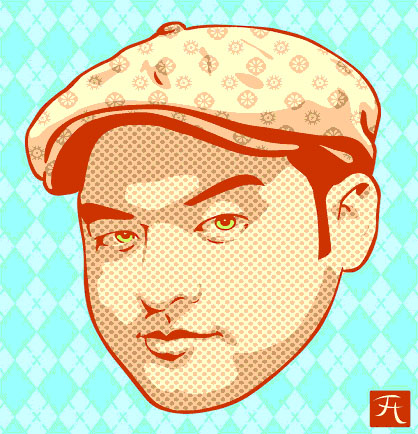

Name: Teddy Hose

OCCUPATION: Illustrator, Animator, Graphic Designer

NATIONALITY: Dad is American (3rd Generation German), Mom is Japanese (straight from Japan).

TEDDY SAYS:
I definitely enjoy being biracial, it gives me perspective culturally, and I usually get a positive response when people ask me about it.  I like the feeling of being unique because I work in the creative field where that is highly valued.  I also believe it makes me more tolerant since the East’s values and tendencies are clearly different than the West.  I can’t help but see things from more than one angle, which can be refreshing. I’m honestly able to communicate better with non-white people in my experience.  Being able to connect with someone based on feeling “different” is always something I look for, as cliché as that sounds.

I think one advantage with being hapa is that we don’t have the typecasting that comes with being one race. Not to say there are those who equate mixed race people to one race (Obama being declared as the first “black” president), but this aspect is great for someone who’s an artist like me.

THE IN-BETWEEN LIFE

NAME: Stephanie Silver

OCCUPATION: Actress

NATIONALITY: Half-Japanese, Half-German/Austrian/Hungarian—aka Germanese, or Double-Jap, or Jap-Squared, or the Axis Powers (minus Italy).

STEPHANIE SAYS:  I grew up with ramen and tempura dishes one week, and pastrami sandwiches and matzo ball soup the next. Which dessert do I like more: mochi or cheesecake? At a frozen yogurt shop, I don’t have to choose anymore. I can have both flavors, a twist, a blend, a hybrid!

Feeling a connection to two distinct cultures. Recognizing my features in an Expressionist painting, and my emotions in a woodblock print. Strangers telling me I should go to Israel, no Berlin, no…Okinawa. Remembering trips to Hawaii during Summer, and New York in the Fall. Learning to surf and going to Temple. Living the in-between life in Los Angeles. Being accepted by most Asian and Jewish groups and looking non-descript enough to pretend I was Latin or Creole to fit in there too. But feeling especially drawn to people with a similar mixed heritage. I had a deeper understanding with them and I was eager to find common ground.

I think seeing how one side of my family would ostracize one or the other of my parents made me embrace different ethnicities more. I’m constantly finding myself attracted to minorities. And I think their families are more accepting of me because of my mixed heritage. It’s as if I’m neutral territory, truly American. I could date Raymond, who is Korean, and his parents wouldn’t mind because I was only half-Japanese. My Japanese grandparents certainly would not feel the same about him. I could be considered as a potential wife for David and Daniel, both Jewish, simply because of my last name.

People are comfortable around me because I blend easily, but they’re curious too. I hear them saying to their friends with pride, “she looks Hawaiian, right, but her father’s Jewish!” I was born into something exciting and somewhat new. We’re a growing group of biracial mixes, foreign yet distinctly native. We’re the physical manifestation of the end of racism.

THE ROAD LESS TRAVELED
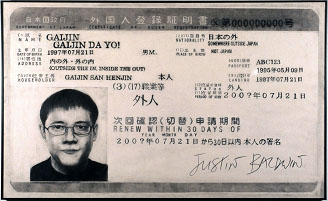
NAME: Justin Baldwin

OCCUPATION: Artist, but an unknown one, so I have a day job working for a Japanese company.

NATIONALITY: I am an American, as is my father. My mother is now a U.S. citizen, but was born in Japan. On my father’s side of the family, there is Irish, German, British, and who knows what else … and, I suspect that on my mother’s side, there may be some Russian (going back a couple hundred years), since my mother has fair skin and green eyes (plus, she’s from Sapporo, and the prefecture of Hokkaido is closer to Russia than anywhere else in Japan).

JUSTIN SAYS:
Although I didn’t study Japanese until I finished college, the biracial factor inspired me to study Japanese and eventually live in Japan. This has subsequently made a profound impact/influence on who I am, and what I do. I suppose, in this sense, it has helped secure jobs (first with the JET Program, and then with the Kurashiki Board of Education, and now with my current corporate incarnation as a Professional Gaijin/Scapegoat). Being biracial in college helped me connect with Roger Shimomura as a student, who remains a close friend and mentor. So in many ways, even though being biracial has not always resulted in the most pleasant experiences, it has led me down avenues that I might not otherwise have taken, meeting new people and places that do end up being very beneficial and positive. Besides, as I mentioned, there’s a certain freedom to being undefined.

DOUBLE NOT HALF

Leah Nanako Winkler

As I scroll through these responses, once again, I am overwhelmed with a simultaneous sense of comfort and disorientation. Entering my mid-20s, I’ve come to accept and embrace the positive effects of my ethnic background, by associating with and learning from the people mentioned in this article. I am learning quickly that my identity crisis/investigation is only a small fraction of a cultural search of where we, as biracial people, stand in this society. The importance of seeing the glass as half-full, as opposed to half-empty, is equal to seeing ourselves as double, rather than “half” of two races. In many ways, we are lucky and unsheltered. I am excited to see how this perspective continues to grow, as I meet more and more of you and hope to strengthen our voice in any and every way possible.

© 2009 Leah Nanako Winkler

doubles

Although “mulatto” is not the “double” on which this article focuses, the perils of navigating a biracial identity that remains disrespected by, unsupported by, unacknowledged by, and unacceptable to the mainstream society surrounding the individual are so accurately communicated that I just had to post this.  Crux of the issue: “feeling of being an incomplete person has sometimes led to deep depression.”  I think that the only way around this is to eradicate the illusion of separation by infusing into our collective consciousness the truth of oneness.  No halves.  No sides.  No divide.

Also touched upon here is the aspect of chaos that the Americans have injected into the Okinawan landscape that is worth analyzing.


Okinawa-born Japanese-American musician Caroline Lufkin (unrelated to article)

In Japan but surrounded by U.S. influence, Okinawa struggles with split identity

By Chico Harlan

VIA

CHATAN, JAPAN — These days, when Melissa Tomlinson describes her fraught relationship with the United States, she speaks in English, the language she once rejected.

She grew up here on the island of Okinawa. Her mother was Japanese, and her father was an American who served in the U.S. Army, came to Okinawa, fell in love, fell out of love, then fell out of touch.

“I had plans to track him down, find him and punch him in the face,” said Tomlinson, 22. “I just wanted to figure out my identity.”

Tomlinson’s family tensions illustrate the complex cultural clashes that dominate the politics of Okinawa and, lately, relations between what have been the world’s two largest economies as they cope with a rising China and a belligerent North Korea.

For the more than 60 years since the end of World War II, native Okinawans and U.S. troops stationed on nearby bases have developed deep, passionate and generation-spanning ties that complicate political and diplomatic debates about the future of the U.S. military here.

Those passions have recently claimed the head of one Japanese prime minister, Yukio Hatoyama, who had called for the Americans to be booted off Okinawa, and caused his successor to sharply tone down his party’s assertive stance toward the United States.

A vocal majority of Okinawans still demand closing the Futenma Marine Corps Air Station. American officials, citing proximity to North Korea, China and Southeast Asia, insist it remain in Okinawa. Japan, in its attempt to mediate, has only frustrated both sides.

The current resolution, which Prime Minister Naoto Kan says his government will honor, calls for Futenma’s eventual relocation to a less populated region in the north of the island. Kan apologized last week for the “heavy burden” facing Okinawans.

Many locals on this Pacific island hosting more than half of the 47,000 U.S. troops stationed in Japan complain most commonly about the noise, congestion and crime. But emotional blood ties and cultural confusion amplify those concerns. Tormented by her identity, Tomlinson said she has tried to kill herself “a couple times” in the past two years.

Tomlinson said she struggles to convince herself — and others — that she is truly Japanese and Okinawan. She called her identity “ambiguous” and said her feeling of being an incomplete person has sometimes led to deep depression.

A generation of biracial Okinawans know about intercultural relationships, writ small. They know about romance and separations, child-support battles and reunions. They know that Japanese children refer to their biracial peers as “halfs,” and nowadays, they know of the local American-Asian school, for biracial children, where those kids are taught to call themselves “doubles.”

Okinawa’s demographics separate it from mainland Japan. Here, the rates of single-parent households and divorce are twice the national average. At the American-Asian school, 70 percent of the 80 students come from single-parent households, Principal Midori Thayer said.

“Unfortunately, some kids never live with their father, but they cannot lose their DNA,” she said. “Their body shows that they are not 100 percent Japanese.”

Denny Tamaki, 50, the local representative to the Japanese parliament, knows only that his father, an American serviceman whom he has never met, was named William.

When William returned to the States and Tamaki’s mother decided not to follow, she burned his photos and letters. When they moved to a new home, she didn’t give him their new address. When Tamaki turned 10, his mother took him to a government office, where they officially changed his first name to Yasuhiro.

Tamaki knows little English and wants Futenma moved off Okinawa because “it feels like we’re living under occupation.” But he has a passion for American music — Aerosmith, for instance — and American television shows.

A decade ago he tried to track down his father, with no luck. When his kids ask about their grandfather, he tells them that it would take the detectives from “CSI: Miami” to find him.

Search for a father

Tomlinson’s mother and father were married on Okinawa, and then moved together to Georgia after his tour on the island ended in 1975. Tomlinson was born in Hinesville, Ga., while her father was stationed at Fort Stewart.

Tomlinson’s parents separated when she was 3; she returned to Okinawa in 1990 with her mother. Her father retained custody of their two older children, who stayed in the United States with him.

Growing up, Tomlinson said, she remembered nothing about the separation, and never spoke to her father or siblings. “I’ve had to live with some tough decisions,” said Melissa’s father, who requested that his name not be used.

Tomlinson said her conflicted feelings were often fueled by her mother, who told her she looked “like an American” and tried to hide her from her co-workers. She said they fought frequently, and she told her mother: “Why did you have me? I want to be a Japanese, but I don’t get to choose.”

In school, her dual identities battled. Sometimes she was an American who didn’t speak proper English. Sometimes she was a Japanese who didn’t look Japanese. For several years, she tried to forget every English word she knew.

During high school, she said, a teacher encouraged her to learn English because she would need it if one day she wanted to track down her father. “Maybe you can hear the truth,” the teacher told her. “You should know both sides.”

At the University of the Ryukyus, Tomlinson tried to find English-speaking friends. She watched American television without the subtitles. Still, she confided to friends that she felt depressed.

From her mother, Tomlinson had heard only nasty tales about her father, who was once stationed at the Army’s Torii base. After her junior year in college, in spring 2009, she decided to try to find him and left school for a time.

In March, her U.S. military ID card, a privilege from a relationship she never had, was expiring. The Army passed along her father’s address. She e-mailed him, asking for him to sign the required forms for a new ID.

Weeks later, she heard back from the father who had not seen her since she was 3.

“Hi Melissa, Hearing from you, to say the least, came as quite a shock,” he wrote. “I was not aware that you could speak English let alone read or write it. The last time we had contact, and I am sure you do not remember it, you could only speak Japanese. Trying to bridge the gap with words after all this time would be futile. In life sometimes we have to make decisions that we don’t know if they are right or not, but we have to live with them.”

Tomlinson read and reread the e-mail. She discussed it with friends, and together they parsed the words. Their relationship continued, e-mail by e-mail, and she learned that he liked fishing, and that he missed Okinawa, and that he says he has thought about her every day.

For all these years, he wrote, he avoided contact because he didn’t want her to be torn between parents.

“It would have made your life miserable,” he wrote.

another social taboo

The first taboo being openly discussing biraciality without adhering to the one-drop rule.  Of course I find this blog post to be interesting, or I wouldn’t put it up here.  I appreciate the bit about biracial identity as well as the outline of the overall struggle and the shame that go along with the labels of mental illness in this country.  Especially in the black community.

Coming out of an entirely different closet… the one of mental illness

by Eliza Barnett

VIA

Unfortunately as prevalent as mental health disorders are the nation (50+ million diagnosed in the US alone) and world wide, it still tops the ranks as the most difficult to admit.

Higher than revealing to be a victim of domestic abuse, sexual assault, or molestation, harder than confessing a drinking problem or previous bankruptcy; surveys have even shown it to more difficult than admitting ones gender identity or homosexuality. Sufferers face significant social taboos. And it doesn’t affect just one type of person. Mental illness knows nothing of age, race, gender, or economic background.

You don’t have to personally admit it yourself to believe the notion the reality that people are more likely to break off, or not even start, a relationship with someone with mental issues -which I for one find particularly interesting because members of society are more likely to stay with someone with a physical disability. People with mental disorders tend to prefer to hide their illness like major depression and anxiety, because unlike people with physical illnesses, people with mental disorders must also fear being rejected by family & friends, harassed, fired or not hired, or denied child custody—just for starters.

(Please check out this personal blog discussing the Price of being Bipolar in Public)

Last week I had an entire conversation with a friend about them being practically afraid to admit their Christian faith at their workplace because of the negative assumptions his non-same faith based peers might think about his character or behavior.

Once you know someone’s religious preference it changes your whole personality to people who don’t agree with you. Sometimes it’s like every negative image or thought they have about it becomes who I am as a person- even though I haven’t changed. It’s their behavior towards me that has.

I’ve read more than a few articles of a biracial person attempting, or enjoying the ability to pass for one race over another—not because they have a problem with it necessarily themselves, but because other people do.

Sometimes it’s like every negative stereotype or prejudice they have against a race I share membership of encompasses who I am as a person. Granted racism is an ongoing issue for those of one race, but it is just as prevalent towards those of plural heritage.

Sexual orientation discrimination —don’t even get me started.

(great message board discussion here coming coming out as gay with coming out as bipolar)

Mental illness sufferers are also victims of discrimination and the issue continually needs to be recognized.

“I’m Asian, I’m gay, and I have faced discrimination – but not for the reasons most people think; it was actually when I got depression that I faced most discrimination.”

(Quote from an article in the Guardian)

Attempts to end this discrimination are being lead by strong individuals, in the public eye, and by everyday people. Changed perception comes through increased knowledge and visibility.

People need to be taught that mental disorders don’t come from places of personal weakness, and don’t make everyone violent or unpredictable. They need to be made comfortable in seeking help. (Two thirds of sufferers in need of treatment do not seek it. ) Even more importantly open, honest visibility helps others with the illnesses themselves to stand up without shame.

Negative stigma’s of this variety aren’t just external, they’re internal. Who wants to think of themselves as crazy…? When feelings of guilt, shame, or a notion that you’re somehow weakened for needing help are thrown in the mix, it only reinforces the negative feelings.

Isn’t it always the case that telling the ones you love is the hardest thing to do? This isn’t any different. And ignorance towards the idea of mental disorders can to be hard to deal with; some people may not even believe mental illnesses exist. Americans particularly have vast misconception that all mental disorders can be simply be self-corrected with enough work.

Similar to the first step in admitting you have an addiction; your own acceptance is where it all begins. Examine your own feeling first and foremost. You have control over who you tell, so it’s okay to be cautious about it.

“There is no rule for who needs to know about your mental illness diagnosis, but sharing it with someone is a great way to get support.

The silence helps maintain the ignorance about mental illness.”

(http://www.webmd.com/mental-health/features/coming-out-about-mental-illness?page=2)

That being said,

“It doesn’t mean that it is always beneficial to open up indiscriminately about mental health, to your detriment. It would be wonderful if everybody came out.

But it is a very subjective decision and consequences should be considered. Society isn’t at the place of acceptance that it needs to be. Not everyone in the world needs to know if you struggle with diabetes or hypertension or some other illness. The same is true for mental illness. Those with the disorder, are the ones in charge, and should think about what the payoff is to share information about their mental health. For example, if you need to miss work to see a psychiatrist, you might want to tell your employer about what you are going through.”

When someone does react negatively, agree to disagree or try to educate that person. Share educational materials. Share your own experience. And to those on the receiving end of the information, think before you speak.

“Try to react the same way you would if you were told about a physical health problem that you don’t know much about. Avoid trying to be the hero or savior. Being empathic and understanding is one thing, but trying rescue someone is a completely different. You shouldn’t try to fix them. This is something that is way beyond your capacity.”

Treatment and support from others goes a long way; the mental illness journey is a rough one for everyone involved. Help is required, it’s critical down the path of recovery, management of ones condition, and ability to lead constructive and healthy lives. Support can and does come from strangers as well, who share in this unity of diagnosis. As corny as it sounds, sharing is caring.

–Posted By Eliza Barnett

speaking of drake…

I’m super-curious about this guy and am itching to know more about the experiential intricacies of his Black/Jewish upbringing, and how he reflects on all of that from where he sits currently as the “New Jew in Hip-Hop.”  I don’t think this is a direct quote from Drake, but it rings true:  “Finally, his outsider background has become an asset.”  That’s exactly how I feel about my own self and I wouldn’t be surprised if a multitude of biracials are emerging into the same space of appreciation for the experience and are cultivating ways to make use of it in a world that was not ready to handle our truth before.  Some still aren’t ready.  Look out, some!

The New Face of Hip-Hop

By JON CARAMANICA

New York Times

For most of his teenage years Drake, tall, broad and handsome, was still known as Aubrey Graham (Drake is his middle name) and played the basketball star Jimmy Brooks on the popular Canadian teenage drama “Degrassi: The Next Generation.” In the last 18 months, though, he’s become the most important and innovative new figure in hip-hop, and an unlikely one at that. Biracial Jewish-Canadian former child actors don’t have a track record of success in the American rap industry.

But when “Thank Me Later” (Aspire/Young Money/Cash Money) is released this week, it will cement Drake’s place among hip-hop’s elite. It’s a moody, entrancing and emotionally articulate album that shows off Drake’s depth as a rapper, a singer and a songwriter, without sacrificing accessibility. That he does all those things well marks him as an adept student of the last 15 years: there’s Jay-Z’s attention to detail, Kanye West’s gift for melody, Lil Wayne’s street-wise pop savvy.

In rapid fashion Drake has become part of hip-hop’s DNA, leapfrogging any number of more established rappers. “I’m where I truly deserve to be,” Drake said over quesadillas at the hotel’s lobby bar. “I believe in myself, in my presence, enough that I don’t feel small in Jay’s presence. I don’t feel small in Wayne’s presence.”

But “Thank Me Later” is fluent enough in hip-hop’s traditions deftly to abandon them altogether in places. Finally his outsider background has become an asset. As a rapper, Drake manages to balance vulnerability and arrogance in equal measure, a rare feat. He also sings — not with technological assistance, as other rappers do, but expertly.

Then there’s his subject matter: not violence or drugs or street-corner bravado. Instead emotions are what fuel Drake, 23, who has an almost pathological gift for connection. Great eye contact. Easy smile. Evident intelligence. Quick to ask questions. “He’s a kid that can really work the room, whatever the room,” said his mother, Sandi Graham. “Thank Me Later” has its share of bluster, but is more notable for its regret, its ache.

As for Ms. Berry’s cousin, Drake’s interested, of course, but wary. “I think I have to live this life for a little bit longer before I even know what love is in this atmosphere,” he said. More fame only means less feeling, he knows.

Dodging vulnerability has been a fact of Drake’s life since childhood. His parents split when he was 3. An only child, he lived with his mother, who soon began battling rheumatoid arthritis, a condition that eventually prevented her from working, forcing Drake to become responsible at a young age. “We would have this little drill where, Lord forbid something happened, if there was a fire or an emergency, he would have to run outside and get a neighbor and call 911,” Ms. Graham said. His father, Dennis, who is black, was an intermittent presence — sometimes struggling with drugs, sometimes in jail.

“One thing I wasn’t was sheltered from the pains of adulthood,” Drake said. When something upset him as a teenager, he often told himself: “That’s just the right now. I can change that. I can change anything. The hand that was dealt doesn’t exist to me.’ ”

From an early age he’d been interested in performing, whether rewriting the lyrics to “Mary Had a Little Lamb” or spending time as a child model. By then, he and his mother were living in Forest Hill, a well-to-do, heavily Jewish neighborhood on the north side of Toronto, where he attended local schools, often the only black student in sight. His mother is white and Jewish, and Drake had a bar mitzvah. At school he struggled academically and socially. “Character-building moments, but not great memories,” he recalled. In eighth grade he got an agent and was soon sent off to audition for “Degrassi: The Next Generation,” an updated version of the popular 1980s Canadian drama.

He auditioned after school, on the same day, he said, that he first smoked pot from a bong. Nevertheless he landed the role of the wealthy, well-liked basketball star Jimmy Brooks, who was originally conceived as a white football player.

“Part of his journey is trying to figure where he does fit in in the world, having a white Jewish mom and a black, often absentee father,” said Linda Schuyler, a creator of the show. “It’s almost a comfort factor with Jimmy Brooks. That was the antithesis of his life at the time. It was probably reassuring and a bit escapist for him to play that role.”

Sometimes he was hiding even when the cameras were off, sleeping on the show’s set. “When I woke up in the morning, I was still the guy that could act and laugh,” he said. “It’s just that home was overwhelming.” Along with “Degrassi” came a new, more diverse school closer to the set, where he first tried rapping in public. As he got older, he also tried out his verses on one of his father’s jailhouse friends, who listened over the phone…

READ MORE

yay, shakespeare in the park

I’m thrilled to know that The Public Theater is once again “putting this mosaic out into the world.”  And that Ruben Santiago-Hudson has biracial kids.  And that he speaks openly about it.  Actually that’s not extraordinary, but I didn’t know that about him before.  I love The Winter’s Tale.  My favorite monologue is in it.  If I weren’t too persnickety to wait in line for hours for tickets, I would be sure to see this.  However, it’s not gonna happen.  My loss, I’m sure.  Just for clarification, the “yay” is for depicting a “non-traditional” marriage/family.  Not for Hudson marrying a Swede and having mixed kids.  Although I like that a lot too.

santiagohudson

Actor Ruben Santiago-Hudson and his twins Trey and Lily attended the “Magic & Bird: A Courtship of Rivals” film premiere on February 17, 2010 in Westwood, California.

Ruben Santiago-Hudson Tells the Tale

The actor discusses starring in the Shakespeare in the Park production of The Winter’s Tale.

By: Brian Scott Lipton

VIA

Ruben Santiago-Hudson has been the epitome of excellence for over 30 years; winning a Tony Award for Seven Guitars, numerous honors for the HBO adaptation of his acclaimed solo play Lackawanna Blues, and plaudits for his direction of several shows including Things of Dry Hours and The First Breeze of Summer. This summer, he’s starring in the Public Theater’s Shakespeare in the Park production of The Winter’s Tale, and in the fall, he’ll be back co-starring on ABC’s hit crime drama Castle. TheaterMania recently spoke with Santiago-Hudson about these projects.

THEATERMANIA: What made you want to do The Winter’s Tale this summer rather than just take a nice breather between shooting Castle?
RUBEN SANTIAGO-HUDSON: I just love the challenge of doing Shakespeare. I am part of the Public Theater family and I got a call to look at the play, and before I could even finish it, I said I’d love to do it.

TM: Your character, Leontes, is considered one of the most difficult in the canon, since you accuse your wife and best friend of infidelity without any seeming cause. How do you justify that?
RSH: It is a challenge to make that action comprehensible to the audience. But I look at the text. Polixenses may be my friend, but he’s stayed with my family for nine months — and I think if anyone stayed that long at my house, I’d find fault with them. And I am sure over that time, Leontes has seen some glimpses of unusual behavior — perhaps wearing less clothing around each other or laughing too loud.

TM: Still, you cause your wife to kill herself and banish your infant daughter. How is the audience supposed to sympathize with that?
RSH: I hope the audience sees that I balance my cruelty with much love and that my actions came from defending my honor and that my rage is from jealousy and madness. It’s important that I am not just being the stereotypical angry black man. And when it all comes clear, I’m the most penitent person — I’m almost a saint by the end of the play.

TM: As is typical of many productions at the Public, the cast is completely multi-racial. For example, your wife, Hermoine, is being played by Linda Emond, who is white. What are your thoughts about this?
RSH: I think it reflects the mirror of modern society. When you look in the newspaper, you see Sandra Bullock with a black child. And this play reflects what my real family looks like — my wife is Swedish and our children are biracial — so it’s great to put out this mosaic to the world. And I think we should put the best artists we can on stage, and what I love about the Public Theater’s audience is they feel the same way. They don’t care if the king is black and the queen is white; they’re out there to see this play done well.

Linda Emond and Ruben Santiago-Hudson<br>in rehearsal for <I>The Winter's Tale</i><br> (© Nella Vera)

Linda Emond and Ruben Santiago-Hudson
in rehearsal for The Winter’s Tale
(© Nella Vera)

“kinds” of biracial

Fantastic commentary on something that I totally missed in the media.  I honestly don’t know who Drake is.  I’ll look him up in a sec…. Oh. I see.  Anyway, Whitney Teal makes such great points here (a fav being that one would never compare G.W. Bush to Eminem), and has me wanting to make a list of all the “kinds of biracial” that I can imagine.  And then I want to study the intricacies of the experiences that molded the various varieties of biracialness.  I love biracial.  It never gets old for me.  I suppose you can call me Captain Obvious for that statement.

Is One Mulatto the Same as the Next?

VIA

By Whitney Teal

Has the election of President Obama changed the way we think about biracial people in this country? I’d argue that it’s questionable. Especially when people are drawing comparisons between the prez — a half-white, half-Kenyan, Ivy League-educated lawyer — and Aubrey Graham, otherwise known as Drake, who is a half-Jewish and half-African-American entertainer from Canada. Yeah, I don’t see the similarities either.

Image of Thomas Chatterton Williams

thomas chatterton williams

But TheRoot.com contributor Thomas Chatterton Williams, who describes himself as the son of a black father and a white mother,” seems to think that the two mulattoes (his word, not mine) deserve a comparison. Yes, Williams thinks that it’s helpful to compare a Canadian rapper and the President (as he puts it, one of the “most visible mulattoes living and working today”). And he’s not alone, either. A few months back, a couple of my Twitter friends and I ripped Chester French band member David-Andrew ‘D.A.’ Wallach a new one for tweeting that he was discussing “all the similarities” between the two men. When I asked him to explain himself, he replied, “For one, I think they’re both extremely studied.” Womp, womp, cop-out. Lots of men are studied. President Obama and Drake are both, simply, biracial. And they’re not even the same “kind” biracial either, but that doesn’t seem to make a difference.

When I showed my sister the story on The Root, she screamed (via Google Messenger) and replied, “Obama and Drake in the same sentence? Do people mention [President] Bush and Eminem in the same sentence?” She’s right. White men are allowed to choose their own identities. Black men not so much, and biracial men certainly not. Which begs the question, why can’t we see that one biracial person is not the same as the next?

In general, polite company, we as general, polite people, recognize that a person’s experiences are not solely dictated by their race or ethnicity. For example, I don’t think people considering Lucy Liu, a famous actress, and Connie Chung, an award-winning journalist, would try and argue that the two have much in common, at least on the surface. The same with Denzel Washington and Reggie Bush, or Barbara Streisand and Heidi Fleiss. No comparisons. But people, general and polite as they are, still seem to view the experiences of biracial people in this country as singular in nature.

And often, as The Root essay explores, polarizing. “Mixed-race blacks […] are the physical incarnation of a racial dilemma that all blacks inevitably must confront: To sell out or keep it real? That is the question,” writes Williams, who spends the better part of 1,000 words waxing on about the definition of authentic blackness (or at least how he sees it). According to Williams, a mixed-race person must choose to be black, like the president and like Drake, who “both proudly define themselves as black.” A mixed-race person must then “act black,” which Williams sees as wearing loose clothes and playing basketball.

If blackness meant just one thing, and if mixed-race people were able to align themselves with just one part of their identity, then his essay might hold more weight. But black people don’t have just one identity, at least not to ourselves. Hollywood directors, novelists and journalists may see us as trash-talking, saggy pant-wearing basketball fanatics, but I don’t think that’s how we see ourselves. And by asserting that he can turn his black switch on and off, simply by altering the fit of his pants, Williams — though he may identify as black — shows how much he doesn’t understand the complexity of black culture.

Which is why I don’t believe that we should automatically label mixed-race people as black; they’re mixed-race. Being biracial may be similar to African-American culture, just as West African and West Indian cultures share similarities to black culture, but ultimately have their own dialects, dress, worship practices, food and courtship rituals. But biracial people etch out their own identities. Sure, they may be similar to that of African-Americans or other cultures. But it’s limiting to both black and biracial people when society automatically labels anyone with brown skin and textured hair black. Whether we’re talking about President Obama or anyone else, what it means to be biracial is an entirely individual question.

chastity brown

Never heard of her, but my interest has been piqued.  Cool name.  Cool hair.  The hair story she relays at the end calls to mind the biracial girl who was removed from her classroom.  You can read the interview in it’s entirety HERE and/or check out her website HERE.

Chastity Brown releases High Noon Teeth

Soul singer straddles multiple genres

By Rob van Alstyne

CP: Your prior album, Sankofa, was almost entirely made up of personal confessionals, whileHigh Noon Teeth incorporates more narrative storytelling and poetic metaphor. Why the shift in tone?

Brown: Some of the songs on Sankofa I hope to never sing again because they’re just so personal. That whole album was a reckoning of sorts that I felt like I had to go through to get to where I am now with my music. I was definitely writing much more imaginative songs this time around, rather than just about my personal experiences, and that was new for me. I talked about metaphors in songwriting a lot with Alexei [Casselle of Roma di Luna] and Joe [Horton, a.k.a. Eric Blair of No Bird Sing] while I was writing the album because that was all new terrain for me, and they both write songs just swarming with beautiful images. I don’t feel the need to be as blatant as I used to. This record was really all about pushing outside of my normal comfort zone and trying to take things to the next level creatively. Hopefully fans that have followed me for a while will appreciate that things are changing.

CP: One holdover from Sankofa is the presence of a song about your childhood, growing up biracial in small-town Tennessee (on Sankofa it was called “Bluegrassy Tune”; it’s present onHigh Noon Teeth in a new arrangement titled “Bound to Happen”). It’s an unflinchingly intense narrative (“Well my daddy was a black man and my mom blond hair, blue eyed/You know people would stare at us children/Like we were some suspicious kind”). What led you to feature it again this time around?

Brown: I decided to record that song the very last day I was in the studio for Sankofa when it was still super new. As I was playing it with the band, it rearranged itself and fine-tuned itself so I wanted to present it again. It’s an important song to me. At least once a week probably I still encounter some stupid racial situation. People ask me all the time if my hair is real, and I was at a show where a woman actually grabbed my hair and jerked it out of nowhere. It caught me so off guard and I remember going home and crying and being so angry. I felt conflicted, part of me wanted to educate her and part of me wanted to smack her and say, “How dare you touch me!” So the song is sort of my way of reaching out and taking the educational route and saying this is who I am and what my experiences have been. Depictions of mixed-race people are very popular in the media now and it’s a little strange for me because I’ve always looked this way. Growing up I was constantly made fun of for my hair; apparently now it’s a cool look.

mixed roots!

I am so, so sad to be missing this year’s festival!  It just doesn’t feel right.  If you are in L.A. this weekend, do yourself a favor and attend it.  Shine some light there for me, please.
newlogo

3rd Annual Mixed Roots Film & Literary Festival (TM)

June 12-13, 2010

Japanese American National Museum

369 East 1st Street

Los Angeles, CA

The Mixed Roots Film & Literary Festival is a non-competitive, annual arts festival dedicated to sharing and nurturing storytelling of the Mixed experience. The Mixed experience refers to interracial and intercultural relationships, transracial and transcultural adoptions, and anyone who identifies as having biracial, multiracial, Hapa or Mixed identity.
A word from the lovely and amazing founders:
Dear Festival Supporters!
If you haven’t reserved your spot at the 3rd Annual Mixed Roots Film & Literary Festival, which takes place this weekend at the Japanese American National Museum, 369 East 1st Street , June 12-13, 2010, in downtown Los Angeles, do it now!
Register now! It’s free!
And tickets to the Loving Prize Presentation with Hapa artist Kip Fulbeck and scholar Dr. Maya Soetoro-Ng, President Obama’s sister, are going fast.  Tickets to this event cost $15 for registered Festival attendees and $20 for non-registered Festival attendees. To purchase a ticket to this event, you can call the Museum directly at (213) 625-0414 (credit card only) or pay by check or credit card at the event. Proceeds from this event will go to JANM.
We’re looking forward to seeing you all next week!  We have an amazing Festival line-up filled with talented artists, and fun.  Don’t forget that books & Festival t-shirts will be for sale at the Festival so you can take a little bit of the experience home.  (We can accept cash, checks, and credit cards.)  And bring a cozy sweater in case you get cold — we’re festing inside in a cool air-conditioned room!
See you soon!

Sincerely,
Heidi & Fanshen & Jenni
www.mxroots.org

Please also consider supporting this important, all-volunteer project by making your tax-deductible, secure on-line donation here.

oblivious to racial overtones

I am pained by this story.  I remember being this little girl.  I remember being singled out at times, usually not having anything to do with my hair unless it was mandatory school-wide lice check day.  No one wanted to deal with me then.  And that was fine with me.  But it wasn’t really.  I can only imagine the consequences this incident will have for this little girl.  Her parents really have their work cut out for them now.  I hope they sue and win big!  The damage is done.  Let’s hope it can be undone.  Oh, and I’d like to send the Mudede family a copy of Teri LaFlesh’s Curly Like Me.  All you need is conditioner people.  All you need is conditioner…

Biracial Girl Removed From Classroom Because Of Her Hair

by Amelia Thomson-DeVeaux

VIA

This story is an example of the sad fact that within schools, sensitivity training can only go so far – sometimes, there are unpredictable situations where teachers just have to intuitively react, and often they’re not prepared to do so.  And often, these issues are much larger than they appear on the surface.  Such is the case with the 8-year-old biracial student who was removed from her advanced-placement class because the teacher claimed that she was allergic to the girl’s hair moisturizer.  The teacher first put the girl in the hallway, and then moved her to a different classroom where she found herself in a lower-level class with predominately African-American students.

This behavior seems bizarre enough – but add the fact that the girl was the only student of color  in her school’s accelerated program, and the concerns of her angry parents, who may now sue the school (the NAACP, along with the Department of Education, have already filed a complaint), seem justified.  The girl’s father, Charles Mudede, is black, and says that he had talked to his daughter about resisting pressures to straighten her hair so that she would look more like her white classmates.  The product that so irritated the teacher was a compromise, Mudede said, “something light that kept her hair in its natural state.”

The girl’s parents have a host of questions to which there seem to be no adequate answers: “Why did the teacher think the problem was his daughter’s hair? Why hadn’t the school called the parents? What investigation was being done to pinpoint the source of the problem? And, finally, why did the school seem oblivious to the racial overtones of a white teacher singling out her only black student?”

Mudede says that the situation escalated because no one at the school seemed prepared to answer these basic questions.  He wrote on his blog,

“When we, her parents, were later informed of this incident, we also learned that once my daughter was removed from the class, the teacher felt much better. We were also told that the teacher had experienced something like a fainting spell because of our daughter’s hair. Feeling the seriousness of this situation, we decided not to send our daughter to school until the teacher had medical proof that our daughter’s hair or something in her hair was to blame for the nausea. (The last thing you want to happen to your daughter is for a teacher to faint or vomit at the mere sight of her.)

Days passed and the school took no action. This unresponsiveness left us with no other choice than to turn to a lawyer. The whole thing is a mess. Getting entangled in a racial dilemma is something most black parents do not want for their children. It’s just not worth the trouble. Then again, like I said, if not checked and confronted, the incident will have permanent consequences for my child.”

And although the school is now making limited comments because of the threat of a lawsuit, it definitely seems as though this situation was horrifically mismanaged; without communicating privately with the student and involving the parents, of course this would turn into a humiliating ordeal for a little girl who clearly was already suffering from self-esteem issues.  If the teacher had allergies, that’s something that she couldn’t help.  But to target the student in such a dismissive embarrassing way shows a level of insensitivity that no teacher should have.