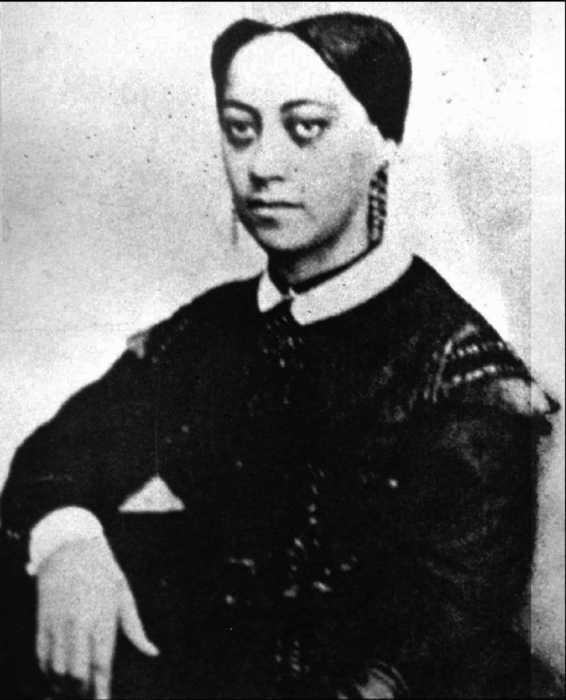
john, how could you?

it’s stories like this that lead to comments (taken from various youtube videos i’ve made) like this :

-mixed people r racist and would love 2 blacks extinct and wiped of the planet!
-Bi racial  my ass,these people are black when they get through talking.Stop running from your blackness and them white folks that you are trying lick up under are calling you nigger behind your backs.More videos we see on youtube or myspace,will thousands of video blogs from these coons hating they’re blackness and fronting like they’re special because the have one parent that is white and the other black,that bull shit and these coons know it.
-Bi-racials almost ALWAYS lean toward their white side.
Look at the pics behind you> the top two are white people!
everyone esle is insignificant. I see why Blacks are attacking all you racists
for the harm you’v done!

all i can say/speculate is “sign of the times,” and “survival of the fittest,” and his karma sure did catch up to him in the end… 

i wonder if his children were mulatto by virtue of carruthers’ mulatto-ness alone, or was kitty also a mulatto.  doesn’t matter.  just curious.  i also wonder who owned him.  it doesn’t seem to be his father or the neighbors whom he apprenticed… maybe it was the father though.  i’ve read this four times and just haven’t a clue.  ah, history…

John Carruthers Stanly: From Slave to Slave Owner

by 

The story of John Carruthers Stanly, a former slave who gained his freedom, only to become the largest slaveholder in Craven County, North Carolina.

John Carruthers Stanly
1774-1846
Black Slaveholder

Stanly, born a slave in 1774, was the son of an African Ibo woman and the white prominent merchant-shipper John Wright Stanly. He was apprenticed to Alexander and Lydia Stewart, close friends and neighbors of his father.  They saw to it that John received an education and learned the trade of barbering.  At an early age, they helped him establish his own barbershop in New Bern.  Many of the town’s farmers and planters frequented his barbershop for a shave or a trim. As a result, Stanly developed a successful business.  By the time he reached the age of twenty-one, literate and economically able to provide for himself, his owners petitioned the Craven County court in 1795 for his emancipation. However, he was not completely satisfied with the ruling of the court and in 1798, through a special act, the state legislature confirmed the emancipation of John Carruthers Stanly, which entitled him to all rights and privileges of a free person.

Between 1800 and 1801, Stanly purchased his slave wife, Kitty, and two mulatto slave children. By March 1805, they were emancipated by the Craven County Superior Court. A few days later, Kitty and Stanly were legally married in New Bern and posted a legal marriage bond in Raleigh. Stanly’s wife was the daughter of Richard and Mary Green and the paternal granddaughter of Amelia Green. Two years later, in 1807, Stanly was successful in getting the court to emancipate his wife’s brother.

Some politically correct Court Historians end the story here, if they acknowledge the existence of black slaveholders at all.  What a noble thing, to purchase and emancipate one’s own family!  But there is much more to the story.

After securing his own and his family’s freedom, Stanly began to focus more on business matters. He obtained other slaves to work for him.  Two of them, Boston and Brister, were taught the barbering trade. Once they became skillful barbers, Stanly let them run the operation while he used the money they helped him earn to invest in additional town property, farmland, and more slaves.

Through his business acumen, Stanley eventually became a very wealthy plantation owner and the largest slaveholder in all of Craven County. He profited from investments in real estate, rental properties, the slave operated barbershop, and plantations from which he sold commodities such as cotton and turpentine.

Stanly’s plantations and rental properties were operated by skilled slaves along with help from some hired free blacks. To improve his rental properties in New Bern, he used skilled slaves and free blacks to build cabins and other residences and to repair and renovate these properties. During the depression of the early 1820s it was slave labor that kept Stanly economically stable.

The 1830 census reveals that Stanly owned, 163 slaves. He has been described as a harsh, profit-minded task master whose treatment of his slaves was no different than the treatment slaves received from white owners. Stanly’s goal, shared by white southern planters, was on expanding his operations and increasing his profits.

During the early 1820s, Stanly’s wife, Kitty, was taken seriously ill.  She became bedridden and, despite careful attention by two slave nurses, she died around 1824. It was at this same time that Stanly began to face a series of financial difficulties.  His fortune began to plummet when the Bank of New Bern, due to the national bank tightening controls of some state and local banks, was forced to collect all outstanding debts. Unfortunately, Stanly had countersigned a security note for John Stanly, his white half-brother, in the amount of $14,962. Stanly was forced to assume the debt. This, along with his own debts forced him to refinance his mortgages and sell large pieces of property, including slaves. When these options did not resolve his economic woes, he resorted to mortgaging his turpentine, cotton, and corn crops, as well as selling his barbershop, which had been operating continuously for forty years. Without a steady flow of income, his fortunes continued to decline.  In 1843, his last 160 acres of land were sold at public auction. Three years later, at the age of 74,  John Carruthers Stanly died.  At the time of his death he still owned seven slaves.

John Wright Stanly House, New Bern, North Carolina

speaking of the confederate flag

ok, so, i like kid rock a little bit.  for three reasons: 1. he’s from detroit (well, Michigan anyway) 2. i think his song Amen is brilliant and beautiful 3. he has a biracial son (is that, like, racist of me…or some kind of positive prejudice…or just silly?)

anywho, i do not like his use of the confederate flag.  to be fair, i don’t like anyone’s use of it.  especially if the user has a child of some significant color.  i understand that to some people the flag is simply a symbol of “southern pride.”  i really do believe that said people do not view the flag as a pro-slavery emblem… they don’t go around looking at black people wishing they were allowed to own them.  that’s too easy, too “obvious racist bad-guy.”  but, i think it is from a vantage point of either white privilege or ignorance (or both) that one can insistently be so insensitive as to say (or infer) “i know that this flag is hurtful to many, it reminds them of a time when they were considered less than human and were treated no better than cattle, it may make them feel unsafe…they may get the idea that i think back on those days as the good old days and wish we could revert back to them.”  i’m sorry, but the flag is just  not THAT cool, not worth all of that.  nothing is.  i would like to believe that it would be an easy “sacrifice” to put that flag away (as in not on your car, belt buckle, t-shirt…but whatever you want in your own home…) so as not to bring up all of that hateful, hurtful stuff to the people who are still negatively affected by the history of the flag, the implications of it.  how about a little more love, compassion, sensitivity… amen.

i mean, this is really not that much cooler than this….

not enough to warrant offending people to their core… even if it’s only 14 people, even one… especially if the one might be your kid, Kid.

Kid Rock’s NAACP Award Protested Over Use Of Confederate Flag

via HuffPost Entertainment

Some people don’t think Kid Rock is meeting their great expectations.

The rocker is set to accept the NAACP’s Detroit chapter’s Great Expectations Award at their annual Freedom Fund dinner in May, and some members of the historic black rights organization are so unhappy about it, they’re boycotting the 10,000 person affair.

It’s the singer’s use of the Confederate flag in his stage shows that has them so upset, according to the Detroit News.

“It’s a slap in the face for anyone who fought for civil rights in this country,” Adolph Mongo, head of Detroiters for Progress and a boycotting NAACP member told the paper last week. “It’s a symbol of hatred and bigotry.”

For his part, Rock defended the use of the flag in a 2008 interview with the Guardian. “Why should someone be able to own any image and say what it is?” he said. “Sure, it’s definitely got some scars, but I’ve never had an issue with it. To me it just represents pride in southern rock’n’roll music, plus it just looks cool.”

He also spoke about touring with a famed rapper and how it impacted his audience.

“I’ve got Rev Run [from Run DMC] on tour with me right now – we have fun trying to count the number of black people every night. We’re like, ‘There’s 14 tonight, yeah!'”

Though he was a staunch defender of President George W. Bush, the singer went to back for Barack Obama after his election, in the process defending America against accusations of racism.

“It’s good the U.S. has proved it’s not as racist as it’s sometimes portrayed,” he told Metro UK (via Spin Magazine).

He also spoke about his own experience growing up with black people in the interview, saying, “Black people were kind to me growing up and taught me hip-hop and the blues.”

For more on the NAACP controversy, click over to the Detroit News.

more on the civil war

I’ve been sucked into the Civil War on the great interweb today.  Haven’t even watched Glory yet.  I’m so fascinated by this history.  Most of the photos and information in this post were found on one of Life Magazine’s photo galleries dedicated to the Civil War.  I must say that I would bet money that the man in the photo entitled Ready to Fight is a mulatto.  To call him biracial for the sake of political correctness would not be historically accurate, and sounds as preposterous to me as do all of the captions claiming that “African Americans” are depicted in the photos.  White folks of the day had a difficult enough time even agreeing that they were human beings… 3/5ths of a person… That’s one of the reasons that I currently hate to use that terminology.  We don’t go around being so specific with Irish Americans, or Italian Americans, or German Americans.  Still seems like some 3/5ths mentality to me.  That is just my opinion though.  I am also of the opinion that the difference between what was going on in the Union Camp in the photo entitled At Your Service and the goings on in the Confederate camp photo titled Off the Clock is… absolutely nothing.  Contrary to popular youtube belief, I am not one of those Yankees who thinks that the Union and President Lincoln were perfect and had nothing but the best of intentions for black people.  Nor am I under the impression that if I dug back far enough in my family tree, I would find abolitionists and/or soldiers fighting for the North.  Quite the contrary, I’m almost positive.  That’s why my existence is a miracle!  Of course everyone’s is, I’m just sayin’… today… in light of this complex history… how did I even happen?

[Nick+Biddle.jpg]

First Blood

Even before blacks were officially recognized as federal soldiers, many slaves — including the man in this portrait, known as Nick Biddle — escaped and joined Union lines. In 1861, Biddle was the orderly of a white Pennsylvania militia officer and, wearing a uniform, traveled with his employee’s company to Baltimore to help protect Washington, D.C., after the surrender of Fort Sumter. Once there, he was set upon by a pro-Confederate mob, attacked with slurs and a brick that hit him in the head so severely it exposed his skull. Some consider him the first man wounded in the Civil War.

VIA

The Grave of Nick Biddle:
By Chaplain James M. Guthrie

The grave of Nick Biddle a Mecca should be
To Pilgrims, who seek in this land of the free
The tombs of the lowly as well as the great
Who struggled for freedom in war of debate;
For there lies a brave man distinguished from all
In that his veins furnished the first blood to fall
In War for the Union, when traitors assailed
Its brave “First Defenders,” whose hearts never quailed.

The eighteenth of April, eighteen-sixty-one,
Was the day Nick Biddle his great honor won
In Baltimore City, where riot ran high,
He stood by our banner to do or to die;
And onward, responsive to liberty’s call
The capital city to reach ere its fall,
Brave Biddle, with others as true and as brave,
Marched through with wildest tempest, the Nation to save.

Their pathway is fearful, surrounded by foes,
Who strive in fierce Madness their course to oppose;
Who hurl threats and curses, defiant of law,
And think by such methods they might overawe
The gallant defenders, who, nevertheless,
Hold back their resentment as forward they press,
And conscious of noble endeavor, despise
The flashing of weapons and traitorous eyes

Behold now the crisis—the mob thirsts for blood:-
It strikes down Nick Biddle and opens the flood—
The torrents of crimson from hearts that are true—
That shall deepen and widen, shall cleanse and renew
The land of our fathers by slavery cursed;
The blood of Nick Biddle, yes, it is the first,
The spatter of blood-drops presaging the storm
That will rage and destroy till Nation reform.

How strange, too, it seems, that the Capitol floor,
Where slaveholders sat in the Congress of yore,
And forged for his kindred chains heavy to bear
To bind down the black man in endless despair,
Should be stained with his blood and thus sanctified;
Made sacred to freedom; through time to abide
A temple of justice, with every right
For all the nation, black, redman, and white

The grave of Nick Biddle, though humble it be,
Is nobler by far in the sight of the free
Than tombs of those chieftains, whose sinful crusade
Brought long years of mourning and countless graves made
In striving to fetter their black fellowmen,
And make of the Southland a vast prison pen;
Their cause was unholy but Biddle’s was just,
And hosts of pure spirits watch over his dust.


Ready for a Fight

A black soldier poses with his revolver in 1865. Many military leaders didn’t believe African Americans were capable of fighting effectively at first, but battles including the one at Port Hudson…proved them wrong.


Mulatto Confederate Soldier Daniel Jenkins and his wife. Jenkins was with the Confederate 9th Kentucky Infantry and was killed at Shiloh on 4/6/62.-VIA


Off the Clock

Confederate soldiers at their campsite play poker, while drinking and smoking between battles, with two slaves serving them.

At Your Service

Four white Union soldiers sit outside their tents at Warrenten, Va., as an African American soldier hands a bottle and a plate of food to one of them, in 1862.
Download now

Women in the War: Mary Walker, American Hero

Caption: Mary Edwards Walker (1832-1919), US Civil War doctor, wearing her Medal of Honor in 1866. Walker was awarded the medal in November 1865 for her service in the US Civil War (1861-1865). She served in the Union Army in several battles, first as a nurse and later as the first-ever female US Army Surgeon. She was captured in April 1864 by Confederate forces and accused of spying, though she was later released. After the ordeal, the government awarded Walker the Medal of Honor for her bravery, the only woman to ever given such an honor.  After the war, she was involved in the temperance movement and the women’s rights movement. She would often wear men’s clothes, and campaigned for dress reform for women. This photograph is from the Matthew Brady Collection, a collection of photographs from during and after the US Civil War.

Download now

Caption: Mary Edwards Walker (1832-1919), US surgeon. Walker received her medical degree from Syracuse Medical College in 1855. During the US Civil War (1861-1865) she served as the first female surgeon in the US Army. She was awarded the Medal of Honour for her wartime service, an award revoked in 1917 and restored in 1977. Walker also campaigned on women’s rights and suffrage, and was well-known for wearing male dress, including a top hat. This photograph dates from between 1911 and 1917. It is from the Harris and Ewing Collection, which mostly consists of photographs taken in Washington DC, USA.


War Orphans Used in Propaganda

An African American brother and sister, both former slaves, pose for a photograph after being freed by Union soldiers in Virginia in 1864. The children’s mother was beaten, branded, and sold at auction because she had been kind to Union soldiers.

Free Children

The same brother and sister are photographed after having been sent to an orphanage in Philadelphia.

Jumping Ship

In some cases, having blacks in their ranks worked against the South, as with Robert Smalls, a slave forced to serve in the Confederate Navy (which permitted slaves to serve with their masters’ consent — technically so long as African Americans made up no more than 5 percent of the crew). Smalls took over his CSA ship and delivered it to Union forces, became a ship pilot in the U.S. Navy, and rose to the rank of captain. Smalls…later became a member of the South Carolina State House of Representatives.


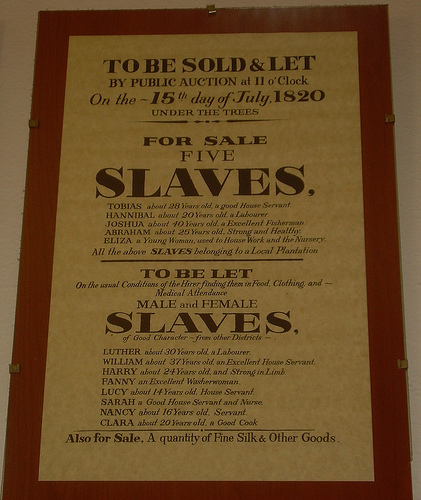
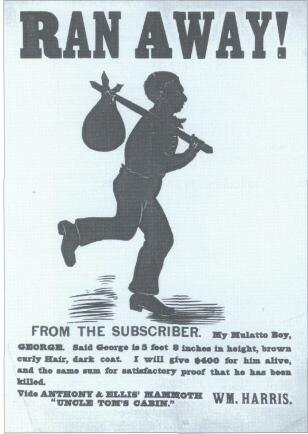
Advertisements for slaves, such as the one by William F. Talbott of Lexington, Ky., were commonplace while Lincoln was growing up.Photo: © PoodlesRock/Corbis

Slavery Lasted Longer in the Union Than in the Confederacy

Slavery technically existed in the North longer than it did in the South, as the 1863 Emancipation Proclamation only applied to the states that had seceded. The Union slave states of West Virginia, Maryland, and Missouri abolished slavery during the war. Kentucky and Delaware, however, continued allowing slavery until the Thirteenth Amendment abolished slavery throughout the United States in December 1865.
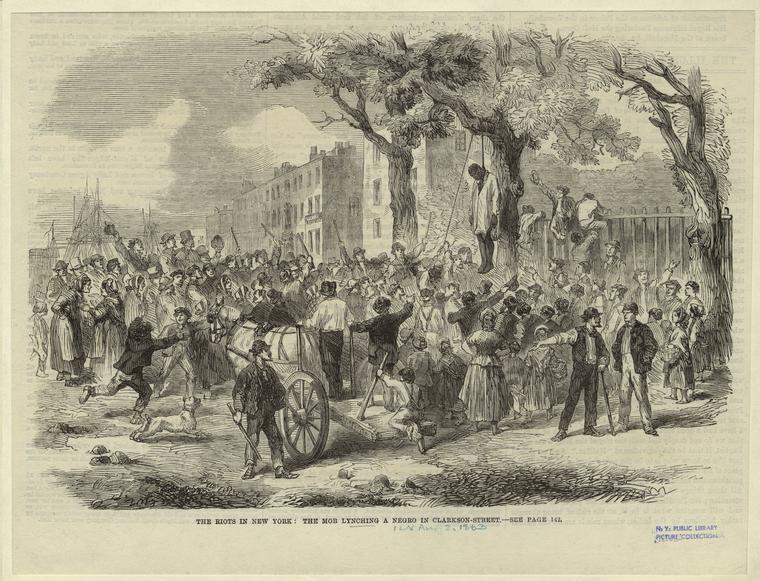
The riots in New York : the mob lynching a negro in Clarkson-Street.

New York City Considered Seceding From the Union

Though New York is viewed by much of America as the emblematic Northern city, it was actually a hotbed of pro-South and anti-war sentiment before and during the Civil War, not least because the city thrived on trade with cotton plantations. In January 1961, Mayor Fernando Wood even tried to convince the City Council to officially secede from the Union and declare itself a neutral city-state. Anti-war feelings crested with the bloody Draft Riots in July 1863, when working-class New Yorkers went on a rampage to protest new laws Congress passed to institute a draft.

The Great Emancipator Rejected Emancipation at First

Though he’s now lauded as the man who freed the slaves, President Abraham Lincoln was routinely lambasted by the abolitionists of his time for not moving fast enough or far enough in ridding the country of the institution of slavery. When the Emancipation Proclamation finally was issued, it exempted the Union border states, Tennessee, seven counties of Virginia, New Orleans, and 13 Louisiana parishes. It also implicitly offered Southern secessionist states a chance to keep their slaves if they rejoined the Union by Jan. 1, 1863.

W. T. F!

I mean… I just don’t have words… which is weird for me… a little sick to my stomach over this, actually… talk about a different fourth grade experience…

I’d love to believe that were I subjected to this horror show I would have been able to poke fun at the situation.  That maybe I would have been able to choose one male white friend and taken the ‘performance’ to a whole ‘nother level by crying, “Oh please don’t sell me away, father…” However, being nine or ten and shy, I probably would at best have refused to participate, but, more likely, gone along, swallowing my anger, humiliation, and shame until I got in the car after school and told my mother who would promptly have taken care of it.  I assure you of that.

My mother would have gone to school and ripped the teacher, and anyone else who was walking by, a new a**hole had this happened to me.  She did that when she didn’t like the way they taught about the Mayflower and the Indians in first grade.  We did it together in the fifth grade when Sr. Mary Ann said some offensive b.s. about MLK and used me, the only student of color, as a reference.  She got fired.

As a “black” student who nearly always served as a speck of pepper in a sea of salt, I can tell you that it is uncomfortable enough to go through the history lessons on the Civil War when the class is simply reading straight from the textbook, but to actually be used to physically demonstrate the atrocity….  It feels bad enough when you’re in geography and your friend accidentally reads the “river Niger” aloud as the river nigger and a hush falls over a crowd and everyone is looking at you in your desk at the back of the room even though their eyes are facing forward… but THIS.  I just can’t… Jessica Boyle, imho, you officially suck as a teacher and a human being.  Hopefully this will open your eyes to all that you have had the privilege of being blind to, and you’ll come out of this a better person.  Good f***ing luck!

Norfolk principal apologizes for mock auction of black students

By Steven G. Vegh The Virginian-Pilot © April 9, 2011

NORFOLK

The principal of Sewells Point Elementary School has apologized to parents for a teacher’s classroom exercise last week that cast her black and mixed-race fourth-graders as available for sale.

The apology came after the teacher separated the students from their white classmates and auctioned them, division spokeswoman Elizabeth Thiel Mather said. The exercise was part of an April 1 class on the Civil War.

In an April 6 letter sent to parents of students in the class, Principal Mary B. Wrushen wrote: “I recently became aware of a history lesson that was presented to the students in Ms. Jessica Boyle’s fourth grade class. Although her actions were well intended to meet the instructional objectives, the activity presented was inappropriate for the students.

Image

“The lesson could have been thought through more carefully, as to not offend her students or put them in an uncomfortable situation,” Wrushen wrote.

Wrushen said the exercise was not supported by the school or division. “I will follow up with the classroom teacher to ensure nothing like this ever occurs again,” the letter said. “In addition, the guidance counselor is available to discuss any concerns your child may still have concerning this classroom lesson.”

Wrushen declined to comment Friday. Boyle, who has been with the division since 2005, did not return a call to the school. She has taught at Sewells Point for three years, and before that was at Dreamkeepers Academy, according to the division website.

Mather said the division was responding to the incident with “appropriate personnel action.” She did not give details.

Wrushen became aware of the auction exercise after receiving complaints from two parents, and spoke to the class about the incident, Mather said.

“This lesson was not part of the approved curriculum,” Mather said.

Chris Lee, whose daughter is in Boyle’s class, was among parents picking up their children Friday at the school on Hampton Boulevard near Norfolk Naval Station. He said he’d heard no details about the exercise, though he received Wrushen’s letter.

“My wife and I were trying to figure out what the letter was about, because we heard nothing about it, we just saw the letter,” he said.

Letter: Principal Mary Wrushen wrote to the parents of students at Sewells Point Elementary to apologise for the controversial history lesson

Told by a reporter about the auction, Lee said, “That sounds inappropriate to me. Wow. That’s interesting – that’s something I have to digest.” He said he would ask his daughter to tell him about the incident.

The school has 590 students.

Contacted Friday by The Virginian-Pilot, School Board Chairman Kirk Houston said he had not known about the auction.

“That’s very disturbing to me, extremely disturbing to me,” he said. “Mock slave auctions involving children are absolutely unacceptable in a classroom. At this point this is a personnel matter, and the School Board will monitor its outcome.”

Peggy Scott, treasurer of the Norfolk Council PTA, also first heard about the incident from The Pilot.

“I’m sitting here with my mouth hanging open,” Scott said. “There are some things you don’t do.”

In a statement Friday, Superintendent Richard Bentley said: “The school district does not condone this type of lesson in any way. It was wrong. It was outside the boundaries of the curriculum and appropriate instructional practices.”

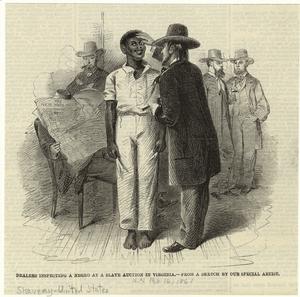
London Illustrated News, February 16, 1861, depicting a slave auction in Virginia. The sign on the podium reads “Negroes for sale at auction this day at 1 o’clock.”

Dealers inspecting a negro at a slave auction in Virginia.

Dealers inspecting a negro at a slave auction in Virginia.  [The Inspection]

Slave Auction, Virginia

by Lefevre James Cranstone Image rights owned by the Virginia Historical Society

Silvia Federici’s Slave auction, United States

what year is this!?

oh my jesus… yes, i had to go there.  i keep searching for an indication that this piece was written forty years ago, and only recently re-published just for… fun… or something.  i do think that there are, like, two valid, worthwhile points contained herein… but… um… oriental!?!?  that, of course, is not my main concern here, but it does point to the antiquated lens through which our dear (he does look kind of sweet and it says he volunteers a lot) mr. raiford views the world around him.  i don’t mean to come down on him.  i thank him for the unique opportunity to analyze the old “what about the children?” plea which i rarely see argued under the guise of modern day quandry.

maybe you should take a moment to skip down to the article and then come back to my stuff…  i’m never sure if it’s best for me to put my thoughts at the beginning or not… you’ve been warned… here they come…

first off, i’d wager to say that parents of mixed race children have long questioned the validity of discrete racial categories that require a child to choose.  i’d also wager to say that the white parents have probably had more questions than the black or ‘minority’ ones.  if this article was indeed written in the 21st century, i think it would be more accurate to say that (some fraction of) the rest of the country is finally beginning to question the validity of discrete racial categories.

most off… i cannot even believe that this man, who uses the term oriental multiple times, has the nerve to caution human beings who love each other and dream of starting a family to grow through life with… not to do so because race “matters” and (in his opinion) the children will be confused and unsupported outside of said family.  how about cautioning the rest of the country, those who haven’t caught up with the times, not to be so rigid in their notions of “us” in opposition to “them,” or who belongs with whom and why?  how about saying something to move us toward the idea that we are all fundamentally the same?  we are people.  who seek love and joy and connection.  and any time people are lucky enough to stumble upon those things we should encourage them to leap right in and build something beautiful from there.  which will encourage the rest of us to do the same. which will cause this society in which race matters more than who a person really is to change because the lines are blurred, have been crossed, eventually forgotten.  there you have a solution for the problem of the 6 year old that mr. raiford proposes will be confused and hurt by not belonging to any group outside of the immediate family.

and another thing… hasn’t the recent census informed us that there actually is a viable mixed-race reference group?  the only satisfaction that brings me personally is that it appears to be a necessary step toward the ultimate realization of the human-race reference group.  only one box to check.

to be fair… parts i liked… which really means agree with:

  • When a black and white couple produces a child, the child, by logical extension of definition, is black and white…
  • Race in the United States is a very discrete category. It is not based on any kind of scientific definition. It is based on a draconian sociological one and a divisive political one.
  • The United States has carefully and systematically created a society where race is a tremendously more important determinant of who we are than ethnicity, religion, national origin or personal achievements.

again, i do not mean to bring down a reign of fury on mr. raiford.  i’m truly grateful for the opportunity to blast these notions.  he seems like a nice guy with misguided concerns.  actually with misguided solutions to concerns that are unfortunately still mildly valid as we seem to be in an in between (united)state(s).  in between where we were and where we’re going.

awesome photo unrelated, source/subject unknown

HARD TIMES FOR MIXED-RACE CHILDREN

Written by GILBERT L. RAIFORD

In the pursuit of accuracy and personal pride, interracial parents are beginning to question the validity of discrete racial categories that require their children to designate single-race identification.

On the surface, this is a laudable pursuit and certainly a legitimate one. After all, we do define people as black or white. So, when a black and white couple produces a child, the child, by logical extension of definition, is black and white or neither black nor white. However, this satisfies only the biological, and perhaps anthropological, approach to understanding race.

There is a more compelling reality: Race in the United States is a very discrete category. It is not based on any kind of scientific definition. It is based on a draconian sociological one and a divisive political one. People here are defined as black or white or Oriental. This takes precedence over being defined as Jewish, Jamaican, Cuban, Haitian, Russian, Chinese, French, Catholic, Protestant, etc. The United States has carefully and systematically created a society where race is a tremendously more important determinant of who we are than ethnicity, religion, national origin or personal achievements. Witness the confusion of black Cubans or black Puerto Ricans or the Eurasians.

In the United States, an African-American parent, no matter how fair-skinned, cannot procreate a “white” child. The system does not make exceptions for an African American whose child is the product of interracial coupling. Of course, the reverse is not true for Anglo-Americans. They can have any race of child they want – black, white or oriental. That is the reality of this society.

I write this not at all to chide or even inform interracial parents. They are adults who most likely know a great deal about the race issues and are intellectually and emotionally strong enough to ignore the stupidity that is generated out of personal and institutionalized racism. Their lives together attest to this fact.

But what about the children?

It is not easy growing up black in this society. It becomes considerably more difficult for one who does not know that he or she is black, but is confronted by this sociological fact everyday and in so many ways, some of them hurtful and insidious. No amount of parental love can shield a 6-year-old from the confusion and hurt of not belonging to any group outside of the immediate family. Adolescents are particularly fragile, having to live with this confusion at the very crossroads of their lives when they are struggling to overcome self-doubt and needing to feel good about themselves, needing self-validation – things that one gets from people other than the immediate family, from a reference group. Presently, there is no viable mixed-race reference group. One is forced to choose. Mental health directs one towards choosing a reference group which minimizes our degree of race-mixing and provides us with full membership.

Superimposed on race is ethnicity.  Ethnicity is a reference group. For African Americans, it provides for a very sustaining sense of identity. It is no wonder that people like Lena Horne, Cab Calloway, W.E.B. DuBois, Walter White and Adam Clayton Power, even though white-looking, affirmed their blackness. It was not race that they were affirming, it was ethnicity, the sustaining sentiment which makes being non-white in America palpable and even enjoyable.

Hopefully, the day will arrive when we are no longer a racial society, a society where race does not matter. That day has not yet come. In the meanwhile, I caution interracial parents to consider the consequences of making their child a cause célèbre in search of a miscegenation reference group. Of course, it is important that a child knows the reality of his or her family genealogy and to even embrace it. It is at least equally important that a child is prepared to negotiate life based on the social context of society. Sadly, race matters.

Gilbert L. Raiford is semi-retired after a career in teaching and working for the U.S. Department of State. He lives in Miami where he volunteers at homeless facilities, the Opera House in Miami and after-care school programs as a fund-raiser. He may be reached at graiford@hotmail.com

just thought we should know

David M. French Dies at 86

Ever wonder who tended to the injuries of demonstrators brutalized during the civil rights protests of the 1960s? David M. French, a former Howard University professor of pediatric surgery and one of the first African-American board certified surgeons, coordinated many of those first aid efforts, as just one piece of a long career that merged medicine and public service. He died March 31 at the age of 86.

David M. French (Ellsworth Davis/Washington Post)

After witnessing firsthand the lack of quality health care available to blacks in the South at civil rights protests (he once converted his family van into an ambulance to lead a medical unit overseeing the care of Mississippi activists demonstrating against racism), French became committed to improving the health of underserved people and began to focus on preventative and community medicine.

French founded Boston University’s department of community health in 1969. He also established a network of community health centers in Boston before moving to Ivory Coast in the 1970s. There, he led an effort to train nurses and improve public health in 20 countries across the continent.

French returned to the United States in the mid-1980s and retired to Barboursville, Va. But his work didn’t end then. He went on to serve as medical director of Helen Keller International, a New York-based nonprofit organization that runs public health programs in developing countries. More recently, he served as medical officer for the nonprofit service and development African Methodist Episcopal Church.

Read more at The Washington Post.

no h8

This is so right on!  Thank you, Karen Finney.  I’m so glad my (white)grandparents allowed me in to their lives.  And so are they! It’s the “little” things…

On another note, this sentence, “the very existence of antimiscegenation laws had been enacted for the purpose of perpetuating the idea of white supremacy,” speaks to the very reason I fell down this rabbit hole I’ll now call the mulatto trail.  I realized one day that anti-miscegenation and the one-drop rule perpetuate the idea of white supremacy, and that by subscribing to that antiquated rule I was upholding that ridiculous notion.  The anti-miscegenation thing has legally been eradicated, but ask any interracial couple who has walked down a street together, and I’m sure they’ll tell you that on more than one occasion they’ve been given the evil-eye or gawked as if they were freaks of nature.  Or both.  And as for the one-drop rule, head on over to my youtube channel, scroll through the comments, and you’ll see that it looms large in the consciousness.  And many people don’t seem to be willing to let it go.

California Prop 8 Gay Marriage Ruling a Win For American Values

By KAREN FINNEY

SOURCE

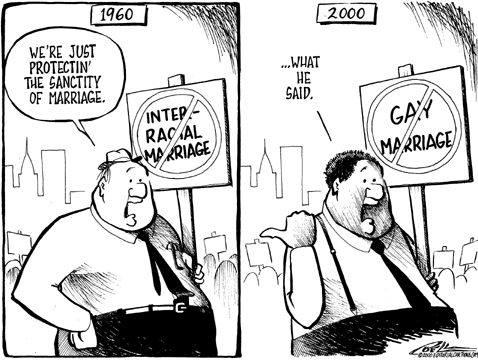
Yesterday’s ruling that California’s Proposition 8 is unconstitutional reaffirms a long-held American value that no matter how you try to spin it, separate is not equal. While some may not agree with same-sex marriage, history should remind us that our Constitution calls us to recognize that the laws in it apply equally, not to be picked apart to support a political agenda or bias. The arguments being used against same sex marriage are frighteningly similar and equally offensive as those once used against interracial marriage. While a Gallup poll in 1967 found that 74 percent of Americans disapproved of interracial marriage, it’s almost hard to remember just how far we’ve come.

I was 16 years old before I was allowed in my grandfather’s home in Greensboro, North Carolina. That’s how long it took for him to even begin to re-think his shame over having a mixed-race granddaughter. He believed, as did many at the time, miscegenation was wrong on moral and legal grounds. Thankfully for me, my parents disagreed. They were married in New York City and had me despite the fact that it was illegal in their home states of Virginia and North Carolina to do so. Thankfully for our country, in the case of Loving v. Virginia, the Supreme Court saw beyond the fear and bigotry of the moment and ruled that antimiscegenation laws violated fundamental American values of Due Process and Equal Protection Under the Law as guaranteed to every American by our constitution.

Just as some used to say that marriage is only valid between a white man and white woman, some now argue that marriage can only be between a man and a woman. Arguments have also been made that same-sex marriage dilutes the institution of marriage, just as similar arguments suggested that interracial marriage diluted the white race. My personal favorite absurd justification says that (despite the idea that we are all God’s children and loved equally) gay marriage is against the laws of God and nature. That argument was used by Leon M. Bazile, the judge in the initial case against the Lovings, who said:

Almighty God created the races white, black, yellow, malay and red, and he placed them on separate continents. And but for the interference with his arrangement there would be no cause for such marriages. The fact that he separated the races shows that he did not intend for the races to mix.

The Supreme Court’s ruling in the Loving case also recognized that the very existence of antimiscegenation laws had been enacted for the purpose of perpetuating the idea of white supremacy:

There is patently no legitimate overriding purpose independent of invidious racial discrimination which justifies this classification. The fact that Virginia prohibits only interracial marriages involving white persons demonstrates that the racial classifications must stand on their own justification, as measures designed to maintain White Supremacy.

Similarly, as Judge Vaughn Walker today affirmed, denying gay couples the right to marry, not only denies basic civil rights, liberty, and freedom, but also codifies bigotry.

Karen FinneyKaren Finney is a political analyst for MSNBC and an independent consultant working with political and corporate clients in the areas of political and communications strategy. She brings over 16 years of experience in national politics and campaigns ranging from the Clinton administration to New York State to the Democratic National Committee.

mulattoes captured

Not like this:

But like this:

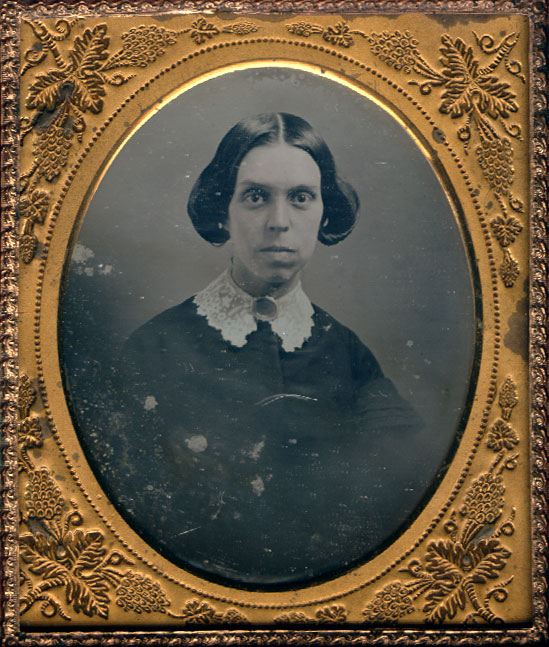
1850 portrait of a mulatto woman

J.P. Ball quarter plate daguerreotype of mulattoes

Sixth Plate Daguerreotype Portrait of A Young Mulatto WomanA fine daguerreotype portrait of a young, well-dressed mulatto woman, with the letters W and MB etched on plate’s verse

Quarter Plate Daguerreotype of Two White Children & Their Mulatto Servants,

*Quarter Plate Daguerreotype of Two White Children & Their Mulatto Servants*

Cased Ninth Plate Daguerreotype of a Mulatto, fine half-length portrait of a 20-something young, mixed race gentleman, Negroid and Caucasian, in typical merchant sailors outfit of the period.

The Daguerreotype was the first successful photographic process, the discovery being announced on 7 January 1839. The process consisted of

  • exposing copper plates to iodine, the fumes forming light-sensitive silver iodide. The plate would have to be used within an hour.
  • exposing to light – between 10 and 20 minutes, depending upon the light available.
  • developing the plate over mercury heated to 75 degrees Centigrade. This caused the mercury to amalgamate with the silver.
  • fixing the image in a warm solution of common salt (later sodium sulphite was used.)
  • rinsing the plate in hot distilled water.

I absolutely love these!  I fully intend to collect them one day when I can afford it.  There seems to me to be so much more to a daguerreotype than a photograph.  They seem haunted to me.  Like the image and the moment was so thoroughly captured that I’m really looking at something/someone frozen in time.  Haunted.

On another note, I get some sort of satisfaction from looking at these and reading the descriptions.  Proof that “we” exist and were once recognized.

*or brothers….(re: white children & their mulatto servants above)*


speaking of freedom

I cannot forget that “liberty and justice for all” wasn’t really for all.  So much for being impeccable with your word, Founding Fathers.  Here’s an interesting snippet of the history of the struggle for freedom in this nation.  The struggle of those who toiled to build it and cultivate it’s wealth, and one man who was dedicated to assisting them.  I’m curious about the early years of Henry Ward Beecher’s life.  I wonder how he came to see the truth, when the illusion was set up to work in his favor.

Underground Railroad

VIA

The road to freedom is one of the great themes of American history. The story of the Underground Railroad exemplifies the profound power of that journey. Following the lead of its famed antislavery preacher Henry Ward Beecher, Plymouth Church played a fundamental part in New York City ‘s underground activity.

From the very beginnings of slavery in America, slaves escaped to freedom. They ran to the wilderness; they went to live with the ever-hospitable Indians; they slipped into cities and made their claim as free Blacks. In the Revolutionary era, Puritan New England and Quaker Pennsylvania passed legislation abolishing slavery. The exodus northward, which came to be known as the Underground Railroad, began. By 1831, the term “Underground Railroad” had been coined to describe the informal, secretive network of ordinary citizens, Black and White, whose safe houses offered refuge.

Although Plymouth Church was not established until 1847, just fourteen years before the start of the Civil War, it later became known as “the Grand Central Depot” of the Underground Railroad. Oral tradition and several published memoirs tell us that slaves seeking passage to Canada may have hidden in the tunnel-like basement beneath the church sanctuary (this space can still be visited during our public and school tours). Beecher’s private stenographer, T.J. Ellinwood, quotes the Minister as claiming, “I opened Plymouth Church”, though you did not know it, to hide fugitives. I took them into my own home and fed them. I piloted them, and sent them toward the North Star, which to them was the Star of Bethlehem.“ The Rev. Charles B. Ray, an African-American living in Manhattan, and the founding editor of the Colored American newspaper, was quoted as saying, “I regularly drop off fugitives at Henry Ward Beecher‘s Plymouth Church in Brooklyn.” Other churches in Brooklyn and Manhattan, especially Black churches, also hid escapees, but most have since moved to newer buildings. Plymouth Church is one of the few active Underground Railroad congregations in New York still housed in its original location.

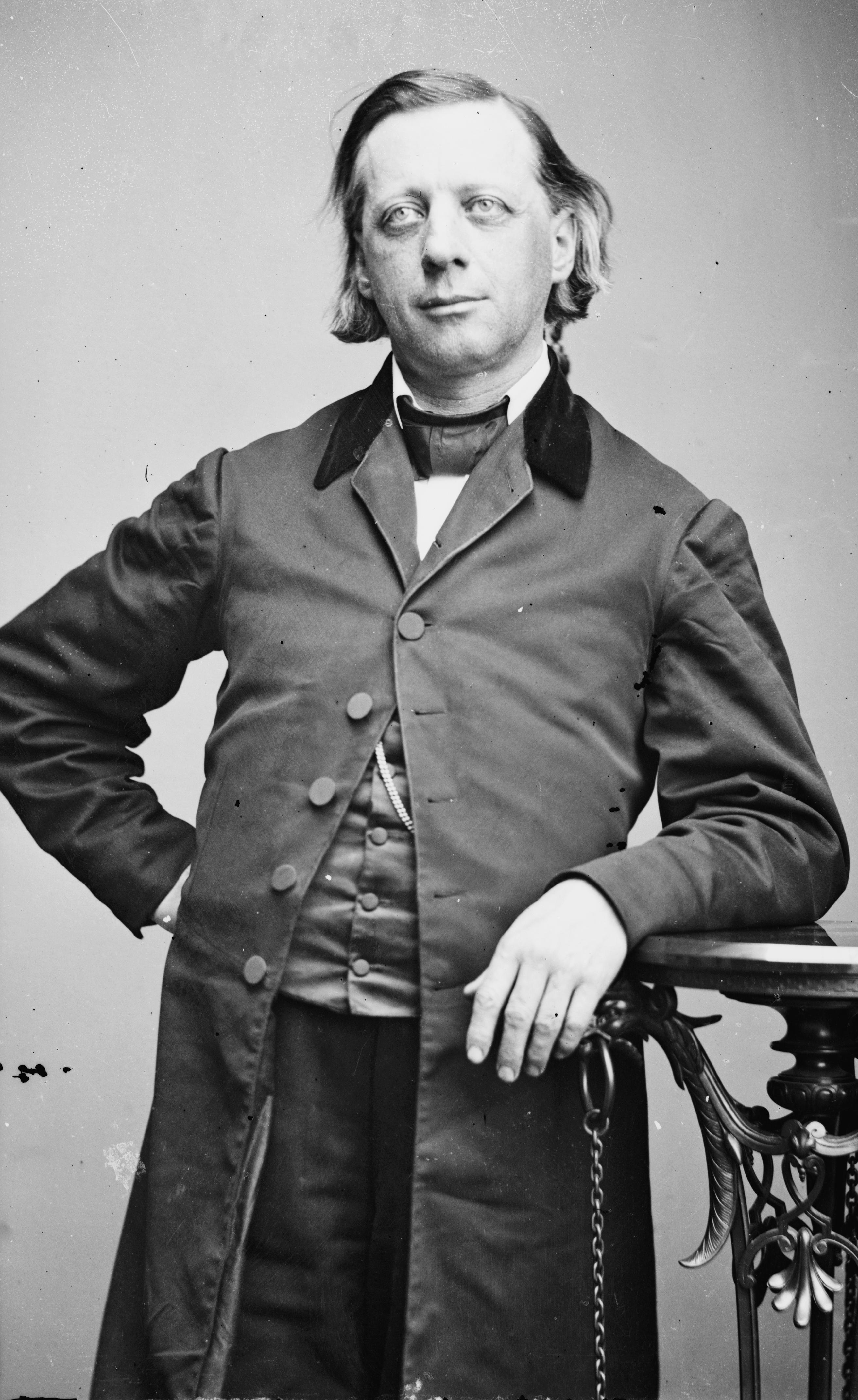
Henry Ward Beecher

Plymouth’s first minister, the Rev.Henry Ward Beecher , spearheaded and symbolized Plymouth’s antislavery activity, but the founding members of Plymouth selected him as their pastor in no small part because they knew he would do so. He already had a record as an opponent to slavery when he made those beliefs clear in his trial sermon for Plymouth. Beecher and his peers were greatly influenced by the Second Great Awakening, a Protestant religious revival of the early 1800’s, firmly committed to abolishing slavery. As a student at Amherst College, he helped found an abolitionist organization, which was promptly shut down by the faculty. At seminary in Cincinnati, he contributed to an antislavery newspaper which was mobbed and destroyed; he also patrolled the streets of that city, fully armed, when temporary special policemen were called upon to protect free Blacks from threats. When he was a minister in Indianapolis, his limited preaching on the subject caused members to leave his church, but he remained active in the Underground Railroad there, as his widow, Eunice, recalled years later.

Enormous publicity surrounded one of Beecher’s first antislavery acts at Plymouth Church. In 1848, 77 fugitive slaves were sold in Washington after the failure of the largest group escape attempt on the Underground Railroad. In that group were two teenage girls, the Edmondson sisters. Thanks to the fundraising efforts of people like Beecher to regain the girls’ freedom, the Edmondsons galvanized public support for the abolitionist movement – and inspired Beecher’s own sister, Harriet, to write Uncle Tom’s Cabin.

Beecher, with his newly elevated public profile, had to be especially circumspect in harboring escaped slaves. Eventually, in 1872, he was named by The Brooklyn Eagle as an active participant in the Underground Railroad. The article claimed that Plymouth’s minister helped dozens of fugitives in cooperation with a man in New York named “Napoleon.” This Napoleon “had the matter of escape under his charge and whenever a slave was sent on to Mr. Beecher he, Napoleon, would fix things along the Central Railroad and see to it that the officials along the route were got into friendly disposition for the fugitive.” The article does not indicate Napoleon’s race, but he may well have been Black, for Black involvement in the Underground Railroad almost certainly exceeded that of Whites.

There are believed to be many members of the Plymouth congregation who were active in the Underground Railroad. Evidence suggests that escaped slaves were hidden in the homes of several Plymouth members. The Church treasurer, S.V. White, had a small chamber in his house said to have been used to hide runaways, a room that was still in existence in the 1900s. One of the Church’s greatest activists in the Underground Railroad was Lewis Tappan. He is best remembered as a leader in organizing efforts to release the escaped slaves of the Amistad in 1839. Later, he helped fund the creation of Plymouth Church (his daughter, Lucy Tappan Bowen, was one of the original 21 members), but he did not join until 1856. As part of his work helping runaway slaves, he provided refuge in his home to a 15-year-old girl who escaped by pretending to be a male conductor on a New York-bound ferry.

All this was taking place in one of the most pro-slavery states of the North. Not until 1827 was slavery finally abolished in New York. Much of this attitude may be traced to the years when New York was a proprietary colony of the Duke of York, a major shareholder in the slave-trading Royal Africa Company. With his powerful influence, he instructed the governors to do everything possible to sell more slaves. After independence, the close business relations between Southern planters and New York merchants continued to enhance pro-owner sympathy.

Whatever ambivalent feelings about slavery remained in New York, they were greatly tested in 1850. That year, the country began negotiating slavery in the newly acquired territories seized during the Mexican-American War. The designation of new slaveholding states, plus the passage of the Fugitive Slave Act requiring all American citizens to assist in apprehending runaway slaves, incensed many Northerners. The work of the Underground Railroad intensified. These were the years of Plymouth Church’s greatest involvement, and, by 1860, it was certainly the most famous church in America. One year later, the Civil War began, and Plymouth continued to supply material and spiritual support to a devastated country. Five brutal years later, slavery was outlawed, and Plymouth Church’s role in the Underground Railroad could finally, thankfully, come to an end.

The exact statistics of the Underground Railroad – how many slaves escaped, how many free citizens aided them – will never be known. But we do know that this was a time and an undertaking in which Blacks and Whites came together to right a grievous wrong. It should also be said that, for the members of Plymouth Church, and for most if not all of those who took part, they did so to live out their Christian faith.

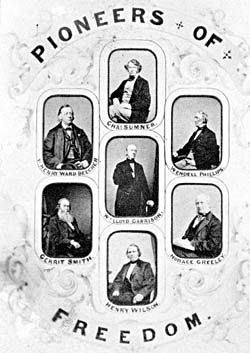
Portraits of abolitionists Charles Sumner, Henry Ward Beecher, Wendell Phillips, William Lloyd Garrison, Gerrit Smith, Horace Greeley and Henry Wilson, c. 1866

mary ellen pleasant

As I was searching the internets last week for photos of black women with white children, I stumbled upon a historical figure who, once again, I am shocked and dismayed to never before have heard mention of:  Mary Ellen (“Mammy”) Pleasant.  I want to know so much more!  Or at least the truth.  I highly doubt that Mary Ellen needed to conjure the dark forces to leverage social change, however I’m sure that that tale eased the minds of the opposition and provided ammunition for attacking Pleasant’s ideals.  I found quite a few intriguing articles on her life and chose the following two to share.  Honestly, when someone next asks me who (dead or alive) I would most like to have dinner with, Mary Ellen Pleasant will be on the short list.

hdr_index

“American civil rights began in the 1850’s with Mary Ellen Pleasant.”  Racism surprised African Americans like Pleasant who came to the Bay Area because they believed in a better life in San Francisco… The Bay Area, where Pleasant lived, became a “hotbed of civil rights activity” in the 19th century and the activists’ rallying cry was “eradicating slavery.”- Dr. Albert Broussard

Mary Ellen Pleasant (1814? – 1904)
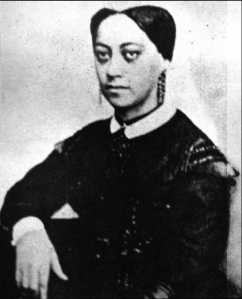
SSMt7.St.4

VIA

Mary Ellen Pleasant is perhaps better known as “Mammy Pleasant”, but it was a name she detested. She was born a slave in Georgia some time between 1814 and 1817, the illegitimate daughter of an enslaved Vodou priestess from Haiti and a Virginia governor’s son, John Pleasants. She was bought out of slavery by a planter and indentured for nine years as a store clerk with abolitionist Quakers in Massachusetts.

Around 1841 she married a wealthy mulatto merchant/contractor from Ohio and Philadelphia named James Smith, who was also a slave rescuer on the Underground Railroad. The two worked to help slaves flee to safety in Canada and safe states. Smith died in 1844, leaving her a $45,000 fortune and a plantation run by freedmen near Harper’s Ferry, Virginia.

Because of slaver reaction to her own ongoing Underground Railroad activities, she was forced to flee to New Orleans in 1850 where she met the Vodou queen Marie Laveau who trained her in how to “pressure the powerful to help the powerless” —blacks and poor women—gain rights and jobs. She then went to San Francisco, arriving in April 1852. Because she had no “freedom papers” she passed herself off as white, while she worked as a steward and cook in a white boardinghouse and invested in real estate and various business activities.

Pleasant’s training with Marie Laveau proved beneficial. Pleasant became so successful at leveraging social change that many called her San Francisco’s “Black City Hall”. Her activities and her money helped ex-slaves avoid extradition, start businesses and find employment in hotels, homes and on the steamships and railroads of California.

In 1858 she returned to the East, bought land to house escaped slaves, and aided abolitionist John Brown both with money and by riding in advance of his famous raid at Harper’s Ferry encouraging slaves to join him.

She went back to San Francisco where her investments with an influential business partner helped her amass a joint fortune estimated at $30 million. She later led the Franchise League movement in San Francisco that earned blacks the right to testify in court, and to ride the trolleys. Her lawsuit in 1868 in San Francisco against the North Beach and Mission RailRoad was used as a precedent in 1982 to achieve contemporary civil rights. Mary Ellen Pleasant died in San Francisco in 1904. Her body was taken by friends to Napa and buried in Tulocay Cemetery. On her tombstone is inscribed “the mother of civil rights in California.”

For more information, incuding a book on Mary Ellen Pleasant by Susheel Bibbs, see http://hometown.aol.com/mepleasant.

VIA

“Mammy Pleasant: Angel or Arch Fiend in the House of Mystery?”

By p. joseph potocki

Mary Ellen “Mammy” Pleasant’s legacy is an enigma rolled up inside layers of legend, gossip, greed, fantasy, racism and conjecture.

This week’s column title first headlined Sunday’s edition of the San Francisco Call—back on May 7, 1899. That 19th century investigative hit piece featured three unflattering John Clawson illustrations portraying “Mammy Pleasant” as a bonneted evil-eyed crone. The story gobbled up the entire front page of that day’s paper. Its “Angel or Arch Fiend” dualism embodies endless confusion and contradictory assertions surrounding the life of this incredible woman—confusion and contradictions lingering on to this very day.

The “Mammy” tag, clearly meant to be a slam, fits neatly within a cluster of Black stereotypes. While Pleasant’s tall, thin frame, her finely honed features and regal bearing contrast sharply with the rotund happy-to-be-a-slave mammy of plantation lore, the name itself attempts to place her on par with a Samba, an Uncle Tom, Step and Fetchit, or to a licentious Jezebel. The mythology of these “halcyon days” of slavery is what social historian Eric Lott calls “the dialectic flickering of racial insult and racial envy.”

Mary Ellen “Mammy” Pleasant’s legacy is an enigma rolled up inside layers of legend, gossip, greed, fantasy, racism and conjecture. She’s been called “San Francisco’s Powerful And Sinister Ruler”, “The Black City Hall”, but also a “one woman social agency” and “the Mother of Civil Rights in California.” That covers one heck of a lot of reputational territory.

Some claim that Mary Ellen Pleasant was a mixed blood Voodoo Queen who aimed “the black arts” against her enemies, that she sold babies, murdered as many as 49 people, ran brothels, committed fraud, spied through walls on victims she would later blackmail, and that she held unholy powers over a vast network of underlings and protégés. One rival charged that Pleasant murdered the rival’s husband, and having accomplished the dastardly deed Pleasant then “put her fingers in the hole in the top of his head and pulled out the protruding brains.”

Others tout Mary Ellen Pleasant’s work as a philanthropist, her many devoted friends, both black and white, her financial wizardry, undying devotion to women’s and civil rights, and, before that—her commitment to the abolition of slavery. In fact, Mary Ellen Pleasant’s Napa gravestone reads—“SHE WAS A FRIEND OF JOHN BROWN.”

Indeed, upon Brown’s capture following his ill-fated attack on Harper’s Ferry he carried with him a promissory note signed MEP. Had not the authorities misread the letter M for a W its certain Mary Ellen Pleasant’s neck would have been stretched as did John Brown’s.

Everything about Pleasant’s formative years is subject to debate. She was born a slave in Virginia, or Georgia, or perhaps it was Louisiana. She claims to have been born free in Philadelphia on August 19, 1814. Others say she was born in 1817, give or take a year—or two. She was convent educated, or else was entirely self-taught. Her mother may have been a West Indies Voodoo Queen, or not. Her father was a wealthy white slave owner. Then again, perhaps he was a slave. Nobody knows for sure.

What we do know is that sometime between 1848 and 1852 Mary Ellen Pleasant arrived in San Francisco. She may have been accompanied by her second husband, a former slave named James Pleasant, or Pleasants, or perhaps it was Pleasance. Whatever his surname it’s clear that the shrewd, focused and ambitious Mary Ellen was a power unto herself.

James, who died in 1877, seems hardly to have factored into Mary Ellen’s life. His one notable contribution was in the co-creation of Mary Ellen’s one and only child, Elizabeth, whom she called Lizzy. However, Mary Ellen gave their daughter her first husband’s family name, which was Smith. It was only fair, since James Henry Smith had left seed money to Mary Ellen upon his death some years before. Mary Ellen built her financial empire with the help of these funds.

Once in San Francisco, Pleasant set about purchasing boardinghouses, real estate, laundries, restaurants and stock shares in mines, railroads and other business ventures. This was no small accomplishment in an era of near unfettered legal bias against both racial minorities and women. Monies from these investments built her the 30-room mansion dubbed “the House of Mystery,” atop Cathedral Hill in San Francisco.

In her later years Pleasant purchased a large tract of land set against the Mayacamas Mountains. She named it Beltane, either after Thomas Bell, or, as some critics claim, in honor of the ancient pagan celebration of the same name. Beltane lies outside Glen Ellen, in the heart of the Sonoma Valley. The stately New Orleans-style Victorian house she built there (now a B&B) is set amidst an immense flowering garden and hundreds of shady oaks. One fanciful claim is that Pleasant cast Voodoo spells from a cave somewhere on the property.

But with all her accrued wealth, Mary Ellen Pleasant seems always to have performed, or dressed as if she performed, domestic labor. It’s said that she would ride to the markets in her own custom built carriage, accompanied by a driver and a footman, each garbed in impeccable livery. Though always attired in a servant’s black dress and large white apron, she “walked like a duchess.”

Sometime in the mid 1860s Mary Ellen Pleasant hooked up with a stockbroker named Thomas Bell. The “canny Scot” was money savvy, but lacked imagination. Pleasant took him under her wing. Together they created one of the largest financial partnerships in that era of San Francisco. Pleasant and Bell may (or may not) have been lovers.

It’s said that Mary Ellen arranged Thomas’s marriage to the future Teresa Bell, having first instructed Teresa in the “genteel arts” necessary to flourish in elite society. Others say Thomas Bell discovered the beautiful Teresa on a visit to a house of ill repute. No matter which story is true it seems the marriage provided adequate cover from charges of miscegenation, which might otherwise have been leveled at the cohabitation of the white Thomas Bell with the octoroon (or perhaps quadroon) “Mammy” Pleasant.

What’s undeniably true is that Mary Ellen Pleasant was actively involved in the Underground Railroad, and that she placed both former slaves and geographically displaced freemen as domestics in many of San Francisco’s “better” households. She also clearly advocated for and personally rescued unprotected and often attractive young white women, who Mary Ellen then trained to become the wives and mistresses of wealthy men in The City.

These actions led to many of the questionable charges against her, since persons beholden to Pleasant for their livelihoods provided her their eyes and ears within San Francisco’s most prominent households.

Mary Ellen was well into her 80’s when her finances began to unravel. She’d both overextended her business dealings, and had incurred the wrath of her former protege, Teresa Bell. Mary Ellen had exposed Teresa’s young lover to embezzlement charges, landing him a stint in San Quentin prison. As payback, the mentally unhinged Teresa became Pleasant’s eternal foe. She set to pummeling Pleasant’s good name—even long after seeing Mary Ellen to her grave. The sensitive nature of Thomas Bell’s and Mary Ellen Pleasant’s financial partnership allowed Teresa to gain control of their mutual resources following Thomas’ death. As a result Mary Ellen Pleasant was stripped of her wealth and forced into bankruptcy.

Pleasant’s diaries were stolen and lost to posterity, while many of Teresa’s hallucinatory rants made their way into newsprint following Pleasant’s death. Consequently, Teresa Bell’s accounts fundamentally shifted the Mary Ellen Pleasant mythos into the realm of evil phantasma. Fortunately, contemporary scholars have begun setting Mary Ellen Pleasant’s record as straight as a story with such twists, squiggles and gaping holes can be set. As confusing and contradictory as her life story may be, Mary Ellen Pleasant optimistically forecast her own legacy when she wrote:

“… You can’t explain away the truth.”

Mary Ellen Pleasant

SOURCE