mixed race in the uk

I guess we’re the fastest growing group in the world, muah-ha-ha-ha! Just kidding. But I’m with you, Dani. We need to educate everyone about this group with rapidly increasing numbers.  I wonder if mixed race people are more likely to be victims of crime in the U.S.

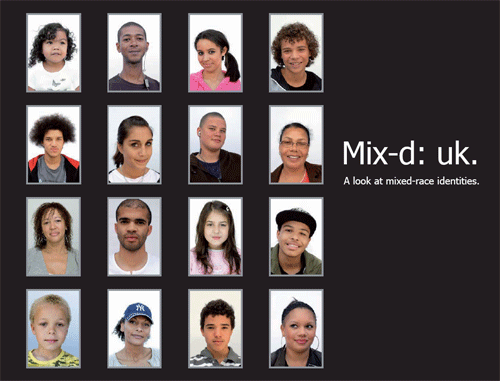
Mixed race ‘fastest growing minority’

Karlene Pinnock BBC NewsBeat

“Best of both”, “pick and mix”, “Asian”, “half-breed” and “coloured” – they are just some of the names mixed race people say they’ve been called.

The mixed race group is the fastest growing ethnic minority group in the UK and is expected to become the largest by 2020.

Britain has one of the highest rates of interracial relationships in the western world.

If government watchdog figures are right, mixed race Britons will overtake Indian people to become the UK’s largest ethnic minority group within 25 years, reaching 1.24 million.

Seventeen-year-old Seeder is from Manchester. She said: “I actually expected mixed raced people to be the biggest ethnicity.

Listen to 1Xtra’s Mixed Race documentary

“Mixed raced isn’t just one race like me, English and Jamaican, there’s so many different mixes of so many different races.”

The latest official statistics available show mixed race people are more likely to be victims of crime than any other ethnic minority.

The risk of being the victim of a racially-motivated crime is also higher.

Dani thinks more needs to be done to educate everyone about the UK’s fastest growing ethnic minority group.

“I remember my teacher describing me as coloured and I was like actually not really fond of that one,” she said.

“We need to start looking at how we can make things more multicultural and I think the education system’s going to be a biggie.”

Mix-d-front-cover

what “race” means

So very interesting….

Q & A with Anne Wojcicki, co-founder of the “personal genetics” company 23andMe.

Q. Have you had any situations where a person finds out they have relatively recent ancestors of a race that they were unaware of? If so, have any reacted badly?

A. We know that quite a few people find surprises about their ancestry through 23andMe’s service. One customer with extensive knowledge of his European paternal ancestry discovered that his maternal line traced to a Native American woman. He tracked down paper records that revealed a “mulatto woman” about seven generations back. Native American ancestry makes some sense given that his ancestry traces to the southern U.S. While he was excited about this new information, his 93-year-old mother was far less positive and remains skeptical! Quite a few African Americans have discovered that their paternal line traces to Europe. Although many African Americans may be aware that they have some European ancestry (the average is about 20 percent), some discover that close to 50 percent of their ancestry traces to Europe, and this can take some getting used to.

Q. As projects like yours and the HapMap uncover numerous instances of genetic differences between human groups or races, what is the responsibility of the genetics community when discussing innate differences between races, particularly when a large part of academia is convinced that there are no such differences?

A. A lot of the difficulty in talking about race has been a lack of agreement on what “race” means. In the past, the idea of pure races also included an ordering of certain races as inherently superior to others. We reject this idea absolutely. However, that doesn’t mean that there are no genetic differences between populations of different ancestral origin. A few of our features use the genome-wide data of reference populations from around the world to trace the origin of pieces of an individual’s genome. Some customers have complex patterns depending on where their ancestors originated. These reference populations aren’t “races”; they’re representative samples of peoples who have lived in a single place for a very long time and have thus accumulated different sets of genetic variants over time.

ancestry


interracial roommates

I just read this New York Times article by Tamar Lewin on the benefits of having a college roommate of a different race.  I’m not at all surprised that are some pros to this situation.  I was surprised by the admission here that campuses have been intentionally segregating students.  The piece makes it clear, but without judgement.  I find it appalling. I would LOVE to make Ohio State out to be the bad guy here, but this practice became apparent to me at my orientation for the University of Michigan which was only attended by incoming minorities, and even more clear when I was placed in an unofficial black dorm on a different campus from all of my classes and all of my friends from high school that were Going Blue.  You see, if having a roommate of a different race reduces racial prejudices, we could be so much farther along in eradicating these race issues if the schools hadn’t been keeping people apart.

michigan-wolverines

Interracial Roommates Can Reduce Prejudice

As a freshman at Ohio State University, and the only black student on his floor, Sam Boakye was determined to get good grades — in part to make sure his white roommate had no basis for negative racial views.

“If you’re surrounded by whites, you have something to prove,” said Mr. Boakye, now a rising senior who was born in Ghana. “You’re pushed to do better, to challenge the stereotype that black people are not that smart.”

Several recent studies, at Ohio State and elsewhere, have found that having a roommate of a different race can reduce prejudice, diversify friendships and even boost black students’ academic performance. But, the research found, such relationships are more stressful and more likely to break up than same-race pairings.

As universities have grown more diverse, and interracial roommate assignments are more common, social scientists have looked to them as natural field experiments that can provide insights on race relations.

…Several studies have shown that living with a roommate of a different race changes students’ attitudes. One, from the University of California at Los Angeles, generally found decreased prejudice among students with different-race roommates — but those who roomed with Asian-Americans, the group that scored the highest on measures of prejudice, became more prejudiced themselves.

Professionals who watch over roommate relationships say that interracial roommate assignments are an important part of campus diversity.

…One new study, of Princeton students, used daily questionnaires to monitor roommate interactions and perceptions.

“In the earliest weeks of the relationship, the positive emotions declined for minority students with white roommates,” said Mr. Trail, an author of the study. “It wasn’t that the white students started being mean or negative. Instead, it was a drop-off in positive behaviors, like smiling or making eye contact, that led the minority students to feel worse.”

“Just having diversity in classrooms doesn’t do anything to increase interracial friendships,” said Claudia Buchmann, an associate professor of sociology at Ohio State… “But the intimacy of living together in residence halls, with no roommate, or a different-race roommate, does lead to more interracial friendships.”

Minority students in a predominantly white environment, she said, often cocoon themselves by clustering together. Both black and white resident advisers at Ohio State said it was common for black freshmen to seek out other black students.

“There are organizations on campus specifically designed to help minority students, and oftentimes minority students try to find their friends through those groups,” said Ellen Speicher, an Ohio State resident adviser who is white and a rising junior. “It makes sense, on a predominantly white campus.”

Mr. Boakye, a resident adviser for two years. said there was comfort in clustering.

“Being a minority at Ohio State, we try to stay together, to build ourselves as a community,” Mr. Boakye said. “It’s different for white guys.

“A lot of them come here without much exposure to diversity,” he said, “so when their first experience with a black guy isn’t so bad, they go and make more black friends. I think I made a good impression on my freshman roommate. When I saw him this year, he said, ‘Hey dude, you’re not the only black friend I have.’ That felt good.”

anger is best controlled

It’s amazing to me how this incident has really opened up a dialogue on the race issues in this country.  I feel like I keep posting about Crowley-Gate(s), but at this point it’s not about them anymore.  It’s about institutionalized racism.  Looking at it honestly and hopefully breaking it down til it doesn’t exist anymore.  Hopefully.

Here’s what former Secretary of State Colin Powell had to say about it on Larry King Live…

KING: Were you ever racially profiled?

POWELL: Yes, many times.

KING: And didn’t you ever bring anger to it?

POWELL: Of course. But, you know, anger is best controlled. And sure I got mad.

I got mad when I, as a national security adviser to the president of the United States, I went down to meet somebody at Reagan National Airport and nobody recognized — nobody thought I could possibly be the national security adviser to the president. I was just a black guy at Reagan National Airport.

And it was only when I went up to the counter and said, “Is my guest here who’s waiting for me?” did somebody say, “Oh, you’re General Powell.” It was inconceivable to him that a black guy could be the national security adviser.

KING: How do you deal with things like that?

POWELL: You just suck it up. What are you going to do? It was a teaching point for him. Yes, I’m the national security adviser, I’m black. And watch, I can do the job. So, you have this kind of — there is no African-American in this country who has not been exposed to this kind of situation.

Do you get angry? Yes. Do you manifest that anger? You protest, you try to get things fixed, but it’s kind of a better course of action to take it easy and don’t let your anger make the current situation worse.

via

Greeting Secretary of Defense Donald Rumsfeld at Ft. Campbell, Kentucky in 1976.