no fear, no bias

When I first read this I thought it was a joke.  I suppose it had something to do with naming this a disorder when it seems like we should all be striving to attain such open-mindedness when it comes to race and the perception of otherness.  Then I thought we should all be so lucky as to be born with this “disorder.”  What this article doesn’t mention though is that there’s a lot more to Williams syndrome than lack of racial biases.  It is not a joke.  And hopefully there will be a cure someday.  I’m grateful to those who did this study and hope to hear that further studies with racially-mixed families will be done to test this explanation of fear based racial biases.

Individuals with Rare Disorder Have No Racial Biases

Robin Nixon
LiveScience Staff Writer

Never has a human population been found that has no racial stereotypes. Not in other cultures or far-flung countries. Nor among tiny tots or people with various psychological conditions.

Until now.

Children with Williams syndrome, a rare genetic disorder that makes them lack normal social anxiety, have no racial biases. They do, however, traffic in gender stereotypes, said study researcher Andreas Meyer-Lindenberg of the University of Heidelberg in Germany.

illustration by Anne Sibley O’Brien

Normally, children show clear preferences for their own ethnic group by the age of three, if not sooner, other research has shown.

And, indeed, the children in this study without Williams syndrome reliably assigned good traits, such as friendliness, to pictures of people the same race as themselves. When asked something negative, such as “which is the naughty boy,” they overwhelmingly pointed to the other race.

Children with Williams syndrome, however, were equally likely to point to the white or black child as naughty or friendly.

While this study was done with white children, other research has shown that blacks and people of other races also think more highly of their own, Meyer-Lindenberg told LiveScience.

Williams syndrome is caused by a gene deletion known to affect the brain as well as other organs. As a result, people with Williams syndrome are “hypersocial,” Meyer-Lindenberg told . They do not experience the jitters and inhibitions the rest of us feel.

“The whole concept [of social anxiety] would be foreign to them,” he said.

They will put themselves at great peril to help someone and despite their skills at empathy, are unable to process social danger signals. As a result, they are at increased risk for rape and physical attack.

Nature or nurture?

While the first human population to demonstrate race-neutrality is missing critical genes, “we are not saying that this is all biologically-based and you can’t do anything about it,” Meyer-Lindenberg said.

“Just because there is a genetic way to knock the system out, does not mean the system itself is 100 percent genetic,” he said.

The study does show, however, that racism requires social fear. “If social fear was culturally reduced, racial stereotypes could also be reduced,” Meyer-Lindenberg said.

Despite their lack of racial bias, children with Williams syndrome hold gender stereotypes just as strongly as normal children, the study found. That is, 99 percent of the 40 children studied pointed to pictures of girls when asked who played with dolls and chose boys when asked, say, who likes toy cars.

The fact that Williams syndrome kids think of men and women differently, but not blacks and whites, shows that sex stereotypes are not caused by social anxiety, Meyer-Lindenberg said.

This may be because we learn about gender within “safe” home environments, while a different race is usually a sign of someone outside our immediate kin. (Studies to test this explanation, such as with racially-mixed families, have not yet been done.)

Racial biases are likely rooted in a general fear of others, while gender stereotypes may arise from sweeping generalizations, Meyer-Lindenberg said. “You watch mother make the meals, so you generalize this to everyone female.”

In their heads

Due to the present study, we now know that “gender and race are processed by different brain mechanisms,” Meyer-Lindenberg said, although those involved in gender are less understood.

Previous work has shown that in the brains of people with Williams syndrome, the amygdala – the emotional seat of the brain – fails to respond to social threats. While the amygdala itself is functionally normal, it is misguided by the pre-frontal cortex – the executive of the brain – to block all social anxiety.

This system is now thought to underlie racism, but it seems uninvolved in the formation of sex stereotypes.

Meyer-Lindenberg and colleagues are now using brain imaging to get a clearer picture of how racism and sexism are differentiated in the brain. The present study was published in the journal Current Biology.

SOURCE

improving the nation’s racial pains

This little article means a lot to me.  It brought some things into focus.  Beyond defusing what I perceive to be the invisibility of the “mulatto,” this race work is important to me because I recognize the truth in the statement “We don’t know how to know each other.”  It pains me because I know how to know each other.  I am each other.  And I know that outside of the dogma of race, there ain’t much difference between anybody.  Oh, and of course, I’ve gotta get this book.

Author takes on difficult race issues

By Bradley Schlegel

WHITPAIN — Growing up in a home with racial preconceptions, Lauren Deslonde said she lacked the knowledge to mount a credible challenge.

“We never talked about race,” said Deslonde, a Lansdale resident and psychology major at Montgomery County Community College.

She said Bruce Jacobs’ book can provide the proper tools to help her 5-year-old biracial daughter learn to improve the nation’s racial pains.

Jacobs, the author of “Race Manners for the 21st Century: Navigating the Minefield Between Black and White Americans in an Age of Fear,” explained Tuesday to an audience of students, faculty and staff that issues between races will improve once people begin to relate on a more personal level.

“It’s a big problem,” he said. “We don’t know how to know each other. In this country, that idea is lost. Or we’ve never had the ability to get that gift.”

The book provides strategies to help people better understand each other, according to Jacobs, who appeared during a Presidential Symposium held in the Science Center auditorium.

“Bruce Jacobs tells it like it is,” said Karen A. Stout, the college’s president, in her introduction. “And he helps all us do the same thing with clarity.”

Discussions over race — which evoke feelings of shame, rage and fear in African-American and self-identified white people — are often unproductive, according to Jacobs.

“This is a hard issue,” he said. “We’re working against a headwind.”

Two of the many impediments include our nation’s history and the media’s role in coarsening the discussion to maximize profits, according to Jacobs.

He said many citizens are still in denial about a culture founded on human slavery and genocide of the Native Americans.

“This gets in our way every day,” said Jacobs, a self-described writer, poet and musician. “All I want to know is, ‘Are you down with repairing the damage or not?'”

On the media, he said companies have replaced journalists and commentators with “rage talk radio” that “scares the pants off of anyone” wishing to have a thoughtful discussion over race and politics.

“That has nothing to do with democratic discourse,” Jacobs said. “It’s a false standard.”

He presented five strategies to make conversations more survivable and rewarding: embrace a person’s goodness while challenging bad ideas; be prepared to occasionally speak inappropriately; talk to people as they show themselves to be; don’t wait for a major issue to communicate with people of another race; and don’t shy away from discussing difficult issues.

The symposium helps students learn to relate to people of other races, according to Sam Wallace, a cultural geography professor at the school.

“Many of my students have not had much contact with the outside world,” he said. “Some have never been to Philadelphia.

SOURCE

start right now

Excerpted from “The Wisdom of No Escape”
by Pema Chodron

There is a story of a woman running away from tigers. She runs and runs, and the tigers are getting closer and closer. When she comes to the edge of a cliff, she sees some vines there, so she climbs down and holds on to the vines. Looking down, she sees that there are tigers below as well. She then notices that a mouse is gnawing away at the vine to which she is clinging. She also sees a beautiful little bunch of strawberries close to her, growing out of a clump of grass. She looks up and she looks down. She looks at the mouse. Then she takes a strawberry, puts it in her mouth, and enjoys it thoroughly.

Tigers above, tigers below. This is actually the predicament that we are always in, in terms of our birth and death. Each moment is just what it is. It might be the only moment of our life, it might be the only strawberry that we’ll ever eat. We could get depressed about it, or we could finally appreciate it and delight in the preciousness of every single moment of our life.

Trungpa Rinpoche always used to say, “You can do it.” That was probably one of his main teachings, “You can do it.” Thich Nhat Hanh, in his Guide to Walking Meditation, begins by talking about how everybody carries around this burden, and if you want to put it off, if you want to lay it down, you can do it. You can connect with the joy in your heart.

…When things are still, you may find that you are feeling grim and doing everything with a grim expression: grimly opening the door, grimly drinking your tea, concentrating so hard on being quiet and still and moving slowly that you’re miserable. On the other hand, you could just relax and realize that, behind all the worry, complaint, and disapproval that goes on in your mind, the sun is always coming up in the morning, moving across the sky, and going down in the evening. The birds are always out there collecting their food and making their nests and flying across the sky. The grass is always being blown by the wind or standing still. Food and flowers and tress are growing out of the earth. There’s enormous richness. You could develop your passion for life and your curiosity and your interest. You could connect with your joyfulness. You could start right now.

The Navajo teach their children that every morning when the sun comes up, its a brand-new sun. Its born each morning, it lives for the duration of one day, and in the evening it passes on, never to return again. As soon as the children are old enough to understand, the adults take them out at dawn and they say, “The sun has only one day. You must live this day in a good way, so that the sun won’t have wasted precious time.” Acknowledging the preciousness of each day is a good way to live, a good way to reconnect with our basic joy.

shocked

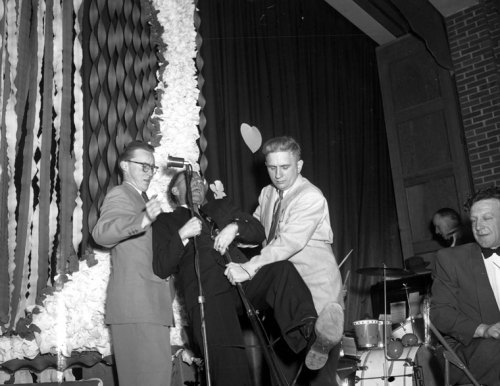
Even though at first hand this picture seems to show that the guy on the right loves holding the middle one’s pole, this is actually  a photograph of Mayor A. W. Shackleford frozen to two microphones by a 50  volt shock caused by improper grounding.  Mayor Shackleford was just about to introduce Teen Queen Donna Glock and  runner-up Shirley Parkinson at a Valentine Dance, 1953, when he grabbed  both microphones. Because the wires were improperly grounded the  current flowed into the Mayor’s body and froze his hands to the  microphones until the power was turned off.  Poor Mayor. source

Photograph of Mayor A. W. Shackleford frozen to two microphones by a 50 volt shock caused by improper grounding. Assisting him is CJOC Announcer Joe McCallum, (left) and City Alderman Cliff Black. Second from the right in the background is Marvin Nelson.

Mayor Shackleford was just about to introduce Teen Queen Donna Glock and runner-up Shirley Parkinson at a Valentine Dance, 1953, when he grabbed both microphones. Because the wires were improperly grounded the current flowed into the Mayor’s body and froze his hands to the microphones until the power was turned off.

The photograph, taken by F. Orville Brunelle of the Lethbridge Herald, appeared in 1300 magazines and newspapers all over the World. Brunell won the Canadian Press Picture Service “Best Picture of the Year” Award for 1953.

source

smash the bnp

I suppose this would be the British equivalent of someone registering me as a member of the KKK.

I looked around the internet to see if I could find any more about the following story.  The only other mention of it was found on stormfront.org, a white pride kinda site. So sad.

-What a load of pig droppings!
Most likely she signed up herself and only after a while noticed that there was a member’s list and now she regrets the decision and comes up with a fake “omg hackerz!!”-story

On the bright side: The woman is a prime example of what happens to White Intelligence when interbreeding with inferior breeds of “humans”.

-I reckon she joined the BNP hoping to get a free holiday to Africa.
It amaze me on how face book is taking so seriously with people. with kids killing them selves over been bullied on it and stuff.  Any way shouldn’t she be more traumatized finding out her dads a spear chucker.

Mixed race woman tells of her anger after computer hacker registered her as BNP member

by Matt Hurst, Birkenhead News

Maxine DeenA WOMAN of mixed race has told of her anger and upset after a computer hacker registered her as a BNP member.

Maxine Deen, whose father is African and her mother white British, says she hasn’t been able to eat or sleep since discovering the changes last week.

The 40-year-old told the News: “People have been ringing my family and saying, why has your daughter joined the BNP?”

She says the trauma has been so great that her youngest child, aged just ten, won’t go out anymore and her extended family feels deeply insulted.

Maxine, who has three children and lives in Tranmere, said: “Last week I wasn’t able to get on my email so my sister looked at my profile on Facebook and discovered the hacker has got me to join the BNP and given all my details out to everyone.

“I am not a member of the BNP, I’m from a black family and my children are black.”

To make matters worse, the BNP website lists her as a member, including her address.

The 40-year-old said: “It’s just made me feel really ill, I haven’t slept or eaten.”

A spokesperson for Merseyside Police said: “Merseyside Police is investigating an allegation of harassment made by a woman from Wirral through the social networking website Facebook.

“An officer has visited both parties involved.”

Maxine’s immediate family are committed Rastafarians, and she said: “I can’t put into words how they feel being exposed to the BNP.”