beauty-full

so, while i was “away” one of the big community newsflashes was that mixed-race is the new standard of beauty.  um…ok, cool…i guess…or, whatever!…i’m not really sure where i stand on this one, because, just like race, a standard of beauty really has no basis in reality.  that’s merely an opinion.  however, the fact 64% of the people polled in the Allure magazine survey that delivered us this “good” news are of the opinion that they generally find mixed-race women to be the epitome of beauty, leads me to ponder a couple of things:

1. we’re not so invisible anymore.  they didn’t choose light-skinned black people with “good hair,” or asians who may also be perceived as a little hispanic too as the exemplification of beauty.  they chose mixed-race.  it was on list.  that’s progress, no?

2. i firmly believe that there is no such thing as race, not in terms of the universal reality which i perceive to be very different from the mainstream worldly reality.  yet within the confines of the discussion of the topic at hand (funny (and frustrating) how this ‘non-existent’ thing is so confining) i would say that we are all mixed race.  so who amongst us is not full of beauty?

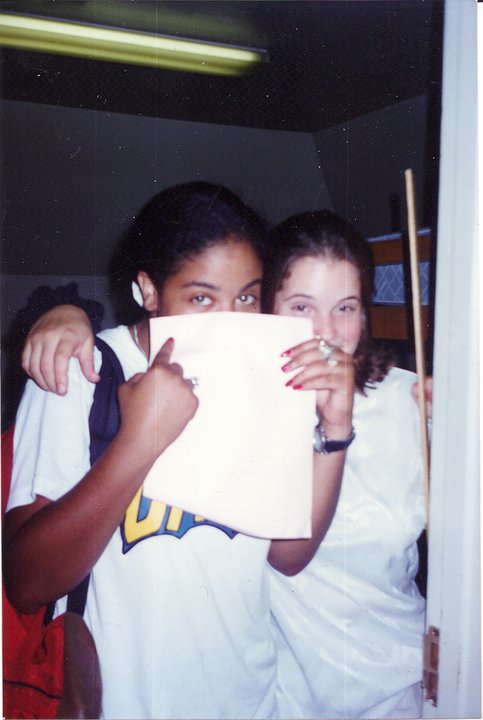
3. i also think about all the previous generations of mixed people who may have felt invisible and/or less than and/or all that jazz… i think about me… i wish i could have told this girl that if she could just wait 10-20 years or so, some of the things she felt uncomfortable with and perhaps even unloveable because of would come to be perceived as beautiful… so she should just rest assured in herself and wait for the world to catch up…

wow! these pictures make me so uncomfortable. just like i was back then.

now…not that i’m all caught up in thinking of myself as some biracial beauty…but…i gotta say…progress, no?

if i had to identify something beautiful about this picture, i would say it’s that i seem unapologetically present and, dare i say, confident even. i’d like to see phrases like that enter the equation when calculating the standard of beauty… confident, present, compassionate, passionate, gracious, generous… how ’bout those undisputably beautiful things?


no h8

This is so right on!  Thank you, Karen Finney.  I’m so glad my (white)grandparents allowed me in to their lives.  And so are they! It’s the “little” things…

On another note, this sentence, “the very existence of antimiscegenation laws had been enacted for the purpose of perpetuating the idea of white supremacy,” speaks to the very reason I fell down this rabbit hole I’ll now call the mulatto trail.  I realized one day that anti-miscegenation and the one-drop rule perpetuate the idea of white supremacy, and that by subscribing to that antiquated rule I was upholding that ridiculous notion.  The anti-miscegenation thing has legally been eradicated, but ask any interracial couple who has walked down a street together, and I’m sure they’ll tell you that on more than one occasion they’ve been given the evil-eye or gawked as if they were freaks of nature.  Or both.  And as for the one-drop rule, head on over to my youtube channel, scroll through the comments, and you’ll see that it looms large in the consciousness.  And many people don’t seem to be willing to let it go.

California Prop 8 Gay Marriage Ruling a Win For American Values

By KAREN FINNEY

SOURCE

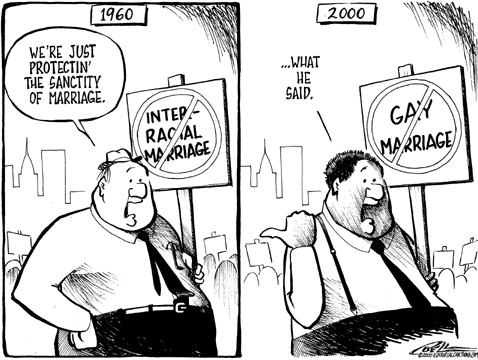
Yesterday’s ruling that California’s Proposition 8 is unconstitutional reaffirms a long-held American value that no matter how you try to spin it, separate is not equal. While some may not agree with same-sex marriage, history should remind us that our Constitution calls us to recognize that the laws in it apply equally, not to be picked apart to support a political agenda or bias. The arguments being used against same sex marriage are frighteningly similar and equally offensive as those once used against interracial marriage. While a Gallup poll in 1967 found that 74 percent of Americans disapproved of interracial marriage, it’s almost hard to remember just how far we’ve come.

I was 16 years old before I was allowed in my grandfather’s home in Greensboro, North Carolina. That’s how long it took for him to even begin to re-think his shame over having a mixed-race granddaughter. He believed, as did many at the time, miscegenation was wrong on moral and legal grounds. Thankfully for me, my parents disagreed. They were married in New York City and had me despite the fact that it was illegal in their home states of Virginia and North Carolina to do so. Thankfully for our country, in the case of Loving v. Virginia, the Supreme Court saw beyond the fear and bigotry of the moment and ruled that antimiscegenation laws violated fundamental American values of Due Process and Equal Protection Under the Law as guaranteed to every American by our constitution.

Just as some used to say that marriage is only valid between a white man and white woman, some now argue that marriage can only be between a man and a woman. Arguments have also been made that same-sex marriage dilutes the institution of marriage, just as similar arguments suggested that interracial marriage diluted the white race. My personal favorite absurd justification says that (despite the idea that we are all God’s children and loved equally) gay marriage is against the laws of God and nature. That argument was used by Leon M. Bazile, the judge in the initial case against the Lovings, who said:

Almighty God created the races white, black, yellow, malay and red, and he placed them on separate continents. And but for the interference with his arrangement there would be no cause for such marriages. The fact that he separated the races shows that he did not intend for the races to mix.

The Supreme Court’s ruling in the Loving case also recognized that the very existence of antimiscegenation laws had been enacted for the purpose of perpetuating the idea of white supremacy:

There is patently no legitimate overriding purpose independent of invidious racial discrimination which justifies this classification. The fact that Virginia prohibits only interracial marriages involving white persons demonstrates that the racial classifications must stand on their own justification, as measures designed to maintain White Supremacy.

Similarly, as Judge Vaughn Walker today affirmed, denying gay couples the right to marry, not only denies basic civil rights, liberty, and freedom, but also codifies bigotry.

Karen FinneyKaren Finney is a political analyst for MSNBC and an independent consultant working with political and corporate clients in the areas of political and communications strategy. She brings over 16 years of experience in national politics and campaigns ranging from the Clinton administration to New York State to the Democratic National Committee.

recently on the interweb

I’ve come across some interesting stories, commentary, and subsequent comments all dealing with… Biracialness! Big shocker, right?  I love reading the comments.  So many different opinions, which simply reinforce my will to stay with my self and stand confident in my personal ideology.

The Seattle Times

Via

Rant and Rave Rant to the women on the bus who, when asked to quell their use of expletives around my young children, disparaged me for having a biracial family and insulted my daughters’ hair. Rave to the man who told them my request concerning their language was valid and that they had no reason to insult me and my family. Thank you, sir.

Answer.com

JUST ASK AND LET THE OTHER TO ANSWER IT FOR YOU

Via

Pregnancy & Parenting

How do I tell my mum I’m having a mixed race baby?

the baby is going to be half black but i don’t think my mum or my family would be too happy about it.. I want my family to accept the baby but what can do I to make them accept my unborn baby…

5 Responses to “How do I tell my mum im having a mixed race baby?”

blessed says:

all you can really do is explain to them as much as you can to get them to understand, but even at that it might not change their minds, but if it doesn’t then just say it’s my baby and no matter what it is going to be family and they’ll just have to get over it.

Charles J says:

You don’t. I would recommend getting an abortion. No one likes a half-breed.

VincentL says:

just tell them straight up…they probably be very mad at first but sooner or later they will adjust to i

Due 12.3.10 says:

just tell her its ur child..

R.I.P Michael Jackson says:

u don’t have to they will c it when u have it………….

Run, Racists, Run! Biracials Are Everywhere!

By Sam Watson

Via

Gone are the days where the majority of people will shout racist remarks at those of color on the streets. It still happens, but nowhere near as much as in the past. Racists are kind of afraid to spew their hatred in public, and I feel us biracials are to blame. We represent an abomination to racists. An old, white guy- a complete stranger- once saw my mom (white, Ukrainian) with my sister and I, when we were very young children, and he shouted, “Slut!” at her. We’re mixed – half white and half black. We represent an absolute breakdown of a racist’s hateful beliefs.

…Racists don’t know whether or not the “white” person next to them is either mixed or married to someone of a different race. Racists better up their paranoia levels, and warn the town sheriff in Bigotville.  During the World Cup, I turned to my seemingly white co-worker, and started ragging on the Mexican team. She instantly scowled at me in return. I forgot! She’s half white and half Mexican! Even I- a biracial- was fooled! We’re everywhere, now, and this is a racist’s worst nightmare.

Comments

-You are right. When it comes to black people, they now hate themselves much more. All of us are mixed up with something. We are one human race. Our race is different from that of the animals, not each other.
-A study I heard cited recently encouraged parents to discuss race and racism with their kids. Several families dropped out because they were so uncomfortable with this requirement of the study.

The study discovered that racism is not discussed at all in many progressive, liberal households. The idea is that if we’re all supposed to be colorblind, discussing race, or any difference for that matter, is taboo. Of course, that’s the best way to make it a dark, secretive thing- precisely the problem. People who desperately want their kids to be not just tolerant, but accepting, are practically guaranteeing their kids get no exposure to the subject by pretending it’s not there.

Racism and bigotry is a vampire- it can’t stand the light. If we want it to die out, we have to do the uncomfortable, inconvenient thing and talk about it even when it’s not a major in-your-face problem.

-I am half German (white) and Puerto Rican (brown) and I always baffle people. I think it’s interesting that we assume that racism is disappearing when I feel like it is only growing. In an all colorful nation I still feel like I need to watch what I say when I am naming a race ~ whether it’s politically “correct” or not because I never know who is going to be offended.

-You better believe we are everywhere. Though I know I’m not the only unique biracial person out there, I do admit that people are surprise when they hear that my mom is from Dominican Republic and my father is from Afghanistan. Talk about fusing two totally different cultures.

I also understand when you talk about racism being a private thing. My step mother is racist, even though she’s married to my father. It makes me mad when she makes stupid comments regaurding race. She also tries to inplant her ideas on my half brother. I try my best to counter these thoughts though… my diverse background has raised me to be open to new ideas, cultures, and people. The more people who are biracial, the more tolerance we have of one another.

-Racism is still alive but it’s a endangered species. I say this because the current generation doesn’t hold race as important as the previous ones. Most of my friends (I, myself included) have bi-racial children. At times I wonder when these kids grow up will that look at their peers and ask in shock “You’re not mixed?” I think it’s a great thing, however as parents we still need to pour our cultures into the children, letting them know they have and even more extended set of roots and the beauty contained within both.

-Racism is part of human nature. Embrace it!

-I’m old enough to have seen overt racism, as well as the more prevalent covert racism. Sometimes I feel that the only hope we have to eradicate racism is the gradual blending of all races into an “everyman.”

-I was recently showing off pictures of my friends in New York to some people here. They nodded politely at all of them, but paused at a picture of two my best friends.

“What race are they?” I was asked.

I couldn’t believe it mattered. A lot of my previous pictures had been of people who were black or Asian or of some non-white race, but these two mixed-race girls came into question?

“Er, she’s Romanian and Jamaican, and she’s Indian, Portuguese and Italian.”

“Oh, okay.” The guy replied. “I just couldn’t figure it out.”

Why should you have to?

startling

Perhaps “startling” would be a bit of an exaggeration today, but a production like this would still be considered mildly innovative indicating that we haven’t evolved much out of our old traditions…

March 1970: Student teachers, Dereck Tapper and Scilla Nicholls in a rehearsal for a production of ‘Romeo and Juliet’ at St Luke’s Teacher Training College in Exeter. The mixed-race casting was considered a startling innovation at the time. (Photo by Keystone/Getty Images)

whiteness defined

This one is so good that I don’t have perspective to add or anything witty to say about it.  However that could just be because I’ve only had three hours of sleep and just can’t do any better.  Either way, this excerpt of a transcript of an NPR interview is definitely worth reading and pondering.  You could also listen to it in it’s entirety HERE.

Author Examines ‘The History Of White People’

Once upon a time, notorious laws in this country defined as black anyone with as much as one drop of black blood. Similar laws struggled with the rights of people of mixed race, octoroons, for example. But nowhere can you find a definition of white people, and as a practical matter, that non-definition has changed. Ethnic groups now regarded as white Irish, Jews, Italians – were once very much on the outside.

These points (are) from Nell Irvin Painter’s new book, “The History of White People,” which traces ideas about color and race from antiquity to the Obama administration.

This is TALK OF THE NATION. I’m Neal Conan in Washington. Nell Irvin Painter is our guest…

CONAN: …you conclude at the end of your book, you say the fundamental black-white binary endures even though the category of whiteness or we might say more precisely a category of non-blackness effectively expands. That non-blackness, is that by lack of a definition of whiteness?

Ms. PAINTER: Yeah, that’s about how it goes. There as you noted, there have not been legal definitions of whiteness. It’s kind of what’s leftover from blackness.

CONAN: What isn’t.

Ms. PAINTER: And blackness, there’s the idea of a one-drop rule is an idea. What the states did was say one-fourth, one-eighth, that kind of thing, one grandparent, one great-grandparent. That’s how they decided what one drop was.

I suppose people use the word one drop because actually color disappears very quickly in people. And so you can look functionally white with one black grandparent, which in most places would make you legally black. So what makes you black has been defined and redefined and re-re-redefined. What makes you white is what’s leftover.

CONAN: And in fact, you say that has been, well, ill-defined but redefined and redefined over the years, too.

Ms. PAINTER: Yeah…  The whole point of defining races is mostly to put people down, and so those needs change over time. Who do you want to put down? Well, you want to put down, say, Jews and Italians and Slavs 100 years ago, but 150 years ago, you wanted to put down the Irish.

…We think of race as something physical, biological and permanent, but the way people used race in the 19th and 20th centuries and probably still today is that it has to do with temperament, racial temperament. So how people look on the outside is a key to what they’re like on the inside, their temperament. So that had to do with Protestantism, too.

…CONAN: It’s interesting, Nell Irvin Painter, you describe how, in fact, racial laws made a transition in the late part of the 20th century from being used to exclude persons of color to define injustices against persons of color.

Ms. PAINTER: Not persons of color, Negroes, to be exact. The laws were against Negroes. But you’re absolutely right that before desegregation, before the Civil Rights Act of 1964, all those laws, exclusionary laws, were meant to keep Negroes out. And the counting up was to keep Negroes out.

And after that, particularly after the 1970s, the need to rectify the injustices meant that we had to count people in order to straighten things out. So now we count up racial categories, say, to track mortgage lending, where there’s still a good deal of racial discrimination.

So in the census, the census keeps counting us by race for purposes of undoing racial harm in the past.

Read more (or listen) HERE

profiled

Yes, I believe they were… Disturbing.
Teen With Asperger’s Arrested: Were Callers Racial Profiling?

by Ken Reibel

VIA

Reginald Latson loves to walk.

“He’ll walk five or 10 miles, it’s nothing to him. Sometimes he walks five miles just to grab a bite to eat at Chili’s,” says his mother, Lisa, who lives in Stafford, Virginia. “Walking is his release.”

Neli, as his family calls him, is 18 and has Asperger’s, a mild form of autism. Three Mondays ago, he rose early and left home without telling his mother. “When I entered his room at 6:30 am and didn’t see him, I assumed he had gone for another walk,” she says. It was a school day.

Four hours later Stafford County authorities had ordered a lock down for eight schools, and Neli was in police custody, facing one count of malicious wounding of a law enforcement officer, one count of assault and battery of a law enforcement officer, and one count of knowingly disarming a police officer in performance of his official duties. The cascade of missteps that led to the arrest suggest a combination of public racial profiling and the over reaction of law enforcement officers who are unfamiliar with autistic behavior.

* * *

After Neli left home early that morning he walked two miles to Porter Library on Parkway Blvd. “He goes there frequently. There’s a teen room there, and he enjoys it,” says Lisa. The library was closed, so he sat under a tree, in the grass, at the front of the building. The parking lot at Park Ridge Elementary, about 400 feet to the west, was filling up.

According to officials reports, someone at the school called police at about 8:38 am to report a suspicious person sitting outside the library, “possibly in possession of a gun.” A bulletin went out with Neli’s description, and officials, concerned that a gunman was on the loose, ordered a school lockdown and set up a search perimeter.

When police arrived at the library, Neli was gone. Unaware of the report, and impatient for the library to open, he began walking in the direction of the high school. A forested green belt of trees some 500 feet-wide with a well-worn path separates the school from nearby homes. At about 9 am, a “school resources officer” who is also a Stafford County Sheriff deputy approached Neli. That’s when accounts begin to diverge.

Lisa said her son complied with a search, which failed to find a weapon. Police say Neli “attacked and assaulted the deputy for no apparent reason.”

Neli told his mother that the school officer threatened him, and that Neli said “You’re harassing me. You’re not allowed to do that. I know my rights,” then turned and walked away. According to Neli, the officer grabbed him from behind and choked him. Police reports say a scuffle ensued, during which the officer pepper sprayed Neli. The police version, which you can read here, says Neli then took the spray from the officer and turned it on him.

According to Lisa, Neli said he took the spray and ran into the woods. The deputy, Thomas Calverley, reportedly suffered a cut to the head and a broken ankle, and underwent surgery.

By this time sheriff deputies were combing the area with search dogs, and at least one TV news crew offered a breathless live report of the manhunt. Neli somehow eluded the dragnet for another 45 minutes before being spotted and arrested in the high school parking lot, shortly before 10 am.

No gun was found “and subsequent investigation has indicated that that a gun was not actually seen by the reporting parties,” according to the official report.

Lisa learned of the arrest at 10:30 am, when she called the police to report that her son was missing. “I was told that he was in custody and was currently being questioned but I was not told why,” she said. “They wouldn’t tell me anything, and wouldn’t allow me to visit him. I told the police that Neli has autism, but they didn’t seem to care.”

For the next 11 days, Neli was held without bail, and in isolation at the Rappahannock Regional Jail. Police allowed Neli’s school counselor to visit, and she relayed messages and information to Lisa, who was allowed only one visit. “He wasn’t able to speak or communicate with me. He appeared to be in a catatonic state,” Lisa says.

She is understandably frustrated and angry.

“The actions that were taken by the police that day were excessive in the least and grossly mishandled,” she wrote on a website started to counter inaccurate local media reports. “Someone says ‘I see a suspicious black male’ and he ‘could’ have a gun, while all my son was doing was sitting in the grass at the library. And you shut down six schools and go out on a manhunt for this dangerous black man who was sitting in the grass. Anyone can read between the lines and see that this just doesn’t add up.”

2010-06-13-Neli61310.jpg

Neli is from a military family, and during his 18 years has lived in Florida, Germany, Oklahoma and Georgia. Seven years ago his family moved to Stafford, a sprawling bedroom community about an hour south of Washington, DC. The family struggled to find appropriate school placement, finally settling on a private school. “The public high school was crowded, with about 30 kids to a class. Neli wasn’t getting the attention he needed, and his self esteem was slipping.” But he had never been in serious trouble. Never like this.

Lisa heeded the warning signs. A month earlier, she asked Neli how he would feel about wearing a medical alert bracelet that identified him as a person with Asperger’s. “He said that he didn’t have a problem with that, but I didn’t follow up. I’m just kicking myself for that,” she said.

Lisa, who works as a defense contractor, had also asked for a two month leave of absence to spend more time with Neli. That Monday was her first day off work. Her husband, Neli’s stepfather, retired from the Army and is currently stationed in Iraq as a military contractor.

* * *

As Neli’s time in isolation dragged on, police interrogators found him non-responsive and disturbed, and a judge ordered the young man transferred to a state mental institution for 30-days of treatment and evaluation. If the case is not resolved by then, he will end up back in jail.

The hospital is a two-and-a-half hour trip from Stafford, which Lisa says she has made four times. Horrified, she watched her son’s mental state worsen with each visit. “He is locked away and doesn’t understand why,” says Lisa. “He’s been through an ordeal.”

That ordeal has also changed Lisa, and the way she thinks about race, the police, and her community. She suspects Neli’s arrest was in part racially motivated, but it is not a charge she makes lightly.

“I used to donate money to the police benevolent society. I never imagined something like this could happen,” she says.

“I don’t think in terms of ‘watch out for those kinds of people’ or ‘you need to be scared,'” she says. “I grew up in south Florida. That’s a melting pot of cultures. I know there are good people and bad of every race.” Her life in the military, she says, has brought her friends “of every racial background.”

Has the ordeal changed her views on race and racism?

“It has,” she said, her voice trailing off. “It most definitely has.”

* * *
Cross posted at AutismNewsBeat.com

exception

…to the “race doesn’t matter” mantra.  It seems to be relevant when physical health is the issue.  Actually, mental health as well, but that’s a different story.  Anywho, I’m happy to read of this research and find it interesting that supremacists are happy to hear of it too.

Genetic screening may redefine medical treatments

by Carolyn Johnson

SOURCE

SAN FRANCISCO (KGO) — New research out of UCSF shows that tracking a patient’s genetic ancestry can improve the diagnosis of asthma and other lung diseases. The results could have broader implications for other diseases that also rely on standard benchmarks such as race, gender and age.

Doctor’s office visits are the norm for 9-year-old Shamatay Hayes. She was diagnosed with asthma at age 2, something she and her mom have struggled to keep under control.

“It is challenging,” her mother says.

At San Francisco General Hospital and at asthma clinic across the country, Shamatay’s lung function is tracked using standard benchmarks such as age, gender and race. But, researchers say there is now a better way.

“So, what we can now do with modern techniques is estimate what a person’s ancestry is or what their heritage is using a series of genetic markers,” says UCSF researcher Dr. Melinda Aldrich.

The genetic markers more accurately determine lung function rather than a patient’s self-identification as simply white, black or Hispanic.

“With increasing African ancestry, we saw a decrement in lung function,” says UCSF associate professor Dr. Esteban Burchar.

Burchard is director of UCSF’s Center for Genes, Environment and Health, and senior author of a paper just published in the New England Journal of Medicine.

“We said forget what you think you are, what people think you are, and we looked at your genetic ancestry. We were able to reclassify patients more accurately than just using self-identified criteria,” explains.

That is increasingly important because race is used to establish normal reference values for everything from diagnosing disease to establishing disability payments. For instance, a mixed-race firefighter who suffers smoke inhalation might not meet the standards for disability of what is considered normal lung function since that is based on just three racial categories right now.

“What we showed is when you use these race-based standards, you could have as much as a 10 percent error rate depending upon what your true ancestry,” Burchard says.

Burchard believes this research brings us closer to truly-personalized medicine, but he is also aware of the potential controversy.

“We’ve had people contact us who were supremacists that said you know what you’re doing is validating what we believe,” he says.

But, the research actually tells a different story.

“Most of us, all of us in fact, are racially mixed,” he says. “We have a very rich heritage and what we’re doing is acknowledging that mixture and incorporating it into our clinical assessments.”

Scientists believe their results on lung function are just the beginning.

Aldrich says, “Wherever potentially we use race now for making medical decisions, it may have an impact with other diseases.”

This would ultimately make medicine more effective for everyone. The genetic tests used by researchers at UCSF cost about $10 per patient. Scientists see it as a small price to pay for a more accurate assessment of disease, which could lead to more effective treatments for patients.

(Copyright ©2010 KGO-TV/DT. All Rights Reserved.)

conspicuously negroid features

Really, Frontline?  Really!?  Negroid?  Whatever, PBS.  Not sure why that caused me intense irritation, but it did.  Moving on…  This strikes me as something that should be common knowledge.

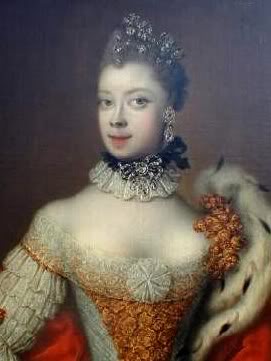
Was This Britain’s First Black Queen?

by Mario de Valdes y Cocom

“The suggestion that Queen Charlotte was black implies that her granddaughter (Queen Victoria) and her great-great-great-great-granddaughter (Queen Elizabeth II) had African forebears. Perhaps, instead of just being a boring bunch of semi-inbred white stiffs, our royal family becomes much more interesting.” (The Guardian, March 12, 2009)

With features as conspicuously Negroid as they were reputed to be by her contemporaries, it is no wonder that the black community, both in the U.S. and throughout the British Commonwealth, have rallied around pictures of Queen Charlotte for generations. They have pointed out the physiological traits that so obviously identify the ethnic strain of the young woman who, at first glance, looks almost anomalous, portrayed as she usually is, in the sumptuous splendour of her coronation robes.

Queen Charlotte, wife of the English King George III (1738-1820), was directly descended from Margarita de Castro y Sousa, a black branch of the Portuguese Royal House…  Six different lines can be traced from English Queen Charlotte back to Margarita de Castro y Sousa, in a gene pool which because of royal inbreeding was already minuscule, thus explaining the Queen’s unmistakable African appearance.

Queen Charlotte’s Portrait:
The Royal FamilyThe Negroid characteristics of the Queen’s portraits certainly had political significance since artists of that period were expected to play down, soften or even obliterate undesirable features in a subjects’s face. Sir Allan Ramsay was the artist responsible for the majority of the paintings of the Queen and his representations of her were the most decidedly African of all her portraits. Ramsey was an anti-slavery intellectual of his day. He also married the niece of Lord Mansfield, the English judge whose 1772 decision was the first in a series of rulings that finally ended slavery in the British Empire. It should be noted too that by the time Sir Ramsay was commissioned to do his first portrait of the Queen, he was already , by marriage, uncle to Dido Elizabeth Lindsay, the black grand niece of Lord Mansfield.


Thus, from just a cursory look at the social awareness and political activism at that level of English society, it would be surprising if the Queen’s negroid physiogomy was of no significance to the Abolitionist movement.

Ramsay painted this one, with her two children, in 1765

Mulatto Queen: Black Grandmother of Queen Victoria

by Gary Lloyd

History reveals two curious details about Queen Charlotte Consort to George III: First, her official coronation portrait shows a woman with distinct mulatto features. Second, the Royal Physician to her granddaughter, Queen Victoria, wrote about her in his memoir: “She had a true mulatto face.”

But if Queen Charlotte was a mulatto, who was the black man who fathered her? And if Queen Victoria became the “Grandmother of Europe” would not her black African great-grandfather be the great-grandfather of virtually every Royal house in Europe?

Mulatto Queen unravels this mystery. Along the way we meet Voltaire, Samuel Johnson, Czar Peter the Great, Liebniz, and finally, the black African rumored to be Queen Charlotte’s biological father.

No stodgy historical drama, Mulatto Queen is a hypnotic, farcical romp through King George III’s England. Think: The Da Vinci Code meets Roots …

The characters are heroic, cowardly, desperately funny, disturbingly neurotic. What with their wedding-cake high wigs, court gowns, rampant alcoholism, bloodlust for public executions, addiction to snuff, penchant for gluttony, the appearance of a 17-year old mulatto girl and King George’s instant attraction to her caused a scandal and a cover-up that persists to this day.

Buy the book HERE

re: doubles

I’m not a fan of the old “best of both worlds” myth.  Not unless the other side of that coin -worst of both worlds- is given as much weight.  However, I didn’t want to simply tout a “tragic japanese-american” fallacy over here today either.  Here’s what I found to counteract that.

The Hapa Advantage

By Leah Nanako Winkler

via

“Hybrids are better”—Shayne Kao

…In the belated honor of “LOVING DAY,” I’ve asked 10 hapas in NYC and beyond (including myself) the following: what we like about being biracial, and how it has shaped us in this world. So, let’s eat some good food and enjoy the sunshine as this community continues to grow and we find each other and ourselves among the masses!

PERSPECTIVE


Name: Teddy Hose

OCCUPATION: Illustrator, Animator, Graphic Designer

NATIONALITY: Dad is American (3rd Generation German), Mom is Japanese (straight from Japan).

TEDDY SAYS:
I definitely enjoy being biracial, it gives me perspective culturally, and I usually get a positive response when people ask me about it.  I like the feeling of being unique because I work in the creative field where that is highly valued.  I also believe it makes me more tolerant since the East’s values and tendencies are clearly different than the West.  I can’t help but see things from more than one angle, which can be refreshing. I’m honestly able to communicate better with non-white people in my experience.  Being able to connect with someone based on feeling “different” is always something I look for, as cliché as that sounds.

I think one advantage with being hapa is that we don’t have the typecasting that comes with being one race. Not to say there are those who equate mixed race people to one race (Obama being declared as the first “black” president), but this aspect is great for someone who’s an artist like me.

THE IN-BETWEEN LIFE

NAME: Stephanie Silver

OCCUPATION: Actress

NATIONALITY: Half-Japanese, Half-German/Austrian/Hungarian—aka Germanese, or Double-Jap, or Jap-Squared, or the Axis Powers (minus Italy).

STEPHANIE SAYS:  I grew up with ramen and tempura dishes one week, and pastrami sandwiches and matzo ball soup the next. Which dessert do I like more: mochi or cheesecake? At a frozen yogurt shop, I don’t have to choose anymore. I can have both flavors, a twist, a blend, a hybrid!

Feeling a connection to two distinct cultures. Recognizing my features in an Expressionist painting, and my emotions in a woodblock print. Strangers telling me I should go to Israel, no Berlin, no…Okinawa. Remembering trips to Hawaii during Summer, and New York in the Fall. Learning to surf and going to Temple. Living the in-between life in Los Angeles. Being accepted by most Asian and Jewish groups and looking non-descript enough to pretend I was Latin or Creole to fit in there too. But feeling especially drawn to people with a similar mixed heritage. I had a deeper understanding with them and I was eager to find common ground.

I think seeing how one side of my family would ostracize one or the other of my parents made me embrace different ethnicities more. I’m constantly finding myself attracted to minorities. And I think their families are more accepting of me because of my mixed heritage. It’s as if I’m neutral territory, truly American. I could date Raymond, who is Korean, and his parents wouldn’t mind because I was only half-Japanese. My Japanese grandparents certainly would not feel the same about him. I could be considered as a potential wife for David and Daniel, both Jewish, simply because of my last name.

People are comfortable around me because I blend easily, but they’re curious too. I hear them saying to their friends with pride, “she looks Hawaiian, right, but her father’s Jewish!” I was born into something exciting and somewhat new. We’re a growing group of biracial mixes, foreign yet distinctly native. We’re the physical manifestation of the end of racism.

THE ROAD LESS TRAVELED

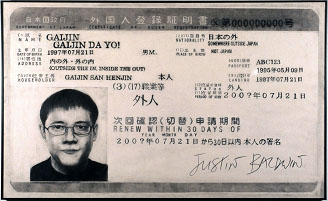
NAME: Justin Baldwin

OCCUPATION: Artist, but an unknown one, so I have a day job working for a Japanese company.

NATIONALITY: I am an American, as is my father. My mother is now a U.S. citizen, but was born in Japan. On my father’s side of the family, there is Irish, German, British, and who knows what else … and, I suspect that on my mother’s side, there may be some Russian (going back a couple hundred years), since my mother has fair skin and green eyes (plus, she’s from Sapporo, and the prefecture of Hokkaido is closer to Russia than anywhere else in Japan).

JUSTIN SAYS:
Although I didn’t study Japanese until I finished college, the biracial factor inspired me to study Japanese and eventually live in Japan. This has subsequently made a profound impact/influence on who I am, and what I do. I suppose, in this sense, it has helped secure jobs (first with the JET Program, and then with the Kurashiki Board of Education, and now with my current corporate incarnation as a Professional Gaijin/Scapegoat). Being biracial in college helped me connect with Roger Shimomura as a student, who remains a close friend and mentor. So in many ways, even though being biracial has not always resulted in the most pleasant experiences, it has led me down avenues that I might not otherwise have taken, meeting new people and places that do end up being very beneficial and positive. Besides, as I mentioned, there’s a certain freedom to being undefined.

DOUBLE NOT HALF

Leah Nanako Winkler

As I scroll through these responses, once again, I am overwhelmed with a simultaneous sense of comfort and disorientation. Entering my mid-20s, I’ve come to accept and embrace the positive effects of my ethnic background, by associating with and learning from the people mentioned in this article. I am learning quickly that my identity crisis/investigation is only a small fraction of a cultural search of where we, as biracial people, stand in this society. The importance of seeing the glass as half-full, as opposed to half-empty, is equal to seeing ourselves as double, rather than “half” of two races. In many ways, we are lucky and unsheltered. I am excited to see how this perspective continues to grow, as I meet more and more of you and hope to strengthen our voice in any and every way possible.

© 2009 Leah Nanako Winkler