empower women, eliminate racism

March 24, 1912 – April 20, 2010

Thank you, Dr. Dorothy Height!

Here’s an excerpt of a 2008 NPR interview with Dr. Height.  You can read the transcript in its entirety HERE.

Civil Rights Elder Sees Dream Come True

hosted by Michel Martin

MARTIN:  Dr. Dorothy Height began a lifetime of activism during the Great Depression, a time when the simple right to vote free of the fear of violence seemed like an impossible dream for many African-Americans. And at the of 96, she is still going to the office just about every day trying to further the cause of equal rights for all Americans. She’s serving as chair and president emerita of the National Council of Negro Women. She was kind enough to receive us at her office on historic Pennsylvania Avenue yesterday. We’re talking about President-elect Barack Obama’s historic win.

MARTIN: I wanted to ask you about that because you have been working in this field since you were a very young woman. I mean, really, your entire adult life. Since your early 20s you’ve been an activist. Did you believe this day would come in your lifetime?

…Dr. HEIGHT: Well, you know, I guess I got to – my faith was renewed working for 33 years with the YWCA of the United States. And I went there as a secretary or a staffer or something related to interracial education. After 33 years, I retired as a director of the Center for Racial Justice, and I split this organization, that from 1946 really set out to open its services to all women, regardless of race or with full regard for race, and so I saw the way an organization that was founded by white, Protestant women that now is very inclusive, and I was a part of that development.

When the YWCA in 1946 adopted an interracial charter, that was ahead of the Supreme Court’s decision on Brown versus the Board of Education, so that in a sense I had already the experience. And I listened to people when they kept saying – well, some people, particularly white people, will say this but they won’t go in. I also know that I worked with many white women who took a strong stand but they didn’t discuss it at home because their husbands didn’t agree with them, but they worked hard to see that the YWCA was integrated, as they called it. And today, the YWCA has Empower Women and Eliminate Racism as its slogan. And I think that made me know that there are many people who know that this is right to do and that they were willing to do it, but they didn’t necessarily announce it.

MARTIN: I remember that, reading in your memoir how your organization, the YWCA, was one of the first – and some precursor organizations were among the first to have integrated meetings, and how dangerous it was for some of these women to participate.

Dr. HEIGHT: At that time there were – when we had meetings, sometimes we were talking about the klan. Sometimes we found that we were denied services that we had been promised when they realized fully what it meant that we would be women of different races. But you know, I found that were strong women in all racial groups, and I think that’s what Barack Obama has shown us. There are people in every group who know what is right and who want to move, and they just need some kind of direction and some kind of feeling that other people are with them. I remember Dr. Mayo(ph) saying, I hear people say the time isn’t right. And he said, but if it isn’t right then it’s your job to ripen the time, and that’s the way I feel about it.

12 Nov 1960, New York, New York, USA — Eleanor Roosevelt is presented the Mary McLeod Bethune Human Rights Award by Dorothy Height, President of the National Council of Negro Women. — Image by © Bettmann/CORBIS

…MARTIN: What role do you think civil rights organizations have now?

Dr. HEIGHT: Well, there’s still a lot of unfinished business. Right now you have going across the country a whole effort to destroy affirmative action. In other words, we’re finding that people are using civil rights in a negative way, and they’re calling it, this is a civil right. In a sense, these bills that are being introduced are really anti-civil rights, and they just use the term civil right in order to fool people and make them vote.

MARTIN: Are you speaking about Ward Connerly and some of his efforts to reverse affirmative action…

Dr. HEIGHT: Yes, Connerly has gone into several states, and he has does this in a misleading way, and I think people ought to be alert to it and realize that if you vote for what he is talking about, you’re cutting back something that got started during the days of Lyndon Johnson and was a part of the whole civil rights effort. It is not a preference. It is a way of saying, those who have been denied should be given an opportunity to be sought in (ph) so they can move ahead.
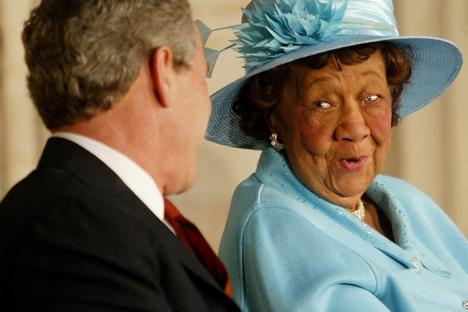
In 2004 President Bush presented Dr. Dorothy Height with the Congressional Gold Medal of Honor.

MARTIN: There are those who would argue, though, that – to be blunt about it – that Barack Obama takes these so-called excuses off the table. People look at that, and they say, look at Barack Obama in the White House. And they say, what discrimination? What could they possibly – what barriers?

Dr. HEIGHT: Yes. I think they will, but I would hope that they would also say to themselves, we need to look at who has the opportunities. We need to look at – Obama himself pointed that to us, that you can’t have a flourishing Wall Street and a destroyed Main Street. He could have also said, I’m working for the middle class, but we still have poverty. And we cannot divide up like that. We cannot say who’s hurting the most. We have to make sure they be dealing with everyone.

I have been working since my teenage days when I did an oration and won my college scholarship on the Constitution of the United States. I chose the 13th, 14th and 15th Amendments. And I looked and realized, here, now, at this age, I’m still working to make the 14th amendment and its promise of equal justice under law, making it real for everybody. That’s what you have to do.

MARTIN: Is there anything that you fear about an Obama presidency, about having an African-American – the first African-American in the White House?

Dr. HEIGHT: I suppose it’s not a real fear. It’s a hope that we will not take it for granted, that now we have achieved and all of our problems are answered. I think we will (unintelligible), as he did, as he said, I will be president of all the people. And by that he meant that he will work for all of us and that we all have to realize that there is unfinished business in civil rights.

It will – we don’t need the marches that we had in the past. But we need more consideration in looking at the boardroom tables and at the policies that are going on, looking at what’s happening in industry, what’s happening in terms of employment opportunities, housing and the like. So that I think it opens up a new way for us to look at our community.

And one thing, I go down now to Deep South and Mississippi and places, where during the ’60s, we moved with fear. I go down now and people are so welcoming that I forget what part of the country I’m in. And I think the people who are saying, we have no problem, have the biggest problem, that they really need to see how we can all work together and recognize that we need each other and see how we can really make this a society in which a person is judged, as Dr. Hayes(ph) said, on the basis of their character and what they do rather than on color of their skin or the language which they speak or their sexual preference, or any of those things.

MARTIN: Since you were a young woman yourself, you’ve been famous when you work with young people. Do you have any wisdom to share, perhaps, to a young Dorothy Height who might be listening to us?

Dr. HEIGHT: I like to say to young people today, you are the beneficiaries of what a lot of people worked and gave their lives for. And you are enjoying things – no matter how bad it may seen, you are still better off than any of those who worked to bring us to this point. And the important thing now is not to go it alone on your own, by yourself, but see how you will join with others. Get organized in how you will serve others and how you will help to move this forward.

And I was so excited to hear President-elect Obama, like they call him now, to hear him say that he needed our help. And I think he does. And we need it not by thinking just of what we want, but how can we help achieve the kind of roles that he has said. Because when you do that and we’re for something bigger than yourself, there’s no way you can help but grow, and that will help to prepare you for the future.

re: emancipated slaves

I posted this picture a couple of weeks ago, but just came across an article (found HERE) with details on those in the photograph.  Wow!
One Drop3.jpg

In honor of Confederate History Month, I present a group of emancipated Louisiana slaves. The following letter was written by Colonel George Hanks, who commanded a Union Corps composed entirely of black troops. Hanks was attempting to raise money for the education of freed slaves:

To the Editor of Harper’s Weekly:

The group of emancipated slaves whose portraits I send you were brought by Colonel Hanks and Mr. Phillip Bacon from New Orleans, where they were set free by General Butler. Mr. Bacon went to New Orleans with our army, and was for eighteen months employed as Assistant-Superintendent of Freedmen, under the care of Colonel Hanks. He established the first school in Louisiana for emancipated slaves, and these children were among his pupils. He will soon return to Louisiana to resume his labor.

Rebecca Huger is eleven years old, and was a slave in her father’s house, the special attendant of a girl a little older than herself. To all appearance she is perfectly white. Her complexion, hair, and features show not the slightest trace of negro blood. In the few months during which she has been at school she has learned to read well, and writes as neatly as most children of her age. Her mother and grandmother live in New Orleans, where they support themselves comfortably by their own labor. The grandmother, an intelligent mulatto, told Mr. Bacon that she had “raised” a large family of children, but these are all that are left to her.

Rosina Downs is not quite seven years old. She is a fair child, with blonde complexion and silky hair. Her father is in the rebel army. She has one sister as white as herself, and three brothers who are darker. Her mother, a bright mulatto, lives in New Orleans in a poor hut, and has hard work to support her family.

Charles Taylor is eight years old. His complexion is very fair, his hair light and silky. Three out of five boys in any school in New York are darker than he. Yet this white boy, with his mother, as he declares, has been twice sold as a slave. First by his father and “owner,” Alexander Wethers, of Lewis County, Virginia, to a slave-trader named Harrison, who sold them to Mr. Thornhill of New Orleans. This man fled at the approach of our army, and his slaves were liberated by General Butler.The boy is decidedly intelligent, and though he has been at school less than a year he reads and writes very well. His mother is a mulatto; she had one daughter sold into Texas before she herself left Virginia, and one son who, she supposes, is with his father in Virginia. These three children, to all appearance of unmixed white race, came to Philadelphia last December, and were taken by their protector, Mr. Bacon, to the St. Lawrence Hotel on Chestnut Street. Within a few hours, Mr. Bacon informed me, he was notified by the landlord that they must therefore be colored persons, and he kept a hotel for white people. From this hospitable establishment the children were taken to the “Continental,” where they were received without hesitation.

Wilson Chinn is about 60 years old, he was “raised” by Isaac Howard of Woodford County, Kentucky. When 21 years old he was taken down the river and sold to Volsey B. Marmillion, a sugar planter about 45 miles above New Orleans. This man was accustomed to brand his negroes, and Wilson has on his forehead the letters “V. B. M.” Of the 210 slaves on this plantation 105 left at one time and came into the Union camp. Thirty of them had been branded like cattle with a hot iron, four of them on the forehead, and the others on the breast or arm.

Augusta Boujey is nine years old. Her mother, who is almost white, was owned by her half-brother, named Solamon, who still retains two of her children.

Mary Johnson was cook in her master’s family in New Orleans. On her left arm are scars of three cuts given to her by her mistress with a rawhide. On her back are scars of more than fifty cuts given by her master. The occasion was that one morning she was half an hour behind time in bringing up his five o’clock cup of coffee. As the Union army approached she ran away from her master, and has since been employed by Colonel Hanks as cook.

Isaac White is a black boy of eight years; but none the less intelligent than his whiter companions. He has been in school about seven months, and I venture to say that not one boy in fifty would have made as much improvement in that space of time.

Robert Whitehead–the Reverend Mr. Whitehead perhaps we ought to style him, since he is a regularly-ordained preacher–was born in Baltimore. He was taken to Norfolk, Virginia, by a Dr. A. F. N. Cook, and sold for $1525; from Norfolk he was taken to New Orleans where he was bought for $1775 by a Dr. Leslie, who hired him out as house and ship painter. When he had earned and paid over that sum to his master, he suggested that a small present for himself would be quite appropriate. Dr. Leslie thought the request reasonable, and made him a donation of a whole quarter of a dollar. The reverend gentleman can read and write well, and is a very stirring speaker. Just now he belongs to the church militant, having enlisted in the United States army.

encourage an important social change

I have long held a sneaking suspicion that by honestly exploring the mulatto experience we will encourage important social change.  I am thrilled to hear that way back when, others had the same idea.  But then slavery ended, and the “powers that be” really needed to maintain the color-coded class system that allowed them such control and wealth, and so did our chances (slim though they were) of being counted for what we really are.  This was not a chance, in my opinion, to distance ourselves from blackness, but to disprove the theory that white and black were different species. I do think we’ve moved beyond that antiquated notion, but I’m not so sure there aren’t a great number of people who consciously or unconsciously believe that black and white occupy space at opposite ends of the spectrum of one species.  I think this article says so much and says it very well.

Census reveals history of U.S. racial identity

by Sally Lehrman

Whether or not they can lay claim to a special category, the “Confederate Southern Americans” who want to write themselves into the U.S. census section denoting “race” have a point.

Race, as the social scientists like to say, is “socially constructed.” Since the founding of this country, we have been making it up as we go. Race is a modern idea, historians and anthropologists tell us, a means to categorize and organize ourselves that we constantly adjust.

The U.S. census serves as an archive of this change, a record of classifications that have been “contradictory and confused from the very outset,” says Margo Anderson, a University of Wisconsin, Milwaukee, urban studies historian and expert on U.S. census history. Begun in 1790 as a solution to the problem of how to allocate seats in Congress, the survey didn’t mention “race” originally, but the idea as we understand it today was central. How should slaves be counted? Were they entirely property or were they people? What to do with “civilized” Indians?

Later Congress debated whether to include the word “mulatto,” Anderson says, and finally agreed – but for opposite reasons. Blacks and whites were different species, some argued, so their “unnatural” offspring should be counted. Others felt that documenting the children of black-white relationships would encourage an important social advance.

“Mexicans” were counted as a race in the 1930 questionnaire, but the Mexican government protested and the category disappeared. “Hindu” lasted for three decades. Koreans were written in, pulled out, and added back again.

All along, the “race” category of the census has been a powerful social and political tool wielded both to discriminate and to guard against discrimination. At first, survey categories reflected ideas about the divide between black and white, which immigrants were eligible for citizenship, and how to sort categories of “Indians.” Later, after the Civil Rights Act of 1964, its groupings also made it possible to measure compliance with equal treatment under the law.

The census reveals the process of race, the categories by which Americans construct difference and with difference, special privileges for some. It measures who and what matters, how resources have been allocated, and reflects the political, economic and social interests that prop up race. Race is defined and contested constantly, shaped in both personal and social realms all at once, according to Michael Omi and Howard Winant, sociologists who developed the central paradigm for studying contemporary race in American society.

Today, for instance, many Latinos refuse to conform to the forms of race described in the census. “Hispanic” is separated out as an “ethnicity” on the survey, so members of this group are expected to choose a race, too. About 40 percent in both 1980 and 2000 selected “some other race,” often writing in an identity such as “Venezuelan” instead.

But that’s not to say race is an illusion, a set of categories we can write in or wipe away like chalk on a blackboard. Race arose in America as a means to support and rationalize the slave economy. By the end of the 17th century, writes social anthropologist Audrey Smedley, wealthy planters had carefully woven it into a “rigid and exclusionist” system, a legal and institutional hierarchy built upon skin color.

We continue to shape race through both our institutions and everyday actions, and it powerfully shapes us. Public health statistics reveal the damage. On average, white people can expect to live about five years longer than African Americans. Even middle-class black people are more likely than any other group to live with a chronic health condition or disability. American Indians and Latinos suffer disproportionately from diabetes, Asian Americans bear a heavier burden of tuberculosis and hepatitis B, and the list goes on. While genetic scientists hunt for possible differences in susceptibility, public health experts shine their light on society.

Forces like everyday prejudice, segregated neighborhoods and unequal schools wear out hearts and immune systems, clog up air passages and make us fat. San Francisco is among the cities, in fact, studying the ways in which we build disparate health opportunity right into our streets. Who enjoys neighborhoods with clean, well-lighted sidewalks? Who has to battle congested traffic and diesel fumes to get to work or school? Who can walk to a farmers’ market on Saturday, and who sees only fast-food outlets block after block?

When confronted with race categories neatly printed out on a form, it’s tempting to see them as natural divisions. The inequities that go along with them, it seems to follow, are natural, too. With their proposition to claim themselves as a race, the Southern Confederates challenge all of us to contemplate what we mean by that term and what role we play in making its harms and hierarchies real. And when we learn about racial differences in health, in economic success, in education or any other measure, we should remember the confederates. Race matters, and we are the hands that shape it.

Read more: http://www.sfgate.com/cgi-bin/article.cgi?f=/c/a/2010/04/17/INA41CUC6V.DTL#ixzz0lZT8DJ4W

heterosis

This strikes me as complete and utter bull****.  Excuse me, bologna is more appropriate for this forum.  I just don’t see how you can conduct a scientific study based on personal opinion.  Perceived attractiveness is not a science.  I have a theory that mixed race people have an interesting look, for lack of a better way to put it.  Since we are still a relatively small group, I think there’s something in a mixed race face that may make one take note.  A gaze may linger while a mind tries to process and perhaps dissect what it’s looking at.  And that probably prompts the occasional, “What are you?”  In my opinion, that does not equal more attractive, but I see how it could be misconstrued that way.

I also object to the antiquated notion of heterosis being used in this way- heck, in any way.  Cross-breeding!?  This leads me to believe that Dr. Lewis looks at race as more than a social construct.  I seriously disagree.

Lastly, the notion that because Halle Berry, Lewis Hamilton, and Barack Obama have risen to the top of their respective fields we are to infer that mixed race people are more successful on average makes my skin crawl.  More successful than whom?  Their black counterparts?  That must be what it means because I don’t think anyone can so easily forget the 40+ white presidents, 70+ white actresses, and I don’t know exactly how many (but most likely all) of the former Formula 1 champions that preceded these super-attractive, super-successful mulattoes.  UGH!  So glad I chose not to spend a semester at Cardiff!

Mixed-race people are ‘more attractive’ and more successful, results of a new study suggest.

The Cardiff University study involved rating 1,205 black, white, and mixed-race faces.

Each face was judged on its attractiveness, with mixed-race faces generally perceived as more attractive.

Author of the study, Dr Michael Lewis, also suggested mixed-race people were disproportionately successful in many professions.

The study based its hypothesis on Darwin’s notion of heterosis, the biological phenomenon that predicts that cross-breeding leads to offspring that are genetically fitter than their parents.

Dr Lewis said the phenomenon was mirrored in the results of his study.

“The results appear to confirm that people whose genetic backgrounds are more diverse are, on average, perceived as more attractive,” Dr Lewis said.

Yet there is reason to believe that mixed-race people may not just be more attractive, but more successful.

Dr Lewis said: “There is evidence, albeit anecdotal, that the impact of heterosis goes beyond just attractiveness.

“This comes from the observation that, although mixed-race people make up a small proportion of the population, they are over-represented at the top level of a number of meritocratic professions like acting with Halle Berry, Formula 1 racing with Lewis Hamilton – and, of course, politics with Barack Obama.”

Dr Lewis will present his findings to the British Psychological Society’s annual meeting on Wednesday.

SOURCE

offspring of a foreign race

I have never before thought of mulattoes as victims of the Holocaust.  How ignorant of me.  I now imagine that some of the children fathered by black U.S. servicemen made up the group mentioned in this Delaware memorial.  So much history to uncover.

Interfaith Yom HaShoah service to
remember victims of the Holocaust

The third community interfaith worship service for Yom HaShoah, Holocaust Memorial Day, will be at 4 p.m., Sunday, April 11, at Epworth United Methodist Church, 19285 Holland Glade Road, Rehoboth Beach.

For the past two years, clergy from six faith communities in the Lewes-Rehoboth area have joined to lead a worship service for the community that remembers the tragic events and honors the victims and heroes of the Holocaust.

Shoah is the Hebrew word for “whirlwind.” It is the term used to describe the Nazi firestorm between 1938 and 1945 that swept up 11 million souls – 6 million Jews and 5 million non-Jews including Poles, Rom Gypsies, homosexuals, disabled, mulatto children, clergy and Germans who didn’t believe in the Nazi ideology.

Men and women, young and old alike, were butchered at the hands of the Nazis. Every year, on Yom HaShoah, people remember the martyrs who sanctified the name of God in the camps, ghettos and gas chambers.   Entire article

I looked into the situation further and came across this paragraph on studyofracialism.org:

African German mulatto children were marginalized in German society, isolated socially and economically, and not allowed to attend university. Racial discrimination prohibited them from seeking most jobs, including service in the military. With the Nazi rise to power they became a target of racial and population policy. By 1937, the Gestapo (German secret state police) had secretly rounded up and forcibly sterilized many of them. Some were subjected to medical experiments; others mysteriously “disappeared.”

Here’s insight into Hitler’s had to say about us (found HERE):

MULATTO CHILDREN

Before World War 1 there weren’t very many Black people in Germany. During ww1, France brought Black soldiers in during France’s occupation of Germany. Since there were different colored people living in Germany, the Nazis forcibly sterilized offspring between black men and white women because it held back the campaign for the perfect race. Children that had a black father and a white mother were mulatto children because of their color. Mostly every German despised them and called them ugly names. Hitler wrote,” These mulatto children came through rape or their mother was a whore. In both cases there is not the slightest moral duty regarding these offspring of a foreign race.” This is what happened to children because of the color of their skin.

Black German girl 1930

Nazi propaganda photo depicts friendship between an “Aryan” and a black woman. The caption states: “The result! A loss of racial pride.” Germany, prewar.

lisa is all

I am reblogging this blog post because the poem is so sweet and the book it was found in sounds like one that should be a school library staple.  I found it HERE.

Poem: “Lisa” by Beverly McLoughland (biracial)

…in a book titled “Through Our Eyes: Poems and Pictures About Growing Up”. I probably picked the book because it had “atypical” (not the usual blonde-haired and blue-eyed) girls on the cover. To see this, I knew it was intentional. I was happy to see children of different races and ethnicities represented on the pages. The book is filled with sweet poems, but we have especially enjoyed this one:

Lisa’s father is

Black

And her mother is

White,

And her skin is a

Cinnamon

Delight,

Her hair is

Dark

And her eyes are

Light,

And Lisa is

Lisa,

Day and

Night.

And Lisa is

Lisa,

Night and

Day,

Though there are

People

Who sometimes

Say–

Well, is Lisa

That,

Or is Lisa

This? –

Lisa is

Everything

She is.

Lisa is

Lisa,

Day and

Night,

And her skin is a

Cinnamon

Delight,

And Lisa is

Sun

And Lisa is

Star,

And Lisa is

All

The dreams that

Are.


no fear, no bias

When I first read this I thought it was a joke.  I suppose it had something to do with naming this a disorder when it seems like we should all be striving to attain such open-mindedness when it comes to race and the perception of otherness.  Then I thought we should all be so lucky as to be born with this “disorder.”  What this article doesn’t mention though is that there’s a lot more to Williams syndrome than lack of racial biases.  It is not a joke.  And hopefully there will be a cure someday.  I’m grateful to those who did this study and hope to hear that further studies with racially-mixed families will be done to test this explanation of fear based racial biases.

Individuals with Rare Disorder Have No Racial Biases

Robin Nixon
LiveScience Staff Writer

Never has a human population been found that has no racial stereotypes. Not in other cultures or far-flung countries. Nor among tiny tots or people with various psychological conditions.

Until now.

Children with Williams syndrome, a rare genetic disorder that makes them lack normal social anxiety, have no racial biases. They do, however, traffic in gender stereotypes, said study researcher Andreas Meyer-Lindenberg of the University of Heidelberg in Germany.

illustration by Anne Sibley O’Brien

Normally, children show clear preferences for their own ethnic group by the age of three, if not sooner, other research has shown.

And, indeed, the children in this study without Williams syndrome reliably assigned good traits, such as friendliness, to pictures of people the same race as themselves. When asked something negative, such as “which is the naughty boy,” they overwhelmingly pointed to the other race.

Children with Williams syndrome, however, were equally likely to point to the white or black child as naughty or friendly.

While this study was done with white children, other research has shown that blacks and people of other races also think more highly of their own, Meyer-Lindenberg told LiveScience.

Williams syndrome is caused by a gene deletion known to affect the brain as well as other organs. As a result, people with Williams syndrome are “hypersocial,” Meyer-Lindenberg told . They do not experience the jitters and inhibitions the rest of us feel.

“The whole concept [of social anxiety] would be foreign to them,” he said.

They will put themselves at great peril to help someone and despite their skills at empathy, are unable to process social danger signals. As a result, they are at increased risk for rape and physical attack.

Nature or nurture?

While the first human population to demonstrate race-neutrality is missing critical genes, “we are not saying that this is all biologically-based and you can’t do anything about it,” Meyer-Lindenberg said.

“Just because there is a genetic way to knock the system out, does not mean the system itself is 100 percent genetic,” he said.

The study does show, however, that racism requires social fear. “If social fear was culturally reduced, racial stereotypes could also be reduced,” Meyer-Lindenberg said.

Despite their lack of racial bias, children with Williams syndrome hold gender stereotypes just as strongly as normal children, the study found. That is, 99 percent of the 40 children studied pointed to pictures of girls when asked who played with dolls and chose boys when asked, say, who likes toy cars.

The fact that Williams syndrome kids think of men and women differently, but not blacks and whites, shows that sex stereotypes are not caused by social anxiety, Meyer-Lindenberg said.

This may be because we learn about gender within “safe” home environments, while a different race is usually a sign of someone outside our immediate kin. (Studies to test this explanation, such as with racially-mixed families, have not yet been done.)

Racial biases are likely rooted in a general fear of others, while gender stereotypes may arise from sweeping generalizations, Meyer-Lindenberg said. “You watch mother make the meals, so you generalize this to everyone female.”

In their heads

Due to the present study, we now know that “gender and race are processed by different brain mechanisms,” Meyer-Lindenberg said, although those involved in gender are less understood.

Previous work has shown that in the brains of people with Williams syndrome, the amygdala – the emotional seat of the brain – fails to respond to social threats. While the amygdala itself is functionally normal, it is misguided by the pre-frontal cortex – the executive of the brain – to block all social anxiety.

This system is now thought to underlie racism, but it seems uninvolved in the formation of sex stereotypes.

Meyer-Lindenberg and colleagues are now using brain imaging to get a clearer picture of how racism and sexism are differentiated in the brain. The present study was published in the journal Current Biology.

SOURCE

improving the nation’s racial pains

This little article means a lot to me.  It brought some things into focus.  Beyond defusing what I perceive to be the invisibility of the “mulatto,” this race work is important to me because I recognize the truth in the statement “We don’t know how to know each other.”  It pains me because I know how to know each other.  I am each other.  And I know that outside of the dogma of race, there ain’t much difference between anybody.  Oh, and of course, I’ve gotta get this book.

Author takes on difficult race issues

By Bradley Schlegel

WHITPAIN — Growing up in a home with racial preconceptions, Lauren Deslonde said she lacked the knowledge to mount a credible challenge.

“We never talked about race,” said Deslonde, a Lansdale resident and psychology major at Montgomery County Community College.

She said Bruce Jacobs’ book can provide the proper tools to help her 5-year-old biracial daughter learn to improve the nation’s racial pains.

Jacobs, the author of “Race Manners for the 21st Century: Navigating the Minefield Between Black and White Americans in an Age of Fear,” explained Tuesday to an audience of students, faculty and staff that issues between races will improve once people begin to relate on a more personal level.

“It’s a big problem,” he said. “We don’t know how to know each other. In this country, that idea is lost. Or we’ve never had the ability to get that gift.”

The book provides strategies to help people better understand each other, according to Jacobs, who appeared during a Presidential Symposium held in the Science Center auditorium.

“Bruce Jacobs tells it like it is,” said Karen A. Stout, the college’s president, in her introduction. “And he helps all us do the same thing with clarity.”

Discussions over race — which evoke feelings of shame, rage and fear in African-American and self-identified white people — are often unproductive, according to Jacobs.

“This is a hard issue,” he said. “We’re working against a headwind.”

Two of the many impediments include our nation’s history and the media’s role in coarsening the discussion to maximize profits, according to Jacobs.

He said many citizens are still in denial about a culture founded on human slavery and genocide of the Native Americans.

“This gets in our way every day,” said Jacobs, a self-described writer, poet and musician. “All I want to know is, ‘Are you down with repairing the damage or not?'”

On the media, he said companies have replaced journalists and commentators with “rage talk radio” that “scares the pants off of anyone” wishing to have a thoughtful discussion over race and politics.

“That has nothing to do with democratic discourse,” Jacobs said. “It’s a false standard.”

He presented five strategies to make conversations more survivable and rewarding: embrace a person’s goodness while challenging bad ideas; be prepared to occasionally speak inappropriately; talk to people as they show themselves to be; don’t wait for a major issue to communicate with people of another race; and don’t shy away from discussing difficult issues.

The symposium helps students learn to relate to people of other races, according to Sam Wallace, a cultural geography professor at the school.

“Many of my students have not had much contact with the outside world,” he said. “Some have never been to Philadelphia.

SOURCE

smash the bnp

I suppose this would be the British equivalent of someone registering me as a member of the KKK.

I looked around the internet to see if I could find any more about the following story.  The only other mention of it was found on stormfront.org, a white pride kinda site. So sad.

-What a load of pig droppings!
Most likely she signed up herself and only after a while noticed that there was a member’s list and now she regrets the decision and comes up with a fake “omg hackerz!!”-story

On the bright side: The woman is a prime example of what happens to White Intelligence when interbreeding with inferior breeds of “humans”.

-I reckon she joined the BNP hoping to get a free holiday to Africa.
It amaze me on how face book is taking so seriously with people. with kids killing them selves over been bullied on it and stuff.  Any way shouldn’t she be more traumatized finding out her dads a spear chucker.

Mixed race woman tells of her anger after computer hacker registered her as BNP member

by Matt Hurst, Birkenhead News

Maxine DeenA WOMAN of mixed race has told of her anger and upset after a computer hacker registered her as a BNP member.
Maxine Deen, whose father is African and her mother white British, says she hasn’t been able to eat or sleep since discovering the changes last week.

The 40-year-old told the News: “People have been ringing my family and saying, why has your daughter joined the BNP?”

She says the trauma has been so great that her youngest child, aged just ten, won’t go out anymore and her extended family feels deeply insulted.

Maxine, who has three children and lives in Tranmere, said: “Last week I wasn’t able to get on my email so my sister looked at my profile on Facebook and discovered the hacker has got me to join the BNP and given all my details out to everyone.

“I am not a member of the BNP, I’m from a black family and my children are black.”

To make matters worse, the BNP website lists her as a member, including her address.

The 40-year-old said: “It’s just made me feel really ill, I haven’t slept or eaten.”

A spokesperson for Merseyside Police said: “Merseyside Police is investigating an allegation of harassment made by a woman from Wirral through the social networking website Facebook.

“An officer has visited both parties involved.”

Maxine’s immediate family are committed Rastafarians, and she said: “I can’t put into words how they feel being exposed to the BNP.”


changing attitudes and understandings about race

I thought I was over the Census, but my interest keeps getting piqued despite my best efforts to ignore the chatter.  What I’m most intrigued by at this moment is the notion that in the next decade or two, if we keep changing our attitudes and understandings for the better, a majority of Americans could come to view themselves as mixed race.  And by that I mean Americans who today consider themselves to be exclusively white or black despite the abstract knowledge that we are all mixed up to some extent.  And if that paradigm shift happens there won’t be much use in classifying ourselves in terms of “race” because we will see ourselves as generally more similar than different regardless of color/phenotype.  Although I respect Obama’s right (and that of every individual) to self-identify any way he chooses, I feel that the checking of just one box is holding us back from reaching that “promised land” where we aren’t so entrenched in these antiquated notions of race and color, but perhaps more interested in heart, spirit, intellect …. Once again I’m a bit speechless because I’m not sure what the world will look like when instinctively and instantly we take people for what the truly are instead of what they truly look like.

Rep. Patrick McHenry claims every census in history has asked for an individual’s race

SOURCE

In an op-ed piece for the conservative Web site Red State on April 1, 2010, Rep. Patrick McHenry, R-NC, the ranking Republican on the Information Policy, Census and National Archives Subcommittee, sought to tamp down some of the misinformation being spread about the census by “otherwise well-meaning conservatives” and warned that failing to fully participate in the census could create a competitive advantage for Democrats.

Specifically, McHenry attempted to allay the fear among some Republicans who distrust the government and view the census as overly prying.

…In his posting on Red State, McHenry said “the most private question on this year’s form asks for an individual’s race and that question has been asked by every census since the 1790 census conducted under then-President George Washington.”

We decided to check that claim out, which was similar to one from Census Bureau Director Robert M. Groves in a March 15, 2010, press release: “It’s one of the shortest forms in our lifetime with just 10 questions very much like the questions James Madison and Thomas Jefferson helped craft on the very first Census.”

Conveniently, the U.S. Census Bureau keeps historical records online of all the questions asked in every census going back to the first one in 1790.

If you follow the census questions asked through U.S. history, you can see how they reflect changing attitudes and understandings about race.

Yes, the 1790 census and others in the early years of the survey addressed race, but it was hardly a matter of checking a box. Rather, the census asked about the number of free white males and females; the number of “all other free persons” and the number of slaves.

By 1850, the Census asked about people’s “color.” According to the Census archives, this column was to be left blank if a person was white, marked “B” if a person was black, and marked “M” if a person was mulatto. A separate form listed slave inhabitants, the last census to do so. By 1870, the “color” options included “W” for white, “B” for black, “M” for mulatto, “C” for Chinese (a category which included all Asians), or “I” for American Indian. The 1890 census added Japanese and more mixed-race categories — mulatto, quadroon and even octoroon, according to amounts of perceived African blood. By 1920 Filipino and Korean sprang up, along with the improbable racial term “Hindu.” New labels emerged after World War II, with Hawaiian, Eskimo and others joining the parade of terms.  The question morphed into “color or race” in the mid-1900s, and then, finally to just “race” in 1970. In 1980, in addition to race, the Census began asking if a person was of Spanish or Hispanic origin or descent.

It’s fair to say that every census has addressed the issue of race in some fashion. But we think it’s a bit of a stretch when McHenry says “this year’s asks for an individual’s race and that question has been asked by every census since the 1790 census.”

In the 1790 Census (and several after it), a respondent was not simply asked their race. Rather, they were asked to list the number of white people, the number of “other free persons” and the number of slaves. In other words, it didn’t ask for the race of non-whites. One could argue this reflects the common attitude about race at the time. But that’s hardly the same as the 2010 version that simply asks a person’s race.

Prior to the Civil War the census was more concerned with whether someone was enslaved or not, than establishing whether someone was white. This is a very different conception from our modern idea of race. Post Civil War, the terminology changed (from “color” to “race,” for example) and the categories expanded over time. Certainly these are different standards when compared to today’s measures. But again, one could argue that the questions comported with attitudes about race at those times, and the census has always asked discriptive questions that corrolate to race. So we rule McHenry’s claim Mostly True.