


I want to yell so loud that Baby Girl can hear me that dirty ain’t a color, disease ain’t the Negro side a town. I want to stop that moment from coming-and it come in ever white child’s life- when they start to think that colored folks ain’t as good as whites.- The Help


 “Negro domestic servant, Atlanta, GA, May 1939.” via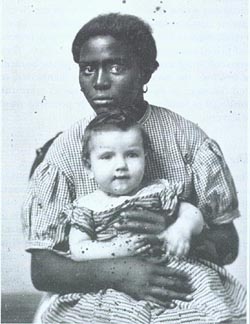
…the dichotomy of love and disdain living side-by-side is what surprises me- The Help

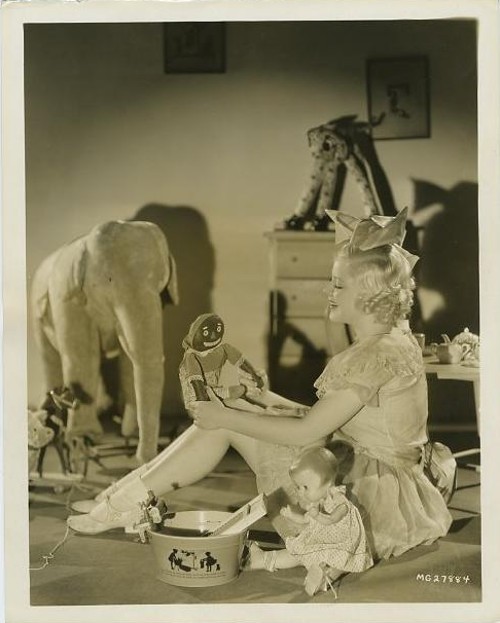

some photos found @ postpostracial
The following essay is reblogged from Southern-Style. A real life modern-ish mammy story! I’ve long been interested in the dynamic between black women and other people’s white children. When I was in college studying African-American history for the first time, I stumbled upon the thought that Mammies had raised our nation and yet black women generally are not revered (to say the least). When I was a nanny myself, I thought a lot about mammy. And, back in January, when I devoured The Help I pondered her some more. If you haven’t read it yet, please do yourself a favor and put Kathryn Stockett’s The Help on your summer reading list. It’s one of the greatest books I’ve ever read. Right up there with The Girl Who Fell From the Sky, Caucasia, The Curious Incident of the Dog in the Nighttime, Memoirs of a Geisha, and Life of Pi. i.e. the rest of your summer reading list.
I Remember Mammy:
Mattie Lee Martin (“Mammy”)
By one who loved her, Sharman Burson Ramsey
Thirteen year old Mattie Lee Martin took her mentally challenged older sister by the hand and led her down the rutted, red clay country road. Neither looked back. Mattie was determined her sister would not be abused again in their grandparent’s home. She’d finally accepted that her parents would never come back to get them. The road led to the town of Dothan, Alabama, and a life, Mattie Lee hoped, that would be better than the one they’d known on that god-forsaken farm.
Mrs. Bender stood at the door of her variety store, broom in hand, and watched the two girls walk toward her down the sidewalk. Mattie, the spokesperson for the two, stepped forward and boldly asked, “I need work and a place where me and my sister can stay. Do you know of anything?” She looked up at Mrs. Bender quite seriously. Her black eyes were wide. Anxiety was written all over her round black face that now dripped in sweat in the hot summer day after her long walk. Mrs. Bender read in that expression that she’d gotten this far, but now the little girl was in a quandary as to what should she do now? She looked at the tight grip she had on her much larger, but obviously more dependent, sister.
Mrs. Bender sized them up and in her gentle voice said, “I hear they are hiring maids across the street at the Wadlington Hotel, but come in here and let me help you with something to wear to your interview. Your sister can rest here while you go and inquire. Tell them I sent you.”
Mattie stood straight and said, “I don’t take no charity. I’ll pay you back.” Mrs. Bender nodded.
That Jewish lady remained a dear friend to Mattie the rest of her life.
Mattie Lee Martin later became highly regarded for her cooking skills. She cooked at the restaurant of the Houston Hotel for awhile and then took a job as the private cook for Dr. Moody, founder of Moody Hospital in Dothan. When the Moodys moved into their big house on Main Street from the house across from the hospital, Mattie for some reason was not going with them. Dr. Moody recommended Mattie to Dr. E. G. Burson, my father. The Moodys gave her a house as a parting gift.
When Mattie Lee Martin interviewed with my mother, she told my mother, “I don’t work with children.”
Yet as the pictures reveal, Mattie Lee Martin became as dear to us as our grandmothers and so she deserved just as endearing a name. Thus she came to be called “Mammy.”

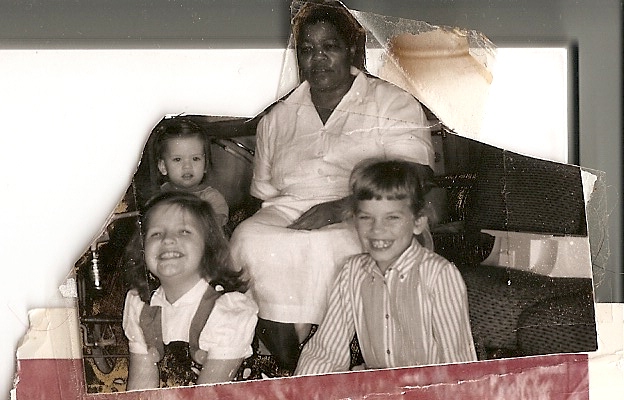
Mammy came to work every morning before seven, except Sunday, either by bus or by taxi and stayed until after five. Even after our overweight dog, Sir Bow Wow, went blind, he would meet Mammy at the bottom of the hill where she got off the bus every morning and together they would plod their way to the house. She cooked, cleaned, and loved us. I remember seeing one of her paychecks in the amount of $27.00. I also remember the days we’d take Mammy home and she’d ask Mother to stop by the grocery store several blocks away. Then she’d put some money in my hand and I’d run into the grocery store and plunk the money down saying, “Bit o Dental Snuff, please.”
Mammy ordered the groceries to cook for lunch from Murphy’s Market downtown first thing in the morning and a boy on a bicycle delivered them in time for her to cook. Dinner was served at exactly 12:00 noon. (In the South we eat breakfast, dinner and supper.) The meat went on a platter before “the doctor”. The table was set precisely with forks on the left of the plate (with the napkin) and the knife (facing inward) on the right. The glass was placed above the knife. She trained us well.
…Mammy had worked for the aristocracy of the town, Dr. and Mrs. Earl Moody. While she often locked horns with my mother (whose own father had been killed when logs rolled off a log truck when she was 13 leaving her mother to struggle raising five children) she refused to give up on us. “Yo mama, she be mean. But I be mean too, so we get along.” Mother had been awarded campaign ribbon for service in World War II as a nurse at the Battle of the Bulge. She could curse a blue streak and did so on occasion when things did not go to suit her. Sometimes those disagreements would get so heated that Mother would fire Mammy, but we’d cry and carry on so, she’d have to go and ask her to come back. My father was a doctor and his father was a doctor and that made us worth Mammy’s time and effort. My mother might not know what was “proper” but Mammy did, and she was determined to turn us out well.
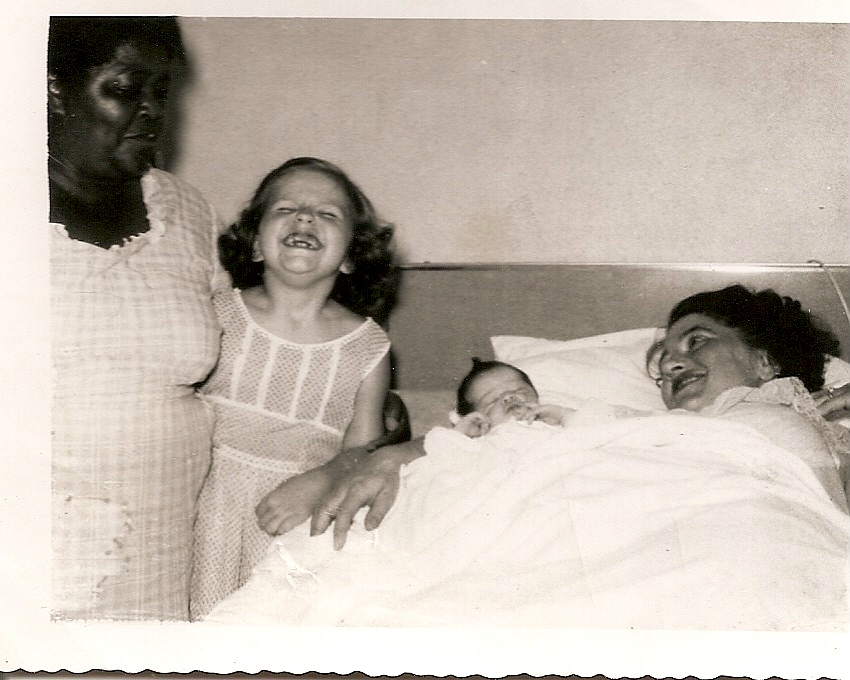
…Mammy did have her own family…a daughter Lucy Mae Dixon who was my Mother’s age. Mammy had very little education herself and the lists she made could barely be read, so she valued a good education. Mammy skrimped and saved and sent her to college in the North. It must have been a Catholic college because Lucy Mae converted to Catholicism. Mammy was a dedicated member of the Cherry Street AME Church. Lucy earned her Masters and came home to teach. Mammy bought her items of silver “on time” as birthday gifts. The mahogany furniture in their living areas was always covered in plastic to “save” it.
…I guess Mammy told my brother and sister the same thing she drilled into me. “Yo daddy be somebody. You gotta be somebody.” My sister is a cardiologist in New Orleans (Dr. Sylvia Burson Rushing) and my brother (Elkanah George Burson III ) has just started a pharmaceutical company (Burel Pharmaceuticals). Me? After you’ve got a man it’s all right “to rune yo hands” with Ajax, I learned. I wash a mean bathtub and have stayed married to the same man, an attorney of whom she approved (whose family once owned the Houston Hotel where she had worked) for forty years doing a little teaching and writing. This humble generous woman whom I never saw wear a single piece of jewelry gave me a pearl and gold bracelet for graduation from high school. She who worked from can to can’t all of her life gave me a silver goblet when I got married. I wonder if she ever knew how much they mean to me and that I realize the sacrifice and love those gifts demonstrated.
…Mammy was a proud person who made the most of her situation and, selflessly, with hard work and determination earned respect and made a good life for herself and her family. She raised us, her white family, to believe we could do whatever we chose to do and that we should make our parents proud. She drilled into us values of honesty, integrity, and a sense of responsibility. Because we had been given so much; much was expected. Because we loved her, it was Mammy we wanted to make proud.
Read more HERE
I accidentally happened upon a fascinating thread discussing the photograph below. It’s definitely worth checking out if you’re interested in this sort of thing. Apparently, Mary categorized herself as “white” on the 1880 Census. I wonder how that was possible. Whatever the case, the point that there are approximately 3000 descendants of this family who, I have little doubt, consider themselves to be exclusively white brings me back to the novel idea that we are all mixed, we are simply American, and the veil of otherness is a detrimental illusion from which we desperately need to wake up. K?

JAMES W. EVANS,
Mr. Evans married Mary Eliza Hoggard, of North Carolina, February 8, 1844. They have three children: Mary Frances, (who married Mr. Frank Collins, a son of J. W. Collins, Register of Clay County, Missouri, and they live with Mr. Evans on the farm); John Henry, (was married August n, 1877, at Hainesville); and William James, (who was born August 29, 1848, and married Caroline Gow, a daughter of Arthur Gow, of Clay County, in November, 1875).
We learn… that the North Carolina counties involved are Clinton County and Clay Counties Missouri. The children grew-up, married and lived in these two counties. The daughter married a Collins.
Apparently, James Evans brought (not bought!) Mary Hoggard from North Carolina and married her in Missouri where they raised their family. This makes sense, since this part of Missouri would have been “Free.”
This indicates to me that whites named Evans and Collins living in these two counties today, have a good chance of being a descendant of the black woman in the photo.
This photo speaks volumes of the kind of dilemma a black mother married to a white man found herself in during the 19th century. This couple were married in Clinton County, Missouri, went by the surname Evans, and would have approximately 3000 descendants today.
The mother is clearly not thrilled with the photograph. I think she was forced to sit for it by her husband. She appears to be thinking it’s not a very good idea, that the photo could prove an embarrassment to her children. Indeed, it could prove an embarrassment to all her descendants 200 years into the future.
I think this is what she was thinking.
Let’s say the tall young man in the rear passed for white, married a white woman and had a family. This photo would not be considered a precious family heirloom but instead an indictment of Negro heritage.
Does this explains why the mother is not smiling…?
All kinds of scary things were going on in the Slave states. People were stock-piling weapons. People were talking about succession. The young man standing was about military age. Free blacks were being snatched-up and sold back into slavery. If the woman had local relatives she had surely cut herself off from them. No way should could afford to have her kin be part of her new family.
At school the children were probably catching hell because of their black mother. If the mother wasn’t on the verge of a nervous breakdown she would be around the time her eldest started talking about joining a local regiment to fight the yankees and preserve slavery.
Her husband’s family surely would have disowned him by then and no white family would have anything to do with them. Of course if they lived on a farm their contact would be minimal, but if they lived on a farm they had slaves and that must have made her a mess too.
But the main thing is sitting for the portrait must have seemed insane to her. Her kids look white. Each one could easily pass. Why do something that would doom them forever to second-class citizenship? She had to be thinking that. The sit had to be the last thing she wanted for her children — proof they were black.
Had the kids looked like mulattoes, it would have been a different story. But these kids look completely white. They could pass with no problem at all — so why do something that could get them lynched?
And that photo would do that had her eldest married a local white girl.
That’s my theory why the mother doesn’t look happy.
That’s six generations. Let’s figure each of her descendants in each of these generations had three children who went on to have three children up until today.
1875 3 times 3 = 9
1900 3 times 9 = 36
1925 108
1950 324
1975 974
2000 2916
That’s almost 3000 “whites” descended from black Mary Hoggard.
See how nonsensical this white-black thing is?
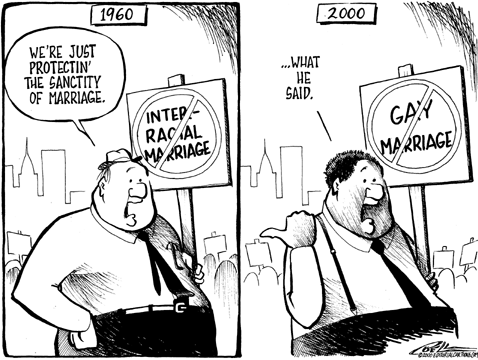
Then:

Now:

Get with the program.

It’s Loving Day! Interracial Marriage has been legal nationwide for an entire 43 years! Imagine that. A few days agao CNN.com ran this piece giving us an idea of what people really think about interracial marriage today. I think it an appropriate post for the occasion.
Your views on interracial marriages
(CNN) — “Interracial/interethnic marriage is a great way of fighting war, hatred and prejudice. Think about it. If we all are mixed, who can we hate?” wrote a reader about a CNN.com story on race and marriage.
That comment was one of the thousands of responses to the story about a new study from the Pew Research Center that found interracial and interethnic marriages are at a record high of about one in seven.
About 14.6 percent of newly married couples reported in 2008 that they married outside their race or ethnicity, according to the Pew report released Friday. In 1980, about 6.8 percent of newlywed couples surveyed said their spouse was of another race or ethnicity.
Overall, reader reactions voiced support for mixed relationships, with many commenters proudly identifying themselves as being in an interracial or interethnic relationship.
“I’ve been happily married in a mixed race marriage for seven years. To anyone who would like to oppose mixed race marriage: What gives you the right? I pay taxes, served in the U.S. military (where I was disabled) and watched all kinds of races die in service to the pledge to protect every American’s freedom. So as far as I’m concerned, blood only has one color: RED, and there’s only one race: the human one,” wrote BeerMan5000.
Reader RippedJeans, a black woman, talked about marrying her white boyfriend of three years. She wrote, “I could not be happier! I love him for the MAN that he is, and I’m truly grateful for having him in my life. Love is colorblind. …”
Danchar821 was also in support of interracial marriages. Reflecting on her personal experience, Danchar821 wrote. “We met online through mutual friends. I went to Mexico every month last year and we were married. I could not be happier. There are cultural differences, but if anything, they have helped me to grow as a person. She is wonderful and so loving and I feel truly blessed and happy. The racism that some people show on here is truly sad. We are expecting our first child — a boy — in September.”
Another couple talked about their wedding ceremony, which celebrated their cultural differences. Reader cellblock131 wrote, “I am Hispanic and married a white woman. … When it came to our wedding, we had a mixture of both cultural practices. For example, my dad read passages in Spanish, then her dad read them in English. The reception had traditional white American dances, plus Mexican in the mix. It was a wonderful wedding.”
One reader identified only as Guest said he won’t date outside his race.
“I care what race the women I date are. I am a white male. I date only white females. Sure there are attractive women in other races but I stick with my own. It’s America land of the free,” wrote Guest.
AntigoneR ignores people’s objections.”I can only speak for myself, but I really don’t care how many people accept or do not accept my interracial relationship. I don’t recall asking their opinion. Having said that, I’m glad to see that the trend in society is more accepting, and that racial barriers are crumbling. I wish it were faster.”
 (fwiw: i’m realizing at this very moment that none of these people are American by birth)
One commenter echoed a common view among the Millennial Generation, found in an earlier study this year from the Pew Center that reported 85 percent of 19- to 28-year-olds accept interracial and interethnic relationships. SIR10LY wrote: “It’s 2010. I can’t even believe this is still an issue! If two people love each other, let them be. … If you’re opposed to it, get with the times already!”
Children of mixed marriages also shared their views.
Reader Anex wrote, “Product of an Interracial marriage and darn proud of it! I’m a happy mutt!”
Other readers pointed to the challenges of marrying someone outside their race.
“But one thing the article does not mention is divorce among interracial couples is much higher than same-race couples. Challenges in understanding, family relations and pressures overall are higher. People should know what they’re getting into,” warned a reader.
WHATRU wrote, “I’m an Arab, my husband is white. It gets more complicated after you have kids. The cultures and beliefs are just too different. It is easier to marry your own kind.”
Reader Toadlife wrote that racial discrimination can also be difficult. “Race matters because racial discrimination continues to happen all around us to this day. If you think otherwise, you are naive and probably white and have all white relatives. Thankfully, we’ve come to a point in our society where race is not a determining factor in one’s fate, but it can still be an obstacle from time to time,” Toadlife wrote.
Reader nal4america said her decision about whom to date is influenced by what race she grew up with. “I’m of West Indian decent and I grew up in a small town in Utah. I am so used to dating outside of my race that I don’t even date men of my race simply because I am not attracted to them. I think the environment you grow up in plays a huge factor in the mate you select. I am 95 percent certain my husband will be of a race other than my own and that’s fine because I believe in the American Race.”
Native Americans had yet another take on the situation.
“… [T]here can never truly be justice and real harmony on stolen land … just like there can never be peace and harmony in a house that’s been burglarized and its inhabitants marginalized and oppressed … ask an Apache or Navaho or black American if they are happy to live in a society dominated by white people. The indigenous were here for many thousands of years before the Europeans destroyed the culture and lands of the indigenous almost worldwide,” wrote hotepk. “…What must happen is either they go back to Europe or pay restitution — like any other convict guilty of a crime — otherwise there will continue to be struggle.”
Ndngirl2010 responded: @hotepk–I am full blooded Navajo and I’m fine with living alongside whites and get this –*gasp*– I married one! A majority of my family doesn’t harbor any animosity toward any other race. Let bygones be bygones and, instead, focus on the future.”
The readers who responded to CNN’s coverage on the Pew Research Center study seemed to acknowledge the growing blurring of races and ethnicities.
Reader HalfBaked shared: “My wife’s biological mother is Filipino/Mexican and her biological father is Scottish. She was adopted at birth into a German-Jewish family. My mother’s side is Italian/Turkish and my father was Hungarian. Our kids are about as ‘mixed’ as you can get.”
I am pained by this story. I remember being this little girl. I remember being singled out at times, usually not having anything to do with my hair unless it was mandatory school-wide lice check day. No one wanted to deal with me then. And that was fine with me. But it wasn’t really. I can only imagine the consequences this incident will have for this little girl. Her parents really have their work cut out for them now. I hope they sue and win big! The damage is done. Let’s hope it can be undone. Oh, and I’d like to send the Mudede family a copy of Teri LaFlesh’s Curly Like Me. All you need is conditioner people. All you need is conditioner…
This story is an example of the sad fact that within schools, sensitivity training can only go so far – sometimes, there are unpredictable situations where teachers just have to intuitively react, and often they’re not prepared to do so. And often, these issues are much larger than they appear on the surface. Such is the case with the 8-year-old biracial student who was removed from her advanced-placement class because the teacher claimed that she was allergic to the girl’s hair moisturizer. The teacher first put the girl in the hallway, and then moved her to a different classroom where she found herself in a lower-level class with predominately African-American students.
This behavior seems bizarre enough – but add the fact that the girl was the only student of color in her school’s accelerated program, and the concerns of her angry parents, who may now sue the school (the NAACP, along with the Department of Education, have already filed a complaint), seem justified. The girl’s father, Charles Mudede, is black, and says that he had talked to his daughter about resisting pressures to straighten her hair so that she would look more like her white classmates. The product that so irritated the teacher was a compromise, Mudede said, “something light that kept her hair in its natural state.”
The girl’s parents have a host of questions to which there seem to be no adequate answers: “Why did the teacher think the problem was his daughter’s hair? Why hadn’t the school called the parents? What investigation was being done to pinpoint the source of the problem? And, finally, why did the school seem oblivious to the racial overtones of a white teacher singling out her only black student?”
Mudede says that the situation escalated because no one at the school seemed prepared to answer these basic questions. He wrote on his blog,
“When we, her parents, were later informed of this incident, we also learned that once my daughter was removed from the class, the teacher felt much better. We were also told that the teacher had experienced something like a fainting spell because of our daughter’s hair. Feeling the seriousness of this situation, we decided not to send our daughter to school until the teacher had medical proof that our daughter’s hair or something in her hair was to blame for the nausea. (The last thing you want to happen to your daughter is for a teacher to faint or vomit at the mere sight of her.)
Days passed and the school took no action. This unresponsiveness left us with no other choice than to turn to a lawyer. The whole thing is a mess. Getting entangled in a racial dilemma is something most black parents do not want for their children. It’s just not worth the trouble. Then again, like I said, if not checked and confronted, the incident will have permanent consequences for my child.”
And although the school is now making limited comments because of the threat of a lawsuit, it definitely seems as though this situation was horrifically mismanaged; without communicating privately with the student and involving the parents, of course this would turn into a humiliating ordeal for a little girl who clearly was already suffering from self-esteem issues. If the teacher had allergies, that’s something that she couldn’t help. But to target the student in such a dismissive embarrassing way shows a level of insensitivity that no teacher should have.
When I started reading this article I thought, “This is about to be some ‘tragic mulatto’ b.s.” Much to my surprise, it isn’t really. I think Sarah played the part of the tragic mulatto very well, and got exactly what she wanted and deserved. I wonder if the congregation’s response would have been different if “Pinky” hadn’t been quite so pink, but maybe “Brownie” instead. Just a thought. I also like this piece of our history because once upon a time, in a former life in which I considered myself black, I was a nanny and I worked in Brooklyn Heights and I walked by that church every day and was very drawn to it. Part of me knew… And part of me was so clueless.
by Vernon Parker
On June 1, 1856, Henry Ward Beecher, minister of Plymouth (Congregational) Church, and an ardent supporter of the antislavery cause, held a public “auction” of a young mulatto slave named Sarah to dramatize the evils of slavery.
The Brooklyn Daily Eagle reported that “she had been brought from a plantation near Staunton, Virginia.” When Sarah was called to the pulpit, she … “walked slowly, head bowed, and took a seat near the famous minister. She lifted her eyes, stared at the spellbound audience, and burst into sobs. Her plight tugged at the heart of the most stolid Congregationalist as Beecher’s inflamed rhetoric described her life. Daughter of a well-known white citizen, she had been put up for sale by her own father. The slave dealer involved contacted Beecher through a mutual friend and they struck a deal allowing Sarah to go north with the promise of either her return or the full manumission fee.”
The mock auction raised sufficient funds to purchase her freedom and buy her a modest home in Peekskill, New York.
The following is an excerpt from James H. Callender’s book Yesterdays on Brooklyn Heights: “As the anti-slavery agitation increased, Mr. Beecher thundered his invectives against the slave-owners of the South, and many of the leading men of his church were said to be directors of the famous ‘Underground Railroad’ by which fugitive slaves were passed along from the South across the border to Canada. It was at the close of one of his most powerful sermons that Mr. Beecher said he had a little matter he wished to present to the congregation. No one had any idea as to what he was going to say and the people waited in profound silence.
“He then suddenly burst forth, ‘Sarah, come up here!’ As the audience gazed, a little mulatto girl arose in the body of the church, ran up the pulpit steps and took Mr. Beecher’s hand. Turning to the assembled multitude, he said — ‘This little girl is a slave, and I have promised her owner $1,200, his price for her, or she will be returned to slavery. Pass the baskets.’ A scarcely stifled sob arose from the almost three thousand present. Bills of all denominations, jewelry, and watches and chains were flung in the overflowing baskets and when the total was counted, Mr. Beecher announced, amid thunders of applause, that Sarah was free, and enough remained to strike the shackles from the limbs of several others.”

I knew nothing of Evelyn Cunningham before her death. Shame on me. All I know now is that in the name of Evelyn, in the name of Lena, and in the name of the nameless: I have got to do better. I’m posting segments of the New York Times obituary of Ms. Cunningham and what I presume to be one of the last interviews with her that appeared in the NY Daily News in November of 2009. For whatever reason, today I am particularly struck by what she said about her four husbands. I feel a feminist kick coming on…

Evelyn Cunningham, a civil-rights-era journalist and later an aide to Gov. Nelson A. Rockefeller of New York, died on Wednesday (April 28th, 2010) in Manhattan. She was 94 and lived in Harlem most of her life.
At a time when few women worked at newspapers — never mind as reporters handling hard news — Ms. Cunningham covered many of the civil rights era’s biggest stories, including the battle over school desegregation in Birmingham, Ala., and the work of the Rev. Dr. Martin Luther King Jr. and Malcolm X.
Starting in 1940, she worked for more than 20 years as a reporter and editor for The Pittsburgh Courier, a black newsweekly with nationwide circulation. Much of that time she worked out of the paper’s New York office.
In the newsroom, she was nicknamed “Big East,” partly because of her height, 5-foot-11 in heels. She also became known as the “lynching editor,” a reference to her reporting on such killings in the segregated South.
…Ms. Cunningham entered another realm of public life in the late 1960s, when she took a job as special assistant to Governor Rockefeller, who had been impressed with her when she interviewed him as a candidate.
Governor Rockefeller named her to lead an office on women’s affairs, and she later served on many government panels dealing with women’s rights and community issues. She continued to advise him when he became President Gerald R. Ford’s vice president.
Evelyn Elizabeth Long was born on Jan. 25, 1916, in Elizabeth City, N.C., the daughter of a taxi driver and a dressmaker. She moved with her parents to New York as a child, and earned a bachelor’s degree from Long Island University. She had no children.
…Politically, Ms. Cunningham described herself as a “Rockefeller Republican,” Ms. Bell-Stevens said. “She said, ‘That means I’m a liberal Republican,’ and then she would add in more recent years that there hasn’t been a good one since.”
In a statement, Mayor Michael R Bloomberg, who appointed Ms. Cunningham to a commission on women’s issues in 2002, said, “With the passing of Evelyn Cunningham, all New Yorkers and all Americans who value our ideals of liberty and justice for all have lost a good friend and a fearless champion.”
…Ms. Cunningham married four times, taking the name of her third husband. Her fourth marriage was to Austin Brown, a Juilliard-trained pianist and watchmaker who died last year.
“Each one of my husbands tried to diminish my independence and my work,” Ms. Cunningham said in a profile in The New York Times in 1998. “They all loved me most while I was cooking — and I am not a good cook.”

Monday, November 23rd 2009
She has interviewed and worked with some of the most historically significant people of the past 60 years; Nelson Rockefeller, Martin Luther King and Malcolm X, Sheriff Eugene (Bull) Connor, Supreme Court Justice Thurgood Marshall, and Presidents Richard Nixon and Gerald Ford.
Yet at 93 years old and after a journalism career that began in 1940 with the Pittsburgh Courier, it’s American women of all races who most impress Evelyn Cunningham.
“The women in my country, there does not seem to be anything they cannot be,” she said. “Presidents, heads of banks, millionaires. In the United States, women seem to gain or get practically everything they want.”
Seated on an overstuffed chair in the sunny study of her Riverside Drive apartment in Harlem, the television tuned to CNN, Cunningham said “I’m still a reporter, every inch of me.”
Though she doesn’t get out as much as she used to, Cunningham said she’s busy.
With the help of a group of local college students who do her leg work (“They think I’m this talky old lady,” she said.), she is writing and rewriting a piece on black history.
“I call it unknown black history, and there is a lot of it out there,” she said. “So much of black history is unknown, but even I am shocked to find out how much of it there is.
“Black people don’t even know what’s missing,” said Cunningham, who declined to give examples pending publication of her work. “That intrigues me to no end. Here I am part of a people who do not know much of their history.”
Cunningham honed her reporting skills covering lynchings in the South before and during the civil rights movement.
She was one of the first reporters to identify the Rev. Martin Luther King Jr. as a rising leader in the movement, and once asked Connor, who became infamous for using police dogs and fire hoses on peaceful demonstrators, for an interview.
He walked away.
Cunningham and several members of the Pittsburgh Courier staff of her era were awarded a George Polk Award in 1998 for the paper’s civil rights reporting.
After the civil rights era, Cunningham went on to hold a variety of civic and government positions, including special assistant to New York Gov. Rockefeller and on President Nixon’s Task Force on Women’s Rights and Responsibilities.
Having lived and worked in the segregated South – she was born in Elizabeth, N.C.- Cunningham said Barack Obama’s election “is hard to believe, hard to believe.
“No, I did not see it happening,” she said. “I never saw it, imagined it, or believed it, and here we got a black President.
“I met him right here in this apartment,” she said. “He came up to see me when he first visited the city. I adored him. He was a natural born leader.
“He is the greatest thing to hit our country.”
But if Cunningham could cover one story today it would not be local.
“I would go to Africa,” she said. “There is so much … I can only put it this way, dirty work going on there that even Africans don’t want people to know.
“That bothers me. It’s terrible and sad.”

 mulatto diaries