startling

Perhaps “startling” would be a bit of an exaggeration today, but a production like this would still be considered mildly innovative indicating that we haven’t evolved much out of our old traditions…

March 1970: Student teachers, Dereck Tapper and Scilla Nicholls in a rehearsal for a production of ‘Romeo and Juliet’ at St Luke’s Teacher Training College in Exeter. The mixed-race casting was considered a startling innovation at the time. (Photo by Keystone/Getty Images)

established social hierarchies

This project calls to my mind the book The Help.  Looking at these photos, I feel as though I know who are the respective givers and receivers of “help” just about as easily I would the characters in that book of Kathryn Stockett’s that I love so much.

WOMEN AND THEIR MAIDS: A PHOTOGRAPHIC LEVELLING

VIA

An interesting photo project, called Lugar Común (Common Place), designed to disrupt our acceptance of established social hierarchies. The photographers, Justine Graham and Ruby Rumié, took pictures of 50 pairs of women — maids and their employers — located in Argentina, Chile, and Colombia.To disrupt the hierarchy inherent in their relationship, Graham and Rumié had them dressed alike, without accessories, and sitting in identical poses.   By doing so, they allowed both women to “…look at the camera with the same pride, with the same openness”.  The viewer is not told which woman is which. They also asked each pair to sit across from one another and look in each others’ eyes. Even though some had known each other for 30 years or more, Graham said that all of the pairs had trouble looking at each other in this way. from

An interesting photo project, called Lugar Común (Common Place), designed to disrupt our acceptance of established social hierarchies. The photographers, Justine Graham and Ruby Rumié, took pictures of 50 pairs of women — maids and their employers — located in Argentina, Chile, and Colombia.

To disrupt the hierarchy inherent in their relationship, Graham and Rumié had them dressed alike, without accessories, and sitting in identical poses.   By doing so, they allowed both women to “…look at the camera with the same pride, with the same openness”.  The viewer is not told which woman is which.

They also asked each pair to sit across from one another and look in each others’ eyes. Even though some had known each other for 30 years or more, Graham said that all of the pairs had trouble looking at each other in this way.

mary ellen pleasant

As I was searching the internets last week for photos of black women with white children, I stumbled upon a historical figure who, once again, I am shocked and dismayed to never before have heard mention of:  Mary Ellen (“Mammy”) Pleasant.  I want to know so much more!  Or at least the truth.  I highly doubt that Mary Ellen needed to conjure the dark forces to leverage social change, however I’m sure that that tale eased the minds of the opposition and provided ammunition for attacking Pleasant’s ideals.  I found quite a few intriguing articles on her life and chose the following two to share.  Honestly, when someone next asks me who (dead or alive) I would most like to have dinner with, Mary Ellen Pleasant will be on the short list.

hdr_index

“American civil rights began in the 1850’s with Mary Ellen Pleasant.”  Racism surprised African Americans like Pleasant who came to the Bay Area because they believed in a better life in San Francisco… The Bay Area, where Pleasant lived, became a “hotbed of civil rights activity” in the 19th century and the activists’ rallying cry was “eradicating slavery.”- Dr. Albert Broussard

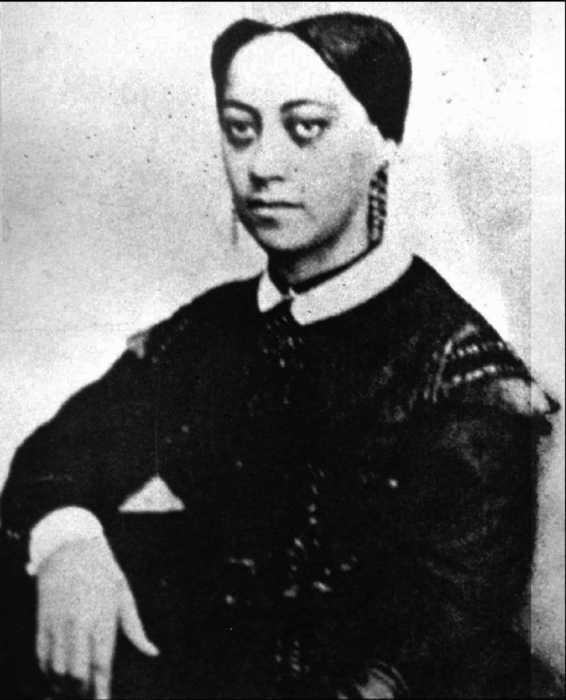
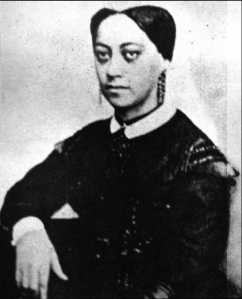
Mary Ellen Pleasant (1814? – 1904)
SSMt7.St.4

VIA

Mary Ellen Pleasant is perhaps better known as “Mammy Pleasant”, but it was a name she detested. She was born a slave in Georgia some time between 1814 and 1817, the illegitimate daughter of an enslaved Vodou priestess from Haiti and a Virginia governor’s son, John Pleasants. She was bought out of slavery by a planter and indentured for nine years as a store clerk with abolitionist Quakers in Massachusetts.

Around 1841 she married a wealthy mulatto merchant/contractor from Ohio and Philadelphia named James Smith, who was also a slave rescuer on the Underground Railroad. The two worked to help slaves flee to safety in Canada and safe states. Smith died in 1844, leaving her a $45,000 fortune and a plantation run by freedmen near Harper’s Ferry, Virginia.

Because of slaver reaction to her own ongoing Underground Railroad activities, she was forced to flee to New Orleans in 1850 where she met the Vodou queen Marie Laveau who trained her in how to “pressure the powerful to help the powerless” —blacks and poor women—gain rights and jobs. She then went to San Francisco, arriving in April 1852. Because she had no “freedom papers” she passed herself off as white, while she worked as a steward and cook in a white boardinghouse and invested in real estate and various business activities.

Pleasant’s training with Marie Laveau proved beneficial. Pleasant became so successful at leveraging social change that many called her San Francisco’s “Black City Hall”. Her activities and her money helped ex-slaves avoid extradition, start businesses and find employment in hotels, homes and on the steamships and railroads of California.

In 1858 she returned to the East, bought land to house escaped slaves, and aided abolitionist John Brown both with money and by riding in advance of his famous raid at Harper’s Ferry encouraging slaves to join him.

She went back to San Francisco where her investments with an influential business partner helped her amass a joint fortune estimated at $30 million. She later led the Franchise League movement in San Francisco that earned blacks the right to testify in court, and to ride the trolleys. Her lawsuit in 1868 in San Francisco against the North Beach and Mission RailRoad was used as a precedent in 1982 to achieve contemporary civil rights. Mary Ellen Pleasant died in San Francisco in 1904. Her body was taken by friends to Napa and buried in Tulocay Cemetery. On her tombstone is inscribed “the mother of civil rights in California.”

For more information, incuding a book on Mary Ellen Pleasant by Susheel Bibbs, see http://hometown.aol.com/mepleasant.

VIA

“Mammy Pleasant: Angel or Arch Fiend in the House of Mystery?”

By p. joseph potocki

Mary Ellen “Mammy” Pleasant’s legacy is an enigma rolled up inside layers of legend, gossip, greed, fantasy, racism and conjecture.

This week’s column title first headlined Sunday’s edition of the San Francisco Call—back on May 7, 1899. That 19th century investigative hit piece featured three unflattering John Clawson illustrations portraying “Mammy Pleasant” as a bonneted evil-eyed crone. The story gobbled up the entire front page of that day’s paper. Its “Angel or Arch Fiend” dualism embodies endless confusion and contradictory assertions surrounding the life of this incredible woman—confusion and contradictions lingering on to this very day.

The “Mammy” tag, clearly meant to be a slam, fits neatly within a cluster of Black stereotypes. While Pleasant’s tall, thin frame, her finely honed features and regal bearing contrast sharply with the rotund happy-to-be-a-slave mammy of plantation lore, the name itself attempts to place her on par with a Samba, an Uncle Tom, Step and Fetchit, or to a licentious Jezebel. The mythology of these “halcyon days” of slavery is what social historian Eric Lott calls “the dialectic flickering of racial insult and racial envy.”

Mary Ellen “Mammy” Pleasant’s legacy is an enigma rolled up inside layers of legend, gossip, greed, fantasy, racism and conjecture. She’s been called “San Francisco’s Powerful And Sinister Ruler”, “The Black City Hall”, but also a “one woman social agency” and “the Mother of Civil Rights in California.” That covers one heck of a lot of reputational territory.

Some claim that Mary Ellen Pleasant was a mixed blood Voodoo Queen who aimed “the black arts” against her enemies, that she sold babies, murdered as many as 49 people, ran brothels, committed fraud, spied through walls on victims she would later blackmail, and that she held unholy powers over a vast network of underlings and protégés. One rival charged that Pleasant murdered the rival’s husband, and having accomplished the dastardly deed Pleasant then “put her fingers in the hole in the top of his head and pulled out the protruding brains.”

Others tout Mary Ellen Pleasant’s work as a philanthropist, her many devoted friends, both black and white, her financial wizardry, undying devotion to women’s and civil rights, and, before that—her commitment to the abolition of slavery. In fact, Mary Ellen Pleasant’s Napa gravestone reads—“SHE WAS A FRIEND OF JOHN BROWN.”

Indeed, upon Brown’s capture following his ill-fated attack on Harper’s Ferry he carried with him a promissory note signed MEP. Had not the authorities misread the letter M for a W its certain Mary Ellen Pleasant’s neck would have been stretched as did John Brown’s.

Everything about Pleasant’s formative years is subject to debate. She was born a slave in Virginia, or Georgia, or perhaps it was Louisiana. She claims to have been born free in Philadelphia on August 19, 1814. Others say she was born in 1817, give or take a year—or two. She was convent educated, or else was entirely self-taught. Her mother may have been a West Indies Voodoo Queen, or not. Her father was a wealthy white slave owner. Then again, perhaps he was a slave. Nobody knows for sure.

What we do know is that sometime between 1848 and 1852 Mary Ellen Pleasant arrived in San Francisco. She may have been accompanied by her second husband, a former slave named James Pleasant, or Pleasants, or perhaps it was Pleasance. Whatever his surname it’s clear that the shrewd, focused and ambitious Mary Ellen was a power unto herself.

James, who died in 1877, seems hardly to have factored into Mary Ellen’s life. His one notable contribution was in the co-creation of Mary Ellen’s one and only child, Elizabeth, whom she called Lizzy. However, Mary Ellen gave their daughter her first husband’s family name, which was Smith. It was only fair, since James Henry Smith had left seed money to Mary Ellen upon his death some years before. Mary Ellen built her financial empire with the help of these funds.

Once in San Francisco, Pleasant set about purchasing boardinghouses, real estate, laundries, restaurants and stock shares in mines, railroads and other business ventures. This was no small accomplishment in an era of near unfettered legal bias against both racial minorities and women. Monies from these investments built her the 30-room mansion dubbed “the House of Mystery,” atop Cathedral Hill in San Francisco.

In her later years Pleasant purchased a large tract of land set against the Mayacamas Mountains. She named it Beltane, either after Thomas Bell, or, as some critics claim, in honor of the ancient pagan celebration of the same name. Beltane lies outside Glen Ellen, in the heart of the Sonoma Valley. The stately New Orleans-style Victorian house she built there (now a B&B) is set amidst an immense flowering garden and hundreds of shady oaks. One fanciful claim is that Pleasant cast Voodoo spells from a cave somewhere on the property.

But with all her accrued wealth, Mary Ellen Pleasant seems always to have performed, or dressed as if she performed, domestic labor. It’s said that she would ride to the markets in her own custom built carriage, accompanied by a driver and a footman, each garbed in impeccable livery. Though always attired in a servant’s black dress and large white apron, she “walked like a duchess.”

Sometime in the mid 1860s Mary Ellen Pleasant hooked up with a stockbroker named Thomas Bell. The “canny Scot” was money savvy, but lacked imagination. Pleasant took him under her wing. Together they created one of the largest financial partnerships in that era of San Francisco. Pleasant and Bell may (or may not) have been lovers.

It’s said that Mary Ellen arranged Thomas’s marriage to the future Teresa Bell, having first instructed Teresa in the “genteel arts” necessary to flourish in elite society. Others say Thomas Bell discovered the beautiful Teresa on a visit to a house of ill repute. No matter which story is true it seems the marriage provided adequate cover from charges of miscegenation, which might otherwise have been leveled at the cohabitation of the white Thomas Bell with the octoroon (or perhaps quadroon) “Mammy” Pleasant.

What’s undeniably true is that Mary Ellen Pleasant was actively involved in the Underground Railroad, and that she placed both former slaves and geographically displaced freemen as domestics in many of San Francisco’s “better” households. She also clearly advocated for and personally rescued unprotected and often attractive young white women, who Mary Ellen then trained to become the wives and mistresses of wealthy men in The City.

These actions led to many of the questionable charges against her, since persons beholden to Pleasant for their livelihoods provided her their eyes and ears within San Francisco’s most prominent households.

Mary Ellen was well into her 80’s when her finances began to unravel. She’d both overextended her business dealings, and had incurred the wrath of her former protege, Teresa Bell. Mary Ellen had exposed Teresa’s young lover to embezzlement charges, landing him a stint in San Quentin prison. As payback, the mentally unhinged Teresa became Pleasant’s eternal foe. She set to pummeling Pleasant’s good name—even long after seeing Mary Ellen to her grave. The sensitive nature of Thomas Bell’s and Mary Ellen Pleasant’s financial partnership allowed Teresa to gain control of their mutual resources following Thomas’ death. As a result Mary Ellen Pleasant was stripped of her wealth and forced into bankruptcy.

Pleasant’s diaries were stolen and lost to posterity, while many of Teresa’s hallucinatory rants made their way into newsprint following Pleasant’s death. Consequently, Teresa Bell’s accounts fundamentally shifted the Mary Ellen Pleasant mythos into the realm of evil phantasma. Fortunately, contemporary scholars have begun setting Mary Ellen Pleasant’s record as straight as a story with such twists, squiggles and gaping holes can be set. As confusing and contradictory as her life story may be, Mary Ellen Pleasant optimistically forecast her own legacy when she wrote:

“… You can’t explain away the truth.”

Mary Ellen Pleasant

SOURCE


a mammy tale

The following essay is reblogged from Southern-Style.  A real life modern-ish mammy story!  I’ve long been interested in the dynamic between black women and other people’s white children.  When I was in college studying African-American history for the first time, I stumbled upon the thought that Mammies had raised our nation and yet black women generally are not revered (to say the least).  When I was a nanny myself, I thought a lot about mammy.  And, back in January, when I devoured The Help I pondered her some more.  If you haven’t read it yet, please do yourself a favor and put Kathryn Stockett’s The Help on your summer reading list.  It’s one of the greatest books I’ve ever read.  Right up there with The Girl Who Fell From the Sky, Caucasia, The Curious Incident of the Dog in the Nighttime, Memoirs of a Geisha, and Life of Pi.  i.e. the rest of your summer reading list.

I Remember Mammy:
Mattie Lee Martin (“Mammy”)
By one who loved her, Sharman Burson Ramsey

Thirteen year old Mattie Lee Martin took her mentally challenged older sister by the hand and led her down the rutted, red clay country road. Neither looked back. Mattie was determined her sister would not be abused again in their grandparent’s home. She’d finally accepted that her parents would never come back to get them. The road led to the town of Dothan, Alabama, and a life, Mattie Lee hoped, that would be better than the one they’d known on that god-forsaken farm.

Mrs. Bender stood at the door of her variety store, broom in hand, and watched the two girls walk toward her down the sidewalk. Mattie, the spokesperson for the two, stepped forward and boldly asked, “I need work and a place where me and my sister can stay. Do you know of anything?” She looked up at Mrs. Bender quite seriously.  Her black eyes were wide.  Anxiety was written all over her round black face that now dripped in sweat in the hot summer day after her long walk. Mrs. Bender read in that expression that she’d gotten this far, but now the little girl was in a quandary as to what should she do now? She looked at the tight grip she had on her much larger, but obviously more dependent, sister.

Mrs. Bender sized them up and in her gentle voice said, “I hear they are hiring maids across the street at the Wadlington Hotel, but come in here and let me help you with something to wear to your interview. Your sister can rest here while you go and inquire. Tell them I sent you.”

Mattie stood straight and said, “I don’t take no charity. I’ll pay you back.” Mrs. Bender nodded.

That Jewish lady remained a dear friend to Mattie the rest of her life.

Mattie Lee Martin later became highly regarded for her cooking skills. She cooked at the restaurant of the Houston Hotel for awhile and then took a job as the private cook for Dr. Moody, founder of Moody Hospital in Dothan. When the Moodys moved into their big house on Main Street from the house across from the hospital, Mattie for some reason was not going with them. Dr. Moody recommended Mattie to Dr. E. G. Burson, my father. The Moodys gave her a house as a parting gift.

When Mattie Lee Martin interviewed with my mother, she told my mother, “I don’t work with children.”

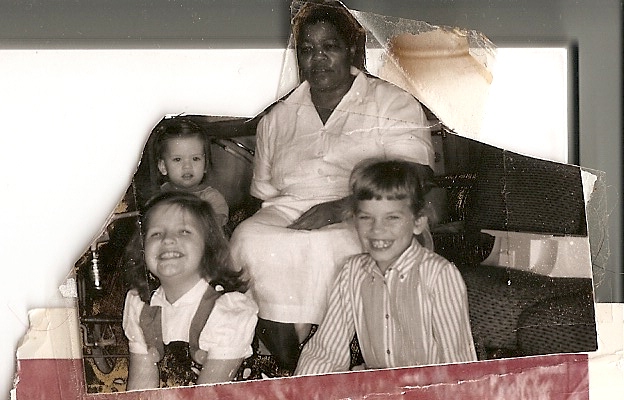
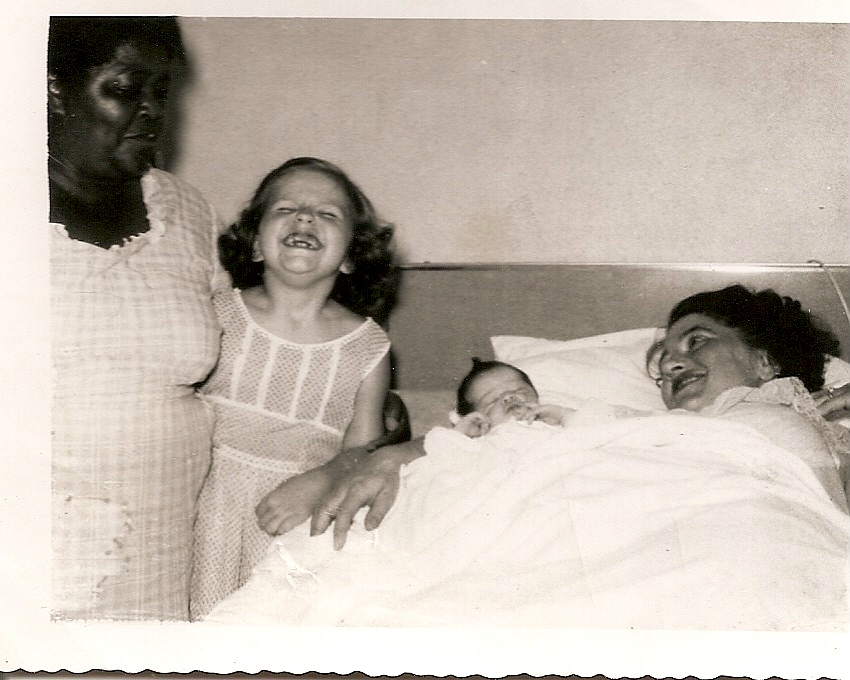
Yet as the pictures reveal, Mattie Lee Martin became as dear to us as our grandmothers and so she deserved just as endearing a name. Thus she came to be called “Mammy.”

Mammy came to work every morning before seven, except Sunday, either by bus or by taxi and stayed until after five.  Even after our overweight dog, Sir Bow Wow, went blind, he would meet Mammy at the bottom of the hill where she got off the bus every morning and together they would plod their way to the house.  She cooked, cleaned, and loved us. I remember seeing one of her paychecks in the amount of $27.00. I also remember the days we’d take Mammy home and she’d ask Mother to stop by the grocery store several blocks away. Then she’d put some money in my hand and I’d run into the grocery store and plunk the money down saying, “Bit o Dental Snuff, please.”

Mammy ordered the groceries to cook for lunch from Murphy’s Market downtown first thing in the morning and a boy on a bicycle delivered them in time for her to cook. Dinner was served at exactly 12:00 noon. (In the South we eat breakfast, dinner and supper.) The meat went on a platter before “the doctor”. The table was set precisely with forks on the left of the plate (with the napkin) and the knife (facing inward) on the right. The glass was placed above the knife. She trained us well.

…Mammy had worked for the aristocracy of the town, Dr. and Mrs. Earl Moody. While she often locked horns with my mother (whose own father had been killed when logs rolled off a log truck when she was 13 leaving her mother to struggle raising five children) she refused to give up on us. “Yo mama, she be mean. But I be mean too, so we get along.” Mother had been awarded campaign ribbon for service in World War II as a nurse at the Battle of the Bulge. She could curse a blue streak and did so on occasion when things did not go to suit her. Sometimes those disagreements would get so heated that Mother would fire Mammy, but we’d cry and carry on so, she’d have to go and ask her to come back. My father was a doctor and his father was a doctor and that made us worth Mammy’s time and effort. My mother might not know what was “proper” but Mammy did, and she was determined to turn us out well.

…Mammy did have her own family…a daughter Lucy Mae Dixon who was my Mother’s age. Mammy had very little education herself and the lists she made could barely be read, so she valued a good education. Mammy skrimped and saved and sent her to college in the North. It must have been a Catholic college because Lucy Mae converted to Catholicism. Mammy was a dedicated member of the Cherry Street AME Church. Lucy earned her Masters and came home to teach. Mammy bought her items of silver “on time” as birthday gifts. The mahogany furniture in their living areas was always covered in plastic to “save” it.

…I guess Mammy told my brother and sister the same thing she drilled into me. “Yo daddy be somebody. You gotta be somebody.” My sister is a cardiologist in New Orleans (Dr. Sylvia Burson Rushing) and my brother (Elkanah George Burson III ) has just started a pharmaceutical company (Burel Pharmaceuticals). Me? After you’ve got a man it’s all right “to rune yo hands” with Ajax, I learned. I wash a mean bathtub and have stayed married to the same man, an attorney of whom she approved (whose family once owned the Houston Hotel where she had worked) for forty years doing a little teaching and writing. This humble generous woman whom I never saw wear a single piece of jewelry gave me a pearl and gold bracelet for graduation from high school.  She who worked from can to can’t all of her life gave me a silver goblet when I got married.  I wonder if she ever knew how much they mean to me and that I realize the sacrifice and love those gifts demonstrated.

…Mammy was a proud person who made the most of her situation and, selflessly, with hard work and determination earned respect and made a good life for herself and her family. She raised us, her white family, to believe we could do whatever we chose to do and that we should make our parents proud. She drilled into us values of honesty, integrity, and a sense of responsibility.  Because we had been given so much; much was expected.  Because we loved her, it was Mammy we wanted to make proud.

Read more HERE

black mother, white children

I accidentally happened upon a fascinating thread discussing the photograph below.  It’s definitely worth checking out if you’re interested in this sort of thing.  Apparently, Mary categorized herself as “white” on the 1880 Census.  I wonder how that was possible.  Whatever the case, the point that there are approximately 3000 descendants of this family who, I have little doubt, consider themselves to be exclusively white brings me back to the novel idea that we are all mixed, we are simply American, and the veil of otherness is a detrimental illusion from which we desperately need to wake up. K?

James William Evans (1814-1883), his wife Mary Eliza Hoggard, and their children William, John and Mary Evans. Mary Eliza Hoggard was a descendant of the free African American Cobb and Bazemore families of  Bertie County, North Carolina. James William Evans was from Dorchester County, Maryland.

JAMES W. EVANS,

Mr. Evans married Mary Eliza Hoggard, of North Carolina, February 8, 1844. They have three children: Mary Frances, (who married Mr. Frank Collins, a son of J. W. Collins, Register of Clay County, Missouri, and they live with Mr. Evans on the farm);  John Henry, (was married August n, 1877, at Hainesville);  and William James, (who was born August 29, 1848, and married Caroline Gow, a daughter of Arthur Gow, of Clay County, in November, 1875).

We learn… that the North Carolina counties involved are Clinton County and Clay Counties Missouri. The children grew-up, married and lived in these two counties. The daughter married a Collins.

Apparently, James Evans brought (not bought!) Mary Hoggard from North Carolina and married her in Missouri where they raised their family. This makes sense, since this part of Missouri would have been “Free.”

This indicates to me that whites named Evans and Collins living in these two counties today, have a good chance of being a descendant of the black woman in the photo.

This photo speaks volumes of the kind of dilemma a black mother married to a white man found herself in during the 19th century.  This couple were married in Clinton County, Missouri, went by the surname Evans, and would have approximately 3000 descendants today.

  • The children are mulatto but 100% passable. The time, right around the Civil War. The choice the children had was really no choice. Quite simply, either they turned their backs on the mother and leave the state or be classified as Negro and endure Jim Crow for the rest of the lives.

    The mother is clearly not thrilled with the photograph. I think she was forced to sit for it by her husband. She appears to be thinking it’s not a very good idea, that the photo could prove an embarrassment  to her children. Indeed, it could prove an embarrassment to all her descendants 200 years into the future.

    I think this is what she was thinking.

    Let’s say the tall young man in the rear passed for white, married a white woman and had a family. This photo would not be considered a precious family heirloom but instead an indictment of Negro heritage.

    Does this explains why the mother is not smiling…?

  • The husband was born in 1818. The photo — judging by the clothing — was taken a few years before the Civil War. Location Virginia, a slave state. Things were starting to heat up. All around them slave owners were getting pissed a the North, Lincoln, and most especially those sympathetic to Negroes. You think interracial dating is tough today, imagine how hard it was then.

    All kinds of scary things were going on in the Slave states. People were stock-piling weapons. People were talking about succession. The young man standing was  about military age. Free blacks were being snatched-up and sold back into slavery. If the woman had local relatives she had surely cut herself off from them. No way should could afford to have her kin be part of her new family.

    At school the children were probably catching hell because of their black mother. If the mother wasn’t on the verge of a nervous breakdown she would be around the time her eldest started talking about joining a local regiment to fight the yankees and preserve slavery.

    Her husband’s family surely would have disowned him by then and no white family would have anything to do with them. Of course if they lived on a farm their contact would be minimal, but if they lived on a farm they had slaves and that must  have made her a mess too.

    But the main thing is sitting for the portrait must have seemed insane to her. Her kids look white. Each one could easily pass. Why do something that would doom them forever to second-class citizenship? She had to be thinking that. The sit had to be the last thing she wanted for her children — proof they were black.

    Had the kids looked like mulattoes, it would have been a different story. But these kids look completely white. They could pass with no problem at all — so why do something that could get them lynched?

    And that photo would do that had her eldest married a local white girl.

    That’s my theory why the mother doesn’t look happy.

  • So, Mary Hoggard Evans (the black woman in the photo) has three children who pass for white. They each get married around 1875.

    That’s six generations. Let’s figure each of her descendants in each of these generations had three children who went on to have three children up until today.

    1875 3 times 3 = 9

    1900 3 times 9 = 36

    1925                   108

    1950                   324

    1975                   974

    2000                   2916

    That’s almost 3000 “whites” descended from black Mary Hoggard.

    See how nonsensical this white-black thing is?

offensive or no?

Upon reading the headline of the article my mom emailed me, I was all set to be very offended by these photos.  After reading it and seeing the pics, I am not offended.  Is that bad?  When I read “blackface” I think poorly applied shoe polish and outrageously red lipstick.  When I saw these pictures and read Schiffer’s statement that they were playing with different men’s fantasies, I thought it made sense.  Lagerfeld and Dom Perignon hired one super Supermodel to play two characters (for lack of a better analogy).  To me this is not offensive.  I don’t think Schiffer kept a black model from working that day.  What if Naomi Campbell had done the ad in “whiteface”?  Would that be offensive?  I also wonder if Heidi Klum would have agreed to participate in this.  I would love to get her take on it.

Claudia Schiffer strikes controversial pose in ‘blackface’ for German magazine

BY MEENA HARTENSTEIN
DAILY NEWS STAFF WRITER

Claudia Schiffer is drawing criticism for her controversial photo on a German magazine cover.

Claudia Schiffer is one of the world’s best-loved supermodels, but she’s drawing a firestorm of criticism for her latest magazine cover.

The blond stunner is at the center of a racially-charged controversy after a photo of her in “blackface” hit the Internet this month.

In the photo, which was shot by Karl Lagerfeld two years ago as part of an ad campaign for Dom Perignon, Schiffer is disguised in an Afro wig and dark face paint, prompting accusations of insensitivity.

“It shows poor taste and it’s offensive,” Shevelle Rhule, fashion editor at black lifestyle magazine Pride, told U.K.’s Daily Mail. “There are not enough women of color featured in mainstream magazines. This just suggests you can counteract the problem by using white models.”

The photo resurfaced when German magazine Stern Fotografie repurposed the image as one of six hardback covers for its 60th anniversary issue.

The other covers also feature Schiffer in various costumed looks shot by Lagerfeld – as a sexy secretary, a leather-clad cop, Marie Antoinette, and even an Asian woman in a kimono.

Schiffer’s rep defended the series, saying, “The pictures have been taken out of context. The images were designed to reflect different men’s fantasies. The pictures were not intended to offend.

The sexy shots of Schiffer are drawing serious criticism from those who think the makeup choice was offensive.

Read more HERE