just thought we should know

David M. French Dies at 86

Ever wonder who tended to the injuries of demonstrators brutalized during the civil rights protests of the 1960s? David M. French, a former Howard University professor of pediatric surgery and one of the first African-American board certified surgeons, coordinated many of those first aid efforts, as just one piece of a long career that merged medicine and public service. He died March 31 at the age of 86.

David M. French (Ellsworth Davis/Washington Post)

After witnessing firsthand the lack of quality health care available to blacks in the South at civil rights protests (he once converted his family van into an ambulance to lead a medical unit overseeing the care of Mississippi activists demonstrating against racism), French became committed to improving the health of underserved people and began to focus on preventative and community medicine.

French founded Boston University’s department of community health in 1969. He also established a network of community health centers in Boston before moving to Ivory Coast in the 1970s. There, he led an effort to train nurses and improve public health in 20 countries across the continent.

French returned to the United States in the mid-1980s and retired to Barboursville, Va. But his work didn’t end then. He went on to serve as medical director of Helen Keller International, a New York-based nonprofit organization that runs public health programs in developing countries. More recently, he served as medical officer for the nonprofit service and development African Methodist Episcopal Church.

Read more at The Washington Post.

not. hilarious.

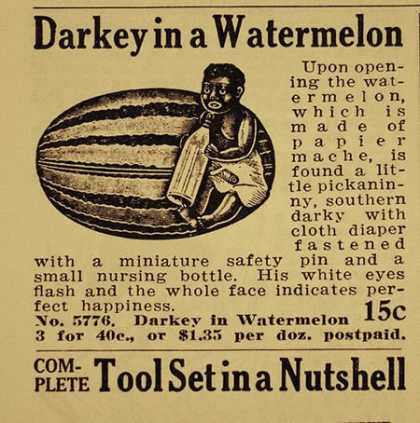
or, “how things got this way.” or, “thank you, racist advertising, for so effectively screwing us up.”

I had never heard the “made at night” thing before reading the comments on the picture I posted last week.  “Funny” how that’s still going around all these years later.  Kind of reminds me of the time my three year old self was called tar baby by a fellow (white)toddler.  I don’t think this is an ad.  It’s probably from a children’s book (perhaps that commenter’s favorite childhood bedtime story.)  Even “better.”

These previous two are another reason why “light skin vs. dark skin dodgeball tournament” cannot be funny to me. Ever. I have answered my own question.  Not ok.

copy reads:
Jell-O is known to all sections as “America’s Most Famous Dessert.”  In the South, for instance, it is inexpensive enough to be found in the cabins of the old plantations.  It is delicious enough to meet the standards of good living at the “Big House.” It is dainty enough for milady’s afternoon tea.  It is appealing enough to turn the sinful, of any color, away from his neighbor’s melon patch.

Let’s break this down:

“cabins of the old plantations” = slave quarters.

“sinful of any color” = just kidding, we mean the darkys… get it?  melon patch! ha! they sure do love watermelon!

I, personally, have always hated jell-o.

jazz’s lasses

I’m freaking out about this right now!  How on earth have I never heard of these women!?  I read the first article and thought “Oh, very cool.”  Then I saw the video…moments ago…currently freaking out.  Anybody wanna make a movie about this with me?  It would be like A League of Their Own kinda.  But with people of color actually doing something other than standing around wishing they could be doing something at which they, too, are really good.  That’s one of my favorite movies of all time, by the way.  I digress.  I wonder if it’s the racism or the sexism that’s kept this a “secret.”  Both I’m sure, but when I watch that video I’m mostly struck by the fact that these are women in positions I don’t think I’ve ever seen held by a woman.  Not then, not now.  And they came out of Mississippi!? O. M. G.

First All-Female Interracial Band Celebrated At Smithsonian

Written by News One

The International Sweethearts of Rhythm, the first all-female interracial band in America, faced down both Jim Crow and sexism in the 1930s and 1940s. Then, they faded into obscurity.

This week the Smithsonian Institution celebrates the Sweethearts’ legacy as part of the launch of the museum’s Jazz Appreciation Month.

the international sweethearts of rhythm

The Sweethearts’ exhibit will be on display at the National Museum of American History in Washington, DC from March 25 to May 31. Members of the Sweethearts, which included Black, white, Latino and Asian women, will participate in several events on March 29 and 30 at the museum. Radio One founder Cathy Hughes, whose mother Helen Jones Woods was an original band member, will also be a participant [NewsOne is a division of Radio One]:

…Ms. Hughes will facilitate an brief (10 minute) onstage discussion with six of the original Sweethearts who will participate in programming at the Smithsonian:  They are Helen Jones Woods (trombonist), Ms. Hughes’ mother; Willie Mae Wong Scott (saxophonist), the child of a Chinese father and mixed race Native American mother, she grew up on Mississippi in 1920s; Sadye Pankey Moore (trumpeter), African American; Johnnie Mae Rice Graham (pianist), African American; Lillie Keeler Sims (trombone), African American woman who played with the Sweethearts their first year but later served as an educator and administrator in the NYC school system 40 years;  and Roz Cron, one of the first white woman to join the band. On March 30th, the Sweethearts and Cathy Hughes will participate in a 60 minute discussion on the Sweetheart’s legacy that will be webcast via UStream.


First integrated, female big band highlighted at Smithsonian

By Sally Holland, CNN

Washington (CNN) — When Rosalind Cron left home in the 1940s to join a teenage girl jazz band called the International Sweethearts of Rhythm, she had no idea what it would be like, as a white girl, traveling with the predominantly black band.

At the time, Cron said she thought “Jim Crow” was a man they were supposed to meet in the South. “I didn’t realize it was a law, and a very strict law — laws, plural,” she said.

State and local ordinances that mandated separate public facilities for blacks and whites made it illegal for Cron to share facilities with her band members.

Cron felt the discrimination because she lived on their tour bus with the other girls, hiding her race. For three years, she said, they were like her sisters.

She spent several hours in jail in El Paso, Texas, in 1944 when authorities didn’t believe the story she had made up that her father was white and her mother was black.

“They went though my wallet and there was a picture of my mother and dad right in front of the house,” she said. She was sprung a few hours later when the band’s manager brought two black girls to the jail who claimed to be Cron’s cousins.

By that time, according to Cron, the authorities that were holding her were glad to get rid of her.

“They just told us never to return. And as far as I know, we didn’t,” she said.

The risks were worth it to play her saxophone with what became known as the nation’s first integrated, female jazz band.

The International Sweethearts of Rhythm were founded at Piney Woods School in Mississippi in 1937, in part as a way for the students to help pay for their education.

They recruited members of different races to help with the “international” part of their image.

Willie Mae Wong had a Chinese father, a mixed-race mother, and no visible musical skills when she was recruited to the group as a 15-year-old. She was out on the street playing stickball when they picked her up.

“The director of the music was named White,” Wong said. “They called me ‘White’s Rabbit’ because he had to spend more time with me to teach me the beat.”

The name “Rabbit” has stuck to this day.

In 1941, the group separated from the school and went professional. They traveled on a bus to gigs across the United States, including venues like the Apollo Theater in New York and the Howard Theater in Washington.

During World War II, the Sweethearts traveled to France and Germany as part of a USO tour in 1945.

Pictures and mementos from the International Sweethearts of Rhythm are on display at the Smithsonian’s American History museum for their 10th annual Jazz Appreciation Month celebration in April.

Thatmanofmine

Six members of the band were in Washington this week to reminisce.

“It was a privilege to come from Mississippi and go and see the other parts of the world,” said Helen Jones, who played the trombone from the band’s founding until it disbanded.

“All I ever wanted to do was play a trumpet,” Sadye Pankey told a group gathered at the museum. And as for music education today, she feels bad for today’s students.

“Some of our schools in our country now have abolished the music, and it’s not fair,” she said.

Cron told the group that if music is your passion, you need to stick with it.

“Don’t let anyone come between you and your horns, or music,” she added.

is this ok?

When I first read this article yesterday, I came to the conclusion that it was all in good fun and why take everything so seriously…  Then I watched Oprah’s Oprah Presents Master Class on OWN last night and she spoke about her little six year old self being made to sleep on the porch because she was the unfavored dark skinned child of the house.  I wanted to cry.  Oprah did.  I felt guilty that I have light skin.  I wanted to inflict harm on the light-skinned woman who inflicted this harm on my Oprah.  (I’m back on the Oprah kool-aid, btw. Loving the Oprah Winfrey Network.  LOVING. IT.)  Anywho, after I grounded myself in the reality that Ms. Winfrey’s just fine now, I thought about this article, this game, and I changed my mind back to “I don’t like it.”  I think.  I’m not sure.  It’s still a major issue.  Maybe making fun of it is the way to take the charge out of it.  Maybe not.


Light Skin Vs. Dark Skin Dodgeball Tourney

by Adrienne Samuels Gibbs, Senior Editor

SOMEWHERE IN THE GULF OF MEXICO ON MONDAY AFTERNOON-

Yes, you read that headline right: Light skin vs. dark skin dodge ball. Of course it helps that the spirits were flowing for hours before the color-charged dodgeball tourney commenced on the top deck of the cruise ship.

Beneath the clear blue skies and in between tremendous gusts of wind, Kid N’ Play were the live sports commentators, selected because they’re fun and also because they represent both sides of the skin spectrum. Both took turns at the mic to recruit, commentate and poke fun at those who dared take to the greens during the second day of the Tom Joyner Morning Show’s Fantastic Voyage.

Many onlookers went out of curiosity. Some went as a form of anger management
therapy. In the end though, it was good colorful fun. Team Light Skin recruited
a few White people and a Portuguese lady. Team Dark Skin wound up with lots of
brown skins and one light skin who said she wanted to be affiliated with her
darker brothers.

Kid, who rooted for team light skin but told EBONY he still loves a dark sista,
took to the mic between games and started singing odes to Pebbles and
Christopher Williams – classic singers who some felt best represented Team
Light. Play, on the other hand, yelled “Nino Brown wins!” when Team Dark threw a
final ball that clinched the tourney.

Off on the sidelines, the spectators got rowdy. Each side began chanting. Then
the guys started taking off their shirts. As for the women? They sat down to
watch the light and dark men go at it with each other. Things got rough as one
ball hit a light guy, richocheted, flew over the edge of the ship and floated
away.  Then a dark guy hurt his ankle. Comedian Damon Williams entered the fray,
ready to add some points to Team Dark’s score.

To be sure, many onlookers shook their heads, not sure what to make of such a
tourney. The Black community has a long history with light-dark issues, most of
which stem from post slavery trauma. The commentators didn’t get into all that,
instead leading the group to poke fun at what is often a deadly serious topic.

Who won? Who knows. It all ended with fun and jokes and hugs.

no recognition

i think this is just wrong… so wrong!  come on guinness!  i really don’t have anything else to say about it… except that i would love to have the opportunity to talk with mrs. lanier about all that she’s witnessed.

Slave’s daughter has ‘119th birthday party’ but Guinness won’t verify her as world’s oldest person

Daughter of Slaves Won’t Be Recognized as Oldest Woman. Rebecca Lanier celebrated her 119th birthday this week. Born to  parents who were former slaves, she believes she’s the oldest person in  the world, and her family has documentation to back up the claim, in the  form of a letter from the Social Security Administration. But the U.K.’s Daily Mail reports that because she was born in the  1890s, when it was commonplace for African-American babies not to be  issued birth certificates, she doesn’t have the documentation Guinness  World Records requires to be honored for her record-setting life. So  they refuse to acknowledge her. Lanier has witnessed more than 20 presidents and lived through two  world wars. She’s outlived her husband and daughters. And after all  this, she’s still suffering residual effects of the racial inequality  that existed more than a century ago, when she was born. “It’s quite a rigorous process that you go through because the birth  certificate is a crucial matter,” a Guinness World Records spokesman  told MailOnline, explaining why Lanier’s age won’t be recognized.

Mrs Rebecca Lanier never had birth certificate, required by Guinness World Records, as she was a black girl born to slave parents

By MARK DUELL

This ‘great-great-great-great grandmother’ claims to have lived through three centuries and her family believe she could be the oldest person in the world.

But Rebecca Lanier, 119, whose secret to long life is to ‘keep on living’, will not be recognised by Guinness World Records because she has no birth certificate.

Mrs Lanier, of Warrensville Heights, Ohio, who was born in March 1892, has seventh-generation grandchildren and outlived her husband and their two daughters.

She was born in a small Mississippi community to parents who had been slaves, at a time when many laws were prejudiced against black people in the South.

Because Mrs Lanier is black she was born with no birth certificate in the 1890s, which was normal in the South even though slavery had ended almost thirty years earlier.

This has caused problems as the Guinness Book of World Records needs that certificate to verify her age, which would make her the oldest living person in the world.

‘It’s quite a rigorous process that you go through because the birth certificate is a crucial matter,’ a Guinness World Records spokesman told MailOnline.

Mrs Lanier does however have a letter from the Social Security Administration that states the year of her birth as 1892, her grandson, Jimmie Shambley, 61, said.

But a Social Security spokesman told MailOnline they do not give verification of age and the burden of evidence is on claimants, who must provide official documents.

These can include birth certificates, citizenship certificates or permanent residence cards, with individuals receiving benefits getting an annual letter with their details on.

She spends her time doing the Chinese martial art tai chi every day and does not need to take any medication for illnesses or ailments.

Mrs Lanier, who now lives with Jimmie Shambley and his family, says she is ‘doing alright’ and had her 119th birthday at Warrensville Heights Senior Center on Tuesday.

When asked ‘How old are you today momma?’ by her great grandson Christopher Shambley, she replied: ‘Don’t worry about how old I am’.

Still going: Her grandson, Jimmie Shambley, said: 'She still is in her right mind and has great health. She makes her bed up every morning as she gets dressed'

‘She still is in her right mind and has great health,’ grandson Jimmie Shambley (above) told Scripps Media. ‘She makes her bed up every morning as she gets herself dressed.’

Mrs Lanier uses a ‘walker’ to balance herself as she moves, but often travels with the family on aeroplanes to various events around the country, they said.

‘She had two daughters. My mother had seven kids,’ Jimmie Shambley told Fox 4.

‘She has 15 great-great grand kids, 18 great-great-great grand kids and has two great-great-great-great grand kids.’

During her life Mrs Lanier has witnessed more than 20 presidents and lived through major events such as two world wars, the birth of flying and the right for women to vote.

‘She’s amazing – she’s just amazing to know,’ one family friend told Fox 4. ‘By her being 119, my friends and I – we range from 60 to 75 – we’re just youngsters.’

The claims come after Georgia great-great grandmother Besse Cooper was visited by Guinness World Records this month to certify her as the world’s oldest living person. Surrounded by family, 114-year-old Cooper accepted a plaque during a small ceremony at a Monroe nursing home. 

Record holder: Besse Cooper, 114, of Georgia, was verified as the world's oldest living person this month by Guinness

Record holder: Besse Cooper, 114, of Georgia, was verified as the world’s oldest living person this month by Guinness
WHEN SHE (Mrs. Lanier) WAS BORN…
  • Mrs Lanier was born in Mississippi in 1892, the year Grover Cleveland was elected to his second term as President
  • Wyoming had just been made a state, but Utah still was not and the U.S. population was around 63million
  • Most blacks did not vote as Mississippi had a $2 poll tax most could not afford
  • Only those who voted could serve on juries
  • General Electric was founded in 1892, but the Ford Motor company was still a decade away
  • Much of Mississippi depended on the cotton crops, which began to fail due to boll weevil infestation
  • She was born barely a year after the 1890 Wounded Knee Massacre of Native Americans that saw 150 Indians killed


a more appropriate (not to mention genius) exhibit

now this is the kind of exhibit i’d pay to see! i would like to take this time to say “told ya so.”  not that anyone’s really argued against this point with me.  i’m just sayin’… it doesn’t exist… and yet it dictates life chances and prevents us from being open to what exists and really matters in ourselves and each other.

Museum of Science explores science, concept of race

By Chris Bergeron/DAILY NEWS STAFF

BOSTON —An African, an Asian and a North American viewing the new exhibit “Race” at the Museum of Science might be surprised to discover they have more in common than individuals of any other species on Earth.

They would learn their variously colored complexions derive from how their skin processes folate and vitamin D. The African would find he’s susceptible to sickle cell anemia, not because of his race but because of the prevalence of malaria in his homeland.

And all three might be troubled to learn world-famous psychologist Arthur Jensen has written that differences in their intelligence can be attributed to their racial origins.

By the exhibit’s end, each might answer the question in its subtitle, “Are We So Different?” by saying, “No, not based on our genes.”

Combining scientific, anthropological and historical evidence, the exhibit argues the fundamental concept of race and racial differences has no biological basis but is a man-made distinction with immeasurable social consequences over the centuries.

Developed by the American Anthropological Association and Science Museum of Minnesota, “Race” invites visitors to examine race and racism through exhibits, interactive stations and artifacts.

1x1334355984.jpg

Museum President and Director Ioannis Miaoulis said it’s the first exhibit to examine race and human variations using the most up-to-date genetic discoveries.

“This exhibit can be inspiring, revealing and even life-changing,” he said opening the show last Thursday.

Chioma Nnaji, research coordinator of the UMass Horizon Center in Boston, praised the exhibit for explaining how a broad misunderstanding of race “complicated” relations between people by emphasizing superficial differences over shared interests.

Citing cutting-edge genetic research, the exhibit states, “Race is a recent human invention.”

Nina Catubig Nolan, chairwoman of the museum’s Race education team, said, “The idea of race doesn’t have a basis in biology. Humans from around the world share 99.5 percent of their genes. That’s more than chimpanzees or fruit flies,” she said.

Flawed science results in social injustice.

The failure to recognize our common genetic heritage is demonstrated by a photo that shows how the U.S. Census labeled people based on mistaken ideas of pigmentation and appearance.

From 1850 to 2000, a mixed-race woman would have been variously described as “mulatto,” “Negro” or, recently, “White and African American.” From 1930 to 1990, a woman from Tijuana who moved to Texas would have been labeled “Mexican,” “white” and “Hispanic white.” Over the course of the 20th century, Inuit women have been called “Indians,” “Eskimos” and in 2000 “Alaska natives.”

Wall text by that photo states: “The idea of race is tied to power and hierarchy among people. The legacy of race continues to shape the lives and relationships of people in the U.S. and around the world.”

Paul Fontaine, vice-president of education at the Museum of Science, said “Race” provides “a perfect opportunity to look at a sociological issue through a scientific lens.”

Museum official sought to open the exhibit just before Martin Luther King Jr. Day and over the following months to encourage discussion about a timely issue and provide an opportunity to present related events and activities, he said.

“When we first saw ‘Race,’ we loved the way it was presented. It was powerful and emotional and based on current genetic research. From this exhibit, visitors will learn race is an artificial construct. Yet it has been the basis for categorizing people and all the negative reactions that have followed from that,” said Fontaine.

“Race” includes fascinating, even a few disturbing, artifacts.

A “hair color table” that measured the spectrum of hair color from Aryan blonde to less desirable shades was used by Nazis to provide a scientific basis for the practice of “racial hygiene” that legitimized the deaths of millions of “non-Aryan” Jews, gypsies and Slavs.

Closer to home, visitors can see a placard for a “Colored Waiting Room” and a sign announcing “We want white tenants for our white community.”

And debunking a television crime show staple, the exhibit uses photos and expert testimony to show forensic pathologists can not definitively determine a victim’s race from their bones and teeth with the regularity or ease of investigators on “CSI Miami.”

Unlike many Museum of Science exhibits, “Race” devotes more than half its gallery space to establishing a historical and social context for its premise that humans have misused the idea as a tool to discriminate rather than seek common ground.

The most effective parts of the exhibit help visitors understand the genetic science that provides the exhibit’s foundation. By twisting a dial, visitors can direct human migration from 100,000 B.C. to 40,000 B.C. across a world map.

At the exhibit’s opening, musician and sound artist Halsey Burgund previewed a segment of his audio installation, “Voices Without Faces, Voices Without Race,” which consists of snippets of conversation from more than 250 people discussing race.

Commissioned by the museum, he recorded people along Rte. 128 responding to three questions: When did you first become aware of race? When were you first privileged by or discriminated against because of race? And, What is your experience of race in Boston? The audio installation will open Feb. 3.

Khaalie Parham, a 15-year-old sophomore at Community Charter School in Cambridge, said people react differently to him depending on whether he’s in his predominantly white hometown of Belmont or among his peers.

“Race has a huge significance in my life. If I’m in Belmont, people look at me differently or cross to the other side of the street than I’m walking on,” he said. “In my school, race isn’t much of a factor. But if people look past differences and what other people say and follow their own mind, then race stops dividing people.

THE ESSENTIALS:

WHAT: “Race: Are We So Different?”

WHERE: Museum of Science, Science Park, Boston

WHEN: Through May 15

ADMISSION: $21 for adults, $19 for seniors (60+) and $18 for children (3-11)

INFO: 617-723-2500, TTY 617-589-0417, www.mos.org.

Visit the American Anthropological Association’s Race Project at www.understandingrace.org

SOURCE

the child was exhibited yesterday

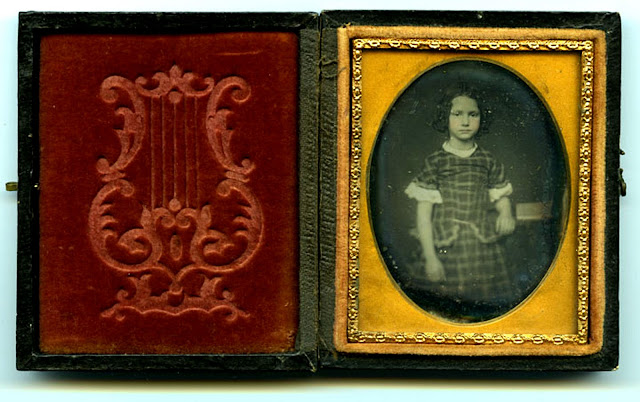
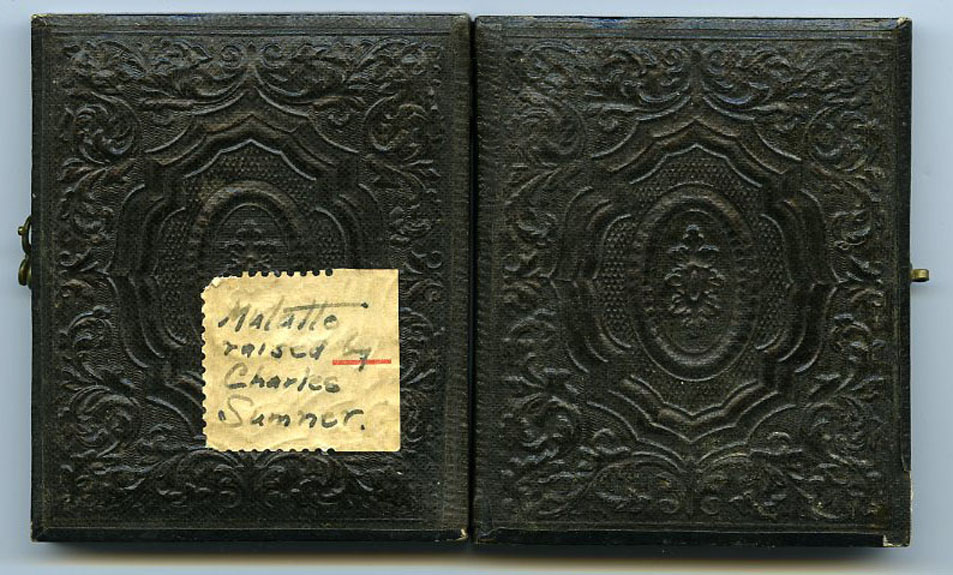
in my search for vintage images of mulatto folks i recently stumbled upon a gem!!   Joan P. Gage is a journalist and a collector of photographs.  on her blog A Rolling Crone she shares one of her collectibles and the fascinating (and still unfolding) story behind it.  i feel all kinds of ways about this piece of our history (and by “our” i do mean mulatto, i do mean american, i do mean human seeing as everything is everything and all.)  anyway, i feel sad for the little girl.  i feel pride for the little girl.  i feel a sense of satisfaction that i can point to this child and to the efforts charles sumner as evidence that, even way back when, a white man and a white-looking black child attempted to change people’s minds (way back)when it would have been much easier (not to mention safer!) to relish in the societal refuge that their phenotype offered.  i am not implying that the attempt was perfect, nor that there is nothing offensive or off-color about the sentiment behind the message.  but, if you consider the general consensus of the times on this matter, i think it safe to view sumner’s cause as a benevolent one.  i wonder how little mary felt.  i wonder if she understood.  i wonder what her parents looked like.  and her siblings.  i assume there’s a reason that they were not photographed or ‘exhibited’ together.  and i wonder how they felt about that, about all of it.  and what became of all of them…

From a New York Times article dated March 9, 1855, which read:
A WHITE SLAVE FROM VIRGINIA. We received a visit yesterday from an interesting little girl, — who, less than a month since, was a slave belonging to Judge NEAL, of Alexandria, Va. Our readers will remember that we lately published a letter, addressed by Hon. CHARLES SUMNER, to some friends in Boston, accompanying a daguerreotype which that gentleman had forwarded to his friends in this city, and which he described as the portrait of a real “Ida May,” — a young female slave, so white as to defy the acutest judge to detect in her features, complexion, hair, or general appearance, the slightest trace of Negro blood. It was this child that visited our office, accompanied by CHARLES H. BRAINARD, in whose care she was placed by Mr. SUMNER, for transmission to Boston. Her history is briefly as follows: Her name is MARY MILDRED BOTTS; her father escaped from the estate of Judge NEAL, Alexandria, six years ago and took refuge in Boston. Two years since he purchased his freedom for $600, his wife and three children being still in bondage. The good feeling of his Boston friends induced them to subscribe for the purchase of his family, and three weeks since, through the agency of Hon. CHARLES SUMNER, the purchase was effected, $800 being paid for the family. They created quite a sensation in Washington, and were provided with a passage in the first class cars in their journey to this city, whence they took their way last evening by the Fall River route to Boston. The child was exhibited yesterday to many prominent individuals in the City, and the general sentiment, in which we fully concur, was one of astonishment that she should ever have been held a slave. She was one of the fairest and most indisputable white children that we have ever seen.

From “Raising Freedom’s Child—Black Children and Visions of the Future after Slavery,” written by a University of New Orleans professor, Mary Niall Mitchell:

By the eve of the Civil War, abolitionists recognized the potential of white-looking children for stirring up antislavery sentiment…Although it was the image of a raggedy, motherless Topsy that viewers might have expected to see in a photograph of a slave girl, it was the “innocent”, “pure,” and “well-loved” white child who appeared, a child who needed the protection of the northern white public.
“Topsy”
George Thomson’s Woodcut Illustrations
1888

The sponsors of seven-year-old Mary Mildred Botts, a freed child from Virginia, may have been the first to capitalize on these ideas, as early as 1855. Her story also marks the beginning of efforts to use photography (in Mary Botts’s case, the daguerreotype, as the carte-de-visite format was not yet available) in the service of raising sentiment and support for the abolitionist cause.”
“…In his own characterization of Mary Botts,” Mitchell continues, “Sumner set a pattern that other abolitionists would follow.  In a letter printed in both the Boston Telegraph and the New York Daily Times, he compared Mary Botts to a fictional white girl who had been kidnapped and enslaved, the protagonist in Mary Hayden Pike’s antislavery novel Ida May:  ‘She is bright and intelligent—another Ida May,’ [Sumner wrote] ‘I think her presence among us (in Boston) will be more effective than any speech I can make.’”

From joanpgage, the blogger (and current owner of the daguerrotype) from which I am re-blogging this piece:

Only a year after parading Mary Botts through New York, Boston and Worcester and dubbing her “The real Ida May”,  Charles Sumner’s devout abolitionist views  led him to a crippling disaster, when, in 1856, he was so badly beaten on the floor of the Senate by South Carolina Representative Preston Brooks,  who broke a cane over his head, that it would take years of therapy before Sumner could return to the Senate.

…Prof. Mitchell is currently working on a book about Mary Botts that will tell more about this former slave’s life, including the drama of how Sumner purchased her and spirited her out of Virginia, how he introduced her to the media and society as a  living advocate for the abolitionist cause, and how her family settled in the free black community in Boston.

I’m eager to learn the rest of the story, but, for now, it’s enough of a thrill just to know that the daguerreotype, taken in 1855, that is part of my collection may represent one of the first efforts EVER to use the modern discovery of photography to touch people’s emotions and change their minds.  This small image of a seven-year-old girl may be an example of the first time photography was used for propaganda, but it was certainly not the last.


unsavory initial recognition

i’ve no idea where i found this.  it’s been waiting to be posted since last july…

in light of the current posting trend over here, i found the last line to be somewhat relevant…”document(s) white recognition of beauty and attraction in their slaves.”  not quite so “flattering” as the modern recognition.

An attractive and well dressed mulatto woman from New Orleans. A sixth plate dagu

Her light skin color was itself evidence of miscegenation.
She was quite possibly a free woman and as such, the photograph would contribute little to a study of slavery. Yet the likelihood remains that she was enslaved. If so, this woman’s attractive looks and fancy dress imply she could have been owned or hired as a slave mistress.

Interracial sexual exploitation, along with brutal punishment and separation of families, was a terrible aspect of slavery. The practice was far from unknown throughout the antebellum South and existed with special visibility in New Orleans. If the daguerreotype of this woman could for a moment be interpreted in such a fashion, then commissioned by her escort, it would document white recognition of beauty and attraction in their slaves.

no h8

This is so right on!  Thank you, Karen Finney.  I’m so glad my (white)grandparents allowed me in to their lives.  And so are they! It’s the “little” things…

On another note, this sentence, “the very existence of antimiscegenation laws had been enacted for the purpose of perpetuating the idea of white supremacy,” speaks to the very reason I fell down this rabbit hole I’ll now call the mulatto trail.  I realized one day that anti-miscegenation and the one-drop rule perpetuate the idea of white supremacy, and that by subscribing to that antiquated rule I was upholding that ridiculous notion.  The anti-miscegenation thing has legally been eradicated, but ask any interracial couple who has walked down a street together, and I’m sure they’ll tell you that on more than one occasion they’ve been given the evil-eye or gawked as if they were freaks of nature.  Or both.  And as for the one-drop rule, head on over to my youtube channel, scroll through the comments, and you’ll see that it looms large in the consciousness.  And many people don’t seem to be willing to let it go.

California Prop 8 Gay Marriage Ruling a Win For American Values

By KAREN FINNEY

SOURCE

Yesterday’s ruling that California’s Proposition 8 is unconstitutional reaffirms a long-held American value that no matter how you try to spin it, separate is not equal. While some may not agree with same-sex marriage, history should remind us that our Constitution calls us to recognize that the laws in it apply equally, not to be picked apart to support a political agenda or bias. The arguments being used against same sex marriage are frighteningly similar and equally offensive as those once used against interracial marriage. While a Gallup poll in 1967 found that 74 percent of Americans disapproved of interracial marriage, it’s almost hard to remember just how far we’ve come.

I was 16 years old before I was allowed in my grandfather’s home in Greensboro, North Carolina. That’s how long it took for him to even begin to re-think his shame over having a mixed-race granddaughter. He believed, as did many at the time, miscegenation was wrong on moral and legal grounds. Thankfully for me, my parents disagreed. They were married in New York City and had me despite the fact that it was illegal in their home states of Virginia and North Carolina to do so. Thankfully for our country, in the case of Loving v. Virginia, the Supreme Court saw beyond the fear and bigotry of the moment and ruled that antimiscegenation laws violated fundamental American values of Due Process and Equal Protection Under the Law as guaranteed to every American by our constitution.

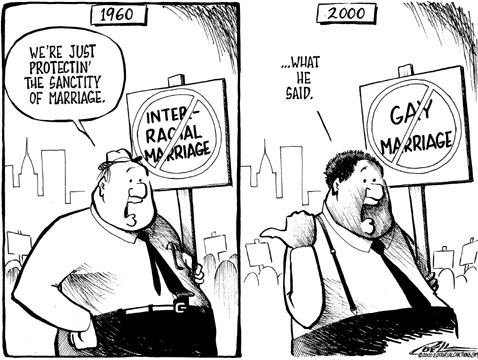
Just as some used to say that marriage is only valid between a white man and white woman, some now argue that marriage can only be between a man and a woman. Arguments have also been made that same-sex marriage dilutes the institution of marriage, just as similar arguments suggested that interracial marriage diluted the white race. My personal favorite absurd justification says that (despite the idea that we are all God’s children and loved equally) gay marriage is against the laws of God and nature. That argument was used by Leon M. Bazile, the judge in the initial case against the Lovings, who said:

Almighty God created the races white, black, yellow, malay and red, and he placed them on separate continents. And but for the interference with his arrangement there would be no cause for such marriages. The fact that he separated the races shows that he did not intend for the races to mix.

The Supreme Court’s ruling in the Loving case also recognized that the very existence of antimiscegenation laws had been enacted for the purpose of perpetuating the idea of white supremacy:

There is patently no legitimate overriding purpose independent of invidious racial discrimination which justifies this classification. The fact that Virginia prohibits only interracial marriages involving white persons demonstrates that the racial classifications must stand on their own justification, as measures designed to maintain White Supremacy.

Similarly, as Judge Vaughn Walker today affirmed, denying gay couples the right to marry, not only denies basic civil rights, liberty, and freedom, but also codifies bigotry.

Karen FinneyKaren Finney is a political analyst for MSNBC and an independent consultant working with political and corporate clients in the areas of political and communications strategy. She brings over 16 years of experience in national politics and campaigns ranging from the Clinton administration to New York State to the Democratic National Committee.

recently on the interweb

I’ve come across some interesting stories, commentary, and subsequent comments all dealing with… Biracialness! Big shocker, right?  I love reading the comments.  So many different opinions, which simply reinforce my will to stay with my self and stand confident in my personal ideology.

The Seattle Times

Via

Rant and Rave Rant to the women on the bus who, when asked to quell their use of expletives around my young children, disparaged me for having a biracial family and insulted my daughters’ hair. Rave to the man who told them my request concerning their language was valid and that they had no reason to insult me and my family. Thank you, sir.

Answer.com

JUST ASK AND LET THE OTHER TO ANSWER IT FOR YOU

Via

Pregnancy & Parenting

How do I tell my mum I’m having a mixed race baby?

the baby is going to be half black but i don’t think my mum or my family would be too happy about it.. I want my family to accept the baby but what can do I to make them accept my unborn baby…

5 Responses to “How do I tell my mum im having a mixed race baby?”

blessed says:

all you can really do is explain to them as much as you can to get them to understand, but even at that it might not change their minds, but if it doesn’t then just say it’s my baby and no matter what it is going to be family and they’ll just have to get over it.

Charles J says:

You don’t. I would recommend getting an abortion. No one likes a half-breed.

VincentL says:

just tell them straight up…they probably be very mad at first but sooner or later they will adjust to i

Due 12.3.10 says:

just tell her its ur child..

R.I.P Michael Jackson says:

u don’t have to they will c it when u have it………….

Run, Racists, Run! Biracials Are Everywhere!

By Sam Watson

Via

Gone are the days where the majority of people will shout racist remarks at those of color on the streets. It still happens, but nowhere near as much as in the past. Racists are kind of afraid to spew their hatred in public, and I feel us biracials are to blame. We represent an abomination to racists. An old, white guy- a complete stranger- once saw my mom (white, Ukrainian) with my sister and I, when we were very young children, and he shouted, “Slut!” at her. We’re mixed – half white and half black. We represent an absolute breakdown of a racist’s hateful beliefs.

…Racists don’t know whether or not the “white” person next to them is either mixed or married to someone of a different race. Racists better up their paranoia levels, and warn the town sheriff in Bigotville.  During the World Cup, I turned to my seemingly white co-worker, and started ragging on the Mexican team. She instantly scowled at me in return. I forgot! She’s half white and half Mexican! Even I- a biracial- was fooled! We’re everywhere, now, and this is a racist’s worst nightmare.

Comments

-You are right. When it comes to black people, they now hate themselves much more. All of us are mixed up with something. We are one human race. Our race is different from that of the animals, not each other.
-A study I heard cited recently encouraged parents to discuss race and racism with their kids. Several families dropped out because they were so uncomfortable with this requirement of the study.

The study discovered that racism is not discussed at all in many progressive, liberal households. The idea is that if we’re all supposed to be colorblind, discussing race, or any difference for that matter, is taboo. Of course, that’s the best way to make it a dark, secretive thing- precisely the problem. People who desperately want their kids to be not just tolerant, but accepting, are practically guaranteeing their kids get no exposure to the subject by pretending it’s not there.

Racism and bigotry is a vampire- it can’t stand the light. If we want it to die out, we have to do the uncomfortable, inconvenient thing and talk about it even when it’s not a major in-your-face problem.

-I am half German (white) and Puerto Rican (brown) and I always baffle people. I think it’s interesting that we assume that racism is disappearing when I feel like it is only growing. In an all colorful nation I still feel like I need to watch what I say when I am naming a race ~ whether it’s politically “correct” or not because I never know who is going to be offended.

-You better believe we are everywhere. Though I know I’m not the only unique biracial person out there, I do admit that people are surprise when they hear that my mom is from Dominican Republic and my father is from Afghanistan. Talk about fusing two totally different cultures.

I also understand when you talk about racism being a private thing. My step mother is racist, even though she’s married to my father. It makes me mad when she makes stupid comments regaurding race. She also tries to inplant her ideas on my half brother. I try my best to counter these thoughts though… my diverse background has raised me to be open to new ideas, cultures, and people. The more people who are biracial, the more tolerance we have of one another.

-Racism is still alive but it’s a endangered species. I say this because the current generation doesn’t hold race as important as the previous ones. Most of my friends (I, myself included) have bi-racial children. At times I wonder when these kids grow up will that look at their peers and ask in shock “You’re not mixed?” I think it’s a great thing, however as parents we still need to pour our cultures into the children, letting them know they have and even more extended set of roots and the beauty contained within both.

-Racism is part of human nature. Embrace it!

-I’m old enough to have seen overt racism, as well as the more prevalent covert racism. Sometimes I feel that the only hope we have to eradicate racism is the gradual blending of all races into an “everyman.”

-I was recently showing off pictures of my friends in New York to some people here. They nodded politely at all of them, but paused at a picture of two my best friends.

“What race are they?” I was asked.

I couldn’t believe it mattered. A lot of my previous pictures had been of people who were black or Asian or of some non-white race, but these two mixed-race girls came into question?

“Er, she’s Romanian and Jamaican, and she’s Indian, Portuguese and Italian.”

“Oh, okay.” The guy replied. “I just couldn’t figure it out.”

Why should you have to?