responsible?

So, I’m sitting here completely stunned by this and unsure how to process it.  It’s not the “possibility” that the government was involved in the assassination that has me floored, but that I have never heard of this trial before.  I wasn’t sure I could believe that the trial even happened.  I came across this on April Fool’s Day after all.  But it seems to be no joke.  The King Center seems to be legit.  The NYTimes made some brief mention of the trial.  However this is not common knowledge.  At least, not to the best of my knowledge.  I can only say that I am truly befuddled.  Yep, befuddled.  The 45th anniversary of the assassination is days away: 6:01 p.m. on Thursday, April 4, 1968.

mlk assassination suit

Assassination Conspiracy Trial

Martin King’s family: share civil trial case that US govt assassinated Martin

logo

Coretta Scott King: “We have done what we can to reveal the truth, and we now urge you as members of the media, and we call upon elected officials, and other persons of influence to do what they can to share the revelation of this case to the widest possible audience.” – King Family Press Conference, Dec. 9, 1999.

From the King Center on the  family’s civil trial that found the US government guilty in Martin’s assassination:

After four weeks of testimony and over 70 witnesses in a civil trial in Memphis, Tennessee, twelve jurors reached a unanimous verdict on December 8, 1999 after about an hour of deliberations that Dr. Martin Luther King, Jr. was assassinated as a result of a conspiracy. In a press statement held the following day in Atlanta, Mrs. Coretta Scott King welcomed the verdict, saying , “There is abundant evidence of a major high level conspiracy in the assassination of my husband, Martin Luther King, Jr. And the civil court’s unanimous verdict has validated our belief. I wholeheartedly applaud the verdict of the jury and I feel that justice has been well served in their deliberations. This verdict is not only a great victory for my family, but also a great victory for America. It is a great victory for truth itself. It is important to know that this was a SWIFT verdict, delivered after about an hour of jury deliberation. The jury was clearly convinced by the extensive evidence that was presented during the trial that, in addition to Mr. Jowers, the conspiracy of the Mafia, local, state and federal government agencies, were deeply involved in the assassination of my husband. The jury also affirmed overwhelming evidence that identified someone else, not James Earl Ray, as the shooter, and that Mr. Ray was set up to take the blame. I want to make it clear that my family has no interest in retribution. Instead, our sole concern has been that the full truth of the assassination has been revealed and adjudicated in a court of law… My husband once said, “The moral arc of the universe is long, but it bends toward justice.” To-day, almost 32 years after my husband and the father of my four children was assassinated, I feel that the jury’s verdict clearly affirms this principle. With this faith, we can begin the 21st century and the new millennium with a new spirit of hope and healing.”
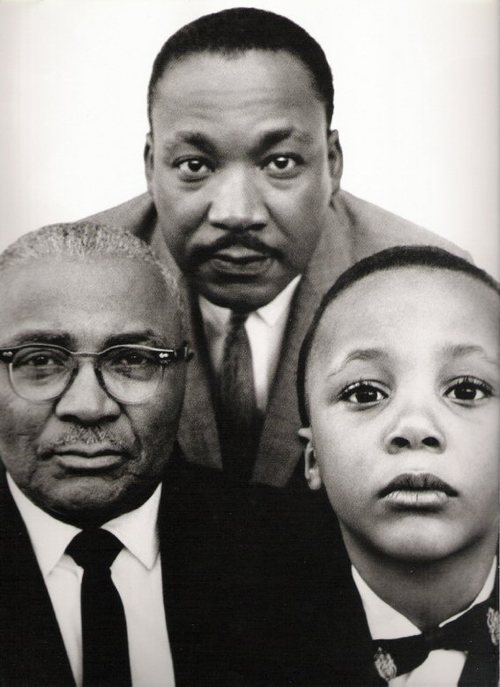
mlk w:father and son 1963

1963

TRANSCRIPTS

View Full Trial Transcript>

View Transcript of King Family Press Conference on the Verdict>

KING FAMILY STATEMENT ON MEDIA REQUESTS REGARDING THE MEMPHIS VERDICT

The King family stands firmly behind the civil trial verdict reached by twelve jurors in the Memphis, Tennessee courtroom on December 8, 1999.

An excerpt from remarks made by Mr. Dexter Scott King, Chairman, President, and CEO of The King Center, during the December 9, 1999 press conference regarding the verdict that may be used in support of this family decision:

“We can say that because of the evidence and information obtained in Memphis we believe that this case is over. This is a period in the chapter. We constantly hear reports, which trouble me, that this verdict creates more questions than answers. That is totally false. Anyone who sat in on almost four weeks of testimony, with over seventy witnesses, credible witnesses I might add, from several judges to other very credible witnesses, would know that the truth is here.”

The question now is, “What will you do with that?” We as a family have done our part. We have carried this mantle for as long as we can carry it. We know what happened. It is on public record. The transcripts will be available; we will make them available on the Web at some point. Any serious researcher who wants to know what happened can find out.”

The King family feels that the jury’s verdict, the transcripts of the conspiracy trial, and the transcripts of the King family’s press conference following the trial — all of which can be found on The King Center’s website — include everything that that family members have to say about the assassination.

Therefore, the King family shares the conviction that there is nothing more to add to their comments on record and will respectfully decline all further requests for comment.

destined to repeat history

Memphis Jury Sees Conspiracy in Martin Luther King’s Killing

header-logo

By EMILY YELLIN
Published: December 09, 1999

A jury in a civil suit brought by the family of the Rev. Dr. Martin Luther King Jr. decided today that a retired Memphis cafe owner was part of a conspiracy in the 1968 killing of Dr. King.

The jury’s decision means it did not believe that James Earl Ray, who was convicted of the crime, fired the shot that killed Dr. King.

After four weeks of testimony and one hour of deliberation, the jury in the wrongful-death case found that Loyd Jowers as well as ”others, including governmental agencies” had been part of a conspiracy. The jury awarded the King family the damages they had sought: $100, which the family says it will donate to charity.

The family has long questioned Mr. Ray’s conviction and hoped the suit would change the legal and historical record of the assassination.

”This is a vindication for us,” said Dexter King, the youngest son of Dr. King.

He said he hoped history books would be rewritten to reflect this version of the assassination.

Mr. Jowers, 73 and in failing health, owned Jim’s Grill in 1968, a restaurant opposite the motel where Dr. King was shot and just below the second-floor rooming house from which, according to James Earl Ray’s confession in 1969, Mr. Ray fired the single shot that killed Dr. King. Mr. Ray, who recanted his confession, hinted at a conspiracy. He died in prison last year while serving a 99-year sentence.

Mr. Jowers, in a 1993 television interview, said that he had hired a Memphis police officer to kill Dr. King from the bushes behind his restaurant. Mr. Jowers said he had been paid to do so by a Memphis grocery store owner with Mafia connections.

In an unlikely alliance, the King family was represented in the case by William Pepper, who had been Mr. Ray’s lawyer. The King family maintains that Mr. Pepper’s version of the assassination is the one that gets at the real truth behind Dr. King’s death, not the official version with Mr. Ray as the gunman.

Mr. Pepper said federal, state and Memphis governmental agencies, as well as the news media conspired in the assassination.

Mr. Jowers’s lawyer, Lewis Garrison, had said since the trial began that he agreed with 80 percent of Mr. Pepper’s conspiracy theories and disagreed only on the extent of his client’s involvement. In his closing argument today, Mr. Garrison repeated what he had said through the trial that his client participated in the conspiracy but did not know that it was a plot to kill Dr. King.

One juror, David Morphy, said after the trial, ”We all thought it was a cut and dried case with the evidence that Mr. Pepper brought to us, that there were a lot of people involved, everyone from the C.I.A., military involvement, and Jowers was involved.”

John Campbell, an assistant district attorney in Memphis, who was not part of the civil proceedings but was part of the criminal case against Mr. Ray, said, ”I’m not surprised by the verdict. This case overlooked so much contradictory evidence that never was presented, what other option did the jury have but to accept Mr. Pepper’s version?”

And Gerald Posner, whose recent book, ”Killing the Dream” made the case that Mr. Ray was the killer, said, ”It distresses me greatly that the legal system was used in such a callous and farcical manner in Memphis. If the King family wanted a rubber stamp of their own view of the facts, they got it.”

racism, albeit defensive, is racism

Just in case it came as a surprise to anyone who read yesterday’s post that black people can be classified as racist, I’m posting this for follow-up.

I did not know that I could love James Earl Jones even more than I already do.

I also did not know that there is a “black version” of the Huffington Post.

black-voices

I’m not sure that I love that.

Anyway, I think this thing that Mr. Jones said about the “need for independent thinking” is pure gold.  And yet he also understood his grandmother, and was even able to discern the truths contained in her closed-minded thinking from the poison of it.  That is beautiful.

James Earl Jones Talks Growing Up With A Racist Grandmother On BBC World News

James Earl Jones-CNO-005897

James Earl Jones opened up about the “most racist person” he has ever known: his grandmother.

During an interview with BBC News, the actor and famous voice of Darth Vader, shared information about growing up in rural Mississippi with his grandmother whom he said was profoundly racist, despite her Cherokee, Choctaw Indian and African American roots.

“She was the most racist person, bigoted person I’ve ever known,” Jones told BBC’s Stephen Sackur. “She trained us that way. She would consider it defensive racism, but it’s still racism, it’s still the same poison.”

Jones said he credits his grandmother with giving him his “first need for independent thinking” after he moved from Mississippi to Michigan, and giving him the ability to empathize with racists.

I’d go to school with white kids and Indian kids. I knew they weren’t the devils that she said they were. I had to start thinking for myself, and I had to start understanding the extent to which she was right too. But I can now live in the shoes of racists. When I hear about racists, I know exactly what they’re feeling. I said ‘I’m gonna allow myself to feel that, just for the hell of it.’ So I know what they’re going through.

The actor is currently starring in “Driving Miss Daisy” alongside Vanessa Redgrave at the Wyndham’s Theatre in London. In November, he received an honorary Academy Award for lifetime achievement onstage after a performance, where he graciously accepted the award.

“You cannot be an actor like I am and not have been in some of the worst movies like I have,” he said. “But I stand before you deeply honored, mighty grateful and just plain gobsmacked.”

The Race Project continued

When I said mildly obsessed I wasn’t exaggerating.  I find these Race Cards to be moving and powerful and unsettling and inspiring.  Michael Bolton (not that Michael Bolton) and Bill Rowe, you really got to me. What a genius project.  It is a brilliant way of taking the racial temperature of an America with a huge population of “Millennials” who think in 160 character blurbs and who we hope are the “raceless” generation.  Of course we Gen X-ers and the Boomers, and even the Builders have Millennial tendencies, so no one should feel excluded from this.  This isn’t for Generation Y, but when you’re taking the racial pulse at The University of Michigan, you will get a sense of how to close to “raceless” our youngest adults are.

 
make-your-race-card2

Click HERE to submit your own Race Card.  I’d love to hear which 6 words you chose, so please leave it in the comment section below if you feel inclined to share.  I’m crafting one myself.  Right now I’ve got:

  • Believing in race ensures potential’s waste
  • Race is a mask, lie, excuse
  • Race brings judgement made in haste
  • Race causes unnecessary confusion of spirit

I think I like the last one best.  I think the ones the rhyme are cheesy.  I think the word race probably doesn’t have to be in it, so I need to start thinking outside of the box I’m currently stuck in on this one.

Here are a few of the ones that intrigued me most.  Of course, I was drawn to the “interracial” ones for obvi reasons.  There are so many intriguing entries to dig through on the Race Card Project website.

We are treated how we look.

image-1


Kimberly Dorsey

Detroit, MI

I am bi-racial and have been raised in a white family inside Detroit. I have suffered many racially motivated injustices in my travels and it makes me angry when people pretend race doesn’t matter. It matters when you are the one being discriminated against.

Yes, they are my REAL kids

Paul David Binkley
Delaware, OH

My wife of twenty two years and I are interracially married, she black and myself white.

Over our years together we have dealt with countless thoughtless comments and questions.

Here is one such event recalled here to explain my six word story.

A few years back, when our youngest still fit in a grocery cart, I was shopping alone with the three of them, engrossed in a price comparison, when an older woman approached and asked bluntly, “are those your kids?”

Wincing, I glanced over at them. My oldest daughter was tracing the colorful letters of a cereal box with her finger. My son was standing with his binkly in his mouth and fingers of one hand gripping the cart. And my baby girl was just sitting there quiet, not even remotely misbehaving.

Reconsidering her question. “Are those your kids,” I realized its true nature. Thinking myself clever, I answered, “Would I bring them to the grocery store if they weren’t?”

To which she humorlessly rejoindered, “No. I mean are they your REAL kids?”

Too desensitized to be deeply offended, I gritted my teeth and answered plainly, “Yes, they are my REAL kids.”

How to protect my black son?

41496_100000657735231_6635_n

Michael Bolton
Scottsdale, AZ
Understanding Race Project- University of Michigan

Dad Caucasian. lived life in black neighborhood mostly. studied black history–college+leisure. love black culture esp music, classic jazz. slave narratives. am black myself but cannot pass as such. other dad, my partner, black, died. am now single dad, not planned. bringing up son in white priviledged neighborhood. not me, not him, we’re poor, but we’re here. avoiding ‘young black males’=main cause of death for ‘young black males’. life so cheap for ‘young black males’. not *my* son. i miss diversity.

Slide2

With blacks come crime and decay.

Bunny Vee
Philadelphia, PA

Called my friend nigger. Ashamed forever.

Bill Rowe
Bucks County, PA

It was 1971 and I was ashamed the moment I said it. Jeff was a friend and to impress the wrong person I said something terrible. What impresses me to this day is the way that he responded. He just said “you don’t mean that” and never said another word. If I read the situation correctly, Jeff forgave the unforgivable. I have never been able to forgive my behavior and I am ashamed to this day of what I did. I moved to another school the following year and we lost contact. I never apologized and wish that I could.
Jeff, wherever you are, I have two 6 word sentences for you. You are the epitome of grace. I’m sorry beyond power of words.

Slide7

because he was smart

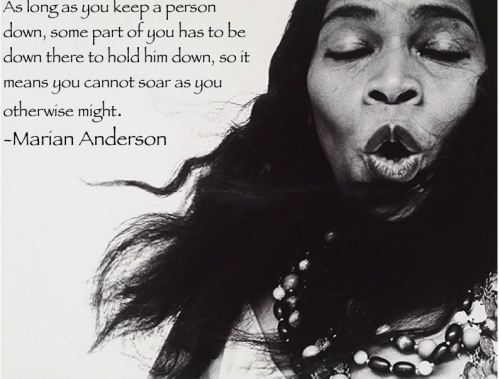
Marian Anderson and Albert Einstein were friends!! Like, friends. Not acquaintances. I am related to Marian Anderson and she hung out with Einstein. Considering the purposefully reposted quote along side Einstein’s notion that the limiters of potential are limited as well, I imagine they had some profound conversations.  That’s nearly as impressive to me as her “dissing” the D.A.R. by singing on the steps outside in response to their choice to disrespect her in honor of the organization’s racial exclusion policy.

Anyway, here’s more on Einstein’s stand for equality. It was a lot more involved than delivering a speech at a University, and there are many more details here than in the article posted yesterday.  Not that the speech wasn’t as big of a deal as I thought. It was!  Not only was Mr. Einstein brave enough to speak out, he did it while he was ill.  Outside.  Ok, it was May, so maybe the weather was fine, but I’m just saying if he was looking for an excuse not to speak, sounds like he had it, but chose not to use it.  Instead, he got up there and spoke to the impressionable minds of the “first institution found anywhere in the world to provide a higher education in the arts and sciences for male youth of African descent.”  If young African American males today are largely still in need of academic encouragement and inspiration and respect, I can only imagine how impactful and empowering Einstein’s presence alone was pre Brown vs. Board of Ed.  Just the simple fact that he spoke, and the forbidden, unspoken truth contained in his words.  I have a feeling this brilliant man knew exactly what he was doing.

Albert Einstein, I acknowledge your greatness as a champion of human and civil rights and your hand in illuminating the fact that limiting the potential of a significant portion of society limits everyone in that society

Thank you.

xo,

Tiff

einstein1d-m

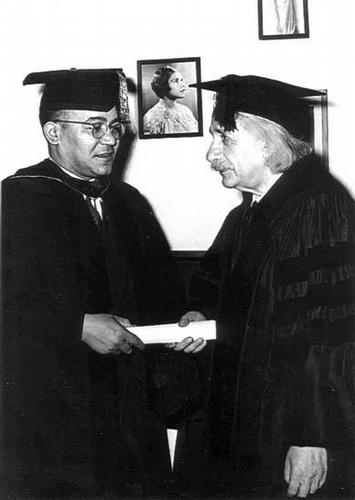
Albert Einstein at Lincoln University

(photo of Marian Anderson in background?)

Albert Einstein passionately fought race prejudice, according to new and old docs

by Ronda Racha Penrice

Nearly 60 years after his death, the great scientist Albert Einstein is still making headlines. The launch of Einstein Archives Online — a more advanced repository of his work — is a long-term collaboration by Israel’s Hebrew University, which he co-founded, California Institute of Technology (Caltech), where he was a guest faculty member on several occasions, and Princeton University, where he was a faculty member, generated global attention on March 19. Eventually, over 80,000 documents held in Hebrew University’s Albert Einstein Archives and Caltech’s Einstein Papers Project will be available on the Internet. About 2,000 are currently available.

Despite this unprecedented access, however, one thing hasn’t changed: Einstein’s strong support of African-American civil rights and his defiant stance against racism are largely footnotes, especially for the mainstream press. While it will, no doubt, be exciting to pull up correspondence between Einstein and W.E.B. Du Bois one day, his association with Du Bois was just the tip of the iceberg.

Einstein, as documented in the 2003 book Einstein on Race and Racism by veteran science writer and journalist Fred Jerome, who also covered civil rights activity in the South in the 1960s, and New York librarian Rodger Taylor whose early writings have focused on jazz and early African-American life in New York, staunchly denounced racism and segregation in the United States, even as his health steadily failed and his own mortality drew nearer.

Jerome first delved into Einstein’s human rights advocacy in his 2002 book, The Einstein File: J. Edgar Hoover’s Secret War Against the World’s Most Famous Scientist. In that groundbreaking work, Jerome highlighted a May 3, 1946 speech Einstein gave at historic Lincoln University, the alma mater of both Thurgood Marshall and Langston Hughes and, as its then president Horace Mann Bond pointed out, “the first institution found anywhere in the world to provide a higher education in the arts and sciences for male youth of African descent.” Interestingly, a young Julian Bond, Horace Mann Bond’s son, was there that day.

The speech was especially significant because, as Jerome also writes in The Einstein File, “During the last twenty years of his life, Einstein almost never spoke at universities.” He routinely turned down almost all of the honorary degree requests he received.

On top of that, Einstein’s health was not the greatest. Yet, he stood outdoors to receive his honorary degree from Lincoln University, which can actually be viewed on the Einstein Archives Online now, and, even more importantly, spoke these poignant words reported in the Baltimore Afro-American May 11, 1946: “There is separation of colored people from white people in the United States. That separation is not a disease of colored people. It is a disease of white people. I do not intend to be quiet about it.”

And he was not. Einstein, as Jerome notes in his essay The Hidden Half-Life of Albert Einstein: Anti-Racism for the Journal of the Research Group of Socialism and Democracy Online, spoke these words in a time known by some as “the Bloody Spring of 1946” because it was just after black men had returned from World War II to the harsh reality that the Double V campaign, which The Pittsburgh Courier especially championed, had succeeded in saving the world from Hitler, but had not destroyed racism at home. 

On February 25, 1946, William Fleming, a white radio repairman, assaulted Ms. Gladys Stephenson, a black woman, and her son James, a Navy veteran, defended her, resulting in both of their arrests. When some white men, including four policemen, headed towards the black side of town, known as Mink Slide, later that evening, they found that a group of veterans had organized themselves for self-defense, and shots were fired.

“African-Americans firing on white policemen was enough for the governor to rush in 500 State Troopers with submachine guns who attacked Mink Slide, destroying virtually every black-owned business in the four-square-block area, seizing whatever weapons they could find, and arresting more than one hundred black men,” writes Jerome.

Twenty-five of the black men arrested were indicted for attempted murder. Einstein immediately joined the National Committee for Justice in Columbia, Tennessee, headed by Eleanor Roosevelt and also supported by Mary McLeod Bethune, Adam Clayton Powell, Jr., Joe Louis, A. Phillip Randolph and Langston Hughes that March. With Thurgood Marshall serving as the chief defense attorney, 24 of the 25 men were acquitted.

The violence didn’t stop in Columbia. On July 26, the heinous murder of two black men, one a veteran, and their wives in Monroe, Georgia was even reported by the New York Times. As with the majority of these acts of domestic terrorism, justice was not served. Einstein was outraged enough to lend his prominence to actor and activist Paul Robeson’s American Crusade to End Lynching (ACEL) that September.

Despite being too ill to participate in the mass rally at the Lincoln Memorial on September 23, 1946 (the day after Lincoln proposed the preliminary Emancipation Proclamation in 1862), Einstein penned a brief letter to President Truman confirming his support of the ACEL.

“May I wholeheartedly endorse the aims of this delegation, in the conviction that the overwhelming majority of the American people is demanding that every citizen be guaranteed protection from acts of violence,” he wrote. That same month, Einstein penned a much longer letter in support of the National Urban League Convention that highlighted the economic injustices, among other inequalities, experienced by black Americans.

When the Nassau Inn in Princeton refused Marian Anderson lodging during her 1937 concert there, Einstein invited her into his home as a guest and they maintained a friendship. Anderson actually stayed in the Einstein home in 1955 two months before his death. Before Einstein even came to this country permanently in 1933, he responded to a 1931 letter written to him by Du Bois, who had studied at the University of Berlin where Einstein was on the faculty, to write something small against racism to be published in The Crisis. Later, Einstein supported Du Bois even as Senator McCarthy placed him at the top of his target list.

From the Scottsboro Boys case to the numerous attempts to stop the execution of Willie McGee, a black Mississippi sharecropper accused of raping a white woman, and efforts to prevent New Jersey from extraditing Sam Buckhannon, a black Georgian who had escaped a chain gang after serving 18 years for stealing a pack of cigarettes, Einstein used his fame to condemn American racism.

In the wake of the monumental effort to digitize Einstein’s life and genius for the masses, let’s hope that more of us will follow Jerome’s lead, and acknowledge Einstein’s greatness as a champion of human and civil rights for African-Americans as one of his greatest contributions to the world.

old paris, eiffel

Excerpted from a blog post by Rodger Taylor on a presentation in Paris about Einstein and racism:

The Book in Bed presentation was by far the largest audience — it seemed a hundred or so people. Half of them appeared to be high school aged.

“Einstein was White. Why should or did he care about racism?” — was a question asked by a French high school student. The question sparked conversation and also framed our presentation the next day.

Some of the responses as to why included:

Because Einstein was smart.

Because he realized that limiting the potential of a significant portion of society limits everyone in that society.

Because he was empathetic — and if he could imagine what is was like to be a beam of light projected into space, he could imagine what it was like to be black in America.

Because he got to know black people on a personal basis — both in the town of Princeton where he lived and beyond and that made a signficiant difference in how he felt about the racism they experienced.

i do not intend to be quiet about it


While perusing Facebook the other day, I came upon a post that really excited me.  About Albert Einstein. Yeah…(nerd.)

I really admire the Einstein, thus was a bit shocked by my ignorance of his strong stance on this issue.  It’s like my strong stance.  How did I miss this?  Naturally, I dug through the interweb to see what else I could find to feed my curiosity.  I found a feast! There will be more on this topic tomorrow I believe.

I’m pleased to report that I have since forgiven myself for my ignorance, as it became clear that this hasn’t been common Einstein knowledge.  It was insignificant, irrelevant, and even egregious for the times.  Who would record such nonsense? Of course equality and human dignity were reserved for whites. No questions allowed.  But Einstein spoke anyway.  Imagine, being afraid of speaking in public, yet being courageous enough to speak publicly on a topic so taboo that he could have literally found himself in danger- political, financial, and physical. That is fierce.  That is being action in alignment with cosmic law.  That is something I truly admire.

Here’s the catalytic FB post:

Image

Einstein, when he arrived in America, was shocked at how Black Americans were treated. “There is separation of colored people from white people in the United States,” he said. “That separation is not a disease of colored people. It is a disease of white people. And, I do not intend to be quiet about it.” And, he wasn’t.

Although he had a fear of speaking in public, he made all the effort he could to spread the word of equality, denouncing racism and segregation and becoming a huge proponent of civil rights even before the term became fashionable. Einstein was a member of several civil rights groups (including the Princeton chapter of the NAACP).


There is, however, a somber point in the social outlook of Americans. Their sense of equality and human dignity is mainly limited to men of white skins. Even among these there are prejudices of which I as a Jew am clearly conscious; but they are unimportant in comparison with the attitude of the “Whites” toward their fellow-citizens of darker complexion, particularly toward Negroes. The more I feel an American, the more this situation pains me. I can escape the feeling of complicity in it only by speaking out.

Many a sincere person will answer: “Our attitude towards Negroes is the result of unfavorable experiences which we have had by living side by side with Negroes in this country. They are not our equals in intelligence, sense of responsibility, reliability.”

I am firmly convinced that whoever believes this suffers from a fatal misconception. Your ancestors dragged these black people from their homes by force; and in the white man’s quest for wealth and an easy life they have been ruthlessly suppressed and exploited, degraded into slavery.  The modern prejudice against Negroes is the result of the desire to maintain this unworthy condition.

 —Albert Einstein “The Negro Question”, 1946


einstein1c-m

Albert Einstein, Civil Rights activist

Little-known aspect of physicist’s life revealed

By Ken Gewertz

Harvard News Office


Here’s something you probably don’t know about Albert Einstein.

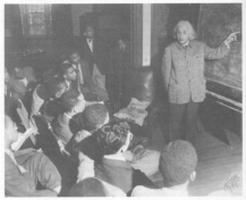
In 1946, the Nobel Prize-winning physicist traveled to Lincoln University in Pennsylvania, the alma mater of Langston Hughes and Thurgood Marshall and the first school in America to grant college degrees to blacks. At Lincoln, Einstein gave a speech in which he called racism “a disease of white people,” and added, “I do not intend to be quiet about it.” He also received an honorary degree and gave a lecture on relativity to Lincoln students.

The reason Einstein’s visit to Lincoln is not better known is that it was virtually ignored by the mainstream press, which regularly covered Einstein’s speeches and activities. (Only the black press gave extensive coverage to the event.) Nor is there mention of the Lincoln visit in any of the major Einstein biographies or archives.

In fact, many significant details are missing from the numerous studies of Einstein’s life and work, most of them having to do with Einstein’s opposition to racism and his relationships with African Americans.

That these omissions need to be recognized and corrected is the contention of Fred Jerome and Rodger Taylor, authors of “Einstein on Race and Racism” (Rutgers University Press, 2006). Jerome and Taylor spoke April 3 at an event sponsored by the W.E.B. Du Bois Institute for African and African American Research. The event also featured remarks by Sylvester James Gates Jr., the John S. Toll Professor of Physics, University of Maryland.

According to Jerome and Taylor, Einstein’s statements at Lincoln were by no means an isolated case. Einstein, who was Jewish, was sensitized to racism by the years of Nazi-inspired threats and harassment he suffered during his tenure at the University of Berlin. Einstein was in the United States when the Nazis came to power in 1933, and, fearful that a return to Germany would place him in mortal danger, he decided to stay, accepting a position at the recently founded Institute for Advanced Study in Princeton, N.J. He became an American citizen in 1940.

But while Einstein may have been grateful to have found a safe haven, his gratitude did not prevent him from criticizing the ethical shortcomings of his new home.

“Einstein realized that African Americans in Princeton were treated like Jews in Germany,” said Taylor. “The town was strictly segregated. There was no high school that blacks could go to until the 1940s.”

Gates, an African-American physicist who has appeared on the PBS show Nova, said that Einstein had been a hero of his since he learned about the theory of relativity as a teenager, but that he was unaware of Einstein’s ideas on civil rights until fairly recently.

Einstein’s approach to problems in physics was to begin by asking very simple, almost childlike questions, such as, “What would the world look like if I could drive along a beam of light?” Gates said.

“He must have developed his ideas about race through a similar process. He was capable of asking the question, ‘What would my life be like if I were black?’”

Gates said that thinking about Einstein’s involvement with civil rights has prompted him to speculate on the value of affirmative action and the goal of diversity it seeks to bring about. There are many instances in which the presence of strength and resilience in a system can be attributed to diversity.

“In the natural world, for example, when a population is under the influence of a stressful environment, diversity ensures its survival,” Gates said.

On a cultural level, the global influence of American popular music might be attributed to the fact that it is an amalgam of musical traditions from Europe and Africa.

These examples have led him to conclude that “diversity actually matters, independent of the moral argument.” Gates said he believes “there is a science of diversity out there waiting for scholars to discover it.”

entire article

—It’s Tiff again.  I just have to comment about that last excerpt from Gates. That “under the influence of a stressful environment, diversity ensures survival” thing.  In this case the stressful environment is racially segregated America.  The mutually exclusive, dangerously juxtaposed, white vs. black America.  To ensure survival, diversity is required.  I’ll go out on a limb here and relate this to being mixed like me (after all, these are the mulatto diaries if I recall correctly.) To ensure the survival of America, we have to exist.  We are everywhere even though we’ve been largely silent and unrecognized in any genuine manner.  Yet things improve, and change happens as we wake up, and adapt, and we are different…and so is America.

The interaction between organism and environment is central in evolution. Extinction ensues when organisms fail to change and adapt to the constantly altering … stressful environmental changes as documented in the fossil record. Extreme environmental stress causes extinction but also leads to evolutionary change and the origination of new species adapted to new environments.”-Eviatar Nevo

Don’t become extinct!

joys, complicated

Joys should be simple.  Didn’t Pippin teach us that?  Sorry, my musical theatre nerd wanted to speak.  But anyway, joys should be simple not complicated.  While I’ve been away examining my life, living my life, changing my life I’ve noticed that I have a tendency to shy away from things that bring me joy.  I have a sneaking suspicion that it’s the experience of feeling that my joys are complicated that informs my reticence.  But the joys actually are not complicated.  Not to me.  Only from the outside looking in.  Only within the parameters of a paradigm in which black and white are mutually exclusive.  Only when clinging to a dogma that rigidly defines an “us” and a “them” and prescribes clearly definable attributes to each.  I’m gonna be a rebel here and doubt those antiquated notions.  That’s not new for me though.  Actually I’m going to be a rebel here just for myself and let go of my discomfort with the complexity others may still perceive in the things that bring me joy, in the things that are me, and I’m just gonna be and enjoy them.  That is new for me.  That is a challenge. But, hey, why not go ahead

As for this article, I love that Mr. McCollum’s mother mandated that his Irish pride run fierce.  I love that he takes pride in facilitating the paradigm shift.  I love that someone wrote this article.

St. Patrick’s Day holds mixed emotions for some

By Martine Powers

Ryan McCollum knows that on St. Patrick’s Day, he cuts an unusual figure.

All in green, a traditional Irish Claddagh ring on his finger and a houndstooth flat cap on his head, everything about his attire screams “Irish and proud.’’

But McCollum, 33, is also black. His father, a Navy man from Springfield, married an Irish-American girl from Downeast Maine.

He knows his appearance does not fit the bill of a stereotypical Irishman – most assume he’s black, or maybe Latino – but since childhood, his mother mandated that his Irish pride run fierce.

“Growing up, I knew I was Irish,’’ said McCollum, of Springfield, “even if the rest of the world didn’t know I was Irish.’’

As the American population has grown increasingly mixed-race in recent decades, some descendants of Irish immigrants are claiming a multiracial heritage, though they may differ in appearance from their red-haired, freckled ancestors. For them, the joys of embracing Irish roots are complicated by the challenges of being multiracial.

“I always feel this deep kinship with Irish people in Boston,’’ said Kelly Bates, a mixed-race Irish-American who lives in Roslindale. “But I don’t always feel like they have this kinship with me.’’

Between 2000 and 2010, the number of Americans who checked two or more races on the US Census increased from 6.8 million to 9 million.

Paul J. McNamara, president of the 275-year-old Charitable Irish Society, said he does not believe that any of the organization’s 400 current members are multiracial, but the group welcomes membership applications from anyone interested in promoting Irish history and culture.

“Most people in our group want to appreciate and retain their Irish roots,’’ McNamara said. “There is a strong element that you want to participate and preserve aspects of the culture.’’

But for Bates, it’s not quite so simple.

Her mother, a black woman from Harlem, married an Irish-American man from Massachusetts. Bates loves to visit her huge, boisterous Irish-Catholic family in Lynn. She grew up reading Irish poetry with her father. She calls him every March 17 to hear the legend of Saint Patrick and the snakes.

In a ritual that is all too familiar for many mixed-race people, new acquaintances try to guess Bates’s heritage. Usually, they pick Puerto Rican or Colombian. Maybe Middle Eastern or Italian.

But Irish? Never.

17mixedirish3[1].r

Kelly Bates, executive director at Access Strategies Fund, is also part Irish.

“You could look at my cousins and me, and you could see the resemblance,’’ said Bates, executive director of the philanthropic foundation Access Strategies Fund. “But they would be accepted [as Irish] right away, and it would be very different for me.’’

Part of that divide may come from Boston’s racially fraught past, she said.

“I’m aware of the fact that my cultural communities have not always been able to build a bridge toward each other, especially in this city,’’ said Bates.

While Irish and African-American communities worked and lived in close proximity in the decades after America’s founding – both groups were stigmatized by English landowners – they grew antagonistic toward one another at the end of the 19th century, said Marie E. Daly, library director at the New England Historic Genealogical Society. In the last century, the communities have butted heads over labor rights, housing, and public school desegregation.

Bates said she is just as proud to be African-American as she is proud to be Irish. After all, she said, the sound of bagpipes and African drums both give her chills. But she sometimes worries about expressing pride in her Irish roots. As much as Irish is a national origin, she said, it also identifies her as white. She does not want others to think she has distanced herself from her black identity.

“I think my black friends and black colleagues don’t know what to make of it when I talk about my Irish heritage,’’ Bates said.

Mari Tanaka, a junior at Harvard, knows that most people think they immediately have her pegged.

“I guess I look Asian, but I don’t feel comfortable with people just assuming that’s all I am,’’ said Tanaka, 21. “Growing up, being Irish has been such a big part of my life.’’

Most of Tanaka’s ancestors hailed from Japan, but her mother’s father is Irish-American. During her childhood in Hawaii, he ensured that she listened to traditional Irish music, watched “Riverdance,’’ and ate corned beef and cabbage on St. Patrick’s Day.

College has offered her an opportunity to further explore her Irish roots. She has connected with Irish-American relatives in Cambridge who show her genealogical charts and tell stories about her ancestors. While she felt pressure to take a class in East Asian Studies, Tanaka, a biology major, instead chose to enroll in a class on Celtic history and culture where she was one of two nonwhite people.

“I felt like, yeah, being Asian, that’s a part of me,’’ Tanaka said. “But there’s another part of me that is much less explored.’’

McCollum, a political consultant, hopes to travel to Ireland, and he knows he will arrive in the land of his ancestors and find that no one looks like him. But that doesn’t bother him.

A history buff, McCollum spends much of his time reading about Irish history and culture, learning about his family’s genealogy, and watching Irish sports.

“For people who are proud of being Irish and knowing their Irish roots, it’s almost like a game – like, ‘How Irish are you? What county are you from? How many times have you been? Is your family still there?’’’ said McCollum, who is board member for the Irish Immigration Center. “If I’m in a room with Irish folks and have to re-prove my Irishness, I can talk to them about facts and history of Ireland.’’

McCollum’s surname adds further confusion: People often assume it represents his Irish side, but it’s a Scottish name probably adopted by his father’s African slave ancestors from their owners.

His African-American heritage is just as important as his Irish roots, he said; his passion for history extends to antislavery politics and the Black Power movement. But because of his skin color, he has no trouble relating to other black people. Being Irish, he said, is a less obvious part of his identity.

“A lot of times, I am that reminder that every Irish person doesn’t look like a stereotypical Irish person,’’ McCollum said. “And I don’t mind being that reminder. Sometimes, I take pride in that.’’

wee bottles of leprechaun gold st. patrick's necklace 8

connect with strangers on a human level

or be kind… or (seeing as it’s easter and all) wwJd

regardless of the title, i thought it a touching story…

Thomas Hawk:“Every so often you take a photograph that has personal impact on your life.  This photo is one of those for me.
I took this photo on the Burnside Bridge in Portland.  The Burnside  Bridge is one of the areas of Portland where homeless people congregate.   There are a few homeless shelters there and lots of homeless people  hang out just underneath the bridge.  I was up shooting the bridge at  night and the “Made in Oregon” neon sign that can be seen from the bridge.
While I was shooting I was wearing headphones and listening to music  on my iPhone.  As I was walking across the bridge this man, this man, approached me saying something while I had my headphones  on.
In a moment that I am very ashamed of I did not remove my headphones.   Instead I said back to the man that I didn’t have any money.  I said  this to the man without having heard what he was asking me.  I could  tell from his expression that he was annoyed by my response.  At this  point I took my headphones off to hear what he was saying.
What the man said to me was that he didn’t want my money.  That he  was not asking me for money, that he was asking me if I would take his  photograph.  I was very embarrassed.  First off, I didn’t even have  enough respect for another human being to take my headphones off and  hear him out in the first place.  And secondly I’d jumped to a  conclusion that the man simply was trying to get me to give him money.  I  felt bad that I’d insulted this man.  And I felt ashamed of the way I’d  treated another human being.
After our interaction on the bridge I could not get my interaction with  this man out of my head for the next few days.  I was so ashamed at  myself for jumping to the conclusion that I had and for not removing my  headphones to speak with the man when he approached me.  This beautiful  man had approached me and wanted nothing more than to be photographed by  a stranger.  He was giving his image to me and I felt that I’d treated  him so badly.  I also felt bad that I didn’t even try to get his name or  an address or something afterwards to send him the photograph.  I had  been taken by surprise by the interaction and was flustered and had  acted poorly and thoughtlessly.
This interaction made me decide to try and make a greater effort in the future to connect with strangers on a human level.”
complete story here

Thomas Hawk:

“Every so often you take a photograph that has personal impact on your life. This photo is one of those for me.

I took this photo on the Burnside Bridge in Portland. The Burnside Bridge is one of the areas of Portland where homeless people congregate. There are a few homeless shelters there and lots of homeless people hang out just underneath the bridge. I was up shooting the bridge at night and the “Made in Oregon” neon sign that can be seen from the bridge.

While I was shooting I was wearing headphones and listening to music on my iPhone. As I was walking across the bridge this man, this man, approached me saying something while I had my headphones on.

In a moment that I am very ashamed of I did not remove my headphones. Instead I said back to the man that I didn’t have any money. I said this to the man without having heard what he was asking me. I could tell from his expression that he was annoyed by my response. At this point I took my headphones off to hear what he was saying.

What the man said to me was that he didn’t want my money. That he was not asking me for money, that he was asking me if I would take his photograph. I was very embarrassed. First off, I didn’t even have enough respect for another human being to take my headphones off and hear him out in the first place. And secondly I’d jumped to a conclusion that the man simply was trying to get me to give him money. I felt bad that I’d insulted this man. And I felt ashamed of the way I’d treated another human being.

After our interaction on the bridge I could not get my interaction with this man out of my head for the next few days. I was so ashamed at myself for jumping to the conclusion that I had and for not removing my headphones to speak with the man when he approached me. This beautiful man had approached me and wanted nothing more than to be photographed by a stranger. He was giving his image to me and I felt that I’d treated him so badly. I also felt bad that I didn’t even try to get his name or an address or something afterwards to send him the photograph. I had been taken by surprise by the interaction and was flustered and had acted poorly and thoughtlessly.

This interaction made me decide to try and make a greater effort in the future to connect with strangers on a human level.”

complete story here

VIA