

Never heard of her, but my interest has been piqued. Cool name. Cool hair. The hair story she relays at the end calls to mind the biracial girl who was removed from her classroom. You can read the interview in it’s entirety HERE and/or check out her website HERE.
Chastity Brown releases High Noon Teeth
Soul singer straddles multiple genres
CP: Your prior album, Sankofa, was almost entirely made up of personal confessionals, whileHigh Noon Teeth incorporates more narrative storytelling and poetic metaphor. Why the shift in tone?
Brown: Some of the songs on Sankofa I hope to never sing again because they’re just so personal. That whole album was a reckoning of sorts that I felt like I had to go through to get to where I am now with my music. I was definitely writing much more imaginative songs this time around, rather than just about my personal experiences, and that was new for me. I talked about metaphors in songwriting a lot with Alexei [Casselle of Roma di Luna] and Joe [Horton, a.k.a. Eric Blair of No Bird Sing] while I was writing the album because that was all new terrain for me, and they both write songs just swarming with beautiful images. I don’t feel the need to be as blatant as I used to. This record was really all about pushing outside of my normal comfort zone and trying to take things to the next level creatively. Hopefully fans that have followed me for a while will appreciate that things are changing.
CP: One holdover from Sankofa is the presence of a song about your childhood, growing up biracial in small-town Tennessee (on Sankofa it was called “Bluegrassy Tune”; it’s present onHigh Noon Teeth in a new arrangement titled “Bound to Happen”). It’s an unflinchingly intense narrative (“Well my daddy was a black man and my mom blond hair, blue eyed/You know people would stare at us children/Like we were some suspicious kind”). What led you to feature it again this time around?
Brown: I decided to record that song the very last day I was in the studio for Sankofa when it was still super new. As I was playing it with the band, it rearranged itself and fine-tuned itself so I wanted to present it again. It’s an important song to me. At least once a week probably I still encounter some stupid racial situation. People ask me all the time if my hair is real, and I was at a show where a woman actually grabbed my hair and jerked it out of nowhere. It caught me so off guard and I remember going home and crying and being so angry. I felt conflicted, part of me wanted to educate her and part of me wanted to smack her and say, “How dare you touch me!” So the song is sort of my way of reaching out and taking the educational route and saying this is who I am and what my experiences have been. Depictions of mixed-race people are very popular in the media now and it’s a little strange for me because I’ve always looked this way. Growing up I was constantly made fun of for my hair; apparently now it’s a cool look.







 Large, jovial Grover Cleveland – also known as “Uncle Jumbo” – enjoyed his beer. In 1870 (15 years before he became president), Grover ran for district attorney of Erie County, New York, against Lyman K. Bass. It was a friendly contest. In fact, it was so friendly that Cleveland and his opponent drank and chatted together daily. In the interest of moderation, they agreed to have no more than four glasses of beer per day. But soon they exceeded that and started “borrowing” glasses from the next day and the next day until they’d exhausted their ration for the whole campaign – with the election still weeks away. The solution: Each brought his own giant tankard to the tavern, called it a “glass,” and went back to the four-a-day ration.
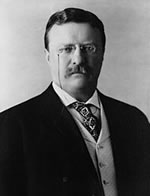 The standard scoop on Teddy Roosevelt was that he was a scrawny, sickly weakling from New York City who built himself up into a rough, tough cowboy type through vigorous outdoor pursuits. What’s seldom mentioned is that Roosevelt went from skinny boy to robust young man to plump (though vigorous) president to obese (though still active) ex-president. While running on the Bull Moose Party ticket in a 1912 attempt to regain the White House, Roosevelt was described as “an eager and valiant trencherman” (it meant he ate a lot). If the main course was roast chicken, TR would consume an entire bird himself, in addition to the rest of the meal. Not to mention the four glasses of whole milk the portly prez routinely threw back with dinner. Photos and films show an aging Roosevelt carrying a decidedly wide load.
 William Howard Taft often dieted because his doctor and his wife told the 290-pound president that he must. But without supervision, Will “the Thrill” didn’t just give in to temptation, he sought it. Once while traveling he asked a railroad conductor for a late-night snack. When the conductor said there was no dining car, Taft angrily called for his secretary, Charles D. Norton, who had probably – under instruction from Mrs. Taft – arranged for the diner to be unhooked. Norton reminded the president that his doctor discouraged between-meal eating. Taft would have none of it. He ordered a stocked dining car attached at the next stop and specified that it have filet mignon. “What’s the use of being president,” he said to Norton, “if you can’t have a train with a diner on it?”
 President Bill Clinton, who famously frequented McDonald’s, was known for eating whatever was put in front of him. He showed a more discriminating, if just as hungry, side in the company of Germany’s chancellor Helmut Kohl, though. Kohl was called “Colossus,” at least in part because he carried 350 pounds on his 6-foot-4 frame. But, in Kohl, Clinton found a gourmand soul mate. In 1994, Clinton hosted the chancellor at Filomena Ristorante of Georgetown for a lunch at which both consumed mass quantities of ravioli, calamari, and red wine, as well as plenty of antipasto, buttered breadsticks, Tuscan white bean soup, salad, and sweet zabaglione with berries. Each ended the meal by ordering a large piece of chocolate cake to go. Clinton once remarked that he and his German counterpart, though the largest of world leaders, were still too slim to be sumo wrestlers.




 mulatto diaries