Reply


In light of the last few posts over here which have left me a bit disheartened, I thought I’d post something more uplifting. Yet, it’s still kind of sad as well as beautiful. At any rate… Yay, Don Ritchie!
Max Read —

Don Ritchie lives across the street from the most famous suicide spot in Australia: A cliff known as “The Gap.” Most people would move, but Ritchie’s stayed for almost 50 years—saving an estimated 160 people from suicide.
So what’s his big secret? Ritchie wakes up every morning and looks out the window for “anyone standing alone too close to the precipice.” If he sees someone who looks like they might be contemplating a jump, he walks over and… strikes up a conversation.
He just gives them a warm smile, asks if they’d like to talk and invites them back to his house for tea. Sometimes, they join him.
“I’m offering them an alternative, really,” Ritchie says. “I always act in a friendly manner. I smile.”
Ritchie’s house might be the worst real estate ever. One person a week commits suicide at the “the Gap,” the cliff he lives across from. It’s protected only by a small, one-meter fence, despite its legendary reputation as a suicide spot dating back to the 1800s.
But the former life insurance salesman says he doesn’t feel “burdened” by the fact that people are always contemplating jumping to their deaths outside his house. In fact, he and his wife Moya see it as a blessing: “I think, ‘Isn’t it wonderful that we live here and we can help people?'”
Obviously, he’s not always successful, and, at times, he’s had to physically restrain people from jumping while Moya calls the police. But it isn’t necessarily traumatic:
Despite all he has seen, he says he is not haunted by the ones who were lost. He cannot remember the first suicide he witnessed, and none have plagued his nightmares. He says he does his best with each person, and if he loses one, he accepts that there was nothing more he could have done.
Ritchie, who basically sounds like the nicest guy in the entire world, is 84, and has spent much of the last year battling cancer. But, as you might expect for a dude who’s managed to live across from a… tragic place, and not become a casualty himself, he’s optimistic: “I imagine somebody else will come along and do what I’ve been doing.” I hope so.

The picture is super-cute. It’s totally o.k. One could come up with adorable captions. However, half of the “cleverly cavalier commenters” offered up offensive ones. It almost pains me to say that I assume (which we all know is a stupid thing to do… ass-u-me) that these smart a**es are privileged white kids tooling around on their macbook pros feeling quite awesome and funny while totally oblivious to… well, i don’t know exactly what… to everything?

That’s actually a pretty culturally-artistic picture.
yo dawg, we got those flintstones. Orange $5, Purple $10, Red $15.
no i didnt enslave your great grandparents! no i wont give you my back pack.. stop blaming me for everything i wasnt around for!!!
Can you take this bag through customs for me girls? Dont worry theres nothing illegal in it.
Watching ‘The Wire’ makes this picture funnier, to me.
Were you made at night?
adorable!
When I first read this article yesterday, I came to the conclusion that it was all in good fun and why take everything so seriously… Then I watched Oprah’s Oprah Presents Master Class on OWN last night and she spoke about her little six year old self being made to sleep on the porch because she was the unfavored dark skinned child of the house. I wanted to cry. Oprah did. I felt guilty that I have light skin. I wanted to inflict harm on the light-skinned woman who inflicted this harm on my Oprah. (I’m back on the Oprah kool-aid, btw. Loving the Oprah Winfrey Network. LOVING. IT.) Anywho, after I grounded myself in the reality that Ms. Winfrey’s just fine now, I thought about this article, this game, and I changed my mind back to “I don’t like it.” I think. I’m not sure. It’s still a major issue. Maybe making fun of it is the way to take the charge out of it. Maybe not.

by Adrienne Samuels Gibbs, Senior Editor
SOMEWHERE IN THE GULF OF MEXICO ON MONDAY AFTERNOON-
Yes, you read that headline right: Light skin vs. dark skin dodge ball. Of course it helps that the spirits were flowing for hours before the color-charged dodgeball tourney commenced on the top deck of the cruise ship.
Beneath the clear blue skies and in between tremendous gusts of wind, Kid N’ Play were the live sports commentators, selected because they’re fun and also because they represent both sides of the skin spectrum. Both took turns at the mic to recruit, commentate and poke fun at those who dared take to the greens during the second day of the Tom Joyner Morning Show’s Fantastic Voyage.
Many onlookers went out of curiosity. Some went as a form of anger management
therapy. In the end though, it was good colorful fun. Team Light Skin recruited
a few White people and a Portuguese lady. Team Dark Skin wound up with lots of
brown skins and one light skin who said she wanted to be affiliated with her
darker brothers.

Kid, who rooted for team light skin but told EBONY he still loves a dark sista,
took to the mic between games and started singing odes to Pebbles and
Christopher Williams – classic singers who some felt best represented Team
Light. Play, on the other hand, yelled “Nino Brown wins!” when Team Dark threw a
final ball that clinched the tourney.
Off on the sidelines, the spectators got rowdy. Each side began chanting. Then
the guys started taking off their shirts. As for the women? They sat down to
watch the light and dark men go at it with each other. Things got rough as one
ball hit a light guy, richocheted, flew over the edge of the ship and floated
away. Then a dark guy hurt his ankle. Comedian Damon Williams entered the fray,
ready to add some points to Team Dark’s score.

To be sure, many onlookers shook their heads, not sure what to make of such a
tourney. The Black community has a long history with light-dark issues, most of
which stem from post slavery trauma. The commentators didn’t get into all that,
instead leading the group to poke fun at what is often a deadly serious topic.
Who won? Who knows. It all ended with fun and jokes and hugs.

i think this is just wrong… so wrong! come on guinness! i really don’t have anything else to say about it… except that i would love to have the opportunity to talk with mrs. lanier about all that she’s witnessed.

Mrs Rebecca Lanier never had birth certificate, required by Guinness World Records, as she was a black girl born to slave parents
By MARK DUELL
This ‘great-great-great-great grandmother’ claims to have lived through three centuries and her family believe she could be the oldest person in the world.
But Rebecca Lanier, 119, whose secret to long life is to ‘keep on living’, will not be recognised by Guinness World Records because she has no birth certificate.
Mrs Lanier, of Warrensville Heights, Ohio, who was born in March 1892, has seventh-generation grandchildren and outlived her husband and their two daughters.
She was born in a small Mississippi community to parents who had been slaves, at a time when many laws were prejudiced against black people in the South.
Because Mrs Lanier is black she was born with no birth certificate in the 1890s, which was normal in the South even though slavery had ended almost thirty years earlier.
This has caused problems as the Guinness Book of World Records needs that certificate to verify her age, which would make her the oldest living person in the world.
‘It’s quite a rigorous process that you go through because the birth certificate is a crucial matter,’ a Guinness World Records spokesman told MailOnline.
Mrs Lanier does however have a letter from the Social Security Administration that states the year of her birth as 1892, her grandson, Jimmie Shambley, 61, said.
But a Social Security spokesman told MailOnline they do not give verification of age and the burden of evidence is on claimants, who must provide official documents.
These can include birth certificates, citizenship certificates or permanent residence cards, with individuals receiving benefits getting an annual letter with their details on.
She spends her time doing the Chinese martial art tai chi every day and does not need to take any medication for illnesses or ailments.
Mrs Lanier, who now lives with Jimmie Shambley and his family, says she is ‘doing alright’ and had her 119th birthday at Warrensville Heights Senior Center on Tuesday.
When asked ‘How old are you today momma?’ by her great grandson Christopher Shambley, she replied: ‘Don’t worry about how old I am’.

Mrs Lanier uses a ‘walker’ to balance herself as she moves, but often travels with the family on aeroplanes to various events around the country, they said.
‘She had two daughters. My mother had seven kids,’ Jimmie Shambley told Fox 4.
‘She has 15 great-great grand kids, 18 great-great-great grand kids and has two great-great-great-great grand kids.’
During her life Mrs Lanier has witnessed more than 20 presidents and lived through major events such as two world wars, the birth of flying and the right for women to vote.
‘She’s amazing – she’s just amazing to know,’ one family friend told Fox 4. ‘By her being 119, my friends and I – we range from 60 to 75 – we’re just youngsters.’
The claims come after Georgia great-great grandmother Besse Cooper was visited by Guinness World Records this month to certify her as the world’s oldest living person. Surrounded by family, 114-year-old Cooper accepted a plaque during a small ceremony at a Monroe nursing home.

now this is the kind of exhibit i’d pay to see! i would like to take this time to say “told ya so.” not that anyone’s really argued against this point with me. i’m just sayin’… it doesn’t exist… and yet it dictates life chances and prevents us from being open to what exists and really matters in ourselves and each other.

By Chris Bergeron/DAILY NEWS STAFF
BOSTON —An African, an Asian and a North American viewing the new exhibit “Race” at the Museum of Science might be surprised to discover they have more in common than individuals of any other species on Earth.
They would learn their variously colored complexions derive from how their skin processes folate and vitamin D. The African would find he’s susceptible to sickle cell anemia, not because of his race but because of the prevalence of malaria in his homeland.
And all three might be troubled to learn world-famous psychologist Arthur Jensen has written that differences in their intelligence can be attributed to their racial origins.
By the exhibit’s end, each might answer the question in its subtitle, “Are We So Different?” by saying, “No, not based on our genes.”
Combining scientific, anthropological and historical evidence, the exhibit argues the fundamental concept of race and racial differences has no biological basis but is a man-made distinction with immeasurable social consequences over the centuries.
Developed by the American Anthropological Association and Science Museum of Minnesota, “Race” invites visitors to examine race and racism through exhibits, interactive stations and artifacts.

Museum President and Director Ioannis Miaoulis said it’s the first exhibit to examine race and human variations using the most up-to-date genetic discoveries.
“This exhibit can be inspiring, revealing and even life-changing,” he said opening the show last Thursday.
Chioma Nnaji, research coordinator of the UMass Horizon Center in Boston, praised the exhibit for explaining how a broad misunderstanding of race “complicated” relations between people by emphasizing superficial differences over shared interests.
Citing cutting-edge genetic research, the exhibit states, “Race is a recent human invention.”
Nina Catubig Nolan, chairwoman of the museum’s Race education team, said, “The idea of race doesn’t have a basis in biology. Humans from around the world share 99.5 percent of their genes. That’s more than chimpanzees or fruit flies,” she said.
Flawed science results in social injustice.
The failure to recognize our common genetic heritage is demonstrated by a photo that shows how the U.S. Census labeled people based on mistaken ideas of pigmentation and appearance.
From 1850 to 2000, a mixed-race woman would have been variously described as “mulatto,” “Negro” or, recently, “White and African American.” From 1930 to 1990, a woman from Tijuana who moved to Texas would have been labeled “Mexican,” “white” and “Hispanic white.” Over the course of the 20th century, Inuit women have been called “Indians,” “Eskimos” and in 2000 “Alaska natives.”
Wall text by that photo states: “The idea of race is tied to power and hierarchy among people. The legacy of race continues to shape the lives and relationships of people in the U.S. and around the world.”
Paul Fontaine, vice-president of education at the Museum of Science, said “Race” provides “a perfect opportunity to look at a sociological issue through a scientific lens.”
Museum official sought to open the exhibit just before Martin Luther King Jr. Day and over the following months to encourage discussion about a timely issue and provide an opportunity to present related events and activities, he said.
“When we first saw ‘Race,’ we loved the way it was presented. It was powerful and emotional and based on current genetic research. From this exhibit, visitors will learn race is an artificial construct. Yet it has been the basis for categorizing people and all the negative reactions that have followed from that,” said Fontaine.
“Race” includes fascinating, even a few disturbing, artifacts.
A “hair color table” that measured the spectrum of hair color from Aryan blonde to less desirable shades was used by Nazis to provide a scientific basis for the practice of “racial hygiene” that legitimized the deaths of millions of “non-Aryan” Jews, gypsies and Slavs.
Closer to home, visitors can see a placard for a “Colored Waiting Room” and a sign announcing “We want white tenants for our white community.”
And debunking a television crime show staple, the exhibit uses photos and expert testimony to show forensic pathologists can not definitively determine a victim’s race from their bones and teeth with the regularity or ease of investigators on “CSI Miami.”
Unlike many Museum of Science exhibits, “Race” devotes more than half its gallery space to establishing a historical and social context for its premise that humans have misused the idea as a tool to discriminate rather than seek common ground.
The most effective parts of the exhibit help visitors understand the genetic science that provides the exhibit’s foundation. By twisting a dial, visitors can direct human migration from 100,000 B.C. to 40,000 B.C. across a world map.
At the exhibit’s opening, musician and sound artist Halsey Burgund previewed a segment of his audio installation, “Voices Without Faces, Voices Without Race,” which consists of snippets of conversation from more than 250 people discussing race.
Commissioned by the museum, he recorded people along Rte. 128 responding to three questions: When did you first become aware of race? When were you first privileged by or discriminated against because of race? And, What is your experience of race in Boston? The audio installation will open Feb. 3.
Khaalie Parham, a 15-year-old sophomore at Community Charter School in Cambridge, said people react differently to him depending on whether he’s in his predominantly white hometown of Belmont or among his peers.
“Race has a huge significance in my life. If I’m in Belmont, people look at me differently or cross to the other side of the street than I’m walking on,” he said. “In my school, race isn’t much of a factor. But if people look past differences and what other people say and follow their own mind, then race stops dividing people.”
THE ESSENTIALS:
WHAT: “Race: Are We So Different?”
WHERE: Museum of Science, Science Park, Boston
WHEN: Through May 15
ADMISSION: $21 for adults, $19 for seniors (60+) and $18 for children (3-11)
INFO: 617-723-2500, TTY 617-589-0417, www.mos.org.
Visit the American Anthropological Association’s Race Project at www.understandingrace.org
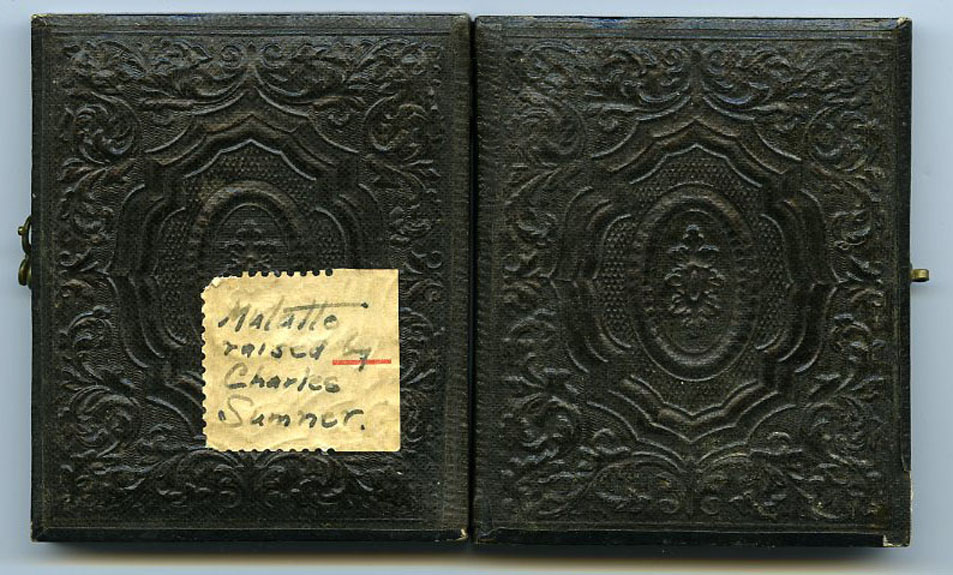
in my search for vintage images of mulatto folks i recently stumbled upon a gem!! Joan P. Gage is a journalist and a collector of photographs. on her blog A Rolling Crone she shares one of her collectibles and the fascinating (and still unfolding) story behind it. i feel all kinds of ways about this piece of our history (and by “our” i do mean mulatto, i do mean american, i do mean human seeing as everything is everything and all.) anyway, i feel sad for the little girl. i feel pride for the little girl. i feel a sense of satisfaction that i can point to this child and to the efforts charles sumner as evidence that, even way back when, a white man and a white-looking black child attempted to change people’s minds (way back)when it would have been much easier (not to mention safer!) to relish in the societal refuge that their phenotype offered. i am not implying that the attempt was perfect, nor that there is nothing offensive or off-color about the sentiment behind the message. but, if you consider the general consensus of the times on this matter, i think it safe to view sumner’s cause as a benevolent one. i wonder how little mary felt. i wonder if she understood. i wonder what her parents looked like. and her siblings. i assume there’s a reason that they were not photographed or ‘exhibited’ together. and i wonder how they felt about that, about all of it. and what became of all of them…
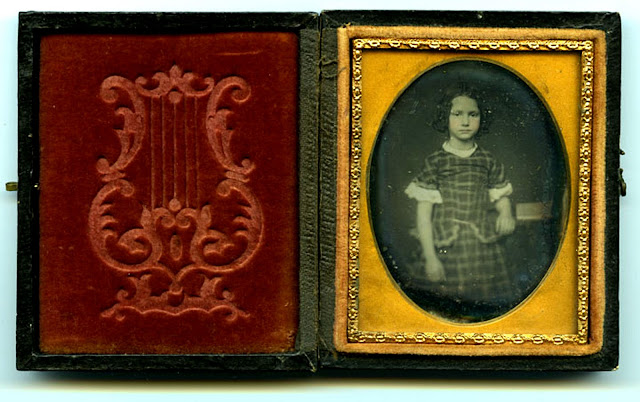
From “Raising Freedom’s Child—Black Children and Visions of the Future after Slavery,” written by a University of New Orleans professor, Mary Niall Mitchell:
 “Topsy”
 From joanpgage, the blogger (and current owner of the daguerrotype) from which I am re-blogging this piece:
…Prof. Mitchell is currently working on a book about Mary Botts that will tell more about this former slave’s life, including the drama of how Sumner purchased her and spirited her out of Virginia, how he introduced her to the media and society as a living advocate for the abolitionist cause, and how her family settled in the free black community in Boston.
 mulatto diaries