stono

I wasn’t familiar with the Stono Rebellion before yesterday.  Nat Turner, yes.  Stono, no.  So I “looked” it up.  Here’s what BlackPast.org had to offer…

Stono Rebellion (1739)

On Sunday, September 9th, 1739 the British colony of South Carolina was shaken by a slave uprising that culminated with the death of sixty people. Led by an Angolan named Jemmy, a band of twenty slaves organized a rebellion on the banks of the Stono River. After breaking into Hutchinson’s store the band, now armed with guns, called for their liberty.  As they marched, overseers were killed and reluctant slaves were forced to join the company. The band reached the Edisto River where white colonists descended upon them, killing most of the rebels.  The survivors were sold off to the West Indies.
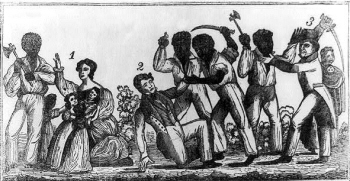

The immediate factors that sparked the uprising remain in doubt. A malaria epidemic in Charlestown, which caused general confusion throughout Carolina, may have influenced the timing of the Rebellion.  The recent (August 1739) passage of the Security Act by the South Carolina Colonial Assembly may also have played a role. The act required all white men to carry firearms to church on Sunday. Thus the enslaved leaders of the rebellion knew their best chance for success would be during the time of the church services when armed white males were away from the plantations.

After the Stono Rebellion South Carolina authorities moved to reduce provocations for rebellion.  Masters, for example, were penalized for imposing excessive work or brutal punishments of slaves and a school was started so that slaves could learn Christian doctrine.  In a colony that already had more blacks than whites, the Assembly also imposed a prohibitive duty on the importation of new slaves from Africa and the West Indies.  Authorities also tightened control over the enslaved.  The Assembly enacted a new law requiring a ratio of one white for every ten blacks on any plantation and passed the Negro Act of 1740 which prohibited enslaved people from growing their own food, assembling in groups, earning money they, rather than their owners, could retain or learning to read.

SOURCE

I read a few more accounts of the Rebellion.  While most of the websites relayed the story in identical fashion, I was slightly disturbed by this one that I found on teachingushistory.org.  I think this 4th grade textbook account is clearly biased in favor of the “white families.”  It’s almost subtle, but not really.  No other recounting mentioned drunk (on stolen goods) slaves, nor started the tale with “while the white families were in church.”   I can imagine my 4th grade self wanting to disappear during this lesson…


The Stono Rebellion occurred during the early morning hours of Sunday, September 9, 1739.  While white families were in church, a slave called Jemmy led a group of about 20 slaves who broke into a store, killed the store owner, and armed themselves with a supply of guns and ammunition.  From there the slaves moved southward from one plantation to another slaughtering whites and burning houses as they went.  Men, women, and children were killed.  Some were beheaded and their heads were left for display.  At one tavern, the insurgents spared the life of the innkeeper because he was known to be good to his slaves. At another, a slave hid his master and distracted the insurgents. (Smith 18)  As the slaves moved southward more slaves from the plantations joined the rebel force, which continued in military fashion displaying a flag and beating a drum.

Lt. Gov. William Bull, who was traveling on horseback with four companions, happened upon the rebels about eleven o’clock in the morning.  Bull and his companions quickly fled for their own safety.  They alerted the militia and local planters, who then organized men to pursue the insurgents. At about four o’clock in the afternoon they came upon the group of slaves about ten miles to the south.  Some slaves were resting.  Others were drunk on whiskey they had stolen in the raid.  The slaves fought hard, but the militia won the fight and ended the Stono Rebellion killing many of the slaves.  Slaves who escaped the scene were tracked down for months, and most were apprehended.   Those responsible for the revolt were executed.  One slave, July, who had saved the lives of his owner and the owner’s family was given his freedom.  Forty-four blacks and twenty-one whites lost their lives as a result of the Stono Rebellion.
SOURCE


blacks were ashamed, whites felt guilty

I would love to take this tour.  So many fascinating (albeit horrifying) pieces of our nation’s history are highlighted.  Underground railroad, black slave owners, paved over cemeteries, middle passage “reception,” color hierarchy.  I’m elated by the notion of forsaking shame and guilt in favor of honest discussion to ensure that this never happens again.  I’d like to think that “it” happening again is an impossibility, and that now our ultimate goal is to get rid of the vestiges of slavery.  Clearly we’re making progress.

Taking a Gullah tour of Charleston

BY SARAH STAPLES

The biggest hint that Charleston is a very different breed of Southern Belle — and that I’m on no ordinary city tour — comes as our air-conditioned mini-bus reaches the mainly African-American east side, a warren of economically deprived streets framing what was once an important stop on the Underground Railroad.

I look up to see a most unusual Star Spangled Banner flying bold African colors of red, black and green from a worn-looking flagpole. It’s an expression of indomitable Gullah pride, explains tour guide Alphonso Brown.

Like many living in the east side, Brown himself is Gullah: a descendant of slaves who endured the brutal “middle passage” from West Africa and the Caribbean during the 18th century, landing at Charleston’s bustling port before being sent to toil on plantations across the South.

Brown’s popular Gullah Tour, which marks its 25th anniversary this year, brims with atypical landmarks like this flag, as it excavates vestiges of an uglier time hidden amid the exquisite cobblestone streets and pastel-painted Georgian home fronts.

A multi-million-dollar waterfront estate, for example, looks impressive — until it is revealed to have been built by a rich slave ship proprietor who added slave quarters and a threatening-looking spiked gate to pen in human chattel. Later, we stop and stretch our legs in a parking lot owned by a Catholic church. It turns out to conceal the paved-over graves of freed slaves, for it was once their cemetery.

And the bus rolls on.

It’s potentially uncomfortable subject matter for his mixed-race audience, but Brown manages to keep the atmosphere light, sprinkling his commentary with anecdotes and jokes, and slipping in and out of the sing-songy Creole of his forefathers. “I-eh hab disshuh dreem,” he recites in Gullah. “We hol’ dees trut’ fuh be sef-ebbuhdent, dat all man duh mek equal.”

Plumped with West-African and Elizabethan English influences, Gullah was initially spoken in secret and spread wherever slaves were taken, along the coast and barrier islands as far as Georgia, and down to around Jacksonville, Fla.

SULLIVAN’S ISLAND


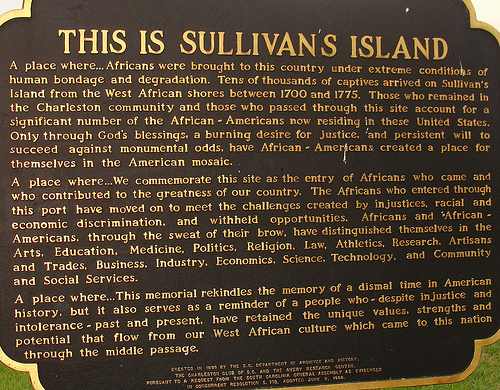
Sullivan’s Island, opposite Charleston, became the macabre version of Ellis: a processing station where newly arrived slaves were kept in preventive isolation before their auction at The Old Slave Mart downtown, which today is a museum.

When the Civil War ended, emancipated blacks stayed on the barrier islands, renting rooms from former masters or squatting on abandoned plantations. In their isolation — bridges were few — they incubated the distinctive Gullah body of traditions for cooking, planting, fishing, praying and burying that are subtly evident throughout Charleston and the Lowcountry today.

Front porches in the city, we learn, often face southeast for shade, as per the African custom. Charlestonians were early, enthusiastic practitioners of root medicine and witchcraft. In literature, the tales of Brer Rabbit and Brer Fox derive from West African oral storytelling. And characteristic dishes, from spicy stone ground grits and shrimp to slippery-smooth okra gumbo, are Gullah to the core.

The inside of Brown’s mini-bus is ringed with pictures of inspiring Gullah throughout history and modern times. Among them is Clarence Thomas, second black appointee to the U.S. Supreme Court, and Philip Simmons, lauded by the Smithsonian Institution as a National Folk Treasure for his ornamental iron gates, which dress many of the city’s architectural landmarks.

CIVIC ACTIVISM

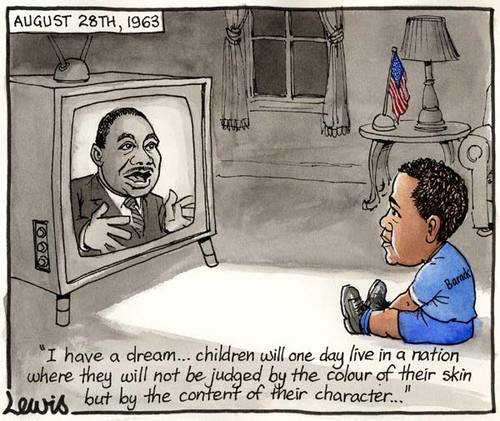
Politically, we learn, the Gullah have been determined organizers of abolitionist and Civil Rights movements. Dr. Martin Luther King, Jr. often retreated to St. Helena Island’s Penn Center — where one of America’s first schools for freed slaves was established — and may have begun drafting his 1963 I have a dream speech there.

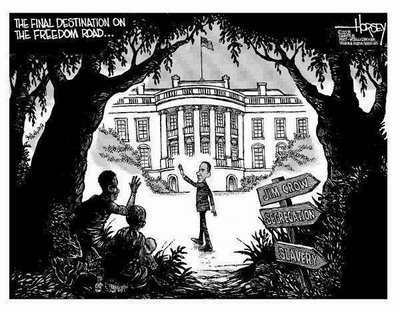
More recently, in the run-up to the last presidential election, the Gullahs’ organized support for Barack Obama helped him clinch the crucial South Carolina primary.

Brown, who grew up in nearby Rantowles — not far from the site of the failed Stono River Rebellion of 1739, in which runaway slaves killed 20 whites before they were themselves slain — is justifiably proud of his ancestors’ achievements and defiant will.

He doesn’t deliver history in monochrome. Brown’s choice of material portrays a complex view of race relations in Charleston, which even during slavery was never officially segregated. We’re told, for example, that one of the richest freed black families was the DeReefs, whose patriarch, Richard Edward DeReef, owned multiple businesses — and at least 16 slaves.

Color was such a delineator of social status that freed “octoroons,” who had one-eighth black blood, judged themselves superior to “quadroons” with one-quarter slave ancestry. They, in turn, held themselves above mulattos, the children of white fathers who were often referred to, in delicate conversation, as “friends.” The divisions were physically embodied in the city’s many integrated churches, where slaves worshipped from the balconies while freed blacks sat behind whites in the lower pews.

A SENSE OF PRIDE

Two hours speed by on this tour. Brown makes it clear that Gullah traditions thriving in secrecy and isolation for centuries have more recently become a source of civic pride. Efforts to preserve and celebrate the culture are being stepped up, he says. And events, such as the Gullah Festival in Beaufort each May, or the Penn Center Heritage Days Celebration every second weekend in November, draw ever-growing crowds.

“Slavery was always a taboo subject: blacks were ashamed and whites felt guilty,” says Chuma Nwokike, owner of Gallery Chuma, which hosts works depicting traditional activities like crabbing and sweetgrass basket-sewing. The gallery doubles as rendezvous point for Brown’s tour.

“Now, the younger generation wants to acknowledge what went on, so we’re better able to come together and say, ‘how can we make sure it never happens again?’ ”

SOURCE

grateful for the choice

I mailed my Census form yesterday.  I must say that after all the hype, I was totally underwhelmed by the experience.  I checked the two boxes.  I can’t say it brought me any great feelings of validation.  I guess I thought they’d be asking some questions that went beyond race.  I also thought that “Negro” would be the only African American classification term offered since there was so much buzz about the word being used in 2010.  At any rate, I enjoyed this article.

More than black or white

By Annette John-Hall

Inquirer Columnist

SOURCE

For Kathrin P. Ivanovic, racial identity means a whole lot more than just black or white.

Her makeup runs the gamut.

“My mother is German and my birth father is African American with Cuban ancestry,” says Ivanovic, 29, director of development at the Nationalities Service Center, a Philadelphia nonprofit that services immigrants and refugees.

“Plus, my adopted dad is white, and I’m queer. Unfortunately, they don’t have a box for that.

“. . . I call myself a mixed chick.”

But when her 2010 U.S. Census form arrives in the mail this week (the 10-question form is being touted as the shortest in census history), Ivanovic will be satisfied to check black and white – which is really how she sees herself anyway.

Since the 2000 census, for millions of Americans like Ivanovic, “check one or more” will apply.

There is plenty to choose from, with the number of racial and ethnic categories at 63. In the 1990 census, there were only five designations offered.

It can be dizzying. If you’re, say, Asian, you can check any combination of Asian American, Chinese, Japanese, Filipino, Korean, Vietnamese, Hawaiian, Guamanian, or Chamorro, Samoan, as well as write-in categories for Other Asian or Other Pacific Islander.

In addition, you can also note if you’re of Hispanic, Latino, or Spanish origin. That’s because since 1970, Hispanic was no longer recognized as an overarching classification.

Still with me? (And here I thought having Negro on the same line as the black or African American box was confusing.)

But I’m all for it, especially if it paints a more genuine picture of who we are – all 300 million of us. Doesn’t matter if only 2 percent of Americans were identified as more than one race in 2000. Nowadays, we’ve got more multiracial and multiethnic couples and children than ever before, which means the percentage is sure to increase this year.

Which in turn enables the government to allocate funds more equitably. Census data are used in everything from determining the number of congressmen your region gets to the assessing the amount of funding for your town’s bridge project to supporting health centers.

Race data also have driven the nation’s civil rights laws (how many people were denied the right to vote, how many were discriminated against in housing, for example) and are still used to monitor inequalities in health and education.

But it wasn’t always that way.

Truth is, the U.S. Census was historically more of an oppressor than an advocate, especially when it came to African Americans.

Racial count

From the time census data were first collected in 1790, when enumerators listed categories of free men and slaves, whites used the census to diminish African Americans.

“You can see why they had a slave category,” says MIT professor Melissa Nobles, author of Shades of Citizenship: Race and the Census in Modern Politics. “Southern slave owners wanted the least amount of information, thinking it would help abolitionists. And abolitionists wanted the most amount of information [to make their case].”

Throughout the 19th century and until 1930, census counters used categories such as quadroon (one-quarter black), octoroon (one-eighth black), and mulatto (half black) to describe any person who had a discernible amount of African American blood.

Like they could tell just from looking.

Even after 1930, Southern laws imposed the “one-drop rule” to its census enumerating, meaning they were to count as mulattos anyone who even looked remotely black – a mandate loosely applied by census counters nationwide.

“They used it for racial social science,” Nobles says. For example, they used census data to prove skewed theories (arguing, for instance, that biracial people – “the tragic mulatto” – were somehow weaker and suffered from higher death rates), which in turn helped legislators make the case against interracial marriage.

But even as the categories have expanded, some today are pushing for a separate, generic multiracial designation.

Ralina L. Joseph, a professor of communications at the University of Washington, worries that even though the data will show us as more diverse and multihued, they could be misinterpreted once again.

“I don’t want people to read the numbers and think that racism is over, that this is a post-racial moment,” says Joseph, who is biracial. “We should hope that people who are disenfranchised through race, class, and poverty levels should be identified as such.”

Some sociologists even insist that racial designations have no place on a census form, if it is indeed as simple as an objective count.

But in a multiracial, multiethnic society where even the president is a self-described “mutt,” Kathrin Ivanovic is grateful for the choice.

“I am mixed. It’s how I view the world, and in some ways it’s how the world views me,” she says. “To not be able to identify that way is dishonest to me personally.”

“The Census Taker” (1870) Harper’s Weekly

the black codes

Northern States had them, too.  I think these things are worth examining.  If we want to know more about why and how things got so out of hand in this country (I mean beyond slavery itself), we retrace our steps back to decrees such as these.

One measure of equality suggested by the British sociologist T.H. Marshall is “citizenship” – the “basic human equality associated with  . . . full membership of a community.”  African American history, from bondage through the civil rights movement, is often seen through the political lens as a struggle for citizenship and full membership in American society.

Legislated repression in post-slavery South

…[I]t shall not be lawful for any freedman, free Negro, or mulatto to
intermarry with any white person; nor for any white person to intermarry
with any freedman, free Negro, or mulatto; and any person who shall so
intermarry shall be deemed guilty of felony and, on conviction thereof,
shall be confined in the state penitentiary for life … — from
Mississippi Black Codes, enacted Nov. 22, 1865

As formerly enslaved Blacks would soon learn, freedom was not as they had
anticipated. White southerners were anxious to regain power over them and
used the law in order to achieve that objective. In 1865, southerners
created Black Codes, which served as a way to control and inhibit the
freedom of ex-slaves. Codes controlled almost all aspects of life and
prohibited Blacks from the freedoms that had been won.

Not only did whites want to control ex-slaves, but also they needed
laborers. While things could no longer be exactly the same as in slavery,
they found a way to guarantee that Blacks would serve as their laborers. To
do this, they created Black Codes. While Codes were unique to the
post-Civil War south, they encompassed some of the antebellum restrictions
on free blacks, northern apprenticeship laws, and the Freedmen’s Bureau and
the War Department regulations. Codes regulated civil and legal rights,
from marriage to the right to hold and sell property to the predestined
definition of Blacks as agricultural laborers.

Laws were different in each state but most embodied the same kinds of
restrictions. Commonly, codes compelled freedmen to work. In many states,
if unemployed, Blacks faced the potential of being arrested and charged
with vagrancy. Many of those that did work had their day regulated. Codes
dictated their hours of labor, duties, and the behavior assigned to them as
agricultural workers.

Black Codes left Blacks with little freedom. The choice of the type of work
was often regulated. Many white southerners believed Blacks were
predestined to work in agriculture. In addition, the advantage of
regulating occupations provided them with laborers. In South Carolina, for
example, a special license and certificate from a local judge, attesting to
a freedman’s skill, had to be obtained before a formerly enslaved person
could earn a living in agriculture or indomestic service.

Self-sufficiency was also discouraged. Codes prevented Blacks from raising
their own crops. In Mississippi, for instance, they were restricted from
renting or leasing any land outside of cities or towns and Black ownership
was left up to local authorities.

Almost every aspect of life was regulated, including the freedom to roam.
Often Blacks were prohibited from entering towns without permission. In
Opelousas, Louisiana Blacks needed permission from their employer to enter
the town. A note was required stating the nature and length of the visit.
Any Black found without a note after ten o’clock at night was subject to
imprisonment. Residency within towns and cities was also discouraged. Local
ordinances in Louisiana made it almost impossible for Blacks to live within
the towns or cities. Residency was only possible if a white employer agreed
to take responsibility for his employee’s conduct.

“This Week In Black History: Legislated repression in post-slavery South.” Michigan Citizen. 2001.

Black Codes in Georgia: 1865–1900

W. E. B. DuBois and his students included a comprehensive hand-written list of the Georgia Black Codes (laws affecting blacks 1865–1900) as part of The Georgia Negro exhibit in order to demonstrate how the law had specifically been used as a tool to discriminate against black people. Three hundred pages of legal material were tediously copied out by hand. DuBois had included a similar compilation of laws affecting the slave trade in his classic 1896 work, The Suppression of the African Slave Trade.

Black codes

Sample pages from DuBois’s list of Black Codes

SOURCE


gum springs

Gum Springs: A Slave’s Legacy

By Michael K. Bohn

This is an excerpt from a four-part series on the history and future of Gum Springs, a historically African-American community in the Mount Vernon area.

The founder of Gum Springs, a mixed race man named West Ford, began his life as a slave. His path to freedom started when his owner, George Washington’s younger brother, John Augustine, died in 1787.

West Ford, shown here in an 1858 drawing, founded the African-American community of Gum Springs in 1833. Fairfax County Public Library, Virginia Room.

John’s will left a third of his slaves to his wife Hannah, including a couple named Billy and Jenny, their daughter Venus, and her son West. Upon Hannah’s death in 1801, her will stipulated that young West be freed when he reached the age of 21. She also asked her heirs to inoculate West for small pox and bind him to a “good tradesman.”

Hannah’s son Bushrod assumed ownership of West, then 16 or 17. Also, Bushrod inherited Mount Vernon when Martha Washington died in 1802, and he moved there and took West with him. Following Hannah’s will, Bushrod freed West in about 1805. According to oral family history, West adopted the surname Ford upon gaining his freedom.

Ford remained at Mount Vernon, working as a wheelwright and carpenter. He could read and write, and ultimately became foreman of the house servants and a guardian of Washington’s tomb. In 1812, he married Priscilla Bell, a free black woman from Alexandria. Because of her status, their four children — William, Daniel, Jane and Julia — were also free.
Virginia required freed slaves to register, and the 1831 entry for West Ford described him as “a yellow man about forty-seven years of age, five feet eight and a half inches high, pleasant countenance, a wrinkle resembling a scar on the left cheek ….” Ford was a mulatto, a term of the time that was used to describe a person of one African and one European parent.

Bushrod Washington died in 1829. An associate justice of the U.S. Supreme Court for 30 years, Washington left West Ford 119 acres of land on the south side of Little Hunting Creek.

Ford sold his inherited land and used the proceeds in 1833 to purchase Samuel Collard’s Gum Spring Farm, a 214-acre tract on the north side of Little Hunting Creek. Collard sold the property to Ford for $500 and five annual installments of $84.80.

In 1857, Ford deeded his Gum Springs land to his four children, dividing the tract into equal parts of 52 3⁄4 acres. The property lines of those parcels coincide exactly with many of today’s lot lines, as well as the main north-south roads in Gum Springs — Holland, Andrus, and Fordson.


The present limits of Gum Springs correspond with the 214-acre parcel bought by West Ford in 1833.

By 1860, Ford and his daughter Jane’s husband, Porter Smith, were growing cash crops of corn, oats, and potatoes. The total tract was assessed at $1,800 in 1860, making West Ford the second-most wealthy freedman in Fairfax County.

Ford was near death in the summer of 1863 when staff members at Mount Vernon brought the weakened man back to the estate for his final days. He died on July 30 and The Alexandria Gazette marked his passing: “He was, we hear, in the 79th year of his age. He was well known to most of our older citizens.”

WEST FORD’S FATHER

“George Washington is my fifth great-grandfather,” Linda Allen Bryant declared on the CBS News TV show, “Sunday Morning” in February 2004. Her assertion, which she first made in 1996, created a stir on two fronts — historians regard George as childless, and Ms. Bryant is African-American.

Bryant, a descendent of Gum Springs founder West Ford, maintains that General Washington was Ford’s father. A health writer and pharmaceutical representative in Aurora, Colo., Bryant seemed to take advantage of the publicity surrounding the Thomas Jefferson-Sally Hemings revelations in 1998 to draw attention to her claim.

The issue of southern plantation masters having their way with female slaves has simmered for years, largely among historians. But the controversy boiled over into the larger public consciousness following disclosures of Jefferson’s relationship with Hemings. Mulatto slaves were a common sight on Virginia’s plantations in the 1700s. They were the product of what some men then considered sport, and the slaves viewed as a loathsome manifestation of their plight.

THE FORD FAMILY ARGUMENT

Linda Bryant has written that John Washington sent Venus to comfort his brother George as a “sleep partner” during a visit by George to his brother’s home. The two surviving portraits of Ford show a resemblance to Washington men, and Ford’s freedom and inheritance reflected special status. Bryant expands her version of the family’s allegations in her novel, “I Cannot Tell a Lie.” She called it a “narrative history,” but the dialogue she injects into the subject is all hers.

Knowing that DNA testing resolved the Hemings’s family claims, the Ford descendents have pressed Mount Vernon for hair samples from the General. The Ladies Association has refused the request.

THE LADIES ASSOCIATION’S POSITION

The Mount Vernon Ladies Association has adamantly denied that General Washington fathered West Ford. “The Ford family contention is based on a family tradition,” said Dennis Pogue, Mount Vernon’s associate director of preservation in 2000. “We respect that, but if this is true, there should be other evidence to support it.” Pogue’s polite approach took a sharper edge in 2004, when he said, “there’s not a shred of evidence” to support the Ford family allegation. In late 2009, Pogue again reiterated Mount Vernon’s position.

Linda Allen Bryant continues to press her case in the court of public opinion, but her views are creating less and less interest.

SOURCE

instead of being a white man (he) is a mulatto

Web Site Tells Forgotten Tales of Slavery

By Dan Nonte and Lanita Withers Goins, University Relations

GREENSBORO, N.C. The 1860 U.S. Census registered the names of slave owners and the age, gender and color of slaves. But there, as in much of the historical record, slaves are nameless.

UNCG’s new Digital Library on American Slavery provides the names of more than 83,000 individual slaves from 15 states and the District of Columbia.

The web site, created in cooperation with University Libraries, features petitions related to slavery collected during an 18-year project led by history professor Loren Schweninger. The petitions filed in county courts and state legislatures cover a wide range of legal issues, including wills, divorce proceedings, punishment of runaway slaves, calls for abolition, property disputes and more.

“It’s among the most specific and detailed databases and web sites dealing with slavery in the U.S. between the Revolutionary War and the Civil War,” said Schweninger, the Elizabeth Rosenthal Excellence Professor in History. “There’s no web site like this, either in extent or content. The amount of information in here to be mined is enormous.”

Started in 1991, the Race and Slavery Petitions Project collected, organized and published the petitions. The Digital Library on American Slavery is the final phase of the project.

A complete collection of the full petitions, “Race, Slavery, and Free Blacks: Petitions to Southern Legislatures and County Courts, 1775-1867,” has been published on 151 reels of microfilm. In addition to UNCG’s Jackson Library, North Carolina university libraries with all or part of the microfilm collection are located at Duke, East Carolina, N.C. A&T, UNC Chapel Hill and Wake Forest.

Schweninger knows the value of conducting research from primary sources, something he learned from his mentor, the late Dr. John Hope Franklin. The stories he found in legal records were often not preserved anywhere else. “This was info that was not tapped,” he said. “Very few scholars had gone to county courts.”

Building the database for the archive was painstaking work. Schweninger visited about 160 county courthouses in the South and 15 state archives between 1991 and 1995. “The first three years, I was on the road 540 days,” he said.

Marguerite Ross Howell, senior associate editor, worked on the project for 11 years and was responsible for entering tens of thousands of slave names and connecting them with their own family members as well as their owners, creating a unique resource from original documents. Nicole Mazgaj, associate editor, worked on the project for seven years and focused her analysis especially on the rich documentary evidence from parish court houses in Louisiana.

“The archive is chock-full of information detailing the personal life of slaves,” Mazgaj said. “It’s probably about the most detailed that you’ll find.”

…The library includes petitions by more than 2,500 slaves and free blacks who sought redress for numerous causes. For example, George Sears of Randolph County, a blacksmith and a free man of color, purchased his slave wife Tillah for $300. He then petitioned the North Carolina General Assembly in 1818 to emancipate his wife and daughters and “render them Competent in Law to inherit the Estate of your Petitioner.”

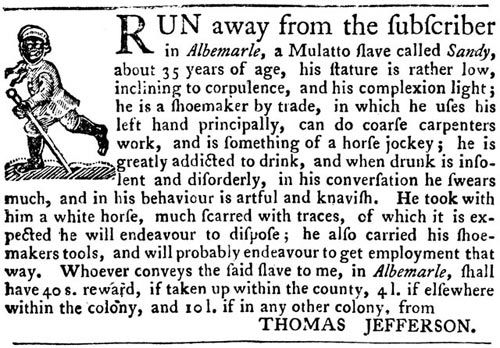
Other petitions show how race and slave status were sometimes in dispute. In one case, a Georgia slave owner sued one of his neighbors for slander for calling him a “damned negro,” averring that he was a black man. In another, a woman in Baltimore petitioned for divorce because her husband “instead of being a white man is a mulatto and in reality had been born a slave.” A New Orleans teenager who was put on the auction block to be sold as a slave asserted in her petition that she was in fact a free white woman.

A number of the petitions also speak to how slaves fought their enslavement, providing details of slaves who ran away, burned down plantations, or plotted to murder slave owners. As the petitions show, the position of free blacks in the South was also precarious, especially as certain states and counties sought to expel them or refused to allow them to enter.

Read more HERE

the first lady’s mix

New York Times

In First Lady’s Roots, a Complex Path From Slavery

Fraser Robinson III and his wife, Marian, with their children, Craig and Michelle, now the first lady.
By RACHEL L. SWARNS and JODI KANTOR Published: October 7, 2009

WASHINGTON — In 1850, the elderly master of a South Carolinaestate took pen in hand and painstakingly divided up his possessions. Among the spinning wheels, scythes, tablecloths and cattle that he bequeathed to his far-flung heirs was a 6-year-old slave girl valued soon afterward at $475.

In his will, she is described simply as the “negro girl Melvinia.” After his death, she was torn away from the people and places she knew and shipped to Georgia. While she was still a teenager, a white man would father her first-born son under circumstances lost in the passage of time.

In the annals of American slavery, this painful story would be utterly unremarkable, save for one reason: This union, consummated some two years before the Civil War, represents the origins of a family line that would extend from rural Georgia, to Birmingham, Ala., to Chicago and, finally, to the White House.

Melvinia Shields, the enslaved and illiterate young girl, and the unknown white man who impregnated her are the great-great-great-grandparents of Michelle Obama, the first lady.

Viewed by many as a powerful symbol of black advancement, Mrs. Obama grew up with only a vague sense of her ancestry, aides and relatives said. During the presidential campaign, the family learned about one paternal great-great-grandfather, a former slave from South Carolina, but the rest of Mrs. Obama’s roots were a mystery.

Now the more complete map of Mrs. Obama’s ancestors — including the slave mother, white father and their biracial son, Dolphus T. Shields — for the first time fully connects the first African-American first lady to the history of slavery, tracing their five-generation journey from bondage to a front-row seat to the presidency.

The findings — uncovered by Megan Smolenyak, a genealogist, and The New York Times — substantiate what Mrs. Obama has called longstanding family rumors about a white forebear.

While President Obama’s biracial background has drawn considerable attention, his wife’s pedigree, which includes American Indian strands, highlights the complicated history of racial intermingling, sometimes born of violence or coercion, that lingers in the bloodlines of many African-Americans. Mrs. Obama and her family declined to comment for this article, aides said, in part because of the personal nature of the subject.

frederick douglass on this day

On July 5th, 1852 Frederick Douglass was asked to give an Independence Day speech before the Rochester Ladies Anti-Slavery society in Rochester, NY at Cortinthian Hall.  Historian Philip S. Foner has called this excerpt “probably the most moving passage in all of Douglass’ speeches.”  You can find the entire speech here.

What, to the American slave, is your 4th of July? I answer; a day that reveals to him, more than all other days in the year, the gross injustice and cruelty to which he is the constant victim. To him, your celebration is a sham; your boasted liberty, an unholy license; your national greatness, swelling vanity; your sound of rejoicing are empty and heartless; your denunciation of tyrants brass fronted impudence; your shout of liberty and equality, hollow mockery; your prayers and hymns, your sermons and thanks-givings, with all your religious parade and solemnity, are to him, mere bombast, fraud, deception, impiety, and hypocrisy — a thin veil to cover up crimes which would disgrace a nation of savages. There is not a nation on the earth guilty of practices more shocking and bloody than are the people of the United States, at this very hour.

022

douglass_helen_eva_frederick

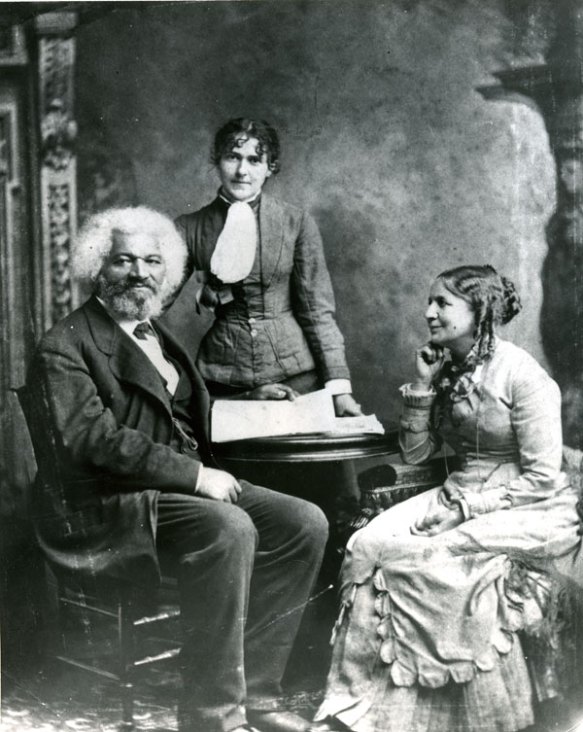
Douglass, his second wife Helen, and their niece Eva

douglass

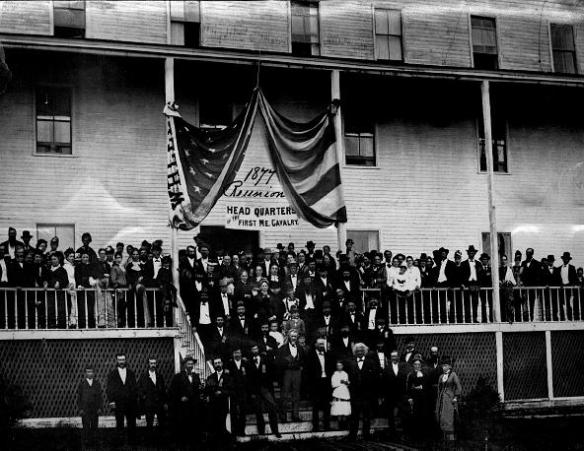
IN 1877, THE GREAT AFRICAN AMERICAN ORATOR AND WRITER FREDERICK DOUGLASS, WHO HAD SPENT MOST OF HIS LIFE FIGHTING FOR THE ABOLITION OF SLAVERY AND FOR THE RIGHTS OF ALL INDIVIDUALS, TRAVELLED THROUGH NEW ENGLAND ON A SPEAKING TOUR. HE WAS INVITED BY VETERANS OF THE FIRST MAINE CAVALRY, A FAMOUS CIVIL WAR UNIT, TO JOIN THEM AT THEIR ANNUAL REUNION IN OLD ORCHARD BEACH. DOUGLASS IS STANDING FOURTH FROM RIGHT IN THE FIRST ROW. HE NOTED THAT IT WAS A SIGN OF GREAT PROGRESS IN RACE RELATIONS THAT HE HAD ENJOYED “A GAME OF CROQUET WITH LADIES AND GENTLEMEN OF A DIFFERENT RACE RIGHT OUT IN FRONT OF THE HOTEL.” via