joys, complicated

Joys should be simple.  Didn’t Pippin teach us that?  Sorry, my musical theatre nerd wanted to speak.  But anyway, joys should be simple not complicated.  While I’ve been away examining my life, living my life, changing my life I’ve noticed that I have a tendency to shy away from things that bring me joy.  I have a sneaking suspicion that it’s the experience of feeling that my joys are complicated that informs my reticence.  But the joys actually are not complicated.  Not to me.  Only from the outside looking in.  Only within the parameters of a paradigm in which black and white are mutually exclusive.  Only when clinging to a dogma that rigidly defines an “us” and a “them” and prescribes clearly definable attributes to each.  I’m gonna be a rebel here and doubt those antiquated notions.  That’s not new for me though.  Actually I’m going to be a rebel here just for myself and let go of my discomfort with the complexity others may still perceive in the things that bring me joy, in the things that are me, and I’m just gonna be and enjoy them.  That is new for me.  That is a challenge. But, hey, why not go ahead

As for this article, I love that Mr. McCollum’s mother mandated that his Irish pride run fierce.  I love that he takes pride in facilitating the paradigm shift.  I love that someone wrote this article.

St. Patrick’s Day holds mixed emotions for some

By Martine Powers

Ryan McCollum knows that on St. Patrick’s Day, he cuts an unusual figure.

All in green, a traditional Irish Claddagh ring on his finger and a houndstooth flat cap on his head, everything about his attire screams “Irish and proud.’’

But McCollum, 33, is also black. His father, a Navy man from Springfield, married an Irish-American girl from Downeast Maine.

He knows his appearance does not fit the bill of a stereotypical Irishman – most assume he’s black, or maybe Latino – but since childhood, his mother mandated that his Irish pride run fierce.

“Growing up, I knew I was Irish,’’ said McCollum, of Springfield, “even if the rest of the world didn’t know I was Irish.’’

As the American population has grown increasingly mixed-race in recent decades, some descendants of Irish immigrants are claiming a multiracial heritage, though they may differ in appearance from their red-haired, freckled ancestors. For them, the joys of embracing Irish roots are complicated by the challenges of being multiracial.

“I always feel this deep kinship with Irish people in Boston,’’ said Kelly Bates, a mixed-race Irish-American who lives in Roslindale. “But I don’t always feel like they have this kinship with me.’’

Between 2000 and 2010, the number of Americans who checked two or more races on the US Census increased from 6.8 million to 9 million.

Paul J. McNamara, president of the 275-year-old Charitable Irish Society, said he does not believe that any of the organization’s 400 current members are multiracial, but the group welcomes membership applications from anyone interested in promoting Irish history and culture.

“Most people in our group want to appreciate and retain their Irish roots,’’ McNamara said. “There is a strong element that you want to participate and preserve aspects of the culture.’’

But for Bates, it’s not quite so simple.

Her mother, a black woman from Harlem, married an Irish-American man from Massachusetts. Bates loves to visit her huge, boisterous Irish-Catholic family in Lynn. She grew up reading Irish poetry with her father. She calls him every March 17 to hear the legend of Saint Patrick and the snakes.

In a ritual that is all too familiar for many mixed-race people, new acquaintances try to guess Bates’s heritage. Usually, they pick Puerto Rican or Colombian. Maybe Middle Eastern or Italian.

But Irish? Never.

17mixedirish3[1].r

Kelly Bates, executive director at Access Strategies Fund, is also part Irish.

“You could look at my cousins and me, and you could see the resemblance,’’ said Bates, executive director of the philanthropic foundation Access Strategies Fund. “But they would be accepted [as Irish] right away, and it would be very different for me.’’

Part of that divide may come from Boston’s racially fraught past, she said.

“I’m aware of the fact that my cultural communities have not always been able to build a bridge toward each other, especially in this city,’’ said Bates.

While Irish and African-American communities worked and lived in close proximity in the decades after America’s founding – both groups were stigmatized by English landowners – they grew antagonistic toward one another at the end of the 19th century, said Marie E. Daly, library director at the New England Historic Genealogical Society. In the last century, the communities have butted heads over labor rights, housing, and public school desegregation.

Bates said she is just as proud to be African-American as she is proud to be Irish. After all, she said, the sound of bagpipes and African drums both give her chills. But she sometimes worries about expressing pride in her Irish roots. As much as Irish is a national origin, she said, it also identifies her as white. She does not want others to think she has distanced herself from her black identity.

“I think my black friends and black colleagues don’t know what to make of it when I talk about my Irish heritage,’’ Bates said.

Mari Tanaka, a junior at Harvard, knows that most people think they immediately have her pegged.

“I guess I look Asian, but I don’t feel comfortable with people just assuming that’s all I am,’’ said Tanaka, 21. “Growing up, being Irish has been such a big part of my life.’’

Most of Tanaka’s ancestors hailed from Japan, but her mother’s father is Irish-American. During her childhood in Hawaii, he ensured that she listened to traditional Irish music, watched “Riverdance,’’ and ate corned beef and cabbage on St. Patrick’s Day.

College has offered her an opportunity to further explore her Irish roots. She has connected with Irish-American relatives in Cambridge who show her genealogical charts and tell stories about her ancestors. While she felt pressure to take a class in East Asian Studies, Tanaka, a biology major, instead chose to enroll in a class on Celtic history and culture where she was one of two nonwhite people.

“I felt like, yeah, being Asian, that’s a part of me,’’ Tanaka said. “But there’s another part of me that is much less explored.’’

McCollum, a political consultant, hopes to travel to Ireland, and he knows he will arrive in the land of his ancestors and find that no one looks like him. But that doesn’t bother him.

A history buff, McCollum spends much of his time reading about Irish history and culture, learning about his family’s genealogy, and watching Irish sports.

“For people who are proud of being Irish and knowing their Irish roots, it’s almost like a game – like, ‘How Irish are you? What county are you from? How many times have you been? Is your family still there?’’’ said McCollum, who is board member for the Irish Immigration Center. “If I’m in a room with Irish folks and have to re-prove my Irishness, I can talk to them about facts and history of Ireland.’’

McCollum’s surname adds further confusion: People often assume it represents his Irish side, but it’s a Scottish name probably adopted by his father’s African slave ancestors from their owners.

His African-American heritage is just as important as his Irish roots, he said; his passion for history extends to antislavery politics and the Black Power movement. But because of his skin color, he has no trouble relating to other black people. Being Irish, he said, is a less obvious part of his identity.

“A lot of times, I am that reminder that every Irish person doesn’t look like a stereotypical Irish person,’’ McCollum said. “And I don’t mind being that reminder. Sometimes, I take pride in that.’’

wee bottles of leprechaun gold st. patrick's necklace 8

speaking of halle berry

i tumbled upon this interesting thread today at black hair media.com.  i personally feel that, of course, they “should be able to” call themselves black women.  i am all about self-identifying as one sees fit.  i wonder what kind of run-ins the questioner has had with biracial women with white mothers that would instigate such an inquiry.  in my opinion, many (certainly not all, or even most) biracial women that i know who have white mothers (into which category fall most of the biracial people i know) not only identify themselves as black, but seem more steeped in black culture than… well… than… me.  i have some theories as to why that is… i’m reluctant to share them… i’m going to sleep on it and hopefully grow a pair overnight, then come back and update this post adding my speculations tomorrow or sometime this weekend.

Topic: biracial women with white mothers
Posted: Today at 11:21am
-Do you think that biracial women with white mothers and black fathers should be able to call themselves black women? I get frustrated with this because how can they be a black woman when they didn’t even come from one and really don’t know much about us. I don’t think they should get that title. I hate hearing Halle Berry (who has a white mother) be called “The most beautiful black woman). To me, that just seems unfair. Who else feels this way?
-I don’t think anyone who’s biracial (that is, black and white) regardless of which one of their parents is black or white should be calling themselves black. If the mother’s white and the father’s black, you are mulatto. If the mother’s black and the father’s white you are a mulatto. Case closed.
 -i use to feel this way..but honestly it all about how they are raise..if they want to identify themselves as white or black they have the right to..what would you say if it were you? AlSO, i rather someone tell me their either black or white.. rather than running around screamin “im mixed” all the time.
 -You know what I just realized??…why do people think of mutliracial people like they are slices of pizza???

Genetics dont work like that.
 -I think white people call every bi racial person black just because they are darker.
Ive only see people sometimes calling biracial white in Africa.
Plus, for me its hard to see biracial peeps with white mothers who raised them feeling they are black just because they have white culture. When you have a black mother and live with her, you feel black just because of what your mother taught you.
But some biracial with white moms, who know they are rejected by their white part, take advantage on the black community since they like them. I guess OP thats the Hally berry case.
-um it depends. i think mixed girls with white moms tend to be more whitewashed. i dont view some of them as true black people because they identified with their white mom more so of course they are gonna have that white influence.  vs. a mixed person with a black mom who was the main influence a lot of times u can just tell a difference. plus some of them like hauts said feel better than regular blacks and take advantage of the praise and attention. NOT ALL MIXED PEOPLE, BUT SOME
also if you are half nonblack and half black, you cannot be the prettiest black anything. how that work when half your genes come from a white woman? halle may be the prettiest mixed woman but her beauty cannot represent black women b/c she is not fully black.

speaking of the confederate flag

ok, so, i like kid rock a little bit.  for three reasons: 1. he’s from detroit (well, Michigan anyway) 2. i think his song Amen is brilliant and beautiful 3. he has a biracial son (is that, like, racist of me…or some kind of positive prejudice…or just silly?)

anywho, i do not like his use of the confederate flag.  to be fair, i don’t like anyone’s use of it.  especially if the user has a child of some significant color.  i understand that to some people the flag is simply a symbol of “southern pride.”  i really do believe that said people do not view the flag as a pro-slavery emblem… they don’t go around looking at black people wishing they were allowed to own them.  that’s too easy, too “obvious racist bad-guy.”  but, i think it is from a vantage point of either white privilege or ignorance (or both) that one can insistently be so insensitive as to say (or infer) “i know that this flag is hurtful to many, it reminds them of a time when they were considered less than human and were treated no better than cattle, it may make them feel unsafe…they may get the idea that i think back on those days as the good old days and wish we could revert back to them.”  i’m sorry, but the flag is just  not THAT cool, not worth all of that.  nothing is.  i would like to believe that it would be an easy “sacrifice” to put that flag away (as in not on your car, belt buckle, t-shirt…but whatever you want in your own home…) so as not to bring up all of that hateful, hurtful stuff to the people who are still negatively affected by the history of the flag, the implications of it.  how about a little more love, compassion, sensitivity… amen.

i mean, this is really not that much cooler than this….

not enough to warrant offending people to their core… even if it’s only 14 people, even one… especially if the one might be your kid, Kid.

Kid Rock’s NAACP Award Protested Over Use Of Confederate Flag

via HuffPost Entertainment

Some people don’t think Kid Rock is meeting their great expectations.

The rocker is set to accept the NAACP’s Detroit chapter’s Great Expectations Award at their annual Freedom Fund dinner in May, and some members of the historic black rights organization are so unhappy about it, they’re boycotting the 10,000 person affair.

It’s the singer’s use of the Confederate flag in his stage shows that has them so upset, according to the Detroit News.

“It’s a slap in the face for anyone who fought for civil rights in this country,” Adolph Mongo, head of Detroiters for Progress and a boycotting NAACP member told the paper last week. “It’s a symbol of hatred and bigotry.”

For his part, Rock defended the use of the flag in a 2008 interview with the Guardian. “Why should someone be able to own any image and say what it is?” he said. “Sure, it’s definitely got some scars, but I’ve never had an issue with it. To me it just represents pride in southern rock’n’roll music, plus it just looks cool.”

He also spoke about touring with a famed rapper and how it impacted his audience.

“I’ve got Rev Run [from Run DMC] on tour with me right now – we have fun trying to count the number of black people every night. We’re like, ‘There’s 14 tonight, yeah!'”

Though he was a staunch defender of President George W. Bush, the singer went to back for Barack Obama after his election, in the process defending America against accusations of racism.

“It’s good the U.S. has proved it’s not as racist as it’s sometimes portrayed,” he told Metro UK (via Spin Magazine).

He also spoke about his own experience growing up with black people in the interview, saying, “Black people were kind to me growing up and taught me hip-hop and the blues.”

For more on the NAACP controversy, click over to the Detroit News.

W. T. F!

I mean… I just don’t have words… which is weird for me… a little sick to my stomach over this, actually… talk about a different fourth grade experience…

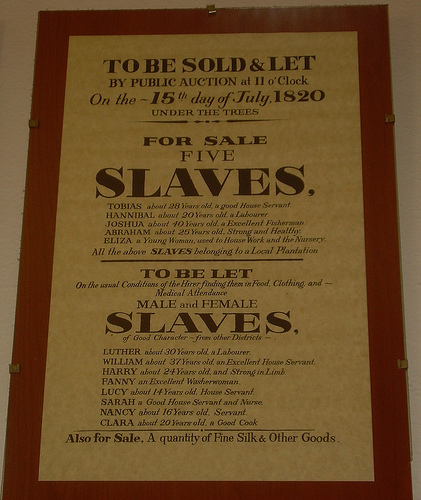
I’d love to believe that were I subjected to this horror show I would have been able to poke fun at the situation.  That maybe I would have been able to choose one male white friend and taken the ‘performance’ to a whole ‘nother level by crying, “Oh please don’t sell me away, father…” However, being nine or ten and shy, I probably would at best have refused to participate, but, more likely, gone along, swallowing my anger, humiliation, and shame until I got in the car after school and told my mother who would promptly have taken care of it.  I assure you of that.

My mother would have gone to school and ripped the teacher, and anyone else who was walking by, a new a**hole had this happened to me.  She did that when she didn’t like the way they taught about the Mayflower and the Indians in first grade.  We did it together in the fifth grade when Sr. Mary Ann said some offensive b.s. about MLK and used me, the only student of color, as a reference.  She got fired.

As a “black” student who nearly always served as a speck of pepper in a sea of salt, I can tell you that it is uncomfortable enough to go through the history lessons on the Civil War when the class is simply reading straight from the textbook, but to actually be used to physically demonstrate the atrocity….  It feels bad enough when you’re in geography and your friend accidentally reads the “river Niger” aloud as the river nigger and a hush falls over a crowd and everyone is looking at you in your desk at the back of the room even though their eyes are facing forward… but THIS.  I just can’t… Jessica Boyle, imho, you officially suck as a teacher and a human being.  Hopefully this will open your eyes to all that you have had the privilege of being blind to, and you’ll come out of this a better person.  Good f***ing luck!

Norfolk principal apologizes for mock auction of black students

By Steven G. Vegh The Virginian-Pilot © April 9, 2011

NORFOLK

The principal of Sewells Point Elementary School has apologized to parents for a teacher’s classroom exercise last week that cast her black and mixed-race fourth-graders as available for sale.

The apology came after the teacher separated the students from their white classmates and auctioned them, division spokeswoman Elizabeth Thiel Mather said. The exercise was part of an April 1 class on the Civil War.

In an April 6 letter sent to parents of students in the class, Principal Mary B. Wrushen wrote: “I recently became aware of a history lesson that was presented to the students in Ms. Jessica Boyle’s fourth grade class. Although her actions were well intended to meet the instructional objectives, the activity presented was inappropriate for the students.

Image

“The lesson could have been thought through more carefully, as to not offend her students or put them in an uncomfortable situation,” Wrushen wrote.

Wrushen said the exercise was not supported by the school or division. “I will follow up with the classroom teacher to ensure nothing like this ever occurs again,” the letter said. “In addition, the guidance counselor is available to discuss any concerns your child may still have concerning this classroom lesson.”

Wrushen declined to comment Friday. Boyle, who has been with the division since 2005, did not return a call to the school. She has taught at Sewells Point for three years, and before that was at Dreamkeepers Academy, according to the division website.

Mather said the division was responding to the incident with “appropriate personnel action.” She did not give details.

Wrushen became aware of the auction exercise after receiving complaints from two parents, and spoke to the class about the incident, Mather said.

“This lesson was not part of the approved curriculum,” Mather said.

Chris Lee, whose daughter is in Boyle’s class, was among parents picking up their children Friday at the school on Hampton Boulevard near Norfolk Naval Station. He said he’d heard no details about the exercise, though he received Wrushen’s letter.

“My wife and I were trying to figure out what the letter was about, because we heard nothing about it, we just saw the letter,” he said.

Letter: Principal Mary Wrushen wrote to the parents of students at Sewells Point Elementary to apologise for the controversial history lesson

Told by a reporter about the auction, Lee said, “That sounds inappropriate to me. Wow. That’s interesting – that’s something I have to digest.” He said he would ask his daughter to tell him about the incident.

The school has 590 students.

Contacted Friday by The Virginian-Pilot, School Board Chairman Kirk Houston said he had not known about the auction.

“That’s very disturbing to me, extremely disturbing to me,” he said. “Mock slave auctions involving children are absolutely unacceptable in a classroom. At this point this is a personnel matter, and the School Board will monitor its outcome.”

Peggy Scott, treasurer of the Norfolk Council PTA, also first heard about the incident from The Pilot.

“I’m sitting here with my mouth hanging open,” Scott said. “There are some things you don’t do.”

In a statement Friday, Superintendent Richard Bentley said: “The school district does not condone this type of lesson in any way. It was wrong. It was outside the boundaries of the curriculum and appropriate instructional practices.”

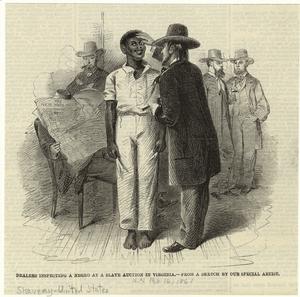
London Illustrated News, February 16, 1861, depicting a slave auction in Virginia. The sign on the podium reads “Negroes for sale at auction this day at 1 o’clock.”

Dealers inspecting a negro at a slave auction in Virginia.

Dealers inspecting a negro at a slave auction in Virginia.  [The Inspection]

Slave Auction, Virginia

by Lefevre James Cranstone Image rights owned by the Virginia Historical Society

Silvia Federici’s Slave auction, United States

social differences/systematic consequences

I’ve just spent the last two hours transfixed by this website.  Definitely worth perusing!

A few personal asides:

I must say that I’m sure my (white) dad would have gotten on the bus and had some words with folks if that thing had happened to me (you’ll read it)…

biracial people can be as insensitive as everybody else and aren’t always the “victims” of ignorant words…

the “you’re gay be with that gay guy” one reminds me of the times someone has wanted to fix me up with someone they’re sure I’m perfect for and it turns out it’s just the other “black” person they know….

ABOUT THIS PROJECT

this project is a response to “it’s not a big deal” – “it” is a big deal.  ”it” is in the everyday.  ”it” is shoved in your face when you are least expecting it.  ”it” happens when you expect it the most.  ”it” is a reminder of your difference.  ”it” enforces difference.  ”it” can be painful.  ”it” can be laughed off.  ”it” can slide unnoticed by either the speaker, listener or both.  ”it” can silence people.  ”it” reminds us of the ways in which we and people like us continue to be excluded and oppressed.  ”it” matters because these relate to a bigger “it”: a society where social difference has systematic consequences for the “others.”

but “it” can create or force moments of dialogue.

~~~~~~~~~

This blog seeks to provide a visual representation of the everyday of “microaggressions.” Each event, observation and experience posted is not necessarily particularly striking in and of themselves.  Often, they are never meant to hurt – acts done with little conscious awareness of their meanings and effects.  Instead, their slow accumulation during a childhood and over a lifetime is in part what defines a marginalized experience, making explanation and communication with someone who does not share this identity particularly difficult.  Social others are microaggressed hourly, daily, weekly, monthly.

The term “microaggressions” was originally coined to speak particularly to racialized experiences.

“Racial microaggressions are brief and commonplace daily verbal, behavioral, or environmental indignities, whether intentional or unintentional, that communicate hostile, derogatory, or negative racial slights and insults toward people of color.”  – “Racial Microaggressions in Everyday Life”

This blog, however, is a space to extend this concept to different socially constructed identities that embody privilege in different ways – sexuality, class, religion, education level, to name a few – in hopes of making visible the ways in which social difference is produced and policed in everyday lives through comments of people around you.

  • Me, a light-skinned biracial girl at a party last weekend:: Okay, a Jack means categories.
  • White guy:: How about minorities you would sleep with?
  • Me:: As a minority, I find that offensive, like sleeping with us is a sacrifice.
  • He looks at me like he hadn’t realized he was in “mixed” company and back-pedals (“I didn’t mean it THAT way”); kisses my ass for the rest of the night, but never apologizes. Made me feel frustrated and invisible.
  • Teacher :: Black men are naturally more aggressive and strong than white men.
  • Me:: No, it has to depend on the man, surely.
  • Teacher :: Not really, no white man could…
  • Me:: Your husband is 6ft tall well built and my dad is 5’7ft and very lean, your husband could wipe the floor with him.
  • Teacher :: There are odd exceptions but, in general.
  • I was 15, Secondary School, England 2001. Made me feel gobsmacked, worried that I would be graded unfairly.
  • I was at the mall earlier today with a group of friends. Another guy from school joins us.
  • New guy:: So, what are you?
  • Me:: My ethnic background?
  • Him:: Yeah
  • Me:: Well, I’m French, Spanish, Irish, Italian, Black American, Mexican, Puerto Rican, American Indian–
  • Him:: No you’re not
  • Me:: Pardon?
  • Him:: You can’t be American Indian. They’re all extinct.
  • I am a 17 year old girl, at a shopping mall. Made me feel frustrated, invisible, patronized.

    They probably just had a crush on you.”

    -What my white father said when I told him two white students called me the n-word on the bus.

    “I would never, ever hire someone with a “black” name on their resume. I wouldn’t even interview them.

    -An African American co-worker at a team dinner.

    • Girl at country themed bar:: Hey, you’re black…
    • Me, a 23-year old male::
    • Girl:: I’m not racist or anything…but WTF are you doing here? There are Confederate rebel flags and sh*t here.
    • Me:: ….
    • Girl:: Oh, I know. You’re here for the white girls.
    • Me:: -_-
    • Girl:: Buy me a drink.
    • Made me a bit uncomfortable.
    • Customer:: If more black people were like you the world would be a better place.
    • Black me:: Have a nice day.
    • What I wanted to say:: If fewer people were as ignorant as you, people who look like me would have better lives. I was 18. (He was in his 40s or 50s.) when: spring 1998, working at Barnes & Noble in Louisiana. 

    You know, it’s so amazing. I was just looking at your hands and feet- they’re so dark on the top, but then at the palms they look just like ours! Hahaha.”

    -My gymnastics coach in front of my suburban, entirely-white team, in which I am the only black person.

    • Workfriend:: Hey that new guy at work is gay; you should totally be with him.
    • Me:: No I don’t find him attractive.
    • Workfriend:: But… he’s gay! You’re gay, he’s gay, what’s stopping you??
    • Me:: Just because he’s gay doesn’t mean-
    • Workfriend:: Ummmmm, he’s gay. He likes having sex with guys like you. You’re just afraid. Duhhh.

    I was 21, at work. Made me feel annoyed, hurt and trivialized. Gay people don’t have sex with anyone just because they are both gay.


    He was pretty dark, so he’s probably not paying rent because he’s an illegal and doesn’t know English.”

    -My (white) stepfather regarding one of his renters. Made me ashamed because I’m Hispanic, too.

    I’m a black woman. My black female friend once told me that a white guy once said to her, “You’re really pretty for a black girl.” And her response was, “I know.”

    Made me realize her and my own unrecognized self hate. Made me feel sad and guilty.

    You could pass for Dominican; some of them are really dark and have bad hair like you. Luckily, I got the GOOD hair”.”

    -Said to me by the black Dominican-American boyfriend of my biracial (black/white) friend visiting us during Spring Break. I am a 20 year old black American woman with naturally kinky-curly hair. Made me feel shocked, ugly, unimportant.

    This 1895 charicature is an unkind parody of a woman seeking to smooth out her hair. The comic strip suggests that her hair stood out on end because of a hair-raising novel.
    • My black/white biracial friend looks at the Facebook profile of a black man she’s crushing on.
    • Her:: Ugh, his [mono-racial and black] girlfriend is so ugly. They’d have kids with huge nasty noses. He needs to get with me and my good mixed nose. *giggles*

    I am a black 20 year old American woman. We were studying together at another friend’s apartment. Made me feel insulted, ugly, disfigured, and defective.

    You know why Vermont is so safe, don’t you? There’s hardly any minorities in it!”

    I was in NY yesterday, meeting my future in-laws for the first time when my fiance’s father said this. He is a white man in his 70s. I am a 22 year old biracial black cis woman …who lives in Vermont. It made me feel furious, invisible, helpless, rejected.

    what year is this!?

    oh my jesus… yes, i had to go there.  i keep searching for an indication that this piece was written forty years ago, and only recently re-published just for… fun… or something.  i do think that there are, like, two valid, worthwhile points contained herein… but… um… oriental!?!?  that, of course, is not my main concern here, but it does point to the antiquated lens through which our dear (he does look kind of sweet and it says he volunteers a lot) mr. raiford views the world around him.  i don’t mean to come down on him.  i thank him for the unique opportunity to analyze the old “what about the children?” plea which i rarely see argued under the guise of modern day quandry.

    maybe you should take a moment to skip down to the article and then come back to my stuff…  i’m never sure if it’s best for me to put my thoughts at the beginning or not… you’ve been warned… here they come…

    first off, i’d wager to say that parents of mixed race children have long questioned the validity of discrete racial categories that require a child to choose.  i’d also wager to say that the white parents have probably had more questions than the black or ‘minority’ ones.  if this article was indeed written in the 21st century, i think it would be more accurate to say that (some fraction of) the rest of the country is finally beginning to question the validity of discrete racial categories.

    most off… i cannot even believe that this man, who uses the term oriental multiple times, has the nerve to caution human beings who love each other and dream of starting a family to grow through life with… not to do so because race “matters” and (in his opinion) the children will be confused and unsupported outside of said family.  how about cautioning the rest of the country, those who haven’t caught up with the times, not to be so rigid in their notions of “us” in opposition to “them,” or who belongs with whom and why?  how about saying something to move us toward the idea that we are all fundamentally the same?  we are people.  who seek love and joy and connection.  and any time people are lucky enough to stumble upon those things we should encourage them to leap right in and build something beautiful from there.  which will encourage the rest of us to do the same. which will cause this society in which race matters more than who a person really is to change because the lines are blurred, have been crossed, eventually forgotten.  there you have a solution for the problem of the 6 year old that mr. raiford proposes will be confused and hurt by not belonging to any group outside of the immediate family.

    and another thing… hasn’t the recent census informed us that there actually is a viable mixed-race reference group?  the only satisfaction that brings me personally is that it appears to be a necessary step toward the ultimate realization of the human-race reference group.  only one box to check.

    to be fair… parts i liked… which really means agree with:

    • When a black and white couple produces a child, the child, by logical extension of definition, is black and white…
    • Race in the United States is a very discrete category. It is not based on any kind of scientific definition. It is based on a draconian sociological one and a divisive political one.
    • The United States has carefully and systematically created a society where race is a tremendously more important determinant of who we are than ethnicity, religion, national origin or personal achievements.

    again, i do not mean to bring down a reign of fury on mr. raiford.  i’m truly grateful for the opportunity to blast these notions.  he seems like a nice guy with misguided concerns.  actually with misguided solutions to concerns that are unfortunately still mildly valid as we seem to be in an in between (united)state(s).  in between where we were and where we’re going.

    awesome photo unrelated, source/subject unknown

    HARD TIMES FOR MIXED-RACE CHILDREN

    Written by GILBERT L. RAIFORD

    In the pursuit of accuracy and personal pride, interracial parents are beginning to question the validity of discrete racial categories that require their children to designate single-race identification.

    On the surface, this is a laudable pursuit and certainly a legitimate one. After all, we do define people as black or white. So, when a black and white couple produces a child, the child, by logical extension of definition, is black and white or neither black nor white. However, this satisfies only the biological, and perhaps anthropological, approach to understanding race.

    There is a more compelling reality: Race in the United States is a very discrete category. It is not based on any kind of scientific definition. It is based on a draconian sociological one and a divisive political one. People here are defined as black or white or Oriental. This takes precedence over being defined as Jewish, Jamaican, Cuban, Haitian, Russian, Chinese, French, Catholic, Protestant, etc. The United States has carefully and systematically created a society where race is a tremendously more important determinant of who we are than ethnicity, religion, national origin or personal achievements. Witness the confusion of black Cubans or black Puerto Ricans or the Eurasians.

    In the United States, an African-American parent, no matter how fair-skinned, cannot procreate a “white” child. The system does not make exceptions for an African American whose child is the product of interracial coupling. Of course, the reverse is not true for Anglo-Americans. They can have any race of child they want – black, white or oriental. That is the reality of this society.

    I write this not at all to chide or even inform interracial parents. They are adults who most likely know a great deal about the race issues and are intellectually and emotionally strong enough to ignore the stupidity that is generated out of personal and institutionalized racism. Their lives together attest to this fact.

    But what about the children?

    It is not easy growing up black in this society. It becomes considerably more difficult for one who does not know that he or she is black, but is confronted by this sociological fact everyday and in so many ways, some of them hurtful and insidious. No amount of parental love can shield a 6-year-old from the confusion and hurt of not belonging to any group outside of the immediate family. Adolescents are particularly fragile, having to live with this confusion at the very crossroads of their lives when they are struggling to overcome self-doubt and needing to feel good about themselves, needing self-validation – things that one gets from people other than the immediate family, from a reference group. Presently, there is no viable mixed-race reference group. One is forced to choose. Mental health directs one towards choosing a reference group which minimizes our degree of race-mixing and provides us with full membership.

    Superimposed on race is ethnicity.  Ethnicity is a reference group. For African Americans, it provides for a very sustaining sense of identity. It is no wonder that people like Lena Horne, Cab Calloway, W.E.B. DuBois, Walter White and Adam Clayton Power, even though white-looking, affirmed their blackness. It was not race that they were affirming, it was ethnicity, the sustaining sentiment which makes being non-white in America palpable and even enjoyable.

    Hopefully, the day will arrive when we are no longer a racial society, a society where race does not matter. That day has not yet come. In the meanwhile, I caution interracial parents to consider the consequences of making their child a cause célèbre in search of a miscegenation reference group. Of course, it is important that a child knows the reality of his or her family genealogy and to even embrace it. It is at least equally important that a child is prepared to negotiate life based on the social context of society. Sadly, race matters.

    Gilbert L. Raiford is semi-retired after a career in teaching and working for the U.S. Department of State. He lives in Miami where he volunteers at homeless facilities, the Opera House in Miami and after-care school programs as a fund-raiser. He may be reached at graiford@hotmail.com

    the child was exhibited yesterday

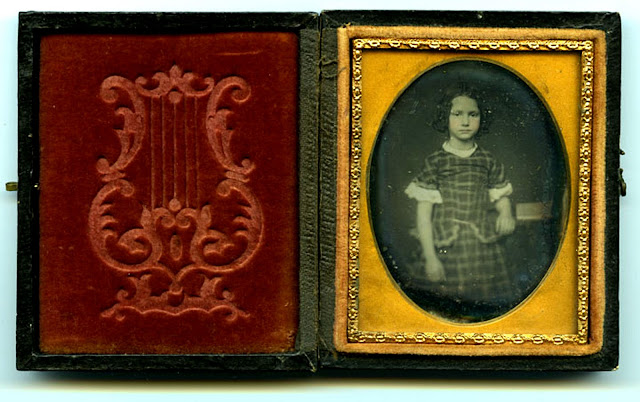
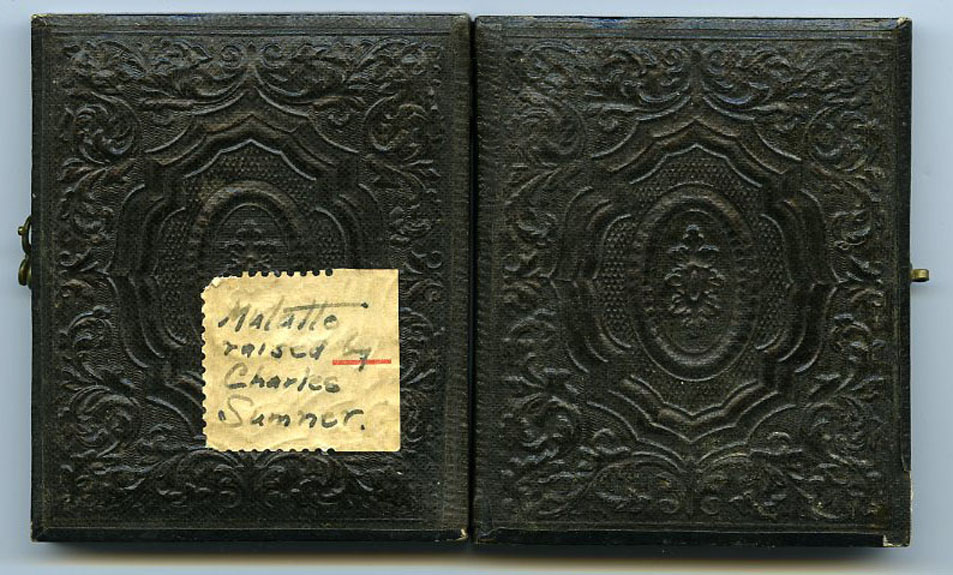
    in my search for vintage images of mulatto folks i recently stumbled upon a gem!!   Joan P. Gage is a journalist and a collector of photographs.  on her blog A Rolling Crone she shares one of her collectibles and the fascinating (and still unfolding) story behind it.  i feel all kinds of ways about this piece of our history (and by “our” i do mean mulatto, i do mean american, i do mean human seeing as everything is everything and all.)  anyway, i feel sad for the little girl.  i feel pride for the little girl.  i feel a sense of satisfaction that i can point to this child and to the efforts charles sumner as evidence that, even way back when, a white man and a white-looking black child attempted to change people’s minds (way back)when it would have been much easier (not to mention safer!) to relish in the societal refuge that their phenotype offered.  i am not implying that the attempt was perfect, nor that there is nothing offensive or off-color about the sentiment behind the message.  but, if you consider the general consensus of the times on this matter, i think it safe to view sumner’s cause as a benevolent one.  i wonder how little mary felt.  i wonder if she understood.  i wonder what her parents looked like.  and her siblings.  i assume there’s a reason that they were not photographed or ‘exhibited’ together.  and i wonder how they felt about that, about all of it.  and what became of all of them…

    From a New York Times article dated March 9, 1855, which read:
    A WHITE SLAVE FROM VIRGINIA. We received a visit yesterday from an interesting little girl, — who, less than a month since, was a slave belonging to Judge NEAL, of Alexandria, Va. Our readers will remember that we lately published a letter, addressed by Hon. CHARLES SUMNER, to some friends in Boston, accompanying a daguerreotype which that gentleman had forwarded to his friends in this city, and which he described as the portrait of a real “Ida May,” — a young female slave, so white as to defy the acutest judge to detect in her features, complexion, hair, or general appearance, the slightest trace of Negro blood. It was this child that visited our office, accompanied by CHARLES H. BRAINARD, in whose care she was placed by Mr. SUMNER, for transmission to Boston. Her history is briefly as follows: Her name is MARY MILDRED BOTTS; her father escaped from the estate of Judge NEAL, Alexandria, six years ago and took refuge in Boston. Two years since he purchased his freedom for $600, his wife and three children being still in bondage. The good feeling of his Boston friends induced them to subscribe for the purchase of his family, and three weeks since, through the agency of Hon. CHARLES SUMNER, the purchase was effected, $800 being paid for the family. They created quite a sensation in Washington, and were provided with a passage in the first class cars in their journey to this city, whence they took their way last evening by the Fall River route to Boston. The child was exhibited yesterday to many prominent individuals in the City, and the general sentiment, in which we fully concur, was one of astonishment that she should ever have been held a slave. She was one of the fairest and most indisputable white children that we have ever seen.

    From “Raising Freedom’s Child—Black Children and Visions of the Future after Slavery,” written by a University of New Orleans professor, Mary Niall Mitchell:

    By the eve of the Civil War, abolitionists recognized the potential of white-looking children for stirring up antislavery sentiment…Although it was the image of a raggedy, motherless Topsy that viewers might have expected to see in a photograph of a slave girl, it was the “innocent”, “pure,” and “well-loved” white child who appeared, a child who needed the protection of the northern white public.
    “Topsy”
    George Thomson’s Woodcut Illustrations
    1888

    The sponsors of seven-year-old Mary Mildred Botts, a freed child from Virginia, may have been the first to capitalize on these ideas, as early as 1855. Her story also marks the beginning of efforts to use photography (in Mary Botts’s case, the daguerreotype, as the carte-de-visite format was not yet available) in the service of raising sentiment and support for the abolitionist cause.”
    “…In his own characterization of Mary Botts,” Mitchell continues, “Sumner set a pattern that other abolitionists would follow.  In a letter printed in both the Boston Telegraph and the New York Daily Times, he compared Mary Botts to a fictional white girl who had been kidnapped and enslaved, the protagonist in Mary Hayden Pike’s antislavery novel Ida May:  ‘She is bright and intelligent—another Ida May,’ [Sumner wrote] ‘I think her presence among us (in Boston) will be more effective than any speech I can make.’”

    From joanpgage, the blogger (and current owner of the daguerrotype) from which I am re-blogging this piece:

    Only a year after parading Mary Botts through New York, Boston and Worcester and dubbing her “The real Ida May”,  Charles Sumner’s devout abolitionist views  led him to a crippling disaster, when, in 1856, he was so badly beaten on the floor of the Senate by South Carolina Representative Preston Brooks,  who broke a cane over his head, that it would take years of therapy before Sumner could return to the Senate.

    …Prof. Mitchell is currently working on a book about Mary Botts that will tell more about this former slave’s life, including the drama of how Sumner purchased her and spirited her out of Virginia, how he introduced her to the media and society as a  living advocate for the abolitionist cause, and how her family settled in the free black community in Boston.

    I’m eager to learn the rest of the story, but, for now, it’s enough of a thrill just to know that the daguerreotype, taken in 1855, that is part of my collection may represent one of the first efforts EVER to use the modern discovery of photography to touch people’s emotions and change their minds.  This small image of a seven-year-old girl may be an example of the first time photography was used for propaganda, but it was certainly not the last.


    beauty-full

    so, while i was “away” one of the big community newsflashes was that mixed-race is the new standard of beauty.  um…ok, cool…i guess…or, whatever!…i’m not really sure where i stand on this one, because, just like race, a standard of beauty really has no basis in reality.  that’s merely an opinion.  however, the fact 64% of the people polled in the Allure magazine survey that delivered us this “good” news are of the opinion that they generally find mixed-race women to be the epitome of beauty, leads me to ponder a couple of things:

    1. we’re not so invisible anymore.  they didn’t choose light-skinned black people with “good hair,” or asians who may also be perceived as a little hispanic too as the exemplification of beauty.  they chose mixed-race.  it was on list.  that’s progress, no?

    2. i firmly believe that there is no such thing as race, not in terms of the universal reality which i perceive to be very different from the mainstream worldly reality.  yet within the confines of the discussion of the topic at hand (funny (and frustrating) how this ‘non-existent’ thing is so confining) i would say that we are all mixed race.  so who amongst us is not full of beauty?

    3. i also think about all the previous generations of mixed people who may have felt invisible and/or less than and/or all that jazz… i think about me… i wish i could have told this girl that if she could just wait 10-20 years or so, some of the things she felt uncomfortable with and perhaps even unloveable because of would come to be perceived as beautiful… so she should just rest assured in herself and wait for the world to catch up…

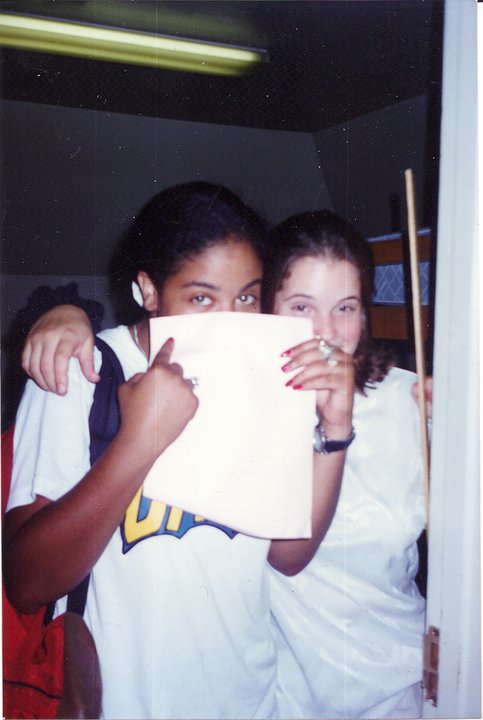
    wow! these pictures make me so uncomfortable. just like i was back then.

    now…not that i’m all caught up in thinking of myself as some biracial beauty…but…i gotta say…progress, no?

    if i had to identify something beautiful about this picture, i would say it’s that i seem unapologetically present and, dare i say, confident even. i’d like to see phrases like that enter the equation when calculating the standard of beauty… confident, present, compassionate, passionate, gracious, generous… how ’bout those undisputably beautiful things?


    no h8

    This is so right on!  Thank you, Karen Finney.  I’m so glad my (white)grandparents allowed me in to their lives.  And so are they! It’s the “little” things…

    On another note, this sentence, “the very existence of antimiscegenation laws had been enacted for the purpose of perpetuating the idea of white supremacy,” speaks to the very reason I fell down this rabbit hole I’ll now call the mulatto trail.  I realized one day that anti-miscegenation and the one-drop rule perpetuate the idea of white supremacy, and that by subscribing to that antiquated rule I was upholding that ridiculous notion.  The anti-miscegenation thing has legally been eradicated, but ask any interracial couple who has walked down a street together, and I’m sure they’ll tell you that on more than one occasion they’ve been given the evil-eye or gawked as if they were freaks of nature.  Or both.  And as for the one-drop rule, head on over to my youtube channel, scroll through the comments, and you’ll see that it looms large in the consciousness.  And many people don’t seem to be willing to let it go.

    California Prop 8 Gay Marriage Ruling a Win For American Values

    By KAREN FINNEY

    SOURCE

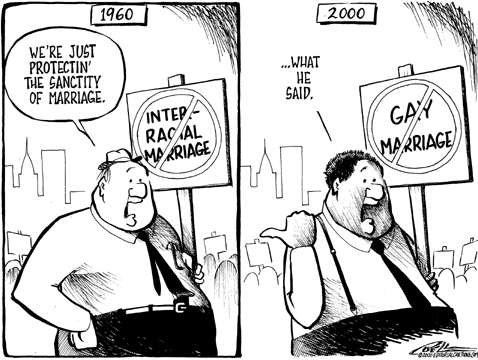
    Yesterday’s ruling that California’s Proposition 8 is unconstitutional reaffirms a long-held American value that no matter how you try to spin it, separate is not equal. While some may not agree with same-sex marriage, history should remind us that our Constitution calls us to recognize that the laws in it apply equally, not to be picked apart to support a political agenda or bias. The arguments being used against same sex marriage are frighteningly similar and equally offensive as those once used against interracial marriage. While a Gallup poll in 1967 found that 74 percent of Americans disapproved of interracial marriage, it’s almost hard to remember just how far we’ve come.

    I was 16 years old before I was allowed in my grandfather’s home in Greensboro, North Carolina. That’s how long it took for him to even begin to re-think his shame over having a mixed-race granddaughter. He believed, as did many at the time, miscegenation was wrong on moral and legal grounds. Thankfully for me, my parents disagreed. They were married in New York City and had me despite the fact that it was illegal in their home states of Virginia and North Carolina to do so. Thankfully for our country, in the case of Loving v. Virginia, the Supreme Court saw beyond the fear and bigotry of the moment and ruled that antimiscegenation laws violated fundamental American values of Due Process and Equal Protection Under the Law as guaranteed to every American by our constitution.

    Just as some used to say that marriage is only valid between a white man and white woman, some now argue that marriage can only be between a man and a woman. Arguments have also been made that same-sex marriage dilutes the institution of marriage, just as similar arguments suggested that interracial marriage diluted the white race. My personal favorite absurd justification says that (despite the idea that we are all God’s children and loved equally) gay marriage is against the laws of God and nature. That argument was used by Leon M. Bazile, the judge in the initial case against the Lovings, who said:

    Almighty God created the races white, black, yellow, malay and red, and he placed them on separate continents. And but for the interference with his arrangement there would be no cause for such marriages. The fact that he separated the races shows that he did not intend for the races to mix.

    The Supreme Court’s ruling in the Loving case also recognized that the very existence of antimiscegenation laws had been enacted for the purpose of perpetuating the idea of white supremacy:

    There is patently no legitimate overriding purpose independent of invidious racial discrimination which justifies this classification. The fact that Virginia prohibits only interracial marriages involving white persons demonstrates that the racial classifications must stand on their own justification, as measures designed to maintain White Supremacy.

    Similarly, as Judge Vaughn Walker today affirmed, denying gay couples the right to marry, not only denies basic civil rights, liberty, and freedom, but also codifies bigotry.

    Karen FinneyKaren Finney is a political analyst for MSNBC and an independent consultant working with political and corporate clients in the areas of political and communications strategy. She brings over 16 years of experience in national politics and campaigns ranging from the Clinton administration to New York State to the Democratic National Committee.