even more on adoption

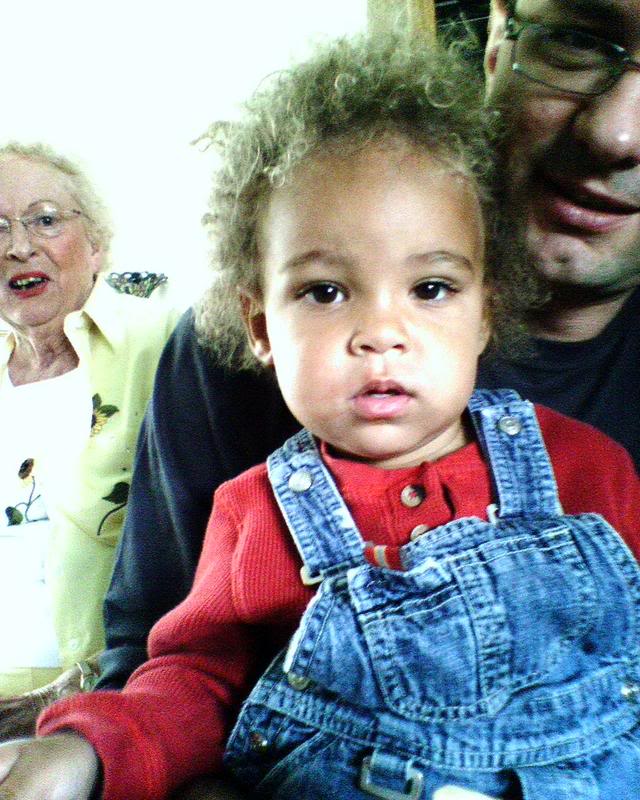
This one isn’t so much about the fact that Biracial and African American children are “hard to place”, but about what they need once they’ve been placed. They need help finding their place.  Relationships are key.  Artifacts, not so much.

New research on multiracial adoption questions current practices

While many people who are adopted by members of another race still identify as black or mixed race, many lack the community and cultural connections with others who share those same identities. New research in the journal Family Process suggests that adopted children of mixed race need early and ongoing experiences within the cultural communities of their origin, and with other multiracial adopted persons, to help them to build healthy cultural identities. The labels black, biracial, multiracial, imply that the transracial adopted child has a healthy sense of that identity and all that it encompasses. Dr. Gina Miranda Samuels, author of a study and a multiracial, transracial adoptee herself, remarks, “we must question the meaning and cultural experiences (or lack thereof) beneath these labels. Furthermore, the idea of ‘colorblindness’ is now challenged as an effective approach in transracial parenting.”

Prior research on transracial adoptees often focused on self-esteem and school achievement in comparison to their non-adopted peers, but not in terms of their cultural sense of belonging. This study explores how transracial adoptees with mixed black-white heritage develop a sense of belonging and connection to their black heritage. Samuels also pays heed to how different racial-ethnic communities, and white adoptive parents, can support the identity development of their child by developing relationships in their child’s racial-ethnic communities.

The author asserts that diverse experiences (not confined to events, books, or dolls) can cause a family to become a truly multicultural as well as multiracial, family, and not a family of white parents with children of color.

Most adoptees interviewed for the study told of their search for their biological black fathers and extended black family in order to feel more deeply connected to their black heritage. This finding emphasizes the importance of culturally grounded relationships over cultural artifacts in identity development. Samuels found that there is often a stigma associated with transracial adoption in communities of color which can in turn diminish the “acceptance” of transracially adopted persons in those communities.

Samuels recommends that social workers and child welfare practitioners raise awareness of the importance of these experiences for transracial adoptees and adoptive families, and recognize both the strengths and challenges embedded in transracial adoption and mixed race identities.

SOURCE

dekotora


The Dekotora or Decotora (デコトラ dekotora), an abbreviation for “Decoration Truck”, is a kind of loudly decorated truck most commonly found in Japan and the Philippines. Dekotora commonly have neon or ultraviolet lights, extravagant paints, and shiny stainless or golden exterior parts. These decorations can be found on both the cab and the trailer, and not only on the exterior but also in the interior. Dekotora may be created by workers out of their work trucks for fun, or they may be designed by hobbyists for special events. They are sometimes also referred to as Art Trucks (アートトラック) ātotorakku).

Note that Dekotora does not refer to vehicles used for advertisements, political campaigns or propaganda.

In 1976, Toei released the first entry in a series of 8 movies called Truck guys (トラック野郎 Torakku Yarō) that featured as the protagonist a costumed trucker who drove his garishly decorated truck all over Japan. This movie was a big hit with both old and young, and caused a wave of Dekotora popularity to sweep the country. While Dekotoras were present throughout the 1970s, before the movie they were restricted to the north-eastern fishing transport trucks. It is possible that the movie was an attempt to popularise these kinds of trucks. In those days, ready-made parts for trucks were not easily available, so these trucks freely utilised parts from sightseeing buses or US military vehicles.

SOURCE

1st photo

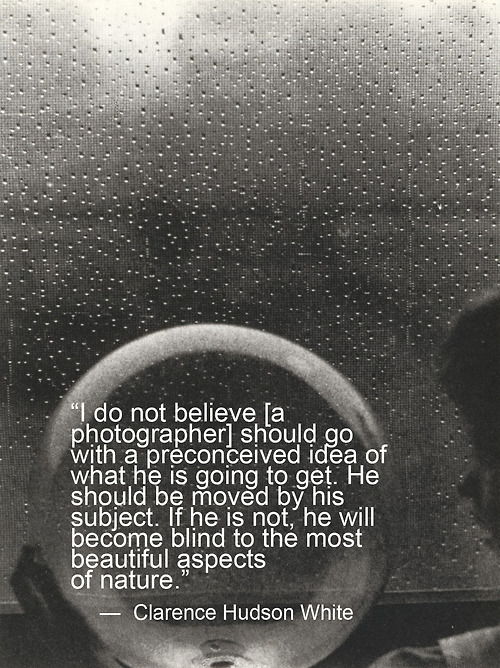
The picture above is reputed to be        the world’s first photograph.  It was taken in 1826 and was developed        by French photographer Joseph Nicéphore Niépce. He called this process        “heliography” or sun drawing and the entire process took eight hours.The next picture below is reputed        to be the world’s first color photograph.  Taken by by Louis Ducos du        Hauron in 1872, the photo is of a view of Angouleme in Southern France.source

The picture above is reputed to be the world’s first photograph.  It was taken in 1826 and was developed by French photographer Joseph Nicéphore Niépce. He called this process “heliography” or sun drawing and the entire process took eight hours.

The next picture below is reputed to be the world’s first color photograph.  Taken by by Louis Ducos du Hauron in 1872, the photo is of a view of Angouleme in Southern France.

source

darktown

I’ll never be able to sing “Sleigh Ride” again!  Ever!  Not even with Amy Grant.  Currier & Ives!?  Puh-lease!  I’ll take Norman Rockwell any day.  ANY day.

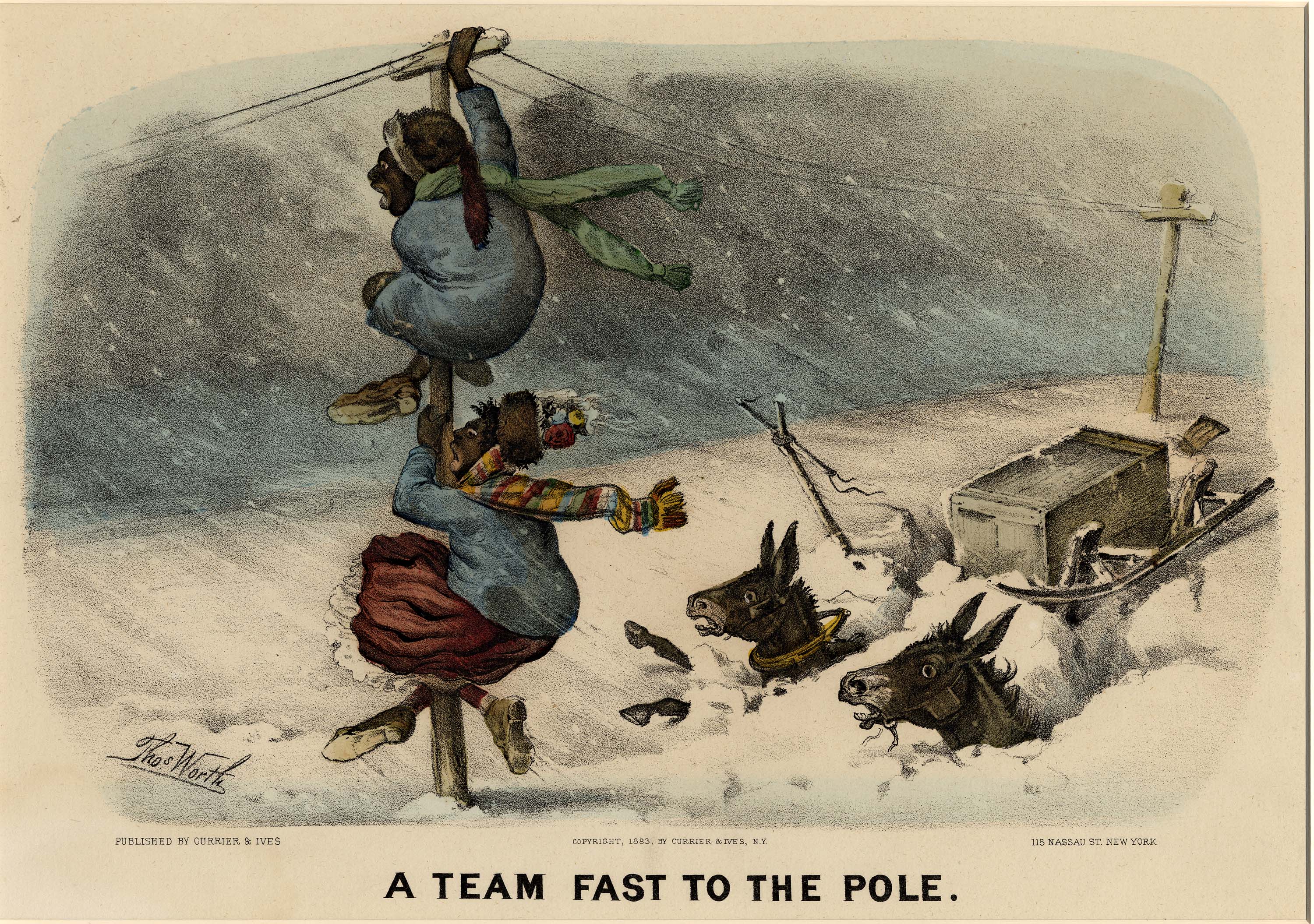
In 1857, Nathaniel Currier, a Massachusetts lithographer, and James Merritt Ives, a self-trained artist and bookkeeper for the business of N. Currier, formed a partnership. The result was the firm of Currier & Ives, which produced three to four prints every week for fifty years – a total of over 7,500 titles. The lithographs produced by the company were published by Currier & Ives, none were actually drawn or lithographed by them. Upon their deaths in 1888 and 1895 respectively, their sons, Edward West Currier and Chauncy Ives, directed the firm until its close in 1907 (American Historical Print Collectors Society).

Previous to the Emancipation Proclamation, Currier & Ives generally depicted blacks as individuals content with their lives and position in society; they were often pictured in the background of idyllic plantation images. Initially after the Proclamation was issued, the firm continued to depict blacks in a positive light, focusing more on individuals, publishing portraits of John Brown, Frederick Douglas, and black Union soldiers fighting for their freedom (222). As time went on, however, and the freedmen began to move north into the cities, it became more apparent that not all Northerners were unanimous in their support of emancipation and the status of the freedman. The political images published by Currier & Ives during this time were vicious attacks against the character and intelligence of blacks, depicting them as unsupportive and disobliging of the political figures who sought to free them, such as Abraham Lincoln, Horace Greeley, and Senator Charles Sumner (226).

During and after Reconstruction, Currier & Ives, and America it seems, continued to appreciate these negative images of African Americans. Out of this, between the mid-1870s to the early 1890s, the Darktown Comics arose, mostly illustrated by Thomas Worth (1834-1917) and James Cameron (1828-1963). The company described the Comics as “pleasant and humorous designs, free from coarseness or vulgarity, being good natured hits at the popular amusements and excitements of the times”. It has been suggested that Darktown may have “served as satires on polite white behavior as well”, as could be supported by previously positive images of African Americans. Regardless of intent, the prints only reinforced negative racial stereotypes throughout the country.
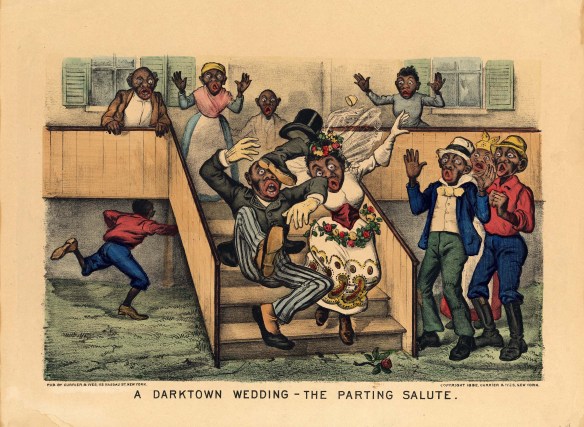
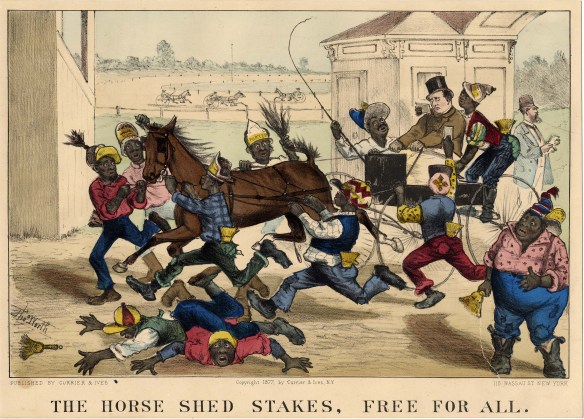
The caricatures presented by the Darktown Comics consisted of “African Americans performing actions that were more or less normal for ‘ordinary’ folk, meaning whites…the implication being that the African Americans could not execute even the simplest tasks of everyday life without making themselves appear ridiculous”. The most common images depicted by Currier & Ives’ artists were of African Americans attempting to have horse, skull, and sulky races; ride in carriages and yachts; hunt; host lawn parties; play tennis; and fight fires–always with disastrous results. And the depiction of  African American lawyers, doctors and the clergymen as bumbling and dishonest were quite malicious. African American children were also featured in a poor light – as mischievous, out of control, disrespectful hoodlums. This is evident in prints by Thomas Worth such as “A Put Up Job” and “A Fall from Grace” (1883) and “Breaking In: A Black Imposition” and “Breaking Out: A Lively Scrimmage” (1881).


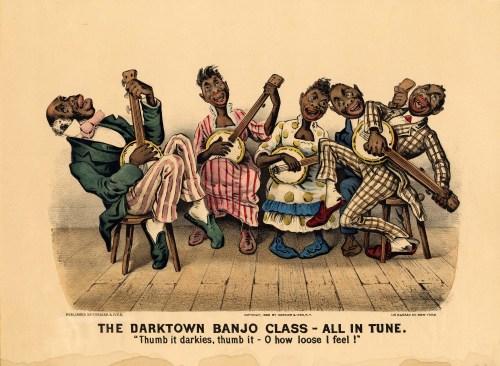
African American stereotypes that still exist today were begun here – the connection of African Americans to music, in Darktown specifically of banjo playing, and of their supposed eating habits, most notable in the Comics, that of eating watermelon. This can be seen in the prints that make up the set of the Darktown Banjo Class and in single prints like “O Dat Watermillion!”. As one can see, African American speech was attacked as well, through phonetic renderings steeped in the distortion of stereotypes and caricature.

The Darktown Comics did not develop or exist in a vacuum, however. In addition to theDarktown prints that came out of this time, Harper’s Weekly featured the Blackville prints; examples of which can be seen at HarpWeek’s exhibition, “Toward Racial Equality:Harper’s Weekly Reports on Black America, 1857-1874 or the Philadelphia Print Shop’sBlackville Prints.” These were similar in content to Darktownspoofs of African American attempts at high fashion, sports, etc. The most prevalent artists of this series were Sol Eytinge, Jr., William Ludwell Sheppard, S.C. McCutcheon and “Sphinx” (Philadelphia Print Shop, Ltd.). Other publications, such as Life, Puck and Judge, as well as Pulitzer’s New York World and Hearst’s New York Journal produced similar images but these were in the context of satire (Hays). Whether or not these images were taken as satire or at face value by the American populous is up for debate, however. Other news and editorial magazines, such as The Outlook and The Independent, also promoted these types of images through their illustrations and advertising—exemplifying the prevalence and acceptance of these racist stereotypes across the country (Hays).
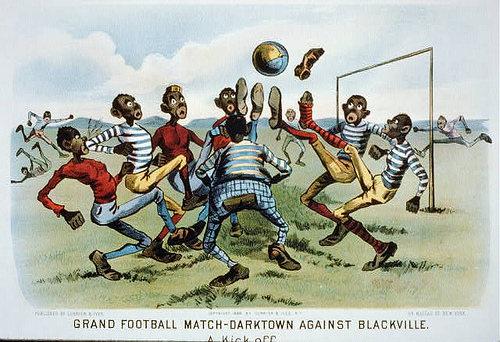
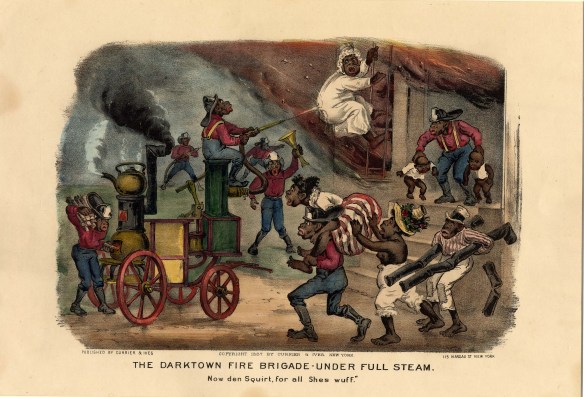
The “high art” of this time, specifically that of southern artists, furthered these stereotypes as well, dehumanizing the African American through their depictions of coal black skin, thick red lips, oversized teeth, and patchwork clothing. It wasn’t until the impact of the Ashcan Society and the period of realism came into play that classical forms of art began to celebrate the figure of the African American as he really appeared. The art of Robert Henry, George Luks, and George Wesley Bellows are forefathers of this new view – a celebration of the African American.

SOURCE
the girl who fell from the sky, or one of the best books ever!

This is exactly how I felt while reading Heidi Durrow’s debut novel The Girl Who Fell From the Sky (available today yesterday wherever books are sold).  Except that I do know her, and I thank God that she’s not dead because I need more from this author/friend of mine.  Heidi has written one of the best books I have ever had the pleasure of reading, biracial subject matter or not.  Truly beautiful, profound, poignant.  All that good stuff and more!  I read (more like devoured) TGWFFTS during an extremely difficult time in my life.  I felt as though the book was saving me.  And reminding me of all the good things I have to offer.  And that no matter what hardships and tragedies we may go through in life, the story goes on- there’s another chapter to be lived.

Though the book is not entirely about being black and white, there are many beautiful passages that honestly touch upon the heart of that matter.  I often find myself lamenting the fact that this biracial identity is so misunderstood out in the world at large.  The Girl Who Fell From the Sky offers much insight.  I sincerely hope that it is widely read.  We all need this book.  Whether we know it or not.

A few of my favorite “themes” of the novel:

Loss of self, becoming the “new girl”, becoming “black”, forsaking white.  Making deals with the self.  Deals which become layers covering over the authentic self.  The self that the biracial kid loses when they feel pressured to be just one thing.  Then eventually you long to be just one thing because no matter how hard you pretend to be whatever it is they want you to be, you can never totally convince yourself that you are exclusively that one thing.  Because you aren’t.  But most people seem completely incapable of understanding that, of allowing that.  So we find ourselves feeling alone and lonely in groups of people.

One of my favorite quotes from the book is, “I think what a family is shouldn’t be so hard to see.  It should be the one thing people know just by looking at you.”  Unfortunately, we’ve been trained to recognize families as homogeneous groups.  Seeing interracial couples is still jarring for many.  Mentally pairing a mother with a child that “does not look like” her can be a major stretch of the imagination.  But it is not an imagined thing for many.  It is a reality.  And for whatever reason that people who don’t have to deal with this don’t seem to understand, we need our families to be recognized.

I could go on and on.  I have pages of notes.  But I hope this is enough to pique your interest and motivate you to buy (and read!) The Girl Who Fell From the Sky.  I’d love to hear what you think!