1


I think it’s possible to be bicultural, yet monolingual, and still experience an unconscious personality shift when moving between the two cultures.
People who are bicultural and speak two languages may actually shift their personalities when they switch from one language to another, according to new research in the Journal of Consumer Research.

“Language can be a cue that activates different culture-specific frames,” write David Luna (Baruch College), Torsten Ringberg, and Laura A. Peracchio (University of Wisconsin-Milwaukee).
The authors studied groups of Hispanic women, all of whom were bilingual, but with varying degrees of cultural identification. They found significant levels of “frame-shifting” (changes in self perception) in bicultural participants-those who participate in both Latino and Anglo culture. While frame-shifting has been studied before, the new research found that biculturals switched frames more quickly and easily than bilingual monoculturals.
The authors found that the women classified themselves as more assertive when they spoke Spanish than when they spoke English. They also had significantly different perceptions of women in ads when the ads were in Spanish versus English. “In the Spanish-language sessions, informants perceived females as more self-sufficient and extroverted,” write the authors.
In one of the studies, a group of bilingual U.S. Hispanic women viewed ads that featured women in different scenarios. The participants saw the ads in one language (English or Spanish) and then, six months later, they viewed the same ads in the other language. Their perceptions of themselves and the women in the ads shifted depending on the language. “One respondent, for example, saw an ad’s main character as a risk-taking, independent woman in the Spanish version of the ad, but as a hopeless, lonely, confused woman in the English version,” write the authors.
The shift in perception seems to happen unconsciously, and may have broad implications for consumer behavior and political choices among biculturals.
David Luna, Torsten Ringberg, and Laura A. Peracchio. “One Individual, Two Identities: Frame-Switching Among Biculturals” Journal of Consumer Research: August 2008.


“Dogs are our link to paradise. They don’t know evil or jealousy or discontent. To sit with a dog on a hillside on a glorious afternoon is to be back in Eden, where doing nothing was not boring—it was peace.”-Milan Kundera

“I think we are drawn to dogs because they are the uninhibited creatures we might be if we weren’t certain we knew better. They fight for honor at the first challenge, make love with no moral restraint, and they do not for all their marvelous instincts appear to know about death. Being such wonderfully uncomplicated beings, they need us to do their worrying.”-George Bird Evans



Oscar! My new dog!
This is a fascinating story of interracial marriage, institutional racism, blended families, and mixed race ideology. I am inspired by the courage of conviction this woman maintained in the face of so much opposition. Oh! And… um…. excuse me South Carolina… 1998!?!? Yes, Michigan!
By DAVID LAUDERDALE
Laura Markovich came to Beaufort County in 1965 because it had one of the few places in the South where whites and blacks could gather.
She came from Michigan to attend a religious “summer school” of her Bahá’í World Faith at Penn Center on St. Helena Island.
What unfolded here became a rare testament of harmony in the messy struggle of race relations in America.
At the secluded Penn Center, on sandy soil where the first school for freed slaves was erected in 1862, the young white widow met a tall and striking black widower.
On the surface, the only thing they had in common were children underfoot. Laura had four children, all white, and Elting B. Smalls Sr. of St. Helena had six children, all black.
Three years later, they were married. They lived in the Tom Fripp community on St. Helena and together had four more children.
 Laura and Elting Smalls, center, on St. Helena Island with two of her daughters, one of their sons, and two family friends.
It was a life so odd for that era in the Deep South that it demanded hard-to-reach courage, resolve and unity.
Those characteristics — and Laura Smalls’ devotion to her faith, early childhood education and family — were cited Tuesday when a standing-room-only crowd gathered back at that same Penn Center for her funeral. She died Feb. 27 at age 79.
Her children composed a eulogy that makes it sound like they were raised in the world of Ozzie and Harriet:
“Her greatest loves were arts and crafts, playing and teaching children, talking to everyone and anyone, and dancing. You can see this evidenced through her children’s passions….Can’t you yet see her sweet smile?”
‘WEDDED WIFE’
That smile was a triumph of the spirit over harrowing details.
To set the stage, their marriage took place days after Dr. Martin Luther King Jr. was assassinated and America’s streets erupted into racial violence. King himself had gathered his troops for retreats at the Penn Center for the same reason the Bahá’ís did. They believed in unity, and this was one place they could find it. Just months before he died, King stood at Penn Center to ring home a point to the antsy civil rights activists: “So I say to you tonight that I have taken a vow. I, Martin Luther King, take thee, nonviolence, to be my wedded wife.”
For Elting Smalls to take Laura Markovich to be his wedded wife was not much easier.
Her faith required written permission from her father, and he didn’t want to give it. It took her three years to get it. Her father never did agree to meet Smalls, a Penn School graduate and career civil service worker at Parris Island Marine Corps Recruit Depot.
And then there was the matter of the law. In June 1967, the U.S. Supreme Court overturned state laws, like South Carolina’s, that banned interracial marriage. But it took South Carolina until 1998 to officially amend the state Constitution to remove what had been ruled a violation of the 14th Amendment. The Smalls wedding was a quiet affair in the home of one of the bride’s closest friends — in Michigan.
Thus a family of whites from up North and a family of black Sea Island Gullahs became one. They lived united, years before integration was forced on the local schools, much less accepted in the home.
BLACK AND PROUD
Sometimes Laura Smalls would take her troupe of white, black and mixed-race children into the historically white waiting room at the doctor’s office, and sometimes into the historically black waiting room, and always let the odd stares fall where they may.
Family members say the white community in town had a stand-offish attitude, but the blacks of St. Helena welcomed them all, as family.
“She didn’t do it to make a statement,” said daughter Lynn Markovich Bryant of Lady’s Island. “She fell in love with Elting and she wasn’t going to let anything stand in her way.”
Bryant gives the world a look at race it rarely sees in her 2002 autobiography, ” ‘I’m Black and I’m Proud,’ Wished the White Girl.”
As a child she was stunned by the ingrained racism she saw in her little classmates. She struggled with white attitudes toward blacks because in her world, there was no racial divide. She chose to attend the predominately black St. Helena Elementary School, where she felt welcomed as a fifth-grader. Today, she has taught there for almost 30 years after finishing second in her class at Beaufort High School, earning a full scholarship to Clemson University, graduating with honors and earning a master’s degree with a 4.0 grade point average.
She sounds like a black person, and she married a black man, joking that she would have had to marry a white for it to have been considered an interracial marriage. Her husband, Wilbert Bryant, teaches at Battery Creek High School.
One day as an adolescent, Lynn Bryant blurted out, “Mama, I hate white people.”
In her book, Bryant writes: “Being a mother to such a multitude of children, this was hardly her first or last problematic situation to resolve. … She ever so warmly and calmly responded as only she could, ‘Well, Lynn don’t you love the Bahá’ís? There are white Bahá’ís.”
EMBRACED
…Smalls was embraced on St. Helena because she was not a white who ignored the natives or said, “My way is better than your way — move over.”
She saw racial progress, her daughter said, but not the level of social interaction that’s necessary for people of different races, cultures and beliefs to quit being so judgmental.
“She taught us that we have more commonality than differences,” Bryant said.
Together, Laura Smalls’ 13 surviving children and stepchildren of all colors wrote: “Our mother did not tell us how to sacrifice and serve others; instead she showed us how to walk the walk.”

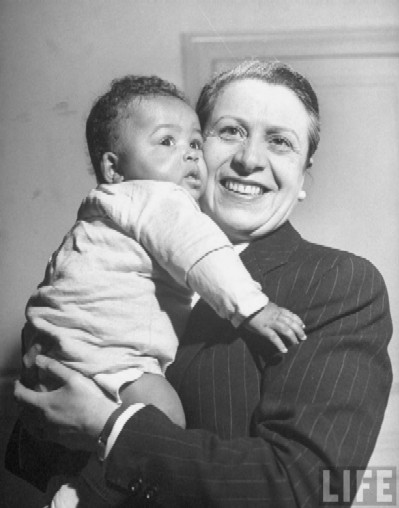
Some returning British husbands were willing to forgive their erring wives if the infant evidence was removed. Mothers sought to have their children adopted. “If I only had someone to take the baby for me and look after him . . .” wrote one mother, “but it must be someone kind—you see I love him.”
Adoption, however, was all but impossible. Like British village matrons, British charitable institutions were turning up suddenly race-conscious noses at illegitimate mulatto babies. Even when the father and mother were married, U.S. custom sometimes intervened to prevent reunion. The League of Colored Peoples asked one Southern Negro father if he wanted to take his white wife to America. “Brother,” he replied, “if I did, I would have to leave her in New York when I went home.”


 mulatto diaries