
Reply


March 24, 1912 – April 20, 2010
Thank you, Dr. Dorothy Height!
Here’s an excerpt of a 2008 NPR interview with Dr. Height. You can read the transcript in its entirety HERE.
hosted by Michel Martin
MARTIN: Dr. Dorothy Height began a lifetime of activism during the Great Depression, a time when the simple right to vote free of the fear of violence seemed like an impossible dream for many African-Americans. And at the of 96, she is still going to the office just about every day trying to further the cause of equal rights for all Americans. She’s serving as chair and president emerita of the National Council of Negro Women. She was kind enough to receive us at her office on historic Pennsylvania Avenue yesterday. We’re talking about President-elect Barack Obama’s historic win.
MARTIN: I wanted to ask you about that because you have been working in this field since you were a very young woman. I mean, really, your entire adult life. Since your early 20s you’ve been an activist. Did you believe this day would come in your lifetime?
…Dr. HEIGHT: Well, you know, I guess I got to – my faith was renewed working for 33 years with the YWCA of the United States. And I went there as a secretary or a staffer or something related to interracial education. After 33 years, I retired as a director of the Center for Racial Justice, and I split this organization, that from 1946 really set out to open its services to all women, regardless of race or with full regard for race, and so I saw the way an organization that was founded by white, Protestant women that now is very inclusive, and I was a part of that development.
When the YWCA in 1946 adopted an interracial charter, that was ahead of the Supreme Court’s decision on Brown versus the Board of Education, so that in a sense I had already the experience. And I listened to people when they kept saying – well, some people, particularly white people, will say this but they won’t go in. I also know that I worked with many white women who took a strong stand but they didn’t discuss it at home because their husbands didn’t agree with them, but they worked hard to see that the YWCA was integrated, as they called it. And today, the YWCA has Empower Women and Eliminate Racism as its slogan. And I think that made me know that there are many people who know that this is right to do and that they were willing to do it, but they didn’t necessarily announce it.
MARTIN: I remember that, reading in your memoir how your organization, the YWCA, was one of the first – and some precursor organizations were among the first to have integrated meetings, and how dangerous it was for some of these women to participate.
Dr. HEIGHT: At that time there were – when we had meetings, sometimes we were talking about the klan. Sometimes we found that we were denied services that we had been promised when they realized fully what it meant that we would be women of different races. But you know, I found that were strong women in all racial groups, and I think that’s what Barack Obama has shown us. There are people in every group who know what is right and who want to move, and they just need some kind of direction and some kind of feeling that other people are with them. I remember Dr. Mayo(ph) saying, I hear people say the time isn’t right. And he said, but if it isn’t right then it’s your job to ripen the time, and that’s the way I feel about it.
 12 Nov 1960, New York, New York, USA — Eleanor Roosevelt is presented the Mary McLeod Bethune Human Rights Award by Dorothy Height, President of the National Council of Negro Women. — Image by © Bettmann/CORBIS
…MARTIN: What role do you think civil rights organizations have now?
Dr. HEIGHT: Well, there’s still a lot of unfinished business. Right now you have going across the country a whole effort to destroy affirmative action. In other words, we’re finding that people are using civil rights in a negative way, and they’re calling it, this is a civil right. In a sense, these bills that are being introduced are really anti-civil rights, and they just use the term civil right in order to fool people and make them vote.
MARTIN: Are you speaking about Ward Connerly and some of his efforts to reverse affirmative action…
Dr. HEIGHT: Yes, Connerly has gone into several states, and he has does this in a misleading way, and I think people ought to be alert to it and realize that if you vote for what he is talking about, you’re cutting back something that got started during the days of Lyndon Johnson and was a part of the whole civil rights effort. It is not a preference. It is a way of saying, those who have been denied should be given an opportunity to be sought in (ph) so they can move ahead.
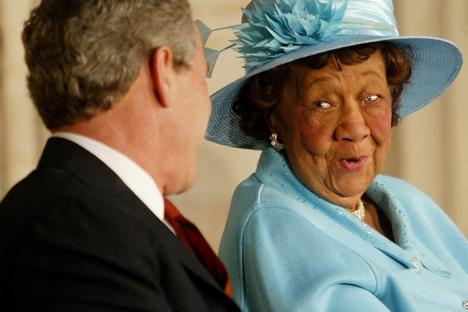 In 2004 President Bush presented Dr. Dorothy Height with the Congressional Gold Medal of Honor.
MARTIN: There are those who would argue, though, that – to be blunt about it – that Barack Obama takes these so-called excuses off the table. People look at that, and they say, look at Barack Obama in the White House. And they say, what discrimination? What could they possibly – what barriers?
Dr. HEIGHT: Yes. I think they will, but I would hope that they would also say to themselves, we need to look at who has the opportunities. We need to look at – Obama himself pointed that to us, that you can’t have a flourishing Wall Street and a destroyed Main Street. He could have also said, I’m working for the middle class, but we still have poverty. And we cannot divide up like that. We cannot say who’s hurting the most. We have to make sure they be dealing with everyone.
I have been working since my teenage days when I did an oration and won my college scholarship on the Constitution of the United States. I chose the 13th, 14th and 15th Amendments. And I looked and realized, here, now, at this age, I’m still working to make the 14th amendment and its promise of equal justice under law, making it real for everybody. That’s what you have to do.
MARTIN: Is there anything that you fear about an Obama presidency, about having an African-American – the first African-American in the White House?
Dr. HEIGHT: I suppose it’s not a real fear. It’s a hope that we will not take it for granted, that now we have achieved and all of our problems are answered. I think we will (unintelligible), as he did, as he said, I will be president of all the people. And by that he meant that he will work for all of us and that we all have to realize that there is unfinished business in civil rights.
It will – we don’t need the marches that we had in the past. But we need more consideration in looking at the boardroom tables and at the policies that are going on, looking at what’s happening in industry, what’s happening in terms of employment opportunities, housing and the like. So that I think it opens up a new way for us to look at our community.
And one thing, I go down now to Deep South and Mississippi and places, where during the ’60s, we moved with fear. I go down now and people are so welcoming that I forget what part of the country I’m in. And I think the people who are saying, we have no problem, have the biggest problem, that they really need to see how we can all work together and recognize that we need each other and see how we can really make this a society in which a person is judged, as Dr. Hayes(ph) said, on the basis of their character and what they do rather than on color of their skin or the language which they speak or their sexual preference, or any of those things.
MARTIN: Since you were a young woman yourself, you’ve been famous when you work with young people. Do you have any wisdom to share, perhaps, to a young Dorothy Height who might be listening to us?
Dr. HEIGHT: I like to say to young people today, you are the beneficiaries of what a lot of people worked and gave their lives for. And you are enjoying things – no matter how bad it may seen, you are still better off than any of those who worked to bring us to this point. And the important thing now is not to go it alone on your own, by yourself, but see how you will join with others. Get organized in how you will serve others and how you will help to move this forward.
And I was so excited to hear President-elect Obama, like they call him now, to hear him say that he needed our help. And I think he does. And we need it not by thinking just of what we want, but how can we help achieve the kind of roles that he has said. Because when you do that and we’re for something bigger than yourself, there’s no way you can help but grow, and that will help to prepare you for the future.

I posted this picture a couple of weeks ago, but just came across an article (found HERE) with details on those in the photograph. Wow!

In honor of Confederate History Month, I present a group of emancipated Louisiana slaves. The following letter was written by Colonel George Hanks, who commanded a Union Corps composed entirely of black troops. Hanks was attempting to raise money for the education of freed slaves:
To the Editor of Harper’s Weekly:
The group of emancipated slaves whose portraits I send you were brought by Colonel Hanks and Mr. Phillip Bacon from New Orleans, where they were set free by General Butler. Mr. Bacon went to New Orleans with our army, and was for eighteen months employed as Assistant-Superintendent of Freedmen, under the care of Colonel Hanks. He established the first school in Louisiana for emancipated slaves, and these children were among his pupils. He will soon return to Louisiana to resume his labor.
Rebecca Huger is eleven years old, and was a slave in her father’s house, the special attendant of a girl a little older than herself. To all appearance she is perfectly white. Her complexion, hair, and features show not the slightest trace of negro blood. In the few months during which she has been at school she has learned to read well, and writes as neatly as most children of her age. Her mother and grandmother live in New Orleans, where they support themselves comfortably by their own labor. The grandmother, an intelligent mulatto, told Mr. Bacon that she had “raised” a large family of children, but these are all that are left to her.
Rosina Downs is not quite seven years old. She is a fair child, with blonde complexion and silky hair. Her father is in the rebel army. She has one sister as white as herself, and three brothers who are darker. Her mother, a bright mulatto, lives in New Orleans in a poor hut, and has hard work to support her family.
Charles Taylor is eight years old. His complexion is very fair, his hair light and silky. Three out of five boys in any school in New York are darker than he. Yet this white boy, with his mother, as he declares, has been twice sold as a slave. First by his father and “owner,” Alexander Wethers, of Lewis County, Virginia, to a slave-trader named Harrison, who sold them to Mr. Thornhill of New Orleans. This man fled at the approach of our army, and his slaves were liberated by General Butler.The boy is decidedly intelligent, and though he has been at school less than a year he reads and writes very well. His mother is a mulatto; she had one daughter sold into Texas before she herself left Virginia, and one son who, she supposes, is with his father in Virginia. These three children, to all appearance of unmixed white race, came to Philadelphia last December, and were taken by their protector, Mr. Bacon, to the St. Lawrence Hotel on Chestnut Street. Within a few hours, Mr. Bacon informed me, he was notified by the landlord that they must therefore be colored persons, and he kept a hotel for white people. From this hospitable establishment the children were taken to the “Continental,” where they were received without hesitation.
Wilson Chinn is about 60 years old, he was “raised” by Isaac Howard of Woodford County, Kentucky. When 21 years old he was taken down the river and sold to Volsey B. Marmillion, a sugar planter about 45 miles above New Orleans. This man was accustomed to brand his negroes, and Wilson has on his forehead the letters “V. B. M.” Of the 210 slaves on this plantation 105 left at one time and came into the Union camp. Thirty of them had been branded like cattle with a hot iron, four of them on the forehead, and the others on the breast or arm.
Augusta Boujey is nine years old. Her mother, who is almost white, was owned by her half-brother, named Solamon, who still retains two of her children.
Mary Johnson was cook in her master’s family in New Orleans. On her left arm are scars of three cuts given to her by her mistress with a rawhide. On her back are scars of more than fifty cuts given by her master. The occasion was that one morning she was half an hour behind time in bringing up his five o’clock cup of coffee. As the Union army approached she ran away from her master, and has since been employed by Colonel Hanks as cook.
Isaac White is a black boy of eight years; but none the less intelligent than his whiter companions. He has been in school about seven months, and I venture to say that not one boy in fifty would have made as much improvement in that space of time.
Robert Whitehead–the Reverend Mr. Whitehead perhaps we ought to style him, since he is a regularly-ordained preacher–was born in Baltimore. He was taken to Norfolk, Virginia, by a Dr. A. F. N. Cook, and sold for $1525; from Norfolk he was taken to New Orleans where he was bought for $1775 by a Dr. Leslie, who hired him out as house and ship painter. When he had earned and paid over that sum to his master, he suggested that a small present for himself would be quite appropriate. Dr. Leslie thought the request reasonable, and made him a donation of a whole quarter of a dollar. The reverend gentleman can read and write well, and is a very stirring speaker. Just now he belongs to the church militant, having enlisted in the United States army.

I have long held a sneaking suspicion that by honestly exploring the mulatto experience we will encourage important social change. I am thrilled to hear that way back when, others had the same idea. But then slavery ended, and the “powers that be” really needed to maintain the color-coded class system that allowed them such control and wealth, and so did our chances (slim though they were) of being counted for what we really are. This was not a chance, in my opinion, to distance ourselves from blackness, but to disprove the theory that white and black were different species. I do think we’ve moved beyond that antiquated notion, but I’m not so sure there aren’t a great number of people who consciously or unconsciously believe that black and white occupy space at opposite ends of the spectrum of one species. I think this article says so much and says it very well.
by Sally Lehrman
Whether or not they can lay claim to a special category, the “Confederate Southern Americans” who want to write themselves into the U.S. census section denoting “race” have a point.
Race, as the social scientists like to say, is “socially constructed.” Since the founding of this country, we have been making it up as we go. Race is a modern idea, historians and anthropologists tell us, a means to categorize and organize ourselves that we constantly adjust.
The U.S. census serves as an archive of this change, a record of classifications that have been “contradictory and confused from the very outset,” says Margo Anderson, a University of Wisconsin, Milwaukee, urban studies historian and expert on U.S. census history. Begun in 1790 as a solution to the problem of how to allocate seats in Congress, the survey didn’t mention “race” originally, but the idea as we understand it today was central. How should slaves be counted? Were they entirely property or were they people? What to do with “civilized” Indians?
Later Congress debated whether to include the word “mulatto,” Anderson says, and finally agreed – but for opposite reasons. Blacks and whites were different species, some argued, so their “unnatural” offspring should be counted. Others felt that documenting the children of black-white relationships would encourage an important social advance.
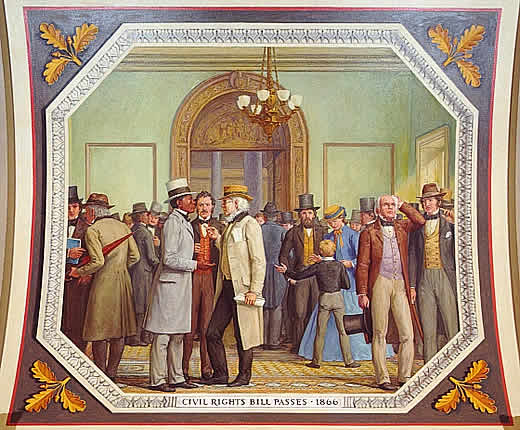
“Mexicans” were counted as a race in the 1930 questionnaire, but the Mexican government protested and the category disappeared. “Hindu” lasted for three decades. Koreans were written in, pulled out, and added back again.
All along, the “race” category of the census has been a powerful social and political tool wielded both to discriminate and to guard against discrimination. At first, survey categories reflected ideas about the divide between black and white, which immigrants were eligible for citizenship, and how to sort categories of “Indians.” Later, after the Civil Rights Act of 1964, its groupings also made it possible to measure compliance with equal treatment under the law.
The census reveals the process of race, the categories by which Americans construct difference and with difference, special privileges for some. It measures who and what matters, how resources have been allocated, and reflects the political, economic and social interests that prop up race. Race is defined and contested constantly, shaped in both personal and social realms all at once, according to Michael Omi and Howard Winant, sociologists who developed the central paradigm for studying contemporary race in American society.
Today, for instance, many Latinos refuse to conform to the forms of race described in the census. “Hispanic” is separated out as an “ethnicity” on the survey, so members of this group are expected to choose a race, too. About 40 percent in both 1980 and 2000 selected “some other race,” often writing in an identity such as “Venezuelan” instead.
But that’s not to say race is an illusion, a set of categories we can write in or wipe away like chalk on a blackboard. Race arose in America as a means to support and rationalize the slave economy. By the end of the 17th century, writes social anthropologist Audrey Smedley, wealthy planters had carefully woven it into a “rigid and exclusionist” system, a legal and institutional hierarchy built upon skin color.
We continue to shape race through both our institutions and everyday actions, and it powerfully shapes us. Public health statistics reveal the damage. On average, white people can expect to live about five years longer than African Americans. Even middle-class black people are more likely than any other group to live with a chronic health condition or disability. American Indians and Latinos suffer disproportionately from diabetes, Asian Americans bear a heavier burden of tuberculosis and hepatitis B, and the list goes on. While genetic scientists hunt for possible differences in susceptibility, public health experts shine their light on society.
Forces like everyday prejudice, segregated neighborhoods and unequal schools wear out hearts and immune systems, clog up air passages and make us fat. San Francisco is among the cities, in fact, studying the ways in which we build disparate health opportunity right into our streets. Who enjoys neighborhoods with clean, well-lighted sidewalks? Who has to battle congested traffic and diesel fumes to get to work or school? Who can walk to a farmers’ market on Saturday, and who sees only fast-food outlets block after block?
When confronted with race categories neatly printed out on a form, it’s tempting to see them as natural divisions. The inequities that go along with them, it seems to follow, are natural, too. With their proposition to claim themselves as a race, the Southern Confederates challenge all of us to contemplate what we mean by that term and what role we play in making its harms and hierarchies real. And when we learn about racial differences in health, in economic success, in education or any other measure, we should remember the confederates. Race matters, and we are the hands that shape it.
Read more: http://www.sfgate.com/cgi-bin/article.cgi?f=/c/a/2010/04/17/INA41CUC6V.DTL#ixzz0lZT8DJ4W


excerpted from a talk entitled “Guidelines for Living Fearlessly”
Pema Chodron Books and Tapes
How to taste the quality of the moment, of the week, without the labels of good and bad, or succeeding and failing. But really just get used to tasting or knowing or experiencing the quality of what you are going through, not as some final thing.
I think Rilke said “no feeling is final”. Its a great line in one of his poems. No feeling is final, but somehow in the moment, we often feel, a sort of – this is how it is – in such a heavy way. And then so much story line goes with that that it drags us down.
So sometimes we like what we are feeling and then we don’t like what we’re feeling. And then we like it again, and then we don’t like it again. And then it just sort of goes like that – it’s actually fine for it to be like that.
Enlightened people, from what I have heard, the moods come and go, the energy shifts come and go. Its not like suddenly you are enlightened and then the rain never comes. It doesn’t mean you don’t wake up with a headache, or a heavy feeling in your heart.
But basically it never goes beyond that, its just the quality of awakened energy as it is manifesting right now. So it is a really profound deep shift of attitude towards our moods and thoughts and our emotions.
The path of liberation depends on not taking everything so personally.
I remember Trungpa Rinpoche saying to a group of students, one of which was complaining about their very very difficult work situation with a very difficult boss, and his answer began with the statement “well the trouble is, we all take everything so personally”. And I remember we all laughed and it seemed like a really funny comment. But I now see exactly what he meant.
Taking it personally means investing so much energy and time as if you are like this, and the situation is like this, and its fixed, instead of realizing that its always shifting and changing.
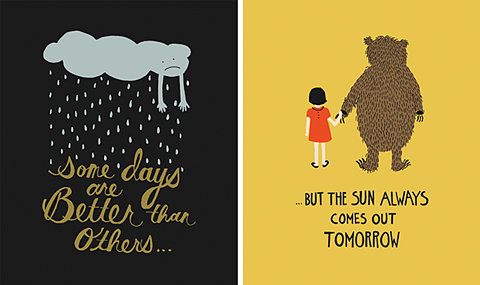
Sometimes the sun is brightly shining, and sometimes it hasn’t shone for the last three days. And you feel what you feel about that. But of course what we are really talking about is the emotional weather.
 mulatto diaries