away we go

awaywego-maya-rudolph-johnkrasinski-500x331

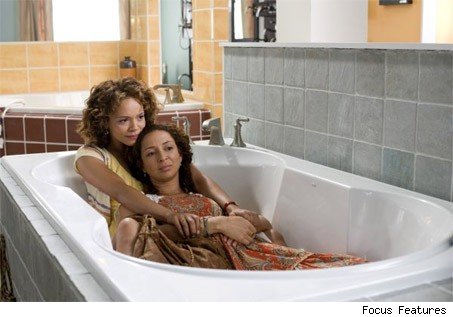
I just saw “Away We Go.”  I totally loved it! So much!  It’s so real, and they handle “the biracial” perfectly.  Outsiders bring it up, but the couple never does.  The way Verona is patronized by LN (Maggie Gyllenhaal) really hit home for me.  And I loved Catherine O’Hara as the mother-in-law asking, “How black is she gonna be?” in reference to the new baby.  And the golliwog slippers!  Here’s an excerpt from a Huffington Post interview with Maya Rudolph that Karen of reelartsy.com hipped me to.

W&H: What are your thoughts on why we don’t see more films with African American women leads.

MR: It’s certainly not for me to answer because I have nothing to do with why the world is as f***ed up as it is. It has less to do with TV and movies and more to do with race and history and culture. It’s obviously a reflection of the world we live in. Although I still can’t believe we have a president who is mixed like me. It’s one thing that we have a black president but for me it’s even crazier because he’s mixed. I feel like I come from a smaller off shoot of black people because I am mixed. People say I’m African American but that doesn’t include the other half of me.

I can’t believe I’m living in a time where I feel proud of my president where I feel like things are actually positive and people feel good about where our country can be.

I don’t know the answer to your question and I don’t know if there is one. I plan to keep doing what I’m doing because race is just not a part of the way I look at the world and the way I live my life. I think that was a minor, key thing in the way that Dave and Vendela wrote the script. Verona is mixed and Burt is white but nobody talks about it. That felt realistic to me in my day to day life. People expect race to be an issue and I was raised in a house where it was never as issue. My parents were interested in having us feel like we were normal whatever that is.

via huffingtonpost.com

maya-rudolph-3

speaking of levy’s

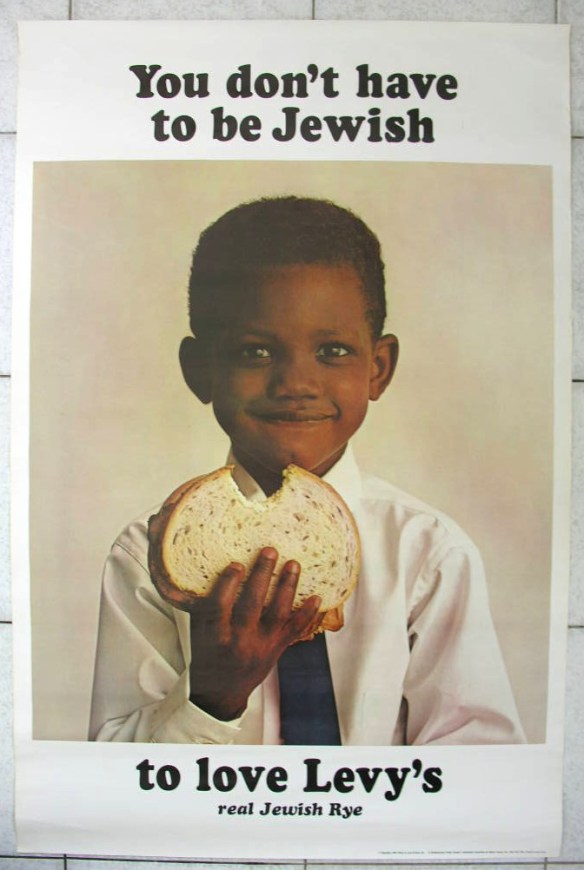
zieff.03.01.02Howard Zieff still remembers how he found the people to photograph in 1967 for his most famous advertisement, which had the tag line, “You don’t have to be Jewish to love Levy’s.”

“We wanted normal-looking people, not blond, perfectly proportioned models,” Zieff recalled. The advertisements, for Levy’s rye bread, featured an American Indian, a Chinese man and a black child.

“I saw the Indian on the street; he was an engineer for the New York Central,” Zieff said. “The Chinese guy worked in a restaurant near my Midtown Manhattan office. And the kid we found in Harlem. They all had great faces, interesting faces, expressive faces.”

…Surprisingly, many in Hollywood are unaware that the reticent and modest Zieff was perhaps the most significant advertising photographer in New York in the 1960s. His work still resonates today.

“Howard was a truly special talent,” said Roy Grace, a former chairman of the advertising agency Doyle Dane Bernbach, now part of DDB Worldwide. “There was Howard Zieff and everyone else.” Grace was the agency’s art director in the 1960s, when he began working with Zieff.

“Howard was the primary force in a certain kind of advertising,” Grace said. “His photographs were a dialogue with humor, a dialogue with what we call real people, which is now commonplace.”

“Then everybody in advertisements was white,” he added. “Every kid was tow-haired and freckled with perfect little buck teeth. Myself and my compatriots were a bunch of guys from the Bronx and Brooklyn. That was not our background. And neither was it Howard’s.”

via http://www.jewishjournal.com/travel/article/from_ordinary_faces_extraordinary_ads_20020301/Levy'sChinese_800

hh0222s

speaking of “black enough”

000000019600_0001

I was happy to come across this article (http://www.politicalarticles.net/blog/2009/06/17/are-you-black-black-enough-and-who-decides/) on the notion of “black enough.”  I’m wondering today why, when I call attention to the absurd and potentially damaging rigid notions of blackness and whiteness, people feel the need to challenge me instead of challenging these notions.  And the one that says that black and white cannot co-exist without the degradation of one, maybe even both, of them.  I do not agree with Taylor’s assertion that “it may be too late in history as well as potentially dangerous to be tampering with the socio-cultural definition of blackness even though the definition is a product of slavery.”  I think it dangerous not to tamper with it.  I think the American consciousness  is infected with racism (colorism at best).  We trace the disease back to slavery.  I don’t think we will heal and prosper and achieve the greatness intended for the nation until we rectify this situation. These definitions. I certainly do agree with his last statement though.

Are You Black; Black Enough; and Who Decides?

By Robert Taylor

In the wake of the claims of Tiger Woods and the election of a mixed race but Black President, a question has been raised in black internet chat rooms around the country as to whether there is a legal or biological definition of who is black.

Actually, there is no law operable today which defines what percentage of “black blood” makes one black. The oft-repeated notion that one drop of black blood makes one black is a cultural definition which has neither a legal nor biological foundation…It is basically a socio-cultural attitude based in major measure on how a person looks.

…Simply put, in America, if you “look” in anyway black, you “are” black. That is not law. That is not science. It just is – a practical reality. Thus Tiger Woods’ mother may be from Thailand and Tiger may object to being called black. But it does not make a practical difference.

Further, it may be too late in history as well as potentially dangerous to be tampering with the socio-cultural definition of blackness even though the definition is a product of slavery. When the Census Bureau decided a few years ago to include a category called “mixed race” in the census, many people rightfully saw it as potentially divisive, asking what practical good does the “mixed race” category serve, but to further divide people along largely artificial lines.

Finally, if one just has to ask the question, the real question should not be “who is black” but instead “who is white.” The scientific theories of Evolution and “Out of Africa” are very clear: There is only one “race” on the planet Earth and it had its origin in East Africa (around present-day Ethiopia) and then spread to all other parts of the world. Adapting to environmental conditions such as the degree of sunlight and developing in relative isolation, some groups evolved lighter skins and others evolved darker skins…Thus technically every person on the planet – from the darkest skinned person in the Congo to the lightest skinned person in Sweden – is of African ancestry.

Therefore the answer to the question above is YOU decide if you are Black enough and whether you realize it or not that gives you tremendous power.

via Politicalarticles.net

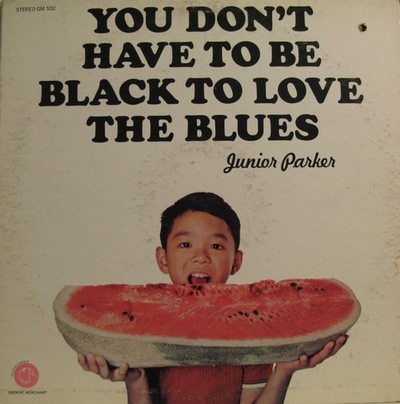
you don't have to black to love the blues

reviewed

I just came across a bad review of Mulatto Diaries: The Movie on a blog http://www.losangelista.com/2009/06/black-biracial-mixed-white-other.html.  Here’s an excerpt…

Her film is called the Mulatto Diaries, and sadly…Tiffany rubbed me the wrong way. She, and a few of the other biracial folks she interviewed in her film, came across like she believes on some level that being black means being ghetto, stupid, uneducated, lazy,uncultured, not being able to speak correct English and not having class or manners.

I am shocked that one could come away from the film with this impression.  Yes, there are clips of me and the interviewees saying that at one time or another a black person/some black people have called us out for not being black enough. What does this mean if not that to some degree, which they find unsatisfactory, we do not ascribe to some stereotypical idea of being black?  I’d really like to know.  There is also a clip of me saying that for me the shame of this biracialness was heightened at the times when I was uncomfortable with my blackness.  That discomfort was shameful.  Not the blackness.

I think my point often is that I know firsthand that blackness indeed is not about donning the stereotypical garb of rap music and ebonics, but embracing the rich and difficult history that led to my being alive.  Here in this country.  Today.  Blessed with so much.  It is only because I am proud of my blackness and secure in my blackness, that I am able to say without shame and in a loud voice that I am also white.  I am proud of who I am and who I am is equal parts both.  It may seem like I go on and on about this.  To an extreme.  Beating a dead horse.  Protesting too much this one drop rule.  But I am trying to make up for hundreds of years of silence.  This silence which I believe has contributed somehow to these negative depictions of blackness and to some illusory idea of the grandeur of whiteness.  I may not always find the way to say exactly what I mean.  I do not know what I am doing.  I only know that I am doing.  I am doing with good intentions.  I am trying to free us all (black, white, mixed, whatever) from the boxes which I believe hold us back from reaching the great heights intended for us.

smashcolorline

utah

I never would have guessed Utah!

shutterstock_1560565Multiracial_400

Census says Utah first in mixed-race growth

By Christopher Smart

The Salt Lake Tribune


http://www.sltrib.com/ci_12530272


Utah’s mixed-race population grew at the fastest rate in the nation from 2007 to 2008 — a trend some say could show Utahns are increasingly comfortable identifying themselves as multiracial.

“People are more willing to take a stand and say, ‘This is what I am,’ ” said Betty Sawyer, who works closely with students of various ethnic backgrounds and is president of Ogden’s NAACP.

New census data show multiracial Americans make up the nation’s fastest-growing demographic group. Between 2007 and 2008 the number of people identifying themselves as being of mixed race grew 3.4 percent; in Utah, the number jumped 5.9 percent.

But before 2000, the U.S. Census Bureau didn’t even provide a way for people to identify themselves as multiracial. 


…Still, the new Census Bureau option doesn’t mean the country has moved beyond racism, said Darron Smith, an adjunct professor of sociology at Utah Valley University in Orem.

Smith, a black man who is married to a white woman, studies census trends.

In Utah Valley, people often make note of the black-and-white couple who have two girls, he explained.

“I always tell my kids they are biracial,” Smith said. “But the world will consider them black.”

While more people are identifying themselves as being of mixed race, those numbers don’t necessarily reflect a more racially progressive society, according to Smith. The percentage of biracial marriages and their mixed-race offspring is still very small — 3 to 5 percent.

“It’s a [statistical] outlier,” he said of interracial marriage. “It’s still not accepted.”

the movie glory

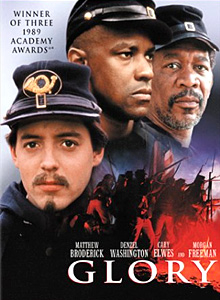
I just finished watching Glory for the 5th time.  It might be my favorite movie.  This movie was actually the catalyst for my whole “biracial” revelatory aha moment.  While watching Glory for the 4th time, I realized that, seeing as this was the history of our country, it is a miracle that I (a black and white person) even exist.  Truly.  And then I realized that I didn’t really exist.  There was no recognition of the miracle.  Not even an internal, personal one.  I realized that the history depicted in the film was the truth and that I had fallen victim to it’s legacy and failed to know myself fully.  

15341747-15341751-large

Watching the movie tonight, I was again blown away by Denzel Washington.  “The tear” is one of the most memorable moments I have witnessed on screen.  I also kept searching for the moment that might have triggered the big realization. My guess is the part where Matthew Broderick (as Robert Shaw) takes the 54th out with the other “negro regiment.”  The other leader is an ass to say the least.  He not only refers to the black soldiers as “little monkey children,” but he is extremely immoral in every sense of the word.  He treats his soldiers like animals, they act like animals.  Robert Shaw treats his soldiers with respect, like men.  In turn they are respectful and respectable men.  

The most poignant moment for me this viewing though was when Broderick and Denzel Washington’s character (whose name escapes me), were discussing the predicament that was life in America at that time.  And arguably still is to a certain extent.  Denzel says “It stinks real bad.  And all of us are in it.  Ain’t no one clean.”  Broderick asks, “How do we get clean?”  There wasn’t a definitive answer, but if I had to glean one from the film it’s that we become clean when we decide to die fighting for what we now know to be right, no matter how many wrongs we may have committed in the past.  

Thank you Edward Zwick, for the movie Glory.  I think it should be required viewing for every American.

how do you think?

basket1am212

This is so ridiculous I don’t even know what to say about it.  Other than, I’m actually glad he said it because I know he isn’t alone in holding this backwards, racist belief.  That’s how he thinks like everyone else, actually.  Well, not everyone thank God, but you know…  Most people wouldn’t admit it though.  Or maybe it’s so subconscious that they aren’t aware of it.  Either way, or whatever, it’s so perverse!!

Manuel Miranda: Latinos are ‘not like African-Americans. We think just like everybody else.’

Manuel Miranda, who was busted for hacking into the files of Senate Democrats while he served as an aide to former Senate Majority Leader Bill Frist (R-TN), is leading the conservative charge against Judge Sonia Sotomayor’s nomination to the Supreme Court. At a Heritage Foundation lunch for conservative bloggers today, Miranda discussed how conservatives could attack Sotomayor’s qualifications without alienating the Latino community. Miranda, who is Latino himself, argued that Latinos had concerns similar to those of “everyone else,” but then appeared to suggest that African-Americans somehow think differently from other people. Latinos are “not like African-Americans. We think just like everybody else”:

Hispanic polls, Hispanic surveys, indicate that Hispanics think just like everyone else. We’re not like African-Americans. We think just like everybody else. When I was on the leader’s staff, someone called me once and asked me: ‘What’s Senator Frist’s Hispanic agenda?’ I said, ‘low taxes, better education, more jobs … what are you talking about?’ And that’s how Hispanics are. This is an opportunity to educate them on all of our issues and they will resonate in the way that they resonate with everyone else.

via http://thinkprogress.org/2009/06/02/manuel-miranda-african-americans/

1am210

hope vs optimism


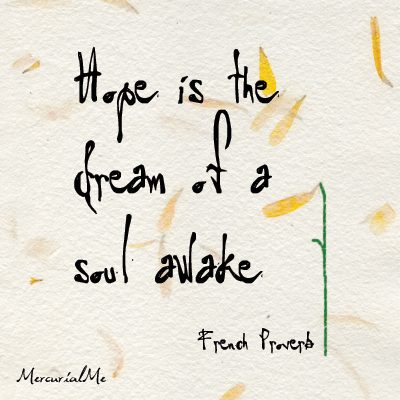
hope is the dream of a soul awake

excerpts from Prisoners of Hope by Cornel West

Over 30 years after the cowardly murder of Martin Luther King, Jr., black America sits on the brink of collective disaster. Yet most of our fellow citizens deny this black despair, downplay this black rage and blind themselves to the omens in our midst. So now, as in the past, we prisoners of hope in desperate times must try to speak our fallible truths, expose the vicious lies and bear our imperfect witness….

…The country is in deep trouble. We’ve forgotten that a rich life consists fundamentally of serving others, trying to leave the world a little better than you found it. This is true at the personal level. But there’s also a political version, which has to do with what you see when you get up in the morning and look in the mirror and ask yourself whether you are simply wasting your time on the planet or spending it in an enriching manner. We need a moral prophetic minority of all colors who muster the courage to question the powers that be, the courage to be impatient with evil and patient with people, and the courage to fight for social justice. In many instances we will be stepping out on nothing, hoping to land on something. That’s the history of black folks in the past and present, and of those of us who value history and struggle. Our courage rests on a deep democratic vision of a better world that lures us and a blood-drenched hope that sustains us.

This hope is not the same as optimism. Optimism adopts the role of the spectator who surveys the evidence in order to infer that things are going to get better. Yet we know that the evidence does not look good. The dominant tendencies of our day are unregulated global capitalism, racial balkanization, social breakdown, and individual depression. Hope enacts the stance of the participant who actively struggles against the evidence in order to change the deadly tides of wealth inequality, group xenophobia, and personal despair. Only a new wave of vision, courage, and hope can keep us sane – and preserve the decency and dignity requisite to revitalize our organizational energy for the work to be done. To live is to wrestle with despair yet never to allow despair to have the last word.

white privilege

GOTPRI2102


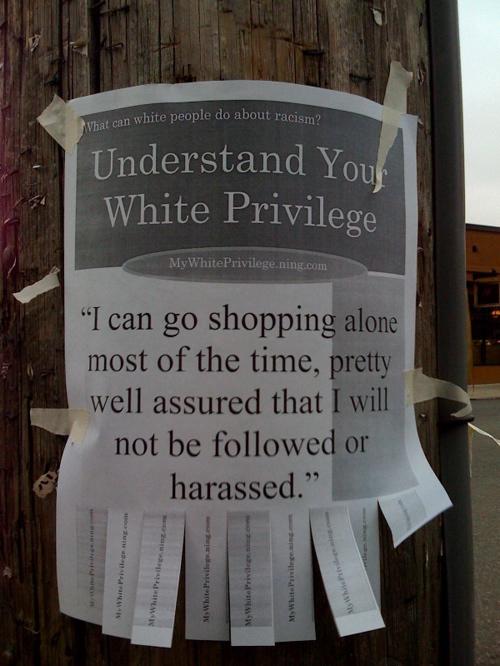
I would’ve thought that I’d first be quoting Tim Wise when discussing white privilege on this blog because I really, really like him, but I stumbled on this very insightful blog post and couldn’t resist posting it here.  It’s so succinct and personal and well written.


http://blindprivilege.com/white-trash-blues-class-privilege-v-white-privilege/

“If you blog about white privilege, you’re probably sick to death of people playing the “white trash” card in your comments. Their argument usually goes something like this:

  • “Being white didn’t give me all these privileges you’re talking about.”
  • “I know plenty of [minority] people who are better off than I am.”
  • And the advanced version, which I’m guilty of using myself: “It’s really more about class than it’s about race.”

I am “poor white trash”. I can relate to all of the statements above. I grew up looking the part of Average White Girl, but middle class white people always pegged me as “different”. This left me vulnerable to losing opportunities and even jobs to white people who “fit in” better. Also, after my family made its great escape from White Trash Hell into Middle Class Purgatory, I learned to my surprise that there were black kids in the world who’d grown up with more money than I ever had. And so on, and so forth.

Here’s where the confusion comes in. Yes, I have a legitimate grievance against the system. Yes, I’ve lost out on things because I didn’t have the $20 to invest or know the magic social password that would have marked me “normal” (read: “middle class, preferably white”). And yes, it hurts when you don’t fit in with your own race because of your class, and you don’t fit in with your class because of your race. It’s hard to see privilege around that stuff, but the examples are out there.

Wealth gets you a ticket, but it doesn’t guarantee you a seat

One of the black kids I went to school with whose family was richer than mine? We discovered we’d given identical answers on a test, and she’d gotten some of them marked wrong while I got 100%. When we examined her other papers, we realized the teacher had been doing this for some time: “giving” the black girl a lesser grade. And one of the Jewish girls I knew whose family was richer than mine? When she was absent for a Jewish holiday and missed a test, one of her teachers decided to teach her a lesson by refusing to let her make up that test anytime but on a Saturday – the Jewish sabbath. The teacher offered truly pathetic excuses why after school, during lunch and during the girl’s study period wouldn’t work. Sunday wouldn’t work because it was the teacher’s Christian sabbath! The girl’s mother had to call the principal and threaten to bring the ACLU into it before she got a proper time slot to retake the test.

I’ve never been pulled over for “looking like you’re out of your neighborhood” (unless you count the time I was lost in a snotty part of Beverly Hills in an American car, gasp!). I’m not nearly as likely to get pulled over for traffic violations as black or Latino people, even if they grew up with more money than I did. Taking things a step further, I’ve never felt pressured to join a gang just to survive. I’ve never worried I’m going to get shot in my own neighborhood (and I’ve lived in some neighborhoods the white middle class considers “bad”).”

That white skin would get you a seat, if only you had a ticket

My approach is to look at all the types of privilege that affect an individual. Take me, for example. I have white privilege and heterosexual privilege and able-bodied privilege working for me; I have class privilege and male privilege working against me. In the case of poor whites, the class privilege often takes more from them than the white privilege gives them (i.e., the college admissions board prefer my skin color, but if I can’t somehow pay tuition, I’m not getting in). In my personal experience, white privilege may be a total bust, and I have the right to feel that way: I do not have the right to muddy a discussion of white privilege with all my anti-privileges. But before I learned to separate the types of privilege, I’m afraid I probably did that once or twice. Not in the “minorities have it so easy” tone that marks one type of troll; I just couldn’t figure out which part of this stuff I wasn’t getting.”
r_1227719922_whiteprivilege

tennessee again

I used to, and by that I mean before yesterday, think that I would love to live in Tennessee.  I admit that this belief had a lot to do with my love and admiration for one Amy Grant.  I know that nothing can come between me and my Amy, but Tennessee I’m rethinking.

jack-in-the-box-is-backkkk

Jack in the Box settles claim on behalf of worker

Associated Press – May 20, 2009 11:15 AM ET

NASHVILLE, Tenn. (AP) – Fast-food chain Jack in the Box has settled a lawsuit filed by federal officials on behalf of a worker at a Nashville restaurant for $20,000.

The Tennessean reported Frances Griffith, a white hostess, said she was subjected to repeated “obscene racial epithets” by African-American co-workers and that one told her she should kill her unborn baby because it was of mixed race.

The lawsuit by the Equal Opportunity Employment Commission stated Griffith called a company ethics hot line last April, after which the chain investigated and fired one employee for making racial remarks.

The claim stated the harassment continued and the company did not respond to her further complaints.

In a statement Tuesday, Jack in the Box said the company doesn’t tolerate discrimination or harassment of any kind.

 Information from: The Tennessean, http://www.tennessean.com

I don’t think of Jack in the Box as having a hostess, but I’ve never actually been to one.  I also don’t suddenly hate Tennessee because crap like this can happen anywhere.