shaking my head

story from

Conservative Activist Forwards Racist Pic Showing Obama As Witch Doctor

By Zachary Roth – July 23, 2009

The election of our first black president has brought with it a strange proliferation of online racism among conservatives.

And we’ve got the latest example.

On Sunday night, Dr. David McKalip forwarded to fellow members of a Google listserv affiliated with the Tea Party movement the image below. Above it, he wrote: “Funny stuff.”

obama-witchdoctor-muck

McKalip isn’t just some random winger. He’s a Florida neurosurgeon, who serves as a member of the American Medical Association’s House of Delegates.

Asked about the email in a brief phone interview with TPMmuckraker, McKalip said he believes that by depicting the president as an African witch doctor, the “artist” who created the image “was expressing concerns that the health-care proposals [made by President Obama] would make the quality of medical care worse in our country.” McKalip said he didn’t know who created it.

But pressed on what was funny about an image that plays on racist stereotypes about Africans, McKalip declined to say, instead offering to talk about why he opposes Obama’s health-care proposals.

“I have a busy day,” he said eventually, before ending the call.

oreo barbie: black edition

I was never allowed to have a Barbie doll.  Of course that just made me want one even more.  I didn’t even like them that much, but EVERYBODY had them.  Everybody, but me.  So I felt left out and/or deprived of something.  Since this was my mother’s rule, I would beg any and everyone else that I lived with or visited to let me have one and keep it at their house.  No one acquiesced.  My mom always said she would not allow it was because those dolls were not only racist, but sexist.  If I recall correctly, her main issue was that the black barbies were just dyed white barbies.   That’s one of the main points of Ann DuCille’s Barbie post.  Today I am proud to have never owned a Barbie.  Thanks, Mom.

2001_oreo_barbie-384x1024

Apparently the “regular” version sold so well they decided to make this one.

The doll was eventually recalled.

Did Mattel intentionally produce a doll that embodied a well-known insult in the Black community?  If they didn’t (and let’s just go with that theory), it means that no one at Mattel involved in the production of this doll had the cultural competence to notice the problem.  This points to both (1) white privilege and the ease with which white people can be ignorant of non-white cultures and (2) a lack of diversity on the Mattel team.  Less employee homogeneity might have saved Mattel both face and money in this instance.  Diversity, then, is often good business.

For more on Barbie and racial politics, see this post inspired by Ann DuCille. Reblogged

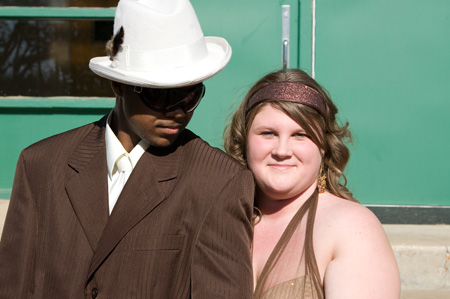
prom night in mississippi

ONE TOWN. TWO PROMS.
UNTIL NOW.

1954
The U.S. Supreme Court orders the integration of all segregated schools in America, including all their events.

1970
The town of Charleston, Mississippi, finally allows black students into their one high school. White parents refuse to integrate the school Graduation Dance, starting a tradition of separate, parent-organized White Proms and Black Proms.

2008

Change happens.

Oh. My. Goodness. Guys did you see this!?  Last night was the premiere of the HBO documentary Prom Night in Mississippi.  It was just so darn good.  One of my favorite documentaries ever!  In case you haven’t heard, the town of Charleston, MS had been holding two separate, segregated proms since the schools integrated in 1970.  Morgan Freeman offered to pay for the prom in 2007 if  they would just hold one for all of the students.  His offer was declined.  He tried again in 2008 and his offer was accepted.  The film exposes the climate of race relations in Mississippi and makes clear that this up and coming generation must make a conscious choice to break the cycle of division.

PNIMbutton230B

I have long been a fan of Morgan Freeman.  Probably since the first time I saw the movie Glory. Then he sealed the deal with Robin Hood and Shawshank.  Anyway, I was inspired by the way he spoke to the students and handled the adults on the school board, but the most poignant Morgan moment for me was when he said “If I go around hating you because you have blond hair and blue eyes, I’m doomed. You’re fine, but I’m doomed.”  I believe that with all my heart.  I’m always saying that this racism thing is a double edged sword.  On the surface it may seem like it’s just those being discriminated against who are being hurt by it, but I’ve always felt that most of the damage is done to the discriminator.  I just loved hearing him say that.

apr2709-promnight

There is a section of the film where the students are so openly talking about the ways they’ve been taught to be racist and pondering why this could be.  Some of the white kids come to the conclusion that it must be that their people don’t want mixed kids in their family.  That’s why the adults are so afraid of an integrated prom.  We’re told that one parent said, “I don’t want no n****r grinding up on my daughter.  I won’t have no mixed kids in this family.”  The fact that people think this way is certainly not news to me.  It’s my history.  I know it well.  And yet, I was so uncomfortable hearing it spoken aloud.  Like kinda squirmy.

There is one interracial couple in the film.  Heck, there is probably one interracial couple in the whole town, and they happen to be students at the school.  They do not hold hands in public.  They have never been on a date because her father, who insists that he is not racist, will not allow it.  He hasn’t “whooped her or nothin”, but he grounded her and took her phone away.  To his dismay she overcame it all and is still dating Jeremy.  They got the most applause during the senior walk at the prom.

9355pic450

There are so many things I want to relay, but really I think you should just see the film.  Please.

more obama love

As someone who is consistently accused of either holding negative ideas about what being black is and/or trying to be white, I cannot tell you just how much gratification I got out of reading President Obama’s response to the reactions to his recent NAACP 100th Anniversary speech.  In this Washington Post interview with Eugene Robinson he explains that though he was speaking directly to a group of affluent, successful, educated African Americans who are dedicated to raising their children to be the same that one should not

“underestimate the degree to which a speech like the one I gave yesterday gets magnified throughout the African American community,” Obama told me in the Oval Office, where a bust of the Rev. Martin Luther King Jr. surveys the room in silent admonition. “Folks on Friday go in and get their hair cut, they’re getting ready for the weekend, they’re sitting in the barber’s chair, and somebody said, ‘Did you see what Obama said yesterday?’ It sparks a conversation. . . . And part of what my goal is here is to make sure that I’m giving a lot of folks permission to talk about things that maybe they’ve talked about around the kitchen table but don’t get fully aired in public.”

0,,6119494,00

I am no Obama, but I must admit that I feel like this is exactly what I’m trying to do.  Get everyone talking about this uncomfortable stuff in ways that almost seem too honest because we’re just not used to having the conversation.  I have been accused of airing “our” dirty laundry.  This always leaves me thinking, “Why not?  Dirty laundry just creates stagnant funk.  Let’s air it out and move on.”

This next bit really spoke to me as well.  Whenever I highlight the widely accepted generalizations of blackness that tend to be negative and also tend to inform the definitions of blackness held by both whites and blacks, I am hoping that by looking back and seeing where these ideas came from and how they seeped into our consciousness that they will be exposed for the ridiculous, limiting notions they are and then will be dispelled.  I’m never saying “that is what blackness is and we ‘mulattoes’ are not like that.”  I just mean that there are many ways to be black.  Mainly just being born black and then living your life as you.  Whoever that turns out to be.  Whoever you turn out to emulate, hang out with, enjoy the music, company, writings of.  I think we’re American first.  And yes being black in America is still not the same as being white in America.  We are still on the outside.  But, in my opinion, the tragedy lies in thinking that’s where one belongs and making a conscious choice to stay on the outside.  Perhaps in order to reject the mainstream as they have rejected us. But with all of it’s faults, this country has a lot to offer a life.  Sometimes I think people are so busy being “black” (or whatever one has been taught to believe should infom their identity) that they miss out on some of the riches of simply being American.

“One of the ways that I think that the civil rights movement . . . weakened itself was by enforcing a single way of being black — being authentically black. And, as a consequence, there were a whole bunch of young black people — and I fell prey to this for a time when I was a teenager — who thought that if you were really ‘down’ you had to be a certain way. And oftentimes that was anti-something. You defined yourself by being against things as opposed to what you were for. And I think now young people realize, you know what, being African American can mean a whole range of things. There’s a whole bunch of possibilities out there for how you want to live your life, what values you want to express, who you choose to interact with.”

…Said Obama: “I do think it is important for the African American community, in its diversity, to stay true to one core aspect of the African American experience, which is we know what it’s like to be on the outside.

President Obama, I just love you and I promise that by focusing on my “unique experience” I am not detaching from the larger struggle. K?

the house at the end of the road

Although I am reading two books similar to this right now, I am so eager to jump into this one.  My “mulatto” google alert alerted me to this review.  I found myself fascinated by the first two paragraphs…

The Family That Rejected Jim Crow

By Martha A. Sandweiss

The Story of Three Generations of An Interracial Family in the American South

By W. Ralph Eubanks

Smithsonian. 206 pp. $26.99

W. Ralph Eubanks’s family memoir tells a double story, one about the past and the other about the author’s efforts to uncover it. This has become a familiar kind of literature, the search for family roots that becomes a search for one’s own identity. But Eubanks has an unusual story to tell. His maternal grandparents, Jim and Edna Richardson, lived on a remote rural road in a black community in the now deserted town of Prestwick, Ala. According to family stories, they married in 1914 and by 1929 had seven children. Jim was a white man, a “boisterous adventurer” and bootlegger who ran a logging business. Edna’s racial heritage was mixed, but she thought of herself as black. In Jim Crow Alabama, where the courts had repeatedly upheld the state constitution’s ban on interracial marriages, the Richardsons constituted an unusual sort of family, and they defied the social rules that governed the segregated South. After Edna died in 1937, Jim remained in Prestwick with his light-skinned children. They could have moved away to start life anew as a “white” family. After all, Eubanks says, the children were so fair that a federal census agent once categorized them as “white.” But the family “made a conscious choice to identify as black people, in spite of skin color and features that would have allowed them to move seamlessly into the white world.”

Eubanks sees this act as both radical and heroic. As a black man married to a white woman, he finds in his grandparents’ lives valuable lessons for his own. “Sometimes it even felt as if they had forged a path for the life my wife and I shared, occasionally guiding us on our way.” He thus crafts a progressive tale of social improvement, with his grandparents’ and parents’ lives in the Jim Crow South paving the way for his own youth during the civil rights era and eventually leading to his 11-year-old daughter’s vision of a world “where race matters less and justice and our common humanity matter more.”

PH2009071502246

rabbis of color

I read an interesting article on the “first” ordained African-American female rabbi here.  I was pleasantly surprised to find a bit about biracials in there….

Alysa Stanton, now 45, recently passed another milestone on her spiritual journey. On June 6 in Cincinnati’s historic Plum Street Temple, she was ordained by Hebrew Union College, the Reform rabbinical school, making her the movement’s first African-American rabbi and the first African-American woman ordained by a mainstream Jewish denomination.

…She converted in 1987. Her mother and siblings quickly accepted her decision, although, she says, “none are running to the mikvah.” But many of her friends and fellow Jews were suspicious. “It was unusual in that I wasn’t converting because of marriage but because of spiritual reasons,” says Stanton. “My Christian friends thought I’d grown horns and some of my African-American friends thought I had sold out. And the Jewish community wasn’t as welcoming as it is today, either. It was a very difficult period.”

Stanton may be a new face in the mainstream rabbinate, but black rabbis have a long history in America. To Gordon, the very notion of a “black rabbi” is a nebulous modern distinction, particularly as a deeper understanding of genetics displaces earlier conceptions of race. There are Jews of all stripes, he says, “who are publicly known as white people but who in older times would have been known as ‘mulattoes’ or in some cases, given today’s term, ‘biracial.’” Thus, there may “already have been some technically African-American Jewish rabbis.”

Black Woman Rabbi

more children’s books with biracial characters

I came across reviews of two books for kids ages 8-12 with biracial main characters at TheHappyNappyBookseller.com. Thanks so much Happy Nappy Bookseller!  I wish I’d had these books when I was a kid.

Prince of Fenway Park

Oscar’s parents adopted him when he was a baby and he worries they divorced after realizing he was half black. Being biracial Oscar has a hard time fitting in at school.

“What didn’t help was that just this year it seemed as if the white kids he’d been friends with in elementary school didn’t have much to say to him anymore, and there weren’t many black kids in Hingham Middle. Occasionally a Hispanic kid would ask him something in Spanish assuming he spoke it. He’d just shrug.” (from ARC)

I don’t run across too many biracial characters in middle grade fiction, so I was very happy to discover this about Oscar. While reading I couldn’t help thinking about all the biracial children who may discover this story and be able to relate to Oscar’s feelings.

“There was a code for race, and the tidy letters were all lined up: Black. He’d never seen it written before. There was a spot for it on the MCAS- standardized tests- and Oscar usually left it blank. The previous year he’d lightly marked both white and black and then smudged them on purpose, which seemed the most honest answer he could give.”

9780312367688

“Her parents were her parents, and she almost never thought about being adopted-except that sometimes, she did.  And they didn’t talk much about the fact that she was biracial and her parents- weren’t.  Her mother had blond hair, even.  Well, greyish blond, but still blond.  It totally didn’t matter, and it was mostly just funny, like when her father got all into celebrating Kwanzaa and everything, and she had to make him promise never to wear kente cloth in front of her friends again.”

obama in moscow

For Russian Blacks, Obama Visit Stirs Special Interest

By Kevin O’Flynn

MOSCOW — The visit to Russia by Barack Obama, the first black man to be elected president of the United States, is significantfor many Russians.


But for Russians of African descent, in particular, the new U.S. leader is a potent symbol of triumph over the same challenges they themselves face in a country where dark-skinned people remain rare and often unwelcome.


Yelena Khanga is one of Russia’s best-known black citizens. The popular host of a top-rated 1990s chat show about sex — “ProEto,” (About That) — she became one of the few black faces regularly seen on Russian television.


Khanga’s grandparents came to the Soviet Union in the 1920s to escape the racism they had endured in the United States as a mixed-race couple.


Today, Khanga says Obama’s election to the American presidency, and his current visit to Moscow, have special meaning for her.


“He did what my grandmother and grandfather dreamed about in their day,” Khanga says. “They couldn’t even have dreamed that, one day, America would have a black president. The only dreams that they had — my grandmother was white, and my grandfather was black — was that Americans would someday allow mixed couples to live in peace, have children, and let the children have decent lives. That is what they dreamed about.”


…Still, Khanga — whose great-grandfather was a slave in Mississippi — says she believes the scourge of racism was far worse in the United States, where there were 4 million African slaves by the time slavery was abolished in 1865 and where it took another century before school segregation and other forms of racial discrimination were formally outlawed.

Khanga notes that there was a very small percentage of mixed-race and black people in the Soviet Union.“I was part of the first generation — now, of course, there are a lot more,” Khanga says. “But…we did not have the history of racism as they did in America. Not everything was easy, and I can be the first to tell you what kinds of problems we had. But, of course, you can’t compare them to the kinds of things that happened in America.”

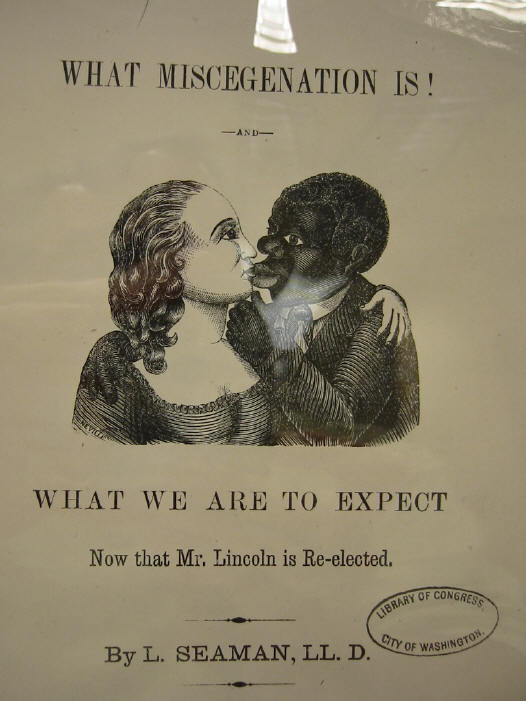
miscegenation

I really enjoyed this article.  You can find the whole thing here where it’s much easier to read.

rainbow children

British family have rainbow children

A mixed race couple have nicknamed their kids the Rainbow Children after a genetic quirk left them with a remarkable spectrum of skin colours

via Published: 6:48PM BST 06 Jul 2009

PD*29916225

White mum Carla Nurse, 27, and her black husband Cornel, 31, were not surprised when their first child Jermaine was born with a mixed race complexion.

But they were amazed when daughter Tanisha arrived with an Afro-Caribbean appearance -and their second son Jayden was born with white skin and blonde hair.

“Where I live it is a predominantly white town and I admit it looks pretty strange when I walk around with my brood of rainbow children,” said Mrs Nurse.

“I am at a complete loss to explain why they are all different colours – I can only think that it is some type of freaky genetic thing.

“After Jayden was born and he looked Aryan my friends nicknamed us the United Nations.”

Mrs Nurse , a part-time model from Lowestoft, Suffolk, said her only concern is that many people assume the children have different fathers.

She said: “I remember giving birth to each one of them at the hospital and all the doctors were looking at me thinking I had all these children to different men.

“When people think I’ve cheated it makes me so angry. “I would never stray from Cornel and never have – I’m totally devoted to him and always will be.”

Mr Nurse ,whose Afro-Caribbean father came from Barbados and white mother came from London, grew up in the Suffolk village of Halesworth just 30 miles away.

Their eldest son Jermaine, now six, has brown eyes with golden brown skin while daughter Tanisha, four, takes after her father with Afro-Caribbean skin, dark eyes and tight black curls.

Youngest son Jayden, now two, has white skin, blonde hair and bright blue eyes.

All three siblings have their mother’s nose and big eyes while Tanisha has full lips similar to Mr Nurse.

Mr Nurse said: “They are definitely all mine and the whole thing is just a freak of nature. Tanisha was dark from the start but as the boys got older one has gone darker and one has got whiter.

frederick douglass on this day

On July 5th, 1852 Frederick Douglass was asked to give an Independence Day speech before the Rochester Ladies Anti-Slavery society in Rochester, NY at Cortinthian Hall.  Historian Philip S. Foner has called this excerpt “probably the most moving passage in all of Douglass’ speeches.”  You can find the entire speech here.

What, to the American slave, is your 4th of July? I answer; a day that reveals to him, more than all other days in the year, the gross injustice and cruelty to which he is the constant victim. To him, your celebration is a sham; your boasted liberty, an unholy license; your national greatness, swelling vanity; your sound of rejoicing are empty and heartless; your denunciation of tyrants brass fronted impudence; your shout of liberty and equality, hollow mockery; your prayers and hymns, your sermons and thanks-givings, with all your religious parade and solemnity, are to him, mere bombast, fraud, deception, impiety, and hypocrisy — a thin veil to cover up crimes which would disgrace a nation of savages. There is not a nation on the earth guilty of practices more shocking and bloody than are the people of the United States, at this very hour.

022

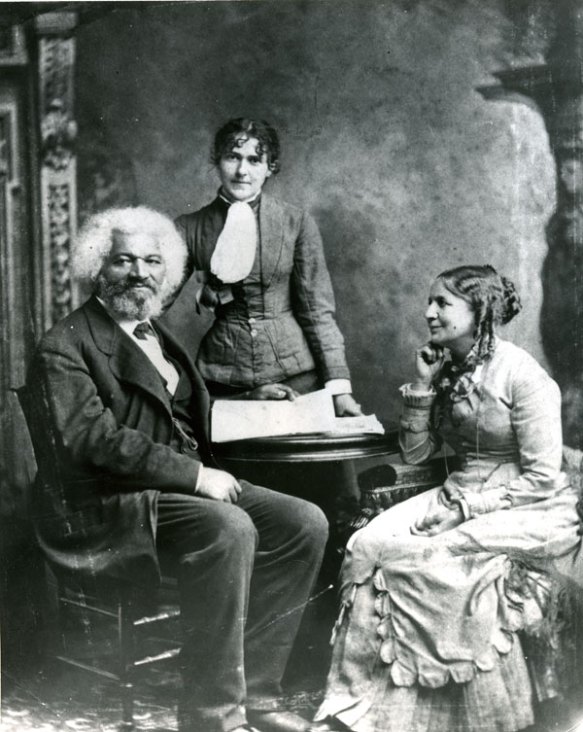
douglass_helen_eva_frederick

Douglass, his second wife Helen, and their niece Eva

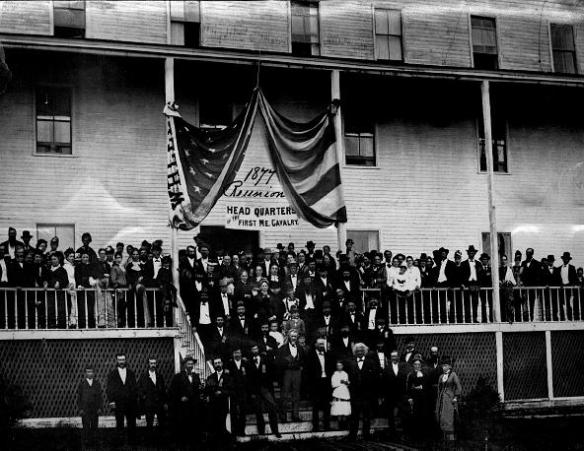
douglass

IN 1877, THE GREAT AFRICAN AMERICAN ORATOR AND WRITER FREDERICK DOUGLASS, WHO HAD SPENT MOST OF HIS LIFE FIGHTING FOR THE ABOLITION OF SLAVERY AND FOR THE RIGHTS OF ALL INDIVIDUALS, TRAVELLED THROUGH NEW ENGLAND ON A SPEAKING TOUR. HE WAS INVITED BY VETERANS OF THE FIRST MAINE CAVALRY, A FAMOUS CIVIL WAR UNIT, TO JOIN THEM AT THEIR ANNUAL REUNION IN OLD ORCHARD BEACH. DOUGLASS IS STANDING FOURTH FROM RIGHT IN THE FIRST ROW. HE NOTED THAT IT WAS A SIGN OF GREAT PROGRESS IN RACE RELATIONS THAT HE HAD ENJOYED “A GAME OF CROQUET WITH LADIES AND GENTLEMEN OF A DIFFERENT RACE RIGHT OUT IN FRONT OF THE HOTEL.” via