speaking of adoption

I’m not happy to be posting something connected to Ohio State University, BUT I’d never heard of an adoption like this one and I found it rather interesting, so pardon me fellow Wolverines…


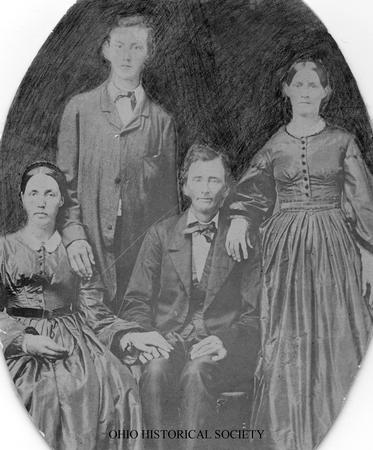
Mary C. Thorne and Family

This is a portrait of Mary C. Thorne of Selma, Clark County, Ohio, with her family. The woman standing is a mulatto fugitive slave that the Thorne family adopted. The image was collected by Ohio State University professor Wilbur H. Siebert (1866-1961). Siebert began researching the Underground Railroad in the 1890s as a way to interest his students in history.

SOURCE

a terrific struggle for supremacy!?

oct 7 11

Savannah Tribune, October 7, 1911. Seems like the phenomenon of albinism was not as widely understood as one might think circa 1911.

oct 7 11 2

oct 7 11 3
I assume that said “recreation pier” was a place of cheap amusement–a midway of some sort. Nobody wasted any time capitalizing on the cash value of these infants. The bit about race supremacy being the crux of their antagonism certainly is nuts. It’s like baby Sallie is getting an exemption from the one-drop rule.

oct 7 11 4

“thick, super-sensual, sagging lips.” Eek!
oct 7 11 5

Gee, that’s arguably kinda racist. Though it’s mighty white on the part of the reporter to allow that baby Marie is “just as clean and equally bright as her sister.” I bet she grew up to be “articulate.”
oct 7 11 6
I wonder what happened to these kids.

reblogged from The Hope Chest

fair and good features….on the dark half

Good Lord!!

Ebony & Ivory

San Jose Mercury Evening News, November 30, 1887. Here’s the “tragic mulatto” principle taken to extremes by cruel Nature. Or then again, maybe circus life would have offered more to this kid than whatever hardscrabble misery awaited him in post-Redemption Florida. If only we had a name other than “it” for the child in question, I might be able to find out what happened to him.

Ebony & Ivory2

reblogged from The Hope Chest

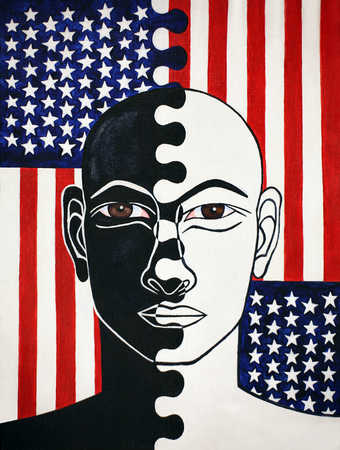
art by Kaadaa

re: willing to accept

Here’s another article that references the perils of placing biracial babies in adoptive homes.  Is adoptive a word?  Anyway, this just reinforces my strong desire to adopt a brood of biracial kids.  I guess it’s not going to be that difficult once I’m ready.  Getting ready is the difficult part.
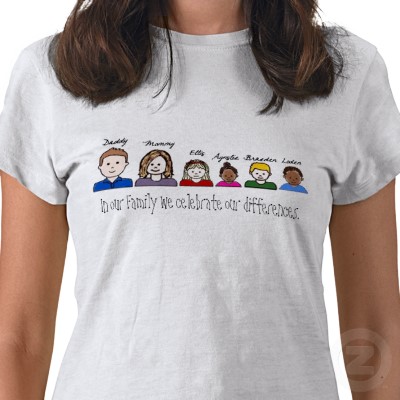
Adoption fulfills dream of blended family for Erie County couple

By DANA MASSING

A chatty little social butterfly, 5-year-old Grace Ann May can be sassy and likes to show off a little.

That’s how Annette May describes the daughter who is most like May was as a child.

“Other than she’s brown and I’m white,” May said.

Grace is one of two girls and two boys who became part of the May family, of Greene Township, through adoption.

Gracie, as she’s called, and two of the others are biracial. The children, who range in age from 5 to 12, were joined by Annette and Scott May’s first biological child, a daughter born on Mother’s Day.

“White, black, purple with pink polka dots, it really doesn’t matter to us,” Annette May said. “Everybody deserves a family that loves them.”

…The Mays’ four adoptions were done through Catholic Charities, even though the family is Presbyterian. The agency works with families of all faiths. It had more adoption options and lower fees than other agencies, Annette May said.

Heather Hough, adoption counselor for the agency, said cute babies with blonde hair and blue eyes are the easiest to find families for.  “Everybody wants those,” she said.

Some children up for adoption have physical, mental or behavioral issues, said Ellen Miller, Catholic Charities’ special-needs adoption coordinator. She worked with the Mays on their adoptions.

The Web site for the Statewide Adoption and Permanency Network, or S.W.A.N., states that “special needs” refers to “children waiting to be adopted who are older, of minority heritage, part of a sibling group or have a disability” or “for whom finding an adoptive family may be more challenging.”

“A lot of our kids, their need is they need a family more than (they) have special requirements,” Miller said.

Annette May said one of the most difficult parts of adopting was answering questions about what she and her husband would accept in a child.

“You can’t make those decisions when you have a child naturally, so I felt very awkward feeling like I could make those decisions in this circumstance…  We had fertility issues,” Annette May said. “We’re kind of traditional folk. We never really financially could afford in-vitro (fertilization) or things like that, and I’m just not that type of person, not interested in going through all that. It sounds very cliché, but as a kid, I always thought it would be very neat to have a blended family.”

That family started with Grace Ann. She was 10 days old when the Mays took her home. They were early in the adoption process and hadn’t expected results so soon, but no other family wanted a biracial baby at the time, Annette May said.
“We’ve always been open to pretty much any age and any race,” she said.

When Gracie was 6 months old, the couple heard from Miller at Catholic Charities again.

“She called and said, ‘We have a biracial little boy, born at Hamot yesterday, needs somebody to pick him up tomorrow. Are you willing?'” Annette May recalled.

“At the time, we just kind of thought, ‘This is so unusual.’ We had those thoughts of, ‘People say it takes forever. It’s a boy and a girl. Are we ever going to have the opportunity if we turn it down?  And so we said yes, and I thought, ‘Hey, people have twins all the time. What’s the big deal? We’ll just get it all out of the way at once — diapers, bottles, the whole thing.'”


Read the rest of the Mays’ story HERE

don’t call me george

The Society for the Prevention of Calling Sleeping Car Porters “George” was a lighthearted association with a useful, if incidental, cause. Most railway porters were black, and many passengers called them all George, following the racist custom of naming slaves after their masters. (George Pullman ran the company that made the cars, so the porters were regarded as his servants.) Strangely, the prevention society was founded not by the black porters, but by white railway employees who were actually named George. Apparently they were either annoyed by the tradition or thought that such a society would be a good joke. People did think it was funny, or at least inoffensive. At its peak, the society had 31,000 members, including King George V of the United Kingdom, Babe Ruth (whose given name was George), and French politician Georges Clemenceau. source

The Society for the Prevention of Calling Sleeping Car Porters “George” was a lighthearted association with a useful, if incidental, cause. Most railway porters were black, and many passengers called them all George, following the racist custom of naming slaves after their masters. (George Pullman ran the company that made the cars, so the porters were regarded as his servants.)

Strangely, the prevention society was founded not by the black porters, but by white railway employees who were actually named George. Apparently they were either annoyed by the tradition or thought that such a society would be a good joke.

People did think it was funny, or at least inoffensive. At its peak, the society had 31,000 members, including King George V of the United Kingdom, Babe Ruth (whose given name was George), and French politician Georges Clemenceau.

via

I found some letters from 1937 to Time magazine in reference to an article they ran on the aforementioned Society.  I wonder whatever happened to John from Detroit.

TIME.com

Letters, Jan. 11, 1937

Double Interest Sirs:

Your article, TIME, Dec. 7, under People interests me doubly.

Whether porters become “Porter” or merely cease being “George,” I remain

GEORGE PORTER

Wallingford, Conn. Georges v. Electromaster

Sirs: Your issue of Dec. 7 failed to mention that the S. P. C. P. G.* is a trifle more than a “joke,” that it does everything in its power to help “George,” that its last known public appearance was in the U. S. Patent Office in July 1930. Electromaster, Inc., manufacturing cleaning and scouring powder, intended to market the product under the trade-mark of “Let George Do It” and for that purpose filed a trade-mark application. Opposition #10833 was filed by the Society. The Notice of Opposition recites that the society is “unincorporated under the laws of all States and having an office and place of business at in West Monroe St., Chicago, Illinois, not to mention the B. & O., the D. L. & W., the Santa Fe and points west.” Four grounds for opposition are set forth; the second goes as follows: “The mark which we are opposing comprises the hateful admonition, ‘Let George Do It’.

Now it is doubtless true that the Georges have performed most of the useful work of the world since the memory of man runneth not to the contrary, but the facile and facetious manner in which responsibility is delegated to us by Tom, Dick and Harry and others too lazy and too incompetent to assume it themselves is decidedly irksome to us Georges. . . . Besides, why should George do it?” . . .

Respondent denies that the trade-mark ‘Let George Do It’ is a hateful admonition; and further denies that the Georges have performed most of the work of the world, or any material part thereof, or that any of it has been of any value to humanity, and demands strict proof thereof. Further answering, Respondent is not concerned, or in any manner interested, excited, pleased or horrified regarding the responsibilities delegated to the Georges by Tom, Dick and Harry, or any others, or that such responsibilities are decidedly irksome to the said Georges, because they have a way of avoiding the seriousness thereof. Besides, why shouldn’t George do it? …

HENRY GOLDHOR

Newark, N. J.

Sirs: Your issue of TIME dated Dec. 7, p. 80, re The Society for the Prevention of Calling Sleeping Car Porters “George.” I wonder how many of your readers know of an organization whose purpose it is to discourage the use of a distinguished Christian name to designate an endroit which invites not even the slightest thought of anything distinguished; I have reference to “The Society for the Prevention of Calling Lavatories John.” The Society is of Detroit origin and confine, but it may be that mention of its existence in TIME will prompt the organization of companion chapters in other centers—perhaps even a national unit.

JOHN W. MACNEV

President

“Society for the Prevention of Calling Lavatories John” Detroit, Mich.

Read more:http://www.time.com/time/magazine/article/0,9171,757243-3,00.html#ixzz0YRZS3SJZ

no difference between them

Here’s a new book full of beautiful black and white portraits of interracial couples!  The foreward is written by one of my favorite mixed chicks, Heidi Durrow.  The photos are stunning.  Thank you, Robert Kalman, for this wonderful book that will no doubt help us break our subconscious instinct to assume that these people do not belong together.  You can purchase your copy here.