a biracial committee in 2009

Remember how I discovered that until the 1990’s biracial described groups of black and white people, not individuals or people of mixed-race?  Well one of those groups still exists.  In fact 6 of them do in Florida.
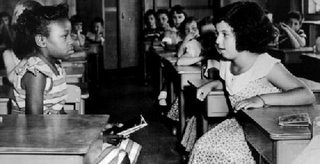
Orange school desegregation: What is biracial committee?

What is it required to do? Its bylaws require members to hold an annual meeting in September and to meet on a regular basis on a schedule that they set themselves. The members are also to meet whenever the committee chairman or superintendent needs them to, such as to review the attendance lines for new schools that open in the fall.

Why are members required to be only black or white? When a group of parents filed a suit against the district, Hispanics were not included in the lawsuit. Blacks were separated from whites, and several black parents sued for their children’s rights to equal access to public schools.

What are the details of the case? A group of Orange parents first sued the district in 1962, spurred by its refusal to let Evelyn R. Ellis attend Boone High. Her father, John P. Ellis, was president of the Orange County NAACP. The lawsuit evolved over the years, with different parties, including the NAACP, signing on. In 1964, a judge declared Orange must desegregate its schools. During that time, Orange often ignored the order and at times deliberately flouted it. In 1971, for example, School Board members voted to go to jail rather than accept busing for racial balance. Later, members agreed to move 900 students around the county. Orange has largely ended that practice for all but about six schools.

http://www.orlandosentinel.com/news/education/orl-asecracebox08040809apr08,0,4849860.story


segregation1

ought to give iowa a try

“dubuque, de moines, davenport, marshalltown, mason city, keokuk, ames, clearlake…”  if you didn’t do the music man in high school that might not mean anything to you, but this op-ed is worth reading anyway. in my opinion.

http://www.nytimes.com/2009/04/09/opinion/09thrasher.html?_r=1


New York Times

OP-ED CONTRIBUTOR

Iowa’s Family Values

Published: April 8, 2009
IF it weren’t for Iowa, my family may never have existed, and this gay, biracial New Yorker might never have been born.

In 1958, when my mother, who was white, and father, who was black, wanted to get married in Nebraska, it was illegal for them to wed. So they decided to go next door to Iowa, a state that was progressive enough to allow interracial marriage. My mom’s brother tried to have the Nebraska state police bar her from leaving the state so she couldn’t marry my dad, which was only the latest legal indignity she had endured. She had been arrested on my parents’ first date, accused of prostitution. (The conventional thought of the time being: Why else would a white woman be seen with a black man?)

On their wedding day, somehow, my parents made it out of Nebraska without getting arrested again, and were wed in Council Bluffs, Iowa, on March 1, 1958. This was five years before Nebraska would strike down its laws against interracial marriage, and almost a decade before the Supreme Court would outlaw miscegenation laws throughout the country in Loving v. Virginia.

When the good state of Iowa conferred the dignity of civic recognition on my parents’ relationship — a relationship some members of their own families thought was deviant and immoral, that the civil authorities of Nebraska had tried to destroy, and that even some of my mom’s college-educated friends believed would produce children striped like zebras — our family began. And by the time my father died, their interracial marriage was seen just as a marriage, and an admirable 45-year one at that.

That I almost cried last week upon reading that the Iowa Supreme Court overturned the state law banning same-sex marriage will therefore come as no surprise. I’m still struck by one thought: over the years, I’ve met so many gay émigrés who felt it was unsafe to be gay in so-called flyover country and fled for the East and West coasts. But as a gay man, I can’t marry in “liberal” New York, where I’m a resident, or in “liberal” California, where I was born, and very soon I will have that right in “conservative” Iowa.

Of course, the desire to define relational rights and responsibilities with a partner, to have access to the protection that this kind of commitment affords, is rather conservative. But it’s a conservative dream that should be offered to all Americans. Though it takes great courage for gays to marry in a handful of states now, one hopes that someday, throughout the nation, gay marriages, like my parents’ union, will just be seen as marriages.

It’s safe to say that neither the dramas of our family, nor its triumphs, could have been possible without the simultaneously radical and conservative occasion of my parents’ civil marriage in Iowa. And so when the time comes, I hope to be married at the City Hall in Council Bluffs, in the state that not only supports my civil rights now, but which supported my parents’ so many years ago.

Steven W. Thrasher is a writer and media producer.

seaprop8

segregation remembered in 1976

I really enjoyed reading this “old” time magazine article.  It’s from the year of my birth, so it’s not that old. Right?  In one of my latest youtube videos I interviewed a biracial woman from West Virginia and we spoke of how some southern whites say they are “proud to be white”, but we think they really mean that they are “proud to not be black”.  The Washington Redskins part of this article brought that conversation to mind.

Segregation Remembered

a day late

I really missed the boat on this one.  A few days ago my mom emailed me a link to some old Life magazine photos taken immediately after Dr. Martin Luther King Jr.’s assassination, but I was working out of town and not paying attention. 


martin-l-king-jr


85755069

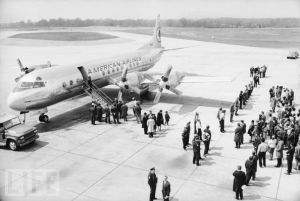
The Plane That Would Take Dr. King’s Remains to Montgomery
An airplane dispatched by the U.S. government to retrieve Dr. King’s body and return it to Montgomery, Alabama, waits on the tarmac in Memphis. “Here we were, two White guys in the Deep South right after the murder of the preeminent leader of the black community, and we’re taking pictures. Voyeurs, in a sense. We were apprehensive about it. But when we got there, there were no big problems for us.”
Photo: Henry Groskinsky/Time & Life Pictures
Apr 04, 1968

the dark tenth

27slaves1
Here’s another gem from my highbeamresearch.com excursion.  An excerpt from a Time Magazine article published in 1931.  My favorite parts of this one are:  “practically from the beginning acquired white blood”- like it just magically happened, “conditions imposed by their maternity”- now it would most frequently be imposed by their paternity, and the 80% thing. People often say (or throw in my face) that “we’re all mixed, we’re all biracial- get over it.” I completely understand that we’re all mixed, but before reading this article I imagined that all blacks are mixed because of the aforementioned “acquiring” of white blood. And when I imagined that I thought of it coming directly from a white person. But this old article points out that the white blood often comes from “Negroes and mulattoes…marrying mainly among their own color and so distributing the primary blood mixtures more and more evenly throughout the new race.” It seems obvious (it is obvious), I just never thought of it in that way. 

Browns

“biracial”

I’ve noticed in my latest research that in the ’50s and ’60s “biracial” described committees, boards, commissions, councils, governments, mediation teams, towns, schools, and groups. Not people. People were “mulatto” and things were biracial. Actually groups of black and white people were biracial. Now we’d say interracial, I guess. It is interesting to notice the shift in the language. I think the definitions are ever-changing. That’s why I have a love-hate relationship with words. I love them, but they can be fickle and misleading.

Kinda like, I know that when I say “monoracial” all the time that the proper term is “uniracial.” But to me uniracial is the big prize. It’s the word we get to use when the illusion of race has been globally recognized for the fallacy that it is and we’re uniracial. Belonging to the human race. We have various cultures and all, but basically we’re people and there’s only one race of us. So I’m saving uniracial. We don’t get to use it yet.

I totally did not intend to bring that up in this post.

Anyway, the first instance I found of a person being labeled biracial was in The New York Times on March 1, 1987- “LIVING IN TWO WORLDS. By Maxine B. Rosenberg. Photographs by George Ancona. A low-key and affecting photo essay about the fewer than two percent of children in the United States who are biracial.”

Biracial shows up thrice more in 1987 in reference to foster/adopted children. Through the early ’90s “biracial” is used mostly for the aforementioned groups with a noted increase in the use of the word as a racial categorization as the articles become more recent. 

This brings me back to my defense of my use of the word “mulatto.” Most of my childhood was spent in the 1980’s when people were still referred to as mulatto and “things” as biracial. But “mulatto” was a bad word not to be spoken, so I was either nothing, “other”, or black.  Everyone like me was. As I see it, this validated and perpetuated the one-drop rule. And threw shadows of shame onto my true identity. It gave me no chance and no choice to form an identity from a foundation of wholeness. I think this word “mulatto” is a larger piece of this race puzzle than most people think.

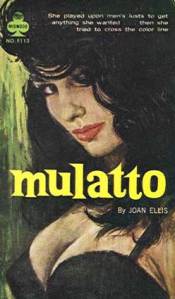
mulatto book coverI mean, I definitely don’t want to be associated with that and if that‘s what people think of as “mulatto” I’d rather deny my whole self and be black which is exactly what “they” wanted when “they” created the system because the system will crash if too many people come to know that there is no great divide between the two races and that a person can actually be both black and white simultaneously.

The system is crashing.

mulatto in history

Lately I’ve been perusing articles tagged ‘biracial’ and ‘mulatto’ on a research website.  I’ve found some interesting stuff (not this particular photo tho). Most interesting to me in this story is the white woman/black man combo, the fact that Rose has no last name, and the description of mulattoes as “children of such unnatural and inordinate copulation.” I think we’re still combating this notion, just as blacks are still combating the “soulless, less than human” one.  

petition1

On the petition of Rose the Mullato Daughter of Mary Davis of ye Province of Maryland against Mr. Henry Darnall about her Freedom Consideration.

Rose Davis is a mulatto woman, born to indentured servant Mary Davis from London and a former slave, Dominggoe, who were married at the time of Rose’s birth.

Rose Davis has been bound-out until the age of 31. On Aug. 11, 1715, Rose turned 31 and was not given her freedom as prescribed by the Laws of Assembly in the Province of Maryland.

The law states that “Issues of such or children of such unnatural and inordinate copulation, shall be servants till they arrive at the age of Thirty One Years.” Her owner Henry Darnall, of this County, has determined that he will not release her from servitude and will keep her as a slave for life.

With so many interracial relationships in the Province between whites and African Americans, the laws were especially harsh against white women and African-American men, in order to keep a larger free African-American population from rising in the Province of Maryland.There are numerous stories and court cases in all counties of Maryland where free people were unjustly held as slaves because of their color and inability to fight against wealthy planters. There also were lawsuits brought against owners because parents felt servitude was harsh, or that their children were being abused. In the case of these children of two races, the females suffered as they could be used as courtesans not unlike the quadroons and octaroons of New Orleans and the mulattoes of Africa.

Maryland manumission records for the Darnells and their cousins / in-laws the Carrolls, show that providing freedom to slaves or mulattoes, regardless of their status, was rare.

What evidence could Rose bring to the courts that would help her win her freedom? Would the family who loved her be there to support her claim?

Only one could make this claim to her birthright and loved her more than anyone: her mother, Mary Davis. Mary a former indentured servant, provided Rose with the family Bible to use as evidence for the upcoming trial.

On 13 March 1716, the Court proceeded with Rose’s petition and her counsel provided the following opening statement:

“The petition hereby showeth that your petitioner being a baptized Mulatto descended by the mother of Christian Race as appears from the evidence of her said mother is ready to provide as well as other testimony’s if need be to confirm the same, and being arrived to the age of thirty one years the 11 day of August 1715, at the time she supposes the servitude imposed in such unhappy issue, expires. They humbly pray the benefit by Law allowed to those in her unhappy circumstances and that she may accordingly receive a free manumission from the said servitude which hand-scribed evidence mentioned in ye petition follows, in the words of her mother.”

“I Mary Davis of Richard Davis, of Mark Lane in the City of London in England where I was born do give this Bible unto my son Thomas, begotten in wedlock on my body by a Negroe called Dominggoe, once a servant to Joseph Tilley of Hunting Creek in Calvert County where I was married to him…. that you may know she my said daughter came of a Christian race by her mother, a true copy take out of the aforesaid Bible.”

What Mary really said was she had come to love and marry a former slave, entered into holy wedlock because of their love for one another and gave birth to two free children. Or so they thought.

On the 8th day of November, in the year of our Lord, 1716, the decision of the Court was read:

“Mature deliberation It is thereupon considered by the Justices that the said Rose the Mulatto and the petitioner aforesaid, serve during LIFE as a slave and that her master, Mr. Henry Darnall pay court fees.”

Rose Davis was one of many family members who could not be rescued from slavery, even in accordance with the laws.

Janice Hayes-Williams. “Our legacy: Mulatto children often kept as slaves despite laws at time.”Maryland Gazette. 2006.