inspired by mad men…sort of

I’ve actually been planning to blog this for a while, but I got lazy and tucked it into a folder on my computer.  Last week’s episode of Mad Men has inspired me to get it together though.  If you saw the episode, you probably know what this is all about.  The blackface.  The throwback to the “good old days” when it was just hilarious (and not at all inappropriate) to mock the darkies.  I’m not exactly sure how I feel about the scene from the show.  It was kind of long and awkward, but perhaps that was the point.  Anyway, it’s not like the writers of the show just pulled that out of thin air.  I bet they didn’t have the song written for the show. As with racist advertising (and as malevolent as), there is a plethora of  good ole “racist” music out there.  Wanna see some?

allcoonsErnest Hogan was a black man. Here are his lyrics:

“All coons look alike to me, I’ve got another beau you see, and he’s just as good to me as you, nig!”

Here’s some back story on Hogan and the song from Wikipedia:
In 1895, black entertainer Ernest Hogan published two of the earliest sheet music rags, one of which (“All Coons Look Alike to Me”) eventually sold a million copies. As fellow Black musician Tom Fletcher said, Hogan was the “first to put on paper the kind of rhythm that was being played by non-reading musicians.” While the song’s success helped introduce the country to ragtime rhythms, its use of racial slurs created a number of derogatory imitation tunes, known as “coon songs” because of their use of extremely racist and stereotypical images of blacks. In Hogan’s later years he admitted shame and a sense of “race betrayal” for the song while also expressing pride in helping bring ragtime to a larger audience.

463px-Cooncooncoon“Coon!  Coon!  Coon! I wish my color would fade.  Coon! Coon! Coon! I’d like a different shade.  Coon! Coon! Coon! Morning, night, and noon, I wish I was a white man ‘stead of a Coon!  Coon! Coon!”

No lyrics for these two, I believe:

watermelon trust
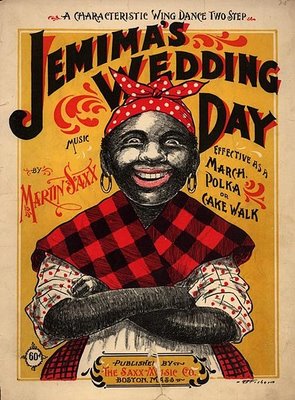
JemimasWeddingDay
Here’s one that I thought was kind of sweet, yet sad:
dpl-hac-11062-0001
“Mama, are there any angels black like me?  I’ve been as good as any little girl could be.  If I hide my face do you think they would see?  I wonder if they’ll find a place for Little black me.”

speaking of henry ford

I kind of love

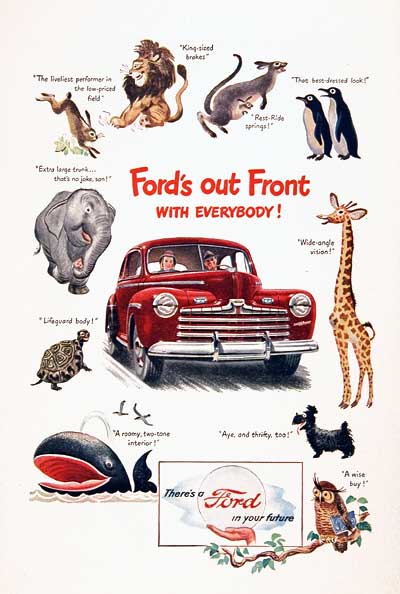
ford

“It is well enough that people of the nation do not understand our banking and monetary system, for if they did, I believe there would be a revolution before tomorrow morning.”- Henry Ford

1914-ford-model-t-touring-ad

“If money is your hope for independence you will never have it. The only real security that a man will have in this world is a reserve of knowledge, experience, and ability.”- Henry Ford

Ford_1939

“If there is any one secret of success, it lies in the ability to get the other person’s point of view and see things from that person’s angle as well as from your own.”- Henry Ford

47fordsuperdeluxesedan

“The highest use of capital is not to make more money, but to make money do more for the betterment of life.”- Henry Ford


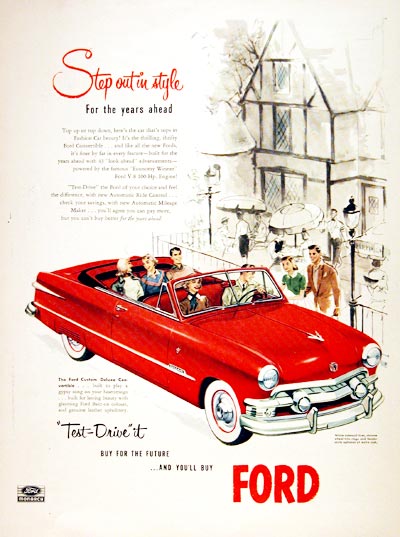
51fordcustomconv2

“Quality means doing it right when no one is looking.”- Henry Ford

56lincolncontinental

“Life is a series of experiences, each one of which makes us bigger, even though sometimes it is hard to realize this. For the world was built to develop character, and we must learn that the setbacks and grieves which we endure help us in our marching onward.”- Henry Ford

56fordthunderbird2
“My best friend is the one who brings out the best in me.” – Henry Ford

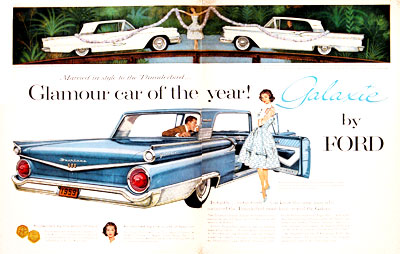
59fordgalaxie500
“Obstacles are those frightful things you see when you take your eyes off your goal.”- Henry Ford

61mercurycomets22

“One of the greatest discoveries a man makes, one of his great surprises, is to find he can do what he was afraid he couldn’t do.”- Henry Ford

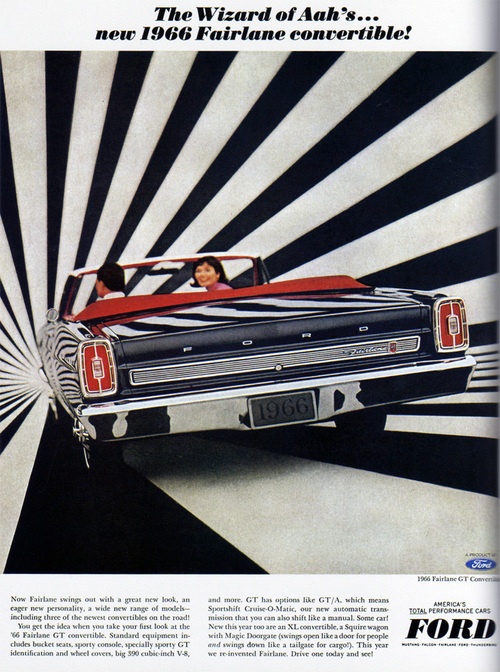
ford fairlane
“The competitor to be feared is one who never bothers about you at all, but goes on making his own business better all the time.”- Henry Ford

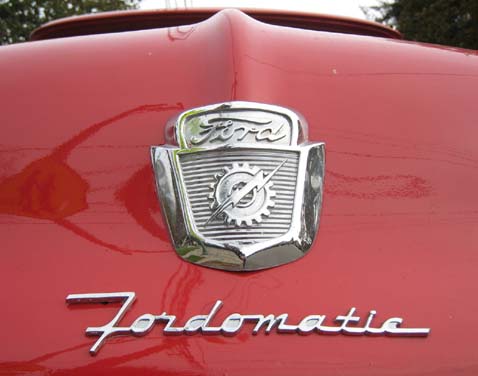
56F100_Emblem_Fordomatic

“Thinking is the hardest work there is, which is probably the reason why so few engage in it.”- Henry Ford

1975 thunderbird

“Time and money spent in helping men to do more for themselves is far better than mere giving.”- Henry Ford

80mercurycougarxr7

“What’s right about America is that although we have a mess of problems, we have great capacity – intellect and resources – to do some thing about them.”- Henry Ford

lincoln

“You will find men who want to be carried on the shoulders of others, who think that the world owes them a living. They don’t seem to see that we must all lift together and pull together.”- Henry Ford

civil rights instruction

I’m thrilled to learn that Mississippi is mandating civil rights instruction for al K-12 students.  They’re the first and only state to do so!  Maybe this will lead to the eradication of segregated proms there.  And maybe even to honest, well- rounded history books/classes throughout the country.  Be the change, Mississippi!

1960-4

JACKSON, Miss. — In Mississippi, where mention of the Civil Rights Movement evokes images of bombings, beatings and the Ku Klux Klan, public schools are preparing to test a program that will ultimately teach students about the subject in every grade from kindergarten through high school.

Many experts believe the effort will make Mississippi the first state to mandate civil rights instruction for all K-12 students.

So far, four school systems have asked to be part of a pilot effort to test the curriculum in high schools. In September, the Mississippi Department of Education will name the systems that have been approved for the pilot. By the 2010-2011 school year, the program should be in place at all grade levels as part of social studies courses.

Advocacy groups such as the William Winter Institute for Racial Reconciliation and Washington-based Teaching for Change are preparing to train Mississippi teachers to tell the “untold story” of the civil rights struggle to the nearly half million students in the state’s public schools.

“Now more than ever we are engaged in national debates about race and so much of those debates are impoverished in their understanding of history,” said Susan Glissen of the Winter Institute. “We want to emphasize the grassroots nature of civil rights and the institution of racism.”
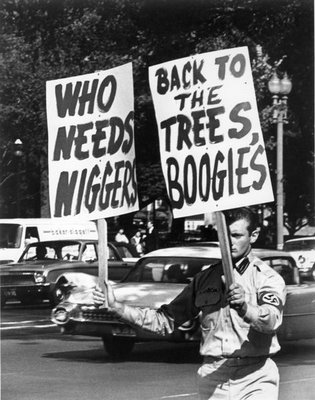
Anti-Civil-Rights

…Education officials looked to other states for a model but couldn’t find one that included anything as comprehensive as what Mississippi has in mind, said Chauncey Spears, who works in the curriculum and instruction office of Mississippi’s education agency.

The Education Commission of the States didn’t know of any other state with a such a program, although it does not specifically track social studies curriculum.

Some states, including Alabama, Georgia and Arkansas, have placed an emphasis on civil rights instruction. New Jersey created an Amistad Commission to ensure the history of slavery is taught in schools. Pennsylvania’s Philadelphia school district requires students to complete an African-American history course before graduation.

“We’re behind time. Students don’t know about what Blacks did. They’re not taught anything about culture, about our history,” said Ollye Shirley, a member of the commission created to research the Mississippi curriculum and a former Jackson Public School board member.
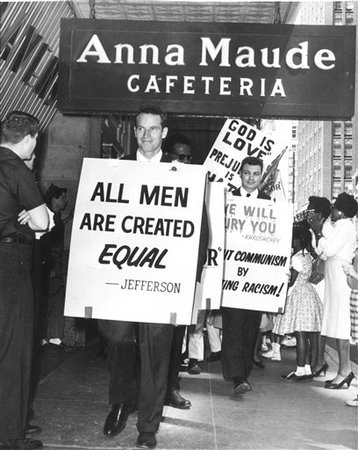
crm

…Deborah Menkart, executive director of Teaching for Change, said it’s important to help students understand that Rosa Parks and Dr. Martin Luther King Jr. weren’t the only important figures in the Civil Rights Movement.

“The traditional version would be that it started in 1954, thereby leaving out the fact that a lot of groundwork had to be done before that,” Menkart said.

via

thank you, gladys

Gladys Hernblad, 79; advocate for racial understanding

By Sally A. Downey

INQUIRER

Gladys Kinard Hernblad, 79, of Northern Liberties, an educator, author, and advocate for interracial understanding, died of heart failure July 27 at Penn Hospice at Rittenhouse.

Mrs. Hernblad grew up in Saluda, S.C. Encouraged by her mother, Sadie, she walked six miles each way to high school, and after graduation moved to Philadelphia in search of better educational and employment opportunities.

She met Robert Hernblad at a gathering for young adults at a fellowship house in North Philadelphia. He was white, of Swedish and Irish descent. She was African American. They married in 1966, one year before the U.S. Supreme Court struck down bans on interracial marriage in all states.

In 1992, Mrs. Hernblad established the Interracial Families United Network. She told a reporter at the time that she and her husband had experienced discrimination in the early years of their marriage. “We had no support for our situation,” she said. The new network, she said, would support, “all interracial marriages – Asian, Hispanic, and African American.”

Mrs. Hernblad was a major supporter of President Obama, not only for his political views, but because his biracial background mirrored her family’s, which she considered a symbol of improving race relations in America.

o-phern03

lambert (not adam)

jlw7GmHzGnhbp8slZyRdKf27o1_500

Lambert 1, NY 1902

Frank Lambert, a French immigrant spent seventeen years developing the Lambert. The first patent was in 1884 and it came to market in 1896. One types by pushing down on one of the keys, causing the whole round disk to tilt down in that direction. Down below, just above the typing point, is a convex, vulcanite surface, with all of the characters molded into it. This surface is connected to the upper disk and tilts in the correct direction, as it descends down to make contact with the paper. The middle knob is pushed down for a space. (via The Martin Howard Collection)

prom night in mississippi

ONE TOWN. TWO PROMS.
UNTIL NOW.

1954
The U.S. Supreme Court orders the integration of all segregated schools in America, including all their events.

1970
The town of Charleston, Mississippi, finally allows black students into their one high school. White parents refuse to integrate the school Graduation Dance, starting a tradition of separate, parent-organized White Proms and Black Proms.

2008

Change happens.

Oh. My. Goodness. Guys did you see this!?  Last night was the premiere of the HBO documentary Prom Night in Mississippi.  It was just so darn good.  One of my favorite documentaries ever!  In case you haven’t heard, the town of Charleston, MS had been holding two separate, segregated proms since the schools integrated in 1970.  Morgan Freeman offered to pay for the prom in 2007 if  they would just hold one for all of the students.  His offer was declined.  He tried again in 2008 and his offer was accepted.  The film exposes the climate of race relations in Mississippi and makes clear that this up and coming generation must make a conscious choice to break the cycle of division.

PNIMbutton230B

I have long been a fan of Morgan Freeman.  Probably since the first time I saw the movie Glory. Then he sealed the deal with Robin Hood and Shawshank.  Anyway, I was inspired by the way he spoke to the students and handled the adults on the school board, but the most poignant Morgan moment for me was when he said “If I go around hating you because you have blond hair and blue eyes, I’m doomed. You’re fine, but I’m doomed.”  I believe that with all my heart.  I’m always saying that this racism thing is a double edged sword.  On the surface it may seem like it’s just those being discriminated against who are being hurt by it, but I’ve always felt that most of the damage is done to the discriminator.  I just loved hearing him say that.

apr2709-promnight

There is a section of the film where the students are so openly talking about the ways they’ve been taught to be racist and pondering why this could be.  Some of the white kids come to the conclusion that it must be that their people don’t want mixed kids in their family.  That’s why the adults are so afraid of an integrated prom.  We’re told that one parent said, “I don’t want no n****r grinding up on my daughter.  I won’t have no mixed kids in this family.”  The fact that people think this way is certainly not news to me.  It’s my history.  I know it well.  And yet, I was so uncomfortable hearing it spoken aloud.  Like kinda squirmy.

There is one interracial couple in the film.  Heck, there is probably one interracial couple in the whole town, and they happen to be students at the school.  They do not hold hands in public.  They have never been on a date because her father, who insists that he is not racist, will not allow it.  He hasn’t “whooped her or nothin”, but he grounded her and took her phone away.  To his dismay she overcame it all and is still dating Jeremy.  They got the most applause during the senior walk at the prom.

9355pic450

There are so many things I want to relay, but really I think you should just see the film.  Please.

the house at the end of the road

Although I am reading two books similar to this right now, I am so eager to jump into this one.  My “mulatto” google alert alerted me to this review.  I found myself fascinated by the first two paragraphs…

The Family That Rejected Jim Crow

By Martha A. Sandweiss

The Story of Three Generations of An Interracial Family in the American South

By W. Ralph Eubanks

Smithsonian. 206 pp. $26.99

W. Ralph Eubanks’s family memoir tells a double story, one about the past and the other about the author’s efforts to uncover it. This has become a familiar kind of literature, the search for family roots that becomes a search for one’s own identity. But Eubanks has an unusual story to tell. His maternal grandparents, Jim and Edna Richardson, lived on a remote rural road in a black community in the now deserted town of Prestwick, Ala. According to family stories, they married in 1914 and by 1929 had seven children. Jim was a white man, a “boisterous adventurer” and bootlegger who ran a logging business. Edna’s racial heritage was mixed, but she thought of herself as black. In Jim Crow Alabama, where the courts had repeatedly upheld the state constitution’s ban on interracial marriages, the Richardsons constituted an unusual sort of family, and they defied the social rules that governed the segregated South. After Edna died in 1937, Jim remained in Prestwick with his light-skinned children. They could have moved away to start life anew as a “white” family. After all, Eubanks says, the children were so fair that a federal census agent once categorized them as “white.” But the family “made a conscious choice to identify as black people, in spite of skin color and features that would have allowed them to move seamlessly into the white world.”

Eubanks sees this act as both radical and heroic. As a black man married to a white woman, he finds in his grandparents’ lives valuable lessons for his own. “Sometimes it even felt as if they had forged a path for the life my wife and I shared, occasionally guiding us on our way.” He thus crafts a progressive tale of social improvement, with his grandparents’ and parents’ lives in the Jim Crow South paving the way for his own youth during the civil rights era and eventually leading to his 11-year-old daughter’s vision of a world “where race matters less and justice and our common humanity matter more.”

PH2009071502246