race manners

Since I’ve been back on the blog, I have said very little about the so-called biracial experience.  It amazes me that it’s still easier, even for me with all of my good “mixed” intentions, to talk about black and white.  I forgive myself for this because without the black and white there is no mixed.  Without the baggage of white vs. black stuff, there is no need for the mixed discussion.  So, I suppose it’s only natural.  It is little disappointing personally that the middle ground isn’t where the conversation begins for me.  It’s on the ends of the spectrum.  But I also suppose that this is natural.  I suppose this has been the disappointment of my life.  And I suppose that this is how we get to the middle ground.  By exploring the ends and inching toward the middle.

A couple of things in Jenee Harris’ article jumped out at me:

1. “My white mother has developed an acute sensitivity to the subtle ways prejudice and bigotry pop up in daily life.”- 

I wonder if my father would say he has developed the same.  I think so…I think that happened when he entered into a relationship with my (black) mother and grew deeper as he witnessed my experience… but we never talk about it…

82920031

me with my parents:)

2. “Well-intended”– re: “adults loved to tell me that people paid “good money” for hair like mine (think 1980s-era perms on white women)” and “A friend got the biscuit analogy…: God burned black people and undercooked white people, but removed her from the heavenly oven at the perfect moment.”

Well…if the intention of the (white) person who said this is to make the biracial person feel better about the perceived plight of their kind…well…i guess one could count that as a good or harmless intention. But I think that summation signifies complacence.  I, however, have to challenge this notion.  You see, giver of said “compliment,” in your quest to make me feel better about being my invisible, displaced, misunderstood, marginalized and tragic self you put me on the receiving end of your pity, your assumptions and judgements.  I do believe this is usually unconscious.  I also must acknowledge that it is an assumption I’m making. Yet there’s a reason that I assume that this is the intention behind the compliments.  The assumption is based on experience, but even those are dangerous to make. It’s the tone with which these comments are usually, subtly uttered.  If you’ve been the biracial person in this kind of conversation, I think you know what I mean.

When I engage in this kind of innocent interaction I can be left feeling frustrated, upset, and worst of all unseen.  It is depressing.  It is literally a depression of my spirit.  Of my freedom.  A depression of my freedom to just be and simply experience this life without being saddled with the weight of the stigma of a couple hundred years of prejudice, condemnation, fear, greed, inferiority, superiority, discrimination, and antagonism.  My take on it is that some people assuage a fleeting feeling of guilt over the fact that this is the biracial’s lot in life by reminding us (and/or reminding themselves) that I should be happy because I have good hair and tan skin which, I infer from your comments, should make up for the fact that on the whole the society we live in cannot acknowledge or understand how I exist.  I thought there was more to that sentence, but I think that’s it.  Our nation’s identity continues to be wrapped up in race and all the baggage that comes with it.  For that to remain intact, biracial just can’t really be.  I don’t think that needs to remain intact.  I think things are shifting.  So slowly.  But they are shifting and I hope I stay awake enough to the shift to feel when my assumptions based on past experience are truly no longer valid.

On the other hand, I’m fairly certain that most of my response falls into the category of  “Oh, come on, stop being so sensitive.

Or am I just being truthful?  That’s the stuff that this brought up for me.

Biracial Children: Racism Advice for White Parents

Race Manners: Comments about the superior beauty of your biracial child aren’t just weird — they’re troubling.

By Jenée Desmond-Harris

Updated Monday April 8, 2013

The Root —

“I’m a Caucasian woman with a biracial child (her father is black). I live in a predominantly white community. Why is it that whenever people discover that I have a ‘mixed’ child, they always say things like, ‘Oh, he/she must be so cute/gorgeous/adorable, those kids are always the best looking. You are so lucky.’ 

I know they mean well, but it seems off to me, and maybe racist. Do they mean compared to ‘real’ black children? When a German and Italian or an Asian and Jewish person have a child, black people don’t say, ‘Mixed children like yours are always the best looking.’ (Plus, it’s not true — not all black-white biracial kids are the ‘best looking.’)

Am I being overly sensitive by feeling there’s something off about these comments? If not, what’s the best way to respond?”

I chose this question for the first installment of Race Manners, The Root‘s new advice column on racial etiquette and ethics, because it hits close to home. Like your daughter, I’m biracial. Like you, my white mother has developed an acute sensitivity to the subtle ways prejudice and bigotry pop up in daily life. I should know. She calls me to file what I’ve deemed her “racism reports.”

And let’s be clear. Americans of all races say bizarre things to and about mixed people, who can inspire some of the most revealing remarks about our black-white baggage. Just think of the public debates about how MSNBC’s Karen Finney, and even President Obama, should be allowed to identify.

But the comments in your question often come from a good place, and they’re often said with a smile. When I was a child, adults loved to tell me that people paid “good money” for hair like mine (think 1980s-era perms on white women) and for tanning beds (again, it was the ’80s and ’90s) to achieve my skin color. Thus, the grown-up argument went, I should be happy (even if these trends didn’t stop people from petting my curls as if I were an exotic poodle, nor did they give me the straight blond hair I envied, and it’s not as if I was on the receiving end of the beauty-shop payments).

A friend got the biscuit analogy. Wait for it: God burned black people and undercooked white people, but removed her from the heavenly oven at the perfect moment, she was told.

Awkward. Well-intended. Poorly thought-through. A window into our shared cultural stuff about identity. These statements are all these things at once.

That’s another reason I selected your question. When it comes to remarks that are so obviously dead-wrong to some of us, and so clearly innocuous to others, there’s often little energy for or interest in breaking down the explanation that lies between “Ugh, so ignorant!” and “Oh, come on, stop being so sensitive.”

I’ll try it out here.

You’re right to be bothered by the remarks from the Biracial Babies Fan Club. Here’s why: These people aren’t pulling an arbitrary appreciation for almond-colored skin and curls from the ether. Instead — even if they are not aware of this — they’re both reflecting and perpetuating troubling beliefs that are bigger than their individual tastes. Specifically, while “mixed kids are the cutest” is evenhanded on its face, treating both black and white (and all other ethnic groups) as inferior to your daughter, I hear it as anti-black.

As Marcia Dawkins, the author of Clearly Invisible: Racial Passing and the Color of Cultural Identity, told me, “The myth that mixed-race offspring are somehow better than nonmixed offspring is an example of ‘hybrid vigor,’ an evolutionary theory which states that the progeny of diverse varieties within a species tend to exhibit better physical and psychological characteristics than either one or both of the parents.”

mixie girl

And just take a wild guess how this idea has popped up for black people. You got it: In order to demean and oppress African Americans, thought leaders throughout history, including the likes of Thomas Jefferson, have said that black-white mixed offspring are better, more attractive, smarter, etc., than “real” blacks and not as good or attractive or smart as “real” whites, Dawkins explains.

So alleging that mixed kids are the best of anything sounds different when you consider that we’ve long put a wholesale premium on all that’s whiter and brighter.

Nowhere is that premium more stubbornly applied today than when it comes to the topic at the center of your question — beauty and attractiveness. In recent memory, we had to re-litigate the harms of colorism when Zoe Saldana was cast to play the lead in a Nina Simone biopic. Tamar Braxton and India.Arie have both been accused of bleaching skin — as if that would be a reasonable thing to do.

A writer lamented in a personal essay for xoJane that she was sick and tired of being complimented for what black men viewed as her “mixed” or “exotic” (read: nonblack) physical features. (As far as I know, “you look a little black” is not a common line of praise among other groups.) Black girls still pick the white dolls in recreated Kenneth Clark experiments. Harlem moms can’t get Barbie birthday decorations in the color of their little princesses. We treated rapper Kendrick Lamar like the department store that featured a wheelchair-bound model in an ad campaign when he cast a dark-skinned woman as a music-video love interest.

Against this backdrop of painful beliefs that people of all colors buy into, yes, “Mixed kids are the cutest” should sound “off.”

As the mom of a mixed kid, you signed up for more than just the task of venturing into the “ethnic” aisle of the drugstore and learning about leave-in conditioner. You took on the work of hearing things like this through the ears of your daughter, and you agreed to have a stake in addressing racism. The fact that these comments bothered you means you’re on the job.

So if it’s at all possible, you should explain everything I’ve said above to people who announce that your daughter is gorgeous based on racial pedigree alone. If you’re shorter on time or familiarity, you could try a reminder that there’s really no such thing as genetic purity in the first place (“Great news, if that’s true, since most of us — including you — are mixed”). As an alternative, the old cocked-head, confused look, combined with “What makes you say that?” always puts the onus back on the speaker to think about what he or she is really saying.

Finally, just a simple, “Thanks, I think she’s beautiful, but I don’t like the implication that it’s because of her ethnic makeup,” could open up an important introductory conversation about why comments about superior biracial beauty aren’t true and aren’t flattering, and why the beliefs they reflect aren’t at all “cute.”

before this hurts too much

Need race-related advice? Send your questions to racemanners@theroot.com.

The Root‘s staff writer, Jenée Desmond-Harris, covers the intersection of race with news, politics and culture. She wants to talk about the complicated ways in which ethnicity, color and identity arise in your personal life — and provide perspective on the ethics and etiquette surrounding race in a changing America.

peaceful changemakers

Basically, I think that Madeleine Rogin is a genius and I hope this curriculum (and others like it) spreads like wildfire.  To know that there are people working so diligently to affect positive change at a core and fundamental level is truly invigorating to me.  It makes me enthusiastic about life. That children are being thoughtfully led to consider social justice, peace, and change and to recognize, then interrupt bias…well, that opens up more space in my heart.  For real.

I only wish I had experienced first-hand the benefit of this kind of education.  As a student, I mean.  I am totally looking forward to experiencing the benefit of communing with citizens who are a product of this type of conscientious education.  But even more selfishly, I cannot help but feel a twinge of envy when contemplating the vast difference between how it felt to be a speck of color in a classroom where exclusivity was a priority (as were the classrooms of my youth), and how I imagine it feels to be in a millennial classroom where inclusivity is a priority.  It gives me hope that this is concrete evidence that we are indeed moving from a country where exclusivity is a priority to a country that takes more pride in inclusivity.  At high levels.  Where it counts.

So, on this 45th anniversary of the assassination of Dr. King, I contemplate:

What was the problem he faced?

Who was involved or affected?

Why was it hard to solve this problem?

And was it solved?

How to Teach Kids about Race and Social Justice: One Teacher’s Approach

By    via

Kindergarten

When it came time to talk about Martin Luther King Jr. to my Kindergarten students, I found myself struggling to communicate who he was. I wanted to convey the themes that stood out to me the most about Dr. King: courage, standing up for a community, and using peaceful means to bring about big, important social changes. But I didn’t know what was developmentally appropriate for five and six year olds. Should I tell them about his assassination?  Should I talk to them about race and racism? Would learning the truth about racism and segregation be too much for them to handle and create divisions in my diverse classroom? Would my students feel burdened or overwhelmed with this information?

For years, I tried to talk about Dr. King without talking about racism. I thought my students would understand the themes of courage, social justice and empathy by talking in general terms about Dr. King’s dream of an inclusive world. But our conversations in class did not convey these themes and my students did not seem to understand the significance of who Dr. King was and what he did. And, inevitably, some of the truth would come out—through a comment from a student who had prior knowledge about the story, or a conversation on the playground between a kindergartener and an older child. I realized that it was my responsibility to tell this story in a way that would effectively communicate the themes I most wanted my students to understand and, in order to do that, I would have to look deeper into our curriculum and face my own discomfort around talking about racism with my students.

I met with my kindergarten team and began an inquiry into our curriculum.  We asked ourselves:  how can we teach the themes of courage, justice, inclusivity and making change through peaceful means to our young students? And how can we do this in a way that is developmentally appropriate and includes all the voices in our classrooms?

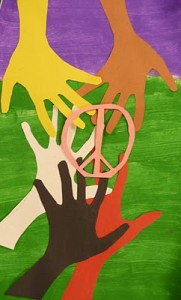
The result of this inquiry has led to the “Peaceful Changemakers” curriculum in kindergarten, and, now, influencing the way that first through fourth grade teachers talk about issues of environmentalism, civil and human rights. Through this curriculum, students learn about many people who work toward making the world a better place through peaceful means.  We realized that in order for our students to have a deeper understanding of Dr. King we would need to integrate the ideas around making big, important changes into our curriculum. We would need to start talking about these themes months before Dr. King’s birthday, so that our students could practice exploring the ideas and having conversations about what it means to stand up for a community and make change before they learned about Dr. King.

MLK-hands2-181x300

We start by studying Dr. Seuss’s the Lorax, and we call the Lorax a “changemaker” because he spoke for the trees. Students answer the following questions about the Lorax: What was the problem he faced? Who was involved or affected? Why was it hard to solve this problem? And was it solved? From there, we learn about Dr. Wangari Maathai, a Kenyan scientist who won the Nobel Peace Prize for planting trees in Kenya. As we learn about these changemakers, students take action to solve problems in their local community.  We work to restore the watershed by planting native trees at a nearby creek and go on trash walks through the local parks. We hang signs around their school educating our school community about how trash on the ground eventually makes its way into the ocean.

Students also honor changemakers from their own families and communities, and family members come into the classroom to present their changemakers. Some of these changemakers are tutors in schools, work in orphanages in other countries, educate others about the importance of reusing and recycling, or turn parking lots into neighborhood parks.

There were also important changes we made to the discussion of Dr. King himself. Through our research, we discovered that it is developmentally appropriate to skip the part of the story around Dr. King’s death; students do not need to know that he was assassinated in order to appreciate his work. I had noticed that when my students learned he was killed, they would often focus on this violent image more than on any other aspect of his life work. And, without the larger unit in which we explore many people who work for change, students would feel burdened and overwhelmed with this information. Now, if my students learn about the assassination from an older sibling or from an outside conversation, I can point to our Changemaker Wall on which we display all the changemakers we have learned about, both famous and not, and remind them that there are so many people working, as Dr. King did, to make a difference.

We also learned it was important not to skip the part about racism and segregation. Using our changemakers framework, where we ask specific questions of each of our changemakers, our students need to know what the problem was in order to think about how to solve it. There is a universality among all the changemakers in that they all work to make a difference and solve big problems, but in order for our students to grasp the significance of this universality they also have to understand the specific problems. Otherwise, they cannot appreciate the courage it takes to solve the problems we face.

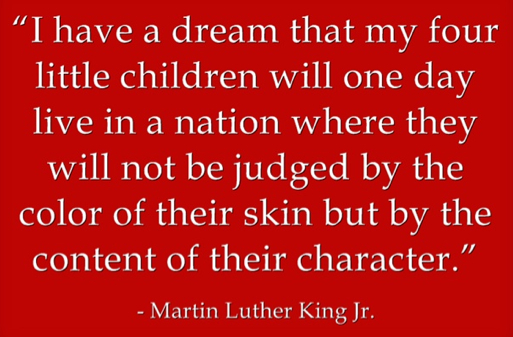
i-have-a-dream-martin-luther-king-jr

We also discovered that our students needed support in developing a basic understanding of skin color differences and language they can use to be inclusive with one another. To this end, students mix paint to find their skin tones, write poems about their skin, and listen to many stories about the different shades of our skin. Talking openly about race and racism with our students is also important so that they can recognize and interrupt bias when they see it. They can also more fully appreciate the work of Dr. King and other changemakers in fighting against segregation and racism.

Now, when it comes time to talk about Martin Luther King Jr. in kindergarten, the students are able to focus on the big ideas around courage, social justice and making peaceful change. They have a deeper understanding of their similarities and differences and a greater appreciation for the importance of standing up for a community and working toward inclusivity and equality.   They recognize they can be changemakers too.

inter-related

universe of souls

In a real sense all life is inter-related.  All men are caught in an inescapable network of mutuality, tied in a single garment of destiny.  whatever affects one directly affects all indirectly.  I can never be what I ought to be until you are what you ought to be, and you can never be what you ought to be until I am what I ought to be.  This is the inter-related structure of reality.“- Rev. Martin Luther King, Jr.

responsible?

So, I’m sitting here completely stunned by this and unsure how to process it.  It’s not the “possibility” that the government was involved in the assassination that has me floored, but that I have never heard of this trial before.  I wasn’t sure I could believe that the trial even happened.  I came across this on April Fool’s Day after all.  But it seems to be no joke.  The King Center seems to be legit.  The NYTimes made some brief mention of the trial.  However this is not common knowledge.  At least, not to the best of my knowledge.  I can only say that I am truly befuddled.  Yep, befuddled.  The 45th anniversary of the assassination is days away: 6:01 p.m. on Thursday, April 4, 1968.

mlk assassination suit

Assassination Conspiracy Trial

Martin King’s family: share civil trial case that US govt assassinated Martin

logo

Coretta Scott King: “We have done what we can to reveal the truth, and we now urge you as members of the media, and we call upon elected officials, and other persons of influence to do what they can to share the revelation of this case to the widest possible audience.” – King Family Press Conference, Dec. 9, 1999.

From the King Center on the  family’s civil trial that found the US government guilty in Martin’s assassination:

After four weeks of testimony and over 70 witnesses in a civil trial in Memphis, Tennessee, twelve jurors reached a unanimous verdict on December 8, 1999 after about an hour of deliberations that Dr. Martin Luther King, Jr. was assassinated as a result of a conspiracy. In a press statement held the following day in Atlanta, Mrs. Coretta Scott King welcomed the verdict, saying , “There is abundant evidence of a major high level conspiracy in the assassination of my husband, Martin Luther King, Jr. And the civil court’s unanimous verdict has validated our belief. I wholeheartedly applaud the verdict of the jury and I feel that justice has been well served in their deliberations. This verdict is not only a great victory for my family, but also a great victory for America. It is a great victory for truth itself. It is important to know that this was a SWIFT verdict, delivered after about an hour of jury deliberation. The jury was clearly convinced by the extensive evidence that was presented during the trial that, in addition to Mr. Jowers, the conspiracy of the Mafia, local, state and federal government agencies, were deeply involved in the assassination of my husband. The jury also affirmed overwhelming evidence that identified someone else, not James Earl Ray, as the shooter, and that Mr. Ray was set up to take the blame. I want to make it clear that my family has no interest in retribution. Instead, our sole concern has been that the full truth of the assassination has been revealed and adjudicated in a court of law… My husband once said, “The moral arc of the universe is long, but it bends toward justice.” To-day, almost 32 years after my husband and the father of my four children was assassinated, I feel that the jury’s verdict clearly affirms this principle. With this faith, we can begin the 21st century and the new millennium with a new spirit of hope and healing.”

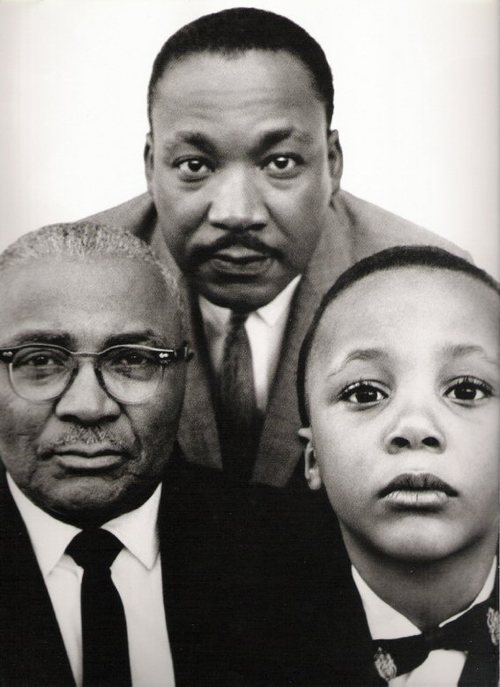
mlk w:father and son 1963

1963

TRANSCRIPTS

View Full Trial Transcript>

View Transcript of King Family Press Conference on the Verdict>

KING FAMILY STATEMENT ON MEDIA REQUESTS REGARDING THE MEMPHIS VERDICT

The King family stands firmly behind the civil trial verdict reached by twelve jurors in the Memphis, Tennessee courtroom on December 8, 1999.

An excerpt from remarks made by Mr. Dexter Scott King, Chairman, President, and CEO of The King Center, during the December 9, 1999 press conference regarding the verdict that may be used in support of this family decision:

“We can say that because of the evidence and information obtained in Memphis we believe that this case is over. This is a period in the chapter. We constantly hear reports, which trouble me, that this verdict creates more questions than answers. That is totally false. Anyone who sat in on almost four weeks of testimony, with over seventy witnesses, credible witnesses I might add, from several judges to other very credible witnesses, would know that the truth is here.”

The question now is, “What will you do with that?” We as a family have done our part. We have carried this mantle for as long as we can carry it. We know what happened. It is on public record. The transcripts will be available; we will make them available on the Web at some point. Any serious researcher who wants to know what happened can find out.”

The King family feels that the jury’s verdict, the transcripts of the conspiracy trial, and the transcripts of the King family’s press conference following the trial — all of which can be found on The King Center’s website — include everything that that family members have to say about the assassination.

Therefore, the King family shares the conviction that there is nothing more to add to their comments on record and will respectfully decline all further requests for comment.

destined to repeat history

Memphis Jury Sees Conspiracy in Martin Luther King’s Killing

header-logo

By EMILY YELLIN
Published: December 09, 1999

A jury in a civil suit brought by the family of the Rev. Dr. Martin Luther King Jr. decided today that a retired Memphis cafe owner was part of a conspiracy in the 1968 killing of Dr. King.

The jury’s decision means it did not believe that James Earl Ray, who was convicted of the crime, fired the shot that killed Dr. King.

After four weeks of testimony and one hour of deliberation, the jury in the wrongful-death case found that Loyd Jowers as well as ”others, including governmental agencies” had been part of a conspiracy. The jury awarded the King family the damages they had sought: $100, which the family says it will donate to charity.

The family has long questioned Mr. Ray’s conviction and hoped the suit would change the legal and historical record of the assassination.

”This is a vindication for us,” said Dexter King, the youngest son of Dr. King.

He said he hoped history books would be rewritten to reflect this version of the assassination.

Mr. Jowers, 73 and in failing health, owned Jim’s Grill in 1968, a restaurant opposite the motel where Dr. King was shot and just below the second-floor rooming house from which, according to James Earl Ray’s confession in 1969, Mr. Ray fired the single shot that killed Dr. King. Mr. Ray, who recanted his confession, hinted at a conspiracy. He died in prison last year while serving a 99-year sentence.

Mr. Jowers, in a 1993 television interview, said that he had hired a Memphis police officer to kill Dr. King from the bushes behind his restaurant. Mr. Jowers said he had been paid to do so by a Memphis grocery store owner with Mafia connections.

In an unlikely alliance, the King family was represented in the case by William Pepper, who had been Mr. Ray’s lawyer. The King family maintains that Mr. Pepper’s version of the assassination is the one that gets at the real truth behind Dr. King’s death, not the official version with Mr. Ray as the gunman.

Mr. Pepper said federal, state and Memphis governmental agencies, as well as the news media conspired in the assassination.

Mr. Jowers’s lawyer, Lewis Garrison, had said since the trial began that he agreed with 80 percent of Mr. Pepper’s conspiracy theories and disagreed only on the extent of his client’s involvement. In his closing argument today, Mr. Garrison repeated what he had said through the trial that his client participated in the conspiracy but did not know that it was a plot to kill Dr. King.

One juror, David Morphy, said after the trial, ”We all thought it was a cut and dried case with the evidence that Mr. Pepper brought to us, that there were a lot of people involved, everyone from the C.I.A., military involvement, and Jowers was involved.”

John Campbell, an assistant district attorney in Memphis, who was not part of the civil proceedings but was part of the criminal case against Mr. Ray, said, ”I’m not surprised by the verdict. This case overlooked so much contradictory evidence that never was presented, what other option did the jury have but to accept Mr. Pepper’s version?”

And Gerald Posner, whose recent book, ”Killing the Dream” made the case that Mr. Ray was the killer, said, ”It distresses me greatly that the legal system was used in such a callous and farcical manner in Memphis. If the King family wanted a rubber stamp of their own view of the facts, they got it.”

love is many things

…but it shouldn’t be a secret.  That really hit home for me.

I wish that this young woman could talk to Nia.  I hope that she at least reads the essay.  Not that Nia touched on the topic of having racist black parents to contend with, but I think that Danielle could be inspired by the way in which Nia boldly and candidly addresses many of the issues facing interracial couples.

Yes, I called Danielle’s parents racist.  They are.  I’ve found that some people are under the impression that black people can’t be classified as racist.  That that is a delineation that we reserve for the “oppressor.”  So not true.

Case in point from U-Mich Race Card Project:

History; NEVER TRUST A WHITE MAN!

Kwende Idrissa Madu
Russellville, AL

I imagine it’s gonna be a tough row to hoe going through life in America completely unwilling and unable to trust a white man.  I also imagine that it could be a large majority of “minorities” who really feel that way.

Back to Danielle though:  I admire her for not letting go of the love of her young life.  For seeing and feeling beyond her parents’ antiquated and limiting fear based belief system.  And for deciding that it’s time to “come out” and love in the open and let the cards fall where they may because that is the only way for her to truly live.

[CONFESSIONS]

“I’m Hiding My Interracial Relationship From My Parents”

A YOUNG WOMAN FEARS THAT HER FAMILY WON’T ACCEPT THE LOVE OF HER LIFE

ByDANIELLE T. POINTDUJOUR

[CONFESSIONS]<br /><br /><br /><br />
�I�m Hiding My Interracial Relationship From My Parents�

I grew up surrounded by love. I have the fondest memories of my parents spontaneously stealing ‘private’ kisses, the grand romantic gestures of my aunts and uncles and watching my grandparents dancing to old records in their living room.  Love was all around me and I spent hours dreaming of the day I’d have one to call my own.  It wasn’t until high school that I started to realize that the love I saw and wanted came with conditions.

Since I wasn’t allowed to date until I was 16, I had a secret boyfriend in the months leading up to that milestone birthday.  Mike was the best beau a teen girl could have—tall, handsome, funny and happy to carry my books and hold my hand.  He reminded me a lot of my father, the way he played with me and did ‘man’ things like pulling out my chair and holding all the doors.  He was great, so naturally I thought nothing of bringing him home for my parents to meet right after I turned 16.  I thought nothing of the fact that he’s White.

I’ll never forget the look on my parents’ faces when Mike walked through the door: confusion mixed with horror.  When he left—after an hour of awkward silence interrupted by short bursts of conversation—the drama began. My parents forbade me from seeing my honey again and told me that boys “like him” are only interested in me for sex and that I should “stick to my own kind.”  They tried to scare me with stories of violent racism and visions of children addicted to drugs because of their struggle with identity.  I tried to explain that his race didn’t matter to me, the way he treated me did.  I wanted him to know that Mike’s love reminded me of the love I grew up with. They weren’t trying to hear it.

For the rest of our high school years we dated in secret and by the time college came, the boy that held my hand became the man who held my heart.  Still, I had to have Black male friends pretend to take me on dates to throw my parents off.  I made up excuses to not come home on breaks so I could spend them with Mike’s family, who welcomed me with open, loving arms and had a hard time understanding my choice to hide our relationship.

I tried a few times to slip the topic of interracial dating into conversations with my parents, telling stories of friends who were happily dating or getting married.  The response was always the same: “Good for them, but you’re going to bring home someone that looks like us.”  My father even hinted that he would cut off my college funds if I went “that way.”

I felt trapped.

After college, Mike and I decided to apply for graduate school in Spain. While his parents were thrilled that we would be living abroad together and sharing an adventure, mine were worried about me going so far away and wondered how I would find the man of my dreams in a country where the majority of the people don’t speak English.  Little did they know the man of my dreams was actually a reality and had been in my life for quite some time.

It has been six months since we moved to Spain together and almost seven years since we started dating, and I couldn’t be happier!  All the fears my parents have for our relationship have yet to materialize, even here in this foreign land. Our love for each other has grown so much that I’ve come to realize that it’s time to tell my parents.  I love this man and I want to shout it from the rooftops. I no longer care what my parents or anyone else thinks about it and I’m tired of lying. Love is many things, but one thing it shouldn’t be is a secret.  Recently, we’ve been talking more about marriage and our future—both things that I want my parents to experience with us.  I hope that they can try to be open-minded enough to share in our love, but if not, that’s okay.  We have plenty of family and friends around that support us unconditionally and they can appreciate just what love is supposed to be: colorblind and limitless.

because he was smart

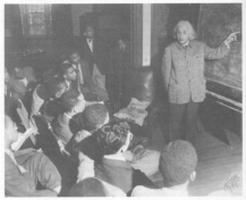
Marian Anderson and Albert Einstein were friends!! Like, friends. Not acquaintances. I am related to Marian Anderson and she hung out with Einstein. Considering the purposefully reposted quote along side Einstein’s notion that the limiters of potential are limited as well, I imagine they had some profound conversations.  That’s nearly as impressive to me as her “dissing” the D.A.R. by singing on the steps outside in response to their choice to disrespect her in honor of the organization’s racial exclusion policy.

Anyway, here’s more on Einstein’s stand for equality. It was a lot more involved than delivering a speech at a University, and there are many more details here than in the article posted yesterday.  Not that the speech wasn’t as big of a deal as I thought. It was!  Not only was Mr. Einstein brave enough to speak out, he did it while he was ill.  Outside.  Ok, it was May, so maybe the weather was fine, but I’m just saying if he was looking for an excuse not to speak, sounds like he had it, but chose not to use it.  Instead, he got up there and spoke to the impressionable minds of the “first institution found anywhere in the world to provide a higher education in the arts and sciences for male youth of African descent.”  If young African American males today are largely still in need of academic encouragement and inspiration and respect, I can only imagine how impactful and empowering Einstein’s presence alone was pre Brown vs. Board of Ed.  Just the simple fact that he spoke, and the forbidden, unspoken truth contained in his words.  I have a feeling this brilliant man knew exactly what he was doing.

Albert Einstein, I acknowledge your greatness as a champion of human and civil rights and your hand in illuminating the fact that limiting the potential of a significant portion of society limits everyone in that society

Thank you.

xo,

Tiff

einstein1d-m

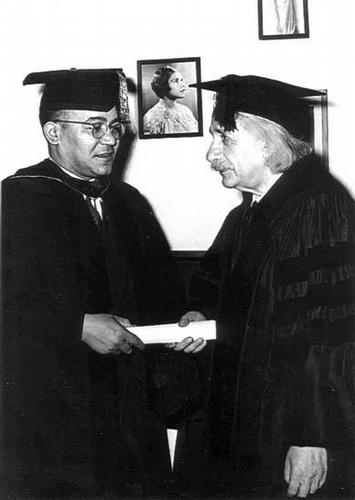
Albert Einstein at Lincoln University

(photo of Marian Anderson in background?)

Albert Einstein passionately fought race prejudice, according to new and old docs

by Ronda Racha Penrice

Nearly 60 years after his death, the great scientist Albert Einstein is still making headlines. The launch of Einstein Archives Online — a more advanced repository of his work — is a long-term collaboration by Israel’s Hebrew University, which he co-founded, California Institute of Technology (Caltech), where he was a guest faculty member on several occasions, and Princeton University, where he was a faculty member, generated global attention on March 19. Eventually, over 80,000 documents held in Hebrew University’s Albert Einstein Archives and Caltech’s Einstein Papers Project will be available on the Internet. About 2,000 are currently available.

Despite this unprecedented access, however, one thing hasn’t changed: Einstein’s strong support of African-American civil rights and his defiant stance against racism are largely footnotes, especially for the mainstream press. While it will, no doubt, be exciting to pull up correspondence between Einstein and W.E.B. Du Bois one day, his association with Du Bois was just the tip of the iceberg.

Einstein, as documented in the 2003 book Einstein on Race and Racism by veteran science writer and journalist Fred Jerome, who also covered civil rights activity in the South in the 1960s, and New York librarian Rodger Taylor whose early writings have focused on jazz and early African-American life in New York, staunchly denounced racism and segregation in the United States, even as his health steadily failed and his own mortality drew nearer.

Jerome first delved into Einstein’s human rights advocacy in his 2002 book, The Einstein File: J. Edgar Hoover’s Secret War Against the World’s Most Famous Scientist. In that groundbreaking work, Jerome highlighted a May 3, 1946 speech Einstein gave at historic Lincoln University, the alma mater of both Thurgood Marshall and Langston Hughes and, as its then president Horace Mann Bond pointed out, “the first institution found anywhere in the world to provide a higher education in the arts and sciences for male youth of African descent.” Interestingly, a young Julian Bond, Horace Mann Bond’s son, was there that day.

The speech was especially significant because, as Jerome also writes in The Einstein File, “During the last twenty years of his life, Einstein almost never spoke at universities.” He routinely turned down almost all of the honorary degree requests he received.

On top of that, Einstein’s health was not the greatest. Yet, he stood outdoors to receive his honorary degree from Lincoln University, which can actually be viewed on the Einstein Archives Online now, and, even more importantly, spoke these poignant words reported in the Baltimore Afro-American May 11, 1946: “There is separation of colored people from white people in the United States. That separation is not a disease of colored people. It is a disease of white people. I do not intend to be quiet about it.”

And he was not. Einstein, as Jerome notes in his essay The Hidden Half-Life of Albert Einstein: Anti-Racism for the Journal of the Research Group of Socialism and Democracy Online, spoke these words in a time known by some as “the Bloody Spring of 1946” because it was just after black men had returned from World War II to the harsh reality that the Double V campaign, which The Pittsburgh Courier especially championed, had succeeded in saving the world from Hitler, but had not destroyed racism at home. 

On February 25, 1946, William Fleming, a white radio repairman, assaulted Ms. Gladys Stephenson, a black woman, and her son James, a Navy veteran, defended her, resulting in both of their arrests. When some white men, including four policemen, headed towards the black side of town, known as Mink Slide, later that evening, they found that a group of veterans had organized themselves for self-defense, and shots were fired.

“African-Americans firing on white policemen was enough for the governor to rush in 500 State Troopers with submachine guns who attacked Mink Slide, destroying virtually every black-owned business in the four-square-block area, seizing whatever weapons they could find, and arresting more than one hundred black men,” writes Jerome.

Twenty-five of the black men arrested were indicted for attempted murder. Einstein immediately joined the National Committee for Justice in Columbia, Tennessee, headed by Eleanor Roosevelt and also supported by Mary McLeod Bethune, Adam Clayton Powell, Jr., Joe Louis, A. Phillip Randolph and Langston Hughes that March. With Thurgood Marshall serving as the chief defense attorney, 24 of the 25 men were acquitted.

The violence didn’t stop in Columbia. On July 26, the heinous murder of two black men, one a veteran, and their wives in Monroe, Georgia was even reported by the New York Times. As with the majority of these acts of domestic terrorism, justice was not served. Einstein was outraged enough to lend his prominence to actor and activist Paul Robeson’s American Crusade to End Lynching (ACEL) that September.

Despite being too ill to participate in the mass rally at the Lincoln Memorial on September 23, 1946 (the day after Lincoln proposed the preliminary Emancipation Proclamation in 1862), Einstein penned a brief letter to President Truman confirming his support of the ACEL.

“May I wholeheartedly endorse the aims of this delegation, in the conviction that the overwhelming majority of the American people is demanding that every citizen be guaranteed protection from acts of violence,” he wrote. That same month, Einstein penned a much longer letter in support of the National Urban League Convention that highlighted the economic injustices, among other inequalities, experienced by black Americans.

When the Nassau Inn in Princeton refused Marian Anderson lodging during her 1937 concert there, Einstein invited her into his home as a guest and they maintained a friendship. Anderson actually stayed in the Einstein home in 1955 two months before his death. Before Einstein even came to this country permanently in 1933, he responded to a 1931 letter written to him by Du Bois, who had studied at the University of Berlin where Einstein was on the faculty, to write something small against racism to be published in The Crisis. Later, Einstein supported Du Bois even as Senator McCarthy placed him at the top of his target list.

From the Scottsboro Boys case to the numerous attempts to stop the execution of Willie McGee, a black Mississippi sharecropper accused of raping a white woman, and efforts to prevent New Jersey from extraditing Sam Buckhannon, a black Georgian who had escaped a chain gang after serving 18 years for stealing a pack of cigarettes, Einstein used his fame to condemn American racism.

In the wake of the monumental effort to digitize Einstein’s life and genius for the masses, let’s hope that more of us will follow Jerome’s lead, and acknowledge Einstein’s greatness as a champion of human and civil rights for African-Americans as one of his greatest contributions to the world.

old paris, eiffel

Excerpted from a blog post by Rodger Taylor on a presentation in Paris about Einstein and racism:

The Book in Bed presentation was by far the largest audience — it seemed a hundred or so people. Half of them appeared to be high school aged.

“Einstein was White. Why should or did he care about racism?” — was a question asked by a French high school student. The question sparked conversation and also framed our presentation the next day.

Some of the responses as to why included:

Because Einstein was smart.

Because he realized that limiting the potential of a significant portion of society limits everyone in that society.

Because he was empathetic — and if he could imagine what is was like to be a beam of light projected into space, he could imagine what it was like to be black in America.

Because he got to know black people on a personal basis — both in the town of Princeton where he lived and beyond and that made a signficiant difference in how he felt about the racism they experienced.

i do not intend to be quiet about it


While perusing Facebook the other day, I came upon a post that really excited me.  About Albert Einstein. Yeah…(nerd.)

I really admire the Einstein, thus was a bit shocked by my ignorance of his strong stance on this issue.  It’s like my strong stance.  How did I miss this?  Naturally, I dug through the interweb to see what else I could find to feed my curiosity.  I found a feast! There will be more on this topic tomorrow I believe.

I’m pleased to report that I have since forgiven myself for my ignorance, as it became clear that this hasn’t been common Einstein knowledge.  It was insignificant, irrelevant, and even egregious for the times.  Who would record such nonsense? Of course equality and human dignity were reserved for whites. No questions allowed.  But Einstein spoke anyway.  Imagine, being afraid of speaking in public, yet being courageous enough to speak publicly on a topic so taboo that he could have literally found himself in danger- political, financial, and physical. That is fierce.  That is being action in alignment with cosmic law.  That is something I truly admire.

Here’s the catalytic FB post:

Image

Einstein, when he arrived in America, was shocked at how Black Americans were treated. “There is separation of colored people from white people in the United States,” he said. “That separation is not a disease of colored people. It is a disease of white people. And, I do not intend to be quiet about it.” And, he wasn’t.

Although he had a fear of speaking in public, he made all the effort he could to spread the word of equality, denouncing racism and segregation and becoming a huge proponent of civil rights even before the term became fashionable. Einstein was a member of several civil rights groups (including the Princeton chapter of the NAACP).


There is, however, a somber point in the social outlook of Americans. Their sense of equality and human dignity is mainly limited to men of white skins. Even among these there are prejudices of which I as a Jew am clearly conscious; but they are unimportant in comparison with the attitude of the “Whites” toward their fellow-citizens of darker complexion, particularly toward Negroes. The more I feel an American, the more this situation pains me. I can escape the feeling of complicity in it only by speaking out.

Many a sincere person will answer: “Our attitude towards Negroes is the result of unfavorable experiences which we have had by living side by side with Negroes in this country. They are not our equals in intelligence, sense of responsibility, reliability.”

I am firmly convinced that whoever believes this suffers from a fatal misconception. Your ancestors dragged these black people from their homes by force; and in the white man’s quest for wealth and an easy life they have been ruthlessly suppressed and exploited, degraded into slavery.  The modern prejudice against Negroes is the result of the desire to maintain this unworthy condition.

 —Albert Einstein “The Negro Question”, 1946


einstein1c-m

Albert Einstein, Civil Rights activist

Little-known aspect of physicist’s life revealed

By Ken Gewertz

Harvard News Office


Here’s something you probably don’t know about Albert Einstein.

In 1946, the Nobel Prize-winning physicist traveled to Lincoln University in Pennsylvania, the alma mater of Langston Hughes and Thurgood Marshall and the first school in America to grant college degrees to blacks. At Lincoln, Einstein gave a speech in which he called racism “a disease of white people,” and added, “I do not intend to be quiet about it.” He also received an honorary degree and gave a lecture on relativity to Lincoln students.

The reason Einstein’s visit to Lincoln is not better known is that it was virtually ignored by the mainstream press, which regularly covered Einstein’s speeches and activities. (Only the black press gave extensive coverage to the event.) Nor is there mention of the Lincoln visit in any of the major Einstein biographies or archives.

In fact, many significant details are missing from the numerous studies of Einstein’s life and work, most of them having to do with Einstein’s opposition to racism and his relationships with African Americans.

That these omissions need to be recognized and corrected is the contention of Fred Jerome and Rodger Taylor, authors of “Einstein on Race and Racism” (Rutgers University Press, 2006). Jerome and Taylor spoke April 3 at an event sponsored by the W.E.B. Du Bois Institute for African and African American Research. The event also featured remarks by Sylvester James Gates Jr., the John S. Toll Professor of Physics, University of Maryland.

According to Jerome and Taylor, Einstein’s statements at Lincoln were by no means an isolated case. Einstein, who was Jewish, was sensitized to racism by the years of Nazi-inspired threats and harassment he suffered during his tenure at the University of Berlin. Einstein was in the United States when the Nazis came to power in 1933, and, fearful that a return to Germany would place him in mortal danger, he decided to stay, accepting a position at the recently founded Institute for Advanced Study in Princeton, N.J. He became an American citizen in 1940.

But while Einstein may have been grateful to have found a safe haven, his gratitude did not prevent him from criticizing the ethical shortcomings of his new home.

“Einstein realized that African Americans in Princeton were treated like Jews in Germany,” said Taylor. “The town was strictly segregated. There was no high school that blacks could go to until the 1940s.”

Gates, an African-American physicist who has appeared on the PBS show Nova, said that Einstein had been a hero of his since he learned about the theory of relativity as a teenager, but that he was unaware of Einstein’s ideas on civil rights until fairly recently.

Einstein’s approach to problems in physics was to begin by asking very simple, almost childlike questions, such as, “What would the world look like if I could drive along a beam of light?” Gates said.

“He must have developed his ideas about race through a similar process. He was capable of asking the question, ‘What would my life be like if I were black?’”

Gates said that thinking about Einstein’s involvement with civil rights has prompted him to speculate on the value of affirmative action and the goal of diversity it seeks to bring about. There are many instances in which the presence of strength and resilience in a system can be attributed to diversity.

“In the natural world, for example, when a population is under the influence of a stressful environment, diversity ensures its survival,” Gates said.

On a cultural level, the global influence of American popular music might be attributed to the fact that it is an amalgam of musical traditions from Europe and Africa.

These examples have led him to conclude that “diversity actually matters, independent of the moral argument.” Gates said he believes “there is a science of diversity out there waiting for scholars to discover it.”

entire article

—It’s Tiff again.  I just have to comment about that last excerpt from Gates. That “under the influence of a stressful environment, diversity ensures survival” thing.  In this case the stressful environment is racially segregated America.  The mutually exclusive, dangerously juxtaposed, white vs. black America.  To ensure survival, diversity is required.  I’ll go out on a limb here and relate this to being mixed like me (after all, these are the mulatto diaries if I recall correctly.) To ensure the survival of America, we have to exist.  We are everywhere even though we’ve been largely silent and unrecognized in any genuine manner.  Yet things improve, and change happens as we wake up, and adapt, and we are different…and so is America.

The interaction between organism and environment is central in evolution. Extinction ensues when organisms fail to change and adapt to the constantly altering … stressful environmental changes as documented in the fossil record. Extreme environmental stress causes extinction but also leads to evolutionary change and the origination of new species adapted to new environments.”-Eviatar Nevo

Don’t become extinct!

joys, complicated

Joys should be simple.  Didn’t Pippin teach us that?  Sorry, my musical theatre nerd wanted to speak.  But anyway, joys should be simple not complicated.  While I’ve been away examining my life, living my life, changing my life I’ve noticed that I have a tendency to shy away from things that bring me joy.  I have a sneaking suspicion that it’s the experience of feeling that my joys are complicated that informs my reticence.  But the joys actually are not complicated.  Not to me.  Only from the outside looking in.  Only within the parameters of a paradigm in which black and white are mutually exclusive.  Only when clinging to a dogma that rigidly defines an “us” and a “them” and prescribes clearly definable attributes to each.  I’m gonna be a rebel here and doubt those antiquated notions.  That’s not new for me though.  Actually I’m going to be a rebel here just for myself and let go of my discomfort with the complexity others may still perceive in the things that bring me joy, in the things that are me, and I’m just gonna be and enjoy them.  That is new for me.  That is a challenge. But, hey, why not go ahead

As for this article, I love that Mr. McCollum’s mother mandated that his Irish pride run fierce.  I love that he takes pride in facilitating the paradigm shift.  I love that someone wrote this article.

St. Patrick’s Day holds mixed emotions for some

By Martine Powers

Ryan McCollum knows that on St. Patrick’s Day, he cuts an unusual figure.

All in green, a traditional Irish Claddagh ring on his finger and a houndstooth flat cap on his head, everything about his attire screams “Irish and proud.’’

But McCollum, 33, is also black. His father, a Navy man from Springfield, married an Irish-American girl from Downeast Maine.

He knows his appearance does not fit the bill of a stereotypical Irishman – most assume he’s black, or maybe Latino – but since childhood, his mother mandated that his Irish pride run fierce.

“Growing up, I knew I was Irish,’’ said McCollum, of Springfield, “even if the rest of the world didn’t know I was Irish.’’

As the American population has grown increasingly mixed-race in recent decades, some descendants of Irish immigrants are claiming a multiracial heritage, though they may differ in appearance from their red-haired, freckled ancestors. For them, the joys of embracing Irish roots are complicated by the challenges of being multiracial.

“I always feel this deep kinship with Irish people in Boston,’’ said Kelly Bates, a mixed-race Irish-American who lives in Roslindale. “But I don’t always feel like they have this kinship with me.’’

Between 2000 and 2010, the number of Americans who checked two or more races on the US Census increased from 6.8 million to 9 million.

Paul J. McNamara, president of the 275-year-old Charitable Irish Society, said he does not believe that any of the organization’s 400 current members are multiracial, but the group welcomes membership applications from anyone interested in promoting Irish history and culture.

“Most people in our group want to appreciate and retain their Irish roots,’’ McNamara said. “There is a strong element that you want to participate and preserve aspects of the culture.’’

But for Bates, it’s not quite so simple.

Her mother, a black woman from Harlem, married an Irish-American man from Massachusetts. Bates loves to visit her huge, boisterous Irish-Catholic family in Lynn. She grew up reading Irish poetry with her father. She calls him every March 17 to hear the legend of Saint Patrick and the snakes.

In a ritual that is all too familiar for many mixed-race people, new acquaintances try to guess Bates’s heritage. Usually, they pick Puerto Rican or Colombian. Maybe Middle Eastern or Italian.

But Irish? Never.

17mixedirish3[1].r

Kelly Bates, executive director at Access Strategies Fund, is also part Irish.

“You could look at my cousins and me, and you could see the resemblance,’’ said Bates, executive director of the philanthropic foundation Access Strategies Fund. “But they would be accepted [as Irish] right away, and it would be very different for me.’’

Part of that divide may come from Boston’s racially fraught past, she said.

“I’m aware of the fact that my cultural communities have not always been able to build a bridge toward each other, especially in this city,’’ said Bates.

While Irish and African-American communities worked and lived in close proximity in the decades after America’s founding – both groups were stigmatized by English landowners – they grew antagonistic toward one another at the end of the 19th century, said Marie E. Daly, library director at the New England Historic Genealogical Society. In the last century, the communities have butted heads over labor rights, housing, and public school desegregation.

Bates said she is just as proud to be African-American as she is proud to be Irish. After all, she said, the sound of bagpipes and African drums both give her chills. But she sometimes worries about expressing pride in her Irish roots. As much as Irish is a national origin, she said, it also identifies her as white. She does not want others to think she has distanced herself from her black identity.

“I think my black friends and black colleagues don’t know what to make of it when I talk about my Irish heritage,’’ Bates said.

Mari Tanaka, a junior at Harvard, knows that most people think they immediately have her pegged.

“I guess I look Asian, but I don’t feel comfortable with people just assuming that’s all I am,’’ said Tanaka, 21. “Growing up, being Irish has been such a big part of my life.’’

Most of Tanaka’s ancestors hailed from Japan, but her mother’s father is Irish-American. During her childhood in Hawaii, he ensured that she listened to traditional Irish music, watched “Riverdance,’’ and ate corned beef and cabbage on St. Patrick’s Day.

College has offered her an opportunity to further explore her Irish roots. She has connected with Irish-American relatives in Cambridge who show her genealogical charts and tell stories about her ancestors. While she felt pressure to take a class in East Asian Studies, Tanaka, a biology major, instead chose to enroll in a class on Celtic history and culture where she was one of two nonwhite people.

“I felt like, yeah, being Asian, that’s a part of me,’’ Tanaka said. “But there’s another part of me that is much less explored.’’

McCollum, a political consultant, hopes to travel to Ireland, and he knows he will arrive in the land of his ancestors and find that no one looks like him. But that doesn’t bother him.

A history buff, McCollum spends much of his time reading about Irish history and culture, learning about his family’s genealogy, and watching Irish sports.

“For people who are proud of being Irish and knowing their Irish roots, it’s almost like a game – like, ‘How Irish are you? What county are you from? How many times have you been? Is your family still there?’’’ said McCollum, who is board member for the Irish Immigration Center. “If I’m in a room with Irish folks and have to re-prove my Irishness, I can talk to them about facts and history of Ireland.’’

McCollum’s surname adds further confusion: People often assume it represents his Irish side, but it’s a Scottish name probably adopted by his father’s African slave ancestors from their owners.

His African-American heritage is just as important as his Irish roots, he said; his passion for history extends to antislavery politics and the Black Power movement. But because of his skin color, he has no trouble relating to other black people. Being Irish, he said, is a less obvious part of his identity.

“A lot of times, I am that reminder that every Irish person doesn’t look like a stereotypical Irish person,’’ McCollum said. “And I don’t mind being that reminder. Sometimes, I take pride in that.’’

wee bottles of leprechaun gold st. patrick's necklace 8