white top

White Top Folk Festival by Jason Riedy.

Text of the sign: “The White Top Folk Festival was held annually from 1931 to 1939 (except 1937) on Whitetop Mountain — the second highest peak in Virginia. Annabel Morris Buchanan, John Powell, and John A. Blakemore organized the event that featured banjo players, fiddlers, string bands, and ballad singers, as well as storytelling, clog dancing, morris and sword dancing, and theatrical presentations. Thousands of people attended the festival each year, including nationally known academic folklorists, art critics, composers, and in 1933, First Lady Eleanor Roosevelt. The festival was cancelled in 1940 because of heavy rains and floods and never returned.

A First Lady in a False Kingdom: A Curious

Convergence on White Top Mountain

CHRISTA SMITH ANDERSON

From 1932 to 1939, the Whitetop Folk Festival attracted people from far and wide to the small mountain community. In 1933, even First Lady Eleanor Roosevelt stopped by to celebrate.

It was August 12, and the tenure of America’s longest-running first lady was in its infancy. Franklin Roosevelt had been in office just over five months. The FBI was still called the Bureau of Investigation, and its director, J. Edgar Hoover, hadn’t started compiling what would become his largest secret file — the 3,271 pages on Eleanor Roosevelt’s activities, many of them anti-segregation and, thus, “subversive.” The Ku Klux Klan didn’t know Eleanor Roosevelt well enough yet to have a price on her head. Another six years would pass before her infamous resignation from the Daughters of the American Revolution (DAR) over that organization’s refusal to allow African-American contralto Marian Anderson to perform in Constitution Hall.

…One of the festival’s organizers, John Powell, proudly asserted that “the great proof of the importance and the significance of the great musical heritage of our people is in the fact that Mrs. Roosevelt should come.”

Like many a memorable character, John Powell, who was also a founder of the Anglo- Saxon Clubs of America, is both compelling and repelling. A classical composer and pianist from Richmond, Virginia, Powell studied in Vienna with Theodor Leschetizky, in Prague with Karl Navrátil. He made his debut in Berlin in 1907, when he was twenty-five years old; the performance was hailed by critics as one of the most successful the city had ever known.

In the first part of his career, Powell incorporated all forms of American music — notably, African-American music — into compositions like Sonata Virginianesque and Rhapsodie Nègre. But by the 1930s, when he was selecting and shaping the White Top Folk Festival musicians, he was committed to promoting what he considered “Anglo-Saxon” music: a pure, white music from a pure, white region of America, whose music was dangerously at risk of becoming defined by a black American baby called Jazz.

By excluding black musicians, probably of some Anglo heritage themselves, Powell and other festival organizers brought to the mountaintop the pernicious bias that would become Powell’s legacy.

In 1924, Powell was instrumental in a court case that prevented the marriage of Dorothy Johns and James Connor by proving that one of Johns’s ancestors was black, thus she could not legally marry Connor, who was white. Some thirty-four years later, Powell was also instrumental — by virtue of his efforts in the 1920s — in making sure that interracial newly-weds Mildred and Richard Loving didn’t get a full night’s sleep. A few weeks after they were married, the Lovings were awakened around two a.m. by flashing police lights and escorted from their bed so they could be booked into the Caroline County, Virginia, jail. Each was charged with a felony.

The Dorothy Johns case was the first test of Virginia’s Racial Integrity Act, the Lovings’ the last. The “one-drop” law made interracial marriage a felony in Virginia and was especially targeted at whites marrying blacks, blacks being defined, of course, as anyone with “one drop” of black blood. Powell worked with other racial eugenicists to get the law passed in 1924, and was the self-proclaimed originator of it. By 1967, when the U.S. Supreme Court overturned the Racial Integrity Act in Loving v. Virginia, there were similar laws in fifteen other states as far north as Delaware, and as far west as Oklahoma.

For Eleanor Roosevelt, this 1933 trip to Southwest Virginia was a sentimental journey. Her father, Elliott, lived out the Panic of 1893 — the Great Depression’s predecessor — in the Southwestern Virginia town of Abingdon, close to the Tennessee and North Carolina borders.

At the festival, Eleanor warmly addressed the crowd of some ten thousand attendees: “To the people who live here I want to say a special word of gratitude. They have given me the feeling that they remember affectionately my father, whom I adore.”  And then she ended her speech, “For the rest of the day I hope to be just a spectator.”

Hundreds of performers took the stage for the festival that year. Among the prizewinners was Jack Reedy from Marion, Virginia. He won first prize in banjo; tied for first in clog dancing; and performing with the Blevins Brothers in the band competition, tied for first.


Eleanor Roosevelt posed with White Top Folk Festival contestants Frank Blevins (fiddle), Jack Reedy (banjo), Edd Blevins (guitar), and six-year-old mandolin sensation, Muriel Dockery, in 1933.
Library of Virginia

Mrs. Roosevelt may very well have heard some of the same songs her father did. But didn’t she, or any of those reporters who’d read about the “quartette of negroes” singing to him in the 1890s, think it curious that in the 1930s, not a one of the singers, instrumentalists, dancers, or storytellers at this folk-music festival with a five-state view was black? Did they not find the complexion of this kingdom to be unusually fair?  I’d like to think the White Top Mountain Folk Music Festival was the fool-me-once in Eleanor’s evolution as a Civil Rights activist.  Eleanor never publicly criticized the White Top Mountain Folk Music Festival organizers for their exclusion of black performers. But her reaction to some of the people who did perform hints at the cost of Powell’s agenda on the music he was trying to elevate. In her “Passing Thoughts of Mrs. Franklin D. Roosevelt” column in the Women’s Democratic News, Eleanor wrote of the women ballad singers she saw and heard on White Top: “[They were] fine featured … showing in their carriage and expression that there is something in inheritance.” As for the music, “Their voices were not remarkable but the whole thing was of great interest to those who believe that there is value in preserving the folk lore which has come out of the early customs and experiences of the people of the country.”

For whatever Powell might have thought of Eleanor Roosevelt in 1933, it’s quite certain that his opinion would’ve changed drastically by the 1950s, when racists flat-out hated her, some of them wondering why on earth a white person would talk so much about civil rights, others coming to the conclusion that Mrs. Roosevelt must have some black ancestry. Eleanor was downright snide about the whole eugenics thing. In her “My Day” newspaper column, she wrote about receiving an “amusing postcard” from someone in Mobile, Alabama, who wrote: “Dear Mrs. Roosevelt:
You have not answered my questions, the amount of Negro blood you have in your veins, if any.”

To which she responded: “I am afraid none of us know how much or what kind of blood we have in our veins, since chemically it is all the same. And most of us cannot trace our ancestry more than a few generations.” She went on, “As far as I know, I have no Negro blood, but, of course, I do have some Southern blood in my veins, for my Grandmother Roosevelt came from Georgia.”

As for John Powell, he was too “refined” to wear a white sheet. His cloak was musical brilliance, and that brilliance was about as flooded out as the last-planned White Top Mountain Folk Music Festival. (The 1940 festival was rained out, and organizers never brought it back.)

But for all the record-industry packaging that would corral white into “hillbilly” and black into “blues,” making country music today seem the province of white folk, when it comes down to it, American country music got its start as a Virginia-born, biracial baby. Biracial unless, of course, you were to follow Powell’s one-drop definition — in which case it’s black music, just like Powell’s own early compositions, just like every song played on White Top Mountain with that African instrument, the banjo.

SOURCE

yellow rose of texas

I’ve heard of this song (the first published edition of which was copyrighted by Firth, Pond and Company of New York on September 2, 1858.), but never actually heard the song itself.  I don’t get the feeling that this is the proudest moment in “mulatto history”, but if these are indeed the facts, it was a moment so…

Picture

Group will shed light on minorities’ role in the settling of the West

BY MITCH MITCHELL

Our ancestors kept secrets.

The secrets they kept, and the secrets their parents kept from them, left holes in our histories.

Minorities helped create Texas and the nation and helped tame the West, but they barely get a mention in most history books.

On Tuesday, a group of people who can shed light on that era will gather at the Palace Arts Theater in Grapevine. Author Liz Lawless, along with amateur historians and living-history storytellers Wendell Prince and Rosieleetta Lee Reed, will attempt to fill some of those historical gaps while dressed in period costumes.

Reed specializes in stories about frontier women, like stagecoach driver Mary Fields… But if you take Reed aside and ask, she may tell you a story about Emily D. West, perhaps a hero of the Battle of San Jacinto, who was made famous by a song that historians say had nothing to do with her:  The Yellow Rose of Texas.

Historians are almost certain that West was a free woman of mixed race who migrated from Connecticut to Texas. Documents place her in Galveston in the employ of Col. James Morgan in 1835, and later at the Battle of San Jacinto.

Beyond that, little is known for sure. Santa Anna’s account is that he was asleep when the Texian army attacked and could not rouse himself to stem the ensuing chaos and his army’s ultimate defeat, said Jeff Dunn, amateur historian and an expert on West. Some say they believe that Santa Anna was involved in a dalliance with West at the time of the attack and that she detained him long enough to ensure a Texas victory.

“Some argued that she was his concubine, and some argued that she was a white woman,” Reed said. “She was black. She was contraband.”

Mexican troops burned Morgan’s property in Galveston and captured West and several of Morgan’s servants days before the epic battle.

“The only reason we know this story exists is because William Bollaert wrote about it to a friend, and then tried to tell him to keep it quiet,” Dunn said. “Off to the left-hand margin he writes ‘private’ and he underlines it three times.”

Bollaert wrote the following, stating that this came from a letter written by Houston to a friend, Dunn said.

“The battle of San Jacinto was probably lost to the Mexicans, owing to the influence of a Mulatto girl [Emily] belonging to Col. Morgan who was closeted in the tent with g’l Santana, at the time the cry was made the Enemy! They come! They come! & detained Santana so long, that order could not be restored readily again.”

It was not until the 1950s, when Henderson Shuffler, another amateur historian and later a publicist for Texas A&M University, linked The Yellow Rose of Texas and West forever, according to the Handbook of Texas Online. However, historians believe that the song was written by an African-American man longing for his light-skinned sweetheart and was linked to West erroneously.

Frontier Texas was a very fluid place racially speaking, said Sam Haynes, University of Texas-Arlington history professor and the director of its Center for Southwestern Studies. Marriages between different racial groups are evident in the state’s early history, Haynes said.

SOURCE

the black codes

Northern States had them, too.  I think these things are worth examining.  If we want to know more about why and how things got so out of hand in this country (I mean beyond slavery itself), we retrace our steps back to decrees such as these.

One measure of equality suggested by the British sociologist T.H. Marshall is “citizenship” – the “basic human equality associated with  . . . full membership of a community.”  African American history, from bondage through the civil rights movement, is often seen through the political lens as a struggle for citizenship and full membership in American society.

Legislated repression in post-slavery South

…[I]t shall not be lawful for any freedman, free Negro, or mulatto to
intermarry with any white person; nor for any white person to intermarry
with any freedman, free Negro, or mulatto; and any person who shall so
intermarry shall be deemed guilty of felony and, on conviction thereof,
shall be confined in the state penitentiary for life … — from
Mississippi Black Codes, enacted Nov. 22, 1865

As formerly enslaved Blacks would soon learn, freedom was not as they had
anticipated. White southerners were anxious to regain power over them and
used the law in order to achieve that objective. In 1865, southerners
created Black Codes, which served as a way to control and inhibit the
freedom of ex-slaves. Codes controlled almost all aspects of life and
prohibited Blacks from the freedoms that had been won.

Not only did whites want to control ex-slaves, but also they needed
laborers. While things could no longer be exactly the same as in slavery,
they found a way to guarantee that Blacks would serve as their laborers. To
do this, they created Black Codes. While Codes were unique to the
post-Civil War south, they encompassed some of the antebellum restrictions
on free blacks, northern apprenticeship laws, and the Freedmen’s Bureau and
the War Department regulations. Codes regulated civil and legal rights,
from marriage to the right to hold and sell property to the predestined
definition of Blacks as agricultural laborers.

Laws were different in each state but most embodied the same kinds of
restrictions. Commonly, codes compelled freedmen to work. In many states,
if unemployed, Blacks faced the potential of being arrested and charged
with vagrancy. Many of those that did work had their day regulated. Codes
dictated their hours of labor, duties, and the behavior assigned to them as
agricultural workers.

Black Codes left Blacks with little freedom. The choice of the type of work
was often regulated. Many white southerners believed Blacks were
predestined to work in agriculture. In addition, the advantage of
regulating occupations provided them with laborers. In South Carolina, for
example, a special license and certificate from a local judge, attesting to
a freedman’s skill, had to be obtained before a formerly enslaved person
could earn a living in agriculture or indomestic service.

Self-sufficiency was also discouraged. Codes prevented Blacks from raising
their own crops. In Mississippi, for instance, they were restricted from
renting or leasing any land outside of cities or towns and Black ownership
was left up to local authorities.

Almost every aspect of life was regulated, including the freedom to roam.
Often Blacks were prohibited from entering towns without permission. In
Opelousas, Louisiana Blacks needed permission from their employer to enter
the town. A note was required stating the nature and length of the visit.
Any Black found without a note after ten o’clock at night was subject to
imprisonment. Residency within towns and cities was also discouraged. Local
ordinances in Louisiana made it almost impossible for Blacks to live within
the towns or cities. Residency was only possible if a white employer agreed
to take responsibility for his employee’s conduct.

“This Week In Black History: Legislated repression in post-slavery South.” Michigan Citizen. 2001.

Black Codes in Georgia: 1865–1900

W. E. B. DuBois and his students included a comprehensive hand-written list of the Georgia Black Codes (laws affecting blacks 1865–1900) as part of The Georgia Negro exhibit in order to demonstrate how the law had specifically been used as a tool to discriminate against black people. Three hundred pages of legal material were tediously copied out by hand. DuBois had included a similar compilation of laws affecting the slave trade in his classic 1896 work, The Suppression of the African Slave Trade.

Black codes

Sample pages from DuBois’s list of Black Codes

SOURCE


gum springs

Gum Springs: A Slave’s Legacy

By Michael K. Bohn

This is an excerpt from a four-part series on the history and future of Gum Springs, a historically African-American community in the Mount Vernon area.

The founder of Gum Springs, a mixed race man named West Ford, began his life as a slave. His path to freedom started when his owner, George Washington’s younger brother, John Augustine, died in 1787.

West Ford, shown here in an 1858 drawing, founded the African-American community of Gum Springs in 1833. Fairfax County Public Library, Virginia Room.

John’s will left a third of his slaves to his wife Hannah, including a couple named Billy and Jenny, their daughter Venus, and her son West. Upon Hannah’s death in 1801, her will stipulated that young West be freed when he reached the age of 21. She also asked her heirs to inoculate West for small pox and bind him to a “good tradesman.”

Hannah’s son Bushrod assumed ownership of West, then 16 or 17. Also, Bushrod inherited Mount Vernon when Martha Washington died in 1802, and he moved there and took West with him. Following Hannah’s will, Bushrod freed West in about 1805. According to oral family history, West adopted the surname Ford upon gaining his freedom.

Ford remained at Mount Vernon, working as a wheelwright and carpenter. He could read and write, and ultimately became foreman of the house servants and a guardian of Washington’s tomb. In 1812, he married Priscilla Bell, a free black woman from Alexandria. Because of her status, their four children — William, Daniel, Jane and Julia — were also free.
Virginia required freed slaves to register, and the 1831 entry for West Ford described him as “a yellow man about forty-seven years of age, five feet eight and a half inches high, pleasant countenance, a wrinkle resembling a scar on the left cheek ….” Ford was a mulatto, a term of the time that was used to describe a person of one African and one European parent.

Bushrod Washington died in 1829. An associate justice of the U.S. Supreme Court for 30 years, Washington left West Ford 119 acres of land on the south side of Little Hunting Creek.

Ford sold his inherited land and used the proceeds in 1833 to purchase Samuel Collard’s Gum Spring Farm, a 214-acre tract on the north side of Little Hunting Creek. Collard sold the property to Ford for $500 and five annual installments of $84.80.

In 1857, Ford deeded his Gum Springs land to his four children, dividing the tract into equal parts of 52 3⁄4 acres. The property lines of those parcels coincide exactly with many of today’s lot lines, as well as the main north-south roads in Gum Springs — Holland, Andrus, and Fordson.


The present limits of Gum Springs correspond with the 214-acre parcel bought by West Ford in 1833.

By 1860, Ford and his daughter Jane’s husband, Porter Smith, were growing cash crops of corn, oats, and potatoes. The total tract was assessed at $1,800 in 1860, making West Ford the second-most wealthy freedman in Fairfax County.

Ford was near death in the summer of 1863 when staff members at Mount Vernon brought the weakened man back to the estate for his final days. He died on July 30 and The Alexandria Gazette marked his passing: “He was, we hear, in the 79th year of his age. He was well known to most of our older citizens.”

WEST FORD’S FATHER

“George Washington is my fifth great-grandfather,” Linda Allen Bryant declared on the CBS News TV show, “Sunday Morning” in February 2004. Her assertion, which she first made in 1996, created a stir on two fronts — historians regard George as childless, and Ms. Bryant is African-American.

Bryant, a descendent of Gum Springs founder West Ford, maintains that General Washington was Ford’s father. A health writer and pharmaceutical representative in Aurora, Colo., Bryant seemed to take advantage of the publicity surrounding the Thomas Jefferson-Sally Hemings revelations in 1998 to draw attention to her claim.

The issue of southern plantation masters having their way with female slaves has simmered for years, largely among historians. But the controversy boiled over into the larger public consciousness following disclosures of Jefferson’s relationship with Hemings. Mulatto slaves were a common sight on Virginia’s plantations in the 1700s. They were the product of what some men then considered sport, and the slaves viewed as a loathsome manifestation of their plight.

THE FORD FAMILY ARGUMENT

Linda Bryant has written that John Washington sent Venus to comfort his brother George as a “sleep partner” during a visit by George to his brother’s home. The two surviving portraits of Ford show a resemblance to Washington men, and Ford’s freedom and inheritance reflected special status. Bryant expands her version of the family’s allegations in her novel, “I Cannot Tell a Lie.” She called it a “narrative history,” but the dialogue she injects into the subject is all hers.

Knowing that DNA testing resolved the Hemings’s family claims, the Ford descendents have pressed Mount Vernon for hair samples from the General. The Ladies Association has refused the request.

THE LADIES ASSOCIATION’S POSITION

The Mount Vernon Ladies Association has adamantly denied that General Washington fathered West Ford. “The Ford family contention is based on a family tradition,” said Dennis Pogue, Mount Vernon’s associate director of preservation in 2000. “We respect that, but if this is true, there should be other evidence to support it.” Pogue’s polite approach took a sharper edge in 2004, when he said, “there’s not a shred of evidence” to support the Ford family allegation. In late 2009, Pogue again reiterated Mount Vernon’s position.

Linda Allen Bryant continues to press her case in the court of public opinion, but her views are creating less and less interest.

SOURCE

long awaited unfinished second novel

I remember reading Invisible Man at the University of Michigan and being uncomfortable wanting to discuss the biracial aspect in my African American studies class.  I did it anyway and of course came up against some opposition.  But I held my ground.  That was probably my first clue that this topic and the ensuing debate would become a passion of mine.

‘Important day for American literature’

CU prof helps publish Ralph Ellison’s unfinished novel

The Associated Press

BOULDER — Adam Bradley was a freshman in college and taking an African-American literature course when he first read “Invisible Man,” a novel that vivified America’s racial divide.

The book changed his life.

Ralph Ellison’s classic novel helped Bradley explore the complexity of his own biracial identity.

Adam Bradley is an associate professor of English at the University of Colorado in Boulder.

It also shaped the direction of his career, as Bradley became a writer and scholar — spending 15 years conducting the literary detective workneeded to bring Ellison’s second novel to fruition.

Ellison’s incomplete, posthumous piece “Three Days Before the Shooting … : The Unfinished Second Novel” goes on sale Tuesday (2/2/20).

Bradley, a University of Colorado associate professor, is one of two editors who made the book’s release possible.

In the book, a racist, “white” U.S. senator is assassinated by a black man who, it turns out, is the senator’s son. The senator’s surrogate father, who is black, tries in vain to save the senator.

“I’m feeling this tremendous degree of excitement at the prospect of sharing this book with Ellison’s readers,” Bradley said.

Bradley said he’s received e-mails from people who read “Invisible Man” in the 1950s and have since been waiting for a second book from Ellison.

“It’s an important day for American literature,” Bradley said.

He said that because the novel is incomplete, it prompts readers to become co-creators of the fiction.

“It’s a natural response — when presented with an incomplete story — to complete the story yourselves,” Bradley said. “

At the same time, it presents another opportunity to come to terms with indeterminacy.”

Later this year, Bradley will teach a CU graduate seminar on Ellison, and Yale University Press will publish “Ralph Ellison in Progress,” his critical exploration of Ellison’s fiction.

Ellison died in 1994, leaving behind 27 boxes of manuscript for his second novel that included handwritten notes, typewritten pages and 460-some computer files.

Just two months before his death, Ellison told The New Yorker Magazine that he was working on the second novel and that “there will be something very soon.”

As an undergraduate at Lewis & Clark College in Portland, Ore., Bradley became intrigued with Ellison, whose father died when he was a child.

A character in “Invisible Man” tells the protagonist: “Be your own father, young man.”

The rich theme of father-son relationships struck Bradley, who was raised by his white mother and met his black father for the first time in his 20s.

“Ellison was a clarifying voice for me during that part of my life,” Bradley said.

His professor at Lewis & Clark — John Callahan — happened to be a friend of Ellison’s and executor of Ellison’s estate.

Callahan, impressed with Bradley, asked him to co-edit the second novel.

At age 19, Bradley began cataloging Ellison’s writings. He earned his Ph.D. in English and American literature and language from Harvard University before fully devoting himself to the project.

In 1999, Callahan released a small portion of Ellison’s second novel in a work titled “Juneteenth.”

Today’s release of “Three Days Before the Shooting …” will give readers their first view of the most complete and cohesive version of Ellison’s magnum opus.

SOURCE

1st photo

The picture above is reputed to be        the world’s first photograph.  It was taken in 1826 and was developed        by French photographer Joseph Nicéphore Niépce. He called this process        “heliography” or sun drawing and the entire process took eight hours.The next picture below is reputed        to be the world’s first color photograph.  Taken by by Louis Ducos du        Hauron in 1872, the photo is of a view of Angouleme in Southern France.source

The picture above is reputed to be the world’s first photograph.  It was taken in 1826 and was developed by French photographer Joseph Nicéphore Niépce. He called this process “heliography” or sun drawing and the entire process took eight hours.

The next picture below is reputed to be the world’s first color photograph.  Taken by by Louis Ducos du Hauron in 1872, the photo is of a view of Angouleme in Southern France.

source

darktown

I’ll never be able to sing “Sleigh Ride” again!  Ever!  Not even with Amy Grant.  Currier & Ives!?  Puh-lease!  I’ll take Norman Rockwell any day.  ANY day.

In 1857, Nathaniel Currier, a Massachusetts lithographer, and James Merritt Ives, a self-trained artist and bookkeeper for the business of N. Currier, formed a partnership. The result was the firm of Currier & Ives, which produced three to four prints every week for fifty years – a total of over 7,500 titles. The lithographs produced by the company were published by Currier & Ives, none were actually drawn or lithographed by them. Upon their deaths in 1888 and 1895 respectively, their sons, Edward West Currier and Chauncy Ives, directed the firm until its close in 1907 (American Historical Print Collectors Society).

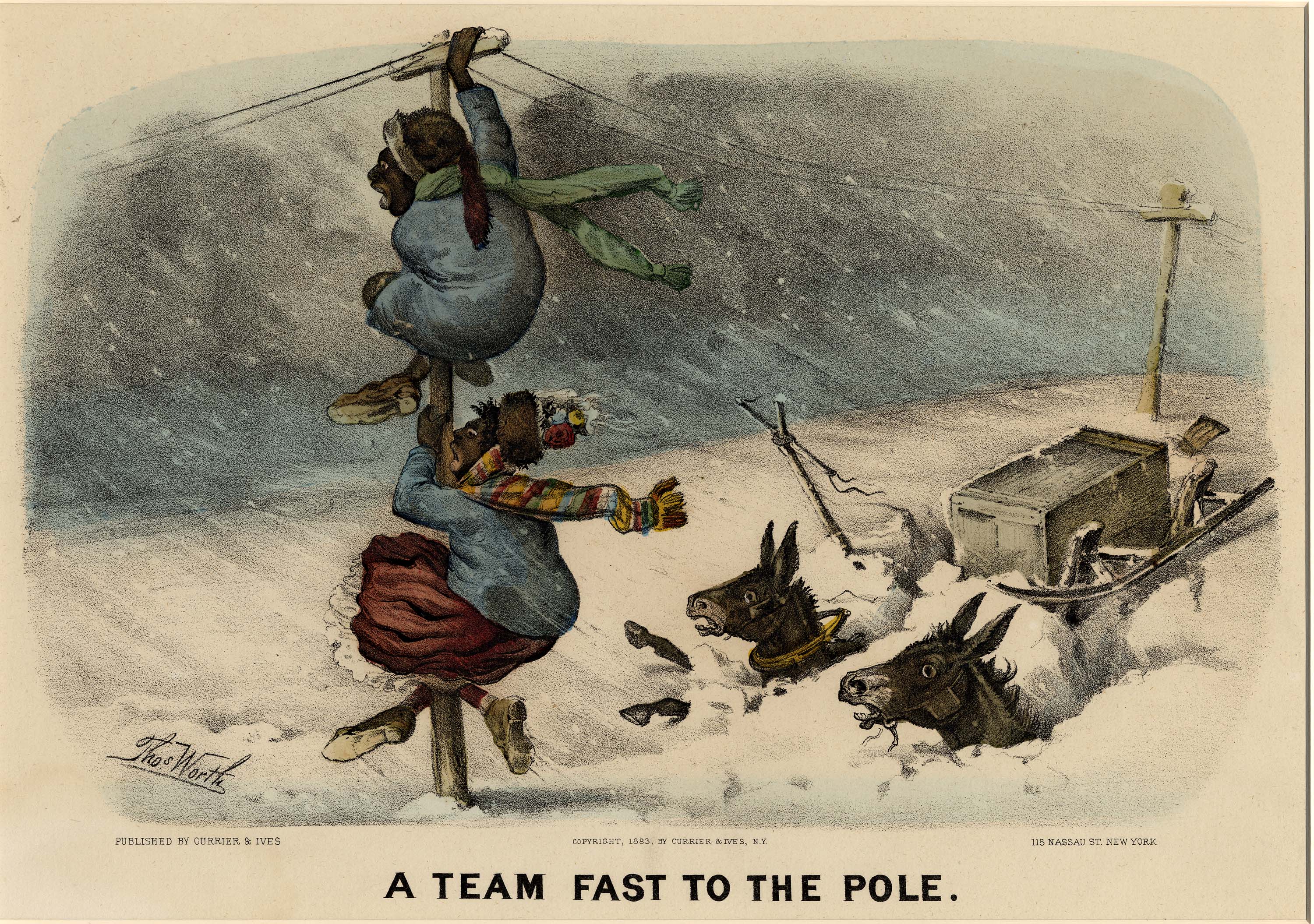
Previous to the Emancipation Proclamation, Currier & Ives generally depicted blacks as individuals content with their lives and position in society; they were often pictured in the background of idyllic plantation images. Initially after the Proclamation was issued, the firm continued to depict blacks in a positive light, focusing more on individuals, publishing portraits of John Brown, Frederick Douglas, and black Union soldiers fighting for their freedom (222). As time went on, however, and the freedmen began to move north into the cities, it became more apparent that not all Northerners were unanimous in their support of emancipation and the status of the freedman. The political images published by Currier & Ives during this time were vicious attacks against the character and intelligence of blacks, depicting them as unsupportive and disobliging of the political figures who sought to free them, such as Abraham Lincoln, Horace Greeley, and Senator Charles Sumner (226).

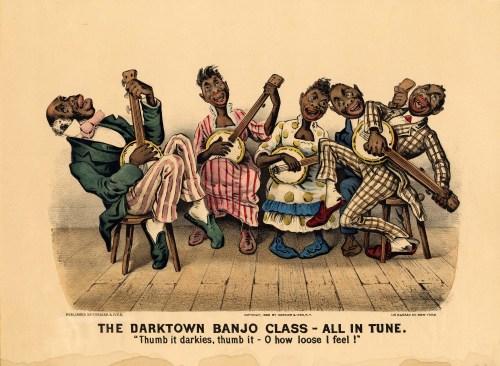
During and after Reconstruction, Currier & Ives, and America it seems, continued to appreciate these negative images of African Americans. Out of this, between the mid-1870s to the early 1890s, the Darktown Comics arose, mostly illustrated by Thomas Worth (1834-1917) and James Cameron (1828-1963). The company described the Comics as “pleasant and humorous designs, free from coarseness or vulgarity, being good natured hits at the popular amusements and excitements of the times”. It has been suggested that Darktown may have “served as satires on polite white behavior as well”, as could be supported by previously positive images of African Americans. Regardless of intent, the prints only reinforced negative racial stereotypes throughout the country.


The caricatures presented by the Darktown Comics consisted of “African Americans performing actions that were more or less normal for ‘ordinary’ folk, meaning whites…the implication being that the African Americans could not execute even the simplest tasks of everyday life without making themselves appear ridiculous”. The most common images depicted by Currier & Ives’ artists were of African Americans attempting to have horse, skull, and sulky races; ride in carriages and yachts; hunt; host lawn parties; play tennis; and fight fires–always with disastrous results. And the depiction of  African American lawyers, doctors and the clergymen as bumbling and dishonest were quite malicious. African American children were also featured in a poor light – as mischievous, out of control, disrespectful hoodlums. This is evident in prints by Thomas Worth such as “A Put Up Job” and “A Fall from Grace” (1883) and “Breaking In: A Black Imposition” and “Breaking Out: A Lively Scrimmage” (1881).


African American stereotypes that still exist today were begun here – the connection of African Americans to music, in Darktown specifically of banjo playing, and of their supposed eating habits, most notable in the Comics, that of eating watermelon. This can be seen in the prints that make up the set of the Darktown Banjo Class and in single prints like “O Dat Watermillion!”. As one can see, African American speech was attacked as well, through phonetic renderings steeped in the distortion of stereotypes and caricature.


The Darktown Comics did not develop or exist in a vacuum, however. In addition to theDarktown prints that came out of this time, Harper’s Weekly featured the Blackville prints; examples of which can be seen at HarpWeek’s exhibition, “Toward Racial Equality:Harper’s Weekly Reports on Black America, 1857-1874 or the Philadelphia Print Shop’sBlackville Prints.” These were similar in content to Darktownspoofs of African American attempts at high fashion, sports, etc. The most prevalent artists of this series were Sol Eytinge, Jr., William Ludwell Sheppard, S.C. McCutcheon and “Sphinx” (Philadelphia Print Shop, Ltd.). Other publications, such as Life, Puck and Judge, as well as Pulitzer’s New York World and Hearst’s New York Journal produced similar images but these were in the context of satire (Hays). Whether or not these images were taken as satire or at face value by the American populous is up for debate, however. Other news and editorial magazines, such as The Outlook and The Independent, also promoted these types of images through their illustrations and advertising—exemplifying the prevalence and acceptance of these racist stereotypes across the country (Hays).


The “high art” of this time, specifically that of southern artists, furthered these stereotypes as well, dehumanizing the African American through their depictions of coal black skin, thick red lips, oversized teeth, and patchwork clothing. It wasn’t until the impact of the Ashcan Society and the period of realism came into play that classical forms of art began to celebrate the figure of the African American as he really appeared. The art of Robert Henry, George Luks, and George Wesley Bellows are forefathers of this new view – a celebration of the African American.

SOURCE