alice disrobed

More on the Rhinelander Trial.  I’d like to make a movie about this.

Leonard “Kip” Rhinelander Trial (1925)

The New Rochelle, New York annulment trial of Leonard “Kip” Rhinelander and his wife, Alice Jones Rhinelander, was a much-publicized issue in the 1920s which highlighted white America’s definitions of race, class, and marriage.

Alice Jones was the daughter of working-class English immigrants.  Her mother was known to be white, while her father’s ancestry was “mixed.”   Leonard “Kip” Rhinelander was descended from a wealthy, white New York family.

Rhinelander and Jones met in 1921, fell in love, and married in 1924.  Because of the Rhinelander family prestige, the union soon became public.  In the social atmosphere of the 1920s, it was scandalous that Rhinelander would marry a woman of lower socioeconomic class, or who possessed any “non-white” blood.  Rhinelander’s father pushed the annulment lawsuit brought by his son only weeks after the wedding, in which Rhinelander, Jr. charged Mrs. Rhinelander with deceiving him as to her race.  The prosecution argued that if Leonard had known she was “not white,” he would not have married Alice.  A leading issue in the trial thus became what Alice Rhinelander’s true race was, bringing into sharp focus the arbitrary nature of white America’s obsession with racial classification during that period.

Attorneys on each side attempted to answer this question using Alice Jones Rhinelander’s social network, her father’s ancestry, and even her language as evidence of her racial status.  The Rhinelander attorneys attempted to paint Leonard as a “dupe” victimized by a “vamp,” playing on sexualized stereotypes of African American women, while defense counsel resorted to desperate means to prove that Rhinelander must have known his bride was not “white” when they induced a stricken Alice to disrobe before the jury.

During the trial, the court required Alice to disrobe on the witness stand for examination of her skin. The court wanted the jury to inspect the color of her nipples.

The Rhinelander Trial held the public in its grip for the better part of 1925, with both black and white press weighing in with varying opinions.  Ultimately, on December 6, 1925, the jury ruled in Mrs. Rhinelander’s favor.  Playing on the notion that race can be visually established, the defense attorney successfully “showed” Mrs. Rhinelander to be “colored,”  argued that she could not have deceived her husband, and therefore his claims for annulment were invalid.

LATE IN 1929, Alice agreed to a divorce in exchange for a small monthly pension, and with the stroke of a pen a Nevada judge erased Kip Rhinelander’s social error. According to the terms of the settlement, Kip Jr. paid Jones a lump sum of $32,500 and $3,600 per year for life if she would disown their family name. Ironically, Jones would outlive her ex-husband by 50 years, passing away in 1989. On her gravestone read the name Alice J. Rhinelander.

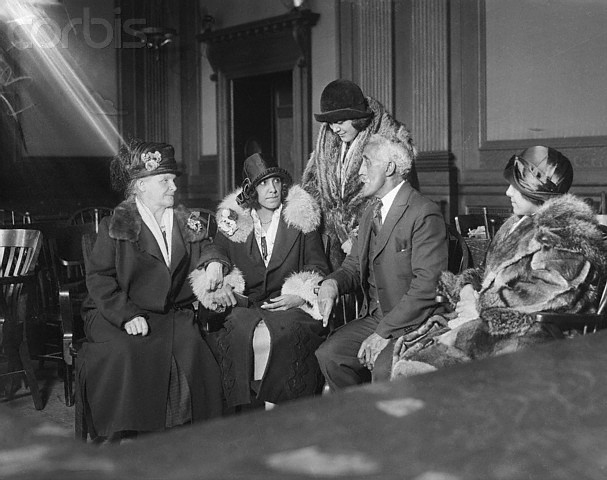
Original caption: Photo shows Mrs. Alice Rhinelander surrounded by relatives as jury decides case…Rhinelander jury locked for night; both sides anxiously await verdict. “Sentiment, passion, and prejudices should not interfere with your honest determination,” Justice Morschauser charged jury deciding Rhinelander case. Having failed to reach a verdict by 5:50 p.m. December 4th, they were ordered locked for the night. Left to right: Mrs. Jones, Alice, Grace, Jones, and Emily awaiting verdict.

SOURCE

passers

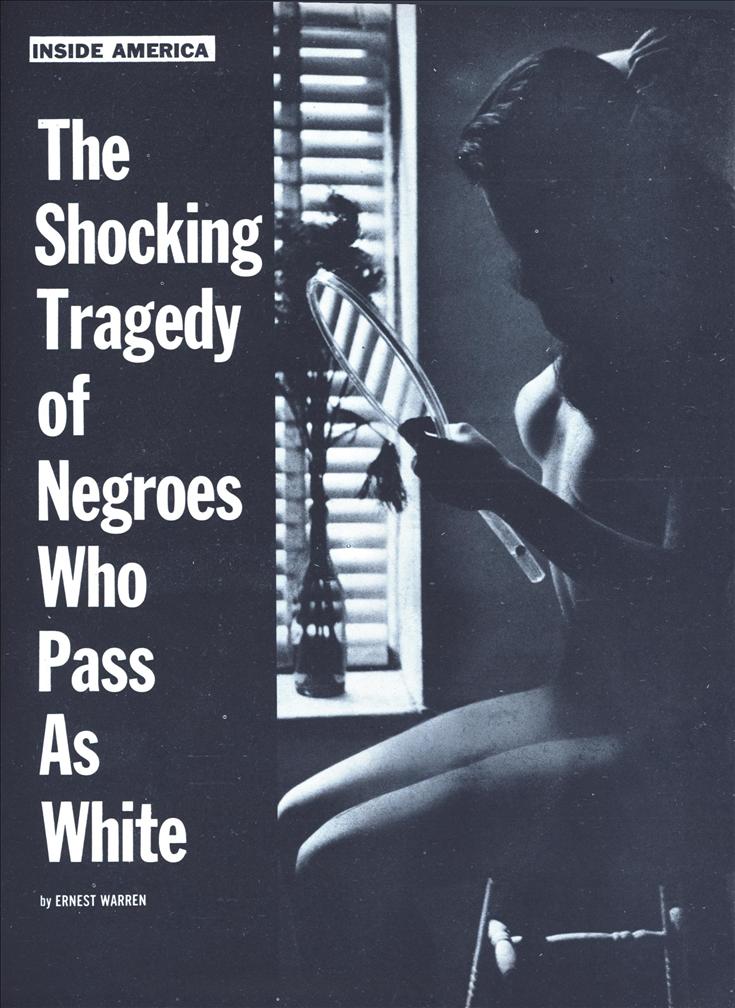
Thank you, Lee, for turning me on to this little “gem.”  Horrifying sums it up well.  I don’t know what content I find most horrifying.  I’m picking up lots of “tragic mulatto” and “jezebel” (the cover page photo!) innuendo though those specific terms aren’t used.  In fact, the passers don’t have to be mulatto at all.  As I’m constantly told, as a nation and a people we’re all mixed and there are plenty of “black” people that are lighter than some mulattoes such as myself.   I do like this notion of “one honest goal: the elimination of the invisible color boundary which for so many years unfairly kept him from his rightful place in the sun.”  We’re still workin’ on it.

ENTIRE ARTICLE

…it seems well-nigh incredible that some five million Negroes have turned their backs on their own race and are passing as white. For almost a quarter of a century, this fantastic lie has been lived by large groups of Negroes with no sign of abatement despite the strong gains that have been made by the champions of anti-segregation.

In the year 1960 alone more than 60,000 negroes are expected to “disappear”, cross the invisible color line into the world of whites. These are not just dreamed up figures. They are actual facts. Just as it is a fact that no one ever reports a Negro to the Missing Persons Bureau unless they are absolutely sure the missing human isn’t passing.

Many shocking incidents were brought to light some years back in a sensational book, ‘Black Metropolis’ by St. Clair Drake and Horace R. Cayton. The authors claim that many “white negroes” as passers are called— hold strong positions in the white world as physicians, scientists, and public administrators—despite the fact that many such jobs are also held by Negroes unashamed of their race.

The late Walter White, himself a Negro, and one of the prime movers in the National Association for the Advancement of Colored People, once attempted to clarify the problem of passing. He said: “Negroes naturally resent the loss of some of the brilliant minds which would be an asset to them in their grim struggle for survival. But if any Negro believes he will be happier living as a white and thereby escape the barbs and handicaps of prejudices, or if he believes he can use his ability and training to greater advantage on the other side of the racial line, most Negroes wish him well.”

When it comes to passing, although most Negroes today refuse to condone it, they will not tell on one another. Most seem to understand the reasoning that prompts lighter-hued members of their race wanting to cross over.

“We know there are stronger anti-discrimination laws than ever before,” they will tell you, “but when a negro has a white skin, he seems to have a compulsion to live the way of the people who have so long opposed him. He doesn’t seem to realize that scientists have proven that the very people who condemn him might not be in a position to do so.”

A scientist like those mentioned above is Dr. Caroline Day, of Atlanta University, who wrote in her famous Harvard African Studies: “The grim joke of the whole matter is that for 150 years and more the Negro has been absorbed and his descendants are constantly rubbing elbows with some of the very ones who are discussing them.”

Even the fact that people, who believe all passers are eventually found out because their children are sure to be black, are merely deluding themselves, hasn’t deterred the practise of passing. Science took the inherited color theory apart a long time ago, with the aid of such eminent savants as Amram Schienfeld, Dr. Ernest A. Hooten and the late Dr. Edward M. East, who theorized thus; “If one of the parents is pure white, the baby cannot he darker than the darker parent. If they both have Negro blood, the baby may be slightly darker than its parents hut the chances are against it.”

With the legalization of racial intermarriage approved in some 22 states, nobody has been able to upset their theory – though, obviously, chances to do so have been many.

Yet the “passers” themselves seldom worry about theories. The “permanent passer”, going over the line, never comes back. He prefers to end his days living a big white lie; and women passers who marry bear children and keep their secret for life.

Only under unusual circumstances, such as the one that befell the wife of a prominent socialite, does a sensational exposure ever occur. This was the Leonard Kip Rhinelander case, which rated lurid headlines when the socialite playboy sought to have his marriage to Alice Jones set aside. Rhinelander claimed his wife was colored and failed to tell him so. In her defense, Alice stripped to the waist and bared her breasts to the jury, thus providing the sensation-seeking New York Graphic with a classic composite-photo of this closed door session for its front page.

Besides the “permanent passer”, the “segmental passer” stands without guilt or censure. The “segmental passers” lead a dual life; whites by day, Negroes by night. You’ll often find them in jobs where opposition to Negroes is strong but secret-Some are telephone operators, receptionist, typists, clerks in large corporations and in department stores, where, though some Negroes are employed the unspoken policy is “Enough is enough.”

On Broadway, particularly, the Negro girl has a tough time getting a chorus or showgirl job. There is a story current of a Negro showgirl, allegedly passing as white, who was recognized by a popular Negro singer, but he refused to reveal her secret. He also reportedly wouldn’t talk to the girl, not because of her “passing” but because of her more than passing interest in a white socialite-playboy who met her nightly.

“Obviously she hasn’t learned yet that mixed marriages are no longer looked on with horror,” a Negro artist told INSIDE STORY, “so she’ll go on living her lie and, in the long run, probably find her heart broken because she feels she can’t reveal her secret to the man should he want to marry her. Life will never be easy for her. She not only sometimes has to listen to blasts against her race, but worry every moment about being exposed.”

While there’s no way of truly gauging the number of passers operating, some estimate is arrived at by studies of census reports, immigration records, vital statistics and information from other sources. Yet this does not take into account the ‘’segmental passer” or the passer who, in the past, was known as an “occasional” a reference to light-hued Negroes who occasionally went downtown to segregated areas and, as a lark, spent their money on white entertainment.

Actually, when it comes to “passing”, the shocked might as well face these facts: Passers not only go through life as white, they have children who look (and are) white. Any anthropologist will tell you that if a person has one-sixteenth or less of Negro blood—it is impossible to determine his or her ancestry.

Yet, the practice of passing still continues, much to the chagrin, not necessarily the shame, of the Negro who believes in living as he was born. To such a Negro, there can be only one honest goal: the elimination of the invisible color boundary which for so many years unfairly kept him from his rightful place in the sun. The passer, working in the movies, working as a white actress or a showgirl, or a model or a clerk, or a receptionist doesn’t think of this. He’s thinking of himself. Or herself. And that, to a good many Negroes, is a “shameful secret!


grateful for the choice

I mailed my Census form yesterday.  I must say that after all the hype, I was totally underwhelmed by the experience.  I checked the two boxes.  I can’t say it brought me any great feelings of validation.  I guess I thought they’d be asking some questions that went beyond race.  I also thought that “Negro” would be the only African American classification term offered since there was so much buzz about the word being used in 2010.  At any rate, I enjoyed this article.

More than black or white

By Annette John-Hall

Inquirer Columnist

SOURCE

For Kathrin P. Ivanovic, racial identity means a whole lot more than just black or white.

Her makeup runs the gamut.

“My mother is German and my birth father is African American with Cuban ancestry,” says Ivanovic, 29, director of development at the Nationalities Service Center, a Philadelphia nonprofit that services immigrants and refugees.

“Plus, my adopted dad is white, and I’m queer. Unfortunately, they don’t have a box for that.

“. . . I call myself a mixed chick.”

But when her 2010 U.S. Census form arrives in the mail this week (the 10-question form is being touted as the shortest in census history), Ivanovic will be satisfied to check black and white – which is really how she sees herself anyway.

Since the 2000 census, for millions of Americans like Ivanovic, “check one or more” will apply.

There is plenty to choose from, with the number of racial and ethnic categories at 63. In the 1990 census, there were only five designations offered.

It can be dizzying. If you’re, say, Asian, you can check any combination of Asian American, Chinese, Japanese, Filipino, Korean, Vietnamese, Hawaiian, Guamanian, or Chamorro, Samoan, as well as write-in categories for Other Asian or Other Pacific Islander.

In addition, you can also note if you’re of Hispanic, Latino, or Spanish origin. That’s because since 1970, Hispanic was no longer recognized as an overarching classification.

Still with me? (And here I thought having Negro on the same line as the black or African American box was confusing.)

But I’m all for it, especially if it paints a more genuine picture of who we are – all 300 million of us. Doesn’t matter if only 2 percent of Americans were identified as more than one race in 2000. Nowadays, we’ve got more multiracial and multiethnic couples and children than ever before, which means the percentage is sure to increase this year.

Which in turn enables the government to allocate funds more equitably. Census data are used in everything from determining the number of congressmen your region gets to the assessing the amount of funding for your town’s bridge project to supporting health centers.

Race data also have driven the nation’s civil rights laws (how many people were denied the right to vote, how many were discriminated against in housing, for example) and are still used to monitor inequalities in health and education.

But it wasn’t always that way.

Truth is, the U.S. Census was historically more of an oppressor than an advocate, especially when it came to African Americans.

Racial count

From the time census data were first collected in 1790, when enumerators listed categories of free men and slaves, whites used the census to diminish African Americans.

“You can see why they had a slave category,” says MIT professor Melissa Nobles, author of Shades of Citizenship: Race and the Census in Modern Politics. “Southern slave owners wanted the least amount of information, thinking it would help abolitionists. And abolitionists wanted the most amount of information [to make their case].”

Throughout the 19th century and until 1930, census counters used categories such as quadroon (one-quarter black), octoroon (one-eighth black), and mulatto (half black) to describe any person who had a discernible amount of African American blood.

Like they could tell just from looking.

Even after 1930, Southern laws imposed the “one-drop rule” to its census enumerating, meaning they were to count as mulattos anyone who even looked remotely black – a mandate loosely applied by census counters nationwide.

“They used it for racial social science,” Nobles says. For example, they used census data to prove skewed theories (arguing, for instance, that biracial people – “the tragic mulatto” – were somehow weaker and suffered from higher death rates), which in turn helped legislators make the case against interracial marriage.

But even as the categories have expanded, some today are pushing for a separate, generic multiracial designation.

Ralina L. Joseph, a professor of communications at the University of Washington, worries that even though the data will show us as more diverse and multihued, they could be misinterpreted once again.

“I don’t want people to read the numbers and think that racism is over, that this is a post-racial moment,” says Joseph, who is biracial. “We should hope that people who are disenfranchised through race, class, and poverty levels should be identified as such.”

Some sociologists even insist that racial designations have no place on a census form, if it is indeed as simple as an objective count.

But in a multiracial, multiethnic society where even the president is a self-described “mutt,” Kathrin Ivanovic is grateful for the choice.

“I am mixed. It’s how I view the world, and in some ways it’s how the world views me,” she says. “To not be able to identify that way is dishonest to me personally.”

“The Census Taker” (1870) Harper’s Weekly

making the best of it

Taking into consideration the lunch counter sit-ins of 1960, I think this is a remarkable story…

Area Woolworth’s first black sales clerk calls hiring proud moment

Jean Fisher Curry was hired in 1961 to work a cosmetics counter in the front of the store.

By Tom Stafford

SPRINGFIELD — There were no lunging police dogs with bared fangs, no fire hoses knocking people to the ground, no instigators putting cigarettes out in the hair of protesters at lunch counter sit-ins.

The first apparent outward sign that Springfield’s F.W. Woolworth store would have its first ‘‘Negro’’ employee — to use the word customary at the time — was a note Jean Fisher, 15, received in class during the fall of 1961, her junior year at South High School.

“I was never in trouble,” said Jean Fisher Curry of Springfield. So when she got the note from the counselor’s office, “I thought, what did I do?”

It wasn’t what she did that was notable but rather what she was about to do.

Like other Distributive Education students, she was told she’d have to meet the standards: keep a B average and take special classes in the department.

“I think (Distributive Education) was the forerunner of the vocational school,” Curry explained.

But if she met the standards, she could work at Woolworth’s — the downtown one at High and Limestone streets.

The importance of that was not lost on Curry: “They didn’t have black people working in the store.”

A happy clerk

“I thought I’d be cleaning,” Curry said.

That might have been OK. Her mother had done that for years in what was called “private family work” — working as a domestic at the Tanglewood Drive home of Seymour and Anne Klein.

Jean Curry hugs her mother, Alberta Fisher, whose encouraging words helped her break new ground as the first black sales clerk at Springfield's Woolworth store. Staff photo by Marshall Gorby

Jean Curry hugs her mother, Alberta Fisher, whose encouraging words helped her break new ground as the first black sales clerk at Springfield’s Woolworth store. Photo by Marshall Gorby.

Being a domestic “never bothered her,” Curry said, “because that was honest work.”

And when the Kleins asked Alberta Fisher to run the lunch counter at Victory Lanes, it showed “they trusted her,” Curry said. “And she was happy with that.”

The job at Woolworth’s wasn’t a cleaning job, however — likely because the Distributive Education program didn’t train people for that task.

“They told me it was a sales clerk,” said Curry,” and I said, ‘Yeah.’ ”

As it turned out, her post would be at the cosmetics counter in front of the store, where she’d be seen by all who walked in the main entrance.

The sightings began soon after she turned 16 on Sept. 15, 1961, and got her work permit.

Shades of discrimination

Curry discovered a shade of racial reasoning involved in her placement in the store.

“They hired a black girl from North and me from South,” she explained. “Because I was light (-skinned), I worked at the front of the store. Because she was darker she worked in the back of the store with the pets.”

Asked whether that was the real reason for the assignments, Curry was emphatic: “There’s no doubt. I knew it, she knew it, and she resented it.”

Curry said that colored her attitude toward her own work: “What was I going to be mad about? I didn’t feel discrimination like somebody darker.”

The attitude ran in her family.

When the census came, the light-skinned Curries listed their race as mulatto., and in the militant black pride era, they joked about being “high yellow.”

Still, they had to follow rules of the racial road.

Springfield then was a town in which blacks weren’t allowed in the Liberty Theater and in which blacks were suspicious of drinking out of segregated fountains, wondering what white people put in them.

Blacks also tended to “stay within our culture,” Curry said, taking the elevator in the Arcade to the music store that catered to their tastes and frequenting the Center Street YMCA.

Woolworth’s also had its rules: Blacks could order only carry-out from the food counter.

And when Curry started, “we were told when we gave people change to lay it on the counter,” she said, thus avoiding problems with white customers who were uncomfortable having physical contact with blacks.

“But like I told (the girl from North),” Curry added, “we may get some money.”

At first, the pay was 65 cents an hour. The following year, it would go up to 85 cents — this in an era when $1 an hour was considered decent pay, Curry said.

In her youthful enthusiasm, “I didn’t think it was a job. I thought it was a career.”

In the same spirit, Curry, who knew that the actress Betty Hutton’s sister, Barbara, was part owner of the chain, half expected one or the other Hutton sister to show up some day, coming through the front door right into her area.

When she told people she worked at Woolworth’s “I always said ‘F.W.’ like I knew him.”

“I couldn’t even tell you what F.W. stood for.”

Her mother and God

The non-Hutton whites who came into her area in the front of the store fell into a couple of categories, Curry said.

“The older ones, the little white-haired ladies, they liked me,” she said.

“They were used to black people working in their homes and knowing their place. And I knew my place.”

“The other ones, I had to grow on them,” she said.

And she did, using the enthusiasm and bedrock values her mother taught her.

Part of it was common courtesy. “I was always very friendly. You just do that,” Curry said.

Also, “we were very religious,” she said. “We went to church. I think God had a place in that.

Constantly on her mind at that time was the desire “to make my mom and dad proud of me,” Curry said.

Finally, there was the work ethic her mother sought to instill in her children.

Throughout their childhoods, Mrs. Fisher recited a saying to her children to encourage them to do the best they could in everything they did.

“She said it so much to me that I knew it by heart,” Curry said.

All that you do, do with your might.  Things done by half are never done right.  All that you do, do with a zeal.  Those that reach the top, have to climb the hill.

Touching moments

If some of the white people of the time were uncomfortable touching blacks, the black friends and family who came to the store were the opposite.

They’d reach out, touch her and say “It’s so good to see you” when they came in, Curry recalled.

Her mother was especially proud.

“Out of all the girls, they chose her to be there,” said Mrs. Fisher, now 91, who also lives in Springfield.

“I was excited about it, really I was,” she continued. “All my whole family — my sisters, everyone — I was just telling everybody. And I still tell it now.”

Curry said the Woolworth’s experience helped her to feel a part of the larger community.

Already with a sense that Woolworth’s was a cut above the competitors of Kresge and McCrory’s, Curry soon got to know the downtown merchants as they stopped into Woolworth’s — people like William Greene, owner of an exclusive dress shop.

“I could go into stores and they’d let me lay things away. A lot of time black people couldn’t go into those stores,” she said.

Knowing as a customer, the mistress of one of the downtown businessmen also marked her as an insider.

“I felt like I was part of Springfield because I was doing those things,” Curry said.

“It wasn’t that I wanted to be white. I was being accepted for who I was, making the best of it. And I said some day I’ll tell these stories to my grandchildren, and they’ll love it.”

SOURCE

a rare testament of harmony

This is a fascinating story of interracial marriage, institutional racism, blended families, and mixed race ideology.  I am inspired by the courage of conviction this woman maintained in the face of so much opposition.  Oh! And… um…. excuse me South Carolina… 1998!?!?  Yes, Michigan!

How one woman overcame the racial barriers that divide us

By DAVID LAUDERDALE

Laura Markovich came to Beaufort County in 1965 because it had one of the few places in the South where whites and blacks could gather.

She came from Michigan to attend a religious “summer school” of her Bahá’í World Faith at Penn Center on St. Helena Island.

What unfolded here became a rare testament of harmony in the messy struggle of race relations in America.

At the secluded Penn Center, on sandy soil where the first school for freed slaves was erected in 1862, the young white widow met a tall and striking black widower.

On the surface, the only thing they had in common were children underfoot. Laura had four children, all white, and Elting B. Smalls Sr. of St. Helena had six children, all black.

Three years later, they were married. They lived in the Tom Fripp community on St. Helena and together had four more children.

Laura and Elting Smalls, center, on St. Helena Island with two of her daughters, one of their sons, and two family friends.

It was a life so odd for that era in the Deep South that it demanded hard-to-reach courage, resolve and unity.

Those characteristics — and Laura Smalls’ devotion to her faith, early childhood education and family — were cited Tuesday when a standing-room-only crowd gathered back at that same Penn Center for her funeral. She died Feb. 27 at age 79.

Her children composed a eulogy that makes it sound like they were raised in the world of Ozzie and Harriet:

“Her greatest loves were arts and crafts, playing and teaching children, talking to everyone and anyone, and dancing. You can see this evidenced through her children’s passions….Can’t you yet see her sweet smile?”

‘WEDDED WIFE’

That smile was a triumph of the spirit over harrowing details.

To set the stage, their marriage took place days after Dr. Martin Luther King Jr. was assassinated and America’s streets erupted into racial violence. King himself had gathered his troops for retreats at the Penn Center for the same reason the Bahá’ís did. They believed in unity, and this was one place they could find it. Just months before he died, King stood at Penn Center to ring home a point to the antsy civil rights activists: “So I say to you tonight that I have taken a vow. I, Martin Luther King, take thee, nonviolence, to be my wedded wife.”

For Elting Smalls to take Laura Markovich to be his wedded wife was not much easier.

Her faith required written permission from her father, and he didn’t want to give it. It took her three years to get it. Her father never did agree to meet Smalls, a Penn School graduate and career civil service worker at Parris Island Marine Corps Recruit Depot.

And then there was the matter of the law. In June 1967, the U.S. Supreme Court overturned state laws, like South Carolina’s, that banned interracial marriage. But it took South Carolina until 1998 to officially amend the state Constitution to remove what had been ruled a violation of the 14th Amendment. The Smalls wedding was a quiet affair in the home of one of the bride’s closest friends — in Michigan.

Thus a family of whites from up North and a family of black Sea Island Gullahs became one. They lived united, years before integration was forced on the local schools, much less accepted in the home.

BLACK AND PROUD

Sometimes Laura Smalls would take her troupe of white, black and mixed-race children into the historically white waiting room at the doctor’s office, and sometimes into the historically black waiting room, and always let the odd stares fall where they may.

Family members say the white community in town had a stand-offish attitude, but the blacks of St. Helena welcomed them all, as family.

“She didn’t do it to make a statement,” said daughter Lynn Markovich Bryant of Lady’s Island. “She fell in love with Elting and she wasn’t going to let anything stand in her way.”

Bryant gives the world a look at race it rarely sees in her 2002 autobiography, ” ‘I’m Black and I’m Proud,’ Wished the White Girl.”

As a child she was stunned by the ingrained racism she saw in her little classmates. She struggled with white attitudes toward blacks because in her world, there was no racial divide. She chose to attend the predominately black St. Helena Elementary School, where she felt welcomed as a fifth-grader. Today, she has taught there for almost 30 years after finishing second in her class at Beaufort High School, earning a full scholarship to Clemson University, graduating with honors and earning a master’s degree with a 4.0 grade point average.

She sounds like a black person, and she married a black man, joking that she would have had to marry a white for it to have been considered an interracial marriage. Her husband, Wilbert Bryant, teaches at Battery Creek High School.

One day as an adolescent, Lynn Bryant blurted out, “Mama, I hate white people.”

In her book, Bryant writes: “Being a mother to such a multitude of children, this was hardly her first or last problematic situation to resolve. … She ever so warmly and calmly responded as only she could, ‘Well, Lynn don’t you love the Bahá’ís? There are white Bahá’ís.”

EMBRACED

…Smalls was embraced on St. Helena because she was not a white who ignored the natives or said, “My way is better than your way — move over.”

She saw racial progress, her daughter said, but not the level of social interaction that’s necessary for people of different races, cultures and beliefs to quit being so judgmental.

“She taught us that we have more commonality than differences,” Bryant said.

Together, Laura Smalls’ 13 surviving children and stepchildren of all colors wrote: “Our mother did not tell us how to sacrifice and serve others; instead she showed us how to walk the walk.”

SOURCE

constitutional/unconstitutional

I love, love, love this op-ed piece on gayness, marriage, family, laws, human rights, and injustice in the good old USA.

U.S. protects Constitution, not justice

State legislation sacrifices human rights in favor of religious ideology

Joshua Colston

SOURCE

When does a society decide to rectify an obvious longstanding injustice? The U.S. has a long history of allowing states to legislate unconstitutional laws such as miscegenation, segregation, slavery, women’s rights, reproductive rights, and LBGT equality based on an imposed religious morality.

Until 1967, the issue of interracial marriage was left up to the state. Opponents of interracial marriage felt that the mixing of races was unnatural, was against their religious ideals, and would lead to the death of the institution of marriage. Anti-miscegenation laws were enforced to protect mixed-race offspring from such an unnatural union.

Women’s rights opponents argued that women should’t be allowed to vote as they are mentally deficient, weak and neurotic by nature. It was argued that freeing the slaves was a disastrous concept and would lead to society’s downfall.

Some religious people believe that homosexuality is a choice or mental illness, advocating faith-based healing or sexual aversion therapies including electroshock or the administration of a corrective rape. No credible evidence shows these treatments to be effective. Rather, they end with suicide or-even worse-the subjects being expelled from their social groups. Am I mistaken assuming sexuality is innate?

The fact is this occurs in nature. Of the approximate 1,500 animal species we have extensively studied, nearly 450 exhibit homosexual behavior, engaging in same-sex relationships.

The belief that same-sex households lead to dangerous environments for children is absurd, since convicted drug dealers, neo-nazis, murders, rapists and convicted pedophiles are allowed to marry and raise children. Who poses a danger?

Coretta Scott King, civil rights leader, and Martin Luther King, Jr.’s widow spoke at Richard Stockton College about gay rights: “Gay and lesbian people have families, and their families should have legal protection. A constitutional amendment banning same-sex marriages is a form of gay bashing, and it would do nothing at all to protect traditional marriages.” This is of the most respected and active people in the civil and women’s rights movements.

Some feel that gay marriage and homosexuality simply go against the established traditions of America. Is American marriage purely for procreation? What about infertile couples, couples who choose not to have children, and the elderly who have long been allowed to marry and are allowed the full benefits and legal protections of the union? American marriage is about mutual love and commitment, not primarily about procreation.

How can such a great society tolerate such a liberal definition of freedom of speech while limiting its definition of equality? Do we really want a society that enables Liberty to rob Justice blind?

more on the racial ‘integrity’ act

Perhaps even more influential than John Powell was Walter Plecker.  Plecker dedicated his life to making sure that people like me could not exist.  And though the notion predated him, I believe that he further ingrained into the consciousness of the nation the myth of the “tragic mulatto.” But even worse than that, he stripped the Native Americans of Virginia of their rights and identity.  In my opinion Powell, Plecker, and the Eugenics movement in general are major pieces of this race in America puzzle. 

John Powell, the renowned Richmond-born composer and pianist, clutches an American flag in this news service photograph from 1920. Wealthy Virginians and powerful newspaper editors supported the white-supremacist sentiments espoused by Powell. Fear of racial mixing was particularly pronounced among genealogy-obsessed Virginians who wanted to maintain a “pure” bloodline.

Disdaining the Ku Klux Klan’s violent white supremacist policies and tactics, elite white Virginians embraced the scientific racism espoused by the Anglo-Saxon Clubs of America. Founded in Richmond in September 1922 by internationally renowned pianist John Powell, self-styled ethnologist Earnest Sevier Cox, and Walter Plecker, the ASCOA committed itself to preserving white “racial purity.” Powell provided the movement’s star power and publicity; Cox’s book White America (1923) provided the pseudoscientific, eugenic justifications; and Plecker backed the other two with the state’s police power. The ASCOA demanded legislation prohibiting interracial marriage and defining anyone with any non-white heritage—even one drop—as black.

Passed at the height of the eugenics movement, the Racial Integrity Act proclaimed the existence of only two racial categories in Virginia—”colored” and white.  The law stripped Native Americans, and members of other groups with dark skin, of their land, voting rights, and legal identity.

Walter Ashby Plecker was the first registrar of Virginia’s Bureau of Vital Statistics, which records births, marriages and deaths. He accepted the job in 1912.  For the next 34 years, he led the effort to purify the white race in Virginia by forcing Indians and other nonwhites to classify themselves as blacks. It amounted to bureaucratic genocide.

He worked with a vengeance.

Plecker was a white supremacist and a zealous advocate of—a now discredited movement to preserve the integrity of white blood by preventing interracial breeding. Unless this can be done,” he once wrote, “we have little to hope for, but may expect in the future decline or complete destruction of our civilization.”

Plecker would recall his early days in a letter to a magazine editor expressing his abhorrence of interracial breeding. He remembered “being largely under the control” of a “faithful” slave named Delia. When the war ended, she stayed on as a servant. The Pleckers were so fond of her that they let her get married in their house. When Plecker’s mother died in 1915, it was Delia “who closed her eyes,” he wrote.

Then Plecker got to his point. “As much as we held in esteem individual negroes this esteem was not of a character that would tolerate marriage with them, though as we know now to our sorrow much illegitimate mixture has occurred.” Plecker added, “If you desire to do the correct thing for the negro race … inspire (them) with the thought that the birth of mulatto children is a standing disgrace.”

Walter Plecker sits at his desk in 1935 at the Bureau of Vital Statistics

Plecker was a devout Presbyterian. He helped establish churches around the state and supported fundamentalist missionaries. Plecker belonged to a conservative Southern branch of the church that believed the Bible was infallible and condoned segregation. Members of Plecker’s branch maintained that God flooded the earth and destroyed Sodom to express his anger at racial interbreeding.

“Let us turn a deaf ear to those who would interpret Christian brotherhood as racial equality,” Plecker wrote in a 1925 essay.

Plecker saw everything in black and white. There were no other races. There was no such thing as a Virginia Indian. The tribes, he said, had become a “mongrel” mixture of black and American Indian blood.

Their existence greatly disturbed Plecker. He was convinced that mulatto offspring would slowly seep into the white race.  “Like rats when you’re not watching,” they “have been sneaking in their birth certificates through their own midwives, giving either Indian or white racial classification,” Plecker wrote.

Photograph of 1943 letter from Walter Plecker.

Many who came into Plecker’s cross hairs were acting with pure intentions. They registered as white or Indian because that’s how their parents identified themselves. Plecker seemed to delight in informing them they were “colored,” citing genealogical records dating back to the early 1800s that he said his office possessed. His tone was cold and final.

In one letter, Plecker informed a Pennsylvania woman that the Virginia man about to become her son-in-law had black blood. “You have to set the thing straight now and we hope your daughter can see the seriousness of the whole matter and dismiss this young man without any more ado,” he wrote.

In another missive, he rejected a Lynchburg woman’s claim that her newborn was white. The father, he told her in a letter, had traces of “negro” blood.

“This is to inform you that this is a mulatto child and you cannot pass it off as white,” he wrote.

“You will have to do something about this matter and see that this child is not allowed to mix with white children. It cannot go to white schools and can never marry a white person in Virginia.

“It is a horrible thing.”

Plecker demanded the removal of bodies from white cemeteries. He tried to evict a set of twins from a Presbyterian orphanage because they were illegitimate and, therefore, the “chances are 10-1 they are of negro blood.”

Plecker maintained that all of his racial designations were based on impeccable records. There was, however, a secret Plecker revealed to only a few trusted allies: A lot of the time he was just guessing.

He acknowledged the sham when a Richmond attorney questioned his authority to change the birth certificate of a woman classified as an Indian before 1924. Plecker quietly admitted he had no such power and rescinded his designation of the woman as “colored.”

Plecker fretted that he would lose his hold on Indians if word of his retreat got out. “In reality I have been doing a good deal of bluffing, knowing all the while that it could never be legally sustained,” he wrote to his cohort, John Powell. “This is the first time that my hand has been absolutely called.”

The setback was temporary, however. The attorney kept quiet.

Plecker’s racial records were largely ignored after 1959, when his handpicked successor retired. Virginia schools were fully integrated in 1963 and, four years later, the state’s ban on interracial marriage was ruled unconstitutional. In 1975, the General Assembly repealed the rest of the Racial Integrity Act.

Virginia has tried to erase Plecker’s legacy. It has established councils on Indian affairs and has conferred official state recognition on eight tribes, a designation that provides no privileges. But Indian leaders say recognition equals respect.

The approach to healing for mixed-race Indians must be holistic, inclusive of their bi-racial and tri-racial and Indian identity.

SOURCE

white top

White Top Folk Festival by Jason Riedy.

Text of the sign: “The White Top Folk Festival was held annually from 1931 to 1939 (except 1937) on Whitetop Mountain — the second highest peak in Virginia. Annabel Morris Buchanan, John Powell, and John A. Blakemore organized the event that featured banjo players, fiddlers, string bands, and ballad singers, as well as storytelling, clog dancing, morris and sword dancing, and theatrical presentations. Thousands of people attended the festival each year, including nationally known academic folklorists, art critics, composers, and in 1933, First Lady Eleanor Roosevelt. The festival was cancelled in 1940 because of heavy rains and floods and never returned.

A First Lady in a False Kingdom: A Curious

Convergence on White Top Mountain

CHRISTA SMITH ANDERSON

From 1932 to 1939, the Whitetop Folk Festival attracted people from far and wide to the small mountain community. In 1933, even First Lady Eleanor Roosevelt stopped by to celebrate.

It was August 12, and the tenure of America’s longest-running first lady was in its infancy. Franklin Roosevelt had been in office just over five months. The FBI was still called the Bureau of Investigation, and its director, J. Edgar Hoover, hadn’t started compiling what would become his largest secret file — the 3,271 pages on Eleanor Roosevelt’s activities, many of them anti-segregation and, thus, “subversive.” The Ku Klux Klan didn’t know Eleanor Roosevelt well enough yet to have a price on her head. Another six years would pass before her infamous resignation from the Daughters of the American Revolution (DAR) over that organization’s refusal to allow African-American contralto Marian Anderson to perform in Constitution Hall.

…One of the festival’s organizers, John Powell, proudly asserted that “the great proof of the importance and the significance of the great musical heritage of our people is in the fact that Mrs. Roosevelt should come.”

Like many a memorable character, John Powell, who was also a founder of the Anglo- Saxon Clubs of America, is both compelling and repelling. A classical composer and pianist from Richmond, Virginia, Powell studied in Vienna with Theodor Leschetizky, in Prague with Karl Navrátil. He made his debut in Berlin in 1907, when he was twenty-five years old; the performance was hailed by critics as one of the most successful the city had ever known.

In the first part of his career, Powell incorporated all forms of American music — notably, African-American music — into compositions like Sonata Virginianesque and Rhapsodie Nègre. But by the 1930s, when he was selecting and shaping the White Top Folk Festival musicians, he was committed to promoting what he considered “Anglo-Saxon” music: a pure, white music from a pure, white region of America, whose music was dangerously at risk of becoming defined by a black American baby called Jazz.

By excluding black musicians, probably of some Anglo heritage themselves, Powell and other festival organizers brought to the mountaintop the pernicious bias that would become Powell’s legacy.

In 1924, Powell was instrumental in a court case that prevented the marriage of Dorothy Johns and James Connor by proving that one of Johns’s ancestors was black, thus she could not legally marry Connor, who was white. Some thirty-four years later, Powell was also instrumental — by virtue of his efforts in the 1920s — in making sure that interracial newly-weds Mildred and Richard Loving didn’t get a full night’s sleep. A few weeks after they were married, the Lovings were awakened around two a.m. by flashing police lights and escorted from their bed so they could be booked into the Caroline County, Virginia, jail. Each was charged with a felony.

The Dorothy Johns case was the first test of Virginia’s Racial Integrity Act, the Lovings’ the last. The “one-drop” law made interracial marriage a felony in Virginia and was especially targeted at whites marrying blacks, blacks being defined, of course, as anyone with “one drop” of black blood. Powell worked with other racial eugenicists to get the law passed in 1924, and was the self-proclaimed originator of it. By 1967, when the U.S. Supreme Court overturned the Racial Integrity Act in Loving v. Virginia, there were similar laws in fifteen other states as far north as Delaware, and as far west as Oklahoma.

For Eleanor Roosevelt, this 1933 trip to Southwest Virginia was a sentimental journey. Her father, Elliott, lived out the Panic of 1893 — the Great Depression’s predecessor — in the Southwestern Virginia town of Abingdon, close to the Tennessee and North Carolina borders.

At the festival, Eleanor warmly addressed the crowd of some ten thousand attendees: “To the people who live here I want to say a special word of gratitude. They have given me the feeling that they remember affectionately my father, whom I adore.”  And then she ended her speech, “For the rest of the day I hope to be just a spectator.”

Hundreds of performers took the stage for the festival that year. Among the prizewinners was Jack Reedy from Marion, Virginia. He won first prize in banjo; tied for first in clog dancing; and performing with the Blevins Brothers in the band competition, tied for first.


Eleanor Roosevelt posed with White Top Folk Festival contestants Frank Blevins (fiddle), Jack Reedy (banjo), Edd Blevins (guitar), and six-year-old mandolin sensation, Muriel Dockery, in 1933.
Library of Virginia

Mrs. Roosevelt may very well have heard some of the same songs her father did. But didn’t she, or any of those reporters who’d read about the “quartette of negroes” singing to him in the 1890s, think it curious that in the 1930s, not a one of the singers, instrumentalists, dancers, or storytellers at this folk-music festival with a five-state view was black? Did they not find the complexion of this kingdom to be unusually fair?  I’d like to think the White Top Mountain Folk Music Festival was the fool-me-once in Eleanor’s evolution as a Civil Rights activist.  Eleanor never publicly criticized the White Top Mountain Folk Music Festival organizers for their exclusion of black performers. But her reaction to some of the people who did perform hints at the cost of Powell’s agenda on the music he was trying to elevate. In her “Passing Thoughts of Mrs. Franklin D. Roosevelt” column in the Women’s Democratic News, Eleanor wrote of the women ballad singers she saw and heard on White Top: “[They were] fine featured … showing in their carriage and expression that there is something in inheritance.” As for the music, “Their voices were not remarkable but the whole thing was of great interest to those who believe that there is value in preserving the folk lore which has come out of the early customs and experiences of the people of the country.”

For whatever Powell might have thought of Eleanor Roosevelt in 1933, it’s quite certain that his opinion would’ve changed drastically by the 1950s, when racists flat-out hated her, some of them wondering why on earth a white person would talk so much about civil rights, others coming to the conclusion that Mrs. Roosevelt must have some black ancestry. Eleanor was downright snide about the whole eugenics thing. In her “My Day” newspaper column, she wrote about receiving an “amusing postcard” from someone in Mobile, Alabama, who wrote: “Dear Mrs. Roosevelt:
You have not answered my questions, the amount of Negro blood you have in your veins, if any.”

To which she responded: “I am afraid none of us know how much or what kind of blood we have in our veins, since chemically it is all the same. And most of us cannot trace our ancestry more than a few generations.” She went on, “As far as I know, I have no Negro blood, but, of course, I do have some Southern blood in my veins, for my Grandmother Roosevelt came from Georgia.”

As for John Powell, he was too “refined” to wear a white sheet. His cloak was musical brilliance, and that brilliance was about as flooded out as the last-planned White Top Mountain Folk Music Festival. (The 1940 festival was rained out, and organizers never brought it back.)

But for all the record-industry packaging that would corral white into “hillbilly” and black into “blues,” making country music today seem the province of white folk, when it comes down to it, American country music got its start as a Virginia-born, biracial baby. Biracial unless, of course, you were to follow Powell’s one-drop definition — in which case it’s black music, just like Powell’s own early compositions, just like every song played on White Top Mountain with that African instrument, the banjo.

SOURCE

yay, houston

Adoptive parents Austin and Thomasson love Houston’s open-mindedness….and the Tex-Mex, too

By Ben Austin

Ben Austin and his partner, Bill Thomasson, are adoptive parents to two former foster children, Ava and Elijah. They make their home in Sugar Land, and say they’ve been impressed by the community’s embrace.

Nearly three years ago, we relocated from the Bay Area in California to my hometown of Houston. We worried if an interracial gay couple with two adopted biracial children would be faced with prejudice and intolerance. After all, the South is not known for being a bastion of acceptance. Well the jury is in, and we have come out the other side of our relocation unscathed. Since coming to Texas we have met dozens of gay and lesbian couples, even more than we knew after several years together in California.

In addition to quickly gaining friendships, we were amazed at how accepting strangers were to our family structure. When we would go to Discovery Green, the Children’s Museum, an Astros game, the Zoo, or even the dog park, we were always casting sideways glances to see if people were staring. The beauty of it was that no one seemed to see us as novel, and if they did, we didn’t see any overt behaviors. In fact, my partner was surprised at the overall friendliness of people who would just strike up conversations for no apparent reason. What’s more is that we are big on family outings, and our experience — or non-experience — has been consistent regardless of the setting.

I am so glad to be home so I can enjoy authentic Tex-Mex cuisine. However, doing such in an inhospitable environment would make staying unbearable. Here, we get to have our enchilada and eat it too.

SOURCE

long awaited unfinished second novel

I remember reading Invisible Man at the University of Michigan and being uncomfortable wanting to discuss the biracial aspect in my African American studies class.  I did it anyway and of course came up against some opposition.  But I held my ground.  That was probably my first clue that this topic and the ensuing debate would become a passion of mine.

‘Important day for American literature’

CU prof helps publish Ralph Ellison’s unfinished novel

The Associated Press

BOULDER — Adam Bradley was a freshman in college and taking an African-American literature course when he first read “Invisible Man,” a novel that vivified America’s racial divide.

The book changed his life.

Ralph Ellison’s classic novel helped Bradley explore the complexity of his own biracial identity.

Adam Bradley is an associate professor of English at the University of Colorado in Boulder.

It also shaped the direction of his career, as Bradley became a writer and scholar — spending 15 years conducting the literary detective workneeded to bring Ellison’s second novel to fruition.

Ellison’s incomplete, posthumous piece “Three Days Before the Shooting … : The Unfinished Second Novel” goes on sale Tuesday (2/2/20).

Bradley, a University of Colorado associate professor, is one of two editors who made the book’s release possible.

In the book, a racist, “white” U.S. senator is assassinated by a black man who, it turns out, is the senator’s son. The senator’s surrogate father, who is black, tries in vain to save the senator.

“I’m feeling this tremendous degree of excitement at the prospect of sharing this book with Ellison’s readers,” Bradley said.

Bradley said he’s received e-mails from people who read “Invisible Man” in the 1950s and have since been waiting for a second book from Ellison.

“It’s an important day for American literature,” Bradley said.

He said that because the novel is incomplete, it prompts readers to become co-creators of the fiction.

“It’s a natural response — when presented with an incomplete story — to complete the story yourselves,” Bradley said. “

At the same time, it presents another opportunity to come to terms with indeterminacy.”

Later this year, Bradley will teach a CU graduate seminar on Ellison, and Yale University Press will publish “Ralph Ellison in Progress,” his critical exploration of Ellison’s fiction.

Ellison died in 1994, leaving behind 27 boxes of manuscript for his second novel that included handwritten notes, typewritten pages and 460-some computer files.

Just two months before his death, Ellison told The New Yorker Magazine that he was working on the second novel and that “there will be something very soon.”

As an undergraduate at Lewis & Clark College in Portland, Ore., Bradley became intrigued with Ellison, whose father died when he was a child.

A character in “Invisible Man” tells the protagonist: “Be your own father, young man.”

The rich theme of father-son relationships struck Bradley, who was raised by his white mother and met his black father for the first time in his 20s.

“Ellison was a clarifying voice for me during that part of my life,” Bradley said.

His professor at Lewis & Clark — John Callahan — happened to be a friend of Ellison’s and executor of Ellison’s estate.

Callahan, impressed with Bradley, asked him to co-edit the second novel.

At age 19, Bradley began cataloging Ellison’s writings. He earned his Ph.D. in English and American literature and language from Harvard University before fully devoting himself to the project.

In 1999, Callahan released a small portion of Ellison’s second novel in a work titled “Juneteenth.”

Today’s release of “Three Days Before the Shooting …” will give readers their first view of the most complete and cohesive version of Ellison’s magnum opus.

SOURCE