are cool




are cool

Text of the sign: “The White Top Folk Festival was held annually from 1931 to 1939 (except 1937) on Whitetop Mountain — the second highest peak in Virginia. Annabel Morris Buchanan, John Powell, and John A. Blakemore organized the event that featured banjo players, fiddlers, string bands, and ballad singers, as well as storytelling, clog dancing, morris and sword dancing, and theatrical presentations. Thousands of people attended the festival each year, including nationally known academic folklorists, art critics, composers, and in 1933, First Lady Eleanor Roosevelt. The festival was cancelled in 1940 because of heavy rains and floods and never returned.
CHRISTA SMITH ANDERSON
From 1932 to 1939, the Whitetop Folk Festival attracted people from far and wide to the small mountain community. In 1933, even First Lady Eleanor Roosevelt stopped by to celebrate.
It was August 12, and the tenure of America’s longest-running first lady was in its infancy. Franklin Roosevelt had been in office just over five months. The FBI was still called the Bureau of Investigation, and its director, J. Edgar Hoover, hadn’t started compiling what would become his largest secret file — the 3,271 pages on Eleanor Roosevelt’s activities, many of them anti-segregation and, thus, “subversive.” The Ku Klux Klan didn’t know Eleanor Roosevelt well enough yet to have a price on her head. Another six years would pass before her infamous resignation from the Daughters of the American Revolution (DAR) over that organization’s refusal to allow African-American contralto Marian Anderson to perform in Constitution Hall.
…One of the festival’s organizers, John Powell, proudly asserted that “the great proof of the importance and the significance of the great musical heritage of our people is in the fact that Mrs. Roosevelt should come.”
Like many a memorable character, John Powell, who was also a founder of the Anglo- Saxon Clubs of America, is both compelling and repelling. A classical composer and pianist from Richmond, Virginia, Powell studied in Vienna with Theodor Leschetizky, in Prague with Karl Navrátil. He made his debut in Berlin in 1907, when he was twenty-five years old; the performance was hailed by critics as one of the most successful the city had ever known.
In the first part of his career, Powell incorporated all forms of American music — notably, African-American music — into compositions like Sonata Virginianesque and Rhapsodie Nègre. But by the 1930s, when he was selecting and shaping the White Top Folk Festival musicians, he was committed to promoting what he considered “Anglo-Saxon” music: a pure, white music from a pure, white region of America, whose music was dangerously at risk of becoming defined by a black American baby called Jazz.
By excluding black musicians, probably of some Anglo heritage themselves, Powell and other festival organizers brought to the mountaintop the pernicious bias that would become Powell’s legacy.
In 1924, Powell was instrumental in a court case that prevented the marriage of Dorothy Johns and James Connor by proving that one of Johns’s ancestors was black, thus she could not legally marry Connor, who was white. Some thirty-four years later, Powell was also instrumental — by virtue of his efforts in the 1920s — in making sure that interracial newly-weds Mildred and Richard Loving didn’t get a full night’s sleep. A few weeks after they were married, the Lovings were awakened around two a.m. by flashing police lights and escorted from their bed so they could be booked into the Caroline County, Virginia, jail. Each was charged with a felony.
The Dorothy Johns case was the first test of Virginia’s Racial Integrity Act, the Lovings’ the last. The “one-drop” law made interracial marriage a felony in Virginia and was especially targeted at whites marrying blacks, blacks being defined, of course, as anyone with “one drop” of black blood. Powell worked with other racial eugenicists to get the law passed in 1924, and was the self-proclaimed originator of it. By 1967, when the U.S. Supreme Court overturned the Racial Integrity Act in Loving v. Virginia, there were similar laws in fifteen other states as far north as Delaware, and as far west as Oklahoma.
For Eleanor Roosevelt, this 1933 trip to Southwest Virginia was a sentimental journey. Her father, Elliott, lived out the Panic of 1893 — the Great Depression’s predecessor — in the Southwestern Virginia town of Abingdon, close to the Tennessee and North Carolina borders.
At the festival, Eleanor warmly addressed the crowd of some ten thousand attendees: “To the people who live here I want to say a special word of gratitude. They have given me the feeling that they remember affectionately my father, whom I adore.” And then she ended her speech, “For the rest of the day I hope to be just a spectator.”
Hundreds of performers took the stage for the festival that year. Among the prizewinners was Jack Reedy from Marion, Virginia. He won first prize in banjo; tied for first in clog dancing; and performing with the Blevins Brothers in the band competition, tied for first.

Eleanor Roosevelt posed with White Top Folk Festival contestants Frank Blevins (fiddle), Jack Reedy (banjo), Edd Blevins (guitar), and six-year-old mandolin sensation, Muriel Dockery, in 1933.
Library of Virginia
Mrs. Roosevelt may very well have heard some of the same songs her father did. But didn’t she, or any of those reporters who’d read about the “quartette of negroes” singing to him in the 1890s, think it curious that in the 1930s, not a one of the singers, instrumentalists, dancers, or storytellers at this folk-music festival with a five-state view was black? Did they not find the complexion of this kingdom to be unusually fair? I’d like to think the White Top Mountain Folk Music Festival was the fool-me-once in Eleanor’s evolution as a Civil Rights activist. Eleanor never publicly criticized the White Top Mountain Folk Music Festival organizers for their exclusion of black performers. But her reaction to some of the people who did perform hints at the cost of Powell’s agenda on the music he was trying to elevate. In her “Passing Thoughts of Mrs. Franklin D. Roosevelt” column in the Women’s Democratic News, Eleanor wrote of the women ballad singers she saw and heard on White Top: “[They were] fine featured … showing in their carriage and expression that there is something in inheritance.” As for the music, “Their voices were not remarkable but the whole thing was of great interest to those who believe that there is value in preserving the folk lore which has come out of the early customs and experiences of the people of the country.”
For whatever Powell might have thought of Eleanor Roosevelt in 1933, it’s quite certain that his opinion would’ve changed drastically by the 1950s, when racists flat-out hated her, some of them wondering why on earth a white person would talk so much about civil rights, others coming to the conclusion that Mrs. Roosevelt must have some black ancestry. Eleanor was downright snide about the whole eugenics thing. In her “My Day” newspaper column, she wrote about receiving an “amusing postcard” from someone in Mobile, Alabama, who wrote: “Dear Mrs. Roosevelt:
You have not answered my questions, the amount of Negro blood you have in your veins, if any.”
To which she responded: “I am afraid none of us know how much or what kind of blood we have in our veins, since chemically it is all the same. And most of us cannot trace our ancestry more than a few generations.” She went on, “As far as I know, I have no Negro blood, but, of course, I do have some Southern blood in my veins, for my Grandmother Roosevelt came from Georgia.”
As for John Powell, he was too “refined” to wear a white sheet. His cloak was musical brilliance, and that brilliance was about as flooded out as the last-planned White Top Mountain Folk Music Festival. (The 1940 festival was rained out, and organizers never brought it back.)
But for all the record-industry packaging that would corral white into “hillbilly” and black into “blues,” making country music today seem the province of white folk, when it comes down to it, American country music got its start as a Virginia-born, biracial baby. Biracial unless, of course, you were to follow Powell’s one-drop definition — in which case it’s black music, just like Powell’s own early compositions, just like every song played on White Top Mountain with that African instrument, the banjo.




The Dekotora or Decotora (デコトラ dekotora), an abbreviation for “Decoration Truck”, is a kind of loudly decorated truck most commonly found in Japan and the Philippines. Dekotora commonly have neon or ultraviolet lights, extravagant paints, and shiny stainless or golden exterior parts. These decorations can be found on both the cab and the trailer, and not only on the exterior but also in the interior. Dekotora may be created by workers out of their work trucks for fun, or they may be designed by hobbyists for special events. They are sometimes also referred to as Art Trucks (アートトラック) ātotorakku).
Note that Dekotora does not refer to vehicles used for advertisements, political campaigns or propaganda.
In 1976, Toei released the first entry in a series of 8 movies called Truck guys (トラック野郎 Torakku Yarō) that featured as the protagonist a costumed trucker who drove his garishly decorated truck all over Japan. This movie was a big hit with both old and young, and caused a wave of Dekotora popularity to sweep the country. While Dekotoras were present throughout the 1970s, before the movie they were restricted to the north-eastern fishing transport trucks. It is possible that the movie was an attempt to popularise these kinds of trucks. In those days, ready-made parts for trucks were not easily available, so these trucks freely utilised parts from sightseeing buses or US military vehicles.

The picture above is reputed to be the world’s first photograph. It was taken in 1826 and was developed by French photographer Joseph Nicéphore Niépce. He called this process “heliography” or sun drawing and the entire process took eight hours.
The next picture below is reputed to be the world’s first color photograph. Taken by by Louis Ducos du Hauron in 1872, the photo is of a view of Angouleme in Southern France.
I work with cars and am fascinated by all these tiny parts!

There’s something truly appealing about seeing every last little piece of a car deconstructed and laid out neatly. Automobiles are fascinating machines, with tons of tiny pieces that do unexpected things, with each part serving a purpose. And knowing that every functional part of a car is the result of a century of hard work and refinement is kind of awe-inspiring.

These cars were carefully deconstructed and laid out for the sake of art. Seeing every bit that makes a car tick is like taking a look inside a secret world. Just like any other complex machine, cars are full of parts both small and large that all work together to make the overall functions go exactly the way they should – and it’s oddly poetic, in a mechanical sort of way.

These exploded views take an object that’s ever-present in our everyday lives and give it an entirely new (to most of us) spin. This is truly art for the geek heart. It kind of makes us wonder what everything else would look like in detailed exploded view. Now where are our screwdrivers?
I hope…
It’s been a rough month. Sorry I haven’t had much to offer the biracial blogosphere. I’m sick of only posting inspirational quotes now, but really don’t remember how to do this anymore. It’s like I wake up everyday to a life that I don’t recognize since I lost Indy. Hopefully, if I just try, the blog and the vlog can help ground me.
I’m thinking that the best place to (re)start is by telling you all what I’ve been doing while I haven’t really been doing anything. Wait for it… Wait for it (yes, I know you can see it already)…
I have been watching a lot of Roseanne. A LOT! I bet I’ve seen half of the nine seasons of episodes. I really liked Roseanne as a kid. I identified with Darlene and Becky back then, though. Now, to my horror, I’m relating to Jackie and Roseanne. Don’t get me wrong, they’re great, but when and how exactly did I get so old!? I have gained new found respect for Roseanne Barr. I am a big fan of John Goodman. Always have been. Roseanne and Dan were such a great couple! And OMG, OMG the clothes!!! (Here is a website dedicated to the “fashion” on Roseanne.) Also, George Clooney was a pretty major player in the first season. I only remembered him being on The Facts of Life, once they had the store, but there he was playing Roseanne and Jackie’s boss at the factory. And did you know that in the pilot episode D.J. was played by some kid named Sal Barone, not Michael Fishman. I hope you did not, because that is completely useless knowledge that has been sealed into my brain since I saw the pilot episode a couple of weeks ago and was so shocked by that. And grateful cuz Fishman was so cute and so funny, and Sal….wasn’t (as). The two Becky thing still confuses me though. Oh, how I wish they would have a Roseanne reunion show. Here’s a photo of what it might look like…
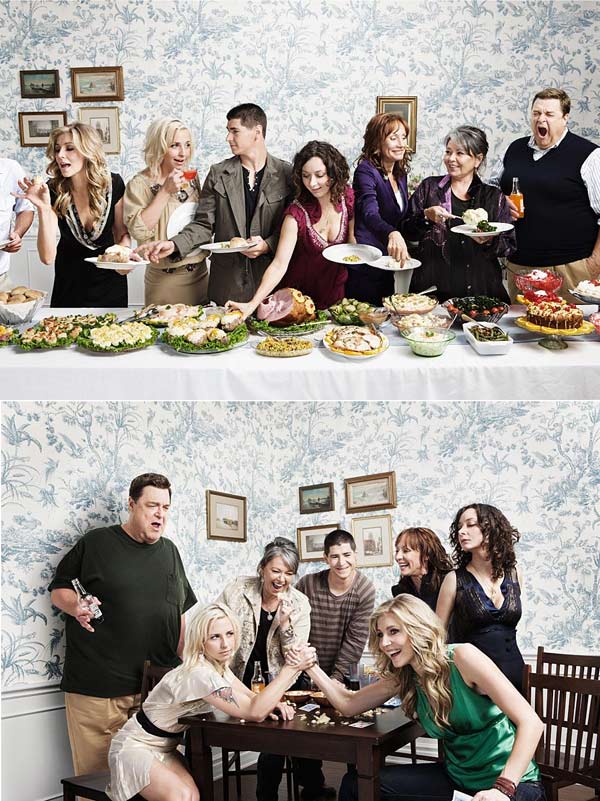
But where’s Jerry? “Who is Jerry?”, you ask. Roseanne and Dan had a baby toward the end of the run. His name was Jerry. By the way, I know people said that the show sucked toward the end and that they should never have won the lottery or whatever, but I watched the entire final season and it was really good, in my opinion. Roseanne was droppin’ pearls and my guess is that America couldn’t handle it.
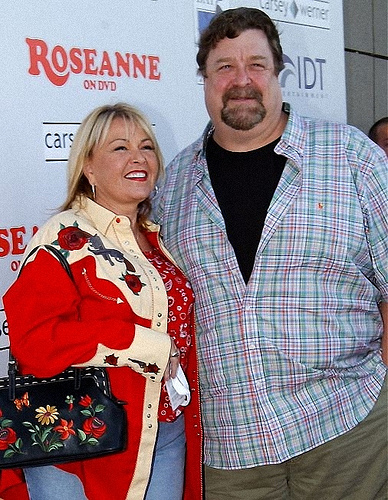 Roseanne + Dan Forever!
In case you missed it (check TVLand and Oxygen)…
The show centered on the Conners, an American working class family struggling to get by on a limited household income in the fictional town of Lanford, Illinois. Many critics considered the show notable as one of the first sitcoms to portray a blue collar American family with two parents working outside the home. For many years, Roseanne tackled taboo subjects or joked about issues that most other popular shows at the time avoided, such as poverty, alcoholism, drug-abuse, sex, menstruation, birth birth control, teenage pregnancy obesity, abortion, race, social class, domestic violence, and homosexuality. Barr’s real-life brother and sister are gay, which is what inspired her to push for introducing gay characters and issues into the show: “My show seeks to portray various slices of real life, and homosexuals are a reality.” The show was also significant for its portrayal of feminist ideals including a female-dominated household, a female lead whose likability did not rely on her appearance, relationships between female characters that were cooperative rather than competitive, and females openly expressing themselves without negative consequences.
In the fall of 2008 Barr said, on what the Conners would be up to now, “I’ve always said now that if they were on TV, DJ would have been killed in Iraq and [the Conners] would have lost their house”. When asked for more details on where the rest of the Conners (Jackie, Becky, Darlene, David, and Mark) would be, Barr said “Your question is intellectual property that may be developed later, so I don’t want to get into that”.



that’s old news. these are cute pics.








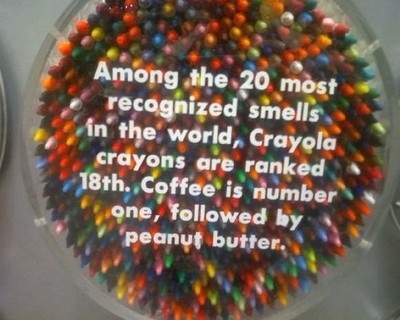
 crayola through the years

“crayolaville”




 mulatto diaries