the greatest negro?

I immediately thought of Obama while reading this article and am quite, quite certain that most agree that he is indeed a “Negro.”  That there was debate around Douglass’ negrocity ( I like to make up words sometimes) is of interest to me because I’m fascinated by the fact that mulatto was a valid and recognized identity in America before 1920.  Then it wasn’t anymore.  The ranking of Negroes from greatest to least strikes me as ludicrous.  That being said, the question, “Will Obama go down in history as the greatest Negro who ever lived?” popped into my head.  And then I thought that seeing as he isn’t one “in the full sense of the term,”  MLK probably outranks him.  How quickly I went from judging the system of rankings to ordering some myself!

Knoxville’s farewell to a civil-rights icon

By Robert Booker

SOURCE

A large crowd packed into Logan Temple A.M.E. Zion Church to honor the memory of the country’s best known civil-rights advocate. Among them were Knoxville’s black elite.

It was Feb. 25, 1895, and they had come to say farewell to Frederick Douglass, who had been born into slavery and died six days earlier.

Two days before the memorial, The Knoxville Tribune had its say about Douglass and wondered if he was a true Negro: “If we consider Douglass as a Negro, he was the brightest of his race in America. But he was not a Negro in the full sense of the term. Although born a slave, his father was a white man and his mother was a mulatto. Born a bastard and a slave, he rose to distinction and influences, and there were those among a class of white people who delighted to honor him.

“There are those who class him as the greatest Negro. This estimate of him is extravagant and unwarranted. In the first place he was not a Negro, and in the next place he is outranked by other Negroes. The greatest Negro who ever lived was Toussaint L’Ouverture the Haitian general, whose death was and will always be a dishonor to France. No Negro in this country ever approached L’Ouverture in intellect.”

L’Ouverture (1744-1803) was the Haitian independence leader who took part in the slave revolt in that country in 1790. He joined the Spaniards when they attacked the French in 1793, but fought for the French when they agreed to abolish slavery. By 1801 he had virtual control over Hispaniola, but was arrested and died in a French prison.

The blacks who spoke at the Douglass memorial took issue with the Tribunes’s assessment of him.

Attorney Samuel R. Maples said he wanted “to correct a statement in one of the local papers that Douglass boasted of his white blood and denied being a Negro. This was not true. Douglass never denied being a Negro. He was very proud of his race.”

Attorney William F. Yardley, who had introduced Douglass when he spoke here at Staub’s Opera House Nov. 21, 1881, said Douglass “Was the victim of the great American curse – slavery. He slept with dogs and ate the crumbs from his master’s table, but his great mind and energy lifted him to the loftiest heights of fame. He was not a creature of circumstance but of force. He was tireless and had been the greatest blessing to his race.”

Charles W. Cansler spoke of Douglass as “An anti-slavery agitator who represented a great moral principle and not a minister of malice. He was seventy-eight years old when he died and spent his life earnestly in the extension of freedom and in establishing justice among men. He was the Moses of his race, and it is hard to tell what his heath means to us.”

Rev. J.R. Riley, pastor of Shiloh Presbyterian Church, spoke of Douglass as a leader: “He was carved by the hand of deity to be a great leader, though cradled in the most iniquitous institution – American slavery – and schooled in dire adversity, his power of mind and greatness of spirit had surmounted all, and he stood out boldly as the greatest man of his race and the peer of all great men.”

It seems that Riley, who was pastor of Shiloh from 1891 to 1913, knew Douglass personally and they had many experiences together. He said his friend had “great personal magnetism. His quick wit and ability to read men made him irresistible in his influence among men.”

the cover of the sheet music for Frederick Douglass's funeral march

This image shows the front cover of “Frederick Douglass Funeral March.”  At each corner of his portrait are pen and ink drawings in circular frames that depict the slave trade, bondage, auction block, and freedom.

grateful for the choice

I mailed my Census form yesterday.  I must say that after all the hype, I was totally underwhelmed by the experience.  I checked the two boxes.  I can’t say it brought me any great feelings of validation.  I guess I thought they’d be asking some questions that went beyond race.  I also thought that “Negro” would be the only African American classification term offered since there was so much buzz about the word being used in 2010.  At any rate, I enjoyed this article.

More than black or white

By Annette John-Hall

Inquirer Columnist

SOURCE

For Kathrin P. Ivanovic, racial identity means a whole lot more than just black or white.

Her makeup runs the gamut.

“My mother is German and my birth father is African American with Cuban ancestry,” says Ivanovic, 29, director of development at the Nationalities Service Center, a Philadelphia nonprofit that services immigrants and refugees.

“Plus, my adopted dad is white, and I’m queer. Unfortunately, they don’t have a box for that.

“. . . I call myself a mixed chick.”

But when her 2010 U.S. Census form arrives in the mail this week (the 10-question form is being touted as the shortest in census history), Ivanovic will be satisfied to check black and white – which is really how she sees herself anyway.

Since the 2000 census, for millions of Americans like Ivanovic, “check one or more” will apply.

There is plenty to choose from, with the number of racial and ethnic categories at 63. In the 1990 census, there were only five designations offered.

It can be dizzying. If you’re, say, Asian, you can check any combination of Asian American, Chinese, Japanese, Filipino, Korean, Vietnamese, Hawaiian, Guamanian, or Chamorro, Samoan, as well as write-in categories for Other Asian or Other Pacific Islander.

In addition, you can also note if you’re of Hispanic, Latino, or Spanish origin. That’s because since 1970, Hispanic was no longer recognized as an overarching classification.

Still with me? (And here I thought having Negro on the same line as the black or African American box was confusing.)

But I’m all for it, especially if it paints a more genuine picture of who we are – all 300 million of us. Doesn’t matter if only 2 percent of Americans were identified as more than one race in 2000. Nowadays, we’ve got more multiracial and multiethnic couples and children than ever before, which means the percentage is sure to increase this year.

Which in turn enables the government to allocate funds more equitably. Census data are used in everything from determining the number of congressmen your region gets to the assessing the amount of funding for your town’s bridge project to supporting health centers.

Race data also have driven the nation’s civil rights laws (how many people were denied the right to vote, how many were discriminated against in housing, for example) and are still used to monitor inequalities in health and education.

But it wasn’t always that way.

Truth is, the U.S. Census was historically more of an oppressor than an advocate, especially when it came to African Americans.

Racial count

From the time census data were first collected in 1790, when enumerators listed categories of free men and slaves, whites used the census to diminish African Americans.

“You can see why they had a slave category,” says MIT professor Melissa Nobles, author of Shades of Citizenship: Race and the Census in Modern Politics. “Southern slave owners wanted the least amount of information, thinking it would help abolitionists. And abolitionists wanted the most amount of information [to make their case].”

Throughout the 19th century and until 1930, census counters used categories such as quadroon (one-quarter black), octoroon (one-eighth black), and mulatto (half black) to describe any person who had a discernible amount of African American blood.

Like they could tell just from looking.

Even after 1930, Southern laws imposed the “one-drop rule” to its census enumerating, meaning they were to count as mulattos anyone who even looked remotely black – a mandate loosely applied by census counters nationwide.

“They used it for racial social science,” Nobles says. For example, they used census data to prove skewed theories (arguing, for instance, that biracial people – “the tragic mulatto” – were somehow weaker and suffered from higher death rates), which in turn helped legislators make the case against interracial marriage.

But even as the categories have expanded, some today are pushing for a separate, generic multiracial designation.

Ralina L. Joseph, a professor of communications at the University of Washington, worries that even though the data will show us as more diverse and multihued, they could be misinterpreted once again.

“I don’t want people to read the numbers and think that racism is over, that this is a post-racial moment,” says Joseph, who is biracial. “We should hope that people who are disenfranchised through race, class, and poverty levels should be identified as such.”

Some sociologists even insist that racial designations have no place on a census form, if it is indeed as simple as an objective count.

But in a multiracial, multiethnic society where even the president is a self-described “mutt,” Kathrin Ivanovic is grateful for the choice.

“I am mixed. It’s how I view the world, and in some ways it’s how the world views me,” she says. “To not be able to identify that way is dishonest to me personally.”

“The Census Taker” (1870) Harper’s Weekly

dumas disappointment

FRANCE: Race row in France after white actor used to play mixed race French national hero

SOURCE

FURIOUS BLACK campaigners in France have protested after filmmakers used a white actor to play legendary mixed race French writer and national hero, Alexandre Dumas.

In a film called L’Autre Dumas, Gerard Depardieu, who is blond and blue-eyed, was given darker skin and curly hair to play Dumas.

FRANCE: Race row in France after white actor used to play mixed race French national hero

Dumas, the grandson of a Haitian slave and the son of a Napoleonic general, was mocked for his African features even as he created well-loved books such as the Count of Monte Cristo and the Three Musketeers. They are also high grossing hit films.

Patrick Lozès, the president of the Council of Black Associations of France (CRAN) told the Times: “In 150 years time could the role of Barack Obama be played in a film by a white actor with a fuzzy wig? Can Martin Luther King be played by a white?”The filmmakers also reportedly credited a fictional white assistant with creating some of Dumas’ well-loved books, The Times newspaper reported.

The campaigners said they are furious because the film not only uses a white actor, but seems to attempt to discredit Dumas’ genius, further bury his black origins and keep black actors off the screen.

“Possibly for commercial reasons they are whitewashing Dumas in order to blacken him further,” the Council said on its website.

make your own definition

I enjoyed and appreciated this article about “us.”  I’ve been thinking lately about the choice we have to either “interact with the system the way it interacts with you,” or to come up with (and stick to and be ready to defend) our own definition of self.  In other words, you can let everyone else define you because it’s the path of least outward resistance, or you can follow the path of the least inward resistance.  I tried to go along with the system.  I think that was the primary source of my former discontent.  Now that I’m being true to myself, lots of things make a lot more sense and the possibilities seem greater.  Other things seem to make no sense at all and the obstacles loom large.  Yet I’m confident that I’m heading in the right direction.

For fast-growing group of Americans, race isn’t defined by one name

The question hit Tiffanie Grier like a hammer, and more than 15 years later, the impact lingers. She was just 9 years old, a third-grader at a school awards program, when she was asked by a friend’s mother about her ambiguous racial appearance.

What are you?

For Grier, now 26 and career placement director for the Boys & Girls Club of Greater Memphis, it was the first of many instances in which she confronted questions related to her heritage as the daughter of a white mother and an African-American father.

“I get asked a lot,” she said. “(People) feel the need to know.”

Far from being a rarity, however, Grier is part of what may be the fastest-growing demographic, both locally and nationally.

Between 2000 and 2008, the number of people of two or more races rose nearly 33 percent, from 3.9 million to nearly 5.2 million nationwide, according to census estimates.

In Shelby County, the growth rate was even faster. The number of multiracial residents increased some 43 percent, from 6,384 to 9,113 during the eight-year period in which the overall county population grew by only about 1 percent.

The 2010 Census, barely two months away, is expected to show even greater growth in the category, demographers say.

The reasons are twofold. First, the number of interracial marriages, and the children produced by them, has risen steadily since 1967, when the U.S. Supreme Court struck down state prohibitions on the unions.

Second, as a result of a growing acceptance of multiracial heritage, researchers say, people have become increasingly willing to check more than one category for race on the census forms. The election of a mixed-race president, Barack Obama, likely will reinforce that trend.

“It’s the wave of the future, for sure,” said William Frey, a demographer with the Brookings Institution in Washington. “I think symbolically … it might have an impact on how people view race.”

The upcoming census will be only the second in which respondents are able to identify themselves as multiracial.

The 2000 Census showed the emerging “two-or-more-races” group was poised for rapid growth. About 42 percent of them were under age 18, compared to only 25 percent of the general population that young, and 70 percent were younger than 35.

“What that’s telling you is that it’s a young population, and that it’s increasing,” said Nicholas Jones, chief of the Census Bureau’s racial statistics branch.

Among the most common combinations named by people in the two-or-more-races category in 2000 were white-Native American/ Alaskan (1.08 million), white-Asian (about 868,000) and white-black (nearly 785,000).

The significance of the emerging multirace demographic is anything but clear. Frey predicts it will diminish the importance of race — helping to propel society beyond a black-white divide — while others say the impact will be more on a personal level.

“I think it’s important to the people themselves — how they identify themselves,” said Darryl Tukufu, vice president for academic affairs and associate professor of sociology at Crichton College in Memphis.
Memphians (clockwise from top left) Felicia Scarpeti-Lomax, Tiffanie Grier, Cardell Orrin  and Desireé Robertson are members of what may be the fastest-growing demographic, both locally and nationally -- people who may identify themselves by two or more races.

(PHOTO BY MIKE BROWN: Memphians (clockwise from top left) Felicia Scarpeti-Lomax, Tiffanie Grier, Cardell Orrin and Desireé Robertson are members of what may be the fastest-growing demographic, both locally and nationally — people who may identify themselves by two or more races.)

Whatever other effects it might have, the relatively recent census acceptance of multiracial classification recalls the nation’s troubled and convoluted history regarding race.

Although many African-Americans have some white ancestry, the historic “one-drop rule” meant that anyone with so much as a drop of black blood was categorized as black and potentially subjected to disenfranchisement and other forms of discrimination.

That history, said Warner Dickerson, president of the Memphis Branch of the NAACP, blurs the significance of the new census categories.

“I happen to be a fair-skinned black man, and you and I both know why,” Dickerson said. “Most of us are mixed with black blood and white blood.”

Because society has labeled them as black, many people with one African-American and one white parent say they will continue to check only the black category on the census form.

“I will be addressed, especially here in the South, as an African-American,” said Cardell Orrin, 35, a Memphis business consultant and co-founder of a political action committee called New Path. “You decide to make your own definition or interact with the system the way it interacts with you.”

Tukufu said the labeling, and discrimination that accompanied it, tended to instill in many mixed-race people a pride in their black heritage. That’s why they’ve stuck with one racial category on census forms.

“But now you have more of the younger folks who identify with both,” he added.

Grier interviewed people of ambiguous racial appearance, including many of mixed heritage, for her master’s thesis at the University of Memphis. She found that the question of how mixed-race people identified themselves often depends on who raised them.

That was the case with Desireé Robertson, 37, of Millington, who was adopted by an African-American couple and didn’t discover until age 30 that her biological mother was white.

“That’s my primary identification,” Robertson said in explaining why she’ll stay with just African-American as her identity in the census.

But Felicia Scarpeti-Lomax, 39, who was raised by both her white Italian-American mother and her black father, plans to use both racial categories.

“For me to use one racial category, that would be eliminating one of my parents, and that’s not my heritage,” Scarpeti-Lomax said.

She formerly lived in New York City, where racial identity was never an issue, she said.

“I never faced this craziness until I moved to the South,” she said.

Scarpeti-Lomax, like many others of biracial heritage, said she’s glad the Census Bureau finally began offered the choice of multiple categories.

“This is 2010 …” she said, “and I just refuse to live my life identified by a color.”

the effect of skin tone

The Science of How We See Obama’s Skin Color

Andrew Romano

When it comes to the policies and politics of Barack Obama, it’s no secret that liberals and conservatives don’t see eye to eye. But according to behavioral sciencist Eugene Caruso of the University of Chicago’s Booth School of Business, these differences in perspective may literally be a difference in perception. In a new study, Caruso and colleagues Emily Balcetis of New York University and Nicole Mead of Tillberg University asked a group of undergraduates which of a series of photographs of Obama–some of them secretly lightened and darkened–best represented who he is as a person. The results were striking: while self-described liberals tended to pick the digitally lightened photos of the president, self-described conservative students more frequently picked the darkened images. The more one agrees with a politician, in other words, the lighter his skin tone seems; the less you agree, the darker it becomes. To discuss how political affinities influence perception–and how politicians and the press could take advantage of these findings–NEWSWEEK’s Andrew Romano spoke to Caruso. Excerpts:

How did the study actually work?
Essentially we were interested in whether political party influences how people literally see the world, and how they may see different depictions of candidates as representative of who they really are. So to test this we gathered up a bunch of photos of Barack Obama and digitally altered them to create a version where his skin tone appeared a bit lighter and a version where his skin tone was a bit darker than it appeared in the original photograph. And then we just showed people several different photos and asked them to rate each one on how much they represented who he really is. What we found was that participants who told us that they had a liberal political orientation rated the lightened photographs as more representative of Obama than the darkened photographs, whereas participants who told us they had a more conservative ideology rated the darkened photographs as more representative of Obama than the lightened ones. 

I’m no expert here, but you’re confident that it’s the skin tone that changes “representativeness” in the eyes of the voter, as opposed to something else about the photographs—like pose, or background, or facial expression?
That’s a great question. What we did was essentially take three different photos with three different poses, and created for each photo a lightened and a darkened version. And then we randomly selected the combination of pose and skin tone that we showed each participant.

So your findings about “representativeness” were consistent across poses—the conservative will be twice as likely to say a “darkened” Obama was representative, regardless of which image of Obama was being darkened?
Right. We were experimentally able to isolate the effect of skin tone because some people saw a lightened version of pose #1 and others saw a darkened version of pose #1—and independent of the pose the lightened versions seemed most representative to liberals and the darkened most representative to conservatives.

Were you surprised by the results?
A little bit. Some of my research deals with how people who have different views on a subject are able to try to understand the views of someone on the other side, and the general finding is that people aren’t particularly good at really coming to understand the perspective of someone with whom they disagree. Beyond that, though, I got interested in this notion of whether our beliefs can actually affect the way we see the world—of whether they can actually affect our perception of objects or people in our environment. And it turns out they can.

Ultimately, what does it mean that someone believes a lightened version of Obama is more representative of him than a darkened version, and vice versa? What are the larger implications of these differences in perception?
Partisanship can affect all sorts of beliefs. It’s not surprising that a liberal and a conservative who read the same health care bill would come to very different conclusions about its merits. But I think our work is more akin to having a liberal and conservative look at the exact same physical copy of a bill sitting on the desk in front of them and disagreeing over how thick it is. That is, even something that we feel we should be able to see similarly, like a person’s racial identity or physical characteristics, can be influenced by our desire to see that person favorably or unfavorably.

But isn’t there a chicken or egg relationship here? Do conservatives see Obama as darker and are thus prone to dislike him, or do they dislike him first and then see him as darker because of it?
That’s a great question. One of the things we’re trying to do now is experimentally try to tease those two options apart. Basically, what we have in our current paper, the one that’s out now, is correlational studies of Obama where we don’t really know what comes first or what’s causing what. The first study in the paper tries to address part of what you’re asking. If we get people to think about a novel candidate and simply manipulate whether they agree with a candidate or not, we can show that people who think this novel biracial candidate agrees with them later report that the lightened photos are more representative of him, suggesting that if you agree with someone then you may come to see him as lighter. From that we can speculate, exactly as you have, about the reverse path—and that is, seeing images of someone when his or her skin tone looks darker may cause people to like that person less than seeing images of that person with lighter skin tone.

read the entire interview here

keith bardwell, please read this article

Just to catch you up to speed.  By the way, don’t worry about us.  We are doing just fine.  Thank you for your grave concern.  That you would go to such lengths as interfering with God’s blessing of love and devotion (I know, I know- only to certain couples) just to spare us a lifetime of confusion and exclusion is sweet.  But no thank you.  Times have changed, my friend.  I mean, you do seem to think of yourself as a kind of a friend of the mulattos.  A really ignorant and misinformed friend.  I see how it could happen.  For years (white)people were taught that race-mixing was wrong.  And if those people were desperate not to feel really racist, that belief was justified with feigned concern for the “spurious issue” which would result from interracial couplings.  That coupled with the “tragic mulatto” propaganda that has been bandied about the country since way back in the day… Well, I can see how you may have been lead astray.  I hope you can open your mind now.  After the couple of weeks I imagine you’ve been having, you really have no excuse.

w onesie

Are Mixed-Race Children Better Adjusted?

By JOHN CLOUD Saturday, Feb. 21, 2009

That Americans like answers in black and white, a cultural trait we confirmed last year when the biracial man running for President was routinely called “black”.

The flattening of Barack Obama’s complex racial background shouldn’t have been surprising. Many multiracial historical figures in the U.S. have been reduced (or have reduced themselves) to a single aspect of their racial identities: Booker T. Washington, Tina Turner, and Greg Louganis are three examples. This phenomenon isn’t entirely pernicious; it is at least partly rooted in our concern that growing up with a fractured identity is hard on kids. The psychologist J.D. Teicher summarized this view in a 1968 paper: “Although the burden of the Negro child is recognized as a heavy one, that of the Negro-White child is seen to be even heavier.”

But new research says this old, problematized view of multiracial identity is outdated. In fact, a new paper in the Journal of Social Issues shows that multiracial adolescents who identify proudly as multiracial fare as well as — and, in many cases, better than — kids who identify with a single group, even if that group is considered high-status (like, say, Asians or whites). This finding was surprising because psychologists have argued for years that mixed-race kids will be better adjusted if they pick a single race as their own.

The population of multiracial kids in the U.S. has soared from approximately 500,000 in 1970 to more than 6.8 million in 2000, according to Census data quoted in this pdf. In the early years, research on these kids highlighted their difficulties: the disapproval they faced from neighbors and members of their extended families; the sense that they weren’t “full” members in any racial community; the insecurity and self-loathing that often resulted from feeling marginalized on all sides. That simple but harsh playground question — “What are you?” — torments many multiracial kids. Psychologists call this a “forced-choice dilemma” that compels children to claim some kind of identity — even if only a half-identity — in return for social acceptance.

But the new Journal of Social Issues paper suggests this dilemma has become less burdensome in the age of Tiger Woods and Barack Obama. The paper’s authors, a team led by Kevin Binning of the Stanford Graduate School of Business and Miguel Unzueta of the UCLA Anderson School of Management, studied 182 multiracial high schoolers in Long Beach, Calif. Binning, Unzueta and their colleagues write that those kids who identified with multiple racial groups reported significantly less psychological stress than those who identified with a single group, whether a “low-status” group like African-Americans or a “high-status” group like whites. The multiracial identifiers were less alienated from peers than monoracial identifiers, and they were no more likely to report having engaged in problem behaviors, such as substance use or persistent school absence.

The writers theorize that multiracial kids who choose to associate with a single race are troubled by their attempts to “pass,” whereas those who choose to give voice to their own uniqueness find pride in that act. “Rather than being ‘caught’ between two worlds,” the authors write, “it might be that individuals who identify with multiple groups are better able to navigate both racially homogeneous and heterogeneous environments than individuals who primarily identify with one racial group.” The multiracial kids are able to “place one foot in the majority and one in the minority group, and in this way might be buffered against the negative consequences of feeling tokenized.”

In short, multiracial kids seem to create their own definitions for fitting in, and they show more psychological flexibility than those mixed-race kids who feel bound to one choice or another.

Fortunately, all these questions of racial identity are becoming less important, as we inch ever closer to the day when the U.S. has no racial majority. One of these days, after all, we will all be celebrating our multiracial pride.
Read more: http://www.time.com/time/health/article/0,8599,1880467,00.html#ixzz0W2BxqzTZ

conditioned to the method of white superiority

I’d love to see the show that this article details.  All whites are racist!?  I have a hard time buying that.  Prejudiced or biased, maybe.  I think all people are no matter the color.  Anyway, it upsets me greatly that the black father of the mixed-race girl doesn’t want to expose her “secret.”  Um…. how is she supposed to form a positive, all-encompassing identity if her black father is hiding from her white friends?  I wonder if this will be on BBC America.

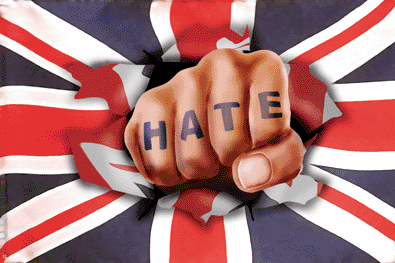
racism-fist-large.gif

TEACHER: ‘ALL WHITES ARE RACIST’

29th October 2009 by Peter Dyke

DailyStarUK

A Bombshell new television show will tonight claim that all white people are racist.

An American schoolteacher and anti-race campaigner will conduct an experiment for Channel 4 to prove how prejudiced Britain is.

Jane Elliott, 76, whose nickname is The Bitch, travelled to the UK for the test.

Part of the show features former Prime Minister Margaret Thatcher made up as a black person and US President Barack Obama as a Chinese.

Elliott is given a group of 30 volunteers, of mixed age and race, and splits them into two teams based on their eye colour.

Those with brown eyes are treated well, but those with blue eyes are ridiculed, humiliated and insulted.

Her aim is to create a mock “apartheid regime” to make the blue eyed people experience prejudice, discrimination and racism.

However at the end of the experiment, set in an old warehouse and lasting several hours, the white and black volunteers end up in a bitter row.

Some even walk out. Many of the white volunteers claim that black people do not have the monopoly on discrimination.

A middle aged white woman says: “They think racism is just for black people. I’ve had comments made about me because I’m blonde and white.”

However one dad, who is black, reveals how he never picks his daughter up from school because her mum is white and he doesn’t want anyone to know she is mixed race in case she is taunted.

At the end of the experiment, Elliott claims the white volunteers have shown their true colours.

She tells the C4 documentary tonight at 10pm: “White people should feel guilty about their behaviour.

“You don’t do things because you’re white, you do things because you’re ignorant.

“We are conditioned to the method of white superiority from the moment of birth.”

stop-racism

homecoming controversy

hampsealblue

Pageant winner makes history at historically black university

via

HAMPTON, Virginia (CBS) – A young woman made history at a Virginia University Wednesday night by becoming the first biracial pageant winner at a historically black university.

Nikole Churchill was coronated as Hampton University’s new homecoming queen, becoming the first half-white, half-asian winner.

“As soon as she was announced the winner, you could hear seats closing, and people booing,” said Hampton University Junior Ashley Sowell.

Some on campus and many more on the internet made an issue of Churchill representing the school.

“You expect to see those types of roles, your representatives… let’s be honest, I want to be represented by someone who looks like me,” said Hampton University Junior Sade Scott.

The University says the controversy is overblown. Officials say Nikole Churchill has the full support of the university. She got a standing ovation at Wednesday night’s coronation, and says she’ll serve proudly.

hu

Congratulations are in order for the 22-year old college Hawaiian senior who became the first ‘non black person’ to receive the honor on at the historically black University on Friday!  But it seems that everybody on campus wasn’t happy to see Nikole take home the crown, and things got so bad she wrote a letter to President Obama:

Aloha Mr. Obama!

My name is Nikole Churchill, a senior nursing major at Hampton University. This past Friday October 9, 2009, I was honored to be crowned Miss Hampton University 2009-2010. It truly was the best night of my life! With that being said, I am sad to say that my crowning was not widely accepted and many negative comments regarding my win have been shared throughout my campus.

It would be much easier to say that possibly some were not accepting of the news because I wasn’t the most qualified contestant; however, the true reason for the disapproval was because of the color of my skin. I am not African American. Despite the unfortunate beliefs that some are saying I should not have won, I am desperately trying to focus on those who believe in me and support me and my goal to represent this beautiful, multicultural campus the very best way that I can. I would love your help!

I am hoping that perhaps you would be able to make an appearance to my campus, Hampton University, so that my fellow Hamptonians can stop focusing so much on the color of my skin and doubting my abilities to represent, but rather be proud of the changes our nation is making towards accepting diversity. People are even nicknaming me, “lil Obama” because of various reasons. This is truly an honor as well!

I am also from Hawaii (Wahiawa) and I am hoping that you can assist me in opening some closed minds and help share some aloha spirit throughout my campus. I feel as though you could relate to my situation, which is why I immediately wanted to contact you. I was interviewed last night at the HU vs. HU football game by news channel 13 and I mentioned how individuals such as you and myself are making changes in hopes people can stop placing so much focus on our skin color by letting that define what we can, cannot, should, and/or should not do. Dr. Harvey welcomed me last night to the family with open arms and I was beyond honored when he told me that he is behind me 100%. I am proud to represent Hampton University and I am so proud having you to represent our home, our country. Your support with my crowning as Miss Hampton University 2009-2010 would be graciously appreciated. Please reply, I will be looking forward to it!

-Nikole Churchill

letter via