What a difference two centuries have made! The smiles!! And yet these families are still relatively rare. So, also, what a difference two centuries have not made.
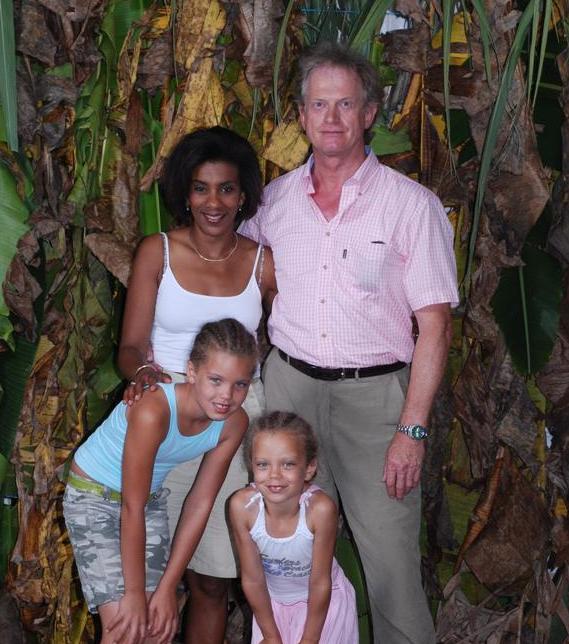


What a difference two centuries have made! The smiles!! And yet these families are still relatively rare. So, also, what a difference two centuries have not made.
Then:

Now:

Get with the program.
Not much to say about this one, other than it’s a crying shame! And 12 is way too young to be dating. Thank you.
Toddler and Teenager Expert Advice from Carleton Kendrick, Ed.M., LCSW
Question: My 12-year-old daughter is very mature emotionally and has very fine-tuned common sense. She and I are close and talk about most issues openly, but recently she brought up an issue that I am not sure how to handle.
We are white, but my daughter has an attraction for the black males in her school. She and her father (my ex-husband) are extremely close, but he is very much against her dating black boys.
My ex has threatened to do one of two things if she should want to date a black male: take me to court and assume custody of her, or exclude her from his life forever. I feel stuck! I can’t side with her dad at all because I feel if she is treated respectfully in a relationship, the color of the boy’s skin doesn’t bother me. I also can’t allow my child to lie to her father about what she is doing with her life and during her time with me. What do I do?

Answer: I commend you for wanting to take the high road in this dilemma and to honor all family members involved with honesty. Your ex is hurt, scared, and angry that his daughter would be attracted to and/or wants to date black boys. His heightened fears and considerable prejudice against the black race have made him become a desperate man.
I doubt there is any court that would grant him custody of your daughter simply because you allowed her to socialize with or date black boys. It would take something rather grievous and destructive in your parenting to have a court consider remanding sole custody to your ex. You cannot prevent him, however, from punishing her by eliminating all contact with her. He does have the power to harm her in that way if he chooses.
Going along with and enforcing your ex’s demands, which are based upon racial prejudice (and possibly racial hatred), would be a horrible lesson in morality and ethics for your daughter. He may also harbor similar prejudices toward other racial, ethnic, or religious groups and threaten the same things if she wants to date any boys in these groups that he does not like or respect.
I would suggest that you, your ex, and your daughter attempt to air this dilemma in the presence of a skilled, family-oriented therapist. My guess is that your ex will not agree to participate in this process and will cling to his ultimatum. In any event, I would recommend that you and your daughter see a therapist together.
I do believe that your 12-year-old daughter is too young to be dating boys, regardless of how emotionally mature you believe she is “for her age.” I would also explore with her why she is drawn to the black boys in her school more than any other group of boys. You seem to have a close enough relationship where you could ask such a question in an open-ended manner. The answers may be very simple or may involve some things that she has not articulated yet. Again, I encourage you to continue to deal with this issue in a forthright and open way, always with the intention of bringing about understanding and harmony, if at all possible.
I’m loving the ideas raised in this piece reflecting on the Pew Research Center’s report on interracial marriage which I blogged about earlier this week. Was that this week? Anyway, I think it’s healthy for white identity to be “threatened”. I’ve been under the impression that white identity is without definition beyond the color and the perks that come with it. Perhaps the perceived “threat” will bring about a deepened awareness of the struggle to maintain personal identity in the face of adversity, stereotypes, and societal expectations. For thoughtful “minorities” this endeavor is par for the course, however it seems to me that the majority of the “majority” do not expend energy grappling with such issues. By being called upon to do so, a new common ground may be created. A ground upon which we collectively come together to redefine “America’s essential character”. Other than that, all I have to say is that I was shocked by the stat that less than 5% of whites marry outside of their race. Not because I was under the impression that the number would be large, but because in the last couple of years I’ve witnessed (and am thrilled to be a part of) the blossoming of a community of biracial people who are proud and happy to be such. Where did we all come from if the numbers are so low!? I suppose that in the grand scheme of things there still aren’t all that many of us. I simply went from 0-60 in a flash, so to speak.

Ithaca, New York (CNN) — According to a recent report by the Pew Research Center, one of every seven new marriages in 2008 was interracial or interethnic — the highest percentage in U.S. history. The media and blogosphere have been atwitter.
Finally, it seems, we have tangible evidence of America’s entry into a new post-racial society, proof of growing racial tolerance. Intermarriage trends are being celebrated as a positive sign that we have come to think of all Americans as, well, Americans.
But others have an entirely different take — a more ominous one. They see increasing interracial marriage rates as proof that the country is amalgamating racially.
To them, intermarriage is a putative threat to whites and America’s essential character. Their concerns are heightened by recent Census Bureau projections that the U.S. will become a majority-minority society by the middle of the century.
My research with Ken Johnson, a demographer at the University of New Hampshire, indicates that for American’s youngest residents, that future is now. Nearly half of U.S.births today are to minority women.
It’s time for everyone — on all sides of this issue — to relax and take a deep breath. The reality is that racial boundaries remain firmly entrenched in American society. They are not likely to go away anytime soon.
We are still far from a melting pot where distinct racial and ethnic groups blend into a multi-ethnic stew.
Indeed, seemingly overlooked in the Pew Report is the finding that less than 5 percent of all married whites have a spouse of a different race or ethnicity. The vast majority of whites today — as in the past — marry other whites.
What is changing are marriage patterns among America’s minorities, but in ways that are not easy to understand or summarize in short news releases. (Pew used the categories of non-Hispanic whites, blacks, Asians, American Indians and Hispanics.)
For example, Pew reports that the share of newly married blacks with spouses of a different race increased threefold between 1980 and 2008. Media accounts have variously trumpeted this as good or bad news for America’s future, depending on the presumptive beliefs and attitudes of their audiences about racial matters.
It is easy to forget the U.S. Supreme Court waited until 1967, in Loving v. Virginia, to outlaw state prohibitions against interracial marriage. Increases in black-white marriages, at least on a percentage basis, are large because baseline numbers are very small.
Romantics like to believe that love is blind. We embrace the idea that falling in love is a product of our emotions rather than rational deliberation. Of course, the empirical evidence suggests otherwise. Love may be blind, but it clearly is not color-blind.
Indeed, for all the hyperventilation, the demographic reality is that only about 15 percent of newly married blacks today became married to whites or other minorities. This is hardly a basis for celebrating a new racial tolerance in America or, if you prefer, for now believing that white identity is rapidly being lost to interracial intimacy and childbearing.
Unfortunately, most of the nation’s headlines ignored Pew’s observation that intermarriage rates with whites actually have declined among Asians and Hispanics since 1980. This is something new.
My research with Julie Carmalt and Zhenchao Qian, to be published in Sociological Forum, documents recent declines in intermarriage rates among U.S.-born Hispanics and Asians after decades-long increases. Declines in intermarriage have been largest among the second generation, the U.S.-born children of immigrant parents.
Among second-generation Hispanics, for example, intermarriages with whites declined by more than one-third between 1995 and 2008. Over the same period, they became more likely to marry Hispanic immigrants.
Since 1980, there has been a fivefold increase in the number of native-born Asian women marrying Asian immigrants.
One explanation is that substantial new immigration has simply expanded the marriage opportunities for native-born Hispanics and Asians. But it is also likely that the extraordinary recent growth of the immigrant population has reinforced a new sense of identity rooted in shared ethnicity and culture. This seems to have encouraged more in-marriage with co-ethnics at the expense of more out-marriage with whites.
Demographers sometimes consider intermarriage to be the final step in the assimilation process, or an indicator of racial boundaries or lack of them. The current retreat from intermarriage among America’s non-black minorities raises new questions about racial and ethnic balkanization in America.
Issues of race and immigration are an important part of the public dialogue.
In today’s highly charged political environment, it is easy to latch onto information that buttresses our own point of view and preconceptions.
Unfortunately, short headlines and easy-to-digest narratives about rising intermarriage rates tend to oversimplify or even distort a complicated statistical story that is still unfolding.
The opinions expressed in this commentary are solely those of Daniel T. Lichter.
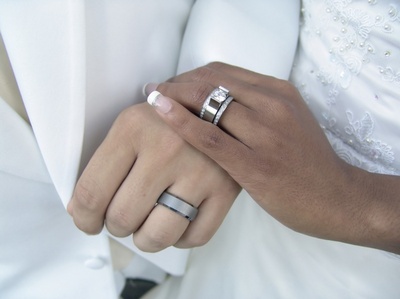
Fantastic commentary on something that I totally missed in the media. I honestly don’t know who Drake is. I’ll look him up in a sec…. Oh. I see. Anyway, Whitney Teal makes such great points here (a fav being that one would never compare G.W. Bush to Eminem), and has me wanting to make a list of all the “kinds of biracial” that I can imagine. And then I want to study the intricacies of the experiences that molded the various varieties of biracialness. I love biracial. It never gets old for me. I suppose you can call me Captain Obvious for that statement.
By Whitney Teal
Has the election of President Obama changed the way we think about biracial people in this country? I’d argue that it’s questionable. Especially when people are drawing comparisons between the prez — a half-white, half-Kenyan, Ivy League-educated lawyer — and Aubrey Graham, otherwise known as Drake, who is a half-Jewish and half-African-American entertainer from Canada. Yeah, I don’t see the similarities either.


But TheRoot.com contributor Thomas Chatterton Williams, who describes himself as the son of a black father and a white mother,” seems to think that the two mulattoes (his word, not mine) deserve a comparison. Yes, Williams thinks that it’s helpful to compare a Canadian rapper and the President (as he puts it, one of the “most visible mulattoes living and working today”). And he’s not alone, either. A few months back, a couple of my Twitter friends and I ripped Chester French band member David-Andrew ‘D.A.’ Wallach a new one for tweeting that he was discussing “all the similarities” between the two men. When I asked him to explain himself, he replied, “For one, I think they’re both extremely studied.” Womp, womp, cop-out. Lots of men are studied. President Obama and Drake are both, simply, biracial. And they’re not even the same “kind” biracial either, but that doesn’t seem to make a difference.
When I showed my sister the story on The Root, she screamed (via Google Messenger) and replied, “Obama and Drake in the same sentence? Do people mention [President] Bush and Eminem in the same sentence?” She’s right. White men are allowed to choose their own identities. Black men not so much, and biracial men certainly not. Which begs the question, why can’t we see that one biracial person is not the same as the next?
In general, polite company, we as general, polite people, recognize that a person’s experiences are not solely dictated by their race or ethnicity. For example, I don’t think people considering Lucy Liu, a famous actress, and Connie Chung, an award-winning journalist, would try and argue that the two have much in common, at least on the surface. The same with Denzel Washington and Reggie Bush, or Barbara Streisand and Heidi Fleiss. No comparisons. But people, general and polite as they are, still seem to view the experiences of biracial people in this country as singular in nature.
And often, as The Root essay explores, polarizing. “Mixed-race blacks […] are the physical incarnation of a racial dilemma that all blacks inevitably must confront: To sell out or keep it real? That is the question,” writes Williams, who spends the better part of 1,000 words waxing on about the definition of authentic blackness (or at least how he sees it). According to Williams, a mixed-race person must choose to be black, like the president and like Drake, who “both proudly define themselves as black.” A mixed-race person must then “act black,” which Williams sees as wearing loose clothes and playing basketball.
If blackness meant just one thing, and if mixed-race people were able to align themselves with just one part of their identity, then his essay might hold more weight. But black people don’t have just one identity, at least not to ourselves. Hollywood directors, novelists and journalists may see us as trash-talking, saggy pant-wearing basketball fanatics, but I don’t think that’s how we see ourselves. And by asserting that he can turn his black switch on and off, simply by altering the fit of his pants, Williams — though he may identify as black — shows how much he doesn’t understand the complexity of black culture.
Which is why I don’t believe that we should automatically label mixed-race people as black; they’re mixed-race. Being biracial may be similar to African-American culture, just as West African and West Indian cultures share similarities to black culture, but ultimately have their own dialects, dress, worship practices, food and courtship rituals. But biracial people etch out their own identities. Sure, they may be similar to that of African-Americans or other cultures. But it’s limiting to both black and biracial people when society automatically labels anyone with brown skin and textured hair black. Whether we’re talking about President Obama or anyone else, what it means to be biracial is an entirely individual question.

Once again, in honor of Loving Day, I thought it would be interesting to post this peek into the modern day interracial dating scene. As experience by a black woman in Boston….

Posted by Meredith Goldstein
QUESTION:
I am a young, black, college-educated professional who has lived in Boston for most of my life. I recently turned 30 and am ready to have a serious relationship with someone special, irrespective of race.
I have dated a few Caucasian and Asian men, and one person from the Middle East. Every one of these encounters ended immediately after they realized that I was expecting more than a sexual relationship (I usually ended it). However, getting to that point was only half the battle. The hardest part was the approach! I think a lot of surprisingly wonderful relationships could be had if people weren’t afraid to step inside or outside of the “crayon box.” There have been many instances where I’ll overhear a white guy telling his friends how “hot” he thinks I am or after having way too many beers obnoxiously yell “I love Black chicks!” Not including the annoying drunk guy — why won’t non-black men approach me if there is physical interest?
And before anyone asks … yes, I date black men. Almost all of my relationships, serious or otherwise, have been within my race. However, I’ve always been open to dating men outside of my race. And due to the reasons previously mentioned, have been unable to do so.
Now back to the second portion of the problem I mentioned earlier. When we get past the “approach” barrier, I then find out that these men were hoping to use me as some sexual guinea pig. I’ve even had one guy tell me that he has a girlfriend but has “always wondered what it would be like to sleep with a pretty black girl.” Needless to say, he did not get the chance to conduct his experiment on me. My other encounters were almost as disappointing. I’ve really clicked with several guys. Had great phone conversations and shared mutual interest in various areas. We’d make each other laugh, talk about work, life goals, family, friends, hobbies, etc … BUT, the conversation would always redirect back to sex… After realizing that I wanted more than to be their guilty pleasure, I would end it. I’ve had white male friends who I get along with great as friends. Then they would profess some secret crush they had on me over the years. They were apprehensive in pursuing a serious relationship and were more than happy to think we could be friends with benefits. There was never a problem with meeting their friends and family — or being introduced as their good friend. Being introduced or even thought of as their girlfriend, however, was an issue.
I’m left to wonder if non-black men still hold some pre-conceived notion about the ENTIRE species of black women. It escapes me as to why black men are able to easily, quickly, and openly approach and date women outside of their race, yet it’s so difficult and rare for non-black men to do the same with black women. When I go to NY, it’s very common to see mixed race relationships involving black women. But, I almost never see that here in MA. Is it a geographical thing? Is Massachusetts just as conservative when it comes to dating? Why are non-black men afraid to approach black women that they are attracted to? Are we seen as nothing more than “angry black women”….or even sex-crazed video vixens waiting to fulfill some secret chocolate craving?
– Cheyenne

ANSWER:
When I go to NY, it’s very common to see mixed race relationships involving black women.” CNS, I see a lot of things in New York that I just don’t see anywhere else. New York is pretty amazing when it comes to diversity, acceptance, and dating without boundaries. New York also has all-night public transportation and cheap cabs. It’s the concrete jungle where dreams are made of. There’s nothing you can’t do. Compare any city to New York and you’re in trouble. (That said, Go Sox!)
There will always be a lot of people who are only comfortable dating within their race, religion, or tax bracket, no matter where you live. Some of those people are very nice despite their boundaries. There will also be some real idiots out there who see dating outside of the “crayon box” as some sort of exciting science project. Luckily, those people tend to expose themselves pretty quickly by getting drunk and yelling things like, “I love black chicks!” I’m sorry that has happened to you. It’s upsetting and disheartening.
There will also be people who share your goal of finding someone awesome, no matter what color they are or where they come from. They’re out there. Some of those men might be scared to approach you, but that might not have anything to do with race. Some men are afraid of the approach, in general.
I’d add that a lot of your other dating issues… are also pretty typical. Guys who seek friends with benefits, guys who fixate on the hookup portion of a date — that’s all typical Love Letters stuff, isn’t it? I’m not saying that you’re wrong about the “crayon box,” but don’t attribute more to race than you have to.
My advice is to keep dating, approach men who appeal to you, be clear about your intentions, and get to know people well. Someone who cares about you, understands your goals, and has earned your trust isn’t going to want to use you as an experiment or a friend with benefits.
Readers? Is this a Massachusetts thing? How can she approach men outside of her “crayon box” without having to wonder whether they’re taking her seriously? Is race as much of an issue as she thinks it is?
– Meredith

It’s Loving Day! Interracial Marriage has been legal nationwide for an entire 43 years! Imagine that. A few days agao CNN.com ran this piece giving us an idea of what people really think about interracial marriage today. I think it an appropriate post for the occasion.
Your views on interracial marriages
(CNN) — “Interracial/interethnic marriage is a great way of fighting war, hatred and prejudice. Think about it. If we all are mixed, who can we hate?” wrote a reader about a CNN.com story on race and marriage.
That comment was one of the thousands of responses to the story about a new study from the Pew Research Center that found interracial and interethnic marriages are at a record high of about one in seven.
About 14.6 percent of newly married couples reported in 2008 that they married outside their race or ethnicity, according to the Pew report released Friday. In 1980, about 6.8 percent of newlywed couples surveyed said their spouse was of another race or ethnicity.
Overall, reader reactions voiced support for mixed relationships, with many commenters proudly identifying themselves as being in an interracial or interethnic relationship.
“I’ve been happily married in a mixed race marriage for seven years. To anyone who would like to oppose mixed race marriage: What gives you the right? I pay taxes, served in the U.S. military (where I was disabled) and watched all kinds of races die in service to the pledge to protect every American’s freedom. So as far as I’m concerned, blood only has one color: RED, and there’s only one race: the human one,” wrote BeerMan5000.
Reader RippedJeans, a black woman, talked about marrying her white boyfriend of three years. She wrote, “I could not be happier! I love him for the MAN that he is, and I’m truly grateful for having him in my life. Love is colorblind. …”
Danchar821 was also in support of interracial marriages. Reflecting on her personal experience, Danchar821 wrote. “We met online through mutual friends. I went to Mexico every month last year and we were married. I could not be happier. There are cultural differences, but if anything, they have helped me to grow as a person. She is wonderful and so loving and I feel truly blessed and happy. The racism that some people show on here is truly sad. We are expecting our first child — a boy — in September.”
Another couple talked about their wedding ceremony, which celebrated their cultural differences. Reader cellblock131 wrote, “I am Hispanic and married a white woman. … When it came to our wedding, we had a mixture of both cultural practices. For example, my dad read passages in Spanish, then her dad read them in English. The reception had traditional white American dances, plus Mexican in the mix. It was a wonderful wedding.”
One reader identified only as Guest said he won’t date outside his race.
“I care what race the women I date are. I am a white male. I date only white females. Sure there are attractive women in other races but I stick with my own. It’s America land of the free,” wrote Guest.
AntigoneR ignores people’s objections.”I can only speak for myself, but I really don’t care how many people accept or do not accept my interracial relationship. I don’t recall asking their opinion. Having said that, I’m glad to see that the trend in society is more accepting, and that racial barriers are crumbling. I wish it were faster.”
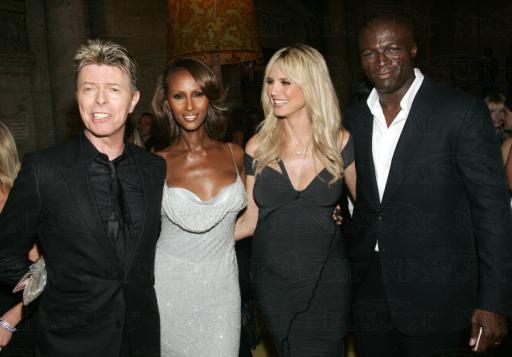 (fwiw: i’m realizing at this very moment that none of these people are American by birth)
One commenter echoed a common view among the Millennial Generation, found in an earlier study this year from the Pew Center that reported 85 percent of 19- to 28-year-olds accept interracial and interethnic relationships. SIR10LY wrote: “It’s 2010. I can’t even believe this is still an issue! If two people love each other, let them be. … If you’re opposed to it, get with the times already!”
Children of mixed marriages also shared their views.
Reader Anex wrote, “Product of an Interracial marriage and darn proud of it! I’m a happy mutt!”
Other readers pointed to the challenges of marrying someone outside their race.
“But one thing the article does not mention is divorce among interracial couples is much higher than same-race couples. Challenges in understanding, family relations and pressures overall are higher. People should know what they’re getting into,” warned a reader.
WHATRU wrote, “I’m an Arab, my husband is white. It gets more complicated after you have kids. The cultures and beliefs are just too different. It is easier to marry your own kind.”
Reader Toadlife wrote that racial discrimination can also be difficult. “Race matters because racial discrimination continues to happen all around us to this day. If you think otherwise, you are naive and probably white and have all white relatives. Thankfully, we’ve come to a point in our society where race is not a determining factor in one’s fate, but it can still be an obstacle from time to time,” Toadlife wrote.
Reader nal4america said her decision about whom to date is influenced by what race she grew up with. “I’m of West Indian decent and I grew up in a small town in Utah. I am so used to dating outside of my race that I don’t even date men of my race simply because I am not attracted to them. I think the environment you grow up in plays a huge factor in the mate you select. I am 95 percent certain my husband will be of a race other than my own and that’s fine because I believe in the American Race.”
Native Americans had yet another take on the situation.
“… [T]here can never truly be justice and real harmony on stolen land … just like there can never be peace and harmony in a house that’s been burglarized and its inhabitants marginalized and oppressed … ask an Apache or Navaho or black American if they are happy to live in a society dominated by white people. The indigenous were here for many thousands of years before the Europeans destroyed the culture and lands of the indigenous almost worldwide,” wrote hotepk. “…What must happen is either they go back to Europe or pay restitution — like any other convict guilty of a crime — otherwise there will continue to be struggle.”
Ndngirl2010 responded: @hotepk–I am full blooded Navajo and I’m fine with living alongside whites and get this –*gasp*– I married one! A majority of my family doesn’t harbor any animosity toward any other race. Let bygones be bygones and, instead, focus on the future.”
The readers who responded to CNN’s coverage on the Pew Research Center study seemed to acknowledge the growing blurring of races and ethnicities.
Reader HalfBaked shared: “My wife’s biological mother is Filipino/Mexican and her biological father is Scottish. She was adopted at birth into a German-Jewish family. My mother’s side is Italian/Turkish and my father was Hungarian. Our kids are about as ‘mixed’ as you can get.”
I am pained by this story. I remember being this little girl. I remember being singled out at times, usually not having anything to do with my hair unless it was mandatory school-wide lice check day. No one wanted to deal with me then. And that was fine with me. But it wasn’t really. I can only imagine the consequences this incident will have for this little girl. Her parents really have their work cut out for them now. I hope they sue and win big! The damage is done. Let’s hope it can be undone. Oh, and I’d like to send the Mudede family a copy of Teri LaFlesh’s Curly Like Me. All you need is conditioner people. All you need is conditioner…
This story is an example of the sad fact that within schools, sensitivity training can only go so far – sometimes, there are unpredictable situations where teachers just have to intuitively react, and often they’re not prepared to do so. And often, these issues are much larger than they appear on the surface. Such is the case with the 8-year-old biracial student who was removed from her advanced-placement class because the teacher claimed that she was allergic to the girl’s hair moisturizer. The teacher first put the girl in the hallway, and then moved her to a different classroom where she found herself in a lower-level class with predominately African-American students.
This behavior seems bizarre enough – but add the fact that the girl was the only student of color in her school’s accelerated program, and the concerns of her angry parents, who may now sue the school (the NAACP, along with the Department of Education, have already filed a complaint), seem justified. The girl’s father, Charles Mudede, is black, and says that he had talked to his daughter about resisting pressures to straighten her hair so that she would look more like her white classmates. The product that so irritated the teacher was a compromise, Mudede said, “something light that kept her hair in its natural state.”
The girl’s parents have a host of questions to which there seem to be no adequate answers: “Why did the teacher think the problem was his daughter’s hair? Why hadn’t the school called the parents? What investigation was being done to pinpoint the source of the problem? And, finally, why did the school seem oblivious to the racial overtones of a white teacher singling out her only black student?”
Mudede says that the situation escalated because no one at the school seemed prepared to answer these basic questions. He wrote on his blog,
“When we, her parents, were later informed of this incident, we also learned that once my daughter was removed from the class, the teacher felt much better. We were also told that the teacher had experienced something like a fainting spell because of our daughter’s hair. Feeling the seriousness of this situation, we decided not to send our daughter to school until the teacher had medical proof that our daughter’s hair or something in her hair was to blame for the nausea. (The last thing you want to happen to your daughter is for a teacher to faint or vomit at the mere sight of her.)
Days passed and the school took no action. This unresponsiveness left us with no other choice than to turn to a lawyer. The whole thing is a mess. Getting entangled in a racial dilemma is something most black parents do not want for their children. It’s just not worth the trouble. Then again, like I said, if not checked and confronted, the incident will have permanent consequences for my child.”
And although the school is now making limited comments because of the threat of a lawsuit, it definitely seems as though this situation was horrifically mismanaged; without communicating privately with the student and involving the parents, of course this would turn into a humiliating ordeal for a little girl who clearly was already suffering from self-esteem issues. If the teacher had allergies, that’s something that she couldn’t help. But to target the student in such a dismissive embarrassing way shows a level of insensitivity that no teacher should have.
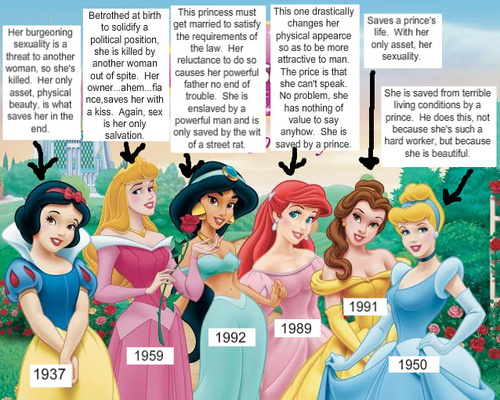
These gender stereotypes, body image issues, and the general superficiality of our culture are even found in our cartoons. Found in our fairy tales. They hit us with this stuff right away. The race stuff too (I’m guessing these charts were created pre-Princess Tiana). It’s no wonder we’re so far off our center.

I think this article is brilliant and I think that everyone should read it. So, here you go, everyone!

By William Leith
Plenty of guys have told me this story. The guy in question is preparing to go to a party with his girlfriend. She is trying on shoes and dresses. He is telling her how good she looks. She tries on more shoes, more dresses. And then: the sudden, inexplicable meltdown. She crumples on the bed. Something is horribly wrong. Now the party is out of the question.
At this point the other guys will say, ‘Yeah – she looks great.’ And: ‘She looks fine.’ And: ‘I saw her the other day, wearing those shorts.’ And: ‘She is hot.’ Then the first guy will say, ‘That’s what I kept telling her. And that’s when she got really upset. She said, “You just don’t understand.”‘
It’s true – men, by and large, do not understand. In her book The Beauty Myth, Naomi Wolf made this point very powerfully. When a woman has a crisis of confidence about the way she looks there is nothing a man can do to console her.
‘Whatever he says hurts her more,’ says Wolf. ‘If he comforts her by calling the issue trivial, he doesn’t understand. It isn’t trivial at all. If he agrees with her that it’s serious, even worse: he can’t possibly love her, he thinks she’s fat and ugly.’
But it doesn’t stop there, says Wolf. What if the man were to say he loves the woman just as she is – that he loves her for her? An absolute no-no, of course, because then ‘he doesn’t think she’s beautiful’. Worse still, though, if he says he loves her because he thinks she’s beautiful.
There’s no way out. It seems to be, in Wolf’s words, ‘an uninhabitable territory between the sexes’. So why don’t men understand? And, given a bit of education, can the situation be improved?
Well, I’m a man, so let’s see. The first thing to say is that, when it comes to their bodies, men have a completely different attitude. I’m not saying they don’t think about their bodies, or worry about them, because they do. But men relate to their bodies in a simple way.
A man’s body is either fine, or it’s not fine. For a man, the body is a practical object. It’s a machine. Sometimes it works well; sometimes it needs fixing. Some guys know how to fix it, by taking up a sport, maybe, or cutting down on the carbs. Some don’t, and go to seed.
Men see their bodies as machines because, for most of their time on this earth, they have defined themselves as hunters and protectors. They equate being attractive with being strong and fast and muscled. That’s a simple concept, isn’t it? And that simplicity is hard-wired into the male brain.
When his girlfriend has a meltdown, and says she hates her body, that is not a simple concept. Unlike men, women do not have a simple relationship with their bodies. They have a complex relationship with their bodies. This is what men often don’t understand. When it comes to their bodies, women are extremely vulnerable – and, what’s more, lots of people take advantage of that vulnerability. This makes the situation worse.
Men don’t have to contend with this – the hair people, and the make-up people, and the fashion people, and the shoe people, and the bra people, and the nail people, and the eyelash people, and the Botox people, and the cosmetic surgery people, and the perfume people, and the hair-removal people. Oh, and the diet people.
Men are not at the mercy of corporate manipulation on remotely this scale. Sure, there are six-packs creeping into our field of vision every so often. And, sure, this is making us feel insecure. I know – I was fat, and it’s no fun being fat, especially with all those pictures of Brad Pitt nagging away.
And then there are the adverts for Lynx, and the Reebok advert in which a man is chased around town by a big fat hairy belly. But for men the message is very direct. Buy some running shoes. Go to the gym. Cut down on the carbs. For men there is no mystery behind the veil of the adverts. You either tackle the situation, or become a fat slob. End of story.
For men the holy grail is within reach – you just need to get fit, and then you’ll be fine; then you can think about something else. But the messages aimed at women are much more complex and confusing. As the American social commentator Warren Farrell has pointed out, women’s magazines often contain articles about being Superwoman, which are next to adverts about being Cinderella.
In other words, the words tell women how to be independent and in control. But the adverts, where the money is, tell them they have to be beautiful.
Farrell said this more than two decades ago – and, shockingly, nothing has changed. There’s a solid pulse running through everything our culture aims at women – be beautiful, be beautiful, be beautiful.
But being beautiful, it turns out, is a near-impossible task. It keeps getting harder and harder. Everybody knows that it entails being slim – and every year the ideal gets slimmer and slimmer. In 1960 the average model weighed 10 per cent less than the average woman. Now she weighs 25 per cent less. Soon she will weigh 30 per cent less. But she doesn’t have the breasts of a skinny woman – nor, as Susie Orbach has recently pointed out, the bottom. To achieve the ideal is vanishingly impossible.
And it’s getting worse. Orbach believes that we are exposed, on a weekly basis, to several thousand images that have been digitally manipulated. And this, in turn, makes more women opt for cosmetic surgery – which, of course, moves the goalposts even farther away.
When lots of people have surgery to make themselves look more beautiful this has the effect of making everybody else feel less beautiful. And this is happening on a global scale – in 2007 people spent £9 billion on cosmetic surgery; the vast majority of them, of course, were women.
So: men are told they should aspire to fitness and strength, and women are told they should aspire to something more nebulous. But that still does not explain, in terms a man could understand, why the female message is so much more powerful and disturbing.
It doesn’t explain why a tenth of women are anorexic, why a growing number are bulimic, why almost half of women, at any given time, are on a diet. It doesn’t quite explain the meltdowns. And it doesn’t explain why women want to be so skinny. Why they think they are fat, when they are not. It doesn’t explain why, when a woman’s body is perfectly attractive, she often thinks it isn’t, and can’t be persuaded otherwise.
In short, it does not explain why a man can look at an advert featuring a six-pack and laugh at it, whereas a woman might look at a picture of Gisele Bündchen and feel a sense of unease that hangs around for days.
John Updike once said that the female body is the world’s prime aesthetic object – we look at it more than we look at anything else, including landscapes, gadgets, cars. In fact, cars and gadgets are often designed to resemble the female body, and landscapes can be painted to remind us of it. When we talk about ‘the nude’ in art we are almost certainly referring to the female nude. As far as nudes are concerned, the male nude is a distant runner-up.
I once wrote the introduction to a book of male nudes by the photographer Rankin; it was a sequel to his previous book of female nudes. One thing struck me above all – male nudes were a much, much harder thing to portray than female ones.
That’s because the female body carries with it a huge weight of iconic significance – thousands of years of being looked at. The female body has meaning. Pictures of the female body can be profound, serious and complex. For thousands of years they have been depicted with reverence. Now imagine having one of those bodies. It puts a bit of pressure on, doesn’t it?
Now I’m beginning to see why women might be so addicted to perfection. They have a lot to live up to – a couple of thousand years of art history, and a couple of thousand airbrushed boobs and bums to deal with every week.
But what started this off in the first place? Why aren’t there so many airbrushed pictures of men around? Of course, these pictures do exist, and their numbers are increasing. But why are women so much more vulnerable to pictures of perfect bodies than men?
In his book The Evolution of Desire, the American psychologist David Buss goes some way towards explaining why this should be so. Since the Stone Age, he explains, men and women have had different attitudes towards sex. Men can pass on their genes with very little risk – all they need is a fertile woman.
But it’s different for women, because pregnancy is incredibly risky. What women need is a man who looks like a good provider – better still, who looks like a proven provider.
So let’s think about our Stone Age man and woman. If he’s going to settle down, and stop playing the field, he wants one thing above all – a woman who looks fertile. More than that, he wants a woman who looks as if she’ll be fertile for many years to come. In other words, he might consider being a provider and protector, as long as his mate looks young, fertile and unblemished.
And now consider his mate. What does she want? Not just a man who is a good hunter and a good fighter, but a man who has a track record as a hunter and fighter. In other words, an older man. And this is not only true of Stone Age couples. In a survey conducted by David Buss, 10,000 people, in 37 cultures, were polled. ‘In all 37 cultures included in the international study on choosing a mate,’ writes Buss, ‘women prefer men who are older than they are.’
Now I’m getting close to understanding why women are so critical of their bodies. Since prehistoric times they have had a hard-wired link to how they look. For tens of thousands of years it was crucial; it could be the difference between having a protector and not having one – between life and death, even.
For men it’s not the same at all. The odd wrinkle or grey hair doesn’t matter. Hell, it might even be an advantage. As long as you’re good at throwing spears and building shelters, you’ll be fine.
Twenty thousand years on, what has changed? Well, as David Buss points out, it’s unlikely that a Stone Age man would have seen ‘hundreds or even dozens of attractive women in that environment’. But now, when he looks at a Playboycentrefold, he is seeing a woman who has competed with thousands of other women for the part – not only that, he’s seeing the best picture out of thousands.
And it’s not just centrefolds, is it? Just look at newsreaders – mostly, it’s a pretty girl and a grey-haired man. Message to men: relax. Message to women: panic! And then there are the girl groups, and the short-skirted girl onCountdown, and even the characters in the Harry Potter films, where the boys are allowed to look like geeks but the girl must look like a model.
As the art critic John Berger wrote: ‘Men look at women. Women watch themselves being looked at. This determines not only the relations of men to women, but the relation of women to themselves.’ It’s a tough one, isn’t it?
Surely guys can understand that, at least. If it happened to us, we’d have a meltdown, too.

 mulatto diaries