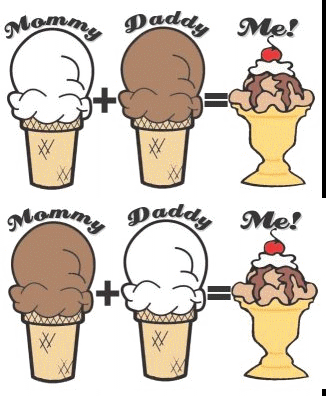
a new biracial children’s book

BiracialSweetie_gif

Though the Newsday reviewer doubts that mixed race kids wonder about the racial features of their soon-to-arrive siblings, I don’t.  Since my “Heidi and Seal” post, I’ve wondered how little Leni will react to her new sister who will likely be brown like her brothers.  I imagine that right now she might think that boys look like the dad and girls look like the mom.  Since their new baby is said to be a girl, that theory (should it really exist in her mind and not just mine) could be blown out of the water.  

Regardless of any of that, I’m so glad to know that this book exists and hope more like it will follow.

review taken from http://www.newsday.com/features/booksmags/ny-bkend0712810377jun01,0,2983687.story

I’M YOUR PEANUT BUTTER BIG BROTHER, by Selina Alko. Knopf, $16.99. Ages 4-8. 

Books that address issues in an obvious way can be a bore, but since books are a useful way to address issues, parents, teachers and librarians are constantly on the lookout for good ones. In Selina Alko’s “I’m Your Peanut Butter Big Brother,” a child in a biracial family wonders what the new baby will look like. The whimsical elaboration of possibilities makes this the rare “issues-book” you’d want to snuggle up and read with your kids. 

“Baby, will your hair look like mine?” the boy asks. He considers the range of hair in his family: “Noel’s string beans locked this way and that, or Akira’s puffy broccoli florets? Maybe, like Auntie Angela, your mushroom bob will wave neatly in half-moon curls. Feathers might hang from a round coconut face. Or, like Grandma Helen, will sharp blades of grass stick straight up?” 

Certainly no two parents, of the same race or not, look precisely alike, and I doubt that children are considering racial features when they wonder: “Baby brother or sister, will you look like me?” But in a world where skin tone, hair texture and eye shape carry social complexity, this book offers a welcome alternative vocabulary.

By Sonja Bolle

first lady love

I didn’t think it was possible for my Michelle Obama love to increase.  I was wrong.  I know it’s silly, because it is a known fact, but the fact that she said “biracial” made me really happy.  I love the the sentiment of the whole speech….

if you are going to doubt something doubt limits

First Lady Michelle Obama told Washington Math Science Technical (WMST) High School’s graduating class that they are “more than ready” for the challenges ahead and to ignore “the doubters.”

…Mrs. Obama spoke about her own upbringing and her struggle to get to – and then through – the Ivy League amidst “voices of people sowing doubts in my head.”   She said that although she was always confident, “there was a part of me that started to believe the doubters.”

…Mrs. Obama talked about other figures who have overcome hardship, including her own husband.  “This biracial kid with a funny name from hawaii, of all places,” she laughed, “who was taught that anything is possible.”

http://www.newsday.com/features/booksmags/ny-bkend0712810377jun01,0,2983687.story

michelle-obama

tennessee again

I used to, and by that I mean before yesterday, think that I would love to live in Tennessee.  I admit that this belief had a lot to do with my love and admiration for one Amy Grant.  I know that nothing can come between me and my Amy, but Tennessee I’m rethinking.

jack-in-the-box-is-backkkk

Jack in the Box settles claim on behalf of worker

Associated Press – May 20, 2009 11:15 AM ET

NASHVILLE, Tenn. (AP) – Fast-food chain Jack in the Box has settled a lawsuit filed by federal officials on behalf of a worker at a Nashville restaurant for $20,000.

The Tennessean reported Frances Griffith, a white hostess, said she was subjected to repeated “obscene racial epithets” by African-American co-workers and that one told her she should kill her unborn baby because it was of mixed race.

The lawsuit by the Equal Opportunity Employment Commission stated Griffith called a company ethics hot line last April, after which the chain investigated and fired one employee for making racial remarks.

The claim stated the harassment continued and the company did not respond to her further complaints.

In a statement Tuesday, Jack in the Box said the company doesn’t tolerate discrimination or harassment of any kind.

 Information from: The Tennessean, http://www.tennessean.com

I don’t think of Jack in the Box as having a hostess, but I’ve never actually been to one.  I also don’t suddenly hate Tennessee because crap like this can happen anywhere.

no wonder i loved wonder woman

7hu2U4T6Cd5e0b5iM71yN163_500

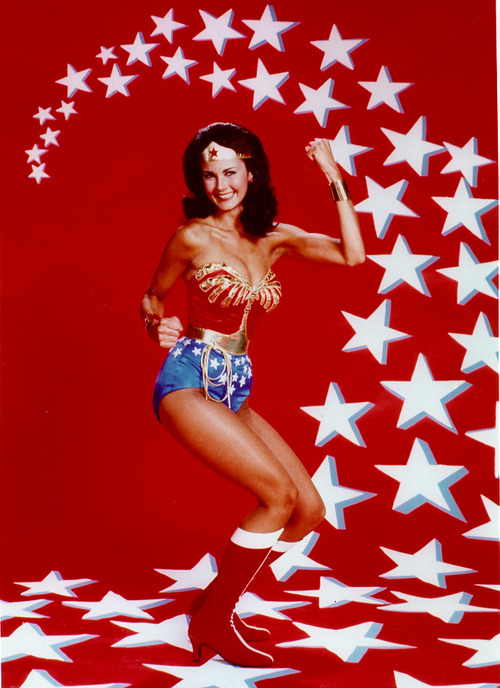
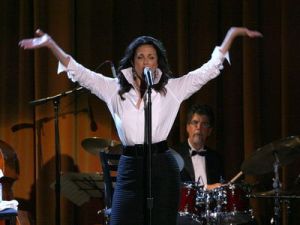
Legend has it that I became the youngest fan of Wonder Woman when at the age of 24 hours my eyes were glued to the tv in the hospital room whenever Diana, Princess of the Amazon appeared.  I must have known she was a kindred biracial spirit.  Only I didn’t know she was biracial until my 31st birthday when I was taken to see Lynda Carter’s cabaret show at Feinstein’s at the Regency in NYC.  It was great!  She talked about her Mexican mom.  She sang.  Really well.  I loved it! Cornel West was there. He loved it too.

6a00e55392afe18833011168b196b5970c-400wi

Carter was born Linda Jean Córdova Carter in Phoenix, Arizona. Her father, Colby Carter is an Irish American, and her mother, Juana Córdova, is of Mexican ancestry.

wonder woman in mirrors

wonder woman

HOLLYWOOD (By Sandra Marquez) August 23, 2007 — 

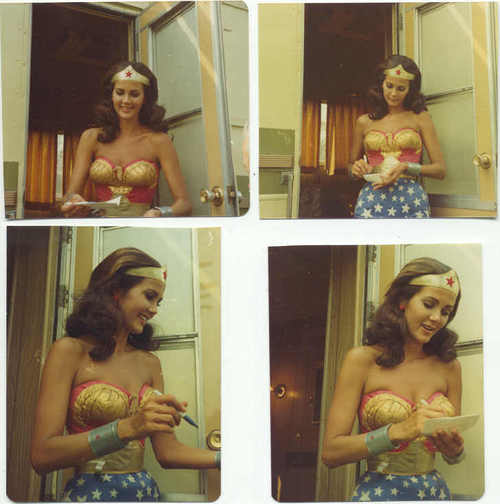
Born to a Mexican-American mother and an Anglo father in Miami, Arizona, Linda Jean Córdova Carter grew up to become one of America’s most iconic figures: Wonder Woman. In many ways, the actress who became known as Lynda Carter on the hit 1970s entertainment series was a mirror. To young Latinas in the know—such as Constance Marie of The George López Show — she was a role model. Many others had no idea that Carter was Mexican American. But she became a universal figure for her portrayal of Wonder Woman as an everyday woman with superhuman powers….

Tell me about your family history.

My mother grew up in a place called Globe, Arizona. My grandmother came to Arizona when she was a baby. They emigrated from Chihuahua, Mexico. Probably my best memories of childhood were in Globe. My grandmother would make her big stack of tortillas and we’d make menudo and it was all about eating.

Did you grow up hearing Spanish?

My father did not speak Spanish, so we didn’t grow up with it on a daily basis, but around my mother’s family I pretty much understood everything.

Raquel Welch has spoken about how, growing up, her Bolivian father would not speak Spanish in the home because he was afraid that she would be discriminated against. Did you ever experience that growing up?

No, but my mother I think did. If anything, I experienced a reverse discrimination in that I am not really Hispanic because my last name is Carter, and because I don’t look it. That I am not really Hispanic because I don’t talk about it 24/7 and my skin is not dark enough.

In your lifetime and career, have you seen a change in how Hispanics are regarded and the roles that are available?

People are surprised when they learn that I am half Latina even though all through my career from the very, very first, I spoke of it. And I speak of it proudly.

Constance Marie of The George López Show keeps a poster of you in her dressing room. She says you are her hero.

I know, I signed a poster for her. She was doing Good Morning America and they surprised her by having me call her. It was just wonderful to have had a positive effect on a person who has gone on to do such wonderful things. And she is so sweet. The one thing about Latinas, there is passion in our lives. We love passionately.

http://latina.ms/linda_jean_cordova_carter.htm

Celeb.lynda


3301740251_3d48566be4


biracial jones sisters of no relation to me

glamour1

glamour2

http://rashidajones.blogspot.com/2009/04/magazines-glamour-scans-2005.html

Big thanks to Karen of Reel Artsy (http://www.reelartsy.com) for bringing this article to my attention!  The things discussed in it are some of what I find to be the most fascinating aspects of the biracial experience.  As an only child I’m left to imagine what it would have been like to have a biracial sibling.  Would he/she have been darker or lighter than me?  What would that have been like?  I always imagine that no matter the phenotype we’d be really close, but that wasn’t always the case for these Jones girls.  Their story reminds me of Danzy Senna’s Caucasia, what with the darker sister living with the black father after the divorce and the lighter sister going with the white mother.  Bel-Air to Brentwood is not so drastic a distance though as Boston to Brazil.  Anyway, I really enjoyed the interview.  It’s so honest, painfully so at times, and I really appreciate that.

My daughters have learned an invaluable lesson from being multiracial:  You can’t let an exterior force define you; you have to define yourself.  Each did that, in her own way.  I’m so proud of them for that.- Quincy Jones

speaking of angelina weld grimke

agrimke

Angelina Weld Grimké (February 27, 1880 – June 10, 1958) was an African-American journalist, teacher, playwright and poet who was part of the Harlem Renaissance and was one of the first African-American women to have a play performed. Born in Boston, the daughter of Archibald Grimke, a prominent journalist who served as Vice-President of the NAACP. The Grimkes were a prominent biracial family whose members included both slaveowners and abolitionists. Two of her great aunts, Angelina and Sarah, were prominent abolitionists in the North. Angelina Weld Grimke was named after her aunt who had died the year before.Her paternal grandfather was their brother Henry Grimké, of their large, slaveholding family based in Charleston, South Carolina. Their paternal grandmother was Nancy Weston, an enslaved woman of European and African descent, with whom Henry became involved after becoming a widower.  Grimke’s mother, Sarah Stanley Grimke, a white woman, left her husband under the influence of her parents who never approved of her interracial marriage, and took her three-year old daughter with her. However, at the age of seven, Angelina was returned to her father, and although she and her mother corresponded, they never saw one another again. Sarah Stanley died of suicide several years later.

Grimké wrote essays, short stories and poems which were published in The CrisisOpportunityThe New NegroCaroling Dusk, and Negro Poets and Their Poems. Some of her more famous poems include, “The Eyes of My Regret”, “At April”, and “Trees”. She was an active writer and activist included among the figures of the Harlem Renaissance. Her poetry dealt with more conventional romantic themes, often marked with frequent images of frustration and isolation. Recent scholarship has revealed Grimke’s unpublished lesbian poems and letters; she did not feel free to live openly as a gay woman during her lifetime. 

Grimké also wrote a play called Rachel, one of the first plays to protest lynching and racial violence. She wrote the three-act drama for the National Association for the Advancement of Colored People (NAACP) to rally public support against the recently released film The Birth of a Nation. The play was produced in 1916 in Washington, D.C., performed by an all-black cast. It was published in 1920.

After her father died, Grimké left Washington, DC, for New York, where she lived a reclusive life in Brooklyn. She died in 1958 after a long illness.

http://www.aaregistry.com/detail.php?id=1123

http://en.wikipedia.org/wiki/Angelina_Weld_Grimké

http://www.scils.rutgers.edu/~cybers/grimke2.html

finally

y188438846791963

I often consider that, because “mulatto” doesn’t really “exist” in the world at large, medical studies that cite race as a qualifier of the subjects studied mean absolutely nothing for me.  Am I to assume that the ills that typically plague African Americans are apt to plague me, or those of Caucasians?  Or neither?  Or both?  I mean surely our DNA does not take into account the one drop rule and decide that I have only black genes.  For these reasons I was very pleased to hear of the Bogalusa Heart Study…

The Bogalusa Heart Study is the longest and most detailed epidemiologic study of a biracial (black-white) population of children in the world. The study focuses on understanding the early natural history of coronary artery disease and essential hypertension. It is the only major program studying a total and geographically well-defined, biracial and semi-rural community. http://www.newswise.com/articles/view/552027/

nancy weston

with friends like these….

Nancy Weston

3397121950_a831785417


She lived in Charleston, South Carolina, in the 1850s as a free woman. However, in order to satisfy the laws of the state, she was a ‘nominal slave’ legally owned by a white friend. She was also the grandmother of writer Angelina Weld Grimke.

‘The Face of Our Past: Images of Black Women from Colonial America to the Present’ edited by Kathleen Thompson and Hilary Mac Austin 

http://www.flickr.com/photos/22067139@N05/3397121950/

I would love to write a book or a screenplay based on this one sentence: she was a ‘nominal slave’ legally owned by a white friend.   That has really got my imagination going.  I’ve actually never heard of nominal slaves before.  I read a bit about them today.  Interesting stuff.  Most of what I read was connected to writings pertaining to black slave owners, and the Weston name in S. Carolina came up frequently.  But Nancy was ‘owned’ by a white friend.  I am fascinated.

From http://www.straightdope.com/columns/read/2821/before-the-civil-war-were-some-slave-owners-black

Between 1800 and 1830 slave states began restricting manumission, seeing free blacks as potential fomenters of slave rebellion. Now you could buy your friends, but you couldn’t free them unless they left the state — which for the freed slave could mean leaving behind family still in bondage. So more free blacks took to owning slaves benevolently. Being a nominal slave was risky — among other things, you could be seized as payment for your nominal owner’s debts. But at least one state, South Carolina, granted nominal slaves certain rights, including the right to buy slaves of their own….

We do, however, need to acknowledge a less common form of black slaveholding. Whites in Louisiana and South Carolina fostered a class of rich people of mixed race — typically they were known as “mulattoes,” although gradations such as “quadroon” and “octoroon” were sometimes used — as a buffer between themselves and slaves. Often the descendants and heirs of well-off whites, these citizens were encouraged to own slaves, tended to side with whites in racial disputes, and generally identified more with their white forebears than black. Nationwide maybe 10 percent of the mixed-race population (about 1 percent of all those identified as African-American) fell into this category.

golden arches

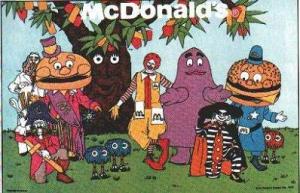
I have already admitted on here that I love McDonald’s.  I understand just how much is wrong with McDonald’s.  I fancy myself a pretty health conscious person, so this McD’s thing gets filed in my ‘contradictory feelings’ folder.  It’s like my kid self just loves that place so much, but my adult self knows better, but that childlike spark ignites everytime I see the golden arches.  It will not be extinguished.  I can trace this love back to my third birthday party.  Held at the McDonald’s in the Renaissance Center in downtown Detroit.  I remember it well.  This picture was taken there.

img008You can see an old school McD’s cup on the table behind me.  My cake had a sugar Ronald McDonald on it and I saved him for as long as I could.  Like he was a doll.  Or my friend.  I have a vivid memory of looking at that thing in the car ride on the way home from the party.  Anyway, I think the love started in November of 1979.  I also think that in the years to come McDonald’s was something that crossed the cultural lines that I couldn’t really understand, but couldn’t help perceiving.  Black people and White people enjoyed McDonald’s.  I would go there with my mom and with my dad long after they stopped going anywhere together.  I have fond memories of both grandmothers taking me there.  McDonald’s was dependable.  Happy Meals made me happy.  McDonald’s provided common ground is what I think I’m trying to say.
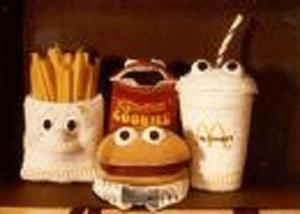
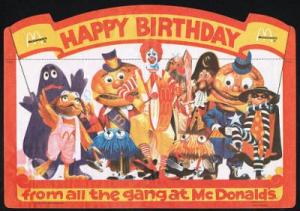
While preparing for this blog post I came across this great article on retrojunk.com http://www.retrojunk.com/details_articles/4432/.  So many memories invoked by the pictures.  They just don’t make playlands like they used to.  I’d forgotten how elaborate they could be.  Here are a few of my fav pics from retrojunk.

happymealgang

mcdhappybdaymat

mcdonaldscharacters

You’ll also find the history of Grimace in there.  I love Grimace.

grimace