
Reply


…to the “race doesn’t matter” mantra. It seems to be relevant when physical health is the issue. Actually, mental health as well, but that’s a different story. Anywho, I’m happy to read of this research and find it interesting that supremacists are happy to hear of it too.
SAN FRANCISCO (KGO) — New research out of UCSF shows that tracking a patient’s genetic ancestry can improve the diagnosis of asthma and other lung diseases. The results could have broader implications for other diseases that also rely on standard benchmarks such as race, gender and age.
Doctor’s office visits are the norm for 9-year-old Shamatay Hayes. She was diagnosed with asthma at age 2, something she and her mom have struggled to keep under control.
“It is challenging,” her mother says.
At San Francisco General Hospital and at asthma clinic across the country, Shamatay’s lung function is tracked using standard benchmarks such as age, gender and race. But, researchers say there is now a better way.
“So, what we can now do with modern techniques is estimate what a person’s ancestry is or what their heritage is using a series of genetic markers,” says UCSF researcher Dr. Melinda Aldrich.
The genetic markers more accurately determine lung function rather than a patient’s self-identification as simply white, black or Hispanic.
“With increasing African ancestry, we saw a decrement in lung function,” says UCSF associate professor Dr. Esteban Burchar.
Burchard is director of UCSF’s Center for Genes, Environment and Health, and senior author of a paper just published in the New England Journal of Medicine.
“We said forget what you think you are, what people think you are, and we looked at your genetic ancestry. We were able to reclassify patients more accurately than just using self-identified criteria,” explains.
That is increasingly important because race is used to establish normal reference values for everything from diagnosing disease to establishing disability payments. For instance, a mixed-race firefighter who suffers smoke inhalation might not meet the standards for disability of what is considered normal lung function since that is based on just three racial categories right now.
“What we showed is when you use these race-based standards, you could have as much as a 10 percent error rate depending upon what your true ancestry,” Burchard says.
Burchard believes this research brings us closer to truly-personalized medicine, but he is also aware of the potential controversy.
“We’ve had people contact us who were supremacists that said you know what you’re doing is validating what we believe,” he says.
But, the research actually tells a different story.
“Most of us, all of us in fact, are racially mixed,” he says. “We have a very rich heritage and what we’re doing is acknowledging that mixture and incorporating it into our clinical assessments.”
Scientists believe their results on lung function are just the beginning.
Aldrich says, “Wherever potentially we use race now for making medical decisions, it may have an impact with other diseases.”
This would ultimately make medicine more effective for everyone. The genetic tests used by researchers at UCSF cost about $10 per patient. Scientists see it as a small price to pay for a more accurate assessment of disease, which could lead to more effective treatments for patients.
(Copyright ©2010 KGO-TV/DT. All Rights Reserved.)
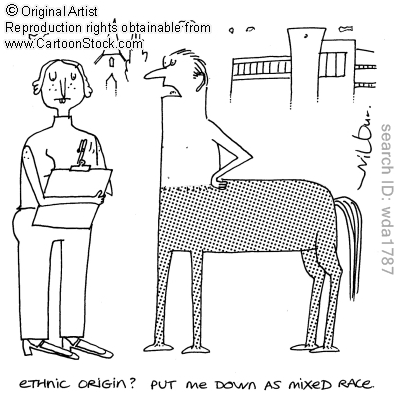
Really, Frontline? Really!? Negroid? Whatever, PBS. Not sure why that caused me intense irritation, but it did. Moving on… This strikes me as something that should be common knowledge.
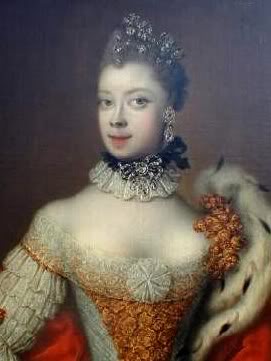
by Mario de Valdes y Cocom
“The suggestion that Queen Charlotte was black implies that her granddaughter (Queen Victoria) and her great-great-great-great-granddaughter (Queen Elizabeth II) had African forebears. Perhaps, instead of just being a boring bunch of semi-inbred white stiffs, our royal family becomes much more interesting.” (The Guardian, March 12, 2009)
With features as conspicuously Negroid as they were reputed to be by her contemporaries, it is no wonder that the black community, both in the U.S. and throughout the British Commonwealth, have rallied around pictures of Queen Charlotte for generations. They have pointed out the physiological traits that so obviously identify the ethnic strain of the young woman who, at first glance, looks almost anomalous, portrayed as she usually is, in the sumptuous splendour of her coronation robes.
Queen Charlotte, wife of the English King George III (1738-1820), was directly descended from Margarita de Castro y Sousa, a black branch of the Portuguese Royal House… Six different lines can be traced from English Queen Charlotte back to Margarita de Castro y Sousa, in a gene pool which because of royal inbreeding was already minuscule, thus explaining the Queen’s unmistakable African appearance.
Queen Charlotte’s Portrait:
 The Negroid characteristics of the Queen’s portraits certainly had political significance since artists of that period were expected to play down, soften or even obliterate undesirable features in a subjects’s face. Sir Allan Ramsay was the artist responsible for the majority of the paintings of the Queen and his representations of her were the most decidedly African of all her portraits. Ramsey was an anti-slavery intellectual of his day. He also married the niece of Lord Mansfield, the English judge whose 1772 decision was the first in a series of rulings that finally ended slavery in the British Empire. It should be noted too that by the time Sir Ramsay was commissioned to do his first portrait of the Queen, he was already , by marriage, uncle to Dido Elizabeth Lindsay, the black grand niece of Lord Mansfield.
Thus, from just a cursory look at the social awareness and political activism at that level of English society, it would be surprising if the Queen’s negroid physiogomy was of no significance to the Abolitionist movement.
 Ramsay painted this one, with her two children, in 1765
by Gary Lloyd
History reveals two curious details about Queen Charlotte Consort to George III: First, her official coronation portrait shows a woman with distinct mulatto features. Second, the Royal Physician to her granddaughter, Queen Victoria, wrote about her in his memoir: “She had a true mulatto face.”
But if Queen Charlotte was a mulatto, who was the black man who fathered her? And if Queen Victoria became the “Grandmother of Europe” would not her black African great-grandfather be the great-grandfather of virtually every Royal house in Europe?
Mulatto Queen unravels this mystery. Along the way we meet Voltaire, Samuel Johnson, Czar Peter the Great, Liebniz, and finally, the black African rumored to be Queen Charlotte’s biological father.
No stodgy historical drama, Mulatto Queen is a hypnotic, farcical romp through King George III’s England. Think: The Da Vinci Code meets Roots …
The characters are heroic, cowardly, desperately funny, disturbingly neurotic. What with their wedding-cake high wigs, court gowns, rampant alcoholism, bloodlust for public executions, addiction to snuff, penchant for gluttony, the appearance of a 17-year old mulatto girl and King George’s instant attraction to her caused a scandal and a cover-up that persists to this day.
Buy the book HERE

I’m not a fan of the old “best of both worlds” myth. Not unless the other side of that coin -worst of both worlds- is given as much weight. However, I didn’t want to simply tout a “tragic japanese-american” fallacy over here today either. Here’s what I found to counteract that.
“Hybrids are better”—Shayne Kao
…In the belated honor of “LOVING DAY,” I’ve asked 10 hapas in NYC and beyond (including myself) the following: what we like about being biracial, and how it has shaped us in this world. So, let’s eat some good food and enjoy the sunshine as this community continues to grow and we find each other and ourselves among the masses!
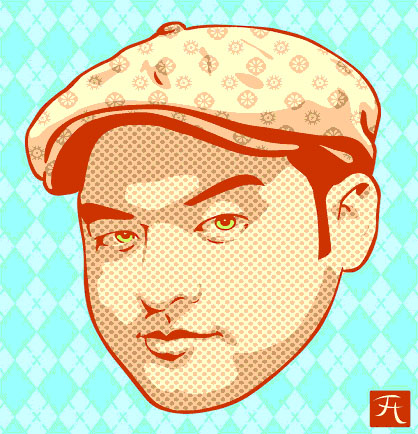
Name: Teddy Hose
OCCUPATION: Illustrator, Animator, Graphic Designer
NATIONALITY: Dad is American (3rd Generation German), Mom is Japanese (straight from Japan).
TEDDY SAYS:
I definitely enjoy being biracial, it gives me perspective culturally, and I usually get a positive response when people ask me about it. I like the feeling of being unique because I work in the creative field where that is highly valued. I also believe it makes me more tolerant since the East’s values and tendencies are clearly different than the West. I can’t help but see things from more than one angle, which can be refreshing. I’m honestly able to communicate better with non-white people in my experience. Being able to connect with someone based on feeling “different” is always something I look for, as cliché as that sounds.
I think one advantage with being hapa is that we don’t have the typecasting that comes with being one race. Not to say there are those who equate mixed race people to one race (Obama being declared as the first “black” president), but this aspect is great for someone who’s an artist like me.

NAME: Stephanie Silver
OCCUPATION: Actress
NATIONALITY: Half-Japanese, Half-German/Austrian/Hungarian—aka Germanese, or Double-Jap, or Jap-Squared, or the Axis Powers (minus Italy).
STEPHANIE SAYS: I grew up with ramen and tempura dishes one week, and pastrami sandwiches and matzo ball soup the next. Which dessert do I like more: mochi or cheesecake? At a frozen yogurt shop, I don’t have to choose anymore. I can have both flavors, a twist, a blend, a hybrid!
Feeling a connection to two distinct cultures. Recognizing my features in an Expressionist painting, and my emotions in a woodblock print. Strangers telling me I should go to Israel, no Berlin, no…Okinawa. Remembering trips to Hawaii during Summer, and New York in the Fall. Learning to surf and going to Temple. Living the in-between life in Los Angeles. Being accepted by most Asian and Jewish groups and looking non-descript enough to pretend I was Latin or Creole to fit in there too. But feeling especially drawn to people with a similar mixed heritage. I had a deeper understanding with them and I was eager to find common ground.
I think seeing how one side of my family would ostracize one or the other of my parents made me embrace different ethnicities more. I’m constantly finding myself attracted to minorities. And I think their families are more accepting of me because of my mixed heritage. It’s as if I’m neutral territory, truly American. I could date Raymond, who is Korean, and his parents wouldn’t mind because I was only half-Japanese. My Japanese grandparents certainly would not feel the same about him. I could be considered as a potential wife for David and Daniel, both Jewish, simply because of my last name.
People are comfortable around me because I blend easily, but they’re curious too. I hear them saying to their friends with pride, “she looks Hawaiian, right, but her father’s Jewish!” I was born into something exciting and somewhat new. We’re a growing group of biracial mixes, foreign yet distinctly native. We’re the physical manifestation of the end of racism.
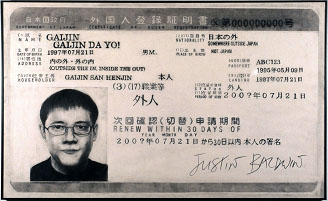
NAME: Justin Baldwin
OCCUPATION: Artist, but an unknown one, so I have a day job working for a Japanese company.
NATIONALITY: I am an American, as is my father. My mother is now a U.S. citizen, but was born in Japan. On my father’s side of the family, there is Irish, German, British, and who knows what else … and, I suspect that on my mother’s side, there may be some Russian (going back a couple hundred years), since my mother has fair skin and green eyes (plus, she’s from Sapporo, and the prefecture of Hokkaido is closer to Russia than anywhere else in Japan).
JUSTIN SAYS:
Although I didn’t study Japanese until I finished college, the biracial factor inspired me to study Japanese and eventually live in Japan. This has subsequently made a profound impact/influence on who I am, and what I do. I suppose, in this sense, it has helped secure jobs (first with the JET Program, and then with the Kurashiki Board of Education, and now with my current corporate incarnation as a Professional Gaijin/Scapegoat). Being biracial in college helped me connect with Roger Shimomura as a student, who remains a close friend and mentor. So in many ways, even though being biracial has not always resulted in the most pleasant experiences, it has led me down avenues that I might not otherwise have taken, meeting new people and places that do end up being very beneficial and positive. Besides, as I mentioned, there’s a certain freedom to being undefined.

As I scroll through these responses, once again, I am overwhelmed with a simultaneous sense of comfort and disorientation. Entering my mid-20s, I’ve come to accept and embrace the positive effects of my ethnic background, by associating with and learning from the people mentioned in this article. I am learning quickly that my identity crisis/investigation is only a small fraction of a cultural search of where we, as biracial people, stand in this society. The importance of seeing the glass as half-full, as opposed to half-empty, is equal to seeing ourselves as double, rather than “half” of two races. In many ways, we are lucky and unsheltered. I am excited to see how this perspective continues to grow, as I meet more and more of you and hope to strengthen our voice in any and every way possible.
© 2009 Leah Nanako Winkler
Although “mulatto” is not the “double” on which this article focuses, the perils of navigating a biracial identity that remains disrespected by, unsupported by, unacknowledged by, and unacceptable to the mainstream society surrounding the individual are so accurately communicated that I just had to post this. Crux of the issue: “feeling of being an incomplete person has sometimes led to deep depression.” I think that the only way around this is to eradicate the illusion of separation by infusing into our collective consciousness the truth of oneness. No halves. No sides. No divide.
Also touched upon here is the aspect of chaos that the Americans have injected into the Okinawan landscape that is worth analyzing.

By Chico Harlan
CHATAN, JAPAN — These days, when Melissa Tomlinson describes her fraught relationship with the United States, she speaks in English, the language she once rejected.
She grew up here on the island of Okinawa. Her mother was Japanese, and her father was an American who served in the U.S. Army, came to Okinawa, fell in love, fell out of love, then fell out of touch.
“I had plans to track him down, find him and punch him in the face,” said Tomlinson, 22. “I just wanted to figure out my identity.”
Tomlinson’s family tensions illustrate the complex cultural clashes that dominate the politics of Okinawa and, lately, relations between what have been the world’s two largest economies as they cope with a rising China and a belligerent North Korea.
For the more than 60 years since the end of World War II, native Okinawans and U.S. troops stationed on nearby bases have developed deep, passionate and generation-spanning ties that complicate political and diplomatic debates about the future of the U.S. military here.
Those passions have recently claimed the head of one Japanese prime minister, Yukio Hatoyama, who had called for the Americans to be booted off Okinawa, and caused his successor to sharply tone down his party’s assertive stance toward the United States.
A vocal majority of Okinawans still demand closing the Futenma Marine Corps Air Station. American officials, citing proximity to North Korea, China and Southeast Asia, insist it remain in Okinawa. Japan, in its attempt to mediate, has only frustrated both sides.
The current resolution, which Prime Minister Naoto Kan says his government will honor, calls for Futenma’s eventual relocation to a less populated region in the north of the island. Kan apologized last week for the “heavy burden” facing Okinawans.
Many locals on this Pacific island hosting more than half of the 47,000 U.S. troops stationed in Japan complain most commonly about the noise, congestion and crime. But emotional blood ties and cultural confusion amplify those concerns. Tormented by her identity, Tomlinson said she has tried to kill herself “a couple times” in the past two years.
Tomlinson said she struggles to convince herself — and others — that she is truly Japanese and Okinawan. She called her identity “ambiguous” and said her feeling of being an incomplete person has sometimes led to deep depression.
A generation of biracial Okinawans know about intercultural relationships, writ small. They know about romance and separations, child-support battles and reunions. They know that Japanese children refer to their biracial peers as “halfs,” and nowadays, they know of the local American-Asian school, for biracial children, where those kids are taught to call themselves “doubles.”
Okinawa’s demographics separate it from mainland Japan. Here, the rates of single-parent households and divorce are twice the national average. At the American-Asian school, 70 percent of the 80 students come from single-parent households, Principal Midori Thayer said.
“Unfortunately, some kids never live with their father, but they cannot lose their DNA,” she said. “Their body shows that they are not 100 percent Japanese.”
Denny Tamaki, 50, the local representative to the Japanese parliament, knows only that his father, an American serviceman whom he has never met, was named William.
When William returned to the States and Tamaki’s mother decided not to follow, she burned his photos and letters. When they moved to a new home, she didn’t give him their new address. When Tamaki turned 10, his mother took him to a government office, where they officially changed his first name to Yasuhiro.
Tamaki knows little English and wants Futenma moved off Okinawa because “it feels like we’re living under occupation.” But he has a passion for American music — Aerosmith, for instance — and American television shows.
A decade ago he tried to track down his father, with no luck. When his kids ask about their grandfather, he tells them that it would take the detectives from “CSI: Miami” to find him.
Search for a father
Tomlinson’s mother and father were married on Okinawa, and then moved together to Georgia after his tour on the island ended in 1975. Tomlinson was born in Hinesville, Ga., while her father was stationed at Fort Stewart.
Tomlinson’s parents separated when she was 3; she returned to Okinawa in 1990 with her mother. Her father retained custody of their two older children, who stayed in the United States with him.
Growing up, Tomlinson said, she remembered nothing about the separation, and never spoke to her father or siblings. “I’ve had to live with some tough decisions,” said Melissa’s father, who requested that his name not be used.
Tomlinson said her conflicted feelings were often fueled by her mother, who told her she looked “like an American” and tried to hide her from her co-workers. She said they fought frequently, and she told her mother: “Why did you have me? I want to be a Japanese, but I don’t get to choose.”
In school, her dual identities battled. Sometimes she was an American who didn’t speak proper English. Sometimes she was a Japanese who didn’t look Japanese. For several years, she tried to forget every English word she knew.
During high school, she said, a teacher encouraged her to learn English because she would need it if one day she wanted to track down her father. “Maybe you can hear the truth,” the teacher told her. “You should know both sides.”
At the University of the Ryukyus, Tomlinson tried to find English-speaking friends. She watched American television without the subtitles. Still, she confided to friends that she felt depressed.
From her mother, Tomlinson had heard only nasty tales about her father, who was once stationed at the Army’s Torii base. After her junior year in college, in spring 2009, she decided to try to find him and left school for a time.
In March, her U.S. military ID card, a privilege from a relationship she never had, was expiring. The Army passed along her father’s address. She e-mailed him, asking for him to sign the required forms for a new ID.
Weeks later, she heard back from the father who had not seen her since she was 3.
“Hi Melissa, Hearing from you, to say the least, came as quite a shock,” he wrote. “I was not aware that you could speak English let alone read or write it. The last time we had contact, and I am sure you do not remember it, you could only speak Japanese. Trying to bridge the gap with words after all this time would be futile. In life sometimes we have to make decisions that we don’t know if they are right or not, but we have to live with them.”
Tomlinson read and reread the e-mail. She discussed it with friends, and together they parsed the words. Their relationship continued, e-mail by e-mail, and she learned that he liked fishing, and that he missed Okinawa, and that he says he has thought about her every day.
For all these years, he wrote, he avoided contact because he didn’t want her to be torn between parents.
“It would have made your life miserable,” he wrote.

I am beyond excited to be participating in the first annual Critical Mixed Race Studies Conference. Fanshen and Heidi proposed a roundtable entitled “Exploring the Mixed Experience in New Media” moderated by historian/scholar Greg Carter and presented by Mixed Chicks Chat hosts and Mixed Roots Film & Literary Festival founders/producers Fanshen Cox and Heidi Durrow, Tiffany Jones (Mulatto Diaries) and Steven Riley (mixedracestudies.org). It was accepted! Thank you Fanshen and Heidi! I can’t wait!

“Emerging Paradigms in Critical Mixed Race Studies,” the first annual Critical Mixed Race Studies Conference, will be held at DePaul University in Chicago on November 5-6, 2010.
The CMRS conference brings together scholars from a variety of disciplines nationwide. Recognizing that the diverse disciplines that have nurtured Mixed Race Studies have reached a watershed moment, the 2010 CMRS conference is devoted to the general theme “Emerging Paradigms in Critical Mixed Race Studies.”
Critical Mixed Race Studies (CMRS) is the transracial, transdisciplinary, and transnational critical analysis of the institutionalization of social, cultural, and political orders based on dominant conceptions of race. CMRS emphasizes the mutability of race and the porosity of racial boundaries in order to critique processes of racialization and social stratification based on race. CMRS addresses local and global systemic injustices rooted in systems of racialization.
 mulatto diaries