Unknown's avatar

About Tiffany

I am "biracial", but I'm mostly lots of other things

more on the civil war

I’ve been sucked into the Civil War on the great interweb today.  Haven’t even watched Glory yet.  I’m so fascinated by this history.  Most of the photos and information in this post were found on one of Life Magazine’s photo galleries dedicated to the Civil War.  I must say that I would bet money that the man in the photo entitled Ready to Fight is a mulatto.  To call him biracial for the sake of political correctness would not be historically accurate, and sounds as preposterous to me as do all of the captions claiming that “African Americans” are depicted in the photos.  White folks of the day had a difficult enough time even agreeing that they were human beings… 3/5ths of a person… That’s one of the reasons that I currently hate to use that terminology.  We don’t go around being so specific with Irish Americans, or Italian Americans, or German Americans.  Still seems like some 3/5ths mentality to me.  That is just my opinion though.  I am also of the opinion that the difference between what was going on in the Union Camp in the photo entitled At Your Service and the goings on in the Confederate camp photo titled Off the Clock is… absolutely nothing.  Contrary to popular youtube belief, I am not one of those Yankees who thinks that the Union and President Lincoln were perfect and had nothing but the best of intentions for black people.  Nor am I under the impression that if I dug back far enough in my family tree, I would find abolitionists and/or soldiers fighting for the North.  Quite the contrary, I’m almost positive.  That’s why my existence is a miracle!  Of course everyone’s is, I’m just sayin’… today… in light of this complex history… how did I even happen?

[Nick+Biddle.jpg]

First Blood

Even before blacks were officially recognized as federal soldiers, many slaves — including the man in this portrait, known as Nick Biddle — escaped and joined Union lines. In 1861, Biddle was the orderly of a white Pennsylvania militia officer and, wearing a uniform, traveled with his employee’s company to Baltimore to help protect Washington, D.C., after the surrender of Fort Sumter. Once there, he was set upon by a pro-Confederate mob, attacked with slurs and a brick that hit him in the head so severely it exposed his skull. Some consider him the first man wounded in the Civil War.

VIA

The Grave of Nick Biddle:
By Chaplain James M. Guthrie

The grave of Nick Biddle a Mecca should be
To Pilgrims, who seek in this land of the free
The tombs of the lowly as well as the great
Who struggled for freedom in war of debate;
For there lies a brave man distinguished from all
In that his veins furnished the first blood to fall
In War for the Union, when traitors assailed
Its brave “First Defenders,” whose hearts never quailed.

The eighteenth of April, eighteen-sixty-one,
Was the day Nick Biddle his great honor won
In Baltimore City, where riot ran high,
He stood by our banner to do or to die;
And onward, responsive to liberty’s call
The capital city to reach ere its fall,
Brave Biddle, with others as true and as brave,
Marched through with wildest tempest, the Nation to save.

Their pathway is fearful, surrounded by foes,
Who strive in fierce Madness their course to oppose;
Who hurl threats and curses, defiant of law,
And think by such methods they might overawe
The gallant defenders, who, nevertheless,
Hold back their resentment as forward they press,
And conscious of noble endeavor, despise
The flashing of weapons and traitorous eyes

Behold now the crisis—the mob thirsts for blood:-
It strikes down Nick Biddle and opens the flood—
The torrents of crimson from hearts that are true—
That shall deepen and widen, shall cleanse and renew
The land of our fathers by slavery cursed;
The blood of Nick Biddle, yes, it is the first,
The spatter of blood-drops presaging the storm
That will rage and destroy till Nation reform.

How strange, too, it seems, that the Capitol floor,
Where slaveholders sat in the Congress of yore,
And forged for his kindred chains heavy to bear
To bind down the black man in endless despair,
Should be stained with his blood and thus sanctified;
Made sacred to freedom; through time to abide
A temple of justice, with every right
For all the nation, black, redman, and white

The grave of Nick Biddle, though humble it be,
Is nobler by far in the sight of the free
Than tombs of those chieftains, whose sinful crusade
Brought long years of mourning and countless graves made
In striving to fetter their black fellowmen,
And make of the Southland a vast prison pen;
Their cause was unholy but Biddle’s was just,
And hosts of pure spirits watch over his dust.


Ready for a Fight

A black soldier poses with his revolver in 1865. Many military leaders didn’t believe African Americans were capable of fighting effectively at first, but battles including the one at Port Hudson…proved them wrong.


Mulatto Confederate Soldier Daniel Jenkins and his wife. Jenkins was with the Confederate 9th Kentucky Infantry and was killed at Shiloh on 4/6/62.-VIA


Off the Clock

Confederate soldiers at their campsite play poker, while drinking and smoking between battles, with two slaves serving them.

At Your Service

Four white Union soldiers sit outside their tents at Warrenten, Va., as an African American soldier hands a bottle and a plate of food to one of them, in 1862.
Download now

Women in the War: Mary Walker, American Hero

Caption: Mary Edwards Walker (1832-1919), US Civil War doctor, wearing her Medal of Honor in 1866. Walker was awarded the medal in November 1865 for her service in the US Civil War (1861-1865). She served in the Union Army in several battles, first as a nurse and later as the first-ever female US Army Surgeon. She was captured in April 1864 by Confederate forces and accused of spying, though she was later released. After the ordeal, the government awarded Walker the Medal of Honor for her bravery, the only woman to ever given such an honor.  After the war, she was involved in the temperance movement and the women’s rights movement. She would often wear men’s clothes, and campaigned for dress reform for women. This photograph is from the Matthew Brady Collection, a collection of photographs from during and after the US Civil War.

Download now

Caption: Mary Edwards Walker (1832-1919), US surgeon. Walker received her medical degree from Syracuse Medical College in 1855. During the US Civil War (1861-1865) she served as the first female surgeon in the US Army. She was awarded the Medal of Honour for her wartime service, an award revoked in 1917 and restored in 1977. Walker also campaigned on women’s rights and suffrage, and was well-known for wearing male dress, including a top hat. This photograph dates from between 1911 and 1917. It is from the Harris and Ewing Collection, which mostly consists of photographs taken in Washington DC, USA.


War Orphans Used in Propaganda

An African American brother and sister, both former slaves, pose for a photograph after being freed by Union soldiers in Virginia in 1864. The children’s mother was beaten, branded, and sold at auction because she had been kind to Union soldiers.

Free Children

The same brother and sister are photographed after having been sent to an orphanage in Philadelphia.

Jumping Ship

In some cases, having blacks in their ranks worked against the South, as with Robert Smalls, a slave forced to serve in the Confederate Navy (which permitted slaves to serve with their masters’ consent — technically so long as African Americans made up no more than 5 percent of the crew). Smalls took over his CSA ship and delivered it to Union forces, became a ship pilot in the U.S. Navy, and rose to the rank of captain. Smalls…later became a member of the South Carolina State House of Representatives.


Advertisements for slaves, such as the one by William F. Talbott of Lexington, Ky., were commonplace while Lincoln was growing up.Photo: © PoodlesRock/Corbis

Slavery Lasted Longer in the Union Than in the Confederacy
Slavery technically existed in the North longer than it did in the South, as the 1863 Emancipation Proclamation only applied to the states that had seceded. The Union slave states of West Virginia, Maryland, and Missouri abolished slavery during the war. Kentucky and Delaware, however, continued allowing slavery until the Thirteenth Amendment abolished slavery throughout the United States in December 1865.
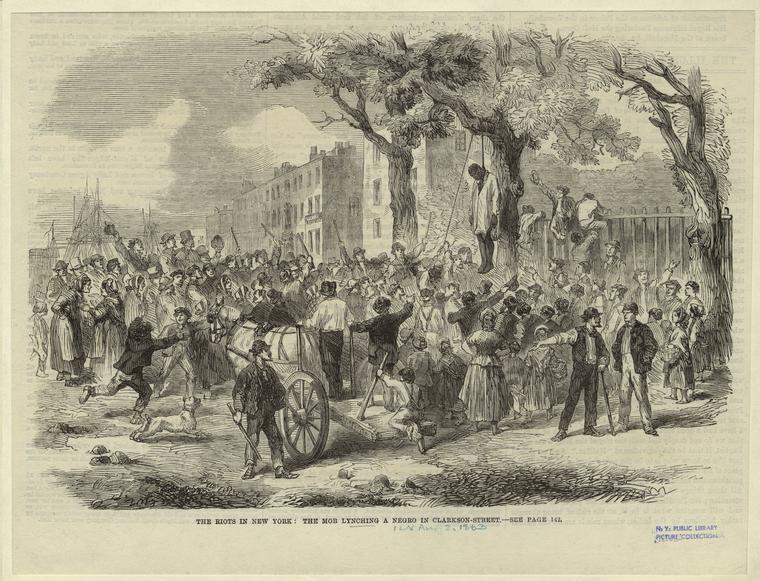
The riots in New York : the mob lynching a negro in Clarkson-Street.

New York City Considered Seceding From the Union

Though New York is viewed by much of America as the emblematic Northern city, it was actually a hotbed of pro-South and anti-war sentiment before and during the Civil War, not least because the city thrived on trade with cotton plantations. In January 1961, Mayor Fernando Wood even tried to convince the City Council to officially secede from the Union and declare itself a neutral city-state. Anti-war feelings crested with the bloody Draft Riots in July 1863, when working-class New Yorkers went on a rampage to protest new laws Congress passed to institute a draft.

The Great Emancipator Rejected Emancipation at First

Though he’s now lauded as the man who freed the slaves, President Abraham Lincoln was routinely lambasted by the abolitionists of his time for not moving fast enough or far enough in ridding the country of the institution of slavery. When the Emancipation Proclamation finally was issued, it exempted the Union border states, Tennessee, seven counties of Virginia, New Orleans, and 13 Louisiana parishes. It also implicitly offered Southern secessionist states a chance to keep their slaves if they rejoined the Union by Jan. 1, 1863.

on this day in american history

it was the beginning of the end… when will it really end?  i think it’s a great day to re-watch the movie Glory.

150 Years Later, America’s Civil War Still Divides

by MELISSA BLOCK

On April 12, 1861, the first shots of the Civil War rang out in South Carolina.

Confederate forces, firing on the Union garrison at Fort Sumter in Charleston Harbor, helped launch a four-year war that would kill more than 620,000 soldiers.

It’s been nearly 150 years since the war began. But even now, the city of Charleston is still figuring out how to talk about the war and commemorate the anniversary.

Defending The Confederate Story

Think back 150 years to what led up to those first shots on Fort Sumter: Abraham Lincoln had just been elected president, promising to restrict the growth of slavery. That prompted South Carolina, on Dec. 20, 1860, to become the first state to secede from the Union.

Last December in Charleston, there was a re-enactment of that Secession Convention. It was followed by a Secession Ball — billed as “a joyous night of music, dancing, food and drink.”

Costumed revelers waltzed and sang Dixie. Many South Carolinians were appalled; the NAACP protested outside.

“There was some criticism,” says South Carolina state Sen. Glenn McConnell. “But I don’t let that bother me.”

McConnell re-enacted the role of the president of the Secession Convention, D.F. Jamison. “It was a fiery speech,” McConnell says. “And I gave it verbatim because I was not gonna be part of sanitizing it or making it appear to be something other than it was.”

A fervent Civil War re-enactor, McConnell brings some heavy artillery with him to the battleground: his own 3,000-pound cannon, known as “Big Ray.”

“Made out of marine bronze, it’s a beautiful thing. It looks like a stick of gold,” he says. “But it can bark — and it can bark loud.”

McConnell is active with the Sons of Confederate Veterans and wants to defend their story, making sure it doesn’t get overshadowed in this year’s commemorations.

“I’ve taken the position that the best way that we can stand up is to try to tell our story, and tell it in the context of, we’ve got a shared historical experience,” he says. “And you don’t have to like something, just tolerate it. Political correctness is almost now the new narrow-mindededness.

“To me, that’s not what we should be about,” he adds. “We should be about being able to say what we think, show what we respect — and you can accept it, reject it, but it doesn’t have to be to the exclusion of the other.”

But there are fears that this anniversary will rekindle old hatreds. How do you honor the Confederate cause without also honoring the institution of slavery?

Righting The Wrongs Of The Past

At Charleston’s Old Slave Mart Museum, you’ll hear the sound of heartbeats.

“It’s so soft that it’s usually subliminal,” says museum director Nichole Green. “It’s just representing in this space the enslaved person … and the anxiety that they must have felt.”

The museum is in the old Ryan’s Mart — a narrow, low-ceilinged building where Green estimates that at least 10,000 slaves were put on the auction block and sold.

The museum displays newspaper ads from the time. “Prime gang of 27 orderly country-raised negroes,” reads one. Among them:

Hercules: prime field hand.

16-year-old Richard: field hand — lost one eye.

Young Patty, age 3.

Green says she’s hopeful the sesquicentennial is part of a healing process.

“The fear that I have is that they … will try to use the sesquicentennial to divide people rather than bring them together,” she says. “And I just have to work harder to make sure that that doesn’t happen.”

Many people in Charleston talk about using this anniversary to right the wrongs of the Civil War centennial, 50 years ago. Then, it was celebrated as a joyful tribute to South Carolina’s Confederate heritage. Now, many remember the 1961 anniversary with embarrassment.

Back then, white Charlestonians gathered with cocktails in hand to cheer fireworks and the re-enactment of the assault on Fort Sumter. Longtime Charleston Mayor Joe Riley was then a freshman cadet at The Citadel, the historic military college. He remembers watching that segregated celebration.

“[People were] celebrating something that we now quite solemnly understand was the beginning of a terrible tragedy that was caused because the South was dependent upon the inhumane practice of slavery,” he says. “And 50 years ago, there was close to universal denial among white Southerners that slavery was the cause.”

The Men Of The 54th: A Story Of African-American Bravery

Among the many stories that wouldn’t have been told 50 years ago: a story of African-American valor on Morris Island, in Charleston Harbor.

The movie Glory showed what happened here in 1863. The 54th Massachusetts Volunteer Infantry — one of the first official black units of the Union army — took huge losses. It was a slaughter, really, as they launched an assault.

“It was a battle that the 54th lost,” says Civil War re-enactor Joseph McGill. “The Confederate forces were successful in holding the fort, but the 54th did manage, indeed, to prove themselves as soldiers.”

McGill wears his Civil War history as close as his Union blues. He’s a re-enactor of Company I with the 54th Massachusetts Regiment.

“The centennial was an opportunity — I think a missed opportunity,” he says. “As African-Americans, we were engaged in a larger fight — a fight for civil rights. And with that, some scholarship — some stories that were told may have gone unchallenged.


U.S. Colored Troops

“There we were, 50 years ago, still fighting the battles that the men of the 54th had already won for us.”

And now?

“Oh we’ve made a lot of progress,” he says. “I was in Washington, D.C., in my Civil War uniform with a bunch of other African-American Civil War re-enactors marching in the inaugural parade for our current president.”

‘It’s My Family; It’s Our People’

The man who encouraged McGill to become a re-enactor — and then trained him how to do it right — is Randy Burbage.

Burbage has 11 Civil War uniforms in all, both Confederate and Union. “In fact,” he says, “we probably portray Union soldiers more than we do Confederates around here, because it’s hard to get real Yankees this far South.

“You know, it’d look bad for 500 Confederate soldiers to lose a battle to 10 Union soldiers, wouldn’t it?”

Burbage is past commander of the South Carolina division of the Sons of Confederate Veterans. He feels a strong connection to his 56 Confederate ancestors.

Talk about the Civil War, and he’ll also mention what happened to his great-great-grandmother when the Union Army occupied Charleston in 1865.

“She was here with the children, and while she was out searching for food for the kids one day, she was raped on the streets of Charleston by a Union soldier while officers watched this happen,” he says. “She never spoke again the rest of her life — it was such a traumatic experience for her.”

On April 12, for the 150th anniversary, Burbage will raise a Confederate flag outside his home. It’s not a racist symbol, in his view. But he’s mindful that Confederate commemorations can be taken that way.

“We gotta be careful how we do this,” he says, “because we don’t want to project that image that we are some sort of racist organization or individuals, because we’re not.”

Burbage knows just how close to the surface these tensions are — and how fraught with emotion the Civil War still is.

After that controversial Secession Ball in December, he met with the NAACP to try to talk through their differences. “I attempted to explain why I feel the way I feel, and listen to the way they feel the way they do,” he says. “It didn’t go too well. It resorted to some name-calling and accusations.”

Burbage says members of the NAACP wanted him to admit that his ancestors were traitors. Months later, his eyes well up with tears as he talks about it.

“Oh yeah it gets to me, it gets to me some,” he says. “It’s my family; it’s our people. And it’s part of our mission as descendants of Confederate veterans to defend their good name and be guardians of their history. And I take that mission pretty seriously.”

There’s a lot riding on it, Burbage says. “I think this next five years is going to be a crucial part of us mending those fences and moving on from what happened 150 years ago.”

Beginning Saturday, if there’s no government shutdown, there will be a single beam of light shining up from Fort Sumter to the sky.

At 4:30 a.m. on April 12 — the moment the first shot was fired in 1861 — that beam of light will split to symbolize the division of the nation.


W. T. F!

I mean… I just don’t have words… which is weird for me… a little sick to my stomach over this, actually… talk about a different fourth grade experience…

I’d love to believe that were I subjected to this horror show I would have been able to poke fun at the situation.  That maybe I would have been able to choose one male white friend and taken the ‘performance’ to a whole ‘nother level by crying, “Oh please don’t sell me away, father…” However, being nine or ten and shy, I probably would at best have refused to participate, but, more likely, gone along, swallowing my anger, humiliation, and shame until I got in the car after school and told my mother who would promptly have taken care of it.  I assure you of that.

My mother would have gone to school and ripped the teacher, and anyone else who was walking by, a new a**hole had this happened to me.  She did that when she didn’t like the way they taught about the Mayflower and the Indians in first grade.  We did it together in the fifth grade when Sr. Mary Ann said some offensive b.s. about MLK and used me, the only student of color, as a reference.  She got fired.

As a “black” student who nearly always served as a speck of pepper in a sea of salt, I can tell you that it is uncomfortable enough to go through the history lessons on the Civil War when the class is simply reading straight from the textbook, but to actually be used to physically demonstrate the atrocity….  It feels bad enough when you’re in geography and your friend accidentally reads the “river Niger” aloud as the river nigger and a hush falls over a crowd and everyone is looking at you in your desk at the back of the room even though their eyes are facing forward… but THIS.  I just can’t… Jessica Boyle, imho, you officially suck as a teacher and a human being.  Hopefully this will open your eyes to all that you have had the privilege of being blind to, and you’ll come out of this a better person.  Good f***ing luck!

Norfolk principal apologizes for mock auction of black students

By Steven G. Vegh The Virginian-Pilot © April 9, 2011

NORFOLK

The principal of Sewells Point Elementary School has apologized to parents for a teacher’s classroom exercise last week that cast her black and mixed-race fourth-graders as available for sale.

The apology came after the teacher separated the students from their white classmates and auctioned them, division spokeswoman Elizabeth Thiel Mather said. The exercise was part of an April 1 class on the Civil War.

In an April 6 letter sent to parents of students in the class, Principal Mary B. Wrushen wrote: “I recently became aware of a history lesson that was presented to the students in Ms. Jessica Boyle’s fourth grade class. Although her actions were well intended to meet the instructional objectives, the activity presented was inappropriate for the students.

Image

“The lesson could have been thought through more carefully, as to not offend her students or put them in an uncomfortable situation,” Wrushen wrote.

Wrushen said the exercise was not supported by the school or division. “I will follow up with the classroom teacher to ensure nothing like this ever occurs again,” the letter said. “In addition, the guidance counselor is available to discuss any concerns your child may still have concerning this classroom lesson.”

Wrushen declined to comment Friday. Boyle, who has been with the division since 2005, did not return a call to the school. She has taught at Sewells Point for three years, and before that was at Dreamkeepers Academy, according to the division website.

Mather said the division was responding to the incident with “appropriate personnel action.” She did not give details.

Wrushen became aware of the auction exercise after receiving complaints from two parents, and spoke to the class about the incident, Mather said.

“This lesson was not part of the approved curriculum,” Mather said.

Chris Lee, whose daughter is in Boyle’s class, was among parents picking up their children Friday at the school on Hampton Boulevard near Norfolk Naval Station. He said he’d heard no details about the exercise, though he received Wrushen’s letter.

“My wife and I were trying to figure out what the letter was about, because we heard nothing about it, we just saw the letter,” he said.

Letter: Principal Mary Wrushen wrote to the parents of students at Sewells Point Elementary to apologise for the controversial history lesson

Told by a reporter about the auction, Lee said, “That sounds inappropriate to me. Wow. That’s interesting – that’s something I have to digest.” He said he would ask his daughter to tell him about the incident.

The school has 590 students.

Contacted Friday by The Virginian-Pilot, School Board Chairman Kirk Houston said he had not known about the auction.

“That’s very disturbing to me, extremely disturbing to me,” he said. “Mock slave auctions involving children are absolutely unacceptable in a classroom. At this point this is a personnel matter, and the School Board will monitor its outcome.”

Peggy Scott, treasurer of the Norfolk Council PTA, also first heard about the incident from The Pilot.

“I’m sitting here with my mouth hanging open,” Scott said. “There are some things you don’t do.”

In a statement Friday, Superintendent Richard Bentley said: “The school district does not condone this type of lesson in any way. It was wrong. It was outside the boundaries of the curriculum and appropriate instructional practices.”

London Illustrated News, February 16, 1861, depicting a slave auction in Virginia. The sign on the podium reads “Negroes for sale at auction this day at 1 o’clock.”

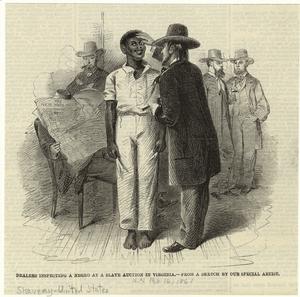
Dealers inspecting a negro at a slave auction in Virginia.

Dealers inspecting a negro at a slave auction in Virginia.  [The Inspection]

Slave Auction, Virginia

by Lefevre James Cranstone Image rights owned by the Virginia Historical Society

Silvia Federici’s Slave auction, United States

social differences/systematic consequences

I’ve just spent the last two hours transfixed by this website.  Definitely worth perusing!

A few personal asides:

I must say that I’m sure my (white) dad would have gotten on the bus and had some words with folks if that thing had happened to me (you’ll read it)…

biracial people can be as insensitive as everybody else and aren’t always the “victims” of ignorant words…

the “you’re gay be with that gay guy” one reminds me of the times someone has wanted to fix me up with someone they’re sure I’m perfect for and it turns out it’s just the other “black” person they know….

ABOUT THIS PROJECT

this project is a response to “it’s not a big deal” – “it” is a big deal.  ”it” is in the everyday.  ”it” is shoved in your face when you are least expecting it.  ”it” happens when you expect it the most.  ”it” is a reminder of your difference.  ”it” enforces difference.  ”it” can be painful.  ”it” can be laughed off.  ”it” can slide unnoticed by either the speaker, listener or both.  ”it” can silence people.  ”it” reminds us of the ways in which we and people like us continue to be excluded and oppressed.  ”it” matters because these relate to a bigger “it”: a society where social difference has systematic consequences for the “others.”

but “it” can create or force moments of dialogue.

~~~~~~~~~

This blog seeks to provide a visual representation of the everyday of “microaggressions.” Each event, observation and experience posted is not necessarily particularly striking in and of themselves.  Often, they are never meant to hurt – acts done with little conscious awareness of their meanings and effects.  Instead, their slow accumulation during a childhood and over a lifetime is in part what defines a marginalized experience, making explanation and communication with someone who does not share this identity particularly difficult.  Social others are microaggressed hourly, daily, weekly, monthly.

The term “microaggressions” was originally coined to speak particularly to racialized experiences.

“Racial microaggressions are brief and commonplace daily verbal, behavioral, or environmental indignities, whether intentional or unintentional, that communicate hostile, derogatory, or negative racial slights and insults toward people of color.”  – “Racial Microaggressions in Everyday Life”

This blog, however, is a space to extend this concept to different socially constructed identities that embody privilege in different ways – sexuality, class, religion, education level, to name a few – in hopes of making visible the ways in which social difference is produced and policed in everyday lives through comments of people around you.

  • Me, a light-skinned biracial girl at a party last weekend:: Okay, a Jack means categories.
  • White guy:: How about minorities you would sleep with?
  • Me:: As a minority, I find that offensive, like sleeping with us is a sacrifice.
  • He looks at me like he hadn’t realized he was in “mixed” company and back-pedals (“I didn’t mean it THAT way”); kisses my ass for the rest of the night, but never apologizes. Made me feel frustrated and invisible.
  • Teacher :: Black men are naturally more aggressive and strong than white men.
  • Me:: No, it has to depend on the man, surely.
  • Teacher :: Not really, no white man could…
  • Me:: Your husband is 6ft tall well built and my dad is 5’7ft and very lean, your husband could wipe the floor with him.
  • Teacher :: There are odd exceptions but, in general.
  • I was 15, Secondary School, England 2001. Made me feel gobsmacked, worried that I would be graded unfairly.
  • I was at the mall earlier today with a group of friends. Another guy from school joins us.
  • New guy:: So, what are you?
  • Me:: My ethnic background?
  • Him:: Yeah
  • Me:: Well, I’m French, Spanish, Irish, Italian, Black American, Mexican, Puerto Rican, American Indian–
  • Him:: No you’re not
  • Me:: Pardon?
  • Him:: You can’t be American Indian. They’re all extinct.
  • I am a 17 year old girl, at a shopping mall. Made me feel frustrated, invisible, patronized.

    They probably just had a crush on you.”

    -What my white father said when I told him two white students called me the n-word on the bus.

    “I would never, ever hire someone with a “black” name on their resume. I wouldn’t even interview them.

    -An African American co-worker at a team dinner.

    • Girl at country themed bar:: Hey, you’re black…
    • Me, a 23-year old male::
    • Girl:: I’m not racist or anything…but WTF are you doing here? There are Confederate rebel flags and sh*t here.
    • Me:: ….
    • Girl:: Oh, I know. You’re here for the white girls.
    • Me:: -_-
    • Girl:: Buy me a drink.
    • Made me a bit uncomfortable.
    • Customer:: If more black people were like you the world would be a better place.
    • Black me:: Have a nice day.
    • What I wanted to say:: If fewer people were as ignorant as you, people who look like me would have better lives. I was 18. (He was in his 40s or 50s.) when: spring 1998, working at Barnes & Noble in Louisiana. 

    You know, it’s so amazing. I was just looking at your hands and feet- they’re so dark on the top, but then at the palms they look just like ours! Hahaha.”

    -My gymnastics coach in front of my suburban, entirely-white team, in which I am the only black person.

    • Workfriend:: Hey that new guy at work is gay; you should totally be with him.
    • Me:: No I don’t find him attractive.
    • Workfriend:: But… he’s gay! You’re gay, he’s gay, what’s stopping you??
    • Me:: Just because he’s gay doesn’t mean-
    • Workfriend:: Ummmmm, he’s gay. He likes having sex with guys like you. You’re just afraid. Duhhh.

    I was 21, at work. Made me feel annoyed, hurt and trivialized. Gay people don’t have sex with anyone just because they are both gay.


    He was pretty dark, so he’s probably not paying rent because he’s an illegal and doesn’t know English.”

    -My (white) stepfather regarding one of his renters. Made me ashamed because I’m Hispanic, too.

    I’m a black woman. My black female friend once told me that a white guy once said to her, “You’re really pretty for a black girl.” And her response was, “I know.”

    Made me realize her and my own unrecognized self hate. Made me feel sad and guilty.

    You could pass for Dominican; some of them are really dark and have bad hair like you. Luckily, I got the GOOD hair”.”

    -Said to me by the black Dominican-American boyfriend of my biracial (black/white) friend visiting us during Spring Break. I am a 20 year old black American woman with naturally kinky-curly hair. Made me feel shocked, ugly, unimportant.

    This 1895 charicature is an unkind parody of a woman seeking to smooth out her hair. The comic strip suggests that her hair stood out on end because of a hair-raising novel.
    • My black/white biracial friend looks at the Facebook profile of a black man she’s crushing on.
    • Her:: Ugh, his [mono-racial and black] girlfriend is so ugly. They’d have kids with huge nasty noses. He needs to get with me and my good mixed nose. *giggles*

    I am a black 20 year old American woman. We were studying together at another friend’s apartment. Made me feel insulted, ugly, disfigured, and defective.

    You know why Vermont is so safe, don’t you? There’s hardly any minorities in it!”

    I was in NY yesterday, meeting my future in-laws for the first time when my fiance’s father said this. He is a white man in his 70s. I am a 22 year old biracial black cis woman …who lives in Vermont. It made me feel furious, invisible, helpless, rejected.

    what is this!?

    all i could find out was…

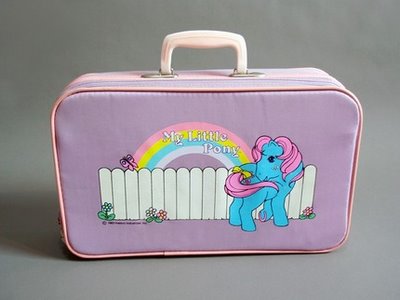
    No joke. They dance, they sing, they bat their gargantuan eyeballs. It’s called My Little Pony Live: The World’s Biggest Teaparty, and you can buy it on DVD if you feel so inclined.

    “Why is this?” might be the more appropriate question.  As much as any little girl of the 1980’s I loved me some MLP’s, but even I am befuddled, albeit mildly amused, by this one.  To this very day, I would be thrilled to receive any of the below pictured vintage items (especially the sleeping bag if you’re looking to get me a present), but if you took me to see that… thing… i do believe i would be upset with you.

    melted into our heart

    The more the wood – the hotter the fire . . .

    Excerpted from “Taking the Leap” by Pema Chodron

    So we start by making friends with our experience and developing warmth for our good old selves. Slowly, very slowly, gently, very gently, we let the stakes get higher as we touch in on more troubling feelings. This leads to trusting that we have the strength and good-heartedness to live in this precious world, despite its land mines, with dignity and kindness. With this kind of confidence, connecting with others comes more easily, because what is there to fear when we have stayed with ourselves through thick and thin? Other people can provoke anything in us and we don’t need to defend ourselves by striking out or shutting down.

    Selfless help, helping others without an agenda, is the result of our having helped ourselves. We feel loving towards ourselves and therefore we feel loving towards others. Over time all those we used to feel separate from become more and more melted into our heart.