yay, shakespeare in the park

I’m thrilled to know that The Public Theater is once again “putting this mosaic out into the world.”  And that Ruben Santiago-Hudson has biracial kids.  And that he speaks openly about it.  Actually that’s not extraordinary, but I didn’t know that about him before.  I love The Winter’s Tale.  My favorite monologue is in it.  If I weren’t too persnickety to wait in line for hours for tickets, I would be sure to see this.  However, it’s not gonna happen.  My loss, I’m sure.  Just for clarification, the “yay” is for depicting a “non-traditional” marriage/family.  Not for Hudson marrying a Swede and having mixed kids.  Although I like that a lot too.

santiagohudson

Actor Ruben Santiago-Hudson and his twins Trey and Lily attended the “Magic & Bird: A Courtship of Rivals” film premiere on February 17, 2010 in Westwood, California.

Ruben Santiago-Hudson Tells the Tale

The actor discusses starring in the Shakespeare in the Park production of The Winter’s Tale.

By: Brian Scott Lipton

VIA

Ruben Santiago-Hudson has been the epitome of excellence for over 30 years; winning a Tony Award for Seven Guitars, numerous honors for the HBO adaptation of his acclaimed solo play Lackawanna Blues, and plaudits for his direction of several shows including Things of Dry Hours and The First Breeze of Summer. This summer, he’s starring in the Public Theater’s Shakespeare in the Park production of The Winter’s Tale, and in the fall, he’ll be back co-starring on ABC’s hit crime drama Castle. TheaterMania recently spoke with Santiago-Hudson about these projects.

THEATERMANIA: What made you want to do The Winter’s Tale this summer rather than just take a nice breather between shooting Castle?
RUBEN SANTIAGO-HUDSON: I just love the challenge of doing Shakespeare. I am part of the Public Theater family and I got a call to look at the play, and before I could even finish it, I said I’d love to do it.

TM: Your character, Leontes, is considered one of the most difficult in the canon, since you accuse your wife and best friend of infidelity without any seeming cause. How do you justify that?
RSH: It is a challenge to make that action comprehensible to the audience. But I look at the text. Polixenses may be my friend, but he’s stayed with my family for nine months — and I think if anyone stayed that long at my house, I’d find fault with them. And I am sure over that time, Leontes has seen some glimpses of unusual behavior — perhaps wearing less clothing around each other or laughing too loud.

TM: Still, you cause your wife to kill herself and banish your infant daughter. How is the audience supposed to sympathize with that?
RSH: I hope the audience sees that I balance my cruelty with much love and that my actions came from defending my honor and that my rage is from jealousy and madness. It’s important that I am not just being the stereotypical angry black man. And when it all comes clear, I’m the most penitent person — I’m almost a saint by the end of the play.

TM: As is typical of many productions at the Public, the cast is completely multi-racial. For example, your wife, Hermoine, is being played by Linda Emond, who is white. What are your thoughts about this?
RSH: I think it reflects the mirror of modern society. When you look in the newspaper, you see Sandra Bullock with a black child. And this play reflects what my real family looks like — my wife is Swedish and our children are biracial — so it’s great to put out this mosaic to the world. And I think we should put the best artists we can on stage, and what I love about the Public Theater’s audience is they feel the same way. They don’t care if the king is black and the queen is white; they’re out there to see this play done well.

Linda Emond and Ruben Santiago-Hudson<br>in rehearsal for <I>The Winter's Tale</i><br> (© Nella Vera)

Linda Emond and Ruben Santiago-Hudson
in rehearsal for The Winter’s Tale
(© Nella Vera)

“kinds” of biracial

Fantastic commentary on something that I totally missed in the media.  I honestly don’t know who Drake is.  I’ll look him up in a sec…. Oh. I see.  Anyway, Whitney Teal makes such great points here (a fav being that one would never compare G.W. Bush to Eminem), and has me wanting to make a list of all the “kinds of biracial” that I can imagine.  And then I want to study the intricacies of the experiences that molded the various varieties of biracialness.  I love biracial.  It never gets old for me.  I suppose you can call me Captain Obvious for that statement.

Is One Mulatto the Same as the Next?

VIA

By Whitney Teal

Has the election of President Obama changed the way we think about biracial people in this country? I’d argue that it’s questionable. Especially when people are drawing comparisons between the prez — a half-white, half-Kenyan, Ivy League-educated lawyer — and Aubrey Graham, otherwise known as Drake, who is a half-Jewish and half-African-American entertainer from Canada. Yeah, I don’t see the similarities either.

Image of Thomas Chatterton Williams

thomas chatterton williams

But TheRoot.com contributor Thomas Chatterton Williams, who describes himself as the son of a black father and a white mother,” seems to think that the two mulattoes (his word, not mine) deserve a comparison. Yes, Williams thinks that it’s helpful to compare a Canadian rapper and the President (as he puts it, one of the “most visible mulattoes living and working today”). And he’s not alone, either. A few months back, a couple of my Twitter friends and I ripped Chester French band member David-Andrew ‘D.A.’ Wallach a new one for tweeting that he was discussing “all the similarities” between the two men. When I asked him to explain himself, he replied, “For one, I think they’re both extremely studied.” Womp, womp, cop-out. Lots of men are studied. President Obama and Drake are both, simply, biracial. And they’re not even the same “kind” biracial either, but that doesn’t seem to make a difference.

When I showed my sister the story on The Root, she screamed (via Google Messenger) and replied, “Obama and Drake in the same sentence? Do people mention [President] Bush and Eminem in the same sentence?” She’s right. White men are allowed to choose their own identities. Black men not so much, and biracial men certainly not. Which begs the question, why can’t we see that one biracial person is not the same as the next?

In general, polite company, we as general, polite people, recognize that a person’s experiences are not solely dictated by their race or ethnicity. For example, I don’t think people considering Lucy Liu, a famous actress, and Connie Chung, an award-winning journalist, would try and argue that the two have much in common, at least on the surface. The same with Denzel Washington and Reggie Bush, or Barbara Streisand and Heidi Fleiss. No comparisons. But people, general and polite as they are, still seem to view the experiences of biracial people in this country as singular in nature.

And often, as The Root essay explores, polarizing. “Mixed-race blacks […] are the physical incarnation of a racial dilemma that all blacks inevitably must confront: To sell out or keep it real? That is the question,” writes Williams, who spends the better part of 1,000 words waxing on about the definition of authentic blackness (or at least how he sees it). According to Williams, a mixed-race person must choose to be black, like the president and like Drake, who “both proudly define themselves as black.” A mixed-race person must then “act black,” which Williams sees as wearing loose clothes and playing basketball.

If blackness meant just one thing, and if mixed-race people were able to align themselves with just one part of their identity, then his essay might hold more weight. But black people don’t have just one identity, at least not to ourselves. Hollywood directors, novelists and journalists may see us as trash-talking, saggy pant-wearing basketball fanatics, but I don’t think that’s how we see ourselves. And by asserting that he can turn his black switch on and off, simply by altering the fit of his pants, Williams — though he may identify as black — shows how much he doesn’t understand the complexity of black culture.

Which is why I don’t believe that we should automatically label mixed-race people as black; they’re mixed-race. Being biracial may be similar to African-American culture, just as West African and West Indian cultures share similarities to black culture, but ultimately have their own dialects, dress, worship practices, food and courtship rituals. But biracial people etch out their own identities. Sure, they may be similar to that of African-Americans or other cultures. But it’s limiting to both black and biracial people when society automatically labels anyone with brown skin and textured hair black. Whether we’re talking about President Obama or anyone else, what it means to be biracial is an entirely individual question.

chastity brown

Never heard of her, but my interest has been piqued.  Cool name.  Cool hair.  The hair story she relays at the end calls to mind the biracial girl who was removed from her classroom.  You can read the interview in it’s entirety HERE and/or check out her website HERE.

Chastity Brown releases High Noon Teeth

Soul singer straddles multiple genres

By Rob van Alstyne

CP: Your prior album, Sankofa, was almost entirely made up of personal confessionals, whileHigh Noon Teeth incorporates more narrative storytelling and poetic metaphor. Why the shift in tone?

Brown: Some of the songs on Sankofa I hope to never sing again because they’re just so personal. That whole album was a reckoning of sorts that I felt like I had to go through to get to where I am now with my music. I was definitely writing much more imaginative songs this time around, rather than just about my personal experiences, and that was new for me. I talked about metaphors in songwriting a lot with Alexei [Casselle of Roma di Luna] and Joe [Horton, a.k.a. Eric Blair of No Bird Sing] while I was writing the album because that was all new terrain for me, and they both write songs just swarming with beautiful images. I don’t feel the need to be as blatant as I used to. This record was really all about pushing outside of my normal comfort zone and trying to take things to the next level creatively. Hopefully fans that have followed me for a while will appreciate that things are changing.

CP: One holdover from Sankofa is the presence of a song about your childhood, growing up biracial in small-town Tennessee (on Sankofa it was called “Bluegrassy Tune”; it’s present onHigh Noon Teeth in a new arrangement titled “Bound to Happen”). It’s an unflinchingly intense narrative (“Well my daddy was a black man and my mom blond hair, blue eyed/You know people would stare at us children/Like we were some suspicious kind”). What led you to feature it again this time around?

Brown: I decided to record that song the very last day I was in the studio for Sankofa when it was still super new. As I was playing it with the band, it rearranged itself and fine-tuned itself so I wanted to present it again. It’s an important song to me. At least once a week probably I still encounter some stupid racial situation. People ask me all the time if my hair is real, and I was at a show where a woman actually grabbed my hair and jerked it out of nowhere. It caught me so off guard and I remember going home and crying and being so angry. I felt conflicted, part of me wanted to educate her and part of me wanted to smack her and say, “How dare you touch me!” So the song is sort of my way of reaching out and taking the educational route and saying this is who I am and what my experiences have been. Depictions of mixed-race people are very popular in the media now and it’s a little strange for me because I’ve always looked this way. Growing up I was constantly made fun of for my hair; apparently now it’s a cool look.

mixed roots!

I am so, so sad to be missing this year’s festival!  It just doesn’t feel right.  If you are in L.A. this weekend, do yourself a favor and attend it.  Shine some light there for me, please.
newlogo

3rd Annual Mixed Roots Film & Literary Festival (TM)

June 12-13, 2010

Japanese American National Museum

369 East 1st Street

Los Angeles, CA

The Mixed Roots Film & Literary Festival is a non-competitive, annual arts festival dedicated to sharing and nurturing storytelling of the Mixed experience. The Mixed experience refers to interracial and intercultural relationships, transracial and transcultural adoptions, and anyone who identifies as having biracial, multiracial, Hapa or Mixed identity.
A word from the lovely and amazing founders:
Dear Festival Supporters!
If you haven’t reserved your spot at the 3rd Annual Mixed Roots Film & Literary Festival, which takes place this weekend at the Japanese American National Museum, 369 East 1st Street , June 12-13, 2010, in downtown Los Angeles, do it now!
Register now! It’s free!
And tickets to the Loving Prize Presentation with Hapa artist Kip Fulbeck and scholar Dr. Maya Soetoro-Ng, President Obama’s sister, are going fast.  Tickets to this event cost $15 for registered Festival attendees and $20 for non-registered Festival attendees. To purchase a ticket to this event, you can call the Museum directly at (213) 625-0414 (credit card only) or pay by check or credit card at the event. Proceeds from this event will go to JANM.
We’re looking forward to seeing you all next week!  We have an amazing Festival line-up filled with talented artists, and fun.  Don’t forget that books & Festival t-shirts will be for sale at the Festival so you can take a little bit of the experience home.  (We can accept cash, checks, and credit cards.)  And bring a cozy sweater in case you get cold — we’re festing inside in a cool air-conditioned room!
See you soon!

Sincerely,
Heidi & Fanshen & Jenni
www.mxroots.org

Please also consider supporting this important, all-volunteer project by making your tax-deductible, secure on-line donation here.

oblivious to racial overtones

I am pained by this story.  I remember being this little girl.  I remember being singled out at times, usually not having anything to do with my hair unless it was mandatory school-wide lice check day.  No one wanted to deal with me then.  And that was fine with me.  But it wasn’t really.  I can only imagine the consequences this incident will have for this little girl.  Her parents really have their work cut out for them now.  I hope they sue and win big!  The damage is done.  Let’s hope it can be undone.  Oh, and I’d like to send the Mudede family a copy of Teri LaFlesh’s Curly Like Me.  All you need is conditioner people.  All you need is conditioner…

Biracial Girl Removed From Classroom Because Of Her Hair

by Amelia Thomson-DeVeaux

VIA

This story is an example of the sad fact that within schools, sensitivity training can only go so far – sometimes, there are unpredictable situations where teachers just have to intuitively react, and often they’re not prepared to do so.  And often, these issues are much larger than they appear on the surface.  Such is the case with the 8-year-old biracial student who was removed from her advanced-placement class because the teacher claimed that she was allergic to the girl’s hair moisturizer.  The teacher first put the girl in the hallway, and then moved her to a different classroom where she found herself in a lower-level class with predominately African-American students.

This behavior seems bizarre enough – but add the fact that the girl was the only student of color  in her school’s accelerated program, and the concerns of her angry parents, who may now sue the school (the NAACP, along with the Department of Education, have already filed a complaint), seem justified.  The girl’s father, Charles Mudede, is black, and says that he had talked to his daughter about resisting pressures to straighten her hair so that she would look more like her white classmates.  The product that so irritated the teacher was a compromise, Mudede said, “something light that kept her hair in its natural state.”

The girl’s parents have a host of questions to which there seem to be no adequate answers: “Why did the teacher think the problem was his daughter’s hair? Why hadn’t the school called the parents? What investigation was being done to pinpoint the source of the problem? And, finally, why did the school seem oblivious to the racial overtones of a white teacher singling out her only black student?”

Mudede says that the situation escalated because no one at the school seemed prepared to answer these basic questions.  He wrote on his blog,

“When we, her parents, were later informed of this incident, we also learned that once my daughter was removed from the class, the teacher felt much better. We were also told that the teacher had experienced something like a fainting spell because of our daughter’s hair. Feeling the seriousness of this situation, we decided not to send our daughter to school until the teacher had medical proof that our daughter’s hair or something in her hair was to blame for the nausea. (The last thing you want to happen to your daughter is for a teacher to faint or vomit at the mere sight of her.)

Days passed and the school took no action. This unresponsiveness left us with no other choice than to turn to a lawyer. The whole thing is a mess. Getting entangled in a racial dilemma is something most black parents do not want for their children. It’s just not worth the trouble. Then again, like I said, if not checked and confronted, the incident will have permanent consequences for my child.”

And although the school is now making limited comments because of the threat of a lawsuit, it definitely seems as though this situation was horrifically mismanaged; without communicating privately with the student and involving the parents, of course this would turn into a humiliating ordeal for a little girl who clearly was already suffering from self-esteem issues.  If the teacher had allergies, that’s something that she couldn’t help.  But to target the student in such a dismissive embarrassing way shows a level of insensitivity that no teacher should have.

decreasingly on the rise

This article raises more questions for me than it imparts information.  That may be it’s purpose.  I want to know why there is a decrease in the rate of increase of interracial marriages.  Ever since my “a-ha” moment surrounding my biracialness, I’ve been super-interested in the greater number of white women/black men couplings as opposed to black women/white men.  I realized on that day that having a black mom/white dad made me a “minority” within a “minority” within a “minority” (and a majority?).  What!?  I don’t even like the word minority.  Let’s use anomaly.  I perceive myself to be an anomaly within an anomaly.  That’s better.  Anyway, I would love to conduct a study on why exactly the trend in gender and race of black/white couples is as it is.  Lastly, what really stands out to me in the information below is that U.S. born Hispanics and U.S. born Asians are marrying (I assume) U.S. born whites.  What does this mean?  Americans are marrying Americans.  That should be the paradigm that we as a nation collectively shift toward.  Race doesn’t exist. Nationality does.

Interracial Marriage: Who is More Likely to Wed Outside Their Race?

by Lynnette Khalfani-Cox

Interracial marriages are on the rise in the U.S., although they’ve slowed somewhat over the past decade. The latest census figures show that interracial marriages in America now account for 8 percent of all marriages, up from 7 percent in 2000. During the decade from 1990 until 2000, there was a sharp increase in mixed-race marriages, with such couplings growing by 65 percent. Since the year 2000, however, mixed-raced marriages have grown by just 20 percent to about 4.5 million couples.

Looking at the data over the past three decades, which groups are more likely to marry outside their race? According to federal statistics, African Americans are three times more likely to marry whites than they were back in 1980. Some attribute this to an increase in African American educational attainment and more professional interaction among blacks and whites.

Other findings from the census data include:

*14.5 percent of black men and 6.5 percent of black women now marry whites

*38 percent of U.S.-born Hispanics marry whites, compared with 30 percent in 1980

*40 percent of U.S.-born Asians marry whites, a number unchanged since 1980

It would have been interesting to see other data that looked at interracial couples of all kinds, not just a look at which “minority” groups marry whites. In this sense, this data is skewed and rather limited when talking about the full scope of interracial marriages.

We all know that the world is fast becoming multicultural, global in nature and interdependent in numerous ways. From the adventurous traveler who meets and marries someone of a different race and culture in another country to the investor who buys stocks and bonds from companies all around the globe, the world is at once becoming smaller, yet bigger and with more possibilities.

The challenge going forward will be how do we deal with the social, economic and political realities of living in an increasingly multiethnic, interracial society? And will we ever get to a point where race will simply cease to matter — all matters personal, professional and otherwise?

SOURCE

yesterday’s history

When I started reading this article I thought, “This is about to be some ‘tragic mulatto’ b.s.”  Much to my surprise, it isn’t really.  I think Sarah played the part of the tragic mulatto very well, and got exactly what she wanted and deserved.  I wonder if the congregation’s response would have been different if “Pinky” hadn’t been quite so pink, but maybe “Brownie” instead.  Just a thought.  I also like this piece of our history because once upon a time, in a former life in which I considered myself black, I was a nanny and I worked in Brooklyn Heights and I walked by that church every day and was very drawn to it.  Part of me knew… And part of me was so clueless.

On This Day in History: June 1
Rev. Beecher’s Freedom Auction

by Vernon Parker

VIA

On June 1, 1856, Henry Ward Beecher, minister of Plymouth (Congregational) Church, and an ardent supporter of the antislavery cause, held a public “auction” of a young mulatto slave named Sarah to dramatize the evils of slavery.

The Brooklyn Daily Eagle reported that “she had been brought from a plantation near Staunton, Virginia.” When Sarah was called to the pulpit, she … “walked slowly, head bowed, and took a seat near the famous minister. She lifted her eyes, stared at the spellbound audience, and burst into sobs. Her plight tugged at the heart of the most stolid Congregationalist as Beecher’s inflamed rhetoric described her life. Daughter of a well-known white citizen, she had been put up for sale by her own father. The slave dealer involved contacted Beecher through a mutual friend and they struck a deal allowing Sarah to go north with the promise of either her return or the full manumission fee.”

The mock auction raised sufficient funds to purchase her freedom and buy her a modest home in Peekskill, New York.

The following is an excerpt from James H. Callender’s book Yesterdays on Brooklyn Heights: “As the anti-slavery agitation increased, Mr. Beecher thundered his invectives against the slave-owners of the South, and many of the leading men of his church were said to be directors of the famous ‘Underground Railroad’ by which fugitive slaves were passed along from the South across the border to Canada. It was at the close of one of his most powerful sermons that Mr. Beecher said he had a little matter he wished to present to the congregation. No one had any idea as to what he was going to say and the people waited in profound silence.

“He then suddenly burst forth, ‘Sarah, come up here!’ As the audience gazed, a little mulatto girl arose in the body of the church, ran up the pulpit steps and took Mr. Beecher’s hand. Turning to the assembled multitude, he said — ‘This little girl is a slave, and I have promised her owner $1,200, his price for her, or she will be returned to slavery. Pass the baskets.’ A scarcely stifled sob arose from the almost three thousand present. Bills of all denominations, jewelry, and watches and chains were flung in the overflowing baskets and when the total was counted, Mr. Beecher announced, amid thunders of applause, that Sarah was free, and enough remained to strike the shackles from the limbs of several others.”

A tintype of Sarah, also known as “Pinky,” the young mulatto slave whose freedom was “auctioned” by Rev. Henry Ward Beecher.

curly like me

It’s here!  The answer to our curly-headed prayers.  I’ve been referring people to Teri LaFlesh’s website for over a year now, and am thrilled to be able to point my fellow biracials, parents of mixies, and anyone else with a “wild” mane to her book Curly Like Me.  Teri was kind enough to send me an advanced copy so that I could write a blurb.  Here’s what I wrote…

“With Curly Like Me, Teri LaFlesh has provided us curly heads with THE Bible of hair care for our tightly curled manes.  If you thought your (or your child’s) hair was hard to manage, Teri will prove you wrong.  After suffering through relaxers, jheri curls, texturizing, dreadlocks, weaves, and extensions, Teri stopped fighting against her curls and embarked on a journey to embrace them.  The results are stunning!  Teri discovered a simple, easy to follow technique that produces healthy, happy, beautiful curls freeing us from chemicals, heat, and perpetual ponytails.  She’s layed it out step by step, providing us with the do’s, the don’ts, and even the why’s!  A more thorough hair care manual we could not ask for.  Perhaps even more momentous though is the journey toward self acceptance that lies in the pages of the book.  It seems as though Ms. LaFlesh learned that what happens when we try to make our hair into something that it is not, is a mirror of what happens when we try to make our SELF into something that it is not.  Curly Like Me is also about embracing every aspect of one’s authentic self. That beautiful and unique being that the world will not be able to experience if we waste our energy fighting against it in hopes of conforming to that which we’re told every day on television, in magazines, and in the movies is ‘normal’ and ‘good.’  The struggle against the “real” hair becomes symbolic of the inner struggle against the real self.  Teri says, ‘I treated my curls as if they weren’t good enough in their natural state.  Yet after all I had done to them they, couldn’t be crushed.’  The same can be said of the human spirit.  Thank you, Teri!!”

so, if you’d like your (or your child’s) hair to look like this someday….

…go buy this book!!  You can get it HERE.

black polish virtuoso

Rita Dove has done us a great service by painstakingly digging up this forgotten history.  Like most people, I had never heard of Bridgetower before Sonata Mulattica popped up in a random google search.  What a fascinating story!  I imagine it was not only challenging, but exciting to imaginatively fill in the blanks of this discarded musicians unique experience.  I would like to know more about his parents.  How they met, how an interracial relationship was received in Poland circa 1780, if he considered himself a mulatto or if there was a one-drop kind of mentality.  I guess I’ll have to read the book to find out what insight Dove’s years of research led her to deduce about those race issues.

More than her standing as former US Poet Laureate, Pulitzer Prize winner, and Possibility Poet it is Dove’s own family that (in my opinion) makes her a perfect and trustworthy candidate to bring us this story:

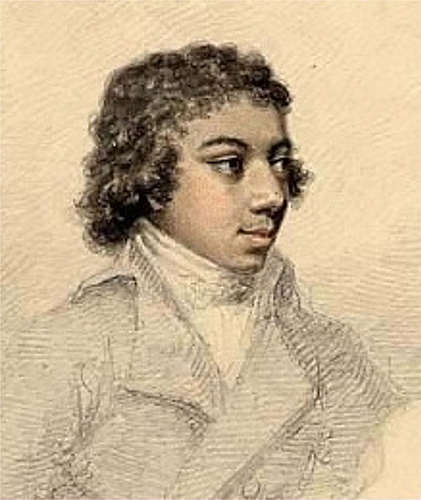
Rita Dove and her husband Fred Viebahn, with their newborn daughter, Aviva, in Tempe, Arizona, January, 1983.

Rita Dove and her husband Fred Viebahn, with their newborn daughter, Aviva, in Tempe, Arizona, January, 1983.(© Fred Viebahn)

Rita Dove’s gorgeously engaging ‘Sonata Mulattica’ weaves the narrative of a black virtuoso all but erased from musical history.

By: Teresa Wiltz

Via: The Root

Way, way back in the day, there was an Afro-Polish violinist, a biracial child prodigy of such virtuosity that even Beethoven felt compelled to dedicate a sonata to him. There were honors and accolades and patronage from a prince.

But fortunes changed, as poet laureate Rita Dove describes in her novel-sized book of poems, Sonata Mulattica: A Life in Five Movements and a Short Play. The violinist, George Augustus Polgreen Bridgetower, and his composer, Ludwig van Beethoven,  performed the sonata together to thunderous acclaim.

The goodwill between them evaporated as the two quarreled over a woman. Beethoven furiously erased Bridgetower’s name and scribbled the name of another violinist when he dedicated the sonata.

That is how the “Sonata Mulattica” became the “Kreutzer Sonata,” one of Beethoven’s most famous works. Through that one fit of jealous retribution, Beethoven wrote Bridgetower out of history.

The Polish black virtuoso, once famous, now forgotten.

This bright-skinned papa’s boy

could have sailed his 15-minute fame

straight into the record books.

Dove first heard about Bridgetower years ago, when she was a musician studying the cello, and later, opera. It wasn’t until she saw Immortal Beloved, a film about Beethoven, that it triggered her memory. Fascinated with the thought of a mixed- race musician in 19th century Europe—“I thought there was more to it than this exotic creature who played the violin”—Dove set out to find out more about him. For five years, she researched and wrote, digging up little nuggets along the way, tucked in letters and diaries, like that of court lady Charlotte Papendiek, and in what little historical accounts she could find.

“It was like tracking the coordinates of some meteor,” Dove says. “ ‘Oh, he went there; he appeared here,’ mapping the trajectory of his life. Other than that, he was a blank slate.”

A blank slate onto which she poured all her imagination and musings about race and class and sexual competition. Bridgetower, the son of a self-proclaimed “African prince” and a Polish-German woman, was born in Poland in 1780. As it happened, his father, who was a bit of an operator, was working in the castle of the Hungarian Prince Esterházy, where Joseph Haydn worked as a musical director.

Even as a very young child, Bridgetower dazzled on the violin; Haydn took him under his wing. Later, Bridgetower traveled from Vienna to London, where he attracted the attention of the Prince of Wales, who would later become Kind George IV.  His was a life of comfort, adulation and high achievement. (He eventually received a degree from Cambridge University.)

Bridgetower, George Augustus Polgreen, 1780-1860.  His passport, obtained in Dresden, 27 July 1803, portrayed him as being of average height, beardless with dark brown hair and eyes, with a broad nose and swarthy complexion. Friends added that he was melancholic and discontent.

At the time, there were a good number of free blacks living in London, says Dove, who won the Pulitzer Prize in 1987. Some were Africans who’d never been enslaved; some were slaves who’d been freed. Class, rather than race, circumscribed one’s lot. So for a black boy with a knack for playing the violin, a child prodigy with a powerful patron, life was considerably sweeter than that of, say, Black Pearl, the young black servant in Dove’s book.

Pathological hit of the day: n****r on a golden chain.

Metaphorically, that is. The African

valet, the maidservant black

as aces in a hole….

Sonata Mulattica is a gorgeously engaging read, utilizing a mix of poetic styles, from nursery rhymes to free verse, until the narrative arc sweeps into the big confrontation between Bridgetower and Beethoven. At that point, the action shifts from poem to play, a play with a distinctly vaudevillian sensibility, complete with baudy references to Othello. Bridgetower becomes a rapping, preening braggadocio:

But I’m a natural man, born under a magical caul,

I’m that last plump raisin in the cereal bowl;

I’m the gravy you lick from your mashed potatoes,

I’m creamier than chocolate, juicier than ripe tomatoes!

But Beethoven soon brings him down to size:

Now you will taste the high price

Of my affection—“Mulatto Sonata,” indeed!

I would sooner dedicate my music

To a barnyard mule

If the two men had not quarreled, two egos run amok, would musical history have been different? Would, we find, as Dove writes, “rafts of black kids scratching out scales on their matchbox violins so that some day/they might play the impossible:/ Beethoven’s Sonata No. 9 in A Major, Op. 47/Also known as The Bridgetower”?

We will, of course, never know.  Still, it’s nice to imagine the possibilities of what could have and should have been.

Teresa Wiltz is The Root’s senior culture writer.

the gains to be realized from black-white intermarriage

What a life! From the seemingly extreme “Take that eugenics!”attitude of her parents, to the prodiginous achievements of her childhood, on to the “passing” years Philippa Schuyler’s story encompasses so many fascinating facets of the “biracial” experience of old.

Philippa Schuyler

1931-1967

Classical pianist, writer

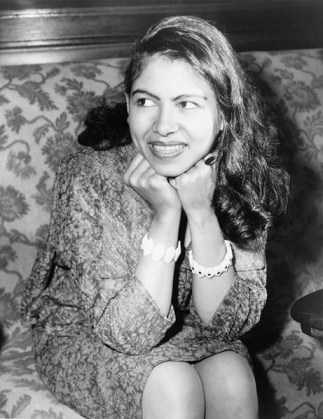
One of the most unusual and perhaps most tragic figures in American cultural history, Philippa Schuyler gained national acclaim as a child prodigy on the piano. Her picture graced the covers of weekly news magazines, and she was hailed as a young American Mozart. Schuyler’s life during adulthood, however, was a difficult one. She struggled with racial discrimination and with issues related to her mixed-race background, traveling the world in an attempt to find not only musical success but also an identity and a place in the world. She turned to writing in the early 1960s, visiting war zones as a newspaper correspondent, and she was killed in a helicopter crash in Vietnam in 1967. After her death she was mostly forgotten for several decades, but her life story was told in a 1995 biography.

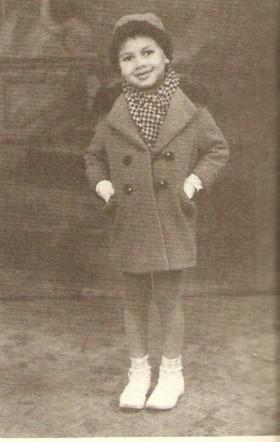
Philippa Duke Schuyler was born on August 2, 1931, in New York and brought up in Harlem at the height of the area’s cultural flowering. The complexities of her life began with her background, for she had two singular parents. Her father George Schuyler was a journalist who wrote for one of the leading black newspapers of the day, the Pittsburgh Courier, and he was well acquainted with numerous writers in both black and white journalistic circles. He was not a civil rights crusader like many of his Harlem contemporaries, but rather a conservative satirist who rejected the idea of a distinctive black culture and later in life joined the ultra-right-wing John Birch Society. Philippa Schuyler’s mother, Josephine Cogdell Schuyler, was a white Southern belle from a Texas ranch who had married George Schuyler after coming to New York to escape a wealthy family of unreconstructed racists. They all refused to attend concerts Philippa Schuyler gave in Texas at the height of her fame.

Schuyler’s parents were in the grip of several novel theories and fads, some of which they devised themselves. They fed Philippa raw vegetables, brains, and liver, believing that cooking leached vital nutrients out of food. And, in contrast to the now-discredited but at the time widely held belief in eugenics, which formed the basis for Nazi ideas of racial purity, they claimed that racial mixing could produce a superior “hybrid” sort of human. That notion had strong effects on Philippa Schuyler’s life, for the Schuylers planned to make their daughter into Exhibit A for the gains that could be realized from black-white intermarriage.

And, indeed, the plan seemed to work. Schuyler walked before she was a year old, was said to be reading the Rubaiyat poems of Omar Khayyam at two and a half, and playing the piano and writing stories at three. When she was five, Schuyler underwent an IQ test at Columbia University; it yielded the genius-level figure of 185. She made rapid progress on the piano, and due to Mr. Schuyler’s connections it wasn’t long before stories about Philippa began to appear in New York newspapers.


Schuyler’s mother, described by the New York Times as “the stage mother from hell, blending a frustrated artist’s ambition with an activist’s self-righteousness,” started to enter her in musical competitions. Schuyler did spectacularly well and was a regular concert attraction by the time she was eight. Just short of her ninth birthday, New York mayor Fiorello LaGuardia named a day after her at the New York World’s Fair. But her childhood was an isolated one; she was taught mostly by private tutors and had no friends her own age. Her mother, who fired her piano teachers whenever she began to get close to one emotionally, beat her regularly.

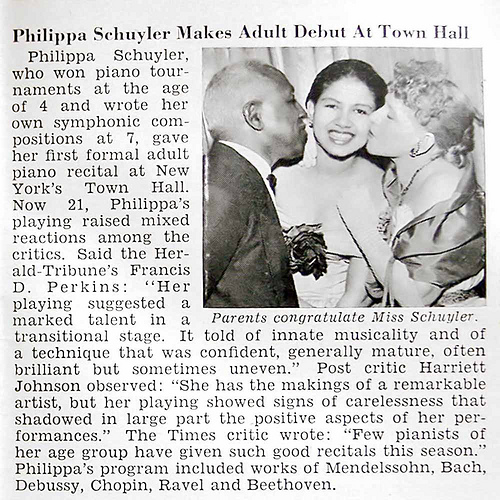
For a period of time during World War II, Schuyler was a national child star. She wrote a symphony at age 13, and leading composer and critic Virgil Thomson pronounced it the equal of works that Mozart had written at that age after the New York Philharmonic performed it in 1945. A concert Schuyler performed with the Philharmonic soon after that was attended by a crowd of 12,000, and profiles of the attractive teen appeared in Time, Look, and The New Yorker. Schuyler was promoted by the black press in general, not just in her father’s Pittsburgh Courier, as a role model, and she certainly inspired a generation of black parents to sign their kids up for piano lessons.

But there were pitfalls ahead for the talented youngster. When she was 13, she discovered a scrapbook her mother had kept of her accomplishments, and more and more she began to feel like an exotic flower on display. On tour, especially in the South, she began to experience racial prejudice, something of which she had been mostly unaware during her sheltered upbringing. Bookings began to dry up, except in black-organized concert series. Observers have offered various explanations as to why. Schuyler herself and many others pointed to discrimination; the world of classical music has never been a nurturing one for African-American performers, and in the 1940s very few blacks indeed had access to major concert stages. Some felt that Schuyler’s playing, although technically flawless, suffered from an emotionless quality brought on by the strictures of her demanding life. And Schuyler faced a problem she had in common with other teenage sensations—the tendency of the spotlight to seek out the next young phenomenon.

Though Schuyler briefly fascinated the nation as a mulatto child prodigy, white America lost interest in her as she aged.

Schuyler and her mother reacted by once again calling in George Schuyler’s connections; he had friends in Latin American countries, and Schuyler began to give concerts there. In 1952 she visited Europe for the first time. Schuyler enjoyed travel, and, like other black performers, found a measure of unprejudiced acceptance among European audiences. Over the next 15 years she would appear in 80 countries and would master four new languages, becoming proficient enough in French, Portuguese, and Italian that she could write for periodicals published in those languages. She traveled to Africa as well as Europe, performing for independence leaders such as Kwame Nkrumah in Ghana and Haile Selassie in Ethiopia—but also passing for white in apartheid-era South Africa. Schuyler began to resist the pressure that still came from her parents, but she remained close to them, writing to her mother almost daily and becoming their chief means of financial support.

Her income came not only from music but also from lectures she gave to groups such as the virulently anti-internationalist John Birch Society, for Schuyler had come to share her father’s conservative politics. Despite her performances in newly independent African capitals, she came to adopt a positive outlook on European colonialism.

Confused and fearful about the future, Schuyler took steps in two new directions. First, since her ethnic identity seemed uncertain to those who had never encountered her, she began in 1962 to bill herself as Felipa Monterro or Felipa Monterro y Schuyler. She even obtained a new passport in that name. Her motivation seems to have been split between a desire to have audiences judge her without knowing of her African-American background, and a broader renunciation of her black identity. The ruse convinced audiences for a time, but the reviews of her concerts were mixed, and she soon abandoned the effort.

Second, Schuyler began to write. Traveling the globe, she filed stories from political hot spots for United Press International and later for the ultraconservative Manchester Union Leader newspaper in New Hampshire.  She wrote several books and magazine articles as well, and at her death she left several unpublished novels in various stages of completion. One of them evolved into an autobiography, Adventures in Black and White, which was published in 1960.

She traveled to Vietnam to do lay missionary work, supporting U.S. military action there and writing a posthumously published book about American soldiers, Good Men Die. She founded an organization devoted to the aid of children fathered by U.S. servicemen, and on several occasions she assisted Catholic organizations in evacuating children and convent residents from areas of what was then the nation of South Vietnam as pro-North Vietnamese guerrillas advanced. It was on one of those evacuation missions, on May 9, 1967, that Schuyler’s helicopter crashed into Da Nang Bay. She drowned, for she was unable to swim. Shortly before her death, she had written a letter that seemed to suggest a political change of heart, expressing sympathy with black activist leader Stokely Carmichael.

Schuyler’s funeral was held at New York’s St. Patrick’s Cathedral, and in death she was once again in the headlines. Two years after her death, Schuyler’s mother hanged herself in her Harlem apartment. A New York City school was named after Schuyler, but her name dropped into temporary obscurity. She became better known with the publication in 1995 of Composition in Black and White: The Life of Philippa Schuyler, a biography by Kathryn Talalay. In 2004, star vocalist Alicia Keys was signed to portray Schuyler in a film co-produced by actress Halle Berry. “This story is so much about finding your place in the world,” Keys told Japan’s Daily Yomiuri newspaper. “Where do we really fit in, in a world so full of boxes and categories?”

SOURCE