yesterday’s history

When I started reading this article I thought, “This is about to be some ‘tragic mulatto’ b.s.”  Much to my surprise, it isn’t really.  I think Sarah played the part of the tragic mulatto very well, and got exactly what she wanted and deserved.  I wonder if the congregation’s response would have been different if “Pinky” hadn’t been quite so pink, but maybe “Brownie” instead.  Just a thought.  I also like this piece of our history because once upon a time, in a former life in which I considered myself black, I was a nanny and I worked in Brooklyn Heights and I walked by that church every day and was very drawn to it.  Part of me knew… And part of me was so clueless.

On This Day in History: June 1
Rev. Beecher’s Freedom Auction

by Vernon Parker

VIA

On June 1, 1856, Henry Ward Beecher, minister of Plymouth (Congregational) Church, and an ardent supporter of the antislavery cause, held a public “auction” of a young mulatto slave named Sarah to dramatize the evils of slavery.

The Brooklyn Daily Eagle reported that “she had been brought from a plantation near Staunton, Virginia.” When Sarah was called to the pulpit, she … “walked slowly, head bowed, and took a seat near the famous minister. She lifted her eyes, stared at the spellbound audience, and burst into sobs. Her plight tugged at the heart of the most stolid Congregationalist as Beecher’s inflamed rhetoric described her life. Daughter of a well-known white citizen, she had been put up for sale by her own father. The slave dealer involved contacted Beecher through a mutual friend and they struck a deal allowing Sarah to go north with the promise of either her return or the full manumission fee.”

The mock auction raised sufficient funds to purchase her freedom and buy her a modest home in Peekskill, New York.

The following is an excerpt from James H. Callender’s book Yesterdays on Brooklyn Heights: “As the anti-slavery agitation increased, Mr. Beecher thundered his invectives against the slave-owners of the South, and many of the leading men of his church were said to be directors of the famous ‘Underground Railroad’ by which fugitive slaves were passed along from the South across the border to Canada. It was at the close of one of his most powerful sermons that Mr. Beecher said he had a little matter he wished to present to the congregation. No one had any idea as to what he was going to say and the people waited in profound silence.

“He then suddenly burst forth, ‘Sarah, come up here!’ As the audience gazed, a little mulatto girl arose in the body of the church, ran up the pulpit steps and took Mr. Beecher’s hand. Turning to the assembled multitude, he said — ‘This little girl is a slave, and I have promised her owner $1,200, his price for her, or she will be returned to slavery. Pass the baskets.’ A scarcely stifled sob arose from the almost three thousand present. Bills of all denominations, jewelry, and watches and chains were flung in the overflowing baskets and when the total was counted, Mr. Beecher announced, amid thunders of applause, that Sarah was free, and enough remained to strike the shackles from the limbs of several others.”

A tintype of Sarah, also known as “Pinky,” the young mulatto slave whose freedom was “auctioned” by Rev. Henry Ward Beecher.

curly like me

It’s here!  The answer to our curly-headed prayers.  I’ve been referring people to Teri LaFlesh’s website for over a year now, and am thrilled to be able to point my fellow biracials, parents of mixies, and anyone else with a “wild” mane to her book Curly Like Me.  Teri was kind enough to send me an advanced copy so that I could write a blurb.  Here’s what I wrote…

“With Curly Like Me, Teri LaFlesh has provided us curly heads with THE Bible of hair care for our tightly curled manes.  If you thought your (or your child’s) hair was hard to manage, Teri will prove you wrong.  After suffering through relaxers, jheri curls, texturizing, dreadlocks, weaves, and extensions, Teri stopped fighting against her curls and embarked on a journey to embrace them.  The results are stunning!  Teri discovered a simple, easy to follow technique that produces healthy, happy, beautiful curls freeing us from chemicals, heat, and perpetual ponytails.  She’s layed it out step by step, providing us with the do’s, the don’ts, and even the why’s!  A more thorough hair care manual we could not ask for.  Perhaps even more momentous though is the journey toward self acceptance that lies in the pages of the book.  It seems as though Ms. LaFlesh learned that what happens when we try to make our hair into something that it is not, is a mirror of what happens when we try to make our SELF into something that it is not.  Curly Like Me is also about embracing every aspect of one’s authentic self. That beautiful and unique being that the world will not be able to experience if we waste our energy fighting against it in hopes of conforming to that which we’re told every day on television, in magazines, and in the movies is ‘normal’ and ‘good.’  The struggle against the “real” hair becomes symbolic of the inner struggle against the real self.  Teri says, ‘I treated my curls as if they weren’t good enough in their natural state.  Yet after all I had done to them they, couldn’t be crushed.’  The same can be said of the human spirit.  Thank you, Teri!!”

so, if you’d like your (or your child’s) hair to look like this someday….

…go buy this book!!  You can get it HERE.

black polish virtuoso

Rita Dove has done us a great service by painstakingly digging up this forgotten history.  Like most people, I had never heard of Bridgetower before Sonata Mulattica popped up in a random google search.  What a fascinating story!  I imagine it was not only challenging, but exciting to imaginatively fill in the blanks of this discarded musicians unique experience.  I would like to know more about his parents.  How they met, how an interracial relationship was received in Poland circa 1780, if he considered himself a mulatto or if there was a one-drop kind of mentality.  I guess I’ll have to read the book to find out what insight Dove’s years of research led her to deduce about those race issues.

More than her standing as former US Poet Laureate, Pulitzer Prize winner, and Possibility Poet it is Dove’s own family that (in my opinion) makes her a perfect and trustworthy candidate to bring us this story:

Rita Dove and her husband Fred Viebahn, with their newborn daughter, Aviva, in Tempe, Arizona, January, 1983.

Rita Dove and her husband Fred Viebahn, with their newborn daughter, Aviva, in Tempe, Arizona, January, 1983.(© Fred Viebahn)

Rita Dove’s gorgeously engaging ‘Sonata Mulattica’ weaves the narrative of a black virtuoso all but erased from musical history.

By: Teresa Wiltz

Via: The Root

Way, way back in the day, there was an Afro-Polish violinist, a biracial child prodigy of such virtuosity that even Beethoven felt compelled to dedicate a sonata to him. There were honors and accolades and patronage from a prince.

But fortunes changed, as poet laureate Rita Dove describes in her novel-sized book of poems, Sonata Mulattica: A Life in Five Movements and a Short Play. The violinist, George Augustus Polgreen Bridgetower, and his composer, Ludwig van Beethoven,  performed the sonata together to thunderous acclaim.

The goodwill between them evaporated as the two quarreled over a woman. Beethoven furiously erased Bridgetower’s name and scribbled the name of another violinist when he dedicated the sonata.

That is how the “Sonata Mulattica” became the “Kreutzer Sonata,” one of Beethoven’s most famous works. Through that one fit of jealous retribution, Beethoven wrote Bridgetower out of history.

The Polish black virtuoso, once famous, now forgotten.

This bright-skinned papa’s boy

could have sailed his 15-minute fame

straight into the record books.

Dove first heard about Bridgetower years ago, when she was a musician studying the cello, and later, opera. It wasn’t until she saw Immortal Beloved, a film about Beethoven, that it triggered her memory. Fascinated with the thought of a mixed- race musician in 19th century Europe—“I thought there was more to it than this exotic creature who played the violin”—Dove set out to find out more about him. For five years, she researched and wrote, digging up little nuggets along the way, tucked in letters and diaries, like that of court lady Charlotte Papendiek, and in what little historical accounts she could find.

“It was like tracking the coordinates of some meteor,” Dove says. “ ‘Oh, he went there; he appeared here,’ mapping the trajectory of his life. Other than that, he was a blank slate.”

A blank slate onto which she poured all her imagination and musings about race and class and sexual competition. Bridgetower, the son of a self-proclaimed “African prince” and a Polish-German woman, was born in Poland in 1780. As it happened, his father, who was a bit of an operator, was working in the castle of the Hungarian Prince Esterházy, where Joseph Haydn worked as a musical director.

Even as a very young child, Bridgetower dazzled on the violin; Haydn took him under his wing. Later, Bridgetower traveled from Vienna to London, where he attracted the attention of the Prince of Wales, who would later become Kind George IV.  His was a life of comfort, adulation and high achievement. (He eventually received a degree from Cambridge University.)

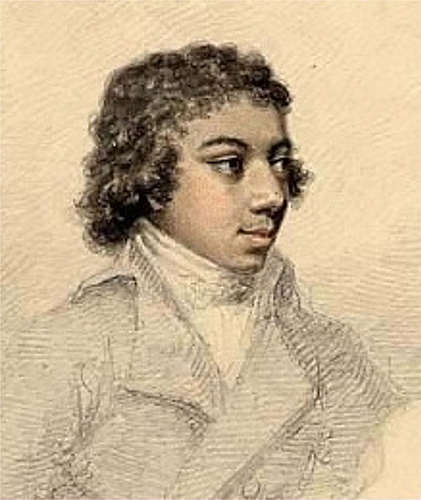
Bridgetower, George Augustus Polgreen, 1780-1860.  His passport, obtained in Dresden, 27 July 1803, portrayed him as being of average height, beardless with dark brown hair and eyes, with a broad nose and swarthy complexion. Friends added that he was melancholic and discontent.

At the time, there were a good number of free blacks living in London, says Dove, who won the Pulitzer Prize in 1987. Some were Africans who’d never been enslaved; some were slaves who’d been freed. Class, rather than race, circumscribed one’s lot. So for a black boy with a knack for playing the violin, a child prodigy with a powerful patron, life was considerably sweeter than that of, say, Black Pearl, the young black servant in Dove’s book.

Pathological hit of the day: n****r on a golden chain.

Metaphorically, that is. The African

valet, the maidservant black

as aces in a hole….

Sonata Mulattica is a gorgeously engaging read, utilizing a mix of poetic styles, from nursery rhymes to free verse, until the narrative arc sweeps into the big confrontation between Bridgetower and Beethoven. At that point, the action shifts from poem to play, a play with a distinctly vaudevillian sensibility, complete with baudy references to Othello. Bridgetower becomes a rapping, preening braggadocio:

But I’m a natural man, born under a magical caul,

I’m that last plump raisin in the cereal bowl;

I’m the gravy you lick from your mashed potatoes,

I’m creamier than chocolate, juicier than ripe tomatoes!

But Beethoven soon brings him down to size:

Now you will taste the high price

Of my affection—“Mulatto Sonata,” indeed!

I would sooner dedicate my music

To a barnyard mule

If the two men had not quarreled, two egos run amok, would musical history have been different? Would, we find, as Dove writes, “rafts of black kids scratching out scales on their matchbox violins so that some day/they might play the impossible:/ Beethoven’s Sonata No. 9 in A Major, Op. 47/Also known as The Bridgetower”?

We will, of course, never know.  Still, it’s nice to imagine the possibilities of what could have and should have been.

Teresa Wiltz is The Root’s senior culture writer.

we want to look related

..but sometimes we don’t.  Or we do, but people can’t see it because of that skin color, hair color, eye color thing.  I don’t think looking alike means being the same shade.  Shapes are involved too.  That we toss all of our kindergarten training aside to rely solely on hue when it comes to this kind of thing is a symptom of this disease I’ll call colorism.  A descendant of our old friend racism.  Needless to say, I like this piece because it points all of that out.

Who does your baby look like?

BY AISHA SULTAN

ST. LOUIS POST-DISPATCH

I remember glancing into a bathroom vanity a few years back and doing a double take.

In the dim light, I could have sworn I saw my mother’s face staring back at me. It was her slightly curved nose, her oval face and heavy eyelids. What could have been an unwelcome reminder of aging instead took me back to my childhood. I remember watching intently, enamored by her face, as my mother applied her makeup for parties.

A homely sort of child, no one ever told me I looked like her when I was young.

Nonetheless, I was still stunned when the doctor handed me my newborn daughter. She looked nothing like me.

Perhaps we expect to replicate ourselves, at least to some degree. Her hair was much lighter than my black locks. Her skin was considerably paler. She looks so much like her paternal grandmother, Georgia Kelley, a Midwestern woman of European descent.

This baby girl looked just like her father, a product of a biracial marriage himself.

One visitor tried to tell me that all newborns resemble their fathers initially. It’s an evolutionary adaptation to reassure dad that he’s actually the daddy.

Dr. Alan Templeton, professor of genetics at Washington University School of Medicine, says he hasn’t ever seen any scientific research supporting that theory.

“I’m actually very skeptical of it,” he said. But, there is plenty of research on organisms, including humans, showing that they rely on resemblances as part of kin recognition. And, we treat those we recognize as kin differently than nonkin, he said.

“This is evolutionarily quite old, and not unique to humans,” he said.

It made me wonder if we subconsciously favor a child who looks more like us?

My sisters joke that I look like my daughter’s Mexican nanny when we are out in public.

Like any biased parent, I think she’s beautiful. But I was tickled when our second child arrived with the exact same almond-shaped eyes as my entire family. He looks like a miniature version of my younger brothers. It’s a public display of genetic prowess: We won round two.

There must be a biological imperative involved. We are hardwired to want to pass along our own very special DNA. The crooked smile and hazel eyes are genetic affirmation.

Almost immediately after a child is born, speculation begins on who the child looks like. It’s one of the most popular topics of discussion as babies’ faces change so rapidly in those early years. And when we tell someone their child looks like them, the typical response is usually a big smile.

But in this age of increasingly biracial and multiracial families, cross-cultural adoption and fertility treatments with donor eggs or sperm, there will be more children who look strikingly different from their parents.

I’ve known a few white women who have married Pakistani men and subtly changed their appearance once their children were born. Typically, blond hair gets dyed a shade or two darker. They get tired of answering the question: “Is she really yours?”
We want to look related. We want outsiders to know we are on the same team, a family.

Parents who adopt children from another ethnicity deal with intrusive (and sometimes obnoxious) questions fairly regularly. Questions such as “How much did they cost? and “Why didn’t you adopt a white baby?” make the old jokes about the milkman seem downright charming.

One mom delights in telling the story of taking her adopted son, who shares her blue eyes and blond hair, to restaurants. She’s been told by bystanders: “Oh, there’s no mistaking he’s your son.”

She smiles and says: “You’re right.”

I’ve heard my share of awkwardly phrased questions when people see pictures of my children. Sometimes, they’ll ask: What is their father? I’m always tempted to answer by species rather than race. But, I know the subtext. Skin color, hair color, eye color — those primitive markers signify if you’re one of us or one of them.

That shorthand just doesn’t work as well in today’s world.

When people tell me my daughter looks just like me, I am secretly delighted even though I don’t buy it. But, there is a reason she frequently makes me want to pull my hair out: her stubborn personality, her passionately held opinions, the smart remarks and proclivity to collect mounds of clutter. Looks notwithstanding, she is a 7-year-old reflection of myself.

the gains to be realized from black-white intermarriage

What a life! From the seemingly extreme “Take that eugenics!”attitude of her parents, to the prodiginous achievements of her childhood, on to the “passing” years Philippa Schuyler’s story encompasses so many fascinating facets of the “biracial” experience of old.

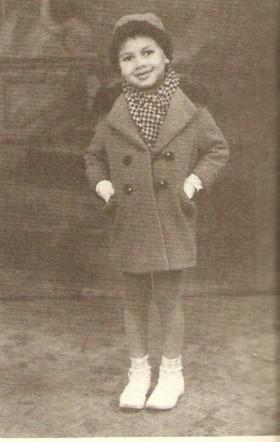
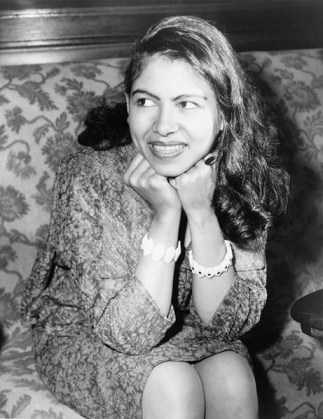
Philippa Schuyler

1931-1967

Classical pianist, writer

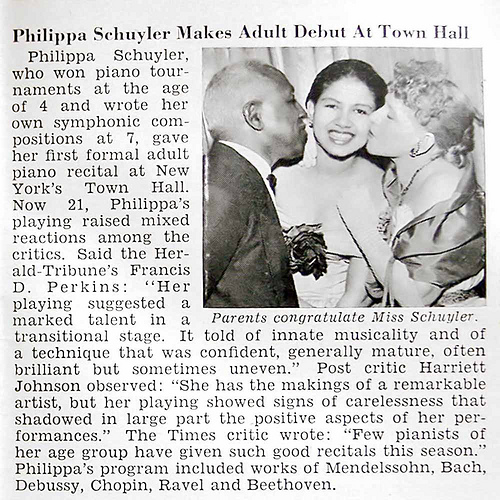
One of the most unusual and perhaps most tragic figures in American cultural history, Philippa Schuyler gained national acclaim as a child prodigy on the piano. Her picture graced the covers of weekly news magazines, and she was hailed as a young American Mozart. Schuyler’s life during adulthood, however, was a difficult one. She struggled with racial discrimination and with issues related to her mixed-race background, traveling the world in an attempt to find not only musical success but also an identity and a place in the world. She turned to writing in the early 1960s, visiting war zones as a newspaper correspondent, and she was killed in a helicopter crash in Vietnam in 1967. After her death she was mostly forgotten for several decades, but her life story was told in a 1995 biography.

Philippa Duke Schuyler was born on August 2, 1931, in New York and brought up in Harlem at the height of the area’s cultural flowering. The complexities of her life began with her background, for she had two singular parents. Her father George Schuyler was a journalist who wrote for one of the leading black newspapers of the day, the Pittsburgh Courier, and he was well acquainted with numerous writers in both black and white journalistic circles. He was not a civil rights crusader like many of his Harlem contemporaries, but rather a conservative satirist who rejected the idea of a distinctive black culture and later in life joined the ultra-right-wing John Birch Society. Philippa Schuyler’s mother, Josephine Cogdell Schuyler, was a white Southern belle from a Texas ranch who had married George Schuyler after coming to New York to escape a wealthy family of unreconstructed racists. They all refused to attend concerts Philippa Schuyler gave in Texas at the height of her fame.

Schuyler’s parents were in the grip of several novel theories and fads, some of which they devised themselves. They fed Philippa raw vegetables, brains, and liver, believing that cooking leached vital nutrients out of food. And, in contrast to the now-discredited but at the time widely held belief in eugenics, which formed the basis for Nazi ideas of racial purity, they claimed that racial mixing could produce a superior “hybrid” sort of human. That notion had strong effects on Philippa Schuyler’s life, for the Schuylers planned to make their daughter into Exhibit A for the gains that could be realized from black-white intermarriage.

And, indeed, the plan seemed to work. Schuyler walked before she was a year old, was said to be reading the Rubaiyat poems of Omar Khayyam at two and a half, and playing the piano and writing stories at three. When she was five, Schuyler underwent an IQ test at Columbia University; it yielded the genius-level figure of 185. She made rapid progress on the piano, and due to Mr. Schuyler’s connections it wasn’t long before stories about Philippa began to appear in New York newspapers.


Schuyler’s mother, described by the New York Times as “the stage mother from hell, blending a frustrated artist’s ambition with an activist’s self-righteousness,” started to enter her in musical competitions. Schuyler did spectacularly well and was a regular concert attraction by the time she was eight. Just short of her ninth birthday, New York mayor Fiorello LaGuardia named a day after her at the New York World’s Fair. But her childhood was an isolated one; she was taught mostly by private tutors and had no friends her own age. Her mother, who fired her piano teachers whenever she began to get close to one emotionally, beat her regularly.

For a period of time during World War II, Schuyler was a national child star. She wrote a symphony at age 13, and leading composer and critic Virgil Thomson pronounced it the equal of works that Mozart had written at that age after the New York Philharmonic performed it in 1945. A concert Schuyler performed with the Philharmonic soon after that was attended by a crowd of 12,000, and profiles of the attractive teen appeared in Time, Look, and The New Yorker. Schuyler was promoted by the black press in general, not just in her father’s Pittsburgh Courier, as a role model, and she certainly inspired a generation of black parents to sign their kids up for piano lessons.

But there were pitfalls ahead for the talented youngster. When she was 13, she discovered a scrapbook her mother had kept of her accomplishments, and more and more she began to feel like an exotic flower on display. On tour, especially in the South, she began to experience racial prejudice, something of which she had been mostly unaware during her sheltered upbringing. Bookings began to dry up, except in black-organized concert series. Observers have offered various explanations as to why. Schuyler herself and many others pointed to discrimination; the world of classical music has never been a nurturing one for African-American performers, and in the 1940s very few blacks indeed had access to major concert stages. Some felt that Schuyler’s playing, although technically flawless, suffered from an emotionless quality brought on by the strictures of her demanding life. And Schuyler faced a problem she had in common with other teenage sensations—the tendency of the spotlight to seek out the next young phenomenon.

Though Schuyler briefly fascinated the nation as a mulatto child prodigy, white America lost interest in her as she aged.

Schuyler and her mother reacted by once again calling in George Schuyler’s connections; he had friends in Latin American countries, and Schuyler began to give concerts there. In 1952 she visited Europe for the first time. Schuyler enjoyed travel, and, like other black performers, found a measure of unprejudiced acceptance among European audiences. Over the next 15 years she would appear in 80 countries and would master four new languages, becoming proficient enough in French, Portuguese, and Italian that she could write for periodicals published in those languages. She traveled to Africa as well as Europe, performing for independence leaders such as Kwame Nkrumah in Ghana and Haile Selassie in Ethiopia—but also passing for white in apartheid-era South Africa. Schuyler began to resist the pressure that still came from her parents, but she remained close to them, writing to her mother almost daily and becoming their chief means of financial support.

Her income came not only from music but also from lectures she gave to groups such as the virulently anti-internationalist John Birch Society, for Schuyler had come to share her father’s conservative politics. Despite her performances in newly independent African capitals, she came to adopt a positive outlook on European colonialism.

Confused and fearful about the future, Schuyler took steps in two new directions. First, since her ethnic identity seemed uncertain to those who had never encountered her, she began in 1962 to bill herself as Felipa Monterro or Felipa Monterro y Schuyler. She even obtained a new passport in that name. Her motivation seems to have been split between a desire to have audiences judge her without knowing of her African-American background, and a broader renunciation of her black identity. The ruse convinced audiences for a time, but the reviews of her concerts were mixed, and she soon abandoned the effort.

Second, Schuyler began to write. Traveling the globe, she filed stories from political hot spots for United Press International and later for the ultraconservative Manchester Union Leader newspaper in New Hampshire.  She wrote several books and magazine articles as well, and at her death she left several unpublished novels in various stages of completion. One of them evolved into an autobiography, Adventures in Black and White, which was published in 1960.

She traveled to Vietnam to do lay missionary work, supporting U.S. military action there and writing a posthumously published book about American soldiers, Good Men Die. She founded an organization devoted to the aid of children fathered by U.S. servicemen, and on several occasions she assisted Catholic organizations in evacuating children and convent residents from areas of what was then the nation of South Vietnam as pro-North Vietnamese guerrillas advanced. It was on one of those evacuation missions, on May 9, 1967, that Schuyler’s helicopter crashed into Da Nang Bay. She drowned, for she was unable to swim. Shortly before her death, she had written a letter that seemed to suggest a political change of heart, expressing sympathy with black activist leader Stokely Carmichael.

Schuyler’s funeral was held at New York’s St. Patrick’s Cathedral, and in death she was once again in the headlines. Two years after her death, Schuyler’s mother hanged herself in her Harlem apartment. A New York City school was named after Schuyler, but her name dropped into temporary obscurity. She became better known with the publication in 1995 of Composition in Black and White: The Life of Philippa Schuyler, a biography by Kathryn Talalay. In 2004, star vocalist Alicia Keys was signed to portray Schuyler in a film co-produced by actress Halle Berry. “This story is so much about finding your place in the world,” Keys told Japan’s Daily Yomiuri newspaper. “Where do we really fit in, in a world so full of boxes and categories?”

SOURCE

further the cause, fill out the survey

My friend Naehalani is conducting two studies on biracial identity for her Senior Thesis.  Yay!  If you have a moment, and are biracial, you can help her with the project by filling out the survey and emailing it to her.  I did.  Just click on “Biracial Survey” and the document should download to your computer.  Open it and answer away.  Instead of circling the most accurate choice for me, I typed my answers in after the questions.  It really did take 5 minutes.  Maybe less.

Naehalani(far left) and her siblings

From Naehalani:

Hello to all!

I need your help!  My name is Naehalani Breeland and I am biracial,
mixed with Hawaiian and Caucasian.  Having grown up predominantly with
my Hawaiian mother in both Hawaii and on the mainland… (and being
strongly influenced by both my Hawaiian culture and mainstream
American culture) I have come to identify as mixed race/biracial.
More and more we are seeing biracial and multiracial individuals speak
out about our unique identity development, juggling identities and so
forth.  So, for my Senior Thesis in psychology at Eugene Lang College
in New York City, I am conducting two studies on biracial identity and
I am asking you all to participate in these studies by filling out the
surveys below.  While this is helping me to graduate (fingers
crossed), it is also helping all of us to inform others on our
biracial/multiracial experiences.

For confidentiality purposes, you can email your completed survey to
me at breelj73@newschool.com or naehalanibreeland@gmail.com.
• Open the word document below
• Fill out the survey
• Save the completed document as CompletedBISurvey and the time (ex:
CompletedBISurvey10:31am) so that I can differentiate them
• Email it back to me.
The survey will take approximately 5 minutes! So quick and easy!  And
again, all the information will be confidential.

Biracial Survey

Also, if any of you are part of a biracial family in which you and
your siblings vary in skin tones please email me!  As an individual
coming from a family of all different skin variations, I have found
that my siblings and I often have different experiences in our
everyday life, and therefore we have also had a different identity
development. Sooo, my second study is on how society and family affect
the growth and perception of biracial individuals when their siblings
are of different skin tones. Basically it is about how we learn who we
are through others’ influence.  This is a small population, I
know…which is why I need all the help I can get from you!

the twins: Naehalani’s niece and nephew

I really really really appreciate your participation in advance.  It’s
helping me more than you all could imagine!!!

Take Care and have a wonderful day!

Naehalani Breeland

you’re not adopted

Wow, what a story!  While I think that Mrs. Brannigan’s choice to feign adoption in order to keep her own son is a sad commentary on black/white race relations, I honestly admire her commitment to her child and think her solution was clever.  This certainly is a unique story of “transracial” “adoption”.

Torment of the child from a mixed- race affair

By Ronan Lang

Tim Brannigan likes to say that he was born on May 10, 1966, and that he died the same day too. Minutes after his birth, Tim was ferried away from his mother Peggy, who subsequently told her own parents, siblings and her three other children that her baby had died in childbirth.

For the next five days in Templemore Hospital in Belfast, Peggy Brannigan had one ashen-faced visitor after another express their deepest condolences for her loss while, just a few doors down, her baby gurgled and cooed away like any healthy newborn.

The reason for the deception was that Peggy was a white woman married to a white man, and her new son was black. During a difficult period in her relationship with her husband Tom, Peggy had met and had a brief affair with a Ghanaian doctor named Michael Euke.

When she became pregnant, Peggy panicked and told her husband that she had been raped.

When the baby was born, Tom went along with the charade. Somehow, Peggy also convinced the hospital staff to assist in her scheme. The plan was for Tim to be smuggled to an orphanage under strict instructions that he was not to be adopted.

Peggy needed time and headspace to figure out what to do, but the plan was eventually to ‘adopt’ her own son. To her credit, by the time of Tim’s first birthday, he was living with his family deep in the heart of the Falls Road.

EastEnders scriptwriters would throw out that idea for being too far-fetched, but it’s all true, and laid out in honest, mind-boggling detail in Tim’s new book, Where Are You Really From?

Speaking to Weekend on a recent visit to Dublin, Tim recalls the night that his mother finally confessed the truth to him.

“I was 19, and I remember it was the night before Live Aid,” he says. “We were at a family function, and we’d both had a few drinks. She was saying how she wanted me to travel and see the world. Then, out of the blue, she said, ‘Timothy love,I’ve something to tell you. I’m your real mum and you are my son. You’re not adopted’.”

It’s a bombshell by anyone’s standards, but Tim, astoundingly, managed to take the news in his stride. He remembers crying, but from happiness.

“Honestly, I found it relatively easy to process,” he explains. “At that stage, my relationship with her was already quite established. I viewed her naturally as my mother. I didn’t call her by her first name, I called her mum, and I was closer to her than most of my other brothers. It all just seemed right to me.”

Having had years to absorb the story, and the chance to revisit his origins through writing the book, Tim says that he understands his mother’s desperate motivations after he was born. “I think she was very proud, and was part of a culture of looking out the net curtains and judging others,” he says.

“Because her family were close to the Catholic Church, and they had a little bit of money, she couldn’t bring herself to tell her parents and it became this massive burden. I think mentally she let this secret get out of all proportions. Even after she told me in 1985, I wasn’t allowed to tell my two eldest brothers the truth. They only found out in the last decade.”

Peggy went on to tell Tim about his real father, who had refused to support Peggy and had only ever seen his son once as a toddler. Nevertheless, Peggy seemed to want Tim to find out more about his father.

“She wanted me to be excited about having this father all of a sudden, but I had no initial desire to meet him,” Tim says.

It would be almost 20 years before Tim finally did meet him. In the meantime, Tim completed a degree in politics at Liverpool Polytechnic, but it was the explosive politics in his native town that were to define his 20s and 30s.

…Surprisingly, Tim reveals that the most sustained racism he ever encountered in his life didn’t come from his neighbours on the Falls Road, schoolmates, Republican comrades or Loyalist foes, but rather from the British Army — even its black members.

“I think I escaped the worst aspects of any racism because Belfast was so conflicted,” he says. “The last thing the British Army were expecting to see was a black kid, so they’d be shouting things like ‘black bastard’, ‘nigger’ and ‘go back to the jungle’. But people on the street would then say, ‘Don’t listen to them Tim, ignore them’, and so I became ‘one of us’ and the soldiers were ‘them’.”

… Sadly, his mum’s health took a turn for the worse in October 2002 and, for the best part of two years, Tim nursed her until she died from a brain tumour in March 2004. With his mother’s wishes in mind, Tim decided to track down his father three years ago as part of a BBC Radio documentary.

“Even after all his messing around, my mum held him in high esteem,” Tim says of his father. “Whereas I was more cynical about him. I was like, ‘Why would I want to track him down? He knows where I am, and he’s never bothered. He’s clearly made his decision.’

“My mum wanted me to do well, and I think she wanted to say to him, ‘Look what I did with our son on my own’. So I started with a view to saying, ‘I’ve been through a lot, but I’m still standing; this is who I am; this is what’s happened to me’.”

It’s a journey that brought Tim as far as Ghana to eventually meet his birth father. Along the way, Tim discovered that he had five brothers and sisters on his father’s side, many of whom live in London. After showing initial enthusiasm towards Tim, they have since cut off contact. They’re likely taking the cue from their father.

“He’s a very successful, quite wealthy guy in Africa,” Tim explains. “Money doesn’t motivate me, but they might think I’m after something.”

Tim met with his father a few times during the documentary trip to Ghana. “It was pretty awkward and stilted,” he recalls. “He’s a man who seems to be able to compartmentalise his life. His wife, as far as I know, to this day doesn’t know about me. We met a few times for a drink, but it was clear he didn’t want me around. He was determined to keep me away from his house and the rest of the family.”

The last time they spoke, or had any contact, was by text and an argumentative phone call over Christmas 2008. Now that his story is out in print, there could be a chance of reconnecting, but Tim isn’t going to hold his breath.

“I think a couple of them are on Facebook so I probably will message them to say, ‘Brace yourselves’,” he says with a smile.

So has Tim dealt with what must be deep disappointment, and made peace with the fact that any kind of relationship with his father and half-siblings looks unlikely?

Tim smiles and pauses before replying: “There are issues … in my quiet moments. I find myself thinking, ‘What if?’, or, ‘Will I try again?’

“It’s still a bit of an emotional maelstrom, but what can I do? Maybe they’ll read this and change their opinions.” He pauses again before continuing: “I guess it comes back to what a social worker warned me when I first started looking for my father. She said, ‘If you don’t want to hurt anyone, then turn around now and don’t do it. Someone always gets hurt’.”

Where Are You Really From? by Tim Brannigan is out now, published by Blackstaff Press, €13

– Ronan Lang

read the rest @ Irish Independent

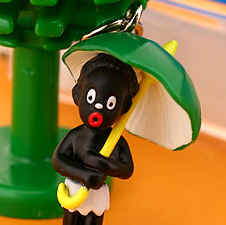
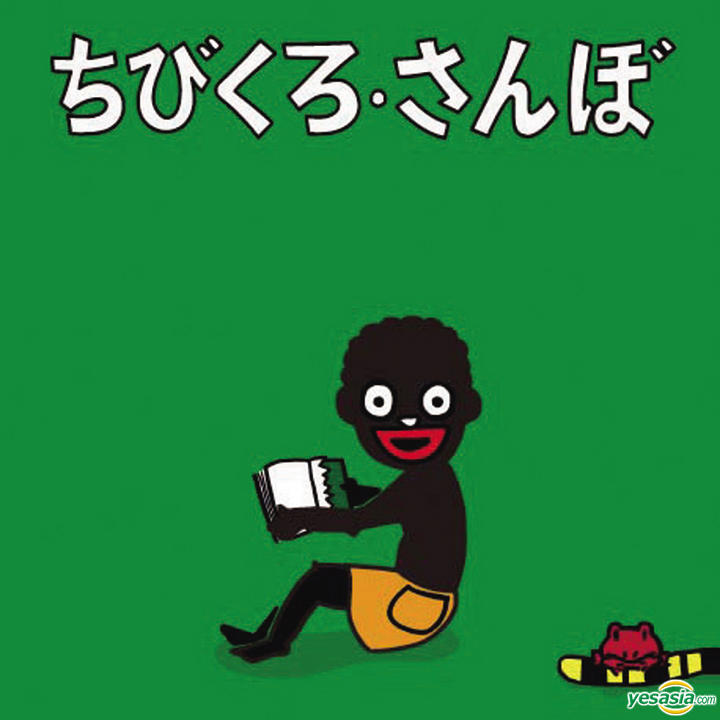
little. black. sambo.

For someone who has a romanticized view of Japan as a near-perfect country/society, this is quite disappointing.  It’s not the first I’ve heard of Japanese insensitivity to stereotypes of African-Americans, and I hope that’s all it is.  Insensitivity.  Oh, Japan.

Little Black Sambo Comes to A Japanese Kindergarten

By Geoff Dean

The end of the last year of kindergarten and/or nursery school in Japan usually features a school play. My elder daughter played Toto in a very loosely arranged “Wizard of Oz” (there were two other Toto`s and all the boys were flying monkeys, meaning there was no scarecrow or tin man) while my younger one recently took a shot at “Alice in Wonderland” in a form probably unrecognizable to Lewis Carroll.

So when a nursery school in Saitama ran a school play, it was nothing out of the ordinary. There were songs, cute costumes, dancing, and kids who cried when the couldn`t remember their lines. Pretty much par for the course. Except that the school play was “Little Black Sambo”.

The Midori (Green) Nursery School of Tokorozawa, Saitama Prefecture (about an hour northwest of Tokyo) might have escaped notice if one concerned parent of a biracial child who attended the school, had not posted the play`s contents to Facebook. On questioning, a teacher at the school admitted reading the controversial book to the kids in her charge and arranging the school play based on the book. She said the kids “all” loved the book and found it very “cute”. The children even sang a ditty she wrote that was translated as “Little Black Sambo, Sambo, Sambo. His face and hands are completely black. Even his butt is completely black.”

This is not the first time that the racial insenstivity of Japan has gotten them in trouble. A few years back, a toothpaste brand called “Darkey” featured a grotesque picture of a person of color with hugely oversized lips and glowing teeth, the implication apparently being that this toothpaste would make your teeth as shiny as those of a “darkey”. It was ultimately pulled from the shelves but not without much consternation. Many Japanese friends asked me what all the fuss was about.

Another involved the drink Calpis which is sold as Calpico is the states. The carton of the drink featured a “minstrel Al Jolson-style” black faced person with a top hat and the proverbial oversized lips. It was also eventually withdrawn.

I am especially concerned that “Little Black Sambo” was performed in a school where a biracial child was in attendance. How was he/she expected to feel? Did the teacher even consider that? I rather doubt it.

Still, the problem in my view ultimately stems from the lack of exposure and contact (deep, not superficial) that Japanese people have with the outside world. Traveling to and shopping in Guam and Hawaii does not equal “cultural sensitivity.” Especially in rural areas like Saitama, the idea that some might find “Sambo” offensive has never sunk in. But then again, when we have a governor of Tokyo like Shintaro Ishihara who constantly blames the rise of crime on foreigners and especially the Chinese, despite reams of data to the contrary, what can be expected?

Now, as for homphobia, ageism, sexism and glorification of the abuse of women in Japanese media….OK, don`t get me started already!

SOURCE

The facts that the story is read at the school and that this “play” was performed are disheartening, but it gets worse!  The parents of the biracial child complained.  Big time.  And yet the school refuses to remove the book from the classroom, or to stop the children from singing the offensive ditty.  I found this letter detailing the fallout after the performance on BlackTokyo.com.

Dear Black Tokyo,

I would like to bring the following matter to your attention.

A daycare center named Midori Hoikuen (みどり保育園), or Green Daycare Center, in Tokorozawa City in Saitama Prefecture, located just 30 minutes by train from Ikebukuro station in Tokyo, has been teaching hate speech to three-year old children daily, despite the protests of the parents of at least one biracial child in the class.

http://tinyurl.com/yz8ht6m

Although technically a private institution, the parents were originally instructed by the city of Tokorozawa that their child would have attend daycare there.

During the two years that the child has attended the daycare center, the parents had never once voiced a single concern about the operation of the daycare center until much to the their shock, the daycare center based a play / musical to be performed on Saturday, February 27th, 2010, on the book Little Black Sambo:

http://tinyurl.com/2xgvg8

This is the very same book that several Japanese publishing companies had stopped printing due to public outrage in 1988. When the book was reprinted by one rogue publisher in 2005, many residents of Japan–foreign and Japanese–signed a petition encouraging the publishing company to use a different title and illustrations for the book due to their offensive nature:

http://www.debito.org/chibikurosanbo.html

Unfortunately, now that the book Little Black Sambo has been republished and widely distributed in Japan, it is apparent that the book is now being taught at Japanese daycare centers and quite possibly preschools and elementary schools across the country as well. At least two additional volumes of the book have also been printed by the same rogue Japanese publishing company.

…Here is a quick translation of some of the frightening lyrics from the song the children are being taught to enjoy singing daily at the daycare center in Tokorozawa:

“Little Black Sambo, sambo, sambo
His face and hands are completely black
Even his butt is completely black”

Obviously, that kind of speech should never be taught to children by teachers at a daycare center. Those words are more akin to what might be taught by a white supremacist group.

Apparently, the book they daycare center is using even comes complete with demeaning pickaninny images.

Now every time the 3-year old biracial child sees a black person he starts using the racial slur and mentions their black skin. The parents now fear taking their own child out in public or overseas. As the child is of such a young age, it also is not effective for the parents to tell the child not to use those derogatory words outside of daycare, as the child will only use them more.

In an attempt to be as understanding of cultural differences, as it was possible that perhaps the daycare center teachers were just not aware of the problems with the book, the parents of the biracial child both wrote letters in Japanese explaining the history of the book, why the title was discriminatory, and mentioning that they thought that illustrations showing demeaning racial stereotypes were not appropriate for young children.

The parents even showed the teachers that the term “sambo” was offensive and derogatory, both in English and in Japanese.

Beside being used as a disparaging reference to black people, the English dictionary makes it clear that the word is also used to refer to people of “mulatto ancestry,” in other words, the offspring of parents of different racial origin.

After doing a little research, the parents soon found that the term had been in use and deemed derogatory as far back as 1748, 150 years before the book Little Black Sambo was even written. In addition, the derogatory word “sambo” has been prohibited from being broadcasted on TV or radio in Japan, which was also explained to the daycare center.

This fact that the book contains offensive slurs shouldn’t even be considered news to anyone in Japan, when when Little Black Sambo was republished in Japan in 2005, the website of the Asahi News reported that the book was said to “discriminate against black people” and the article can still be found online:

http://book.asahi.com/news/TKY200504190160.html

In an attempt to help the daycare center out of a sticky situation, the parents of the biracial child even had the two following books sent by express mail and took them to the daycare center:

The Japanese translations of “Sam and the Tigers” and “The Story of Little Babaji.”

Both books above are modern, politically-correct retellings of Little Black Sambo that would not cause offense.

However, the daycare center said that they were not only already aware of the politically correct versions of the book, but has also refused to use them.

The daycare center’s excuse is that since all of the children have already learned the title Little Black Sambo, there will be no change in the title whatsoever. The staff have continued to teach the use of the discriminatory word “sambo” and encourage the children to enjoy using it.

In addition, at a meeting with one of the parents of the biracial child, the daycare center said that although they could not make any promises, they would “try” to change the lyrics of the song. However, it seems that additional lyrics were never actually taught and the biracial child and others in the school continue to use the hate speech filled one.

It appears that nothing has been done at all and that the daycare center is just trying to avoid the problem. Despite the parents’ protests, the daycare center still continues to use the racial slur in the presence of their biracial child and encourages the child’s classmates to enjoy singing the song which clearly contains hate speech.

Despite the daycare center’s claims, the fact is that there is no good excuse for racial discrimination.

It is shocking that a daycare center of all places, located just 30 minutes by train from downtown Tokyo, where the population includes a fair number of black people and numerous African Embassies, is teaching hate speech to small children.

As can be imagined, this has caused quite a lot of stress for the family with the biracial child. While understanding that this matter needs to be brought to the attention of the public, one of the parents of the biracial child has expressed concern for their family’s safety, and so wishes that the family not be further identified publicly.

Japanese society is based on shame and often slow to change. As a culture is appears that may Japanese people prefer to try to ignore problems and just hope they go away. Only by shaming organizations that discriminate and drawing the public’s attention to the problem of racial discrimination in Japan, will real change eventually come about.

Please take the time to contact the daycare center yourself, either in English or Japanese, and raise your concerns about the daycare center’s teaching of hate speech to young children. It will only take a minute of your time and contact information is provided below.

Midori Hoikuen (みどり保育園)

Tel: 04-2948-2613 (Monday to Saturday, 9 AM – 5 PM)
Fax: 04-2947-3924
E-mail: qqew85hd@world.ocn.ne.jp

Address:

Sayamagaoka 1-3003-52
Tokorozawa, Saitama 359-1161

Please also make your voice heard, by sending a carbon copy to Tokorozawa City Hall, Department of Daycare Services, which has been informed of this issue:

EMAIL: a9126@city.tokorozawa.saitama.jp

Thank you very much for your time. Your assistance would be greatly appreciated.

Sincerely,

Mark Thompson

This message can be freely copied, distributed or published online. Please help raise awareness of racial discrimination.

heterosis

This strikes me as complete and utter bull****.  Excuse me, bologna is more appropriate for this forum.  I just don’t see how you can conduct a scientific study based on personal opinion.  Perceived attractiveness is not a science.  I have a theory that mixed race people have an interesting look, for lack of a better way to put it.  Since we are still a relatively small group, I think there’s something in a mixed race face that may make one take note.  A gaze may linger while a mind tries to process and perhaps dissect what it’s looking at.  And that probably prompts the occasional, “What are you?”  In my opinion, that does not equal more attractive, but I see how it could be misconstrued that way.

I also object to the antiquated notion of heterosis being used in this way- heck, in any way.  Cross-breeding!?  This leads me to believe that Dr. Lewis looks at race as more than a social construct.  I seriously disagree.

Lastly, the notion that because Halle Berry, Lewis Hamilton, and Barack Obama have risen to the top of their respective fields we are to infer that mixed race people are more successful on average makes my skin crawl.  More successful than whom?  Their black counterparts?  That must be what it means because I don’t think anyone can so easily forget the 40+ white presidents, 70+ white actresses, and I don’t know exactly how many (but most likely all) of the former Formula 1 champions that preceded these super-attractive, super-successful mulattoes.  UGH!  So glad I chose not to spend a semester at Cardiff!

Mixed-race people are ‘more attractive’ and more successful, results of a new study suggest.

The Cardiff University study involved rating 1,205 black, white, and mixed-race faces.

Each face was judged on its attractiveness, with mixed-race faces generally perceived as more attractive.

Author of the study, Dr Michael Lewis, also suggested mixed-race people were disproportionately successful in many professions.

The study based its hypothesis on Darwin’s notion of heterosis, the biological phenomenon that predicts that cross-breeding leads to offspring that are genetically fitter than their parents.

Dr Lewis said the phenomenon was mirrored in the results of his study.

“The results appear to confirm that people whose genetic backgrounds are more diverse are, on average, perceived as more attractive,” Dr Lewis said.

Yet there is reason to believe that mixed-race people may not just be more attractive, but more successful.

Dr Lewis said: “There is evidence, albeit anecdotal, that the impact of heterosis goes beyond just attractiveness.

“This comes from the observation that, although mixed-race people make up a small proportion of the population, they are over-represented at the top level of a number of meritocratic professions like acting with Halle Berry, Formula 1 racing with Lewis Hamilton – and, of course, politics with Barack Obama.”

Dr Lewis will present his findings to the British Psychological Society’s annual meeting on Wednesday.

SOURCE

lisa is all

I am reblogging this blog post because the poem is so sweet and the book it was found in sounds like one that should be a school library staple.  I found it HERE.

Poem: “Lisa” by Beverly McLoughland (biracial)

…in a book titled “Through Our Eyes: Poems and Pictures About Growing Up”. I probably picked the book because it had “atypical” (not the usual blonde-haired and blue-eyed) girls on the cover. To see this, I knew it was intentional. I was happy to see children of different races and ethnicities represented on the pages. The book is filled with sweet poems, but we have especially enjoyed this one:

Lisa’s father is

Black

And her mother is

White,

And her skin is a

Cinnamon

Delight,

Her hair is

Dark

And her eyes are

Light,

And Lisa is

Lisa,

Day and

Night.

And Lisa is

Lisa,

Night and

Day,

Though there are

People

Who sometimes

Say–

Well, is Lisa

That,

Or is Lisa

This? –

Lisa is

Everything

She is.

Lisa is

Lisa,

Day and

Night,

And her skin is a

Cinnamon

Delight,

And Lisa is

Sun

And Lisa is

Star,

And Lisa is

All

The dreams that

Are.