2





Peel your ears (1) and get this, nickel rats (2). Some nighthawk (3)has been using his noggin (4) so much that rather than hittin’ the hop(5) they’ve compiled a collection of the best US slang from the 1920s to the 1960s. So grab a flop (6), chill your chat (7) and learn how to talk like a real hipster. Or something.
A hot-looking lady.
Coffin.
Gunfire.
Empty beer bottles.
An informer (someone who drops a dime in payphone to call the cops).
Embarrassed, ie red.
Out of work, unemployed.
A blabbermouth.
Knife wounds.
Drink some water.
Be hip, aware, alert to the situation.
Vintage liquor or wine.
Putting on makeup.
Party girl (deriving from a supposed natural ability to regularly fall over backwards).
A priest.
Going to the gas chamber.
Cool. Obviously.
Killed/assassinated.
I’m impressed, I really like it.
Speak up.
You’re a bit crazy.
1 Listen up 2 You cheap crooks 3 Late-night person
4 Brain 5 Doing drugs 6 Have a sit down 7 Shut up
The third edition of Straight From The Fridge, Dad by Max Décharné is out now (No Exit Press)


I think this sounds like one of the most fascinating books on the subject. I’m really looking forward to reading the different experiences of black mothers and white mothers and women of various generations. Wow!
by Lylah M. Alphonse
When social scientist Marion Kilson’s children were born, in the 1960s, she assumed that they would identify as African American, like their father, not European American like herself. “I was still in graduate school,” she remembers. “I wrote my term paper on slave revolts. I assumed my children would be identified as African American, and I wanted them to know that not all African Americans had been gospel about their slave status.”
Her friend and fellow social scientist Florence Ladd, on the other hand, says that she didn’t have expectations about her child’s race in his early years; it was her stepson, who is white, who “made me think about his future and racial identification in infancy.”
In their book, Is That Your Child? Mothers Talk About Rearing Biracial Children, Kilson and Ladd discuss the challenges facing parents in a multicultural world….
Kilson, who is European American, and Ladd, who is African American, had known each other for 40 years but had never really talked about their experiences parenting biracial children before, Kilson says. They talked to about 25 Boston-area parents while working on Is That Your Child?, and they kicked off their research by interviewing each other.
Kilson and Ladd focused on mothers rather than fathers (“We just felt that was really that a man would do better than we could,” Kilson says) and decided not to touch on racial issues faced by adoptive parents. The parents they spoke with were from different generations, but most were upper middle class and all were from the United States. “Growing up in this society, we have a different take on race,” Kilson says.
“Americans have a hard time seeing relationships when their skin color is different,” she continues, talking about the times when her daughter, whose husband is Scottish, has been asked if she’s the nanny of her lighter-skinned child. (I can’t even count the number of times people have asked, “So, what are you?” or asked if my kids all have the same father.)
Older generations tend to be more focused on the racial differences between a parent and a child, Kilson points out, even if they don’t intend to be negative. She doesn’t think it’s possible to raise a truly color-blind child in American society…but younger people, who are more comfortable with race and diversity, navigate this multicultural world with ease. It’s all they’ve ever known.
“I perceive that, for our children, they didn’t have a public choice about racial identity, whereas for our children’s generation, their children have a choice about affirming all of their identities,” Kilson points out.
And the possibilities are endless. “When children see themselves in public figures as well as teachers — that hope flows through them as well,” Frohlich says. “We do expect children to value one another as individuals, regardless of ethnicity.”- source

If Heidi Klum wasn’t Heidi Klum, I bet she’d hear “Is that your child?” a lot.



She saw this little tree being blown about by the wind and devised a plan to help the tree keep his leaves.
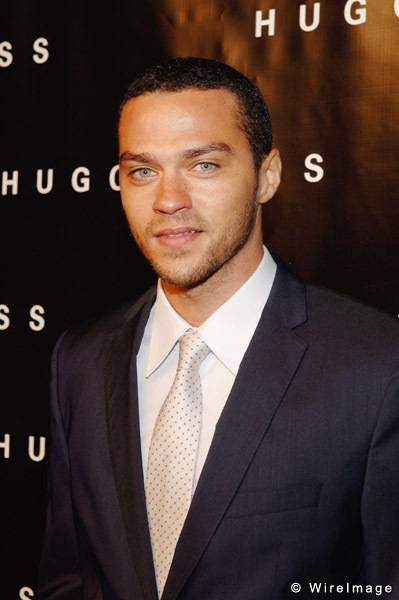
The new (biracial) guy on Grey’s Anatomy? As soon as he first hit the screen I was like, “I think he’s one of us!” But I wasn’t 100% sure until I saw Jesse Williams on the Bonnie Hunt Show. He showed pictures of himself as a child with his (Black) dad. So cute! Then and now!! My friend google led me to some more info about him….

Williams is the son of an African American father and a Swedish mother, and as a teenager, he moved from urban Chicago to ‘lily-white’ suburban Massachusetts. His interest in acting was sparked, in part, when a film he was writing about this uneasy transition was chosen as a finalist in the Sundance Screenwriter’s Lab. “It was a big part of my life. I really rejected that move. It was a complete cultural shock.” Williams recalls, “It wasn’t good. My friends were sh***y, the people were sh***y, the parents were sh***y. A lot of parents closed the door in my face, so I was like, I don’t need to be here. I’m not going to try and change you, which, I guess I did try for a while.”- via

This is from an off-broadway play that Williams did last year. So wish I had seen it.
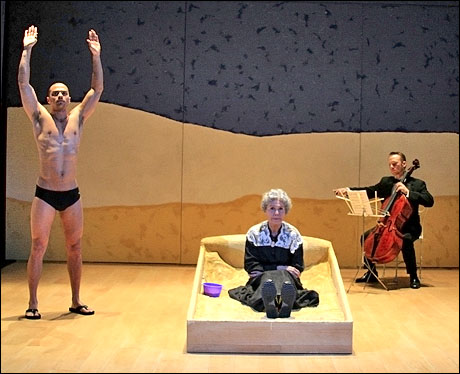
Jesse Williams isn’t embarrassed to admit he wasn’t fully aware of who Edward Albee was when he auditioned for him to play the scantily-clad Angel of Death in the revival of The Sandbox that the 80-year-old playwright is now directing (in tandem with The American Dream) at The Cherry Lane. “Actually, I think it helped me, not being so intimidated,” says Williams. “He was so funny, cracking jokes with me even from the beginning. And I didn’t even fully process that he had offered me the job. But it’s all been an amazing experience, getting this immediate response from the audience, and working with this cast. And honestly, I don’t even really know what I look like on stage. I said I was going to go to the gym more often, but I end up just doing push-ups in the basement of the theater and trying to keep quiet.”
Williams’ enthusiasm is understandable, since he has only been acting professionally for a couple of years. While studying filmmaking at Philadelphia’s Temple University, he did some commercial and modeling work, with the occasional acting audition — even turning down a prime soap opera role. “I am a biracial man, and I was supposed to play this tragic mulatto character lusting after a white girl, and I didn’t want to leave school to do that kind of part.” Instead, after graduation, he took a job as a public school teacher in Philadelphia, and then a high-level law firm job in New York — “I was supervising 60 attorneys, even though I’m not a lawyer” — before deciding to focus on acting.- via
Oh, Jesse Williams. I can’t wait to interview you!
 mulatto diaries
