happy?

May is Mental Health Awareness Month, so Happy Mental Health Awareness Month to you!

I intend to explore the impact of race on mental health, both individual and collective, in a few posts this month.  And, of course, how biracial factors into it.  Or, more accurately, how it factors into biracial.  All I know right now is that it does.

May the force be with me.

To kick things off:

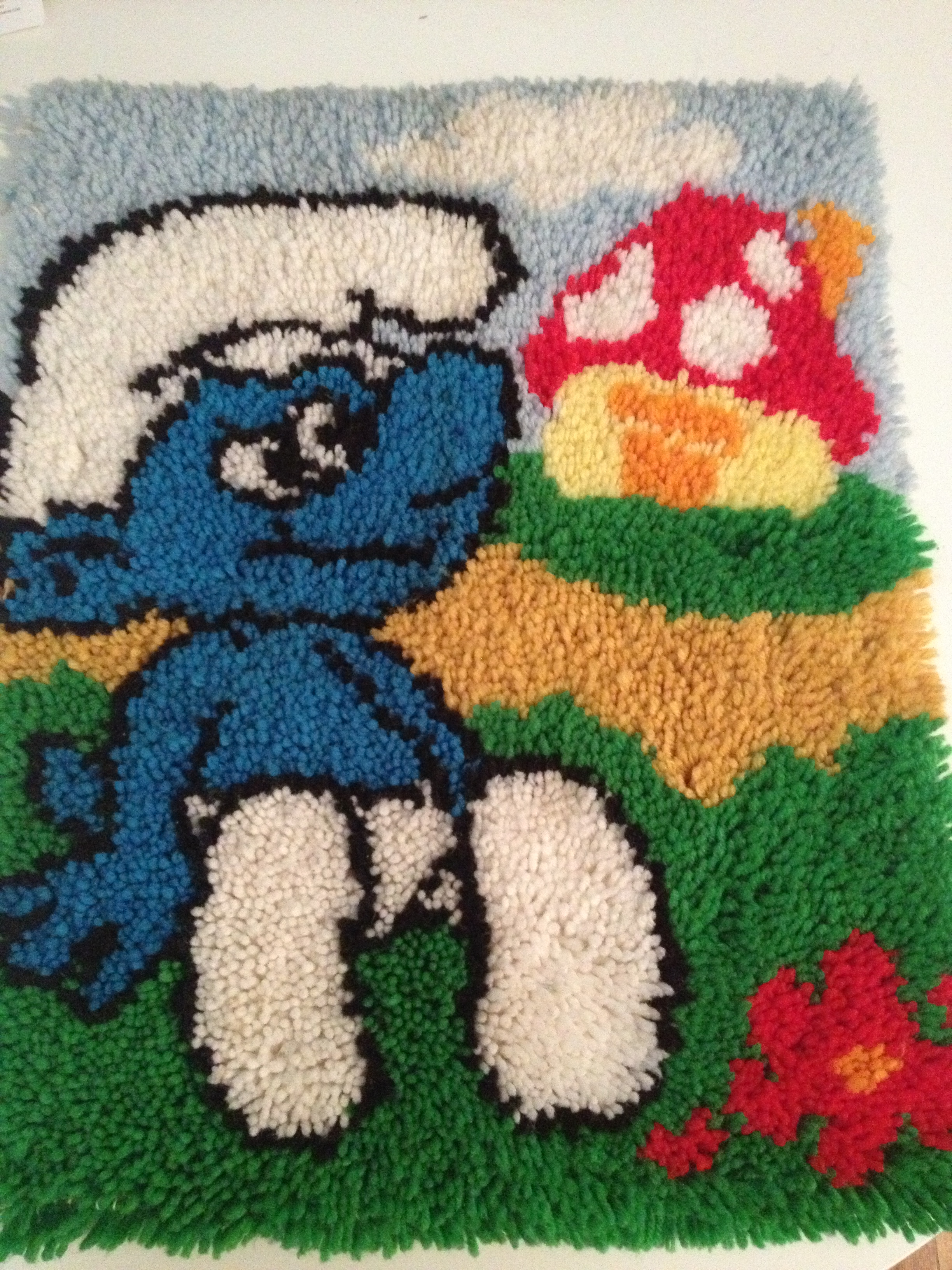
Lately I’ve been pondering my dis-ease in the world and have come to think that maybe it’s why (on the whole) i don’t talk to people much.  As little as possible at least.  On a personal level, anyway.  Although I genuinely enjoy people, intend to love them even…but, my default mode is to just smile at them a lot…because eventually someone is probably going to say something that makes me feel invisible with an invalid life experience,  and that throws me right into the center of the dis-ease I walk in this world carrying.  This has led me to experience anxiety and depression.  I have experienced many things in the last 36 years, don’t get me wrong.  Many things in perfect alignment with the love, beauty, and sheer wonder of the Universe.  But if i’m honest, I will acknowledge here that the dis-ease has weighed heavier.  It has been my most constant companion, so constant I was not fully aware of it.  I just thought that was life.  This has affected my relationships, my endeavors, and certainly my happiness.  That’s most likely why I cherish my experiences of joy and freedom so steadfastly that I have a (bad?) habit of clinging to the past (perhaps missing my future.)  Nostalgia and I are super-tight.  I recently bought a latch-hook Smurf wall-hanging at a flea market.  It wasn’t all that cheap.  Totally cute,  but i don’t really want it.  I saw it and for a fleeting moment a spark of pure childhood joy was ignited and i impulsively purchased that thing.  Didn’t even try to bring the price down. (smh)
photo
Clearly I digress…what I was trying to say, I think, is that depression and anxiety have been a part of my biracial experience.  That’s why i speak so fervently about freeing the mind and spirit from the confines of racial identity and racial separation and a whole bunch of other issues we needlessly toil under the illusion of.  I am passionate about this for a few reasons.  The one I’ll give now is: because it has been my “biracial” american experience and i can only be as free from the shackles of it as is the “biracial” american community in which i live.   I don’t mean a literal community of “mixed-race” people*, but the diverse community of this country.  and yes, it extends to the global community as well because basically all i’m talking about is how we’re all the same thing.

please be well

*and on the other hand, that’s exactly what i mean because i believe that we are as a country and a species quite literraly a conglomerate of mixed-race people.  Given that on this other hand we’re still pretending that race has any real relevance.  Biological or otherwise.

mental health month calendar jpg

mental health month wellness calendar

nick of time

I simply could not let the month go by completely without acknowledging Confederate History Month.  So, if you didn’t know… now you know…and you have the next hour and 16 minutes or so to observe it as you see fit.

From Wikipedia (the shame, i know):

-Confederate History Month is a month annually designated by six state governments in the Southern United States for the purpose of recognizing and honoring the history of the Confederate States of America. April has traditionally been chosen, as Confederate Memorial Day falls during that month in many of these states.

Although Confederate Memorial Day is a holiday in most Southern states, the tradition of having a Confederate History Month is not uniform. State governments or chief executives that have regularly declared Confederate History Month are as follows:

  • Alabama
  • Florida (since 2007)
  • Georgia (by proclamation since 1995, by legislative authority since 2009)
  • Louisiana
  • Mississippi
  • Texas (since 1999)
  • Virginia (1994–2002, 2010)

Four states that were historically part of the Confederacy, Arkansas, North Carolina, South Carolina, and Tennessee, do not have a tradition of declaring a Confederate History Month.-

Yep, Confederate Memorial Day.  Who knew?

Reading this passionate blog post refuting (with what I hope are actual facts… mea culpa re: no fact checking) the good old “It was about States Rights, not slavery” stance might be a fine way to spend the last few moments of this month of remarkable celebration.

poorrichardthin11

Confederate History Month: Celebrating Racists, Traitors And Slavers

Right now, this very second, we are in the middle of Confederate History Month. Right now, this very second, there are entire states celebrating their failed attempt to secede from the United States while killing hundreds of thousands of American soldiers and civilians.

These people are, by and large, a**holes.

Now, this isn’t like the descendants of World War II vets (and the surviving vets themselves)commemorating a long and bloody war; these people are celebrating the side that lost. You know, the one that attacked the very country Southern conservatives claim to love more than life itself? And let’s be honest, most of the people who fly the Confederate flag are not liberals. These are the people who long for the “good ol’ days” when the South was a decent proper place where a white man could whip a black slave just for fun.

Oh, did I offend? Tough noogies.

This is about the time that some jackass insists that the Civil War was about “state’s rights.” You see, this is a story that Southerners enamored of the Old South tell themselves, and anyone in earshot, to avoid the reality that they are “proud” of a heritage inextricably bound to slavery and treason.

Take a moment to enjoy the sound of right-wing heads exploding.

Now, there are a numbers of ways to debunk this fairy tale that the South was all about state’s rights and “freedom” from an oppressive central government and it’s hilarious watching traitor-worshipping conservatives contort themselves to avoid the truth. So let’s make a list!

1. Declaration of Causes of Seceding States:

Georgia “For the last ten years we have had numerous and serious causes of complaint against our non-slave-holding confederate States with reference to the subject of African slavery.”

Mississippi “Our position is thoroughly identified with the institution of slavery– the greatest material interest of the world.”
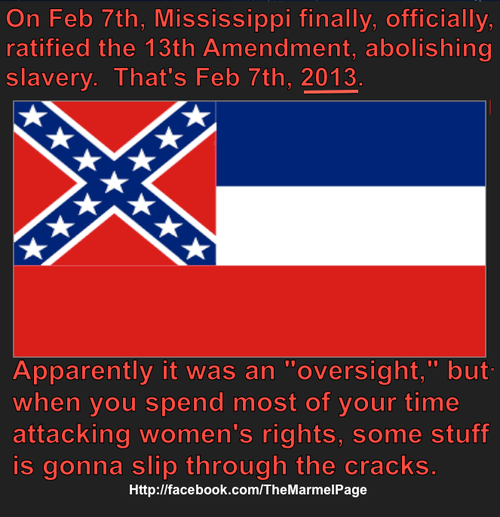
mississippi abolishes slavery

South Carolina “Those [non-slaveholding] States have assumed the right of deciding upon the propriety of our domestic institutions; and have denied the rights of property established in fifteen of the States and recognized by the Constitution; they have denounced as sinful the institution of slavery; they have permitted open establishment among them of societies, whose avowed object is to disturb the peace and to eloign the property of the citizens of other States.”

Texas “They [non-slaveholding states] demand the abolition of negro slavery throughout the confederacy, the recognition of political equality between the white and negro races, and avow their determination to press on their crusade against us, so long as a negro slave remains in these States.”

Does it get any clearer than that? Yes, actually, it does.

2. The Cornerstone Address (I wrote about this in brief on my blog so it might seem a bit cribbed):

“The new Constitution has put at rest forever all the agitating questions relating to our peculiar institutions—African slavery as it exists among us—the proper status of the negro in our form of civilization. This was the immediate cause of the late rupture and present revolution. Jefferson, in his forecast, had anticipated this, as the ‘rock upon which the old Union would split.’ He was right. What was conjecture with him, is now a realized fact. But whether he fully comprehended the great truth upon which that rock stood and stands, may be doubted. The prevailing ideas entertained by him and most of the leading statesmen at the time of the formation of the old Constitution were, that the enslavement of the African was in violation of the laws of nature; that it was wrong in principle, socially, morally and politically. It was an evil they knew not well how to deal with; but the general opinion of the men of that day was, that, somehow or other, in the order of Providence, the institution would be evanescent and pass away… Those ideas, however, were fundamentally wrong. They rested upon the assumption of the equality of races. This was an error. It was a sandy foundation, and the idea of a Government built upon it—when the ‘storm came and the wind blew, it fell’.”

Our new Government is founded upon exactly the opposite ideas; its foundations are laid, its cornerstone rests, upon the great truth that the negro is not equal to the white man; that slavery, subordination to the superior race, is his natural and moral condition.”

This speech was delivered on March 21, 1861, by the VICE PRESIDENT of the Confederate States of America, Alexander Stephens. But what the hell did he know? He was just the VICE PRESIDENT. Do keep in mind, dear conservatives, that this was over one hundred years before Dan Quayle and Sarah Palin. Vice Presidents generally had to be reasonably intelligent.

3. This is all crap! The Confederacy was all about FREEDOM™ and State’s Rights™ (FREEDOM and State’s Rights are both trademarks of the Angry Ignorant White Man Coalition, also known as the GOP)!!! 

Well, OK, if that were true, then the newly-minted CSA’s constitution would reflect that. Heck, if states wanted to abolish slavery on their own, then FREEDOM™ and State’s Rights™ would demand they be allowed to do so:

Article IV Section 9(3) The Confederate States may acquire new territory; and Congress shall have power to legislate and provide governments for the inhabitants of all territory belonging to the Confederate States, lying without the limits of the several states; and may permit them, at such times, and in such manner as it may by law provide, to form states to be admitted into the Confederacy. In all such territory, the institution of negro slavery as it now exists in the Confederate States, shall be recognized and protected by Congress, and by the territorial government: and the inhabitants of the several Confederate States and Territories, shall have the right to take to such territory any slaves lawfully held by them in any of the states or territories of the Confederate states.

Soooooo, no state could join the Confederacy unless it allowed slavery? What if they didn’t want it or changed their minds later? Well, that was just too bad. You HAD to allow slavery. Why? Because the central government would have forced you to. Just to make this crystal clear, a central government forbidding the enslavement of other human beings is “tyranny,” but a central government forcing states to adopt slavery is “FREEDOM™?” Yeah, that makes perfect sense.

There you have it, in their very own words; the traitors of the Confederacy attacked the United States and caused the bloodiest war in American history for the sole purpose of preserving their “right” to treat other human beings as property. Anyone that flies the Confederate flag, reminisces about “better times” or insists that “The South Will Rise Again!” is celebrating racists, traitors and slavers. If you celebrate a culture based on the most immoral of all crimes against humanity, you are, by definition, a racist asshole. If you try to pretend that slavery wasn’t so bad or that the “War of Southern Scumbaggery” was about FREEDOM™, you are a lying racist asshole. If you actually believe the right-wing whitewashing of the Civil War, you are delusional but not necessarily an a**hole (although the odds against this are not good).

bleaching history

creality

creality

The moment we realize the power of our intent is the moment we become free.

The person that you were in the past, even just a day ago, no longer exists. The person you will be in the future does not yet exist.

The real you can only be found in this very moment.

But who you will become in the future is the result of your action now. This is the power of your intent. When you say ‘yes’ to something, it will be created. When you say ‘no’ to something, it will not be created.

When you understand the real power you have in choice, everything becomes possible. -don Miguel Ruiz Jr.

create reality

signs

I think this list is cute.

For the record numbers 6, 9, and 16 do not apply to me at all.  I’m not sure if 13, 14, or 19 do either.  Not very important, just sayin’.

But especially not #6.  That is important.

Summer 2010 021

Not awkward, and I only “don’t look like them” if you’re only looking at color.

#2 “Growing up you experienced premature existential crises over not fitting in to one specific ethnic marker” is the one that strikes me as true in a bittersweet kind of way.  I am not sure if existential crisis was used here for humorous exaggeration, but I can genuinely relate to that.  Almost literally, but I would say racial marker, but who cares, so anyway…I am not saying that I would prefer to fit into any one specific racial marker.  I would not.  I would not prefer that anyone prefer to fit into or view themselves as exclusively belonging to any one specific racial marker.  I would really, really, really prefer that no one expect anyone else to fit into any one specific ethnic marker.

Then it wouldn’t matter that I don’t fit into one, but I look like I do, but I don’t meet the expectations set by the color, I mean, assumption.  It would be irrelevant that I don’t get counted on my terms, am rarely acknowledged or seen in the way I perceive myself. Which is kind of raceless.  But kind of not because, clearly, I’m so not raceless.  I’m race-ful. Biracial is two races.  Multi-racial is however many more than that. And that shouldn’t be difficult, but it is, so I’d like to get rid of the whole thing.  If two is nearly impossible (and not really allowed if one of them is “black”), then one race can’t be very healthy either.

Oh! Wait!  We can’t forget that everyone is multiracial in some real, dna-tested kinda sense.  So basically everyone is “mixed” therefore everyone is not allowed to be who they really are.  And the system is set up so that we are unconscious to this because it’s “normal” and so we believe in the status quo and we don’t even want to know the truths underneath all of these restrictions that we accept as natural and allow to heavily influence our lives.

Switching to a lower gear… It’s also worth mentioning that any early existential crisis(es) shaped me into the person I am, and that person is pretty cool, so I’m at peace with the challenges I faced.  As futile and unnecessary as I believe them to have been.  That is why  I am not at peace with things staying the same, or thinking staying small, or identities and lives being wrapped up in artificial boxes that must be checked to maintain the political, economical and social status quo.  The status quo needs to go.  That just came out  rhyming like that, sorry.  It’s just that there’s so much time and energy being wasted in the world on the wrong things.  In my humble and guilty opinion.  I still waste and misplace all kinds of energy.

19 Signs You Are Multiracial

DEC. 2, 2012

1. People speak to you in various foreign languages you do not understand.

2. Growing up you experienced premature existential crises over not fitting in to one specific ethnic marker.

troubled thoughts

3. People often ask, “WHAT ARE YOU?”  in tones which make you feel subhuman or extraterrestrial.

4. You hesitate before filling out the “ethnic background” section of tests/ questionnaires.

5. You feel mild guilt over not identifying with one of your cultures (i.e. you hate the food).

6. You feel awkward during get-togethers with one side of the family because you look nothing like your other family members.

7. Men (or women) use your questionable ethnicity as a means to hit on you.

8. You’ve been examined like you are some rare, exotic creature.

9. You can’t understand your grandparents’ language.

10. There is an undeniable clashing of cultures whenever the two sides of your family meet.

11. Your grandparents initially disapproved of your parents’ union.

12. Similar to a “gay-dar,” you’ve developed a “multiracial-radar.”

13. You were totally eating fusion cuisine way before Kogi came into existence.

14. Playing “guess my ethnicity” is a legitimate game.

15. You’ve lied about your ethnicity in the past just for the hell of it, or to avoid conversation.

16. Your last name doesn’t really look like it belongs to you.

17. You’ve been criticized for not being [insert ethnicity here] enough, or speaking [insert language here] well enough.

18. People you meet over the phone are surprised when they meet you in person.

19. You identify as a person of color, you just don’t know which.

race manners

Since I’ve been back on the blog, I have said very little about the so-called biracial experience.  It amazes me that it’s still easier, even for me with all of my good “mixed” intentions, to talk about black and white.  I forgive myself for this because without the black and white there is no mixed.  Without the baggage of white vs. black stuff, there is no need for the mixed discussion.  So, I suppose it’s only natural.  It is little disappointing personally that the middle ground isn’t where the conversation begins for me.  It’s on the ends of the spectrum.  But I also suppose that this is natural.  I suppose this has been the disappointment of my life.  And I suppose that this is how we get to the middle ground.  By exploring the ends and inching toward the middle.

A couple of things in Jenee Harris’ article jumped out at me:

1. “My white mother has developed an acute sensitivity to the subtle ways prejudice and bigotry pop up in daily life.”- 

I wonder if my father would say he has developed the same.  I think so…I think that happened when he entered into a relationship with my (black) mother and grew deeper as he witnessed my experience… but we never talk about it…

82920031

me with my parents:)

2. “Well-intended”– re: “adults loved to tell me that people paid “good money” for hair like mine (think 1980s-era perms on white women)” and “A friend got the biscuit analogy…: God burned black people and undercooked white people, but removed her from the heavenly oven at the perfect moment.”

Well…if the intention of the (white) person who said this is to make the biracial person feel better about the perceived plight of their kind…well…i guess one could count that as a good or harmless intention. But I think that summation signifies complacence.  I, however, have to challenge this notion.  You see, giver of said “compliment,” in your quest to make me feel better about being my invisible, displaced, misunderstood, marginalized and tragic self you put me on the receiving end of your pity, your assumptions and judgements.  I do believe this is usually unconscious.  I also must acknowledge that it is an assumption I’m making. Yet there’s a reason that I assume that this is the intention behind the compliments.  The assumption is based on experience, but even those are dangerous to make. It’s the tone with which these comments are usually, subtly uttered.  If you’ve been the biracial person in this kind of conversation, I think you know what I mean.

When I engage in this kind of innocent interaction I can be left feeling frustrated, upset, and worst of all unseen.  It is depressing.  It is literally a depression of my spirit.  Of my freedom.  A depression of my freedom to just be and simply experience this life without being saddled with the weight of the stigma of a couple hundred years of prejudice, condemnation, fear, greed, inferiority, superiority, discrimination, and antagonism.  My take on it is that some people assuage a fleeting feeling of guilt over the fact that this is the biracial’s lot in life by reminding us (and/or reminding themselves) that I should be happy because I have good hair and tan skin which, I infer from your comments, should make up for the fact that on the whole the society we live in cannot acknowledge or understand how I exist.  I thought there was more to that sentence, but I think that’s it.  Our nation’s identity continues to be wrapped up in race and all the baggage that comes with it.  For that to remain intact, biracial just can’t really be.  I don’t think that needs to remain intact.  I think things are shifting.  So slowly.  But they are shifting and I hope I stay awake enough to the shift to feel when my assumptions based on past experience are truly no longer valid.

On the other hand, I’m fairly certain that most of my response falls into the category of  “Oh, come on, stop being so sensitive.

Or am I just being truthful?  That’s the stuff that this brought up for me.

Biracial Children: Racism Advice for White Parents

Race Manners: Comments about the superior beauty of your biracial child aren’t just weird — they’re troubling.

By Jenée Desmond-Harris

Updated Monday April 8, 2013

The Root —

“I’m a Caucasian woman with a biracial child (her father is black). I live in a predominantly white community. Why is it that whenever people discover that I have a ‘mixed’ child, they always say things like, ‘Oh, he/she must be so cute/gorgeous/adorable, those kids are always the best looking. You are so lucky.’ 

I know they mean well, but it seems off to me, and maybe racist. Do they mean compared to ‘real’ black children? When a German and Italian or an Asian and Jewish person have a child, black people don’t say, ‘Mixed children like yours are always the best looking.’ (Plus, it’s not true — not all black-white biracial kids are the ‘best looking.’)

Am I being overly sensitive by feeling there’s something off about these comments? If not, what’s the best way to respond?”

I chose this question for the first installment of Race Manners, The Root‘s new advice column on racial etiquette and ethics, because it hits close to home. Like your daughter, I’m biracial. Like you, my white mother has developed an acute sensitivity to the subtle ways prejudice and bigotry pop up in daily life. I should know. She calls me to file what I’ve deemed her “racism reports.”

And let’s be clear. Americans of all races say bizarre things to and about mixed people, who can inspire some of the most revealing remarks about our black-white baggage. Just think of the public debates about how MSNBC’s Karen Finney, and even President Obama, should be allowed to identify.

But the comments in your question often come from a good place, and they’re often said with a smile. When I was a child, adults loved to tell me that people paid “good money” for hair like mine (think 1980s-era perms on white women) and for tanning beds (again, it was the ’80s and ’90s) to achieve my skin color. Thus, the grown-up argument went, I should be happy (even if these trends didn’t stop people from petting my curls as if I were an exotic poodle, nor did they give me the straight blond hair I envied, and it’s not as if I was on the receiving end of the beauty-shop payments).

A friend got the biscuit analogy. Wait for it: God burned black people and undercooked white people, but removed her from the heavenly oven at the perfect moment, she was told.

Awkward. Well-intended. Poorly thought-through. A window into our shared cultural stuff about identity. These statements are all these things at once.

That’s another reason I selected your question. When it comes to remarks that are so obviously dead-wrong to some of us, and so clearly innocuous to others, there’s often little energy for or interest in breaking down the explanation that lies between “Ugh, so ignorant!” and “Oh, come on, stop being so sensitive.”

I’ll try it out here.

You’re right to be bothered by the remarks from the Biracial Babies Fan Club. Here’s why: These people aren’t pulling an arbitrary appreciation for almond-colored skin and curls from the ether. Instead — even if they are not aware of this — they’re both reflecting and perpetuating troubling beliefs that are bigger than their individual tastes. Specifically, while “mixed kids are the cutest” is evenhanded on its face, treating both black and white (and all other ethnic groups) as inferior to your daughter, I hear it as anti-black.

As Marcia Dawkins, the author of Clearly Invisible: Racial Passing and the Color of Cultural Identity, told me, “The myth that mixed-race offspring are somehow better than nonmixed offspring is an example of ‘hybrid vigor,’ an evolutionary theory which states that the progeny of diverse varieties within a species tend to exhibit better physical and psychological characteristics than either one or both of the parents.”

mixie girl

And just take a wild guess how this idea has popped up for black people. You got it: In order to demean and oppress African Americans, thought leaders throughout history, including the likes of Thomas Jefferson, have said that black-white mixed offspring are better, more attractive, smarter, etc., than “real” blacks and not as good or attractive or smart as “real” whites, Dawkins explains.

So alleging that mixed kids are the best of anything sounds different when you consider that we’ve long put a wholesale premium on all that’s whiter and brighter.

Nowhere is that premium more stubbornly applied today than when it comes to the topic at the center of your question — beauty and attractiveness. In recent memory, we had to re-litigate the harms of colorism when Zoe Saldana was cast to play the lead in a Nina Simone biopic. Tamar Braxton and India.Arie have both been accused of bleaching skin — as if that would be a reasonable thing to do.

A writer lamented in a personal essay for xoJane that she was sick and tired of being complimented for what black men viewed as her “mixed” or “exotic” (read: nonblack) physical features. (As far as I know, “you look a little black” is not a common line of praise among other groups.) Black girls still pick the white dolls in recreated Kenneth Clark experiments. Harlem moms can’t get Barbie birthday decorations in the color of their little princesses. We treated rapper Kendrick Lamar like the department store that featured a wheelchair-bound model in an ad campaign when he cast a dark-skinned woman as a music-video love interest.

Against this backdrop of painful beliefs that people of all colors buy into, yes, “Mixed kids are the cutest” should sound “off.”

As the mom of a mixed kid, you signed up for more than just the task of venturing into the “ethnic” aisle of the drugstore and learning about leave-in conditioner. You took on the work of hearing things like this through the ears of your daughter, and you agreed to have a stake in addressing racism. The fact that these comments bothered you means you’re on the job.

So if it’s at all possible, you should explain everything I’ve said above to people who announce that your daughter is gorgeous based on racial pedigree alone. If you’re shorter on time or familiarity, you could try a reminder that there’s really no such thing as genetic purity in the first place (“Great news, if that’s true, since most of us — including you — are mixed”). As an alternative, the old cocked-head, confused look, combined with “What makes you say that?” always puts the onus back on the speaker to think about what he or she is really saying.

Finally, just a simple, “Thanks, I think she’s beautiful, but I don’t like the implication that it’s because of her ethnic makeup,” could open up an important introductory conversation about why comments about superior biracial beauty aren’t true and aren’t flattering, and why the beliefs they reflect aren’t at all “cute.”

before this hurts too much

Need race-related advice? Send your questions to racemanners@theroot.com.

The Root‘s staff writer, Jenée Desmond-Harris, covers the intersection of race with news, politics and culture. She wants to talk about the complicated ways in which ethnicity, color and identity arise in your personal life — and provide perspective on the ethics and etiquette surrounding race in a changing America.

peaceful changemakers

Basically, I think that Madeleine Rogin is a genius and I hope this curriculum (and others like it) spreads like wildfire.  To know that there are people working so diligently to affect positive change at a core and fundamental level is truly invigorating to me.  It makes me enthusiastic about life. That children are being thoughtfully led to consider social justice, peace, and change and to recognize, then interrupt bias…well, that opens up more space in my heart.  For real.

I only wish I had experienced first-hand the benefit of this kind of education.  As a student, I mean.  I am totally looking forward to experiencing the benefit of communing with citizens who are a product of this type of conscientious education.  But even more selfishly, I cannot help but feel a twinge of envy when contemplating the vast difference between how it felt to be a speck of color in a classroom where exclusivity was a priority (as were the classrooms of my youth), and how I imagine it feels to be in a millennial classroom where inclusivity is a priority.  It gives me hope that this is concrete evidence that we are indeed moving from a country where exclusivity is a priority to a country that takes more pride in inclusivity.  At high levels.  Where it counts.

So, on this 45th anniversary of the assassination of Dr. King, I contemplate:

What was the problem he faced?

Who was involved or affected?

Why was it hard to solve this problem?

And was it solved?

How to Teach Kids about Race and Social Justice: One Teacher’s Approach

By    via

Kindergarten

When it came time to talk about Martin Luther King Jr. to my Kindergarten students, I found myself struggling to communicate who he was. I wanted to convey the themes that stood out to me the most about Dr. King: courage, standing up for a community, and using peaceful means to bring about big, important social changes. But I didn’t know what was developmentally appropriate for five and six year olds. Should I tell them about his assassination?  Should I talk to them about race and racism? Would learning the truth about racism and segregation be too much for them to handle and create divisions in my diverse classroom? Would my students feel burdened or overwhelmed with this information?

For years, I tried to talk about Dr. King without talking about racism. I thought my students would understand the themes of courage, social justice and empathy by talking in general terms about Dr. King’s dream of an inclusive world. But our conversations in class did not convey these themes and my students did not seem to understand the significance of who Dr. King was and what he did. And, inevitably, some of the truth would come out—through a comment from a student who had prior knowledge about the story, or a conversation on the playground between a kindergartener and an older child. I realized that it was my responsibility to tell this story in a way that would effectively communicate the themes I most wanted my students to understand and, in order to do that, I would have to look deeper into our curriculum and face my own discomfort around talking about racism with my students.

I met with my kindergarten team and began an inquiry into our curriculum.  We asked ourselves:  how can we teach the themes of courage, justice, inclusivity and making change through peaceful means to our young students? And how can we do this in a way that is developmentally appropriate and includes all the voices in our classrooms?

The result of this inquiry has led to the “Peaceful Changemakers” curriculum in kindergarten, and, now, influencing the way that first through fourth grade teachers talk about issues of environmentalism, civil and human rights. Through this curriculum, students learn about many people who work toward making the world a better place through peaceful means.  We realized that in order for our students to have a deeper understanding of Dr. King we would need to integrate the ideas around making big, important changes into our curriculum. We would need to start talking about these themes months before Dr. King’s birthday, so that our students could practice exploring the ideas and having conversations about what it means to stand up for a community and make change before they learned about Dr. King.

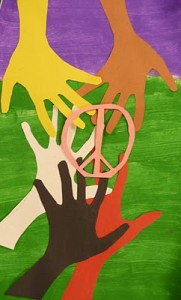
MLK-hands2-181x300

We start by studying Dr. Seuss’s the Lorax, and we call the Lorax a “changemaker” because he spoke for the trees. Students answer the following questions about the Lorax: What was the problem he faced? Who was involved or affected? Why was it hard to solve this problem? And was it solved? From there, we learn about Dr. Wangari Maathai, a Kenyan scientist who won the Nobel Peace Prize for planting trees in Kenya. As we learn about these changemakers, students take action to solve problems in their local community.  We work to restore the watershed by planting native trees at a nearby creek and go on trash walks through the local parks. We hang signs around their school educating our school community about how trash on the ground eventually makes its way into the ocean.

Students also honor changemakers from their own families and communities, and family members come into the classroom to present their changemakers. Some of these changemakers are tutors in schools, work in orphanages in other countries, educate others about the importance of reusing and recycling, or turn parking lots into neighborhood parks.

There were also important changes we made to the discussion of Dr. King himself. Through our research, we discovered that it is developmentally appropriate to skip the part of the story around Dr. King’s death; students do not need to know that he was assassinated in order to appreciate his work. I had noticed that when my students learned he was killed, they would often focus on this violent image more than on any other aspect of his life work. And, without the larger unit in which we explore many people who work for change, students would feel burdened and overwhelmed with this information. Now, if my students learn about the assassination from an older sibling or from an outside conversation, I can point to our Changemaker Wall on which we display all the changemakers we have learned about, both famous and not, and remind them that there are so many people working, as Dr. King did, to make a difference.

We also learned it was important not to skip the part about racism and segregation. Using our changemakers framework, where we ask specific questions of each of our changemakers, our students need to know what the problem was in order to think about how to solve it. There is a universality among all the changemakers in that they all work to make a difference and solve big problems, but in order for our students to grasp the significance of this universality they also have to understand the specific problems. Otherwise, they cannot appreciate the courage it takes to solve the problems we face.

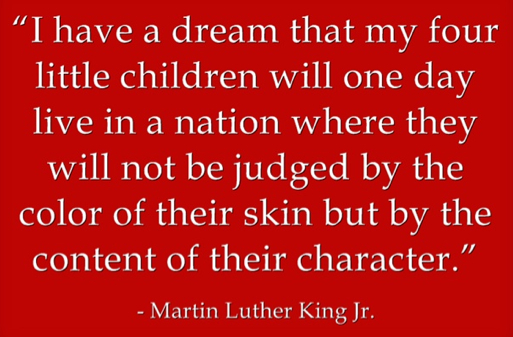
i-have-a-dream-martin-luther-king-jr

We also discovered that our students needed support in developing a basic understanding of skin color differences and language they can use to be inclusive with one another. To this end, students mix paint to find their skin tones, write poems about their skin, and listen to many stories about the different shades of our skin. Talking openly about race and racism with our students is also important so that they can recognize and interrupt bias when they see it. They can also more fully appreciate the work of Dr. King and other changemakers in fighting against segregation and racism.

Now, when it comes time to talk about Martin Luther King Jr. in kindergarten, the students are able to focus on the big ideas around courage, social justice and making peaceful change. They have a deeper understanding of their similarities and differences and a greater appreciation for the importance of standing up for a community and working toward inclusivity and equality.   They recognize they can be changemakers too.