passers

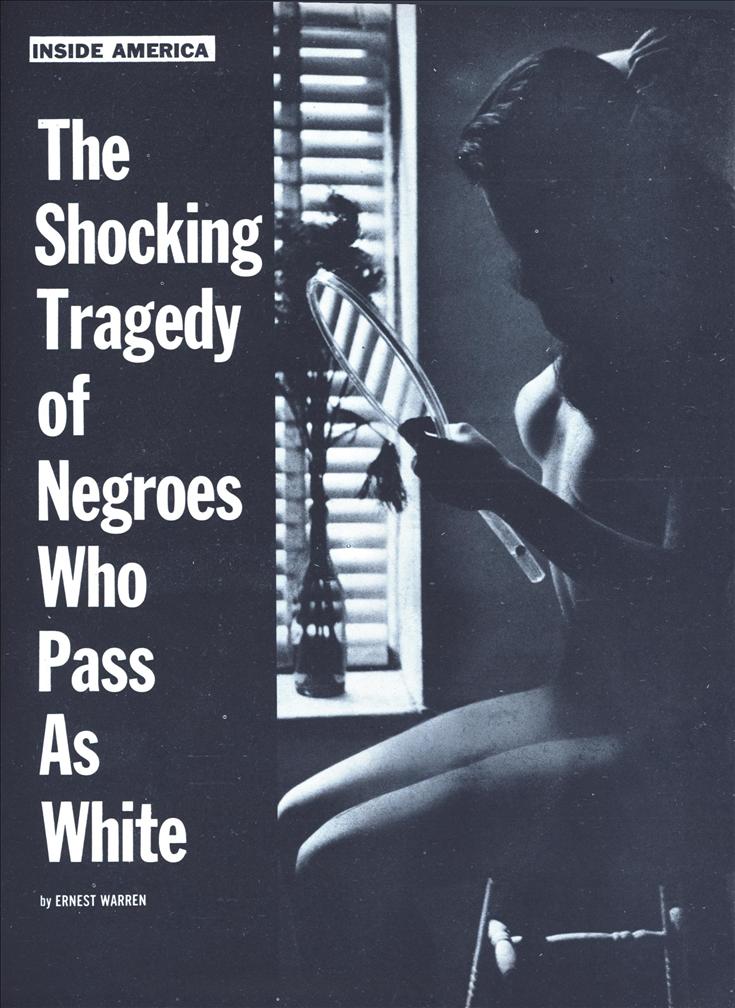
Thank you, Lee, for turning me on to this little “gem.”  Horrifying sums it up well.  I don’t know what content I find most horrifying.  I’m picking up lots of “tragic mulatto” and “jezebel” (the cover page photo!) innuendo though those specific terms aren’t used.  In fact, the passers don’t have to be mulatto at all.  As I’m constantly told, as a nation and a people we’re all mixed and there are plenty of “black” people that are lighter than some mulattoes such as myself.   I do like this notion of “one honest goal: the elimination of the invisible color boundary which for so many years unfairly kept him from his rightful place in the sun.”  We’re still workin’ on it.
ENTIRE ARTICLE

…it seems well-nigh incredible that some five million Negroes have turned their backs on their own race and are passing as white. For almost a quarter of a century, this fantastic lie has been lived by large groups of Negroes with no sign of abatement despite the strong gains that have been made by the champions of anti-segregation.

In the year 1960 alone more than 60,000 negroes are expected to “disappear”, cross the invisible color line into the world of whites. These are not just dreamed up figures. They are actual facts. Just as it is a fact that no one ever reports a Negro to the Missing Persons Bureau unless they are absolutely sure the missing human isn’t passing.

Many shocking incidents were brought to light some years back in a sensational book, ‘Black Metropolis’ by St. Clair Drake and Horace R. Cayton. The authors claim that many “white negroes” as passers are called— hold strong positions in the white world as physicians, scientists, and public administrators—despite the fact that many such jobs are also held by Negroes unashamed of their race.

The late Walter White, himself a Negro, and one of the prime movers in the National Association for the Advancement of Colored People, once attempted to clarify the problem of passing. He said: “Negroes naturally resent the loss of some of the brilliant minds which would be an asset to them in their grim struggle for survival. But if any Negro believes he will be happier living as a white and thereby escape the barbs and handicaps of prejudices, or if he believes he can use his ability and training to greater advantage on the other side of the racial line, most Negroes wish him well.”

When it comes to passing, although most Negroes today refuse to condone it, they will not tell on one another. Most seem to understand the reasoning that prompts lighter-hued members of their race wanting to cross over.

“We know there are stronger anti-discrimination laws than ever before,” they will tell you, “but when a negro has a white skin, he seems to have a compulsion to live the way of the people who have so long opposed him. He doesn’t seem to realize that scientists have proven that the very people who condemn him might not be in a position to do so.”

A scientist like those mentioned above is Dr. Caroline Day, of Atlanta University, who wrote in her famous Harvard African Studies: “The grim joke of the whole matter is that for 150 years and more the Negro has been absorbed and his descendants are constantly rubbing elbows with some of the very ones who are discussing them.”

Even the fact that people, who believe all passers are eventually found out because their children are sure to be black, are merely deluding themselves, hasn’t deterred the practise of passing. Science took the inherited color theory apart a long time ago, with the aid of such eminent savants as Amram Schienfeld, Dr. Ernest A. Hooten and the late Dr. Edward M. East, who theorized thus; “If one of the parents is pure white, the baby cannot he darker than the darker parent. If they both have Negro blood, the baby may be slightly darker than its parents hut the chances are against it.”

With the legalization of racial intermarriage approved in some 22 states, nobody has been able to upset their theory – though, obviously, chances to do so have been many.

Yet the “passers” themselves seldom worry about theories. The “permanent passer”, going over the line, never comes back. He prefers to end his days living a big white lie; and women passers who marry bear children and keep their secret for life.

Only under unusual circumstances, such as the one that befell the wife of a prominent socialite, does a sensational exposure ever occur. This was the Leonard Kip Rhinelander case, which rated lurid headlines when the socialite playboy sought to have his marriage to Alice Jones set aside. Rhinelander claimed his wife was colored and failed to tell him so. In her defense, Alice stripped to the waist and bared her breasts to the jury, thus providing the sensation-seeking New York Graphic with a classic composite-photo of this closed door session for its front page.

Besides the “permanent passer”, the “segmental passer” stands without guilt or censure. The “segmental passers” lead a dual life; whites by day, Negroes by night. You’ll often find them in jobs where opposition to Negroes is strong but secret-Some are telephone operators, receptionist, typists, clerks in large corporations and in department stores, where, though some Negroes are employed the unspoken policy is “Enough is enough.”

On Broadway, particularly, the Negro girl has a tough time getting a chorus or showgirl job. There is a story current of a Negro showgirl, allegedly passing as white, who was recognized by a popular Negro singer, but he refused to reveal her secret. He also reportedly wouldn’t talk to the girl, not because of her “passing” but because of her more than passing interest in a white socialite-playboy who met her nightly.

“Obviously she hasn’t learned yet that mixed marriages are no longer looked on with horror,” a Negro artist told INSIDE STORY, “so she’ll go on living her lie and, in the long run, probably find her heart broken because she feels she can’t reveal her secret to the man should he want to marry her. Life will never be easy for her. She not only sometimes has to listen to blasts against her race, but worry every moment about being exposed.”

While there’s no way of truly gauging the number of passers operating, some estimate is arrived at by studies of census reports, immigration records, vital statistics and information from other sources. Yet this does not take into account the ‘’segmental passer” or the passer who, in the past, was known as an “occasional” a reference to light-hued Negroes who occasionally went downtown to segregated areas and, as a lark, spent their money on white entertainment.

Actually, when it comes to “passing”, the shocked might as well face these facts: Passers not only go through life as white, they have children who look (and are) white. Any anthropologist will tell you that if a person has one-sixteenth or less of Negro blood—it is impossible to determine his or her ancestry.

Yet, the practice of passing still continues, much to the chagrin, not necessarily the shame, of the Negro who believes in living as he was born. To such a Negro, there can be only one honest goal: the elimination of the invisible color boundary which for so many years unfairly kept him from his rightful place in the sun. The passer, working in the movies, working as a white actress or a showgirl, or a model or a clerk, or a receptionist doesn’t think of this. He’s thinking of himself. Or herself. And that, to a good many Negroes, is a “shameful secret!


grateful for the choice

I mailed my Census form yesterday.  I must say that after all the hype, I was totally underwhelmed by the experience.  I checked the two boxes.  I can’t say it brought me any great feelings of validation.  I guess I thought they’d be asking some questions that went beyond race.  I also thought that “Negro” would be the only African American classification term offered since there was so much buzz about the word being used in 2010.  At any rate, I enjoyed this article.

More than black or white

By Annette John-Hall

Inquirer Columnist

SOURCE

For Kathrin P. Ivanovic, racial identity means a whole lot more than just black or white.

Her makeup runs the gamut.

“My mother is German and my birth father is African American with Cuban ancestry,” says Ivanovic, 29, director of development at the Nationalities Service Center, a Philadelphia nonprofit that services immigrants and refugees.

“Plus, my adopted dad is white, and I’m queer. Unfortunately, they don’t have a box for that.

“. . . I call myself a mixed chick.”

But when her 2010 U.S. Census form arrives in the mail this week (the 10-question form is being touted as the shortest in census history), Ivanovic will be satisfied to check black and white – which is really how she sees herself anyway.

Since the 2000 census, for millions of Americans like Ivanovic, “check one or more” will apply.

There is plenty to choose from, with the number of racial and ethnic categories at 63. In the 1990 census, there were only five designations offered.

It can be dizzying. If you’re, say, Asian, you can check any combination of Asian American, Chinese, Japanese, Filipino, Korean, Vietnamese, Hawaiian, Guamanian, or Chamorro, Samoan, as well as write-in categories for Other Asian or Other Pacific Islander.

In addition, you can also note if you’re of Hispanic, Latino, or Spanish origin. That’s because since 1970, Hispanic was no longer recognized as an overarching classification.

Still with me? (And here I thought having Negro on the same line as the black or African American box was confusing.)

But I’m all for it, especially if it paints a more genuine picture of who we are – all 300 million of us. Doesn’t matter if only 2 percent of Americans were identified as more than one race in 2000. Nowadays, we’ve got more multiracial and multiethnic couples and children than ever before, which means the percentage is sure to increase this year.

Which in turn enables the government to allocate funds more equitably. Census data are used in everything from determining the number of congressmen your region gets to the assessing the amount of funding for your town’s bridge project to supporting health centers.

Race data also have driven the nation’s civil rights laws (how many people were denied the right to vote, how many were discriminated against in housing, for example) and are still used to monitor inequalities in health and education.

But it wasn’t always that way.

Truth is, the U.S. Census was historically more of an oppressor than an advocate, especially when it came to African Americans.

Racial count

From the time census data were first collected in 1790, when enumerators listed categories of free men and slaves, whites used the census to diminish African Americans.

“You can see why they had a slave category,” says MIT professor Melissa Nobles, author of Shades of Citizenship: Race and the Census in Modern Politics. “Southern slave owners wanted the least amount of information, thinking it would help abolitionists. And abolitionists wanted the most amount of information [to make their case].”

Throughout the 19th century and until 1930, census counters used categories such as quadroon (one-quarter black), octoroon (one-eighth black), and mulatto (half black) to describe any person who had a discernible amount of African American blood.

Like they could tell just from looking.

Even after 1930, Southern laws imposed the “one-drop rule” to its census enumerating, meaning they were to count as mulattos anyone who even looked remotely black – a mandate loosely applied by census counters nationwide.

“They used it for racial social science,” Nobles says. For example, they used census data to prove skewed theories (arguing, for instance, that biracial people – “the tragic mulatto” – were somehow weaker and suffered from higher death rates), which in turn helped legislators make the case against interracial marriage.

But even as the categories have expanded, some today are pushing for a separate, generic multiracial designation.

Ralina L. Joseph, a professor of communications at the University of Washington, worries that even though the data will show us as more diverse and multihued, they could be misinterpreted once again.

“I don’t want people to read the numbers and think that racism is over, that this is a post-racial moment,” says Joseph, who is biracial. “We should hope that people who are disenfranchised through race, class, and poverty levels should be identified as such.”

Some sociologists even insist that racial designations have no place on a census form, if it is indeed as simple as an objective count.

But in a multiracial, multiethnic society where even the president is a self-described “mutt,” Kathrin Ivanovic is grateful for the choice.

“I am mixed. It’s how I view the world, and in some ways it’s how the world views me,” she says. “To not be able to identify that way is dishonest to me personally.”

“The Census Taker” (1870) Harper’s Weekly

mixed race barbies

I don’t think I would have been allowed to have one of these Barbies either.  Actually, I kind of don’t get this.  The designer doesn’t say that she made them so that little mixed girls will have a doll that more accurately represents their background.  She says it’s for African-American girls (which is weird because this is in the UK), so how are these different from the black barbies that have been around for years?  Is it that they’re wearing Rocawear, which we can assume white Barbie either knows nothing about, or wouldn’t be caught dead in?  Is it that African-American girls have career aspirations that include having Jay Z as their boss?   Ok, clearly I don’t just kind of not get it, I don’t get it at all.

First collection of mixed race Barbie dolls hits the UK

The ‘So In Style’ dolls designed by African American mum debut today in Selfridges

The So In Style dolls launched today at Selfridges

It seems Barbie has some new friends to add to her circle and they come in the shape of four mixed race girls named Jayla, Kara, Trichelle and Chandra. The first of their kind in a sea of fair skinned Barbie dolls, the four ‘So In Style’ girls were unveiled today as part of a cultural Barbie retrospective at the Wonder Room concept store within Selfridges.

Adding to the Wonder Room’s repertoire of all things contemporary and interesting, the mixed race dolls, designed by Barbie designer Stacey McBride-Irby, feature as part of an exhibition to celebrate 40 years of black Barbie history.

Unveiled by brand consultant and founder of WAH-Nails Sharmadean Reid, the authentic looking dolls stand alongside vintage black Barbies as well as 12 larger than life dolls.  The woman behind the creation of the ‘So In Style’ girls, who are decked out in Jay Z’s Rocawear clothing, says her inspiration behind the range was her daughter and her own heritage.

“As a Barbie doll designer for more than 10 years, I want African-American girls to know that dolls can represent their career aspirations, hobbies and ethnic backgrounds. Barbie inspired me to realise my dream of becoming a designer, and I want my dolls to inspire girls to play, create and live out their dreams,” explains Stacey.

The dolls are available in Selfridges (link) from today and cost £25.

SOURCE

making the best of it

Taking into consideration the lunch counter sit-ins of 1960, I think this is a remarkable story…

Area Woolworth’s first black sales clerk calls hiring proud moment

Jean Fisher Curry was hired in 1961 to work a cosmetics counter in the front of the store.

By Tom Stafford

SPRINGFIELD — There were no lunging police dogs with bared fangs, no fire hoses knocking people to the ground, no instigators putting cigarettes out in the hair of protesters at lunch counter sit-ins.

The first apparent outward sign that Springfield’s F.W. Woolworth store would have its first ‘‘Negro’’ employee — to use the word customary at the time — was a note Jean Fisher, 15, received in class during the fall of 1961, her junior year at South High School.

“I was never in trouble,” said Jean Fisher Curry of Springfield. So when she got the note from the counselor’s office, “I thought, what did I do?”

It wasn’t what she did that was notable but rather what she was about to do.

Like other Distributive Education students, she was told she’d have to meet the standards: keep a B average and take special classes in the department.

“I think (Distributive Education) was the forerunner of the vocational school,” Curry explained.

But if she met the standards, she could work at Woolworth’s — the downtown one at High and Limestone streets.

The importance of that was not lost on Curry: “They didn’t have black people working in the store.”

A happy clerk

“I thought I’d be cleaning,” Curry said.

That might have been OK. Her mother had done that for years in what was called “private family work” — working as a domestic at the Tanglewood Drive home of Seymour and Anne Klein.

Jean Curry hugs her mother, Alberta Fisher, whose encouraging words helped her break new ground as the first black sales clerk at Springfield's Woolworth store. Staff photo by Marshall Gorby

Jean Curry hugs her mother, Alberta Fisher, whose encouraging words helped her break new ground as the first black sales clerk at Springfield’s Woolworth store. Photo by Marshall Gorby.

Being a domestic “never bothered her,” Curry said, “because that was honest work.”

And when the Kleins asked Alberta Fisher to run the lunch counter at Victory Lanes, it showed “they trusted her,” Curry said. “And she was happy with that.”

The job at Woolworth’s wasn’t a cleaning job, however — likely because the Distributive Education program didn’t train people for that task.

“They told me it was a sales clerk,” said Curry,” and I said, ‘Yeah.’ ”

As it turned out, her post would be at the cosmetics counter in front of the store, where she’d be seen by all who walked in the main entrance.

The sightings began soon after she turned 16 on Sept. 15, 1961, and got her work permit.

Shades of discrimination

Curry discovered a shade of racial reasoning involved in her placement in the store.

“They hired a black girl from North and me from South,” she explained. “Because I was light (-skinned), I worked at the front of the store. Because she was darker she worked in the back of the store with the pets.”

Asked whether that was the real reason for the assignments, Curry was emphatic: “There’s no doubt. I knew it, she knew it, and she resented it.”

Curry said that colored her attitude toward her own work: “What was I going to be mad about? I didn’t feel discrimination like somebody darker.”

The attitude ran in her family.

When the census came, the light-skinned Curries listed their race as mulatto., and in the militant black pride era, they joked about being “high yellow.”

Still, they had to follow rules of the racial road.

Springfield then was a town in which blacks weren’t allowed in the Liberty Theater and in which blacks were suspicious of drinking out of segregated fountains, wondering what white people put in them.

Blacks also tended to “stay within our culture,” Curry said, taking the elevator in the Arcade to the music store that catered to their tastes and frequenting the Center Street YMCA.

Woolworth’s also had its rules: Blacks could order only carry-out from the food counter.

And when Curry started, “we were told when we gave people change to lay it on the counter,” she said, thus avoiding problems with white customers who were uncomfortable having physical contact with blacks.

“But like I told (the girl from North),” Curry added, “we may get some money.”

At first, the pay was 65 cents an hour. The following year, it would go up to 85 cents — this in an era when $1 an hour was considered decent pay, Curry said.

In her youthful enthusiasm, “I didn’t think it was a job. I thought it was a career.”

In the same spirit, Curry, who knew that the actress Betty Hutton’s sister, Barbara, was part owner of the chain, half expected one or the other Hutton sister to show up some day, coming through the front door right into her area.

When she told people she worked at Woolworth’s “I always said ‘F.W.’ like I knew him.”

“I couldn’t even tell you what F.W. stood for.”

Her mother and God

The non-Hutton whites who came into her area in the front of the store fell into a couple of categories, Curry said.

“The older ones, the little white-haired ladies, they liked me,” she said.

“They were used to black people working in their homes and knowing their place. And I knew my place.”

“The other ones, I had to grow on them,” she said.

And she did, using the enthusiasm and bedrock values her mother taught her.

Part of it was common courtesy. “I was always very friendly. You just do that,” Curry said.

Also, “we were very religious,” she said. “We went to church. I think God had a place in that.

Constantly on her mind at that time was the desire “to make my mom and dad proud of me,” Curry said.

Finally, there was the work ethic her mother sought to instill in her children.

Throughout their childhoods, Mrs. Fisher recited a saying to her children to encourage them to do the best they could in everything they did.

“She said it so much to me that I knew it by heart,” Curry said.

All that you do, do with your might.  Things done by half are never done right.  All that you do, do with a zeal.  Those that reach the top, have to climb the hill.

Touching moments

If some of the white people of the time were uncomfortable touching blacks, the black friends and family who came to the store were the opposite.

They’d reach out, touch her and say “It’s so good to see you” when they came in, Curry recalled.

Her mother was especially proud.

“Out of all the girls, they chose her to be there,” said Mrs. Fisher, now 91, who also lives in Springfield.

“I was excited about it, really I was,” she continued. “All my whole family — my sisters, everyone — I was just telling everybody. And I still tell it now.”

Curry said the Woolworth’s experience helped her to feel a part of the larger community.

Already with a sense that Woolworth’s was a cut above the competitors of Kresge and McCrory’s, Curry soon got to know the downtown merchants as they stopped into Woolworth’s — people like William Greene, owner of an exclusive dress shop.

“I could go into stores and they’d let me lay things away. A lot of time black people couldn’t go into those stores,” she said.

Knowing as a customer, the mistress of one of the downtown businessmen also marked her as an insider.

“I felt like I was part of Springfield because I was doing those things,” Curry said.

“It wasn’t that I wanted to be white. I was being accepted for who I was, making the best of it. And I said some day I’ll tell these stories to my grandchildren, and they’ll love it.”

SOURCE

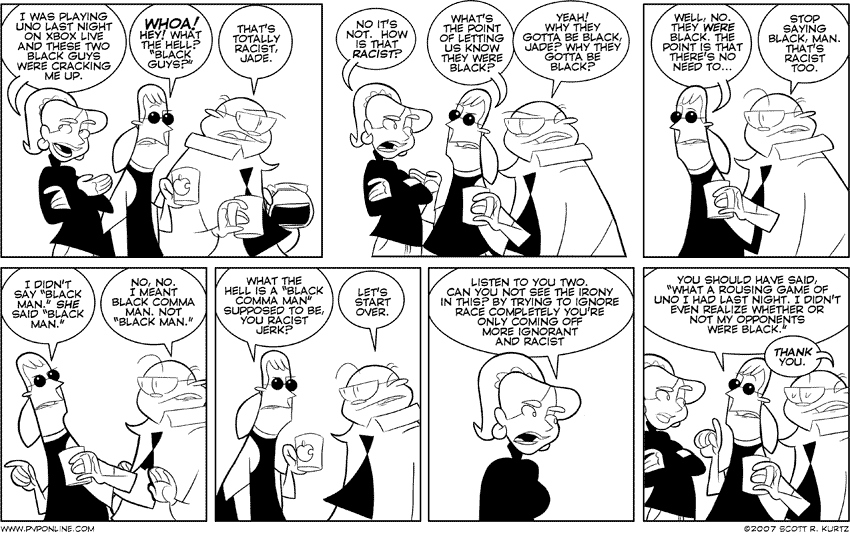
strategic colorblindness

Ignoring the obvious does not equal social change or justice.  It’s simply a detrimental sweeping under the rug and ignoring of the elephant.  I think that the only way to achieve true color blindness, is to work through the complex and intricate web of color consciousness that has been the way of the nation from day one.  And to work through it we have to dialogue about it.  Honestly.

Seeing race and seeming racist? Whites go out of their way to avoid talking about race

White people – including children as young as 10 — may avoid talking about race so as not to appear prejudiced, according to new research. But that approach often backfires as blacks tend to view this “colorblind” approach as evidence of prejudice, especially when race is clearly relevant. These results are from two separate sets of experiments led by researchers from Tufts University and Harvard Business School. Their findings are reported in the October issue of the Journal of Personality and Social Psychology and the September issue of Developmental Psychology. Both journals are published by the American Psychological Association.

“Efforts to talk about race are fraught with the potential for misunderstandings,” said the studies’ lead author, Evan Apfelbaum, a PhD candidate at Tufts University. “One way that whites try to appear unbiased is to avoid talking about race altogether, a tendency we refer to as strategic colorblindness.”

In one study, 101 white undergraduate students were paired with either a white or black female partner who pretended to be another participant. The pairs were presented with 30 photographs of faces that varied in race, gender and background color. Each white participant’s objective was to guess which of the photographs the partner was holding by asking as few yes-or-no questions as possible.

Even though asking about the race of the person in the photograph was a sound strategy for completing the task, white participants were far less likely to do so with a black versus a white partner. Moreover, when the black partner was the first one to have a turn asking questions, whether she mentioned race had a dramatic effect. White participants whose black partner asked about race mentioned race on their own turn 95 percent of the time. When the black partner never asked about race, white participants only did so 10 percent of the time.

“There was clear evidence the white participants’ behavior was influenced by the precedent set by their partner, but especially when that partner was black,” said Samuel Sommers, assistant professor at Tufts and co-author of both papers. “Whites are strategically avoiding the topic of race because they’re worried that they’ll look bad if they admit they notice it in other people.”

The researchers also wanted to see how outsiders interpreted such interactions. In another experiment, 74 black and white college students evaluated videos of whites engaging in the photo task. The results showed that whites’ effort to appear colorblind backfired. Black observers rated whites’ avoidance of asking about race as being evidence of prejudice. What’s more, when the researchers showed silent video clips of whites from the study to another group of individuals, those whites who avoided asking about race were judged as less friendly, just on the basis of their nonverbal behavior.

“The findings suggest that when race is clearly relevant, whites who think that it is a wise social strategy to avoid talking about race should think again,” said Apfelbaum.

Even children appear to adopt this strategically colorblind approach. In another set of experiments, 101 white children between the ages of 8 and 11 were asked to perform a similar photo task. The children were told that asking as few yes-or-no questions as possible would mean they would get a higher score on the task.

The results showed that the older children, ages 10 and 11, avoided asking about race more than the younger children, even though this led them to perform less efficiently than their younger counterparts on the task. In a control version where all the faces in the photos were white, the older children outperformed the younger children, as expected. “This result is fascinating because it shows that children as young as 10 feel the need to try to avoid appearing prejudiced, even if doing so leads them to perform poorly on a basic cognitive test,” said Kristin Pauker, a PhD candidate at Tufts and co-author of this study.

The authors associated with both studies said their findings offer several important implications. “Our findings don’t suggest that individuals who avoid talking about race are racists,” Apfelbaum explained. “On the contrary, most are well-intentioned people who earnestly believe that colorblindness is the culturally sensitive way to interact. But, as we’ve shown, bending over backward to avoid even mentioning race sometimes creates more interpersonal problems than it solves.”

SOURCE

click to enlarge