
Reply

I was pained by this headline, but upon reading the article wasn’t as offended as I’d prepared myself to be. There’s a lot of history behind this pain, and I won’t ask anyone not to feel it or to ignore it. That would be detrimental to our progress. I’m glad Jill Scott has put this out there in this way. I wonder, though, if her soul burns when she sees a not-so-successful black man with a white woman. The history is the same and the choice sends the same message wealthy man or not, right? Anyhow, I think we need to dialogue about this so that we’re clear on where these pains and hurts originate, so that eventually the love a person lives will speak to his soul’s credibility. Not the color of the love a person lives.
Jill Scott ‘pained by mixed-race couples’
Jill Scott has reportedly said that her “soul burns” every time she see a “successful black man with a white woman”.
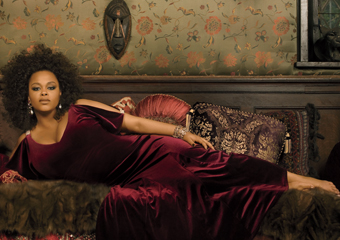
In an interview with Essence magazine, the R&B-soul singer-songwriter said that she wished that a male, African-American friend was married to a black, rather than a Caucasian, woman.
Scott wrote: “My new friend is handsome, African-American, intelligent and seemingly wealthy. He is an athlete, loves his momma, and is happily married to a white woman. I admit when I saw his wedding ring, I privately hoped. But something in me just knew he didn’t marry a sister. Although my guess hit the mark, when my friend told me his wife was indeed Caucasian, I felt my spirit wince. I didn’t immediately understand it. My face read happy for you. My body showed no reaction to my inner pinch, but the sting was there, quiet like a mosquito under a summer dress.”
She continued: “Was I jealous? Did the reality of his relationship somehow diminish his soul’s credibility? The answer is not simple. One could easily dispel the wince as racist or separatist, but that’s not how I was brought up. I was reared in a Jehovah’s Witness household. I was taught that every man should be judged by his deeds and not his colour and I firmly stand where my grandmother left me. African people worldwide are known to be welcoming and open-minded. We share our culture sometimes to our own peril and most of us love the very notion of love. My position is that for women of colour, this very common “wince” has solely to do with the African story in America.”
Scott added: “Our minds do understand that people of all races find genuine love in many places. We dig that the world is full of amazing options. But underneath, there is a bite, no matter the ointment, that has yet to stop burning. Some may find these thoughts to be hurtful. That is not my intent. I’m just sayin’.”


Excerpted from Pema Chodron’s “The Answer to Anger & Aggression is Patience”, Shambhala Sun, March 2005.
That’s what it’s like with aggression: you can’t speak because everyone will feel the vibes. No matter what is coming out of your mouth, it’s like you’re sitting on top of a keg of dynamite and it’s vibrating.
Patience has a lot to do with getting smart at that point and just waiting: not speaking or doing anything. On the other hand, it also means being completely and totally honest with yourself about the fact that you’re furious. You’re not suppressing anything—patience has nothing to do with suppression. In fact, it has everything to do with a gentle, honest relationship with yourself. If you wait and don’t feed your discursive thought, you can be honest about the fact that you’re angry. But at the same time you can continue to let go of the internal dialogue. In that dialogue you are blaming and criticizing, and then probably feeling guilty and beating yourself up for doing that. It’s torturous, because you feel bad about being so angry at the same time that you really are extremely angry, and you can’t drop it. It’s painful to experience such awful confusion. Still, you just wait and remain patient with your confusion and the pain that comes with it.
Patience has a quality of enormous honesty in it, but it also has a quality of not escalating things, allowing a lot of space for the other person to speak, for the other person to express themselves, while you don’t react, even though inside you are reacting. You let the words go and just be there.
This suggests the fearlessness that goes with patience. If you practice the kind of patience that leads to the de-escalation of aggression and the cessation of suffering, you will be cultivating enormous courage. You will really get to know anger and how it breeds violent words and actions. You will see the whole thing without acting it out. When you practice patience, you’re not repressing anger, you’re just sitting there with it—going cold turkey with the aggression. As a result, you really get to know the energy of anger and you also get to know where it leads, even without going there. You’ve expressed your anger so many times, you know where it will lead. The desire to say something mean, to gossip or slander, to complain—to just somehow get rid of that aggression—is like a tidal wave. But you realize that such actions don’t get rid of the aggression; they escalate it. So instead you’re patient, patient with yourself.

So here’s what came from my search for more on Isabella Fowler. In these paragraphs excerpted from Black Slaveowners: free Black slave masters in South Carolina, 1790-1860 by Larry Koger we see where the intraracial divide between mulattoes and “negroes”started. I must admit that I am disappointed (to say the least) in the behavior of these privileged “biracials.” I cannot defend the behavior. Don’t want to. On the other hand, it’s easy for me to sit in judgement in the year 2010 when my freedom and my opportunity for advancement are not on the line. I would love to believe that back then, were I given the choice I would free my people. That I would not see myself as separate from or better than, and that the only privilege I would take advantage of would be the one by which I could exercise my right to right some wrongs and provide an opportunity for others to be liberated and elevated alongside me. I would love to believe that… but circumstances were different and I can’t possibly know how I would have behaved. I do know that none of those attitudes/ideals have taken root in me, yet the accusations continue to be hurled and conclusions jumped to. All of that being said, it’s 2010 and the time for ridding ourselves of these old paradigms of house slaves vs. field hands is long overdue. Maybe by 2012… according to Willie Lynch (perhaps a mythical “legend”) that’s when the stronghold of slave conditioning will lose it’s grip.

The mulatto children of slave masters, who were accepted as legitimate heirs, held a position in the household of their fathers which placed them in a superior status over the other slaves. These children were accustomed to the master-slave relationship; however, they conceived of themselves not as slaves but slave masters. In spite of the fact that they were of African descent, the white blood that ran through their veins separated them from their fellow black slaves on the estates of their fathers. For example, the children of Michael Fowler, a white planter of Christ Church Parish, and his black companion named Sibb were raised in an environment which condoned slavery. According to Calvin D. Wilson, in 1912, “there was a rich planter in Charleston named Fowler who took a woman of African descent and established her in his home…. There was a daughter born, who was called Isabella; the planter insisted that she should be known as Miss Fowler.” Clearly Michael Fowler expected his slaves to serve and regard his mulatto children as thought they were white. So the offspring of Fowler were treated as little masters and mistresses by the slaves of their father.
In fact, the process of cultural assimilation was so complete that the children of Michael Fowler, once reaching maturity and inheriting their father’s plantation and slaves, chose to align themselves with the values of white slaveowners rather than embracing the spirit of freedom and liberty espoused by the abolitionists. In 1810, the estate of the deceased Michael Fowler was divided among his mulatto children…. When the descendants of Michael Fowler received their slaves, manumission was still the privilege of the slaveowners; however, none of the heirs chose to emancipate their slaves… Undoubtedly, the children of Michael Fowler considered slavery a viable labor system and chose to hold their slaves in bondage.
Mulatto children were not always acknowledged as the offspring of white slaveholders. However, upon the death of their owners, they occasionally were manumitted and provided for once freed. These children probably were unaware of the bond of kinship to their owners. Yet that bond allowed them to receive preferential treatment from their slave masters. The unknowing mulatto offspring of white slaveowners often were trained as house servants or artisans. Although they were not acknowledged as the children of slave masters, their encounter with the culture of their masters influenced them to become slaveowners.
In fact, the slaves of both mixed and unmixed racial heritage who served as house servants or artisans accepted certain aspects of the culture of white slaveowners. Regrettably, the close interaction with the Southern culture influenced many slaves to identify with their owners. For the house slaves, the contact with their masters and mistresses perpetuated the difference between themselves and the majority of the slaves who tilled the soil. The house servants were taught to consider themselves superior to the common field hands. Furthermore, the house slaves’ conception of superiority was reinforced by their dress, food, and housing, which was slightly better than that given to the field hands. So it was that they separated themselves from the field slaves and occasionally accepted the values of their slaveowners and looked upon slavery as a justified institution. As a consequence, they envied the life of splendor that their owners enjoyed and viewed slavery as a means of obtaining the luxuries possessed by their masters.


I wanted to know more about this “colored slave owner” after reading that small bit about him in the gullah tour article. There is more information out there than I’d expected. I wish I could see a photograph of his Caucasian and Indian (American) parents. The New York Times article truly fascinates me. First of all, I’d love to know who wrote it! Secondly, it’s nice to hear (although there’s nothing nice about the sick and twisted system) that there were legitimate and acknowledged mulatto children. But that nice feeling quickly disappeared when I searched for more information on Isabella. I’ll include that in a separate post.
![[Richard DeReef]](https://i0.wp.com/www.gullahtours.com/_derived/dereef.jpg)

IMAGE: ON RIGHT — Richard Edward Dereef (1798-1876), a free black wood factor and real estate investor, built this small two story frame single house sometime after he purchased the site in April, 1838. The site was part of a large lot, extending to Calhoun Street, on which Dereef erected several buildings, of which only this house remains. Dereef, a native Charlestonian, was one of the wealthiest men of the free black community. He and his son, Richard, Jr., had a wood factorage business on Dereef’s Wharf at the foot of Chapel Street, and lived nearby on Washington street. By 1867 Dereef had conveyed this property, apparently built for rental purposes, to Margaret Walker, a black woman.
(Stockton, unpub. MS.) SOURCE
May 26, 1907, Sunday
To the Editor of the New York Times:
Truth is stranger than fiction, and had not the information of the ownership of slaves by colored citizens of Charleston, and elsewhere, been sent forth by such an authority as The News and Courier, the statement would have been regarded as incredible. But The News and Courier has not stated nearly all the truth which is, according to your confession, surprising to you, and, according to your belief, surprising to many others in the North.
The prevalent views, State documents, Congressional debates, and lecture courses bearing upon the general subject render it difficult of belief that the proclamation of emancipation by Mr. Lincoln reduced many colored people of the South, and especially in the City of Charleston, from a state of affluence and competence to a condition of need, if not of poverty.
But such was the case.
Those slave owners were not called “negroes,” but “colored people,” as they were generally of mixed blood- sometimes of Caucasian and African; sometimes of Caucasian and Indian; (American.) Many of the colored people of Charleston had no African blood whatever. The question you ask, and The News and Courier failed to answer, is: How did those people come into possession of their slaves- by inheritance, gift, or purchase? The answer is, By all these ways. They were generally the children of rich planters who, in the early days of the coast settlements, established themselves in lower South Carolina, with Charleston as the centre of operation. These children were regarded as such, and not as illegitimate of slaves. They bore the name of the father with recognition and as by right. They were also educated.
Upon the death of the father these children would come, by inheritance, into possession of the estate, including beasts of burden, slaves, etc. There was a very large number of free colored people in Charleston in the eighteenth century.
An interesting article on this subject may be found in the January issue of The Southern Workman. Some of those who owned slaves in years before the war were by name De Reefs, McKinlays, Westons, Hollaways, Thornes, and Howards. There are descendants of some of those people in New York and Brooklyn to-day. There is information enough at hand on this subject to fill a book, but let me relate you one story which may prove interesting.
There was a rich planter in Charleston of the name of Fowler. He took a woman of African descent and established her in his home. Whether there were a pledge of relationship or form of ceremony is not of record, but it was known that he had no other family. There was a daughter born in that home to whom was given the name of Isabella. But the planter insisted upon it that all persons should know her as Miss Fowler. She grew to womanhood, and was married to Richard De Reef, a young man of Caucasian-Indian blood. At the time of her marriage her father presented to her as a wedding gift a plantation and a sufficient number of slaves to work it.
The News and Courier says that two colored Charlestonians had each fourteen slaves, but the records of the family showed that at emanicpation Mrs. Isabella De Reef liverated forty instead of fourteen.
In another thing the News and Courier is wrong- that is, in saying those free persons of color had no political privileges. The De Reef brothers- Richard and Joseph- born, respectively, in 1798 and in 1802, voted on reaching their majority, and ever after. Some others may have enjoyed the same privilege, but there are colored men in Charleston to-day, and some now living elsewhere, who could claim the right to vote on the “grandfather clause”; these were never enfranchised by an amendment to the Constitution of the United States.
A former Charlestonian.
New York, May 23, 1907.
click HERE for a link to a copy of the original NYTimes article

 mulatto diaries