It’s official! Mulatto Diaries: The Movie will be screened this summer at the Mixed Roots Film & Literary Festival! I’m so excited! It’ll be shown Saturday June 13th at the Japanese American National Museum in Los Angeles. Go to www.mxroots.org for more details! If you can, make a tax deductible donation while you’re there. Then book a flight and come to L.A. to see my movie. Please.
symmetry
I came across this article a while ago and have been thinking about it a lot since that “Plight of Mixed-Race Children” post a few days ago. I am generally still offended by that Freakonomics blog article, but maybe it’s a harsh reality that I don’t want to acknowledge. The study Levitt spoke of did have just over 90,000 participants. The “more attractive” thing really stuck out to me as being inappropriate. Then I remembered reading about this UCLA study…
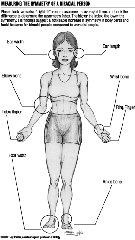
11-05-2002
(Daily Bruin) (U-WIRE) LOS ANGELES — A recent study by University of California — Los Angeles Assistant Adjunct Professor of Biology Jay Phelan concluded that biracial people are perceived as more attractive than “uniracial” people because they have more symmetric features.
Symmetry, according to Phelan, reflects an organism’s developmental stability and is strongly associated with longevity, health and fitness….
Symmetry, he found, was greater in heterozygous organisms. In other words, organisms are more symmetrical – and therefore potentially more “fit” – when their genes have two different alleles (for instance, one dominant allele and one recessive allele rather than two dominant or two recessive alleles).
Crossing organisms from different populations, he believed, would result in “hybrid vigor.” The theory was that their heterozygosity was making them stronger and healthier.
Genes produce enzymes that assist in bodily processes. When two slightly different enzymes are produced by heterozygous genes, the organism is “covered under a wider range of conditions,” he said.
Most humans are heterozygous in about 20 percent of their genes.
Assuming that biracial people are more heterozygous since they come from different populations (despite the debate surrounding the relative amounts of genetic variation within and among populations), Phelan started by measuring the symmetry of 99 UCLA student volunteers who were either biracial or uniracial.
Biracial people were defined as those whose mother and father were of different races, but each of their parents were uniracial. Both parents of the uniracial subjects were of the same race.
Phelan’s study concluded that biracial people were significantly more symmetrical than “uniracial” people. All 25 of the least symmetrical subjects were from uniracial groups, which were either Asian, black, Hispanic or white. Seven of the eight most symmetrical subjects were from biracial groups (Hispanic-white, Asian-white, black-white or Asian-Hispanic).
In addition, Phelan found that symmetry was about the same for all uniracial people no matter which group they were in, and about the same for all biracial people, regardless of racial background.
Phelan, however, did not want to stop merely with symmetry. He hypothesized that those who were more symmetrical would also be perceived as more attractive.
To determine attractiveness, 30 people then rated photos of the subjects who had been measured for symmetry on attractiveness, ranking them from one to seven (seven being the highest).
The results: Biracial people were perceived as significantly more attractive than “uniracial” people.
Emily Shin, a third-year psychology student and president of the UCLA Hapa Club, appreciates Phelan’s work.
“I think that it’s really great that people are doing research on hapa people, generally a group that’s marginalized,” Shin said.
She added, however, that there is some dissent in the hapa community about research like Phelan’s, which perpetuates the stereotype that hapas are on average, more attractive people.
“It makes hapa people, especially hapa girls, feel very objectified,” Shin added…..
David Zisser. “Study indicates mixed race, physical symmetry correlate.” University Wire. 2002.
I don’t know what I think of all this just yet. Right now I’m thinking, “If a majority of mixed-race children are struggling as Levitt’s article (which i initially brushed off as ridiculous mostly because of the attractiveness issue) suggests, then we need to help them because it doesn’t have to be that way.”
again with the monkeys
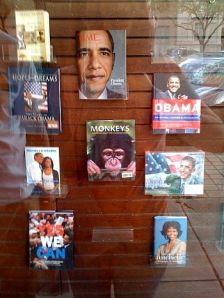
a barnes & noble window display…

Circulating via email, a photo taken of a window of the Barnes & Noble bookstore in Coral Gables, Florida featuring a display of Barack Obama books into which a book named ‘Monkeys’ has been inserted.
Official statement from Barnes & Noble, Inc.:
Barnes & Noble would like to publicly apologize for what happened in our Coral Gables, Florida store. We believe that a customer played a cruel joke and placed an inappropriate title in the front window of our store, where we were featuring books written by or about President Obama. We want to assure our customers that the book placed by someone other than our booksellers was never intended to be included in our display and was removed as soon as we became aware of the situation. We are looking into it and are taking the steps necessary so that it does not happen again. From time to time customers will move titles from one area of the store to another. In this particular case, we do not condone whatever message may have been intended with the placement of this title in our Presidential display. It certainly was not part of our merchandising and we regret that we didn’t see the placement of this title immediately.
Mary Ellen Keating, Spokesperson
Barnes & Noble, Inc.
sorry mary ellen. i’ve actually been to a barnes & noble before, and i highly doubt that some stealth customer squeezed unnoticed into the window display and made the old switcheroo.
twistori
i don’t twitter (or is it i don’t tweet on twitter?), but i am now officially obsessed with twistori!

Josh Catone of ReadWriteWeb.com describes the site so well…
Twistori, according to the site, is the “first step in an ongoing social experiment.” Twistori pulls tweets from Twitter containing specific keywords: i love, i hate, i think, i believe, i feel, and i wish. It then publishes the tweets it finds anonymously in a non-stop, auto-updating river of news. The result is a continuous stream of feelings from the Twitter community….. a stream of consciousness view of the Twitter emotional landscape.
right now i am glued to the wishes of twitterers. recent favs-
“i wish i had the guts to go to the store in my robe. but i don’t think i do.”
“i wish my mind had the courage to stop tearing me down. goodnight.”
“i wish my name was ariola.”
you can check it out at www.twistori.com.
plight?
Thanks to The Topaz Club this offensive NYTimes Freakonomics blog post (dated 8/12/08) was brought to my attention…
The Plight of Mixed-Race Children
By STEVEN D. LEVITTWhat’s it like to grow up with one parent who is black and another who is white?
In a recent paper I co-authored with Roland Fryer, Lisa Kahn, and Jorg Spenkuch, we look at data to try to answer that question. Here is what we find:
1) Mixed-race kids grow up in households that are similar along many dimensions to those in which black children grow up: similar incomes, the father is much less likely to be around than in white households, etc.
2) In terms of academic performance, mixed-race kids fall in between blacks and whites.
3) Mixed-race kids do have one advantage over white and black kids: the mixed-race kids are much more attractive on average.
The really interesting result, though, is the next one.
4) There are some bad adolescent behaviors that whites do more than blacks (like drinking and smoking), and there are other bad adolescent behaviors that blacks do more than whites (watching TV, fighting, getting sexually transmitted diseases). Mixed-race kids manage to be as bad as whites on the white behaviors and as bad as blacks on the black behaviors. Mixed-race kids act out in almost every way measured in the data set.
We try to use economic theory to explain this set of facts. I can’t say we are entirely successful. If we had to pick an explanation that best fits the facts, it would be the old sociology model of mixed-race individuals as the “marginal man”: not part of either racial group and therefore torn by inner conflict. One reason this model is largely consistent with our facts is because it makes so few strong predictions that it is hard to falsify, which isn’t really fair to the competing models.
http://freakonomics.blogs.nytimes.com/2008/08/12/the-plight-of-mixed-race-children/
My jaw dropped.
Then I wrote this…
Mr. Levitt,
I was deeply offended by your “Plight of Mixed-Race Children” blog post. Clearly the “tragic mulatto” was already a joke to you when you set out to determine how the young ones are doing. First of all, the “more attractive” stereotype is becoming as irritating to me as the blacks and fried chicken thing. If you took this seriously you would look beyond that to find out if those “attractive” children perceived themselves that way. Or did they feel physically flawed somehow because they did not fit in easily with either their black or white counterparts. Did their peers regard them as attractive? I believe that this more attractive thing comes in to play after adolescence and should have had no place in your “study”.
You also seem to believe that all of these young black and white people have white mothers and black fathers. Black fathers being absent and poor, generally leaving white mothers on their own to care for their children in lower class surroundings. That’s what I infer from this crappy post. Come the f*** on! Many biracials have a white father and a black mother. Did the possibility of that even cross your mind? I am left to assume that this white man, Steven D. Levitt, wouldn’t dream of procreating with a black woman and that you judge the white men who would as somewhat less than yourself.
Where on Earth did you get your “data”? What questions exactly were you trying to answer? Why not interview biracial adults about their adolescent experience? Why do you even care what it’s like to grow up black and white? Clearly you do not.
I am 32. I have a black mother and a white father. I grew up in the wealthy suburbs of Detroit. I excelled academically and artistically. I earned a full-ride to the University of Michigan without trying very hard. During my adolescent years I did not have sex, a cigarette, a sip of alcohol, or get into a fight. I did not come away from my adolescent experience thinking “That was kind of rough, but as least I am more attractive than all those ‘monoracial’ kids.” I have a vlog on youtube called “mulatto diaries”. Should you someday find that you truly care to know what it is like to grow up in America with a black and a white parent, watch it. You will find the stories of many other biracial people there. You don’t have to take only my word for it.
fyi: I’ll be posting this on my blog mulattodiaries.wordpress.com.
Sincerely,
Tiffany Jones
double standard?
A couple of weeks ago I happened upon this place in Harlem….

Obama Fried Chicken!?!? I was kind of shocked by it, and expected to hear about a little protest or something. Aren’t we trying to combat these stereotypes?
Then, two days ago I saw this on the aol homepage…
A German company has introduced a new line of frozen snacks called “Obama-Fingers”. After receiving some negative attention, the Sprehe company claimed to be unaware of the stereotype that African Americans LOVE fried chicken, and stated that they only wanted it to be thought of as an American-style snack. Side note: We wouldn’t dip our fingers in curry sauce. I like ranch dressing. Some like to use bbq sauce, blue cheese dressing, or honey mustard for dipping. That’s pretty irrelevant, I’m just sayin’. What is relevant tho is the stereotyping issue. It’s ok for blacks to perpetuate the stereotype, but not for the Germans? In my opinion, if we want to get rid of the stereotype, it isn’t ok for anyone to perpetuate it.
belated
oh, yeah! i have a blog….
I know it’s 2 days late and I made a video about it, but i’m not through with St. Patrick’s Day yet. That day I watched Good Morning America as usual. Diane Sawyer brought up the fact that Obama is Irish. As if she could hear chuckling across the country, she said something like, “No really. Through his mother’s lineage…” That’s kinda how I always felt as a kid. Like, I know everyone’s a little Irish today, but I’m REALLY Irish everyday. You just don’t see it.
Also, I really love St. Patrick’s prayer. I used to say it every morning. Not when I was a kid, but like 4 or 5 years ago. Here it is…
I arise today
Through God’s strength to pilot me;
God’s might to uphold me,
God’s wisdom to guide me,
God’s eye to look before me,
God’s ear to hear me,
God’s word to speak for me,
God’s hand to guard me,
God’s way to lie before me,
God’s shield to protect me,
God’s hosts to save me
Afar and anear,
Alone or in a mulitude.
Christ shield me today
Against wounding
Christ with me, Christ before me, Christ behind me,
Christ in me, Christ beneath me, Christ above me,
Christ on my right, Christ on my left,
Christ when I lie down, Christ when I sit down,
Christ in the heart of everyone who thinks of me,
Christ in the mouth of everyone who speaks of me,
Christ in the eye that sees me,
Christ in the ear that hears me.
I arise today
Through the mighty strength
Of the Lord of creation.
That’s the part I used to say anyway. There’s more depending on the version you’re reading.
watermelons!?
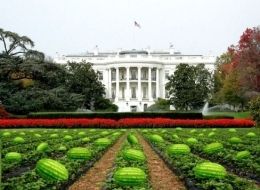
In case you hadn’t heard, Dean Grose, the mayor of Los Alamitos, CA, sent out an email containing this picture with the caption “No Easter Egg Hunt this year.”
Apparently he was “unaware of the racial stereotype that black people like watermelons.” Puh-Leeze! That’s just gross, Grose. I’m glad these stereotypes are coming to light though. It’s hard to deny that they exist when they keep popping up all over the place.
jennifer beals
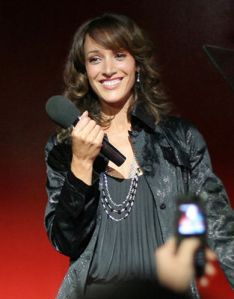
I can’t believe I’ve had a blog for however long I’ve had this blog, and have not yet mentioned Jennifer Beals. Well, the time has come! Here is a quote from an article in H Monthly Magazine…

“Once one part of the collective sees themselves represented and is given permission to celebrate their own authenticity, then it helps the rest of the collective to see how everyone is connected,” she reasons. “It behooves all of us to have everyone experience their deepest, most beautiful, most profound and powerful self, because those people are more apt to give their gift to everyone else rather than shudder in fear….There used to be whole realms of people who weren’t talked about—whose very existence didn’t seem worthy subject matter for pop culture. Now that’s starting to change a little bit.”
I honestly don’t know anything about H Monthly Magazine, but I thoroughly enjoyed the article and my love and admiration for this biracial lady grew maybe like two sizes when I read it.
heart

Happy Valentine’s Day! I’m not a big believer in this Hallmark holiday, but will take the opportunity to reflect on the fact that we are all part of the human heart. That’s what the mulatto diaries is all about. On this Valentine’s day my heart goes out to the families of those who lost their lives on Flight 3407.