
5


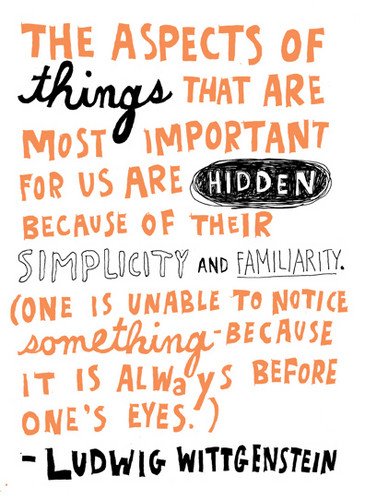
Here’s more of the article I excerpted from last Sunday…
By Pema Chödrön
Let’s say you’re having a conversation with someone. You’re one with the whole situation. You’re open and receptive and there and interested. Then there is a little shenpa pulling-away, a kind of uneasy feeling in the stomach—which we usually don’t notice—and then comes our big thought. We are suddenly verbalizing to ourselves, “How am I looking here? Did I just say something stupid? Am I too fat? That was a stupid thing to say, wasn’t it, and I am too fat….”
Some thought or other causes us to split off, and before we know it we’re completely self-absorbed. We’re probably not even hearing the words of the person we’re conversing with, because we have retreated into a bubble of self-absorption. That’s splitting off. That’s dividing in two.
The Buddha taught about this basic split as the birth of dualism, the birth of self versus other, of me versus you. It happens moment after moment. When we start out, we are “one-with.” We have a sense of our interconnectedness, though we might not use that fancy word. We’re simply listening and there. And then, split! We pull back into our own worry or concern or even our own elation. Somehow we’re no longer together. Now it’s more about me and self, rather than them and other. By contrast, being “one-with” is neither about other nor about self. It’s just totally open, present, there.
Settling the Score
If the path of the peacemaker, of happiness, is being open and receptive and one with your experience, then settling the score is the path of making war, whereby aggression gives birth to aggression and violence gives birth to violence. Nothing is settled. Nothing is made even. But the mind of settling the score does not take that into consideration. When you are caught by that mind, because of the highly charged and ever-expanding emotionality you’re going through, you do not see what settling the score is really doing. You probably don’t even see yourself trying to settle the score.
If we started to think about and talk about and make an in-depth exploration of the various wars around the world, we would probably get very churned up. Thinking about wars can indeed get us really worked up. If we did that, we would have plenty of emotional reactivity to work with, because despite all the teachings we may have heard and all the practice we may have done, our knee-jerk reaction is to get highly activated. Before long, we start focusing on those people who caused the whole thing. We get ourselves going and then at some irrational level, we start wanting to settle the score, to get the bad guy and make him pay. But what if we could think of all of those wars and do something that would really cause peace to be the result? Where communication from the heart would be the result? Where the outcome would be more together rather than more split apart?
In a way, that would really be settling the score. That would really be getting even. But settling the score doesn’t usually mean that. It means I want my side to win and the other side to lose. They deserve to lose because of what they’ve done. The side that I want to lose can be an individual in my life or a government. It can be a type or group of people. It can be anything or anyone I point the finger at. I get quite enraged thinking about how they’re responsible for everything, so of course I want to settle the score. It’s only natural.
We all do this. But in so doing we become mired in what the Buddhist teachings refer to as samsara. We use a method to relate to our pain. We use a method to relate to the underlying groundlessness and feelings of insecurity. We feel that things are out of control, that they are definitely not going the way we want them to go. But our method to heal the anguish of things not going the way we want them to is what Dzigar Kongtrul Rinpoche calls pouring kerosene on the fire to put it out.
We bite the hook and escalate the emotional reactivity. We speak out and we act out. The terrorists blow up the bus and then the army comes in to settle the score. It might be better to pause and reflect on how the terrorists got to the place where they were so full of hatred that they wanted to blow up a bus of innocent people. Is the score really settled? Or is the very thing that caused the bus to be blown up in the first place now escalating? Look at this cycle in your own life and in your own experience. See if it is happening: Are you trying to settle the score?





Mrs. H.A. Deming spent a year assembling lines from 38 English and American poets into this mosaic verse, published originally in the San Francisco Times in the 19th century:
“Life”
Why all this toil for triumphs of an hour? [Young]
Life’s a short summer–man is but a flower. [Dr. Johnson]
By turns we catch the fatal breath and die; [Pope]
The cradle and the tomb, alas! how nigh. [Prior]
To be better far than not to be, [Sewell]
Though all man’s life may seem a tragedy; [Spencer]
But light cares speak when mighty griefs are dumb– [Daniel]
The bottom is but shallow whence they come. [Sir Walter Raleigh]
Thy fate is the common fate of all; [Longfellow]
Unmingled joys here no man befall; [Southwell]
Nature to each allots his proper sphere, [Congreve]
Fortune makes folly her peculiar care. [Churchill]
Custom does often reason overrule, [Rochester]
And throw a cruel sunshine on a fool. [Armstrong]
Live well; how long or short permit to Heaven. [Milton]
They who forgive most shall be most forgiven. [Bailey]
Sin may be clasped so close we cannot see its face– [French]
Vile intercourse where virtue has no place; [Somerville]
Then keep each passion down, however dear, [Thompson]
Thou pendulum betwixt a smile and tear. [Byron]
Her sensual snares let faithless pleasure lay, [Smollett]
With craft and skill to ruin and betray; [Crabbe]
Soar not too high to fall, but stoop to rise; [Massinger]
We masters grow of all that we despise. [Crowley]
Oh, then, renounce that impious self-esteem. [Beattie]
Riches have wings and grandeur is a dream. [Cowper]
Think not ambition wise because ’tis brave, [Sir William Davenant]
The paths of glory lead but to the grave; [Gray]
What is ambition? ‘Tis a glorious cheat, [Wills]
Only destructive to the brave and great. [Addison]
What’s all the gaudy glitter of a crown? [Dryden]
The way to bliss lies not on beds of down. [Francis Quarles]
How long we live, not years, but actions tell; [Watkins]
That man lives twice who lives the first life well. [Herrick]
Make, then, while yet ye may, your God your friend, [William Mason]
Whom Christians worship, yet not comprehend. [Hill]
The trust that’s given guard, and to yourself be just, [Dana]
For live we how we may, yet die we must. [Shakespeare]

 mulatto diaries