yellow rose of texas

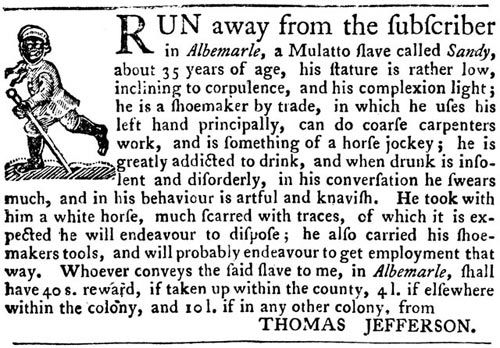
I’ve heard of this song (the first published edition of which was copyrighted by Firth, Pond and Company of New York on September 2, 1858.), but never actually heard the song itself.  I don’t get the feeling that this is the proudest moment in “mulatto history”, but if these are indeed the facts, it was a moment so…

Picture

Group will shed light on minorities’ role in the settling of the West

BY MITCH MITCHELL

Our ancestors kept secrets.

The secrets they kept, and the secrets their parents kept from them, left holes in our histories.

Minorities helped create Texas and the nation and helped tame the West, but they barely get a mention in most history books.

On Tuesday, a group of people who can shed light on that era will gather at the Palace Arts Theater in Grapevine. Author Liz Lawless, along with amateur historians and living-history storytellers Wendell Prince and Rosieleetta Lee Reed, will attempt to fill some of those historical gaps while dressed in period costumes.

Reed specializes in stories about frontier women, like stagecoach driver Mary Fields… But if you take Reed aside and ask, she may tell you a story about Emily D. West, perhaps a hero of the Battle of San Jacinto, who was made famous by a song that historians say had nothing to do with her:  The Yellow Rose of Texas.

Historians are almost certain that West was a free woman of mixed race who migrated from Connecticut to Texas. Documents place her in Galveston in the employ of Col. James Morgan in 1835, and later at the Battle of San Jacinto.

Beyond that, little is known for sure. Santa Anna’s account is that he was asleep when the Texian army attacked and could not rouse himself to stem the ensuing chaos and his army’s ultimate defeat, said Jeff Dunn, amateur historian and an expert on West. Some say they believe that Santa Anna was involved in a dalliance with West at the time of the attack and that she detained him long enough to ensure a Texas victory.

“Some argued that she was his concubine, and some argued that she was a white woman,” Reed said. “She was black. She was contraband.”

Mexican troops burned Morgan’s property in Galveston and captured West and several of Morgan’s servants days before the epic battle.

“The only reason we know this story exists is because William Bollaert wrote about it to a friend, and then tried to tell him to keep it quiet,” Dunn said. “Off to the left-hand margin he writes ‘private’ and he underlines it three times.”

Bollaert wrote the following, stating that this came from a letter written by Houston to a friend, Dunn said.

“The battle of San Jacinto was probably lost to the Mexicans, owing to the influence of a Mulatto girl [Emily] belonging to Col. Morgan who was closeted in the tent with g’l Santana, at the time the cry was made the Enemy! They come! They come! & detained Santana so long, that order could not be restored readily again.”

It was not until the 1950s, when Henderson Shuffler, another amateur historian and later a publicist for Texas A&M University, linked The Yellow Rose of Texas and West forever, according to the Handbook of Texas Online. However, historians believe that the song was written by an African-American man longing for his light-skinned sweetheart and was linked to West erroneously.

Frontier Texas was a very fluid place racially speaking, said Sam Haynes, University of Texas-Arlington history professor and the director of its Center for Southwestern Studies. Marriages between different racial groups are evident in the state’s early history, Haynes said.

SOURCE

the black codes

Northern States had them, too.  I think these things are worth examining.  If we want to know more about why and how things got so out of hand in this country (I mean beyond slavery itself), we retrace our steps back to decrees such as these.

One measure of equality suggested by the British sociologist T.H. Marshall is “citizenship” – the “basic human equality associated with  . . . full membership of a community.”  African American history, from bondage through the civil rights movement, is often seen through the political lens as a struggle for citizenship and full membership in American society.

Legislated repression in post-slavery South

…[I]t shall not be lawful for any freedman, free Negro, or mulatto to
intermarry with any white person; nor for any white person to intermarry
with any freedman, free Negro, or mulatto; and any person who shall so
intermarry shall be deemed guilty of felony and, on conviction thereof,
shall be confined in the state penitentiary for life … — from
Mississippi Black Codes, enacted Nov. 22, 1865

As formerly enslaved Blacks would soon learn, freedom was not as they had
anticipated. White southerners were anxious to regain power over them and
used the law in order to achieve that objective. In 1865, southerners
created Black Codes, which served as a way to control and inhibit the
freedom of ex-slaves. Codes controlled almost all aspects of life and
prohibited Blacks from the freedoms that had been won.

Not only did whites want to control ex-slaves, but also they needed
laborers. While things could no longer be exactly the same as in slavery,
they found a way to guarantee that Blacks would serve as their laborers. To
do this, they created Black Codes. While Codes were unique to the
post-Civil War south, they encompassed some of the antebellum restrictions
on free blacks, northern apprenticeship laws, and the Freedmen’s Bureau and
the War Department regulations. Codes regulated civil and legal rights,
from marriage to the right to hold and sell property to the predestined
definition of Blacks as agricultural laborers.

Laws were different in each state but most embodied the same kinds of
restrictions. Commonly, codes compelled freedmen to work. In many states,
if unemployed, Blacks faced the potential of being arrested and charged
with vagrancy. Many of those that did work had their day regulated. Codes
dictated their hours of labor, duties, and the behavior assigned to them as
agricultural workers.

Black Codes left Blacks with little freedom. The choice of the type of work
was often regulated. Many white southerners believed Blacks were
predestined to work in agriculture. In addition, the advantage of
regulating occupations provided them with laborers. In South Carolina, for
example, a special license and certificate from a local judge, attesting to
a freedman’s skill, had to be obtained before a formerly enslaved person
could earn a living in agriculture or indomestic service.

Self-sufficiency was also discouraged. Codes prevented Blacks from raising
their own crops. In Mississippi, for instance, they were restricted from
renting or leasing any land outside of cities or towns and Black ownership
was left up to local authorities.

Almost every aspect of life was regulated, including the freedom to roam.
Often Blacks were prohibited from entering towns without permission. In
Opelousas, Louisiana Blacks needed permission from their employer to enter
the town. A note was required stating the nature and length of the visit.
Any Black found without a note after ten o’clock at night was subject to
imprisonment. Residency within towns and cities was also discouraged. Local
ordinances in Louisiana made it almost impossible for Blacks to live within
the towns or cities. Residency was only possible if a white employer agreed
to take responsibility for his employee’s conduct.

“This Week In Black History: Legislated repression in post-slavery South.” Michigan Citizen. 2001.

Black Codes in Georgia: 1865–1900

W. E. B. DuBois and his students included a comprehensive hand-written list of the Georgia Black Codes (laws affecting blacks 1865–1900) as part of The Georgia Negro exhibit in order to demonstrate how the law had specifically been used as a tool to discriminate against black people. Three hundred pages of legal material were tediously copied out by hand. DuBois had included a similar compilation of laws affecting the slave trade in his classic 1896 work, The Suppression of the African Slave Trade.

Black codes

Sample pages from DuBois’s list of Black Codes

SOURCE


long awaited unfinished second novel

I remember reading Invisible Man at the University of Michigan and being uncomfortable wanting to discuss the biracial aspect in my African American studies class.  I did it anyway and of course came up against some opposition.  But I held my ground.  That was probably my first clue that this topic and the ensuing debate would become a passion of mine.

‘Important day for American literature’

CU prof helps publish Ralph Ellison’s unfinished novel

The Associated Press

BOULDER — Adam Bradley was a freshman in college and taking an African-American literature course when he first read “Invisible Man,” a novel that vivified America’s racial divide.

The book changed his life.

Ralph Ellison’s classic novel helped Bradley explore the complexity of his own biracial identity.

Adam Bradley is an associate professor of English at the University of Colorado in Boulder.

It also shaped the direction of his career, as Bradley became a writer and scholar — spending 15 years conducting the literary detective workneeded to bring Ellison’s second novel to fruition.

Ellison’s incomplete, posthumous piece “Three Days Before the Shooting … : The Unfinished Second Novel” goes on sale Tuesday (2/2/20).

Bradley, a University of Colorado associate professor, is one of two editors who made the book’s release possible.

In the book, a racist, “white” U.S. senator is assassinated by a black man who, it turns out, is the senator’s son. The senator’s surrogate father, who is black, tries in vain to save the senator.

“I’m feeling this tremendous degree of excitement at the prospect of sharing this book with Ellison’s readers,” Bradley said.

Bradley said he’s received e-mails from people who read “Invisible Man” in the 1950s and have since been waiting for a second book from Ellison.

“It’s an important day for American literature,” Bradley said.

He said that because the novel is incomplete, it prompts readers to become co-creators of the fiction.

“It’s a natural response — when presented with an incomplete story — to complete the story yourselves,” Bradley said. “

At the same time, it presents another opportunity to come to terms with indeterminacy.”

Later this year, Bradley will teach a CU graduate seminar on Ellison, and Yale University Press will publish “Ralph Ellison in Progress,” his critical exploration of Ellison’s fiction.

Ellison died in 1994, leaving behind 27 boxes of manuscript for his second novel that included handwritten notes, typewritten pages and 460-some computer files.

Just two months before his death, Ellison told The New Yorker Magazine that he was working on the second novel and that “there will be something very soon.”

As an undergraduate at Lewis & Clark College in Portland, Ore., Bradley became intrigued with Ellison, whose father died when he was a child.

A character in “Invisible Man” tells the protagonist: “Be your own father, young man.”

The rich theme of father-son relationships struck Bradley, who was raised by his white mother and met his black father for the first time in his 20s.

“Ellison was a clarifying voice for me during that part of my life,” Bradley said.

His professor at Lewis & Clark — John Callahan — happened to be a friend of Ellison’s and executor of Ellison’s estate.

Callahan, impressed with Bradley, asked him to co-edit the second novel.

At age 19, Bradley began cataloging Ellison’s writings. He earned his Ph.D. in English and American literature and language from Harvard University before fully devoting himself to the project.

In 1999, Callahan released a small portion of Ellison’s second novel in a work titled “Juneteenth.”

Today’s release of “Three Days Before the Shooting …” will give readers their first view of the most complete and cohesive version of Ellison’s magnum opus.

SOURCE

dumas disappointment

FRANCE: Race row in France after white actor used to play mixed race French national hero

SOURCE

FURIOUS BLACK campaigners in France have protested after filmmakers used a white actor to play legendary mixed race French writer and national hero, Alexandre Dumas.

In a film called L’Autre Dumas, Gerard Depardieu, who is blond and blue-eyed, was given darker skin and curly hair to play Dumas.

FRANCE: Race row in France after white actor used to play mixed race French national hero

Dumas, the grandson of a Haitian slave and the son of a Napoleonic general, was mocked for his African features even as he created well-loved books such as the Count of Monte Cristo and the Three Musketeers. They are also high grossing hit films.

Patrick Lozès, the president of the Council of Black Associations of France (CRAN) told the Times: “In 150 years time could the role of Barack Obama be played in a film by a white actor with a fuzzy wig? Can Martin Luther King be played by a white?”The filmmakers also reportedly credited a fictional white assistant with creating some of Dumas’ well-loved books, The Times newspaper reported.

The campaigners said they are furious because the film not only uses a white actor, but seems to attempt to discredit Dumas’ genius, further bury his black origins and keep black actors off the screen.

“Possibly for commercial reasons they are whitewashing Dumas in order to blacken him further,” the Council said on its website.

hmmm

Initially upon reading this article I thought, “This is great!  Mixed kids today are fairing better.”  By the third time I read it though, I found it laughable.  As if it’s some great revelation that for these individuals to actually embrace who they quite literally are will yield positive results.  Not just for them, but maybe for everyone! Woweee!! Sounds like common sense to me.  Common enough that I came to that conclusion without doing any studies at all.  Well, I guess in all fairness I studied myself.  Anyway, though I realize that because we have historically not been encouraged to do all of this embracing  the notion may be considered “progressive,” I suppose it’s the assertion that this is merely ‘preliminary evidence’ that’s rubbing me the wrong way.  As if the jury’s still out and maybe we’re better off with the twisted way we’ve been approaching this subject for centuries.  On the other hand, maybe I should just be glad that the studies are being conducted at all.  After all, I still come up against vehement opposition to my choice to identify as biracial daily.  On youtube of course.  Which doesn’t have much affect on me personally, but just goes to show that there’s more embracing to be done and that we’re definitely living in a society that needs some positive results as far as shifting the racial paradigm goes.

Multiracial identity associated with better social and personal well-being

SOURCE

Many people assume that individuals who identify with one race should be better off than multiracial individuals who identify with a mixed race heritage. However, a new study in the Journal of Social Issues found that students who reported they were from multiple ethnic/racial groups were more engaged at school and felt better in general than those who reported they were from a single group. Kevin Binning, Ph.D., Miguel Unzueta, Ph.D., Yuen Huo, Ph.D., and Ludwin Molina, Ph.D., surveyed roughly 180 high school students to see how they were doing in school and how they felt in general: were they experiencing stress, isolation, etc.? The study compared multiracial students who reported being from a single racial or ethnic group (i.e. Black, Mexican, White) with multiracial students who reported they were from various racial and ethnic groups (i.e. multiracial, Black and White, etc.).

On several indicators (i.e. happiness, stress, citizenship behavior, and school alienation), students who reported they were from multiple groups were more engaged in school and felt better than those who reported they were from a single group.

Results suggest there may be a positive link between the tendency to embrace a multiracial identity and social and personal well-being.

“The population of multiracial individuals is currently large and is likely to grow over time,” the authors note. “Our study provides preliminary evidence that encouraging such individuals to embrace their multiracial identity may yield positive results not only for them, but possibly for society more generally.”

even more on adoption

This one isn’t so much about the fact that Biracial and African American children are “hard to place”, but about what they need once they’ve been placed. They need help finding their place.  Relationships are key.  Artifacts, not so much.

New research on multiracial adoption questions current practices

While many people who are adopted by members of another race still identify as black or mixed race, many lack the community and cultural connections with others who share those same identities. New research in the journal Family Process suggests that adopted children of mixed race need early and ongoing experiences within the cultural communities of their origin, and with other multiracial adopted persons, to help them to build healthy cultural identities. The labels black, biracial, multiracial, imply that the transracial adopted child has a healthy sense of that identity and all that it encompasses. Dr. Gina Miranda Samuels, author of a study and a multiracial, transracial adoptee herself, remarks, “we must question the meaning and cultural experiences (or lack thereof) beneath these labels. Furthermore, the idea of ‘colorblindness’ is now challenged as an effective approach in transracial parenting.”

Prior research on transracial adoptees often focused on self-esteem and school achievement in comparison to their non-adopted peers, but not in terms of their cultural sense of belonging. This study explores how transracial adoptees with mixed black-white heritage develop a sense of belonging and connection to their black heritage. Samuels also pays heed to how different racial-ethnic communities, and white adoptive parents, can support the identity development of their child by developing relationships in their child’s racial-ethnic communities.

The author asserts that diverse experiences (not confined to events, books, or dolls) can cause a family to become a truly multicultural as well as multiracial, family, and not a family of white parents with children of color.

Most adoptees interviewed for the study told of their search for their biological black fathers and extended black family in order to feel more deeply connected to their black heritage. This finding emphasizes the importance of culturally grounded relationships over cultural artifacts in identity development. Samuels found that there is often a stigma associated with transracial adoption in communities of color which can in turn diminish the “acceptance” of transracially adopted persons in those communities.

Samuels recommends that social workers and child welfare practitioners raise awareness of the importance of these experiences for transracial adoptees and adoptive families, and recognize both the strengths and challenges embedded in transracial adoption and mixed race identities.

SOURCE

darktown

I’ll never be able to sing “Sleigh Ride” again!  Ever!  Not even with Amy Grant.  Currier & Ives!?  Puh-lease!  I’ll take Norman Rockwell any day.  ANY day.

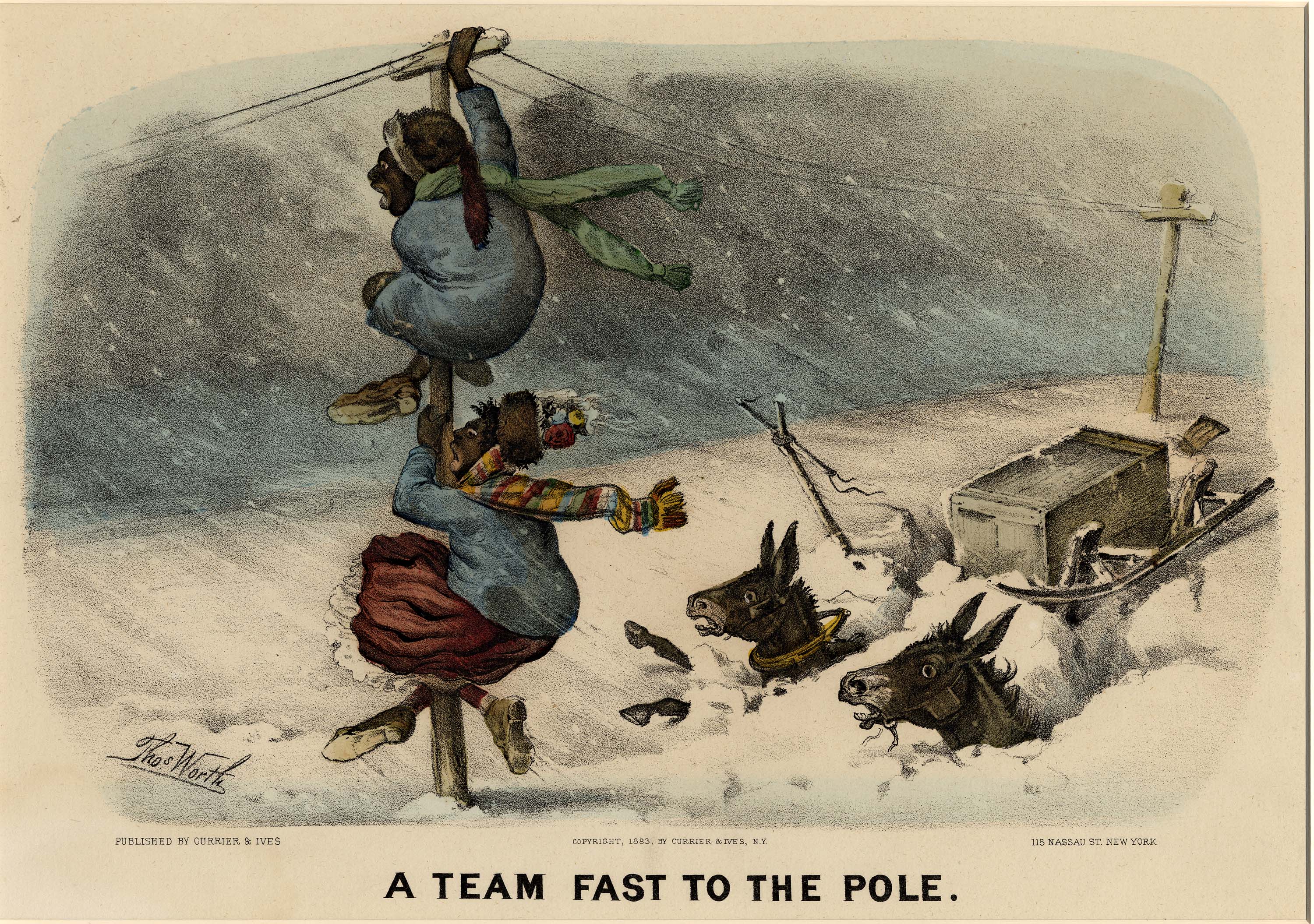
In 1857, Nathaniel Currier, a Massachusetts lithographer, and James Merritt Ives, a self-trained artist and bookkeeper for the business of N. Currier, formed a partnership. The result was the firm of Currier & Ives, which produced three to four prints every week for fifty years – a total of over 7,500 titles. The lithographs produced by the company were published by Currier & Ives, none were actually drawn or lithographed by them. Upon their deaths in 1888 and 1895 respectively, their sons, Edward West Currier and Chauncy Ives, directed the firm until its close in 1907 (American Historical Print Collectors Society).

Previous to the Emancipation Proclamation, Currier & Ives generally depicted blacks as individuals content with their lives and position in society; they were often pictured in the background of idyllic plantation images. Initially after the Proclamation was issued, the firm continued to depict blacks in a positive light, focusing more on individuals, publishing portraits of John Brown, Frederick Douglas, and black Union soldiers fighting for their freedom (222). As time went on, however, and the freedmen began to move north into the cities, it became more apparent that not all Northerners were unanimous in their support of emancipation and the status of the freedman. The political images published by Currier & Ives during this time were vicious attacks against the character and intelligence of blacks, depicting them as unsupportive and disobliging of the political figures who sought to free them, such as Abraham Lincoln, Horace Greeley, and Senator Charles Sumner (226).

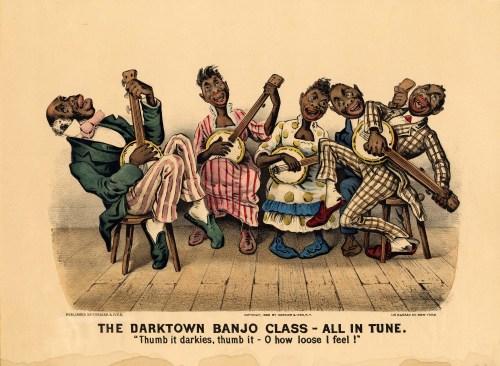
During and after Reconstruction, Currier & Ives, and America it seems, continued to appreciate these negative images of African Americans. Out of this, between the mid-1870s to the early 1890s, the Darktown Comics arose, mostly illustrated by Thomas Worth (1834-1917) and James Cameron (1828-1963). The company described the Comics as “pleasant and humorous designs, free from coarseness or vulgarity, being good natured hits at the popular amusements and excitements of the times”. It has been suggested that Darktown may have “served as satires on polite white behavior as well”, as could be supported by previously positive images of African Americans. Regardless of intent, the prints only reinforced negative racial stereotypes throughout the country.


The caricatures presented by the Darktown Comics consisted of “African Americans performing actions that were more or less normal for ‘ordinary’ folk, meaning whites…the implication being that the African Americans could not execute even the simplest tasks of everyday life without making themselves appear ridiculous”. The most common images depicted by Currier & Ives’ artists were of African Americans attempting to have horse, skull, and sulky races; ride in carriages and yachts; hunt; host lawn parties; play tennis; and fight fires–always with disastrous results. And the depiction of  African American lawyers, doctors and the clergymen as bumbling and dishonest were quite malicious. African American children were also featured in a poor light – as mischievous, out of control, disrespectful hoodlums. This is evident in prints by Thomas Worth such as “A Put Up Job” and “A Fall from Grace” (1883) and “Breaking In: A Black Imposition” and “Breaking Out: A Lively Scrimmage” (1881).


African American stereotypes that still exist today were begun here – the connection of African Americans to music, in Darktown specifically of banjo playing, and of their supposed eating habits, most notable in the Comics, that of eating watermelon. This can be seen in the prints that make up the set of the Darktown Banjo Class and in single prints like “O Dat Watermillion!”. As one can see, African American speech was attacked as well, through phonetic renderings steeped in the distortion of stereotypes and caricature.


The Darktown Comics did not develop or exist in a vacuum, however. In addition to theDarktown prints that came out of this time, Harper’s Weekly featured the Blackville prints; examples of which can be seen at HarpWeek’s exhibition, “Toward Racial Equality:Harper’s Weekly Reports on Black America, 1857-1874 or the Philadelphia Print Shop’sBlackville Prints.” These were similar in content to Darktownspoofs of African American attempts at high fashion, sports, etc. The most prevalent artists of this series were Sol Eytinge, Jr., William Ludwell Sheppard, S.C. McCutcheon and “Sphinx” (Philadelphia Print Shop, Ltd.). Other publications, such as Life, Puck and Judge, as well as Pulitzer’s New York World and Hearst’s New York Journal produced similar images but these were in the context of satire (Hays). Whether or not these images were taken as satire or at face value by the American populous is up for debate, however. Other news and editorial magazines, such as The Outlook and The Independent, also promoted these types of images through their illustrations and advertising—exemplifying the prevalence and acceptance of these racist stereotypes across the country (Hays).


The “high art” of this time, specifically that of southern artists, furthered these stereotypes as well, dehumanizing the African American through their depictions of coal black skin, thick red lips, oversized teeth, and patchwork clothing. It wasn’t until the impact of the Ashcan Society and the period of realism came into play that classical forms of art began to celebrate the figure of the African American as he really appeared. The art of Robert Henry, George Luks, and George Wesley Bellows are forefathers of this new view – a celebration of the African American.

SOURCE

even if others think differently

This is the first thing I’ve read/heard that makes me want to see Avatar.  Not that that’s the point of the article or anything.  I’m just sayin’.

Supa sista!

Richard Barnett

SOURCE

Philly hip-hop poet Ursula Rucker celebrates black history at Montreal’s Festival Voix d’Amériques

Famed poet and Philadelphia native Ursula Desiré Rucker cannot believe she has never been invited to perform at an event during Black History Month. Ever.

Until now.

“It’s the weirdest thing,” says Rucker, who headlines Montreal’s internationally renowned Festival Voix d’Amériques next week. “Growing up, my family joked it was the shortest month of the year. But today, for me, [Black History Month] is all year long.”

Rucker shot to fame in 1994 after she nervously stood before an audience on open-mic night at Zanzibar Blue in Philly, the City of Brotherly Love most folks these days call “Killadelphia.”

…In many ways, Rucker has become the hip-hop nation’s Maya Angelou – if Angelou’s words were stamped “Explicit lyrics.”

But Rucker isn’t R-rated so much as she is brutally frank about issues ranging from womanhood and slavery to love and politics. For instance, right now many blacks are deeply insulted by John Cameron’s movie Avatar, basically a racist piece of s*** white folks have made the top-grossing film of all time.

Avatar is yet another “white messiah” fable – much like the films A Man Called Horse,Dances With Wolves and At Play in the Fields of the Lord – and Rucker is having none of it.

“The most important thing I try to impress upon my children each and every day is to be who you are even if others think differently,” says Rucker, a married mother with four sons aged 5 to 15. “We went to see Avatar and it was the same old story as Pocahontas: The oppressor comes in and makes everything better. I don’t Facebook much, but I had to post something! My 11-year-old son was like, ‘Must you always be ranting about something!’ But if I don’t speak my mind, then that’s not me!”

…For many white folks, that clenched fist basically means black power. But Rucker is for everybody. In fact, she grew up in a mixed-race family in Philly.

“My mom is Italian and my dad is black from Virginia,” Rucker says. “Growing up was pretty cool except when I was really young. I had issues with it. When I found out everyone else’s mom wasn’t white, I started feeling strange. Sometimes when I was little I’d be embarrassed to go out [with my mom]. Then when I hung out with my mom’s family, one of my aunts would use the term ‘coloured.’ They were old-school.”

“But then in college I got revolutionary. Being light-skinned in the 1980s was interesting in America.” Those years helped shape Rucker and her sweet “song-speak” on her landmark 2001 album Supa Sista before she wowed audiences at the 2005 Amnesty International Australia Freedom Festival. Still, after all these years, Ursula Desiré Rucker has yet to headline a Black History Month event back home in America.

Which is why she is so looking forward to being the guest of honour at the Festival Voix d’Amériques here in February.

“Being a person of mixed race isn’t an issue for me [anymore] – I’m so comfortable with who I am now. I’m proud of both [my racial heritages] but,” Rucker says with typical fire, “I lean [more] to being black in America because that’s where I’m needed most.”

speaking of norman rockwell

This post is completely reblogged.  I came across it HERE yesterday while looking for more of Jason Claiborne’s work.  I became curious about Norman Rockwell’s own views on race.  Angelo Lopez broke it down pretty well, as far as Rockwell’s work is concerned anyway, and I thought I’d share.

Norman Rockwell and the Civil Rights Paintings

By Angelo Lopez

Fifty years after he first started doing work for the magazine, Norman Rockwell was tired of doing the same sweet views of America for the Saturday Evening Post in the early 1960s. The great illustrator was increasingly influenced by his close friends and loved ones to look at some of the problems that was afflicting American society. Rockwell had formed close friendships with Erik Erickson and Robert Coles, psychiatrists specializing in the treatment of children and both were advocates of the civil rights movement.

His most profound influence was his third wife, Mary L. “Molly” Punderson, who was an ardent liberal and who urged him in new directions. On December 14, 1963, Rockwell did his last cover for the Saturday Evening Post and he began working for Look magazine. Look magazine finally gave Norman Rockwell the opportunity to express his social concerns.

Rockwell’s first painting was The Problem We All Live With, one of his greatest paintings. This painting depicts Ruby Bridges, the little girl who integrated the New Orleans school system in 1960, being escorted to her class by federal marshals in the face of hostile crowds. It’s a simple picture, the disembodied figures of 4 stiff suited men and the vulnerable yet defiant figure of a school age African American girl marching lockstep. To the right is a tomato staining a wall, obviously thrown at the girl but just missing. My eyes focus on the girl and her immaculate white, a contrast to the graffiti stained wall in the background. As a painting it’s a wonder, with it’s composition conveying Rockwell’s message in a few simple figures. To look at the picture, go here.

An even greater departure from Rockwell’s usual sweet America paintings is Southern Justice, painted in 1963. Rockwell did a finished painting, but the editors published Rockwell’s color study instead, and I think his color study conveys the terror of the scene more successfully. It depicts the deaths of 3 Civil Rights workers who were killed for their efforts to register African American voters. It is done in a monochrome sienna color, and it is a horrifying vision of racism. A look of it can be seenhere.

Rockwell’s most optimistic view of the civil rights movement wasNegro In The Suburbs, painted in 1967. It depicts an African American family moving into a white suburban neighborhood. The African American children look over by the kids in the neighborhood, with all the children sharing a love of baseball, America’s game. This painting can be found in this gallery.